Guest Post by @cagoldberglaw:  Scared as Hell: Section 230 Denies Access to Justice, Not Free Speech Protection via @musictechpolicy

By Carrie A. Goldberg

[Chris Castle editor’s note:  We should all be aware that in addition to the “value gap” of the DMCA safe harbor, Big Tech also has another safe harbor in Section 230 which I call the “values gap.”  You have to ask yourself, how do they sleep at night?  We are honored to be able to post this article by one of the great lawyers of our time, Carrie Goldberg, author of the new book Nobody’s Victim: Fighting Psychos, Stalkers, Pervs, and Trolls and victim rights lawyer extraordinaire.  Carrie is going after Grindr for putting a product into commerce with a design defect that allows stalkers to use the app to assault users.  This argument is similar to the Ford Pinto’s exploding gas tank.  This post started as a Twitter thread, and we’re very pleased that Carrie agreed to let us post it as an article.]

For the past 2-1/2 years my firm has been in the fight of our life in the case Herrick vs. Grindr which involved owners and operators of the Grindr gay dating app refusing to assist our client, Matthew Herrick, when mobs of strangers were coming to his home to have sex with him.

Using Grindr’s geolocating and other technology, Herrick’s ex impersonated him and directed over 1200 men to him in person. Sometimes 23 a day. Herrick went to the police and got an order of protection. Nothing Herrick was able to do helped to stop this assault.

And neither did Grindr. No, Grindr said in court they didn’t need to help Matthew because the Communications Decency Act Section 230 protected them from any legal responsibility for harms caused by their app.  The district judge agreed. We appealed it to a panel of judges sitting on the Second Circuit Court of Appeals.

The Second Circuit panel also said Grindr bore no responsibility to Matthew and that the earlier judge was right to throw the case out. We sought a rehearing en banc before all the judges on the Second Circuit trying to explain that we were not suing for words or communications from a user (for which Grindr would get Section 230 immunity) but rather, we were suing Grindr because its product was defective.

Why?  Because Grindr designed their product without an internal system or other protective functionality to save users and the world at large from people abusing their product to impersonate, stalk, prey—easily foreseeable harms that a reasonable person could have predicted might happen before Grindr was put into commerce.

In August we submitted a cert petition for the Supreme Court of the United States to review the Second Circuit’s ruling and reverse it. We’ll know Oct. 1 if they will. In my practice, I see a lot of people like Matthew whose lives were destroyed because apps and social media companies ignored them.  People who are victims of revenge porn, sextortion, harassment, doxxing, horrible content coming up in search engines, all of which could be prevented by eliminating these design defects and putting people over profits.

These Big Tech companies have ZERO incentive to build safety precautions into their products because this 1996 law Section 230 has been interpreted by the courts to shield tech companies from just about any responsibility.  It means we as individuals CAN NOT sue them. A bunch of politicians, lobbyists and even some professors will say that Section 230 protects our speech.

That is not true.

What Section 230 does is remove options for us as individuals when lives are destroyed through tech. Our courts are no longer an option for us to get justice.  I can’t overstate how extreme it is for there to be companies that are UNTOUCHABLE by our courts.

Our tort system is centuries old and it is the great equalizer enforced by the courts—an entire branch of government and integral to our entire concept of checks and balances. In almost every kind of harm, for a couple hundred bucks a single person can use the tort law and the courts to hold the most powerful person or company responsible if they caused us harm and we can stop them from further hurting us which is Matthew’s case.

The ramifications of Section 230 immunity don’t just impact those harmed. Section 230 harms us all as a society. We are entering an era of greater surveillance, Artificial Intelligence, self-driving cars, facial recognition technology.  Companies developing this have ZERO incentive to be thinking about how their products will be abused and exploited by bad actors. Why?  First and foremost because there is no pressure on them from the threat of litigation.

So in addition to Matthew’s battle with the courts, my big discovery is that our politicians are now inserting language into our international trade agreements that echos Section 230.

If they succeed and we are injured by some other country’s negligent tech product, app or social media company, our country is immunizing those companies too. Those international companies now can’t be sued by us either.

Look at Article 19.17 of NAFTA 2.0 nafta excerpt

The language, which is even MORE expansive than Section 230 in protecting tech companies was already included in NAFTA.

And we have some politicians working to include it in trade deals with Japan, India, and the EU.  This is INSANE.

These politicians are taking away our rights against tech companies in our own country and others. This means they can all be as exploitive of users and privacy and human rights as they want.

Everybody should be scared as hell. Section 230 is NOT about online speech. It is about access to justice.  No other industry is immune like this. These companies basically have sovereign immunity. The most powerful, wealthy, omniscient, omnipotent industry in the history of the world has as much or more protections from being sued as a government.

We need to hold our politicians accountable. We need to expose those who are fighting against our individual rights and voting to exclude these companies from judicial systems around the world. Additionally, if our American companies don’t like changes we make to Section 230, they’ll just relocate to a country with whom we have a trade agreement.

Who in congress is THAT owned by Big Tech that they would betray the American people and strip them of all recourse for injuries that occur online?

European Internet “Self-Governing” Body Ignores Own Report and Continues to Serve Criminals

This article was written by my colleague Volker Rieck.  It has been translated from German. It originally appeared here.  While the failure of internet self governing bodies may seem far afield from my usual focus on artists’ rights, it is not.  Artist rights and royalties have been greatly diminished because of a market failure caused by lax enforcement of copyright protections on the internet. And the reason there is little enforcement of criminal activity on the internet is because the “self-government” of the internet, ICANN, and its regional affiliates are spectacularly inept or corrupt.  This article details how the RIPE (the European/Mideast arm of ICANN) has ignored its own internal reports and continues to provide services to criminal organizations. I am not an expert on US Treasury sanctions, but looking at RIPE’s own report it’s likely that RIPE is violating the US prohibitions against providing services to companies/individuals on the Office of Foreign Asset Control “Specially Designated Nationals and Blocked Persons List.”

-Dr. David Lowery

PS.  RIPE client CyberBunker was just taken down today by German police.  See here.

and Republic of CyberBunker?  Clearly RIPE does not give a shit about its responsibilities and duties here. Time to make RIPE and ICANN accountable to the rule of law.  Just like the rest of us. 

Internet self-administration a la RIPE NCC: An oath of disclosure!

There are many examples of successful self-regulation in business. One of them is the age ratings for films and games. The rating processes are relatively quiet and, despite there being many films and games to rate, there are very few complaints.

The reason for this could be that film and game self-regulation assigns duties and responsibilities to all parties involved.

RIPE NCC: Epic Fail

The exact opposite of this successful self-regulation is the sort of self-regulation you find on the internet. RIPE NCC (Réseaux IP Européens) is responsible for assigning numbers and names on the Internet for Europe and parts of Asia. Other parts of the world are represented by 4 others organizations of ICANN, the worldwide Internet self-government organization. As early as spring 2018, this blog pointed out the failure of RIPE NCC to abide by it’s responsibilities as required. Crucially my article revealed that RIPE NCC provides services to criminal customers. Conversely these criminals pay for membership in RIPE NCC and hence help fund RIPE.

While I’m not surprised that the internet overlords pay no attention to this blog, I am quite surprised to find they seem to have ignored their own internal reports.  Recently I discovered on RIPE’s own website a presentation which describes the problem even more clearly and in depth: “Criminal Abuse in RIPE IP space.”

The presentation was given by Dhia Mahjoub, PhD, who is Head of Security R&D Cisco Umbrella, at the RIPE 77 Conference. According to Mahjoub’s CV, he seems to be a proven expert who has given presentations at several conferences. His presentation was held on 18 October, 2018 and can be downloaded here.

Undoubtedly the most interesting thing about this presentation is the fact that it was held at a meeting of RIPE NCC. In other words: those responsible at RIPE NCC have been aware of the illegal activities of their members since October 2018 at the latest.  Yet, RIPE NCC still allows these companies to use the Internet for criminal purposes.

In the 64-page presentation, Mahjoub describes how dubious data centers develop infrastructure for criminals with the help of RIPE NCC. He examined 30 suspicious data centers of which 11 are in the care of RIPE NCC.

The variety of criminal activities taking place is manifold: botnets, sending spam, distributing malware, fake shops, fake software, phishing, money laundering, illegal video streaming, Bitcoin mining, Trojans, etc.

Mahjoub names three countries that stand out for :

Switzerland, the Netherlands and Sweden.

He also gives examples of data centres whose business model is to support criminal activities in total or in part. Specifically: Private Layer PA/CH (which appeared in our 2018 blog post), Serverius NL, Worldstream NL, Altushost NL, Felicity NL, Portlane SE, etc.

Mahjoub gives a very detailed breakdown of how the participants are related to each other:

Illustration: Excerpt from the presentation – Private Layer network.

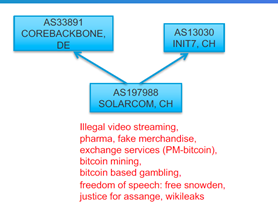
The German company Corebackbone is also involved:

Illustration: Excerpt from the presentation – Corebackbone, Germany.

The dubious players in this space have been well known for years and have been left to pursue their business undisturbed.

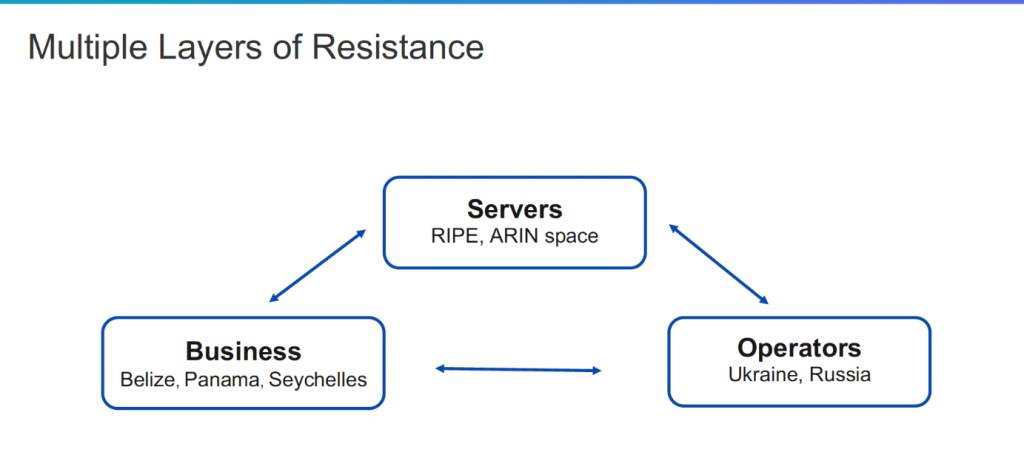
The presentation also shows how these companiescompanies are scattered across different countries which obviously hampers prosecution. And is it any surprise thatIt Mahjoub’s presentation references offshore letterbox companies that can be found in the Panama Papers?

Illustration: Excerpt from the presentation – How to make a business resilient on the Internet.

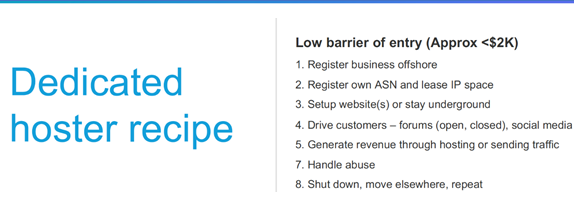
The presentation also describes how such businesses are rebuilt over and over again with low investments:

Illustration: Excerpt from the presentation – The recipe of a dedicated hoster.

RIPE NCC: Blind in both eyes – where is the self regulation?

Anyone who thinks that the findings from the presentation have changed anything at RIPE NCC will be sadly mistaken. Although many evil organizations and their criminal activities were clearly described in the October 2018 presentation, they are all still present and all this with the blessing of RIPE NCC. There is no better way to show that self-regulation of the Internet has failed completely.

RIPE’s refusal to take action against criminal members would only be understandable if RIPE itself were a part of organized crime. RIPE NCC’s Executive Board Treasurer, Remco van Mook, was country manager for Equinix in the Netherlands. Equinix provides a wide range of hosting services for Private Layer locations, Panama and Switzerland, as well as peering in over 5 data centers in Europe. (Editor note: It’s also a US Government contractor! Yikes!) Let’s hope for the executive board members of RIPE this is simply incompetence and arrogance, not criminal conspiracy.

Is it time for law enforcement and politicians to address this problem? What a crazy world we live in, where powerful tech elites make it so easy for criminals. Perhaps by regulating the RIPE’s self-regulation, we could make the Internet much safer for everyone involved?

Guest Post: The Coming Crisis: Just in time for #ClimateStrike, #SayNoToZoe on CASE Act Threats

Guest post by Chris Castle

The new copyright small claims court legislation (The CASE Act) passed the House Judiciary Committee, but not without thuggery from Rep. Zoe Lofgren and the Internet Association. Chris Castle narrates the issues and proposes a solution for Big Tech’s “Senate strategy” that inevitably includes Senator Ron Wyden, the grifter from Oregon and proud father of Section 230 of the Communications Decency Act.  Lofgren’s threat comes about 8:27:00 on the YouTube video here.

Internet Association Statement on CASE Act

Michael Beckerman

We are up against a direct threat on stopping the CASE Act from Rep. Zoe Lofgren (D-Google) and our old “friend” Senator Ron Wyden, the data center senator.  Just in time for #ClimateStrike, the political muscle that comes from jamming electricity burning data centers down the throats of politicians in exchange for backroom deals on tax reductions for a company that pays very little tax anyway.

We usually associate the iconic ACLU brand with good things, but not when it comes to Google.  When it comes to giving indie artists a remedy for their rights in the CASE Act, ACLU sides with the multinational culture devouring Big Tech companies.  For example, in a fine example of policy laundering, ACLU takes a gratuitous swipe at the Copyright Office using a Google “study” to allege bias.  ACLU Statement on CASE Act

See: ACLU Gets $700,000 from Google Buzz Award musictechpolicy.com/2011/10/31/the-…r-the-company”/

ACLU Helps EFF With DMCA Delaying Tactics musictechpolicy.com/2010/07/07/aclu…laying-tactics/

ACLU Cribs from Google Lobbyists on Pro-Piracy Letter to Congress musictechpolicy.com/2016/05/04/why-…ns-from-google/

aclu cy pres

Here’s the background on data center lobbying that almost sank the CLASSICS Act–if we have a radio station in every congressional district and data centers sucking down electricity in every state, artists have an even bigger burden than ever before on policy justice.

Why Artists Should Care About Data Center Lobbying

Ron Wyden’s Teachable Moment: Should one Senator be allowed to stop 415 Members of Congress on the Pre-72 Fix

Did a Wyden Campaign Donor Fund Hedge Fund Operated Out of Senator’s Basement?

Google Investing $3.3 Billion in Data Centers in Europe  (How will this affect Google’s Copyright Directive, privacy and antitrust lobbying?)

From Nature:

Already, data centres use an estimated 200 terawatt hours (TWh) each year. That is more than the national energy consumption of some countries, including Iran, but half of the electricity used for transport worldwide, and just 1% of global electricity demand (see ‘Energy scale’). Data centres contribute around 0.3% to overall carbon emissions, whereas the information and communications technology (ICT) ecosystem as a whole — under a sweeping definition that encompasses personal digital devices, mobile-phone networks and televisions — accounts for more than 2% of global emissions. That puts ICT’s carbon footprint on a par with the aviation industry’s emissions from fuel.

According to The Oregonian (Senator Ron Wyden’s home state):

Data centers have become one of Oregon’s biggest industries, with Google, Apple, Facebook and Amazon spending billions of dollars to buy and equip online storage facilities in rural parts of the state. They’re lured primarily by tax savings, which can shave tens of millions of dollars from a server farm’s annual operating cost.

heres-steam-shooting-out-of-the-dalles-data-center-in-oregon-as-its-cooling-down
Google’s Massive Data Center in The Dalles, Oregon

Google CEO on EU charm offensive says about their plans to hog Europe’s electricity and vaporize lakes and rivers:

Today I am in Helsinki, Finland, to meet with Finnish Prime Minister Rinne to discuss his priorities for the European Union Presidency, from building sustainable economic growth to achieving a carbon-free future.

The Nordic countries are great examples of how the internet can help drive economic growth. As part of our vision to build a more helpful Google for everyone, we are supporting Europe’s digital ambitions in two ways.

First, by continuing to invest in sustainable digital infrastructure across Europe. Today, I announced that we plan to invest 3 billion euros to expand our data centers across Europe over the next two years. That will bring our total investment in Europe’s internet infrastructure to 15 billion euros since 2007. Our investments generate economic activity for the region and support more than 13,000 full-time jobs in the EU every year, according to a study published today by Copenhagen Economics.

Are Data Centers The New Cornhusker Kickback and the Facebook Fakeout?

The Mother’s Milk of Algorithms: Google Expands Its Data Center Lobbying Footprint in Minnesota–Home to Senator Amy Klobuchar


@sound_wavves: Charleston musicians are challenging Spotify’s business model at rallies across the country

Artists across the country stand up to Spotify’s hyperefficient market share payouts!

The back patio at The Royal American, an uptown Charleston dive bar and music venue, serves as a hangout for those looking to sip a signature rum punch away from the bar, smoke an American Spirit between sets or play a round of cornhole.

Last Friday night, however, it served as a gathering spot for musicians protesting Spotify’s business model, which they said fails to pay artists their due.

A group of Charleston musicians — electronic artist Diaspoura (Anjali Naik), classical violinist Vivek Menon, singer Niecy Blues (Deniece Williams), drummer Chase Bunes and jazz and hip-hop-inspired producer Contour (Khari Lucas) — was responsible for the rally, one of five organized across the country. Other locations were Portland, Maine, Los Angeles, New York City and Spartanburg. The Charleston musicians started with a small gathering in the New York City subway, then decided to branch out, working with colleagues in each of the participating cities….

Spotify’s press team did not respond to requests for comment.

Because of the streaming problem, musicians rely heavily on playing live shows and selling merchandise such as T-shirts, CDs and vinyl to generate income. Most work part-time, or even full-time, jobs in addition to writing, practicing and performing.

Read Kalyn Oyer’s post on the Post and Courier site

Also read the Austin Music Census that confirms the problem with data.

@musictechsolve: Vote for Creator and Startup Licensing Education at SXSW

sxswedu-panelpicker_vote-facebook
Click Here to Vote on Panel Picker

[From Chris Castle]

Deadline for SXSW Panel Picker is today! Please vote for my creator and startup licensing panel at SXSW.EDU. If the latest Spotify litigation shows anything it’s the importance of licensing education.

I have a workshop in the SXSW.edu track titled “TEACHING ARTIST ROYALTIES TO CREATORS AND STARTUPS.”  It follows my philosophy that we need smart artists and smart startups to work together if we all are to succeed.

The workshop has three purposes:

–A building block approach to teaching artists and songwriters about the principal royalty streams that sustain them.  This is targeted financial literacy which is as critical to artists and songwriters as balancing your checkbook.

–A licensing roadmap overlay for entrepreneurship studies.  It’s far too frequent that entrepreneurs spend more time developing their product roadmap and critical path than they do developing their licensing roadmap side by side with the product.  That way when a startup gets to launch there is less likelihood they will go into the terminal holding pattern or worse–launch without licenses.

–the importance of clean and stable metadata to both artists and startups (and mature companies) and how to accomplish this goal starting with the digital audio workstation.

The class description:

Royalty rates, royalty reporting and earnings are some of the least understood–yet most important–parts of a creator’s career or a startups nightmare. Understanding royalties is as important as understanding how to balance your checkbook.

Starting with metadata and simple revenue streams, leading to complex calculations and government run compulsory licenses and sometimes impenetrable royalty statements, the workshop gives educators core tools and building blocks to teach the subject.

I’d really appreciate your vote for the class in the SXSW Panel Picker here. To vote, you just need to sign in to PanelPicker or create a free SXSW account with your email only.

Texas Bar Section Announces Nominations are Open for the Cindi Lazzari Artist Advocate Award — Artist Rights Watch

[Thanks to Chris Castle for this post.]

We’re pleased to help get out the word that nominations are open for the Cindi Lazzari Artist Advocate Award for “heroes and heroines” involved with artist advocacy in all Texas communities.  For Texas readers, there’s info below about how to nominate.  If you’re not in Texas you may want to look into whether your community has a similar award.  If not, you might consider starting one.

If you would like to nominate someone for the award, you may use this form.

PRESS RELEASE:

The State Bar of Texas Entertainment and Sports Law Section (TESLAW) announced that nominations for the Cindi Lazzari Artist Advocate Award are open now until 11:59 pm Central Time on October 1, 2019.  The award is named for the late Cindi Lazzari, a leading Texas attorney who went far beyond the call of duty in her efforts to protect the rights of artists in the music industry.

In these challenging times for Texas musicians, TESLAW wants to hear about the exciting heroes and heroines who carry on the tradition of Cindi’s good works in all the music communities across Texas.  Nominees need not be attorneys.

Previous recipients of the Lazzari Award include Juan Tejeda (musician, arts administrator and activist), Robin Shivers (artist manager and founder of the Health Alliance for Austin Musicians), Texas Accountants and Lawyers for the Arts, SIMS Foundation, Nikki Rowling (co-founder of Austin Music Foundation and author of the Austin Music Census), Casey Monahan (the first head of the Governor’s Music Office) and Margaret Moser (the journalist and long-time music editor for the Austin Chronicle).

Nominations for the 2019 Lazzari Award will be accepted through October 1, 2019 and should be sent by e-mail only to law@amyemitchell.com. The nomination email should include (1) the nominee’s name and contact information; (2) a one-page statement as to why the nominating individual believes the nominee should receive the award; and (3) a biography of the nominee.

TESLAW will present the Cindi Lazzari Artist Advocate Award at the annual Entertainment Law Institute, to be held in Austin November 20-22, 2019.

For further information, please see TESLAW’s web page at http://teslaw.org/awards/cindi-lazzari-artist-advocate-award/

via Texas Bar Section Announces Nominations are Open for the Cindi Lazzari Artist Advocate Award — Artist Rights Watch

@Hypebot Posts Claim Forms for PledgeMusic Bankruptcy

Thanks to the good work by Bruce Houghton at Hypebot, we now have the form you need to file if you are owed money by PledgeMusic (which of course Pledge didn’t bother to post) and an email address to send it to.

This is good for fans who pledged but believe their money never got to the artist, the artists who are owed money by Pledge and of course the vendors who are owed money for goods they made or services rendered for Pledge campaigns (like Bandwear that is apparently owned $200,000).

Here’s the info from Hypebot:

“On the subject of filing a claim for monies due, Insolvency Examiner Erica Baker wrote:

“If you are owed money by the company then you should arrange for a Proof of Debt form to be submitted as soon as possible – I will ask the case officer to send you a form.”

While lacking a firm deadline, the form is fairly straightforward. Any artist, label or fan affected should fill out the form and send it in with any receipts or proof asap. Download it here.

UPDATE: The form can be returned via email to Sultana.Begum@insolvency.gov.uk

We’d love to hear from artists and others their experiences with the Insolvency Service.”

We would love to hear, too, so if you want to leave a comment and we will post them.

You can read the full Hypebot post here.

How to Contact the Court in PledgeMusic Case

PledgeMusic had posted this information on their website when we checked today:

As a result of the making of the order, the Official Receiver becomes liquidator of the company. Any enquiries should be forwarded to LondonB.OR@insolvency.gov.uk, quoting reference LQD5671373.

We gather that what that means is that if you are (1) an artist who is owed money by PledgeMusic, (2) a fan who gave money to an artist who you think did not receive your money from PledgeMusic, or (3) a vendor who didn’t get paid because PledgeMusic didn’t pay your artist, then you should write to that email address which we assume is for the “Official Receiver” who is now in charge of running the case.  (OK, that does sound like a character out of Harry Potter, but that’s how it is.)

We also assume because Pledge didn’t say that there is a deadline for submitting your claim there probably is one.  That’s probably why PledgeMusic didn’t say what the deadline was, a fact they almost certainly know very well.  Because if you fail to get your claim in on time, there’s more for them in the pot.  Ponzi to the very end.

You should take legal advice about what you should say and how to handle it, but if you can’t afford a lawyer you could say in your email that you think you are owed money, how much and why, and ask them what you should do about it.  It probably wouldn’t hurt to tell them what you have done to try to collect your money from Pledge and the approximate or exact dates you tried to get their attention.

And be sure to tell the Official Receiver if you think Pledge breached its obligations to you or otherwise did you wrong, threatened you, or any other bad stuff.

The Official Receiver probably frequently deals with people who are owed money and have no lawyer so don’t be shy about it.  The Insolvency Service (who actually appoints the Official Receiver) also responded to Chris Castle on Twitter:

Insolvency Service 1

We will keep you posted with more information as we find out.