TikTok Sale Extended…Again

By Chris Castle

Imagine if the original Napster had received TikTok-level attention from POTUS?  Forget I said that.  The ongoing divestment of TikTok from its parent company ByteDance has reached yet another critical point with yet another bandaid.  Congress originally set a January 19, 2025 deadline for ByteDance to either sell TikTok’s U.S. operations or face a potential ban in the United States as part of the Protecting Americans from Foreign Adversary Controlled Applications Act or “PAFACA” (I guess “covfefe” was taken). The US Supreme Court upheld that law in TikTok v. Garland.

When January 20 came around, President Trump gave ByteDance an extension to April 5, 2025 by executive order. When that deadline came, President Trump granted an extension to the extension to the January 19 deadline by another executive order, providing additional time for ByteDance to finalize a deal to divest. The extended deadline now pushes the timeline for divestment negotiations to July 1, 2025.

This new extension is designed to allow for further negotiation time among ByteDance, potential buyers, and regulatory authorities, while addressing the ongoing trade issues and concerns raised by both the U.S. and Chinese governments. 

It’s getting mushy, but I’ll take a stab at the status of the divestment process. I might miss someone as they’re all getting into the act. 

I would point out that all these bids anticipate a major overhaul in how TikTok operates which—just sayin’—means it likely would no longer be TikTok as its hundreds of millions of users now know it.  I went down this path with Napster, and I would just say that it’s a very big deal to change a platform that has inherent legal issues into one that satisfies a standard that does not yet exist.  I always used the rule of thumb that changing old Napster to new Napster (neither of which had anything to do with the service that eventually launched with the “Napster” brand but bore no resemblance to original Napster or its DNA) would result in an initial loss of 90% of the users. Just sayin’.

Offers and Terms

Multiple parties have expressed interest in acquiring TikTok’s U.S. operations, but the terms of these offers remain fluid due to ongoing negotiations and the complexity of the deal. Key bidders include:

ByteDance Investors:  According to Reuters, “the biggest non-Chinese investors in parent company ByteDance to up their stakes and acquire the short video app’s U.S. operations.” This would involve Susquehanna International Group, General Atlantic, and KKR. ByteDance looks like it retains a minority ownership position of less than 20%, which I would bet probably means 19.99999999% or something like that. Reuters describes this as the front runner bid, and I tend to buy into that characterization. From a cap table point of view, this would be the cleanest with the least hocus pocus. However, the Reuters story is based on anonymous sources and doesn’t say how the deal would address the data privacy issues (other than that Oracle would continue to hold the data), or the algorithm. Remember, Oracle has been holding the data and that evidently has been unsatisfactory to Congress which is how we got here. Nothing against Oracle, but I suspect this significant wrinkle will have to get fleshed out.

Lawsuit by Bidder Company Led by Former Myspace Executive:  In a lawsuit in Florida federal court by TikTok Global LLC filed April 3, TikTok Global accuses ByteDance, TikTok Inc., and founder Yiming Zhang of sabotaging a $33 billion U.S.-based TikTok acquisition deal by engaging in fraud, antitrust violations, and breach of contract. TikTok Global LLC is led by Brad Greenberg the former MySpace executive and Internet entrepreneur. The factual allegations in the complaint start in 2020 with the executive order in Trump I, and alleges that:

This set the stage for what should have been a straightforward process of acquisition and divestment, but instead, it became a twisted tale of corporate intrigue, conspiracy, and antitrust violations….Plaintiff would soon discover, the game was rigged from the start because ByteDance had other plans, plans that circumvented proper procedures, stifled competition, and maintained ByteDance’s control over TikTok’s U.S. operations – all under the guise of compliance with the executive order.

The fact-heavy complaint alleges ByteDance misled regulators, misappropriated the “TikTok Global” brand, and conspired to maintain control of TikTok in violation of U.S. government directives. The suit brings six causes of action, including tortious interference and unjust enrichment, underscoring a complex clash over corporate deception and national security compliance. Emphasis on “alleged” as the case is pretty fact-dependent and plaintiff will have to prove their case, but the well-drafted complaint makes some extensive claims that may give a window into the behind the scenes in the world of Mr. Tok. Watch this space, it could be a sleeper that eventually wakes up to bite, no pun intended.

Oracle and Walmart: This proposal, which nearly closed in 2024 (I guess), involved a sale of TikTok’s U.S. business to a consortium of U.S.-based companies, with Oracle managing data security and infrastructure. ByteDance was to retain a minority stake in the new entity. However, this deal has not closed, who knows why aside from competition and then there’s those trade tariffs and the need for approval from both U.S. and Chinese regulators who have to be just so chummy right at the moment.

AppLovin: A preliminary bid has been submitted by AppLovin, an adtech company, to acquire TikTok’s U.S. operations. It appears that AppLovin’s offer includes managing TikTok’s user base and revenue model, with a focus on ad-driven strategies, although further negotiations are still required.  According to Pitchbook, “AppLovin is a vertically integrated advertising technology company that acts as a demand-side platform for advertisers, a supply-side platform for publishers, and an exchange facilitating transactions between the two. About 80% of AppLovin’s revenue comes from the DSP, AppDiscovery, while the remainder comes from the SSP, Max, and gaming studios, which develop mobile games. AppLovin announced in February 2025 its plans to divest from the lower-margin gaming studios to focus exclusively on the ad tech platform.”  It’s a public company trading as APP and seems to be worth about $100 billion.   Call me crazy, but I’m a bit suspicious of a public company with “lovin” in its name.  A bit groovy for the complexity of this negotiation, but you watch, they’ll get the deal.

Amazon and Blackstone: Amazon and Blackstone have also expressed interest in acquiring TikTok or a stake in a TikTok spinoff in Blackstone’s case. These offers would likely involve ByteDance retaining a minority interest in TikTok’s U.S. operations, though specifics of the terms remain unclear.  Remember, Blackstone owns HFA through SESAC.  So there’s that.

Frank McCourt/Project Liberty:  The “People’s Bid” for TikTok is spearheaded by Project Liberty, founded by Frank McCourt. This initiative aims to acquire TikTok and change its platform to prioritize user privacy, data control, and digital empowerment. The consortium includes notable figures such as Tim Berners-Lee, Kevin O’Leary, and Jonathan Haidt, alongside technologists and academics like Lawrence Lessig.  This one gives me the creeps as readers can imagine; anything with Lessig in it is DOA for me.

The bid proposes migrating TikTok to a new open-source protocol to address concerns raised by Congress while preserving its creative essence. As of now, the consortium has raised approximately $20 billion to support this ambitious vision.  Again, these people act like you can just put hundreds of millions of users on hold while this changeover happens.  I don’t think so, but I’m not as smart as these city fellers.

PRC’s Reaction

The People’s Republic of China (PRC) has strongly opposed the forced sale of TikTok’s U.S. operations, so there’s that. PRC officials argue that such a divestment would be a dangerous precedent, potentially harming Chinese tech companies’ international expansion. And they’re not wrong about that, it’s kind of the idea. Furthermore, the PRC’s position seems to be that any divestment agreement that involves the transfer of TikTok’s algorithm to a foreign entity requires Chinese regulatory approval.  Which I suspect would be DOA.

They didn’t just make that up– the PRC, through the Cyberspace Administration of China (CAC), owns a “golden share” in ByteDance’s main Chinese subsidiary. This 1% stake, acquired in 2021, grants the PRC significant influence over ByteDance including the ability to influence content and business strategies.

Unsurprisingly, ByteDance must ensure that the PRC government (i.e., the Chinese Communist Party) maintains control over TikTok’s core algorithm, a key asset for the company. PRC authorities have been clear that they will not approve any sale that results in ByteDance losing full control over TikTok’s proprietary technology, complicating the negotiations with prospective buyers.  

So a pressing question is whether TikTok without the algorithm is really TikTok from the users experience.  And then there’s that pesky issue of valuation—is TikTok with an unknown algo worth as much as TikTok with the proven, albeit awful, current algo.

Algorithm Lease Proposal

In an attempt to address both U.S. security concerns and the PRC’s objections, a novel solution has been proposed: leasing TikTok’s algorithm. Under this arrangement, ByteDance would retain ownership of the algorithm, while a U.S.-based company, most likely Oracle, would manage the operational side of TikTok’s U.S. business.

ByteDance would maintain control over its technology, while allowing a U.S. entity to oversee the platform’s operation within the U.S. The U.S. company would be responsible for ensuring compliance with U.S. data privacy laws and national security regulations, while ByteDance would continue to control its proprietary algorithm and intellectual property.

Under this leasing proposal, Oracle would be in charge of managing TikTok’s data security and ensuring that sensitive user data is handled according to U.S. regulations. This arrangement would allow ByteDance to retain its technological edge while addressing American security concerns regarding data privacy.

The primary concern is safeguarding user data rather than the algorithm itself. The proposal aims to address these concerns while avoiding the need for China’s approval of a full sale.

Now remember, the reason we are in this situation at all is that Chinese law requires TikTok to turn over on demand any data it gathers on TikTok users which I discussed on MTP back in 2020. The “National Intelligence Law” even requires TikTok to allow the PRC’s State Security police to take over the operation of TikTok for intelligence gathering purposes on any aspect of the users’ lives.  And if you wonder what that really means to the CCP, I have a name for you:  Jimmy Lai. You could ask that Hong Konger, but he’s in prison. 

This leasing proposal has sparked debate because it doesn’t seem to truly remove ByteDance’s influence over TikTok (and therefore the PRC’s influence). It’s being compared to “Project Texas 2.0,” a previous plan to secure TikTok’s data and operations.  I’m not sure how the leasing proposal solves this problem. Or said another way, if the idea is to get the PRC’s hands off of Americans’ user data, what the hell are we doing?

Next Steps

As the revised deadline approaches, I’d expect a few steps, each of which has its own steps within steps:

Finalization of a Deal: This is the biggest one–easy to say, nearly impossible to accomplish.  ByteDance will likely continue negotiating with interested parties while they snarf down user data, working to secure an agreement that satisfies both U.S. regulatory requirements and Chinese legal constraints. The latest extension provides runway for both sides to close key issues that are closable, particularly concerning the algorithm lease and ByteDance’s continued role in the business.

Operational Contingency:  I suppose at some point the buyer is going to be asked if whatever their proposal is will actually function and whether the fans will actually stick around to justify whatever the valuation is.  One of the problems with rich people getting ego involved in a fight over something they think is valuable is that they project all kinds of ideas on it that show how smart they are, only to find that once they get the thing they can’t actually do what they thought they would do.  By the time they figure out that it doesn’t work, they’ve moved on to the next episode in Short Attention Span Theater and it’s called Myspace.

China’s Approval: ByteDance will need to secure approval from PRC regulatory authorities for any deal involving the algorithm lease or a full divestment. So why introduce the complexity of the algo lease when you have to go through that step anyway?  Without PRC approval, any sale or lease of TikTok’s technology is likely dead, or at best could face significant legal and diplomatic hurdles.

Legal Action: If an agreement is not reached by the new deadline of July 1, 2025, further legal action could be pursued, either by ByteDance to contest the divestment order or by the U.S. government to enforce a ban on TikTok’s operations.  I doubt that President Trump is going to keep extending the deadline if there’s no significant progress.

If I were a betting man, I’d bet on the whole thing collapsing into a shut down and litigation, but watch this space.

[This post first appeared on MusicTech.Solutions]

Can RICO Be Far Behind?  President Trump and Kid Rock Announce Whole of Government Enforcement of the BOTS Act

By Chris Castle

Yes, the sound you hear echoing from Silicon Valley is the sound of gnashing teeth and rending garments—some freaking guitar player did an end run around Big Tech’s brutal lobbying power and got to the President of the United States.  Don’t you just hate it when that happens?  Maybe not, but trust me, they really hate it because in those dark hours they don’t talk about at parties, they really hate us and think we are beneath them.  Remember that when you deal with YouTube and Spotify.

But to no avail.  President Trump signed an executive order yesterday that can only be described as taking a whole of government approach to enforcement of the BOTS Act.  As readers will recall, I have long said when it comes to StubHub, SeatGeek and their ilk, no bots, no billionaires.  It is hard to imagine a world where StubHub & Co.  are not basing their entire business model on the use of bots and other automated processes to snarf up tickets before the fans can get them.  This was also the subject of our ticketing panel at the 2024 Artist Rights Symposium in Washington, DC.

Remember, the BOTS Act, sponsored by Senator Marsha Blackburn and signed into law by President Obama in 2016, was designed to curb the use of automated software (bots) that purchase large quantities of event tickets, often within seconds of their release, to resell them at inflated prices through market makers like StubHub. It was so under-enforced that until the Executive Order it was entirely possible that StubHub could have sneaked out an IPO to slurp up money from the pubic trough before anyone knows better.

The government’s enforcement of the BOTS Act is so poor that Senator Blackburn found it necessary to introduce even more legislation to try to get the FTC to do their job. The Mitigating Automated Internet Networks for (MAIN) Event Ticketing Act is a bill introduced in 2023 by Senators Blackburn and Ben Ray Luján that aims to give the FTC even fewer excuses not to enforce the BOTS Act. It would further the FTC’s consumer protection mission against IPO-driven ticket scalping.

There are entire business lines built around furthering illegal ticket scalping that are so blatant they actually hold trade shows.  For example, NITO complained to the FTC that their investigators found multiple software platforms on the trade show floor  at a ticket brokers conference that are illegal under the BOTS Act and possibly under other laws such as Treasury Department regulations, financial crimes, wire fraud and the like.

The NITO FTC complaint details how multiple technology companies, many of whom exhibited at World Ticket Conference hosted by The National Association of Ticket Brokers in Nashville on July 24-26, 2024, provide tools that enable scalpers to circumvent ticket purchasing limits. These tools include sophisticated browser extensions, proxy services, and virtual credit card platforms designed to bypass security measures implemented by primary ticket sellers.

As is mentioned in the Executive Order, the sad truth is that the FTC didn’t take its first action to enforce the 2016 law until 2021. And that’s the only action it has ever taken.   Which is why President Trump’s executive order is so critical in stopping these scoundrels.

Kid Rock apparently had a chance to present these issues to President Trump and was present at the signing ceremony for the Executive Order. He said:

First off thank you Mr. President because this has happened at lightning speed.  I want to make sure Alina Habba gets her credit too because I know she worked very hard in this but thank you for making this happen so quick.

Anyone who’s bought a concert ticket in the last decade, maybe 20 years, no matter what your politics are knows it is a conundrum.  You buy a ticket for $100 but by the time you check out it’s $170.  You don’t know what you were charged for, but more importantly these bots come in and get all the good tickets to your favorite shows you want to go to.  Then they’re relisted immediately for sometimes a four or five hundred percent markup—the artists don’t get that money!

Ultimately I think this is a great first step. I would love down the road if there be some legislation that we could actually put a cap on the resale of tickets.

Yes, folks, we may be onto something here.

The reason I say that the EO establishes a “whole of government” approach is because of what else is in the order.  The actual EO was published, and the press release on the White House site says this:

  • The Order directs the Federal Trade Commission (FTC) to:
    • Work with the Attorney General to ensure that competition laws are appropriately enforced in the concert and entertainment industry.
    • Rigorously enforce the Better Online Ticket Sales (BOTS) Act and promote its enforcement by state consumer protection authorities.
    • Ensure price transparency at all stages of the ticket-purchase process, including the secondary ticketing market.
    • Evaluate and, if appropriate, take enforcement action to prevent unfair, deceptive, and anti-competitive conduct in the secondary ticketing market.
  • The Order directs the Secretary of the Treasury and Attorney General to ensure that ticket scalpers are operating in full compliance with the Internal Revenue Code and other applicable law.
  • Treasury, the Department of Justice, and the FTC will also deliver a report within 180 days summarizing actions taken to address the issue of unfair practices in the live concert and entertainment industry and recommend additional regulations or legislation needed to protect consumers in this industry.

In other words, the EO directs other Executive Branch agencies at the DOJ, FTC, Treasury to take enforcement seriously.  If the Department of Justice is involved, that could very well lead to enforcement of the BOTS Act’s criminal penalties.  And it’s kind of hard to have a StubHub IPO from prison although President Trump may want to add the Securities and Exchange Commission to the list of agencies he is calling into action.

In addition to fines, individuals convicted under the BOTS Act could face imprisonment for up to 1 year for a first offense. Repeat offenders may face longer prison sentences, depending on the nature of the violation and if there are aggravating factors involved (such as fraud or large-scale operations).  And remember, wire fraud is a common RICO predicate under the racketeering laws which is where I personally think this whole situation needs to go and go quickly. Remember, StubHub narrowly escaped a claim for civil RICO already.

So we shall see who is serious and who isn’t.  But I will say I’m hopeful. If you wanted to seriously go after actually solving the problem on the law enforcement side, this is how you would do it.

If you wanted to go after it on the property rights side, Kid Rock’s line about establishing a cap is how you would start.  The guy has clearly thought this through and we’re lucky that he has.  We’ll get around to speculative ticketing and taking out some of the other trash down the road if that’s even a problem after getting after bots.  But on property rights, let’s start with respecting the artist’s rights to set their own prices and have them followed instead of the current catastrophe.

The other take away from this is that Marsha was right—BOTS Act is probably enough law to handle the problem.  You just need to enforce it.

I always say you can’t get Silicon Valley to behave with fines alone because they print money due to the income transfer.  Prison, though, prison is the key that picks the lock.

[Editor Charlie sez: This post first appeared on MusicTechPolicy]

@Artist Rights Institute Newsletter 3/31/25

The Artist Rights Institute’s news digest Newsletter from Artist Rights Watch.

New Survey for Songwriters: We are surveying songwriters about whether they want to form a certified union. Please fill out our short Survey Monkey confidential survey here! Thanks!

Ticketing

Executive Order on Combating Unfair Practices in the Live Entertainment Market

Music Industry reacts to Executive Order on Ticket Scalping (Bruce Houghton/Hypebot)

What Hath Trump Wrought: The Effect of the Anti-Scalping Executive Order on StubHub’s IPO (Chris Castle/MusicTech.Solutions)

StubHub IPO Filing

Copyright Litigation

Merlin sues TikTok rival Triller for breach of contract over allegedly unpaid music licensing fees (Daniel Tencer/Music Business Worldwide)

Artificial Intelligence: Legislation

Artificial intelligence firms should pay artists and musicians for using their work amid uproar over Labour’s plans to exempt them from copyright laws, according to a new poll of Brits (Chris Pollard/Daily Mail)

European Union’s latest draft AI Code of Practice renders copyright ‘meaningless,’ rightsholders warn (Mandy Dalugdug/Music Business Worldwide)

Artificial Intelligence
The Style Returns: Some notes on ChatGPT and Studio Ghibli
 (Andres Guadamuz/TechnoLlama) 

OpenAI’s Preemption Request Highlights State Laws’ Downsides (Oliver Roberts/Bloomberg Law)

Copyright: Termination Rights

Update on Vetter v. Resnik case (Chris Castle/MusicTechPolicy)

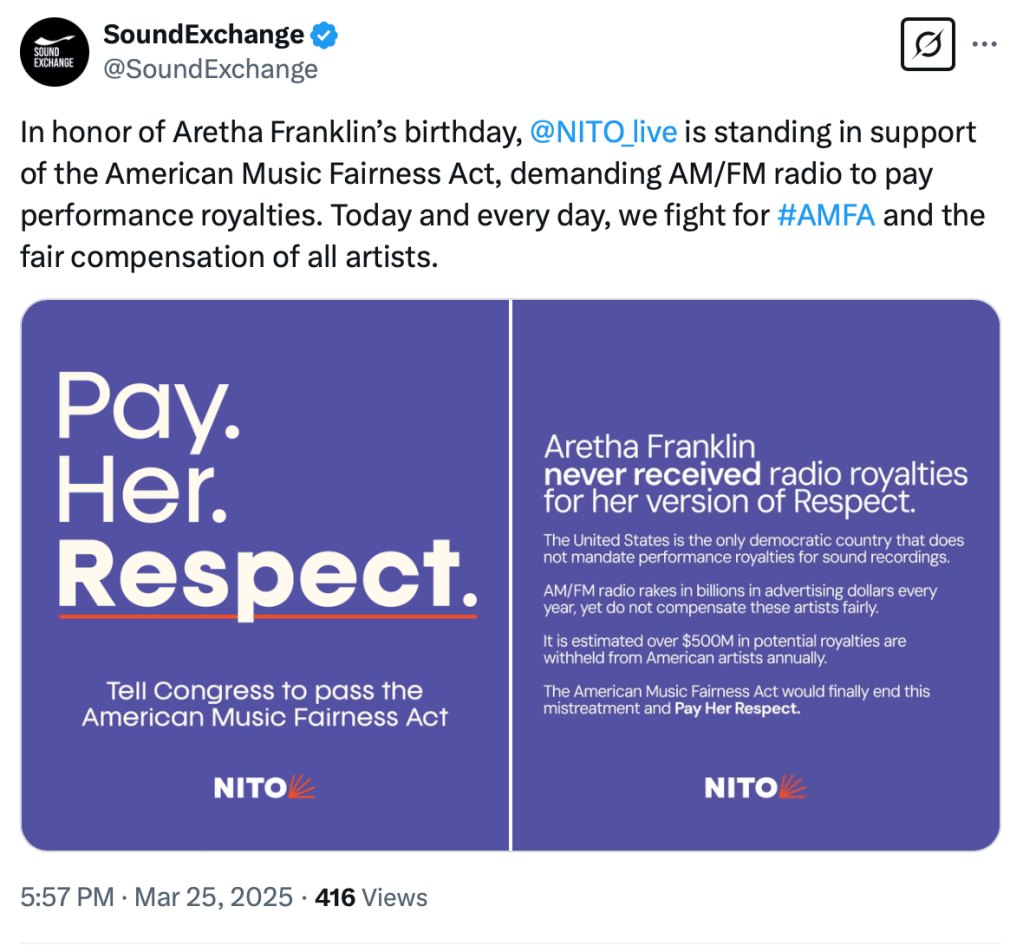
Tell Congress to Honor Aretha, Pass #AMFA #IRespectMusic

It’s time.

We join our friends Blake Morgan, #IRespectMusic, SoundExchange, the National Independent Talent Organization (NITO) and many, many others in asking you to join the fight to support artist pay for radio play by passing the American Music Fairness Act. Find out how you can help here, or find your representative in Congress here.

@Artist Rights Institute Newsletter 3/24/25

The Artist Rights Institute’s news digest Newsletter

New Survey for Songwriters: We are surveying songwriters about whether they want to form a certified union. Please fill out our short Survey Monkey confidential survey here! Thanks!

Songwriters and Union Organizing

RICO and Criminal Copyright Infringement

AI Piracy

@alexreisner: Search LibGen, the Pirated-Books Database That Meta Used to Train AI (Alex Reisner/The Atlantic)

OpenAI and Google’s Dark New Campaign to Dismantle Artists’ Protections (Brian Merchant/Blood in the Machine)

Alden newspapers slam OpenAI, Google’s AI proposals (Sara Fischer/Axios)

AI Litigation

French Publishers and Authors Sue Meta over Copyright Works Used in AI Training (Kelvin Chan/AP)

DC Circuit Affirms Human Authorship Required for Copyright (David Newhoff/The Illusion of More)

OpenAI Asks White House for Relief From State AI Rules (Jackie Davalos/Bloomberg)

Microsoft faces FTC antitrust probe over AI and licensing practices (Prasanth Aby Thomas/Computer World)

Google and its Confederate AI Platforms Want Retroactive Absolution for AI Training Wrapped in the American Flag(Chris Castle/MusicTechPolicy)

AI and Human Rights

Human Rights and AI Opt Out (Chris Castle/MusicTechPolicy)

Say Goodbye to Net Zero: The AI Data Center Corporate Welfare Scam

We’ve reported for years about how data centers are a good explanation for why Senators like Ron Wyden seem to always inject themselves into copyright legislation for the sole purpose of slowing it down or killing it, watering it down, or turning it on its head. Why would a senator from Oregon–a state that gave us Courtney Love, Esperanza Spalding, The Decemberists, Sleater-Kinney and the Dandy Warhols–be so such an incredibly basic, no-vibe cosplayer?

Easy answer–he does the bidding of the Big Tech data center operators sucking down that good taxpayer subsidized Oregon hydroelectric power–literally and figuratively. Big Tech loves them some weak copyright and expanded loopholes that let them get away with some hard core damage to artists. Almost as much as they love flexing political muscle.

Senator Wyden with his hand in his own pocket.

This is coming up again in the various public comments on artificial intelligence, which is the data hog of data hogs. For example, the Artist Rights Institute made this point using Oregon as an example in the recent UK Intellectual Property Office call for public comments that produced a huge push back on the plans of UK Prime Minister Sir Kier Starmer to turn Britain into a Google lake for AI, especially the build out of AI data centers.

Google Data Center at The Dalles, Oregon

The thrust of the Oregon discussion in the ARI comment is that Oregon’s experience with data centers should be food for thought in other places (like the UK) as what seems to happen is electricity prices for local rate payers increase while data centers have negotiated taxpayer subsidized discounts. Yes, that old corporate welfare strikes again.

Oregon Taxpayers’ Experience with Crowding Out by Data Centres is a Cautionary Tale for UK

We call the IPO’s attention to the real-world example of the U.S. State of Oregon, a state that is roughly the geographical size of the UK.  Google built the first Oregon data centre in The Dalles, Oregon in 2006.  Oregon now has 125 of the very data centres that Big Tech will necessarily need to build in the UK to implement AI.  In other words, Oregon was sold much the same story that Big Tech is selling you today.

The rapid growth of Oregon data centres driven by the same tech giants like Amazon, Apple, Google, Oracle, and Meta, has significantly increased Oregon’s demand for electricity. This surge in demand has led to higher power costs, which are often passed on to local rate payers while data centre owners receive tax benefits.  This increase in price foreshadows the market effect of crowding out local rate payers in the rush for electricity to run AI—demand will only increase and increase substantially as we enter what the International Energy Agency has called “the age of electricity”.[1]

Portland General Electric, a local power operator, has faced increasing criticism for raising rates to accommodate the encroaching electrical power needs of these data centers. Local residents argue that they unfairly bear the increased electrical costs while data centers benefit from tax incentives and other advantages granted by government.[2] 

This is particularly galling in that the hydroelectric power in Oregon is largely produced by massive taxpayer-funded hydroelectric and other power projects built long ago.[3]  The relatively recent 125 Oregon data centres received significant tax incentives during their construction to be offset by a promise of future jobs.  While there were new temporary jobs created during the construction phase of the data centres, there are relatively few permanent jobs required to operate them long term as one would expect from digitized assets owned by AI platforms.

Of course, the UK has approximately 16 times the population of Oregon.  Given this disparity, it seems plausible that whatever problems that Oregon has with the concentration of data centers, the UK will have those same problems many times over due to the concentration of populations.


[1] International Energy Agency, Electricity 2025 (Revised Edition Feb. 2025) available at https://iea.blob.core.windows.net/assets/0f028d5f-26b1-47ca-ad2a-5ca3103d070a/Electricity2025.pdf.

 [2] Jamie Parfitt, As PGE closes in on another rate increase, are the costs of growing demand for power being borne fairly? KGW8 News (Dec. 13, 2024) available at https://www.kgw.com/article/news/local/the-story/pge-rate-increase-data-centers-power-cost-demand-growth/283-399b079b-cbf5-41cf-8190-4c5f204d2d90 (“Like utilities nationwide, PGE is experiencing a surge in requests for new, substantial amounts of electricity load, including from advanced manufacturing, data centers and AI-related companies.”) 

[3] See, e.g., State of Oregon, Facilities Under Energy Facility Siting Council available at https://www.oregon.gov/energy/facilities-safety/facilities/Pages/Facilities-Under-EFSC.aspx

Will AI Produce the Oregon Effect Internationally?

So let’s look at a quick and dirty comparison of the prices that local residents and businesses pay for electricity compared to what data centers in the same states pay. We’re posting this chart because ya’ll love numbers, but mostly to start discussion and research into just how much of an impact all these data centers might have on the supply and demand price setting in a few representative state and countries. But remember this–our experience with Senator Wyden should tell you that all these data centers will give Big Tech even more political clout than they already have.

The chart shows the percentage difference between the residential rate and the data center rate for energy in each state measured. The percentage difference is calculated as: ((Residential Rate – Data Center Rate) ÷ Residential Rate) × 100. When we say “~X% lower” we mean that the data center price per kilowatt hour (¢/kWh) is approximately X% lower than the residential rate, all based on data from Choose Energy or Electricity Plans. We don’t pretend to be energy analysts, so if we got this wrong, someone will let us know.

On a country by country comparison, here’s some more food for thought:

Data is from (1) here and (2) here

As you can see, most of the G7 countries have significantly higher electricity prices (and therefore potentially higher data prices) than the US and Canada. This suggests that Big Tech data centers will produce the Oregon Effect in those countries with higher residential energy costs in a pre-AI world. That in turn suggests that Big Tech is going to be coming around with their tin cup for corporate welfare to keep their data center electric bills low, or maybe they’ll just buy the electric plants. For themselves.

Either way, it’s unlikely that this data center thumb on the scale and the corporate welfare that goes with it will cause energy prices to decline. And you can just forget that whole Net Zero thing.

If you don’t like where this is going, call your elected representative!

@ArtistRights Institute Newsletter 3/17/25

This image has an empty alt attribute; its file name is ari-basic-logo-3.jpg

The Artist Rights Institute’s news digest Newsletter

Take our new confidential survey for publishers and songwriters!

UK AI Opt-Out Legislation

UK Music Chief Calls on Ministers to Drop Opposition Against Measures to Stop AI Firms Stealing Music

Human Rights and AI Opt Out (Chris Castle/MusicTechPolicy) 

Ticketing

New Oregon bill would ban speculative ticketing, eliminate hidden ticket sale fees, crack down on deceptive resellers (Diane Lugo/Salem Statesman Journal-USA Today)

AI Litigation/Legislation

French Publishers and Authors Sue Meta over Copyright Works Used in AI Training (Kelvin Chan/AP);

AI Layoffs

‘AI Will Be Writing 90% of Code in 3-6 Months,’ Says Anthropic’s Dario Amodei (Ankush Das/Analytics India)

Amazon to Target Managers in 2025’s Bold Layoffs Purge (Anna Verasai/The HR Digest)

AI Litigation: Kadrey v. Meta

Authors Defeat Meta’s Motion to Dismiss AI Case on Meta Removing Watermarks to Promote Infringement

Judge Allows Authors AI Copyright Infringement Lawsuit Against Meta to Move Forward (Anthony Ha/Techcrunch)

America’s AI Action Plan Request for Information

Google and Its Confederate AI Platforms Want Retroactive Absolution for AI Training Wrapped in the American Flag (Chris Castle/MusicTechPolicy)

Google Calls for Weakened Copyright and Export Rules in AI Policy Proposal (Kyle Wiggers/TechCrunch) 

Artist Rights Institute Submission

Conversation with @KCEsq and @MusicTechPolicy on a Songwriter Union, Better Royalties and Health Care for Songwriters

Forming a songwriter union is a hot topic these days, thank you Chappell Roan! Artist Rights Institute put a casual poll in the field to get a sense of what people are thinking about this issue. If you haven’t taken that poll yet, please join us on Survey Monkey here (all results are anonymized) we would love to get your feedback. We will post the results on Trichordist.

Reaction to the poll led to an Artist Rights Institute podcast with Chris Castle and Kevin Casini who both fans of the Trichordist audience, so naturally they wanted to launch the podcast here. There are a number of resources mentioned in the podcast that we have linked to below. Please leave comments if you have questions!

Check out the video with Kevin and Chris, and while you’re on the Artist Rights Institute’s cool new YouTube channel subscribe and bookmark the Artist Rights Symposium videos!

Important resources:

Union Organizing and Union Health Care Insurance Plans

National Labor Relations Board

AFL-CIO Organizing Institute

American Federation of Musicians

SAG-AFTRA

Health Care:

Health Alliance for Austin Musician http://www.myhaam.org Musician Services (512) 541-4226 (opt 2).

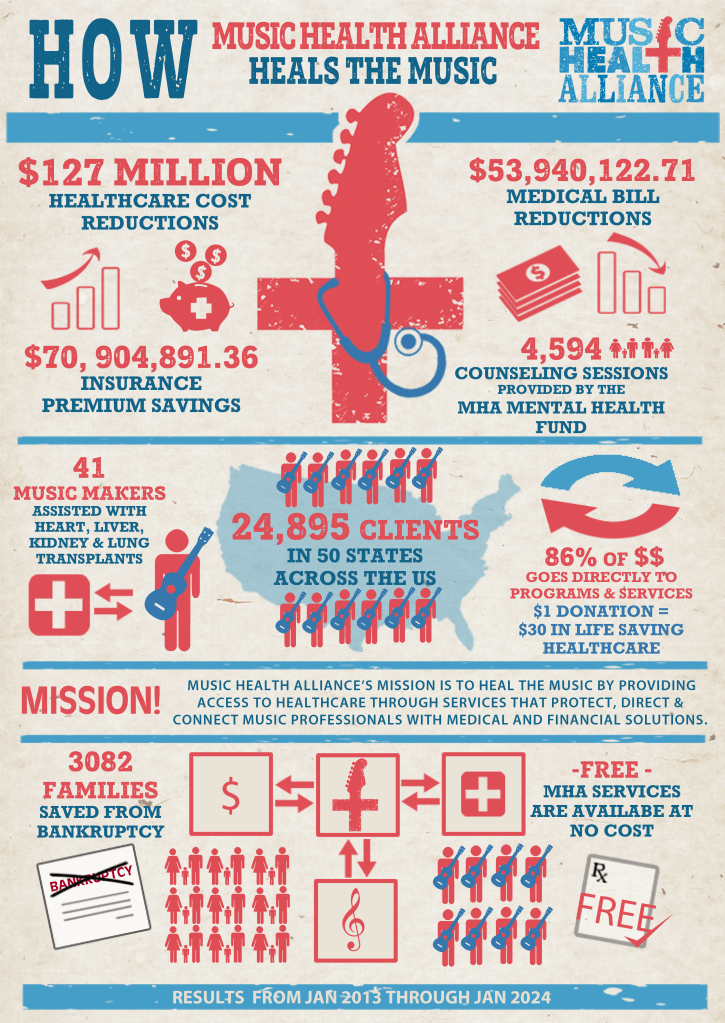
Music Health Alliance https://www.musichealthalliance.com Request assistance

American Association of Independent Music Benefits Store

Mental Health

SIMS Foundation (Austin) 512-494-1007

Industry-wide Agreements

See discussion of Canada’s Mechanical License Agreement https://musictechpolicy.com/2012/01/1…

Controlled Compositions

Copyright Office Circular on Work For Hire Explainer

Controlled Compositions Part 1 https://musictechpolicy.com/2010/03/2… and Controlled Compositions and Frozen Mechanicals https://musictechpolicy.com/2020/10/1…

We will be coming back to this topic soon. Feel free to leave comments if you have questions or want us to focus on any particular point.

Copyright 2025 Artist Rights Institute. All Rights Reserved. This video or any transcript may not be used for text or data mining or for the purpose of training artificial intelligence models or systems.

New Songwriter Union Survey and @ArtistRights Institute Newsletter 3/10/25

The Artist Rights Institute’s news digest Newsletter

New Survey for Songwriters: We are surveying songwriters about whether they want to form a certified union. Please fill out our short Survey Monkey confidential survey here! Thanks!

Big Tech’s “Text and Data Mining” Lobbying Head Fake

George York of Digital Creators Coalition and RIAA gives an excellent overview of international AI Text and Data Mining (TDM) loopholes and how to plug them. Nov. 20, 2024 Artist Rights Symposium, Washington, DC. Watch the Symposium playlist here.

Music

“I felt like a puppet”: the Motown hit Marvin Gaye felt like he didn’t deserve (Ben Forrest/Far Out) (h/t @ElizaNealsRocks

TikTok

Negotiations over a TikTok US deal have reportedly yet to begin (Stuart Dredge/Music Ally)

Artificial Intelligence: Text and Data Mining Exceptions

Digital Creators Coalition Letter to USTR on US Trade Policy for Threats from Text and Data Mining Exceptions Misapplied in AI Training (Chris Castle/Artist Rights Watch)

Sony slams ‘unworkable’ AI plans as music theft (William Turvill/The Sunday Times)

AI copyright shake-up could breach international law (Mark Sellman/The Times). (Tracks comments on Berne et al made by Digital Creators Coalition to USTR)

REPORT ON PIRATED CONTENT USED IN THE TRAINING OF GENERATIVE AI (Rights Alliance for Creative Industry on the Internet)

Ticketing

TWO PEOPLE ARRESTED ON CYBERCRIME CHARGES AFTER STEALING STUBHUB TICKETS TO ERAS TOUR(Daniel Kreps/Rolling Stone)

Faux “Data Mining” is the Key that Picks the Lock of Human Expression

The Artist Rights Institute filed a comment in the UK Intellectual Property Office’s consultation on Copyright and AI that we drafted. The Trichordist will be posting excerpts from that comment from time to time.

Confounding culture with data to confuse both the public and lawmakers requires a vulpine lust that we haven’t seen since the breathless Dot Bomb assault on both copyright and the public financial markets. 

We strongly disagree that all the world’s culture can be squeezed through the keyhole of “data” to be “mined” as a matter of legal definitions.  In fact, a recent study by leading European scholars have found that data mining exceptions were never intended to excuse copyright infringement:

Generative AI is transforming creative fields by rapidly producing texts, images, music, and videos. These AI creations often seem as impressive as human-made works but require extensive training on vast amounts of data, much of which are copyright protected. This dependency on copyrighted material has sparked legal debates, as AI training involves “copying” and “reproducing” these works, actions that could potentially infringe on copyrights. In defense, AI proponents in the United States invoke “fair use” under Section 107 of the [US] Copyright Act [a losing argument in the one reported case on point[1]], while in Europe, they cite Article 4(1) of the 2019 DSM Directive, which allows certain uses of copyrighted works for “text and data mining.”

This study challenges the prevailing European legal stance, presenting several arguments:

1. The exception for text and data mining should not apply to generative AI training because the technologies differ fundamentally – one processes semantic information only, while the other also extracts syntactic information

2. There is no suitable copyright exception or limitation to justify the massive infringements occurring during the training of generative AI. This concerns the copying of protected works during data collection, the full or partial replication inside the AI model, and the reproduction of works from the training data initiated by the end-users of AI systems like ChatGPT….[2] 

Moreover, the existing text and data mining exception in European law was never intended to address AI scraping and training:

Axel Voss, a German centre-right member of the European parliament, who played a key role in writing the EU’s 2019 copyright directive, said that law was not conceived to deal with generative AI models: systems that can generate text, images or music with a simple text prompt.[3]

Confounding culture with data to confuse both the public and lawmakers requires a vulpine lust that we haven’t seen since the breathless Dot Bomb assault on both copyright and the public financial markets.  This lust for data, control and money will drive lobbyists and Big Tech’s amen corner to seek copyright exceptions under the banner of “innovation.”  Any country that appeases AI platforms in the hope of cashing in on tech at the expense of culture will be appeasing their way towards an inevitable race to the bottom.  More countries can be predictably expected to offer ever more accommodating terms in the face of Silicon Valley’s army of lobbyists who mean to engage in a lightning strike across the world.  The fight for the survival of culture is on.  The fight for survival of humanity may literally be the next one up.  

We are far beyond any reasonable definition of “text and data mining.”  What we can expect is for Big Tech to seek to distract both creators and lawmakers with inapt legal diversions such as trying to pretend that snarfing down all with world’s creations is mere “text and data mining”.  The ensuing delay will allow AI platforms to enlarge their training databases, raise more money, and further the AI narrative as they profit from the delay and capital formation.


[1] Thomson-Reuters Enterprise Centre GMBH v. Ross Intelligence, Inc., (Case No. 1:20-cv-00613 U.S.D.C. Del. Feb. 11, 2025) (Memorandum Opinion, Doc. 770 rejecting fair use asserted by defendant AI platform) available at https://storage.courtlistener.com/recap/gov.uscourts.ded.72109/gov.uscourts.ded.72109.770.0.pdf (“[The AI platform]’s use is not transformative because it does not have a ‘further purpose or different character’ from [the copyright owner]’s [citations omitted]…I consider the “likely effect [of the AI platform’s copying]”….The original market is obvious: legal-research platforms. And at least one potential derivative market is also obvious: data to train legal AIs…..Copyrights encourage people to develop things that help society, like [the copyright owner’s] good legal-research tools. Their builders earn the right to be paid accordingly.” Id. at 19-23).  See also Kevin Madigan, First of Its Kind Decision Finds AI Training Is Not Fair Use, Copyright Alliance (Feb. 12, 2025) available at https://copyrightalliance.org/ai-training-not-fair-use/ (discussion of AI platform’s landmark loss on fair use defense).

[2] Professor Tim W. Dornis and Professor Sebastian Stober, Copyright Law and Generative AI Training – Technological and Legal Foundations, Recht und Digitalisierung/Digitization and the Law (Dec. 20, 2024)(Abstract) available at https://papers.ssrn.com/sol3/papers.cfm?abstract_id=4946214

[3] Jennifer Rankin, EU accused of leaving ‘devastating’ copyright loophole in AI Act, The Guardian (Feb. 19, 2025) available at https://www.theguardian.com/technology/2025/feb/19/eu-accused-of-leaving-devastating-copyright-loophole-in-ai-act