Fired for Cause:  @RepFitzgerald Asks for Conditional Redesignation of the MLC

By Chris Castle

U.S. Representative Scott Fitzgerald joined in the MLC review currently underway and sent a letter to Register of Copyrights Shira Perlmutter on August 29 regarding operational and performance issues relating to the MLC.  The letter was in the context of the five year review for “redesignation” of The MLC, Inc. as the mechanical licensing collective.  (That may be confusing because of the choice of “The MLC” as the name of the operational entity that the government permits to run the mechanical licensing collective.  The main difference is that The MLC, Inc. is an entity that is “designated” or appointed to operationalize the statutory body.  The MLC, Inc. can be replaced.  The mechanical licensing collective (lower case) is the statutory body created by Title I of the Music Modernization Act) and it lasts as long as the MMA is not repealed or modified. Unlikely, but we live in hope.)

I would say that songwriters probably don’t have anything more important to do today in their business beyond reading and understanding Rep. Fitzgerald’s excellent letter.

Rep. Fitzgerald’s letter is important because he proposes that the MLC, Inc. be given a conditional redesignation, not an outright redesignation.  In a nutshell, that is because Rep. Fitzgerald raises many…let’s just say “issues”…that he would like to see fixed before committing to another five years for The MLC, Inc.  As a member of the House Judiciary Subcommittee on Courts, Intellectual Property, and the Internet, Rep. Fitzgerald’s point of view on this subject must be given added gravitas.

In case you’re not following along at home, the Copyright Office is currently conducting an operational and performance review of The MLC, Inc. to determine if it is deserving of being given another five years to operate the mechanical licensing collective.  (See Periodic Review of the Mechanical Licensing Collective and the Digital Licensee Coordinator (Docket 2024-1), available at https://www.copyright.gov/rulemaking/mma-designations/2024/.)

The redesignation process may not be quickly resolved.  It is important to realize that the Copyright Office is not obligated to redesignate The MLC, Inc. by any particular deadline or at all.  It is easy to understand that any redesignation might be contingent on The MLC, Inc. fixing certain…issues…because the redesignation rulemaking is itself an operational and performance review.  It is also easy to understand that the Copyright Office might need to bring in some technical and operational assistance in order to diligence its statutory review obligations.  This could take a while.

Let’s consider the broad strokes of Rep. Fitzgerald’s letter.

Budget Transparency

Rep. Fitzgerald is concerned with a lack of candor and transparency in The MLC, Inc.’s annual report among other things. If you’ve read the MLC’s annual reports, you may agree with me that the reports are long on cheerleading and short on financial facts.  It’s like The MLC, Inc. thought they were answering the question “How can you tolerate your own awesomeness?”   That question is not on the list.  Rep. Fitzgerald says “Unfortunately, the current annual report lacks key data necessary to examine the MLC’s ability to execute these authorities and functions.”  He then goes on to make recommendations for greater transparency in future annual reports.
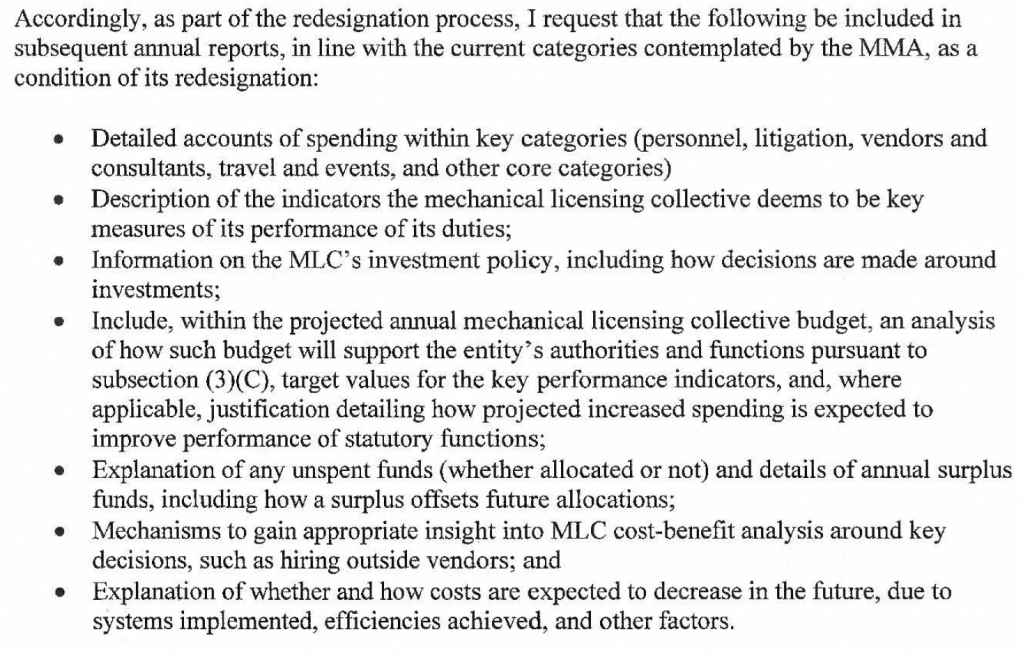
I agree with Rep. Fitzgerald that these are all important points.  I disagree with him slightly about the timing of this disclosure.  These important disclosures need not be prospective–they could be both prospective and retroactive. I see no reason at all why The MLC, Inc. cannot be required to revise all of its four annual reports filed to date (https://www.themlc.com/governance) in line with this expanded criteria.  I am just guessing, but the kind of detail that Rep. Fitzgerald is focused on are really just data that any business would accumulate or require in the normal course of prudently operating its business.  That suggests to me that there is no additional work required in bringing The MLC, Inc. into compliance; it’s just a matter of disclosure.

There is nothing proprietary about that disclosure and there is no reason to keep secrets about how you handle other people’s money.  It is important to recognize that The MLC, Inc. only handles other people’s money.  It has no revenue because all of the money under its management comes from either royalties that belong to copyright owners or operating capital paid by the services that use the blanket license.  It should not be overlooked that the services rely on the MLC and it has a duty to everyone to properly handle the funds. The MLC, Inc. also operates at the pleasure of the government, so it should not be heard to be too precious about information flow, particularly information related to its own operational performance. Those duties flow in many directions.

Board Neutrality

The board composition of the mechanical licensing collective (and therefore The MLC, Inc.) is set by Congress in Title I.  It should come as no surprise to anyone that the major publishers and their lobbyists who created Title I wrote themselves a winning hand directly into the statute itself.  (And FYI, there is gambling at Rick’s American Café, too.)  As Rep. Fitzgerald says:  

Of the 14 voting members, ten are comprised of music publishers and four are songwriters. Publishers were given a majority of seats in order to assist with the collective’s primary task of matching and distributing royalties. However, the MMA did not provide this allocation in order to convert the MLC into an extension of the music publishers.

I would argue with him about that, too, because I believe that’s exactly what the MMA was intended to do by those who drafted it who also dictated who controlled the pen.  This is a rotten system and it was obviously on its way to putrefaction before the ink was dry.

For context, Section 8 of the Clayton Act, one of our principal antitrust laws, prohibits interlocking boards on competitor corporations.  I’m not saying that The MLC, Inc. has a Section 8 problem–yet–but rather that interlocking boards is a disfavored arrangement by way of understanding Rep. Fitzgerald’s issue with The MLC, Inc.’s form of governance:

Per the MMA, the MLC is required to maintain an independent board of directors. However, what we’ve seen since establishing the collective is anything but independent. For example, in both 2023 and 2024, all ten publishers represented by the voting members on the MLC Board of Directors were also members of the NMPA’s board.  This not only raises questions about the MLC’s ability to act as a “fair” administrator of the blanket license but, more importantly, raises concerns that the MLC is using its expenditures to advance arguments indistinguishable from those of the music publishers-including, at times, arguments contrary to the positions of songwriters and the digital streamers.

Said another way, Rep. Fitzgerald is concerned that The MLC, Inc. is acting very much like HFA did when it was owned by the NMPA.  That would be HFA, the principal vendor of The MLC, Inc. (and that dividing line is blurry, too).

It is important to realize that the gravamen of Rep. Fitzgerald’s complaint (as I understand it) is not solely with the statute, it is with the decisions about how to interpret the statute taken by The MLC, Inc. and not so far countermanded by the Copyright Office in its oversight role.  That’s the best news I’ve had all day.  This conflict and competition issue is easily solved by voluntary action which could be taken immediately (with or without changing the board composition).  In fact, given the sensitivity that large or dominant corporations have about such things, I’m kind of surprised that they walked right into that one.  The devil may be in the details, but God is in the little things.

Investment Policy

Rep. Fitzgerald is also concerned about The MLC, Inc.’s “investment policy.”  Readers will recall that I have been questioning both the provenance and wisdom of The MLC, Inc. unilaterally deciding that it can invest the hundreds of millions in the black box in the open market.  I personally cannot find any authority for such a momentous action in the statute or any regulation.  Rep. Fitzgerald also raises questions about the “investment policy”:

Further, questions remain regarding the MLC’s investment policy by which it may invest royalty and assessment funds. The MLC’s Investment Policy Statement provides little insight into how those funds are invested, their market risk, the revenue generated from those investments, and the percentage of revenue (minus fees) transferred to the copyright owner upon distribution of royalties. I would urge the Copyright Office to require more transparency into these investments as a condition of redesignation.

It should be obvious that The MLC, Inc.’s “investment policy” has taken on a renewed seriousness and can no longer be dodged.

Black Box

It should go without saying that fair distribution of unmatched funds starts with paying the right people.  Not “connect to collect” or “play your part” or any other sloganeering.  Tracking them down. Like orphan works, The MLC, Inc. needs to take active measures to find the people to whom they owe money, not wait for the people who don’t know they are owed to find out that they haven’t been paid.  

Although there are some reasonable boundaries on a cost/benefit analysis of just how much to spend on tracking down people owed small sums, it is important to realize that the extraordinary benefits conferred on digital services by the Music Modernization Act, safe harbors and all, justifies higher expectations of those same services in finding the people they owe money.  The MLC, Inc. is uniquely different than its counterparts in other countries for this reason.

I tried to raise the need for increased vigilance at the MLC during a Copyright Office roundtable on the MMA. I was startled that the then-head of DiMA (since moved on) had the brass to condescend to me as if he had ever paid a royalty or rendered a royalty statement.  I was pointing out that the MLC was different than any other collecting society in the world because the licensees pay the operating costs and received significant legal benefits in return. Those legal benefits took away songwriters’ fundamental rights to protect their interests through enforcing justifiable infringement actions which is not true in other countries. 

In countries where the operating cost of their collecting society is deducted from royalties, it is far more appropriate for that society to consider a more restrictive cost/benefit analysis when expending resources to track down the songwriters they owe. This is particularly true when no black box writer is granting nonmonetary consideration like a safe harbor whether they know it or not.

I got an earful from this person about how the services weren’t an open checkbook to track down people they owed money to (try that argument when failing to comply with Know Your Customer laws).  Grocers know more about ham sandwiches than digital services know about copyright owners. The general tone was that I should be grateful to Big Daddy and be more careful how I spend my lunch money. And yes I do resent this paternalistic response which I’m sorry to say was not challenged by the Copyright Office lawyer presiding who shortly thereafter went to work for Spotify.  Nobody ever asked for an open check.  I just asked that they make a greater effort than the effort that got Spotify sued a number of times resulting in over $50 million in settlements, a generous accommodation in my view. If anyone should be grateful, it is the services who should be grateful, not the songwriters.

And yet here we are again in the same place.  Except this time the services have a safe harbor against the entire world which I believe has value greater than the operating costs of the MLC.  I’d be perfectly happy to go back to the way it was before the services got everything they wanted and then some in Title I of the MMA, but I bet I won’t get any takers on that idea.

Instead, I have to congratulate Rep. Fitzgerald for truly excellent work product in his letter and for framing the issue exactly as it should be posed.  Failing to fix these major problems should result in no redesignation—fired for cause.

[This post first appeared in MusicTech.Solutions]
Save the Date:  4th Annual Artist Rights Symposium on Nov. 20 in Washington DC

We’re excited to announce that the 4th Annual Artist Rights Symposium will be held on November 20, this time in Washington DC.  We have some big surprises in store that will be announced soon with new partners and speaker lineups. 

The topics we plan on covering will be ticketing, song metadata and black box issues, creator rights of publicity and transparency for artificial intelligence.

Watch this space!

Are You Better Off Today Than You Were Five Years Ago? Selected comments on the MLC Redesignation: Gwendolyn Seale

The Copyright Office solicited public comments about how things are going with the MLC to help the Office decide whether to permit The MLC, Inc. to continue to operate the Collective (see this post for more details on the “redesignation” requirement). We are impressed with the quality of many of the comments filed at the Copyright Office. While comments are now closed, you can read all the comments at this link.

For context, the “redesignation” is a process of review by the Copyright Office required every five years under the Music Modernization Act. Remember, the “mechanical licensing collective” is a statutory entity that requires someone to operate it. The MLC, Inc. is the current operator (which makes it confusing but there it is). If the Copyright Office finds the MLC, Inc. is not sufficiently fulfilling its role or is not up to the job of running the MLC, the head of the Copyright Office can “fire” the MLC, Inc. and find someone else to hopefully do a better job running the MLC. Given the millions upon millions that the music users have invested in the MLC, and the hundreds of millions of songwriter money held by the MLC in the black box, firing the MLC, Inc. will be a big deal. Given how many problems there are with the MLC, firing the MLC, Inc. that runs the collective

The next step in this important “redesignation” process is that The MLC, Inc. and the Digital Licensee Coordinator called “the DLC” (the MLC’s counterpart that represents the blanket license music users) will be making “reply comments” due on July 29. The Copyright Office will post these comments for the public shortly after the 29th. These reply comments will likely rebut previously filed public comments on the shortcomings of the MLC, Inc. or DLC (which were mostly directed at the MLC, Inc.) and expand upon comments each of the two orgs made in previous filings. If you’re interested in this drama, stay tuned, the Copyright Office will be posting them next week.

If you have been reading the comments we’ve posted on Trichordist (or if you have gone to the filings themselves which we recommend), you will see that there is a recurring theme with the comments. Many commenters say that they wish for The MLC, Inc. to be redesignated BUT…. They then list a number of items that they object to about the way the Collective has been managed by The MLC, Inc. usually accompanied by a request that the The MLC, Inc. change the way it operates.

That structure seems to be inconsistent with a blanket ask for redesignation. Rather, the commenters seem to be making an “if/then” proposal that if The MLC, Inc. improves its operations, including in some cases operating in an opposite manner to its current policies and practices, then The MLC, Inc. should be redesignated. Not wishing to speak for any commenter, let it just be said that this appears to be a conditional proposal for redesignation. Maybe that is not what the commenters were thinking, but it does appear to be what many of them are saying.

Today’s comment is by music lawyer Gwendolyn Seale who makes a number of excellent points in her filing including questioning whether the compulsory license itself is fit for purpose and what might happen if the MLC, Inc. is not redesignated. In particular, she addresses an alarming trend in the MLC, Inc.’s public messaging about the black box that has grown more cloudy as the size of the black box at the MLC has grown into the hundreds of millions.

For purposes of these posts, we may quote sections of comments out of sequence but in context. We recommend that you read the comments in their entirety. You can read Gwen Seale’s comment at this link.

Words Matter: The MLC Must Improve Its Presentation of Information

Confusion Regarding the Term, “Match Rate”

Upon reviewing the MLC’s 2021 Interim Annual Report in early 2022, I noticed reference to the
MLC having attained an 86% match rate. This metric seemed impressive, however, upon
learning the MLC’s definition of “match rate” (which I only learned by asking the MLC), I was
baffled. When the term, “match” is used alone, it refers to the matching of a sound recording
from a DSP report to a particular musical work. The Copyright Office’s NOI indicates the same
regarding the term, “match.”

Please describe how the Mechanical Licensing Collective has worked to improve automated and manual matching since the blanket license became available and plans to further enhance such matching over the next 5 years, including with respect to the matching of reported sound recordings to musical works as well as the matching of those musical works to identified and located copyright owners.

Being that a “match” constitutes pairing a sound recording with a particular musical work, it is
logical to deduce the “match rate” as being the percentage of sound recordings in DSP reports
which are matched to musical works registered at the MLC. However, that is not the case and
instead the term “match rate” as used by the MLC refers to the total amount of royalties matched
to musical works registered at the MLC over a given period. This definition was not provided to
the public so far as I can tell until June 30, 2022, in its final 2021 Annual Report.

As the most popular musical works are the ones generating the bulk of mechanical royalties over
a given month and are typically owned and/or controlled by the major music publishers with the
resources and capabilities to constantly monitor activities concerning their clients’ musical works
and engage in manual matching, the current definition of match rate (i.e., the royalty-based
definition) does not mean very much by itself. It would be useful for the MLC to also provide the
monthly match rate on a recordings-to-musical works-matched basis (hereinafter, “works-based
calculation”). Doing so would shine a light on the efficacy of the MLC’s and its vendors’
matching technology and would help to ensure the musical works of countless self-published
songwriters are being matched to reported sound recordings. I understand that there are issues
with catalog “fluff” and some sound recordings do not generate a single stream over a month’s
time. Thus, a works-based calculation could be tailored in a manner where recordings with less
than x streams per month or that generate less than x cents in mechanical royalties are omitted
from the calculation. Input from the Copyright Office regarding match rate terminology would
be helpful as well.

Historical Royalties: Eliminate  Illuminate = Obfuscate

The impetus behind establishing the MLC was to ensure that songwriters and publishers could
finally collect the nearly half billion dollars in historical royalties5 owed by the DSPs from the
early 2000s through the end of 2020. The task of the MLC was to eliminate the historical
royalties by ensuring that sound recordings could be matched to registered works in the MLC
database from this period. The MLC stated that eliminating these royalties was its goal:

The MLC cannot stress enough that its goal is to eliminate unclaimed accrued royalties, and that it has developed a realistic plan to pursue this goal.


Over time, the MLC shifted the language from eliminating to “illuminating” the historical royalties, beginning with the 2022 MLC Annual report:

Together, we will not only illuminate the “black box,” but also seek to eliminate it entirely!

At present, the MLC no longer references “elimination” of the historical royalties and purports
the job is done since the historical royalties have been “illuminated:”

Is there still a Black Box of Mechanical Royalties With The MLC?
No, the data on all unmatched uses is posted and available to be searched by Members. This includes all data for historical and blanket unmatched uses. All of these remaining unmatched uses are available to be searched by Members in The MLC’s Matching Tool. With this unprecedented transparency, The MLC has illuminated the so-called “black box” of streaming mechanical royalties for the first time.

The MLC started by moving the goalposts and concluded with eliminating them altogether. This
obfuscation of language is problematic. It misleads the public about the MLC’s performance and
gaslights those with knowledge about matching works and distributing royalties. Words matter.

This issue can be quickly solved by the MLC removing that particular FAQ above, and by providing monthly data regarding the total amount of unmatched, unclaimed, and on-hold
royalties (historical + blanket) in the MLC’s possession in a place that is easy to find on its
website.


.

Who Will Get to the Bottom of The Hundreds of Millions of Black Box Money at MLC?

By Chris Castle

One of the most common questions we get from songwriters about the MLC concerns the gigantic level of “unmatched funds” that have been sitting in the MLC’s accounts since February 2021.  Are they really just waiting until The MLC, Inc. gets redesignated and then distributes hundreds of millions on a market share basis like the lobbyists drafted into the MMA?  

Not My Monkey

Nobody can believe that the MLC can’t manage to pay out several hundred million dollars of streaming mechanical royalties for over three years so far.  (Resulting in the MLC holding $804,555,579 in stocks as of the end of 2022 on its tax return, Part X, line 11.) The proverbial monkey with a dart board could have paid more songwriters in three years.  Face it—doesn’t it just sound illegal?  In my experience, when something sounds or feels illegal, it probably is.

What’s lacking here is a champion to extract the songwriters’ money.  Clearly the largely unelected smart people in charge could have done something about it by now if they wanted to, but they haven’t.  It’s looking more and more like nobody cares or at least nobody wants to do anything about it.  There is profit in delay.

Or maybe nobody is taking responsibility because there’s nobody to complain to.  Or is there? What if such a champion exists?  What if there were no more waiting?  What if there were someone who could bring the real heat to the situation?

Let’s explore one potentially overlooked angle—a federal agency called the Office of the Inspector General.  Who can bring in the OIG?  Who has jurisdiction?  I think someone does and this is the primary reason why the MLC is different from HFA.

Does The Inspector General Have MLC Jurisdiction?

Who has jurisdiction over the MLC (aside from its severely conflicted board of directors which is not setting the world on fire to pump the hundreds of millions of black box money back into the songwriter economy).  The Music Modernization Act says that the mechanical licensing collective operates at the pleasure of the Congress under the oversight of the U.S. Copyright Office and the OIG has oversight of the Copyright Office through its oversight of the Library of Congress.

But, hold on, you say.  The MLC, Inc. is a private company and the government typically does not have direct oversight over the operations of a private company.

The key concept there is “operates” and that’s the difference between the statutory concept of a mechanical licensing collective and the actual operational collective which is a real company with real employees and real board members.  Kind of like shadows on the wall of a cave for you Plato fans.  Or the magic 8 ball.

The MLC, Inc. is all caught up with the government.  It exists because the government allows it to, it collects money under the government’s blanket mechanical license, its operating costs are set by the government, and its board members are “inferior officers” of the United States.   Even though The MLC, Inc. is technically a private organization, it is at best a quasi-governmental organization, almost like the Tennessee Valley Authority or the Corporation for Public Broadcasting.  So it seems to me that The MLC, Inc. is a stand-in for the federal government.

But The MLC, Inc. is not the federal government.  When Congress passed the MMA and it charged the Copyright Office with oversight of the MLC.  Unfortunately, Congress does not appear to have appropriated funds for the additional oversight work it imposed on the Office.  

Neither did Congress empower the Office to charge the customary reasonable fees to cover the oversight work Congress mandated.  The Copyright Office has an entire fee schedule for its many services, but not MLC oversight.  

Even though the MLC’s operating costs are controlled by the Copyright Royalty Board and paid by the users of the blanket license through an assessment, this assessment money does not cover the transaction cost of having the Copyright Office fulfill an oversight role.

An oversight role may be ill suited to the historical role of the Copyright Office, a pre-New Deal agency with no direct enforcement powers—and no culture of cracking heads about wasteful spending like sending a contingent to Grammy Week.

In fact, there’s an argument that The MLC, Inc. should write a check to the taxpayer to offset the additional costs of MLC oversight.  If that hasn’t happened in five years, it’s probably not going to happen.  

Where Does the Inspector General Fit In?

Fortunately, the Copyright Office has a deep bench to draw on at the Office of the Inspector General for the Library of Congress, currently Dr. Glenda B. Arrington.  That kind of necessary detailed oversight is provided through the OIG’s subpoena power, mutual aid relationships with law enforcement partners as well as its own law enforcement powers as an independent agency of the Department of Homeland Security.  Obviously, all of these functions are desirable but none of them are a cultural fit in the Copyright Office or are a realistic resource allocation.

The OIG is better suited to overseeing waste, fraud and abuse at the MLC given that the traditional role of the Copyright Office does not involve confronting the executives of quasi-governmental organizations like the MLC about their operations, nor does it involve parsing through voluminous accounting statements, tracing financial transactions, demanding answers that the MLC does not want to give, and perhaps even making referrals to the Department of Justice to open investigations into potential malfeasance.  

Or demanding that the MLC set a payment schedule to pry loose the damn black box money.

One of the key roles of the OIG is to conduct audits.  A baseline audit of the MLC, its closely held investment policy and open market trading in hundreds of millions in black box funds might be a good place to start.  

It must be said that the first task of the OIG might be to determine whether Congress ever authorized MLC to “invest” the black box funds in the first place.  Congress is usually very specific about authorizing an agency to “invest” other people’s money, particularly when the people doing the investing are also tasked with finding the proper owners and returning that money to them, with interest. 

None of that customary specificity is present with the MLC.

For example, MLC CEO Kris Ahrens told Congress that the simple requirement that the MLC pay interest on “unmatched” funds in its possession (commonly called “black box”) was the basis on which the MLC was investing hundreds of millions in the open market.  This because he assumed the MLC would have to earn enough from trading securities or other investment income to cover their payment obligations.  That obligation is mostly to cover the federal short term interest rate that the MLC is required to pay on black box.

The Ghost of Grammy Week

The MLC has taken the requirement that the MLC pay interest on black box and bootstrapped that mandate to justify investment of the black box in the open market.  That is quite a bootstrap.

An equally plausible explanation would be that the requirement to pay interest on black box is that the interest is a reasonable cost of the collective to be covered by the administrative assessment.  The plain meaning of the statute reflects the intent of the drafters—the interest payment is a penalty to be paid by the MLC for failing to find the owners of the money in the first place, not an excuse to create a relatively secret $800 million hedge fund for the MLC.  

I say relatively secret because The MLC, Inc. has been given the opportunity to inform Congress of how much money they made or lost in the black box quasi-hedge fund, who bears the risk of loss and who profits from trading.  They have not answered these questions.  Perhaps they could answer them to the OIG getting to the bottom of the coverup.

We do not really know the extent of the MLC’s black box holdings, but it presumably would include the hundreds of millions invested under its stewardship in the $1.9 billion Payton Limited Maturity Fund SI (PYLSX). Based on public SEC filings brought to my attention, The MLC, Inc.’s investment in this fund is sufficient to require disclosure by PYLSX as a “Control Person” that owns 25% or more of PYLSX’s $1.9 billion net asset value. PYLSX is required to disclose the MLC as a Control Person in its fundraising materials to the Securities and Exchange Commission (Form N-1A Registration Statement filed February 28, 2023).  This might be a good place to start.

Otherwise, the MLC’s investment policy makes no sense.  The interest payment is a penalty, and the black box is not a profit center.

But you don’t even have to rely on The MLC, Inc.’s quasi governmental status in order for OIG to exert jurisdiction over the MLC.  It is also good to remember that the Presidential Signing Statement for the Music Modernization Act specifically addresses the role of the MLC’s board of directors as “inferior officers” of the United States:

Because the directors [likely both voting and nonvoting] are inferior officers under the Appointments Clause of the Constitution, the Librarian [of Congress] must approve each subsequent selection of a new director. I expect that the Register of Copyrights will work with the collective, once it has been designated, to ensure that the Librarian retains the ultimate authority, as required by the Constitution, to appoint and remove all directors.

The term “inferior officers” refers to those individuals who occupy positions that wield significant authority, but whose work is directed and supervised at some level by others who were appointed by presidential nomination with the advice and consent of the Senate. Therefore, the OIG could likely review the actions of the MLC’s board (voting and nonvoting members) as they would any other inferior offices of the United States in the normal course of the OIG’s activities.

Next Steps for OIG Investigation

How would the OIG at the Library of Congress actually get involved?  In theory, no additional legislation is necessary and in fact the public might be able to use the OIG whistleblower hotline to persuade the IG to get involved without any other inputs.  The process goes something like this:

  1. Receipt of Allegations: The first step in the OIG investigation process is the receipt of allegations. Allegations of fraud, waste, abuse, and other irregularities concerning LOC  programs and operations like the MLC are received from hotline complaints or other communications. 
  2. Preliminary Review: Once an allegation is received, it undergoes a preliminary review to determine if OIG investigative attention is warranted. This involves determining whether the allegation is credible and reasonably detailed (such as providing a copy of the MLC Congressional testimony including Questions for the Record). If the Office is actually bringing the OIG into the matter, this step would likely be collapsed into investigative action.
  3. Investigative Activity: If the preliminary review warrants further investigation, the OIG conducts the investigation through a variety of activities. These include record reviews and document analysis, witness and subject interviews, IG and grand jury subpoenas, search warrants, special techniques such as consensual monitoring and undercover operations, and coordination with other law enforcement agencies, such as the FBI, as appropriate.  That monitoring might include detailed investigation into the $500,000,000 or more in black box funds, much of which is traded on open market transactions like PYLSX.
  4. Investigative Outputs: Upon completing an investigation, reports and other documents may be written for use by the public, senior decision makers and other stakeholders, including U.S. Attorneys and Copyright Office management. Results of OIG’s administrative investigations, such as employee and program integrity cases, are transmitted to officials for appropriate action. 
  5. Monitoring of Results: The OIG monitors the results of those investigations conducted based on OIG referrals to ensure allegations are sufficiently addressed.

So it seems that the Office of the Inspector General is well suited to assisting the Copyright Office by investigating how the MLC is complying with its statutory financial obligations.  In particular, the OIG is ideally positioned to investigate how the MLC is handling the black box and its open market investments that it so far has refused to disclose to Members of Congress at a Congressional hearing as well as in answers to Questions for the Record from Chairman Issa.

This post previously appeared on MusicTech.Solutions

Dave Rowntree is Suing the UK Performing Rights Society Over Misallocation of Unmatched Royalties (Black Box)

According to press reports, Dave Rowntree of Blur filed the UK equivalent of a class action lawsuit against PRS (the UK version of ASCAP and BMI). The claim is a “collective proceeding” filed with the UK’s antitrust tribunal. The class action established a website to communicate about the claim with interested parties. The website says:

Collective Proceedings Against PRS for Music

If You Were a Writer Member of the Performing Right Society at Any Time Since 9 March 2017,
a Proposed Legal Claim Could Affect Your Rights

On 27 February 2024, the claim was brought against PRS that asks the Competition Appeal Tribunal for permission to go forward as an “opt-out collective action.”  The claim concerns the way in which PRS distributes, or permits to be distributed, certain royalty sums that are called in the PRS Rules and Regulations (“PRS Rules and Regulations”) and the PRS Distribution Policy Guide terms such as  “unmatchable” (including “copyright control”), “non-distributable”, and “unclaimed” and colloquially referred to within the music industry as “Black Box” royalties. The majority of Black Box royalties are royalties belonging to PRS writer members but when the Black Box royalties are distributed, the distribution is heavily skewed in favour of publishers who receive a large portion of the writer share. In other words, Black Box royalties are transferred from PRS writer members and given to PRS publisher members who have no right to those royalties.

David Rowntree seeks to represent the class of PRS writer members who have lost money arising from the proposed claim.

Of course, the Mechanical Licensing Collective is sitting on hundreds of millions of black box money for the US as well, and may end up being the defendant in a separate class action at some point in the future.

When Will the MLC Disclose How they Invest the Black Box Money?

[this post originally appeared in MusicTech.Solutions as “Unrealized Losses and the Black Box Investment Policy” by Chris Castle. We asked him to update it a bit to repost.]

Well, another quarter is rolling around and the MLC is still sitting on 100s of millions of dollars of songwriter money as far as I can tell. Billboard says the MLC has “matched”–maybe different than “paid”–$200 million of the $427 million in black box that it was paid by the services in 2021. This doesn’t count the unmatched that the MLC has itself added to that sum. And Congress still haven’t required them to disclose their investment policy, returns on investment or much of anything else.

Compare the MLC to community banks. There are approximately 1,000 community banks with net assets between $250,00,000 to $500,000,000. There are approximately another 1,200 community banks with net assets between $100,000,000 to $250,000,000. It’s admittedly rough justice, but why should one entity holding hundreds of millions of other peoples’ money have virtually no disclosure requirements and be essentially unregulated while another is the opposite?

Remember that the MLC is supposed to pay interest “at the Federal, short-term rate” “for the benefit of copyright owners entitled to payment of such accrued royalties.” Note that the Federal short-term rate is today a lot higher than it was when the lobbyists wrote the Music Modernization Act, currently 4.21% or thereabouts. And through the power of compound interest, that’s a bunch of cash the MLC is supposed to come up with. I wonder where they’ll get it from. Wouldn’t you like to know?

Anyway, let’s talk about interest rates. The “risk free rate” is often thought of as the rate of interest paid on US government bonds. That interest rate is thought of as risk free because it is backed by the full faith and credit of the United States that you hear so much about these days. Want to know where you can find that full faith and credit? Look in the mirror. 

When you ask around about what collective management organizations do with their “black box” monies while they are waiting to match money with songwriters or at least copyright owners, you often hear that the money is invested in very safe instruments, like U.S. treasury bonds. This might be particularly true of CMOs that are required to pay interest on black box because that interest has to come from somewhere.

But–and here it is–but, as we have learned from the Silicon Valley Bank collapse and the number of federal government officials in the mumble tank about why these banks are failing and why they are getting bailed out by, you know, the full faith and credit of the United States, “risk free” seems to be a relative concept. When you buy US government bonds, there are a number of different maturity dates available to you, kind of like buying a certificate of deposit. A common maturity date is the 10-year bond and the two-year bond, both of which were recently down sharply.

But–there is a connection between the interest rate that the bond pays, the price of the bond, and the maturity date of that bond. When bond interest rates increase, the face price tends to decrease. So if you paid $100 for a bond with a interest rate of say .08% and that rate then increased to say 4.5%, the face price of that bond will no longer be $100, it will be less. If that increase happens fairly quickly, you can have difficulty finding a buyer. The good news is that when the Federal Reserve raises the interest rate, there is about as much news coverage of the event as it is theoretically possible to have, both before during and after the rate increase, not to mention the Federal Reserve chair testifying to Congress. It’s very public. Closely watched doesn’t really capture that level of attention.

When bond prices decline, holders only “realize” the loss or gain if they sell the bond unless the bond is marked to market so the firm has to disclose the amount of what the loss would be if they sold the bond. Hence the concept of “unrealized losses,” “maturity risk,” or “interest rate risk.”  Some think that US banks currently have $620 billion in unrealized losses due to interest rate risk. And don’t forget, these are your betters. These are the smart people. These are the city fellers.

This interest rate risk issue is not limited to banks, however. It is also present anytime that an entity tasked with caring for other people’s money invests that money in treasury bonds, crypto, or whatever. Like the MLC. You don’t have to be Wall Street Bets to end up losing your shirt or something in this environment.

So the point is that the same problem of interest rate risk and unrealized losses could apply to CMOs, such as The MLC, Inc. because of their undisclosed “investment policy” of investing the $424 million of black box they were paid by the services. They don’t disclose what the investment policy is and they don’t disclose their holdings so we don’t really know what has happened, if anything. The money could be perfectly safe.

Or not.

Clowns to the Left of Me, Jokers To the Right: When Will the MLC Show Us the Money?

If you’ve received one of these emails from the MLC about having to recast their monthly statement inside of a single month, when you’re eying that $500,000,000 of supposedly unmatched money that’s sitting in the MLC, Inc.’s bank account (maybe?), or if you’re trying to figure out when they are launching the vastly overdue claiming portal, you’re probably wondering–who’s in the clown car today? Bozo or Pennywise?

But maybe they’re smarter than they look. Because all they have to do to distribute that $500,000,000 on a market share basis is keep you looking at the bright and shiny object while they run out the clock.

And if you’re waiting for the Copyright Office to save you because they have “oversight”, you’re going to be waiting for a long time. Here’s the reality–nobody is minding the store. There’s a difference between “oversight” and “overwatch.” In Washington, “oversight” means finding someone else to blame and from the very beginning it has been clear who the MLC intends to blame–you. Because you didn’t “play your part” or sufficiently “connect to collect”.

The Copyright Office has done a couple things while under the supervision of the current head lobbyist for Spotify. They’re good at studies, terrible at oversight, so let’s give credit where it’s due. But also realize that’s where it stops because they have about as much moxie as a starfish. (And if you think the NMPA is going to save you, take a look at the frozen mechanicals debacle and ask yourself if a rational person could really take that seriously.)

At the core of the MLC’s business model is the ability to match. Matching is kind of a “See Spot run” building block. If you can’t match, it’s very close to saying you can’t count. Because it depends on what the definition of “match” is.

So what is a match? Or as the Bard might say, how can I screw thee? Let me count the ways. The Copyright Office produced the Unclaimed Royalties Best Practices study partly on this very topic. Notice the difference between “best practices” and “rules.” “Best practices” is not the same as “rule”. If you violate a best practice, nothing happens to you, so therefore perfect for Washington. If you violate a rule, bad things happen to you. The connective tissue is enforcement. If you violate a rule at the Securities and Exchange Commission, you wear stripes. If you violate a rule at the Environmental Protection Agency, you will pay a fine, for sure. If you violate a rule at the MLC? There really aren’t any so it can’t happen. In other words, it’s just like the Harry Fox Agency.

But that’s what we have so let’s look at one passage in particular from the Best Practice Study because that’s the closest we have to a rule book.

The Office recommends that the MLC make all [matching] metrics publicly available, except to the extent it would cause confidential or business sensitive information to be improperly disclosed. [God forbid.] Specifically regarding match rates, the Office acknowledges the MLC’s point that “vendors can easily increase their claimed ‘match percentage’ by simply dropping the confidence level at which they call something a match.” For that reason, the Office recommends that the MLC provide appropriate context for its metrics, including information surrounding how it defines a match, relevant confidence levels, and how confidence levels are tuned. Additionally, so that they are clear and precise, and to avoid possible confusion, the Office recommends that all royalty figures be provided both with and without accrued interest. [How about a best practice of how they are practicing complying with best practices best?

The Office recommends that in addition to providing annual statistics in its annual report, the MLC also have a dedicated public webpage displaying all of these metrics in a clear, well-organized, user-friendly, and accessible manner. The webpage should be interactive and allow users to search, sort, and break down the data so it may be more easily reviewed and analyzed. The webpage should also have an export or download feature, including bulk exporting/downloading, to aid public consumption and dissemination. The Office recommends that the webpage be updated monthly after each batch of new reports of usage arrive and go through initial matching processes. All metrics should be retained and made available online indefinitely (though the MLC could distinguish between current and historic metrics in the future) so long-term trends can be assessed and to ensure the public and the Office have access to them in connection with the review of the MLC’s designation every five years. The MLC should also be very clear about how applicable metrics may change in response to DMP reporting adjustments and the reconciliation of any related royalty underpayments or overpayments permitted by the Office’s regulations. Relatedly, the Office also recommends that the MLC make publicly available relevant metrics about DMP reported usage that the MLC determines is not subject to blanket licenses (e.g., where it is subject to a voluntary license instead, public domain musical works, etc.), such that any related paid royalties have been credited or refunded back to the DMP.

What would also be nice is to tell you how much of your money they are holding and how you get it back. Maybe they could practice the best out of that.

There’s nothing particularly insightful about any of that, right? It’s the kind of thing that any songwriter giving the subject a moment or two of thought could have figured out at any point in the last 100 years. It’s also the kind of thing that you would have expected to have been built into the MLC’s system–which is essentially the HFA system–from the beginning.

It doesn’t matter what they say they aspire to do. Naturally they have to say they aspire to get it 100% correct–because otherwise that raises some interesting questions about intent, right?

Will they ever be called to account for their failures? Doubtful. The only business in the world where you can get the government to let you hold $500,000,000 of other people’s money and then keep it because paying it out was just too hard for you.

Do you think this mess is what Congress had in mind after they were fed a bunch of crap by the know-nothing lobbyists?

So let’s ask again–Bozo or Pennywise?

Songwriters and Publishers Ask the MLC: Where’s my money?–MusicTechPolicy

By Chris Castle

If anyone connected to The Mechanical Licensing Collective, Inc. quango brings up the $424,000,000 black box payment that the MLC received in February as part of services claiming their safe harbor under the Music Modernization Act Title I giveaway, it’s usually in the context of claiming credit for the payment as in “Aren’t we great, we got the services to pay $424,000,000 of black box money owed to songwriters.” (Followed shortly by so where’s my bonus?)

Notice what’s not mentioned in that sentence? True, some services paid some money to the MLC which was required by Title I in order for the major infringers like Spotify to enjoy yet another safe harbor. But the payment was not made to songwriters or publishers–it was made to the MLC quango, which is where it sits today, seven months later

How could this be, you say? Very simple. Nobody made sure that the MLC was in a position to pay the money out before they took the money in. This is the kind of thing that you would make sure is tied down in the two-plus years the MLC was operational before they got the money. You know, like when did Noah build the Ark?  Before the rain.

This is the kind of thing you might expect to be mentioned in the MLC’s annual report which was due June 30 but seems to have been delayed. What should have happened, of course, is that the Copyright Office in its supposed oversight role for the MLC quango should be closely reviewing MLC’s progress with paying out a half billion of other people’s money. This is what you would expect from a bit-in-the mouth hard-driving approach to oversight of hundreds of millions that Congress tasked to the Copyright Office. 

Ask yourself (or maybe the Library of Congress Inspector General) whether you think that a pre-New Deal federal agency that has never had enforcement powers is culturally suited to the kind of rigorous prosecution that the oversight role requires? Having created the MLC self-licking ice cream cone, does anyone seriously think that the Copyright Office will rock the boat, particularly when the lawyers seem very interested in landing a job at Spotify (regulated by the Copyright Office) or the National Association of Broadcasters both of which have an ontologically hostile relationship with songwriters? Do you think anyone at the MLC is looking over their shoulder because they’re afraid of the Copyright Office? And if they don’t fear the oversight, what incentive do they have? Nobody else will be twisting their arms.

So should it come as a surprise to anyone that people are asking “where’s my money?” Or that no one is answering?

Guest Post: Honesty In Our Favor: HFA Loses Attempt To Exit Eight Mile Style Case–What Implications For MLC?

Guest post by Chris Castle

The Uniform Commercial Code defines “good faith” as “honesty in fact and the observance of reasonable commercial standards of fair dealing.”

Spotify was sued by Eight Mile Style and Martin Affiliated, two publishers that control rights in some of the early Eminem repertoire, including Lose Yourself. Remember that earlier this year, Spotify announced with great fanfare that Lose Yourself was streamed over 1 billion times on the platform. That’s just one measurement of Eminem’s dominance on Spotify. Turns out that Spotify had failed to license a good chunk of Eminem’s catalog.

The publishers eventually joined the Harry Fox Agency to the lawsuit as participating in the situation, adding claims of vicarious and contributory copyright infringement against the long-time publishing administrator to the industry. In fact, the Harry Fox Agency gave some people the impression that when it came to Section 115 of the Copyright Act, HFA thought they were the government. What ever is this venerable organization doing getting sued for copyright infringement instead of leading the charge against the infringer?

At one point a few years ago, quite a few years ago now, HFA decided to jump up on top of the wall. They started working for tech companies like Spotify and also administering publishing rights. That’s right–both sides. What could possibly go wrong?

Let me illustrate with an anecdote (one that does not involve HFA, or MRI for that matter). A highly ethical licensing administrator interviewed for a job handling music licensing for a big tech company. After several rounds of interviews, the administrator was told they weren’t getting the job. Asking for a reason, the tech company told the administrator that the company thought the administrator were likely going to flag and at least try to fix any problems they found in the tech company’s reporting. The administrator didn’t find this remarkable as this was the honest thing to do. The company said, we don’t want honesty when it’s not in our favor. The company hired someone else because they did not want “honesty in fact”.

There are serious allegations against the Harry Fox Agency in the Eight Mile Case. Remember, this is a defense motion to dismiss, so the plaintiff largely gets the benefit of the doubt in their favor. You may ask yourself what possible motivation could Spotify have for engaging in such risky behavior. In her order denying in part and granting in part HFA’s motion to dismiss, Judge Trauger puts her finger right on the most plausible explanation:

[I]t is undisputed that [Eminem, aka Marshall] Mathers is an artist who has enjoyed extraordinary commercial success and has built a large, dedicated fanbase, such that his omission from a major streaming platform might discourage some meaningful number of potential users from subscribing

In other words, they did it for the subscribers, they did it for the growth and they did it for the money.

While Eight Mile alleged both vicarious and contributory infringement, Judge Trauger dismissed the claim for vicarious infringement on technical grounds (with leave to amend). Not so with the claim for contributory infringement, however:

HFA objects that it was under no obligation to police Spotify’s in-house decisions regarding infringement. Whether that is true or not, the plaintiffs have not merely alleged that HFA failed to affirmatively police Spotify’s conduct; they have alleged both that HFA knew and, through the ordinary fulfillment of its duties, should have known that the infringement was occurring and that HFA was helping to conceal it.…There is little doubt, moreover, that those allegations of knowledge were pleaded sufficiently. Even when a claim is governed by the heightened pleading requirements of Rule 9(b), “[m]alice, intent, knowledge, and other conditions of a person’s mind may be alleged generally.” Fed. R. Civ. P. 9(b). The Supreme Court, moreover, has recognized a party’s “aiming to satisfy a known source of demand for copyright infringement” as evidence of an improper purpose in the contributory infringement analysis. Grokster, 545 U.S. at 939. That circumstantial evidence is only heightened when the defendant, knowing of the capacity for infringement, fails to take steps to avoid it. See id. (citing Groskter’s lack of “attempt[s] to develop filtering tools or other mechanisms to diminish the infringing activity using their software”).

The plaintiffs have plausibly alleged that HFA became aware of Spotify’s licensing predicament and offered services that directly filled its need to maintain an illusion of lawfulness while continuing to infringe. 

If these allegations turn out to be proven true, songwriters (and the Copyright Office for that matter) may well ask themselves if there are implications for HFA’s continued role as a vendor for The MLC, if not why they were selected in the first place.

This post first appeared in MusicTechPolicy