Has the MLC Become a $1.2 billion Hedge Fund?

It’s becoming increasingly clear that the MLC has little to no oversight. The Copyright Office is tasked by Congress with oversight authority over this quasi-governmental organization under the Music Modernization Act. Yet there is nothing happening in the way of guardrails. The Copyright Office haven’t even concluded their mandated five-year review of the MLC that started a year ago. Not only has no one responded to Congressman Fitzgerald’s inquiries about the MLC’s oddball finances, the Copyright Office hasn’t responded to the many public comments demanding answers on the MLC’s sketchy finances as demonstrated on their tax returns.

The MLC’s 2023 tax return shows the quango is holding $1,212,282,220 invested in publicly traded securities–that’s $1.2 BILLION. That’s a fortune for an organization that makes no money–because as we were told ad nauseum the services pay it’s operating costs and bloated salaries-and has no profits because it is not an operating company. But it does hold several fortunes in unmatched royalties it does not seem to be in a hurry to match and pay out to songwriters.

The Supplement to the MLC’s 2023 tax return includes this language:

In our Form 990 for 2023, we provided information regarding funds we were holding in banks and investments as of the beginning of 2023 and the end of 2023. These included assessment funds that we subsequently use to fund our operations; royalty funds we were not yet able to distribute and on which we are required to earn interest in accordance with the Music Modernization Act (MMA) of 2018; and royalty funds we were holding pending distribution.

What the MMA actually says in the black box penalty language of 17 USC §115 (d)(3)(H)(ii) is:

Interest-bearing account.—Accrued royalties for unmatched works (and shares thereof) shall be maintained by the mechanical licensing collective in an interest-bearing account that earns monthly interest—

(I) at the Federal, short-term rate; and

(II) that accrues for the benefit of copyright owners entitled to payment of such accrued royalties.

The black box penalty in 17 USC §115 (d)(3)(H)(ii) is similar to the late fee charged to licensees. The code creates an incentive for the MLC to pay out unmatched funds quickly to avoid the market share distribution of black box which could happen any minute now (particularly since the Copyright Office hasn’t completed the five-year review it started over a year ago).

This language of 17 USC §115 (d)(3)(H)(ii) does not “require” the MLC to “earn interest”, it requires them to PAY interest. Because it is inextricably tied to job performance, it would not be a payment borne by the licensees as part of the administrative assessment as part of the “collective total costs.”

That’s why it’s a penalty. It is, in my view, absolutely false and misleading to state in a matter under the jurisdiction of the federal government that the MLC is in compliance with a code section that does not say what they say it says. And it’s not just this one time, the CEO has said almost these exact words in testimony to the House IP Subcommittee and in supplemental written testimony to answer questions for the record from the Subcommittee.

Even if you want to be generous and accept the MLC’s argument–and it’s just an argument–that the MMA “requires” the MLC to “earn” interest, an “interest bearing account” simply does not contemplate “investing” other people’s money–your money–in publicly traded securities by a stock broker. When asked direct questions about who bears the downside and who gets the ups on their stock trading, the MLC has never answered the question. 

The closest to an answer we get from the plain statutory language is that the MLC is required to pay interest on unmatched funds at the “federal short term rate” which is approximately 4.23%. Does that mean that if the MLC makes more than a 4.23% return they keep the upside? Or if the stock brokers don’t achieve that return, does that mean the licensees cough up the difference in additional administrative assessment contributions? Unlikely, so would the MLC’s board members pass the hat? I’ll believe that when I see it.

While the MLC refuses to answer who participates in the benefits or downside of the investment policy, the amount invested in publicly traded securities over 12 months has radically increased from $804,555,579 at the beginning of 2023. As of the end of 2023, the MLC’s holdings in publicly traded securities alone increased to $1,212,282,220, approximately a 50% gain over 12 months. What we don’t know is if that gain is due to slick stock trading, monkey with a dartboard or the addition of new money, Madoff-style. (And of course if they do manage to “blow up the compulsory” which is the latest from the smart people, who knows who gets to keep the black box?)

The MLC offers this explanation:

At the beginning of 2023, we were holding $138.8 million in “Savings and temporary cash investments.” By the end of 2023, we had moved $131.1 million of these funds to “Investments – publicly traded securities,” leaving the remaining $7.7 million in “Savings and temporary cash investments.” At the beginning of 2023, we were holding $804.6 million in “Investments – publicly traded securities.” By the end of 2023, the amount of funds we were holding in this category increased to $1.2 billion. This year-end amount included the $131.1 million we had moved from “Savings and temporary cash investments”
into this category during the year.

Realize that this language explains nothing. Not only do they round down by $12,282,220, they simply describe movements of cash without explaining why it happened.

So once again, we are presented with a document that avoids the key issue at best and is misleading at worst. But what is clear is that the MLC has more in holdings that approximately 130 regional banks that have substantial disclosure obligations. It’s looking more and more like a hedge fund.

MTP Interview: Attorney Tim Kappel and Abby North Discuss Landmark Vetter v. Resnick case with Chris Castle

In a rare treat, Abby North and Chris Castle got to speak with New Orleans attorney Tim Kappel about his client’s case Vetter v. Resnick. The landmark case stands for winning the long-fought principle that termination rights in copyright cause the transfer of the worldwide copyright not just US rights as had been the business practice. The case is a major victory for songwriters and their heirs.

Cyril Vetter and Don Smith co-wrote the song “Double Shot (Of My Baby’s Love)” in 1962. They assigned all their interests in the song to Windsong Music Publishers. Vetter later served a termination notice on Resnick to recapture his rights under the U.S. Copyright Act, arguing that this termination applied globally, not just in the U.S. Resnick rejected Vetter’s global termination and Vetter sued for declaratory relief in the Middle District of Louisiana.

In a major win for songwriters and their heirs, Chief District Judge Shelly D. Dick agreed with Vetter, granting him worldwide rights to the song, which contradicted established but inequitable business practices in the U.S. music publishing industry. In the podcast, Chris Castle and Abby North discuss the case with Vetter’s attorney, Tim Kappel. These documents are referenced in the podcast.

Understanding Trump’s TikTok Trolling: Crazy or Crazy Like a Fox?

By Chris Castle

Let’s be honest–it may look like things are getting weird with TikTok and Bytedance, but let me suggest things are maybe even weirder than they appear. New information has come to light.

First of all, I think it’s clear that at least as of January 19, the Protecting Americans from Foreign Adversary Controlled Applications Act will make it unlawful for companies in the United States to provide services to distribute, maintain, or update the social media platform TikTok, unless U. S. operation of the platform is severed from Chinese control which basically means owned by Bytedance. It’s potentially clear–although the situation is changing daily in Trump time–that the statute may also ban a number of other data-scraping apps owned and distributed by Bytedance that have problems and addictive properties similar to TikTok.

After TikTok’s faux shut down, President Trump immediately got into the act to “Save TikTok”. His first move was to post on social media that he would issue an executive order today “delaying” the effectiveness of the Act. Mr. Trump’s statements may have seemed a bit disjointed because from a statutory point of view, the President does not have the authority to “delay” the effectiveness of the Act. In fact, that is exactly what the Supreme Court just refused to do.

But “Saving TikTok” may not mean saving TikTok if you catch my drift. Saving it for whom exactly?

This may all seem rather bizarre, but if you read President Trump’s “Friend of the Court” brief filed during the Supreme Court’s review of TikTok’s request for a delay in enforcing the Act, it would all be clear–maybe–because that is exactly what he asked the Supreme Court to do–delay the effective date so the could apply Art of the Deal principles to the situation. This is, of course, not what the Supreme Court really is about, but it does reveal what was on his mind. The President says:

In light of this Court’s well-placed concerns about the “highly expedited” resolution of novel, difficult, and “very significant” constitutional questions…the Court should consider staying the statutory deadline for divestment and taking time to consider the merits in the ordinary course. Such an approach would allow this Court more breathing space to consider the merits, and it would also allow President Trump’s Administration the opportunity to pursue a negotiated resolution that, if successful, would obviate the need for this Court to decide these questions.

When a statute has been duly passed by Congress and signed into law by the then-sitting President (Biden) and upheld by the Supreme Court, the next President as chief magistrate must likely enforce the law under the “Take Care” clause of the Constitution (“take care that the laws be faithfully executed” in Article II, Section 3 for those reading along at home).

Of late there has, of course, been an unfortunate reliance on what I think is a misinterpretation of “prosecutorial discretion” that I personally find loathsome and flat out wrong. Prosecutorial discretion historically has been decisions based on resources and the strength of the evidence in particular cases; doing otherwise often results in the prosecutor getting unelected (see, e.g., Chesa Boudin and George Gascon). We’ll see if this dubious practice will continue.

Without getting into the entire history of executive orders that exceed presidential authority, there isn’t a clear precedent for a presidential executive order actually limiting the enforcement of an act of Congress that has been upheld by the Supreme Court (like the TikTok divestment). One notable and frequently cited case is Youngstown Sheet & Tube Co. v. Sawyer (1952), where the Supreme Court struck down then-President Harry Truman’s executive order to seize control of steel mills during the Korean War. The Court ruled that President Truman lacked the constitutional or statutory authority to issue such an order in a somewhat but not entirely similar situation to TikTok. In general, executive orders are subject to judicial review, and it is pretty old news that the Supreme Court has the power to strike down executive actions that exceed presidential authority or violate the Constitution. That principle of US law was established in 1803 by our first Chief Justice of the Supreme Court.

Having said that, I do understand why President Trump is trolling TikTok, or at least I think I do today. As he said in a speech to his supporters regarding a solution for TikTok’s problem (and has repeated a number of times since his inauguration):

So I said very simply, a joint venture. So, if TikTok is worth nothing, zero without an approval, you know you don’t approve, they’re out of business, they’re worth nothing.

If you do approve, they’re worth like a trillion dollars, they’re worth some crazy number. So I said, I’ll approve, but let the United States of America own 50% of TikTok. I’m approving on behalf of the United States.

So they’ll have a partner, the United States, and they’ll have a lot of bidders and the United States will do what we call a joint venture. And there’s no risk, we’re not putting up any money. All we’re doing is giving them the approval without which they don’t have anything.

As I’ve said before, President Trump has all the leverage that anyone could have in a situation where the Chinese Communist Party has their eye fixed on an IPO on the New York Stock Exchange. Not to be conspiratorial, but I do find it interesting that shortly before the Supreme Court decision, Softbank’s CEO committed to investing $100 billion in the US–Softbank being a major investor in TikTok and a beneficiary of that IPO and the same CEO just committed a portion of $500 billion to the Stargate AI infrastructure investment alongside Oracle and OpenAI.

I do think that someone might challenge any executive order that is inconsistent with the Truman precedent in the Youngstown Supreme Court case. The Supreme Court could probably strike down such an executive order. In the meantime, President Trump will likely be trying to close a deal to sell TikTok and destroy the CCP’s connection to user data. At some point, Congress may have to get involved again to bless whatever the final deal is.

So could Trump pull this off? Oh, yes, he could. It would be unusual, but not impossible in my judgement. Murky, yes. But when the dust settles, it looks like TikTok doesn’t have much of a choice. They will either hand over 50% of its company to the US (either in the form of voting power (like “golden shares“), stock or a financial interest), or they can shut down. And it may not just be TikTok–it may be all of the Bytedance companies that have a TikTok problem. Even though giving up a 50% share would essentially cut in half any ownership stake of Softbank, there may be some tolerance given that the alternative is zero–not just for TikTok, by the way, but potentially all of the Bytedance companies.

Is giving up 50% of your company because your lawyers and lobbyists failed a happy thing? Do you think Xi Jinping is in the habit of giving a hug when someone he’s paid a fortune to fails miserably? Not really. I would not want to be the food taster for TikTok’s head lobbyists.

Of course, the US should not take on any of TikTok’s obligations or litigation, such as the Multidistrict Social Media Addiction Litigation which potentially has massive liabilities for TikTok. TikTok’s benefit from social media addiction should not be lost on anyone given the user reaction that TikTok has riled up. Social media addiction is a real thing. 

Stay tuned, we’ll see what happens. Whatever happens, it won’t change the fact that TikTok pays garbage royalties if they pay at all.

Confirm Your Mechanical Rates Have Escalated

By Chris Castle

As you probably already know, the statutory mechanical royalty rate for physical or downloads (not streaming) has increased as of January 1, 2025. This means that all floating rate licenses (e.g., not subject to controlled comp rates) should have increased as of January 1, 2025 from 12.4¢ to 12.7¢ due to the Phonorecords IV cost of living adjustment. (And of course should have increased in prior PR IV years in 24.). And of course we have Trichordist readers to thank for helping to persuade the Copyright Royalty Judges to reject the Phonorecords IV frozen mechanical rate settlement that led to the labels agreeing to an increase from 9.1¢ to 12¢ plus a cost of living adjustment on physical and downloads that rose to 12.4¢ in 2024 and now to 12.7¢ in 2025. (But remember there is no cost of living adjustment for streaming mechanicals like Spotify.)

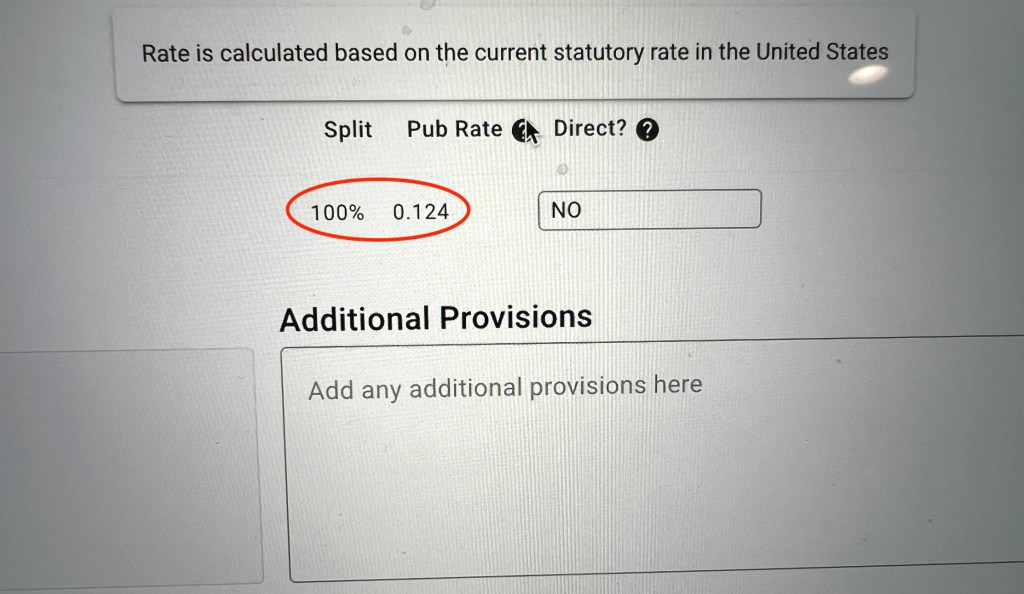
It’s probably just a glitch, but I understand that HFA hasn’t updated the 1/1/25 rates yet for “licensing out” in at least one instance (see screen capture below obtained this week). I’m inclined to believe that the issue is with the database and would not be a one-off, but I could be wrong. That suggests to me that every songwriter and publisher with either a newly issued license since 1/1/25 or a floating rate license in place during PR IV rate period (2023-2027) should probably confirm that the respective COLA escalations have been properly applied as of January 1 of 2024 and 2025. I would imagine that this isn’t an isolated incident, but maybe it is. No reason to let grass grow, however.

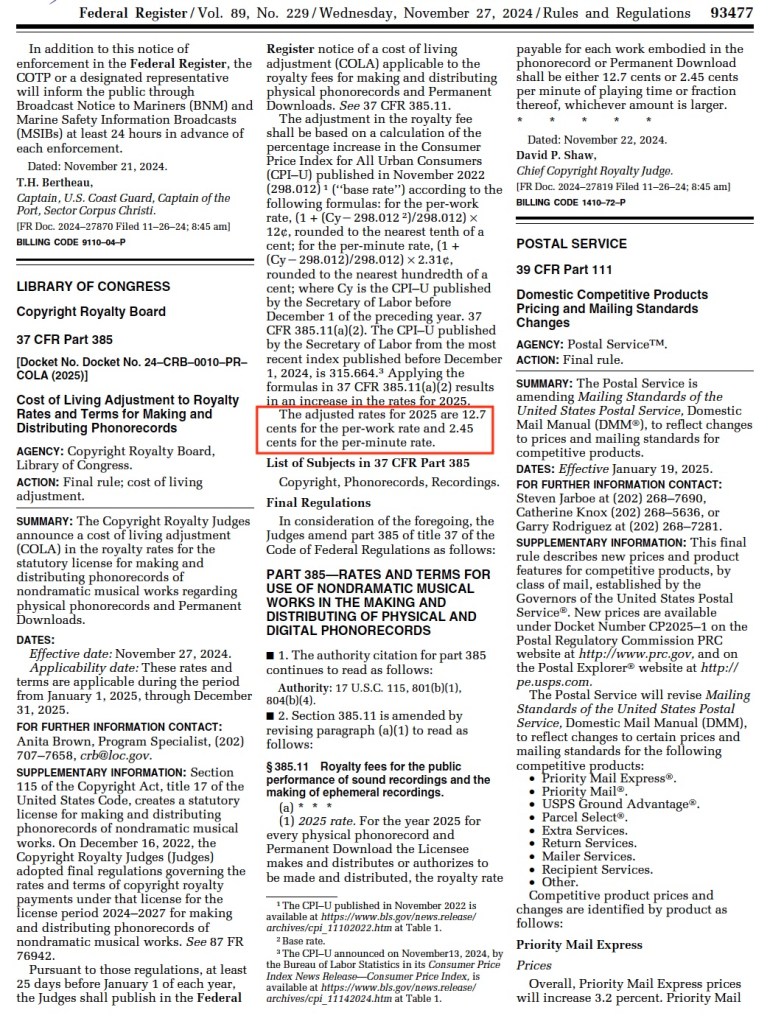
Here’s the Copyright Royalty Board’s timely notice of the new rate effective 1/1/25–which means that the HFA system does not appear to have been updated unless the screen capture reflects a one-off which seems doubtful to me.

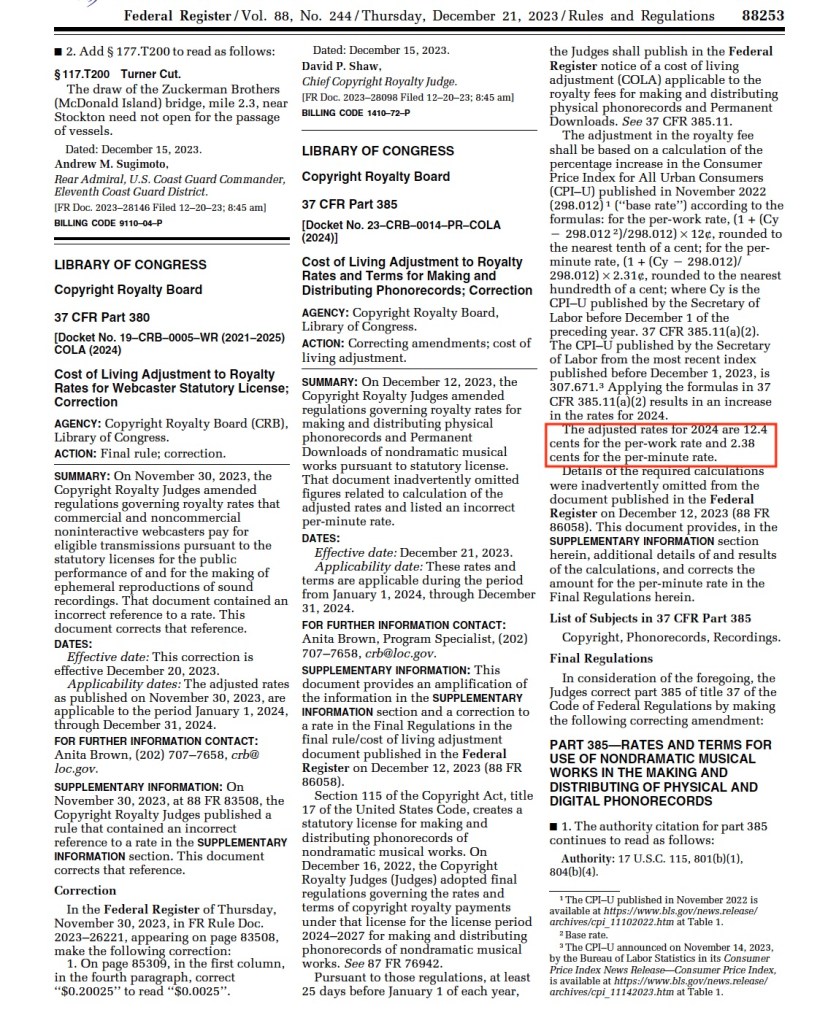
And for reference, this is the rate for 2024 with the COLA adjustment that may also have been misapplied–everyone would have to check to know if it was misapplied to them.

Does it have an index? @LizPelly’s Must-Read Investigation in “Mood Machine” Raises Deep Questions About Spotify’s Financial Integrity

Spotify Playlist Editors

By Chris Castle

If you don’t know of Liz Pelly, I predict you soon will. I’ve been a fan for years but I really think that her latest work, Mood Machine: The Rise of Spotify and the Costs of the Perfect Playlist, coming in January by One Signal Publishers, an imprint of Atria Books at Simon & Schuster, will be one of those before and after books. Meaning the world you knew before reading the book was radically different than the world you know afterward. It is that insightful. And incriminating.

We are fortunate that Ms. Pelly has allowed Harper’s to excerpt Mood Machine in the current issue. I want to suggest that if you are a musician or care about musicians, or if you are at a record label or music publisher, or even if you are in the business of investing in music, you likely have nothing more important to do today than read this taste of the future. 

The essence of what Ms. Pelly has identified is the intentional and abiding manipulation of Spotify’s corporate playlists. She explains what called her to write Mood Machine:

Spotify, the rumor had it, was filling its most popular playlists with stock music attributed to pseudonymous musicians—variously called ghost or fake artists—presumably in an effort to reduce its royalty payouts. Some even speculated that Spotify might be making the tracks itself. At a time when playlists created by the company were becoming crucial sources of revenue for independent artists and labels, this was a troubling allegation.

What you will marvel at is the elaborate means Ms. Pelly has discovered–through dogged reporting worthy of the great deadline artists–that Spotify undertook to deceive users into believing that playlists were organic. And, it must be said, to deceive investors, too. As she tells us:

For years, I referred to the names that would pop up on these playlists simply as “mystery viral artists.” Such artists often had millions of streams on Spotify and pride of place on the company’s own mood-themed playlists, which were compiled by a team of in-house curators. And they often had Spotify’s verified-artist badge. But they were clearly fake. Their “labels” were frequently listed as stock-music companies like Epidemic, and their profiles included generic, possibly AI-generated imagery, often with no artist biographies or links to websites. Google searches came up empty.

You really must read Ms. Pelly’s except in Harper’s for the story…and did I say the book itself is available for preorder now?

All this background manipulation–undisclosed and furtive manipulation by a global network of confederates–was happening while Spotify devoted substantial resources worthy of a state security operation into programming music in its own proprietary playlists. That programmed music not only was trivial and, to be kind, low brow, but also essentially at no cost to Spotify. It’s not just that it was free, it was free in a particular way. In Silicon Valley-speak, Ms. Pelly has discovered how Spotify disaggregated the musician from the value chain.

What she has uncovered has breathtaking implications, particularly with the concomitant rise of artificial intelligence and that assault on creators. The UK Parliament’s House of Commons Digital, Culture, Media & Sport Committee’s Inquiry into the Economics of Music Streaming quoted me as saying “If a highly trained soloist views getting included on a Spotify “Sleep” playlist as a career booster, something is really wrong.” That sentiment clearly resonated with the Committee, but was my feeble attempt at calling government’s attention to then-only-suspected playlist grift that was going on at Spotify. Ms. Pelly’s book is a solid indictment–there’s that word again–of Spotify’s wild-eyed, drooling greed and public deception. 

Ms. Pelly’s work raises serious questions about streaming payola and its fellow-travelers in the annals of crime. The last time this happened in the music business was with Fred Dannen’s 1991 book called Hit Men that blew the lid off of radio payola. That book also sent record executives running to unfamiliar places called “book stores” but for a particular reason. They weren’t running to read the book. They already knew the story, sometimes all too well. They were running to see if their name was in the index.

Like the misguided iHeart and Pandora “steering agreements” that nobody ever investigated which preceded mainstream streaming manipulation, it’s worth investigating whether Spotify’s fakery actually rises to the level of a kind of payola or other prosecutable offense. As the noted broadcasting lawyer David Oxenford observed before the rise of Spotify:

The payola statute, 47 USC Section 508, applies to radio stations and their employees, so by its terms it does not apply to Internet radio (at least to the extent that Internet Radio is not transmitted by radio waves – we’ll ignore questions of whether Internet radio transmitted by wi-fi, WiMax or cellular technology might be considered a “radio” service for purposes of this statute). But that does not end the inquiry.Note that neither the prosecutions brought by Eliot Spitzer in New York state a few years ago nor the prosecution of legendary disc jockey Alan Fried in the 1950s were brought under the payola statute. Instead, both were based on state law commercial bribery statutes on the theory that improper payments were being received for a commercial advantage. Such statutes are in no way limited to radio, but can apply to any business. Thus, Internet radio stations would need to be concerned.

Ms. Pelly’s investigative work raises serious questions of its own about the corrosive effects of fake playlists on the music community including musicians and songwriters. She also raises equally serious questions about Spotify’s financial reporting obligations as a public company.

For example, I suspect that if Spotify were found to be using deception to boost certain recordings on its proprietary playlists without disclosing this to the public, it could potentially raise issues under securities laws, including the Sarbanes-Oxley Act (SOX). SOX requires companies to maintain accurate financial records and disclose material information that could affect investors’ decisions.

Deceptive practices that mislead investors about the company’s performance or business practices could be considered a violation of SOX. Additionally, such actions could lead to investigations by regulatory bodies like the Securities and Exchange Commission (SEC) and potential legal consequences.

Publicly traded companies like Spotify are required to disclose “risk factors” in their public filings which are potential events that could significantly impact Spotify’s business, financial condition, or operations. Ms. Pelly’s reporting raises issues that likely should be addressed in a risk factor. Imagine that risk factor in Spotify’s next SEC filing? It might read something like this:


Risk Factor: Potential Legal and Regulatory Actions

Spotify is currently under investigation for alleged deceptive practices related to the manipulation of Spotify’s proprietary playlists. If these allegations are substantiated, Spotify could face significant legal and regulatory actions, including fines, penalties, and enforcement actions by regulatory bodies such as the Securities and Exchange Commission (SEC) and the Federal Trade Commission (FTC). Such actions could result in substantial financial liabilities, damage to our reputation, and a loss of user trust, which could adversely affect our business operations and financial performance.


[A version of this post first appeared in MusicTech.Solutions]

Step Right Up: The Chamber of Progress’s Ticketing Chamber of Horrors Fools Nobody

It’s one of those sad facts there are people you meet in life who just always seem to have the wrong side of the deal. Sometimes it’s emotionally understandable in the case of kids like the Cox character from William Boyd’s Good and Bad at Games or even Smike from Nicholas Nickleby. But when you see one of these cringy Silicon Valley policy laundries like “Chamber of Progress” keep getting the wrong side of the deal, there’s a much simpler explanation.

And now they are wrapping themselves in the flag of progressivism as they run the thimblerig on–of all things–ticketing. And cutesy names like “Chamber of Progress” notwithstanding, the group’s latest “report” if you can call it that would have state legislators believe that the StubHubs of this world are actually on the side of all that is good, just innocent puppies scampering across the stage with an IPO in their mouth. 

These high minded choir boys fancy their souls are just purer than everyone else’s in their cyberlibertarian progressivism who oppose asymmetrical commercial power except when it suits them and only when it suits them. We see it with Chamber of Progress’s “Generate and Create” obfuscation campaign to promote Silicon Valley’s interests in the “fair use” copyright exception absurdly applied to generative AI. This under the guise of “supporting” artists while destroying their craft and, yes, their humanity. OK, I went there. And we now we see it in ticketing, too. Can’t these guys get a real job?

As we will see, what the Chamber of Progress is really about when it comes to our community is locking in asymmetrical power relationships and protecting Silicon Valley’s cybergod-given right to extract money from relationships where they are not wanted and transactions where they don’t belong. Far from “forget the middleman”, StubHub’s entire business model is based on imposing themselves as the middleman with, it would appear, some pretty nefarious partners. While Chamber of Progress wants to point to the pending Department of Justice case against LiveNation as an excuse for just about anything you can think of, it is well to remember that pending cases don’t always turn out as advertised and flags can become shrouds. Since they seem to like DOJ investigations so much, let’s not forget there’s another one that may be in the offing they’ll like a lot less.

The Flawed Premise of Faux Property Rights

The report starts off from a very flawed premise and a classic projection about the plethora of state ticketing laws backed or opposed by StubHub & Co. The Chamber tells us that “legislators should adopt resale ticketing laws to foster competition, reduce ticket prices, and increase transparency.” Reduce ticket prices? Really? If anyone is acting to increase ticket prices it’s the middleman resellers whose very existence undermines the longstanding economic relationship between artists and fans. Economic relationships that thrive in an environment of classical enforceable property rights.

It begins like a lot of these propaganda campaigns do–identify your villains (those you want to unseat) and then trot out a parade of horrors you create by shading the facts. By the end, a busy legislator or staffer is ready to believe they discovered the cause of cancer and that the potholes are somebody else’s fault!

But here is the essential flaw that I think brings down the entire chamber of horrors this report tries to manufacture. They really want you to believe that once an artist sells a ticket, that ticket can then be resold or repackaged because the artist has sold the right to control the ticket to the purchaser. This tortured analysis of the artist’s property rights is simply incorrect and this one error is the beginning of a cascading effect of really bad stuff for everyone in the chain. Here’s what the report says:

The use of “license” language in ticketing legislation has created a loophole that unscrupulous venues can exploit. When a ticket is defined as a “license” rather than a property right, it gives venues and event organizers the power to revoke the license of any ticket that is resold. This means that even if a ticket was legally purchased, the venue can declare it invalid if it is resold to another party. 

Resale freedom laws provide essential benefits to consumers by ensuring their rights to buy, sell, and transfer tickets without arbitrary restrictions by primary sellers like Live Nation. These laws help to keep ticket prices affordable and enhance consumer choice and access to live events. Resale freedom laws ban anti-consumer practices and empower fans to find tickets on the platform of their choice, increasing their chances of securing seats for popular events. 

See what they did there? First, they are selling “freedom” as in “resale freedom.” This is both laughable but truly Orwellian Newspeak, as in SLAVERY IS FREEDOM. This is not supposed to be a funny joke, somebody paid a lot of money for this report. Yet what do you expect from people who think “Chamber of Progress” is a great brand?

But seriously, they skip over the fact that the artist sets the price for their ticket. They skip over it because they have to if they want to make their sponsor’s case. That doesn’t make them correct, however. The report bungles the economic relationships in ticketing because they either fail to understand or don’t want to understand the reality.

The Report Gets the Economics Backwards

Live shows are not fungible or interchangeable. The ticket starts out as the artist’s property and the artist decides the ticket’s face price based on the economic relationship the artist wants with their fan. As David Lowery has said many times, the economic relationship between artists and fans is analogous to a subscription, it’s not a one-time transaction from which the artist wants to extract the net present value of all possible transactions with the fan. The resellers have the opposite relationship with the fan because to them, fans are fungible. Resellers want to extract the maximum from each fan transaction because they don’t care about a long-term relationship with the fan. Upside down world, right?

When the artist sells a ticket, they sell a right to attend the show under certain conditions. They don’t sell a piece of property. They don’t sell a pork belly or a can of Coke. They sell an emotional connection. That’s not a “loophole.” Pretending that a ticket is a pork belly is creating a loophole out of thin air.

That is true of cover charge for bands at your local dive bar and it is true of Taylor Swift at your local soft-seat venue or stadium. It’s also true in dynamic pricing situations–I’m not a fan of dynamic pricing, but I respect the artist’s decision if they think it’s right for them. Big or small, this is the core relationship that must be respected if you want live music to survive and it’s something I think about in Austin where the city styles itself the Live Music Capitol of the World.

So Chamber of Progress objects to state laws that confirm this license relationship, and that’s an important distinction. These laws confirm the reality of the true original property right, they don’t recreate an alternate reality out of whole cloth. The fact that it is even necessary to pass these laws belies the oligopoly power of StubHub & Co. 

But Chamber of Progress goes even further because the point of the report is to identify a villain. And here is where the fudging starts. They tell you “When a ticket is defined as a “license” rather than a property right, it gives venues and event organizers the power to revoke the license of any ticket that is resold.”

Not true. The artist has that right and delegates that right to the venues as part of the ticketing function. But even StubHub is leery of attacking artists directly so they devise this bizarre rhetorical construct of licensing vs. ownership in order to blame venues, and for what? Preventing scalpers from profiting from their scams and preventing resellers from profiting from their arbitrage. 

Bots and Scammers

This fallacy alone is really enough to refute the entire report, but wait, there’s more. There are two key foundations for the ticket reselling business at scale: bots and making a market for scammers to sell what they don’t own, aka speculative ticketing. They need bots because it allows scalpers to beat fans to tickets in quantity and they need spec ticketing because it allows them to sell a ticket that doesn’t even exist yet but for which there is demand.

Remember–bots are illegal. The Better Online Ticket Sales Act of 2016 sponsored by Senators Marsha Blackburn and Richard Blumenthal banned the use of bots for ticket sales in the US. The National Independent Talent Association asked the Federal Trade Commission to investigate open and notorious bot technologies on sale at the big ticket resellers convention:

Our organization recently attended the World Ticket Conference organized by the National Association of Ticket Brokers (NATB). At this event, we observed a sold-out exhibition hall filled with vendors selling and marketing products designed to bypass security measures for ticket purchases, in direct violation of the BOTS Act.

Realize, this isn’t a question of whether or not resellers profit from the use of bots on their platforms–the question is why aren’t people being prosecuted for violating the BOTS Act. But the Chamber of Progress wants you to believe there is something wrong with passing state laws to give state Attorneys General the power to prosecute these laws shoulder-to-shoulder with the overworked and under-resourced FTC.

Bills that purportedly claim to enhance transparency through speculative ticket bans, protect consumer rights through anti-bots legislation, or improve access through customer data sharing often contain hidden provisions that restrict competition and limit consumer choices. 

In other words, the report opposes banning speculative ticket sales–selling something you don’t own is already illegal, probably since the dawn of our legal systems–and opposes state anti-bots legislation–already illegal under the federal BOTS Act. This should tell you all you need to know.

It’s Just Business: Racketeering, Silicon Valley Style

The real story that goes unreported is that StubHub is currently being sued in a New York class action for violating the civil Racketeer Influenced and Corrupt Organizations laws in selling tickets to a UK football match without rights. They have managed to punt that case based on their one-sided adhesion contract requiring arbitration in their terms of service, but interestingly the federal judge overseeing the case has retained jurisdiction. Imagine the risk factor in the StubHub IPO prospectus about how they could be subject to the RICO laws.

I recently posted about a “model” ticketing legislation that some of these characters were trying to get adopted by ALEC (the conservative state lobbying operation) which I gather has been dropped since the old link to the model bill is dead. It looks to me like the Chamber report is a new offensive rising out of the ashes of the ALEC lobbying effort. 

“Progressives” Who Fail to Address Asymmetry between Big Tech and Artists are Not Progressives

So once again, our friends in Silicon Valley are trying to elbow their way into a place they are not wanted, not needed, and are poisonous all in the aid of making them even richer all under a miasma of crap about “reseller freedom.” Fortunately, the public is getting wise to their scams no matter how much they try to sell their oppressive tactics as some kind of freedom. If they want to really be progressive, they’d help artists establish a resale royalty so that we could share in the riches from their arbitrage in return for a right to resell our tickets. Don’t hold your breath.

As we’ve seen with their logical backflips in AI and now with ticketing, the Chamber of Progress may be a lot of things, but “progressive” they ain’t. Maybe we can help them find productive work in this season of hope.

[A version of this post first appeared on MusicTechPolicy.]

The Madness of Amazon’s Song Royalty Refund Demand

You can check out any time you like, but you can never leave.
Hotel California, written by Don Felder, Glenn Frey and Don Henley

There’s no opt-out in either the Hotel California or the compulsory song license. And Amazon’s demand for a royalty refund from songwriters demonstrates once again the madness of the Copyright Royalty Board rate-setting procedures. Whether it creates enough ripples in the booming business around buying out songwriter royalties remains to be seen.

How did we get to this point in the circus act? You may have noticed that sliced bread is in close competition with fire and the wheel for second place behind Greatest Human Accomplishments. Both fire and the wheel are yielding to streaming mechanical royalty rates in the Phonorecords III remand negotiations.  Yes, the so-called “headline rates” in Phonorecords III (or “PR III”) are a Nobel-worthy accomplishment.  At least according to the press agents.

And yet something curious has happened.  I’m told that Amazon, through its agent Music Reports (MRI), has posted what is essentially a demand letter in the MRI user portal.  This demand letter instructs publishers who have directly licensed songs to Amazon to pay up because of an overpayment of streaming mechanicals due to the adjustment required by the new-ish Phonorecords III remand rates that finally set the streaming mechanical rates for the industry.  Something similar may be happening at the MLC; we’ll come to that below in just a bit.

In a testament to just how whack the Copyright Royalty Board system actually is, the PR III remand concerns royalties paid from 2018 through 2022.  That’s right—starting six years ago.  This is largely due to the failure of the publishers to obtain a waiver of the PR III decision as a negotiating chip when they gave away the rest of the farm in Title I of the Music Modernization Act (also hailed as a great gift to songwriters). But I’d say it is primarily due to the desire of digital music services like Amazon—including the largest corporations in commercial history—to crush the kitchen tables of songwriters.  Because judging by the massive overlawyering in the Copyright Royalty Board, that sure looks like the motive.

And when it comes to the services crushing the little people, money is no object, even if they spend more on litigation than the royalty increase cost them.  Evidently the sadistic psychic benefit greatly exceeds the cost.

But Amazon evidently has discovered that even after all the shenanigans with PR III, it appears that they paid too much and now they want it back.  That’s right—Amazon shamelessly wants you to cut them a check.  Because a market value over $2,000,000,000,000 is just not enough. I wonder which buffoon advised Mr. Bezos that was a good idea.

Here’s what it looks like on MRI:

A few questions come to mind.  First, realize what Amazon is saying.  They were evidently accounting to publishers at the rates for Phonorecords II during the several years that the PR III rates were on appeal and then re-litigated before the Copyright Royalty Board.  The final PR III rates (sometimes called “remand rates”) issued in August of last year (2023) were supposed to be an improvement over the PR II rates don’t you know.  At least according to the braying that accompanied the announcement.  In fact, the PR III remand rates where it all ended up were themselves supposed to be an improvement, meaning that publishers were to be paid more under PR III than under PR II. Maybe that’s the difference between an increase in the payable rates compared to an increase in the payable royalties.

So if that’s true, and if Amazon paid PR II rates during the lengthy PR III appeal, why is there now an overpayment by Amazon?  An overpayment that they now want you to pay back? Wouldn’t you expect to see the true-up on new rates result in publishers receiving a credit for increased rates?  Especially if the stream counts and subscriber totals stayed the same on these previously-issued accounting statements? (Not to mention this may be happening at other services, too.)

Some of these PR III statements pre-date and overlap with the MLC’s creation and the “license availability date” for the 2021 blanket license established under Title I of the MMA.  That means that if you or your publisher had a direct deal with Amazon during the PR III rate period, there may be overlapping periods when the MLC took over Amazon’s accountings.

It has long been the standard industry practice that overpayments are just debited to your royalty account.  Nobody asks you to cut a check. Debiting your account is not much better–you still have to pay them back, and the so-called “overpayment” will still potentially zero out your MLC accounts, too. If you did a royalty buyout that included an assumption that these royalties would be paid, your financier may come up short under either direct license or MLC.

This is particularly true for publishing administrators.  If a service were to debit an administrator’s account, that might result in the administrator having to go out of pocket in order to pay some of their publishers for the amount of the demand. If that overpayment is large enough, that administrator may owe royalties to publishers that did not have the benefit of the overpayment. This is pretty elementary math, 2 plus 2 being what it is. You don’t even have to carry the 1.

However, great news!  Amazon will give you an interest-free payday loan so you can pay down your new debt over six months. Or before they send it to collection.

Now the MLC—it’s entirely possible that Amazon is pulling the same stunt under the statutory license. However, it appears that MLC is doing what is normally done in these situations and will be debiting and crediting as necessary.  If you’re concerned, it would be worth checking and asking for an explanation from the MLC.

Even so, it does not change anything about why there is an overpayment in the first place.  If there were ever a situation that cried out for an intensive royalty compliance exam, this is it.  It is hard to believe that all this to-ing and fro-ing with your royalty payments across multiple rates in multiple accounting periods hasn’t resulted in mistakes.  No crime, it’s complex.  That’s why we have audits. At a minimum, Amazon needs to provide publishers with a detailed breakdown of how the repayment was determined along with an explanation of where the rates changed that caused the overpayment.

That’s why Amazon and any other similarly situated service should welcome an extensive audit.  In fact, the MLC should just include the true-up (or true-down in Amazon’s case) in their already-noticed audit of Amazon. This episode also raises the question of who else is going to pull the same stunt.

This slice of life demonstrates once again how unworkable the entire Copyright Royalty Board system is for streaming mechanical royalties. The services get to drag out appeals forever, and songwriters pay the consequences. But like the man said, you can never leave. And the Music Modernization Act just got every one locked in even deeper.

[A version of this post first appeared on MusicTechPolicy]

Stubhub & Co. Launch Stealth state-by-state legislative offensive strategy for Astroturf “Model” State Ticketing Laws

By Chris Castle

Yes, it’s kismet in the legislature–the sketchy ticket resellers are redoubling their efforts to normalize “speculative tickets.” They have found a willing partner in gaslighting with an organization called “ALEC”.

The American Legislative Exchange Council (hence “ALEC“) is a nonprofit organization that brings together private sector representatives and relatively conservative state legislators to draft (and pass) “model legislation” that pushes a particular narrative. (That private sector representation is led by Netchoice, aka, Big Tech.) Unlike other model legislation with a social benefit like say the Uniform Partnership Act, ALEC’s “model legislation” pushes a particular agenda. Examples would be “stand your ground” gun laws, Voter ID laws, and “right to work” laws.

Netchoice Members (Netchoice leads ALEC’s Private Enterprise Advisory Council)

ALEC’s many successfully-passed “model” laws are intended to be passed by state legislatures as-written. Like Al Capone’s green beer, it ain’t meant to be good it’s meant to be drunk. A cynic–not mentioning the names of any particular cynics–might say that the ALEC strategy is an end-run around federal legislation (like the fake library legislation that was shot down in New York). If ALEC can get a critical mass of states to pass one of their “model bills” as-drafted on any particular subject, then the need for federal legislation on that topic may become more muted. In fact, if federal legislation becomes inevitable, the ALEC model bills then provide guidance for federal legislation, or new federal legislation has to draft around the states that adopt the model bill.

So much for Justice Louis Brandeis’ concept of states as laboratories of democracy (New State Ice Co. v. Liebmann, 285 U.S. 262 (1932)), unless that lab belongs to Dr. Frankenstein. ALEC’s mission claims to promote principles of limited government, free markets, and federalism; I will leave you to decide if it’s more about checkbook federalism.

Ticketing Panel, Artist Rights Symposium 11/20/24, Washington DC
L-R: Chris Castle (Artist Rights Institute), Dr. David Lowery (Univ. of Georgia, Terry College of Business), Mala Sharma (Georgia Music Partners), Stephen Parker (National Independent Venue Association), Kevin Erickson (Future of Music Coalition)

Like so many of these bills, ALEC’s Live Event Ticketing Consumer Protection & Reform Act disguises its true objective with a bunch of gaslighting bromides that they evidently believe to be persuasive and then when you’re not looking they slip in the knife. Then when the knife is protruding from your back you discover the true purpose. I think this section of the bill is the true purpose:

This is an odd construct. The model bill starts out by requiring positive behavior of a primary seller (which would be the band on fan club sales or other direct to fan sales). That positive behavior immediately turns to using the ticket purchaser into an enforcer of the values beneficial to the ticket reseller. This is done by forcing a purchaser to be able to resell their ticket without regard to any restrictions placed on reselling by the artist. 

And you know that’s the intention because the section also requires there to be no maximum or minimum price. While the model bill doesn’t require any particular restriction on the platforms, it has enough in it that it can look like a consumer protection bill, but what it is really doing and apparently was designed to accomplish is eliminate an artist’s a ability to set prices.

ALEC is serious about violations of the act, including civil penalties. Their model ticketing legislation can be enforced by both the Federal Trade Commission and state attorneys general. Penalties can include fines of up to $15,000 per day of violation and $1,000 per event ticket advertised or sold. One problem with the model bill is that it appropriates jurisdiction already available to federal agencies like the FTC which is already failing to enforce the existing BOTS Act and other property theft laws.

The main targets seem to be Stubhub’s competitors like “Primary Ticket Merchants,” These are the original sellers of event tickets, such as event organizers or venues. “Secondary Ticket Merchants” may also be prosecuted as well as individuals.

We continue to study the proposed model legislation, but I tend to agree with Stephen Parker (NIVA) and Kevin Erickson (Future of Music) on my Artist Rights Institute panel in DC yesterday. The better model bill may be their bill passed in Maryland, recently signed into law by Maryland governor Wes More.

Key differences between Maryland and the ALEC bill I could spot:

  • Scope of Penalties: The Maryland bill specifies fines for speculative ticket sales, while the ALEC bill includes broader penalties for various violations.
  • Refund Policies: The Maryland bill explicitly requires refunds for counterfeit tickets, canceled events, or mismatched tickets, whereas the ALEC bill focuses more on transparency and restrictive practices.
  • Study on Resale Impact: The Maryland bill includes a provision for studying the impact of resale price caps, which is not present in the ALEC bill.

    It appears that the Live Event Ticketing Consumer Protection & Reform Act will be introduced at the ALEC meeting on December 5, 2024. This is where ALEC members, including state legislators and private sector representatives, will discuss and vote on the model policy. 

    Watch this space.

Kim Dot Com Emerges from the Memory Hole

By Chris Castle

“If you get down on your knees and beg to be arrested, don’t be surprised if you are.”

That was what I told a TV news anchor in an interview I did in 2012 right after Kim Dot Com was arrested on his vast estate in New Zealand.  Dot Com’s arrest started a long running extradition proceeding between the United States and New Zealand that Dot Com and his team of lawyers somehow managed to drag out until this year.  That’s right—twelve years.  That puts him right up there with Roman Polanski and Meng Wanzhou.  So now Dot Com is subject to extradition back the US to face criminal charges, and yet nobody in New Zealand seems to be in a big hurry to arrest him and send him Stateside.

The first time I connected the dots on Dot Com’s piracy site Megaupload was when film maker Ellen Seidler launched a site called Pop Up Pirates.   Megaupload figured large in her site for a simple reason:  When you tried to access a film stored on Megaupload, it launched a popup with an ad.  At that time, many of those ads included a credit saying “Ads by Google.”  Ellen gave me a short clip of her launching the Mega popup in real time with a close up of that ad.  I played the clip on a panel with one of the Google charm offensive folks who I thought was going to vomit when he realized what I had just shown the audience.  I thought I conclusively demonstrated that Google profited from piracy and paid pirates—being Kim Dot Com aka “Defendant.”

Shortly after, I started posting about this obvious connection, which is how Dot Com and his confederates were getting rich from their the-Hong Kong-based pirate site.  And of course, I would find it hard to believe that anyone was operating a lucrative pirate site from Hong Kong without taking care of people if you know what I mean.  So there’s that.

Fast forward a year and I was in front of the National Association of Attorneys General demonstrating Google’s many, many connections to crime, terrorists, and general issue bad guys.  

Right about this time I got a call from a distinguished music industry executive who asked me whether I was seriously suggesting that a public company was involved in funding crime.  I said that’s exactly what I was saying.  If that were to happen today, nobody, and I mean nobody, would question that Google is the paymaster of the dark web.

Which leads me to the Dot Com indictment.  It turns out that we are not the only ones who made the connection between Google and massive piracy. The Department of Justice did, too, and describes the connection quite clearly in the indictment.

Adbright and Google were Sequoia investments and PartyGaming was one of the big donors to Creative Commons (and the whole Lessig/Nesson poker lobbying extravaganza).

So who had an interest in keeping Kim Dot Com out of an American jail in case he might negotiate a plea deal as did his confederate Andrus Nomm back in 2018? According to the New Zealand Herald:

While [Dot Com] and his co-accused have denied all charges, Nomm testified in support of the US case. As an insider, his testimony will be key to supporting prosecution arguments the so-called “Megaconspiracy” knew what it was doing, attacking any claim the accused were acting in the belief the website was lawful.

Nomm’s testimony was included in the case for extradition in New Zealand but documents showing how will not be made public until after the judge’s decision has been made. The Herald is unable to report the details of the US case that Nomm pleaded guilty to in the United States until then.

The press release from the U.S. Department of Justice tells us:

In court papers, Nomm agreed that the harm caused to copyright holders by the Mega Conspiracy’s criminal conduct exceeded $400 million.  He further acknowledged that the group obtained at least $175 million in proceeds through their conduct.  Megaupload.com had claimed that, at one time, it accounted for four percent of total Internet traffic, having more than one billion total visits, 150 million registered users and 50 million daily visitors.

In a statement of facts filed with his plea agreement, Nomm admitted that he was a computer programmer who worked for the Mega Conspiracy from 2007 until his arrest in January 2012.  Nomm further admitted that, through his work as a computer programmer, he was aware that copyright-infringing content was stored on the websites, including copyright protected motion pictures and television programs, some of which contained the “FBI Anti-Piracy” warning.  Nomm also admitted that he personally downloaded copyright-infringing files from the Mega websites.  Despite his knowledge in this regard, Nomm continued to participate in the Mega Conspiracy. 

An extradition hearing for co-defendants Kim Dotcom, Mathias Ortmann, Bram Van der Kolk and Finn Batato is currently scheduled for June 2015 in Auckland, New Zealand.  Co-defendants Julius Bencko and Sven Echternach remain at large.

This case is being investigated by the FBI’s Headquarters and Washington Field Office.  The case is being prosecuted by Senior Counsel Ryan K. Dickey and Brian L. Levine of the Criminal Division’s Computer Crime and Intellectual Property Section and Assistant U.S. Attorney Jay V. Prabhu of the Eastern District of Virginia.  The Criminal Division’s Office of International Affairs also provided significant assistance.

So if there was a “conspiracy”, it takes more than two to tango. That racketeering and money laundering conspiracy might have included the advertising companies that played an essential role in providing illicit revenue to the “Megaconspiracy”. Recall that Google got caught in a federal sting operation, paid a $500,000,000 fine and entered a nonprosecution agreement with the same DOJ for promoting the sale of illegal drugs online, all at roughly the same time as they appear to have been the paymaster for Mr. Dot Com. Why else were Adbright, Google and Partygaming mentioned in the indictment?

Stay tuned, boys and girls.  The plot sickens.

Now with added retroactive acrobatics: @DamianCollins calls on UK Prime Minister to stop Google’s “Text and Data Mining” Circus

By Chris Castle

Damian Collins (former chair of the UK Parliament’s Digital Culture Media and Sport Select Committee) warns of Google’s latest artificial intelligence shenanigans in a must-read opinion piece in the Daily Mail. Mr. Collins highlights Google’s attempt to lobby its way into what is essentially a retroactive safe harbor to protect Google and its confederates in the AI land grab. (Safe harbors aka pirate utopias.)

While Mr. Collins writes about Google’s efforts to rewrite the laws of the UK to free ride in his home country which is egregious bullying, the episode he documents is instructive for all of us. If Google & Co. will do it to the Mother of Parliaments, it’s only a matter of time until Google & Co. do the same everywhere or know the reason why. Their goal is to hoover up all the world’s culture that the AI platforms have not scraped already and–crucially–to get away with it. And as Austin songwriter Guy Forsyth says, “…nothing says freedom like getting away with it.”

The timeline of AI’s appropriation of all the world’s culture is a critical understanding to appreciate just how depraved Big Tech’s unbridled greed really is. The important thing to remember is that AI platforms like Google have been scraping the Internet to train their AI for some time now, possibly many years. This apparently includes social media platforms they control. My theory is that Google Books was an early effort at digitization for large language models to support products like corpus machine translation as a predecessor to Gemini (“your twin”) and other Google AI products. We should ask Ray Kurzweil.

There is starting to be increasing evidence that this is exactly what these people are up to. 

The New York Times Uncovers the Crimes

According to an extensive long-form report in the New York Times by a team of very highly respected journalists, it turns out that Google has been planning this “Text and Data Mining” land grab for some time. At the very moment YouTube was issuing press releases about their Music AI Incubator and their “partners”–Google was stealing anything that was not nailed down that anyone had hosted on their massive platforms, including Google Docs, Google Maps, and…YouTube. The Times tells us:

Google transcribed YouTube videos to harvest text for its A.I. models, five people with knowledge of the company’s practices said. That potentially violated the copyrights to the videos, which belong to their creators….Google said that its A.I. models “are trained on some YouTube content,” which was allowed under agreements with YouTube creators, and that the company did not use data from office apps outside of an experimental program. 

I find it hard to believe that YouTube was both allowed to transcribe and scrape under all its content deals, or that they parsed through all videos to find the unprotected ones that fall victim to Google’s interpretation of the YouTube terms of use. So as we say in Texas, that sounds like bullshit for starters. 

How does this relate to the Text and Data Mining exception that Mr. Collins warns of? Note that the NYT tells us “Google transcribed YouTube videos to harvest text.” That’s a clue.

As Mr. Collins tells us: 

Google [recently] published a policy paper entitled: Unlocking The UK’s AI Potential.

What’s not to like?, you might ask. Artificial intelligence has the potential to revolutionise our economy and we don’t want to be left behind as the rest of the world embraces its benefits.

But buried in Google’s report is a call for a ‘text and data mining’ (TDM) exception to copyright. 

This TDM exception would allow Google to scrape the entire history of human creativity from the internet without permission and without payment.

And, of course, Mr. Collins is exactly correct, it’s safe to assume that’s exactly what Google have in mind. 

The Conspiracy of Dunces and the YouTube Fraud

In fairness, it wasn’t just Google ripping us off, but Google didn’t do anything to stop it as far as I can tell. One thing to remember is that YouTube was, and I think still is, not very crawlable by outsiders. It is almost certainly the case that Google would know who was crawling youtube.com, such as Bingbot, DuckDuckBot, Yandex Bot, or Yahoo Slurp if for no other reason that those spiders were not googlebot. With that understanding, the Times also tells us:

OpenAI researchers created a speech recognition tool called Whisper. It could transcribe the audio from YouTube videos, yielding new conversational text that would make an A.I. system smarter.

Some OpenAI employees discussed how such a move might go against YouTube’s rules, three people with knowledge of the conversations said. YouTube, which is owned by Google, prohibits use of its videos for applications that are “independent” of the video platform. [Whatever “independent” means.]

Ultimately, an OpenAI team transcribed more than one million hours of YouTube videos, the people said. The team included Greg Brockman, OpenAI’s president, who personally helped collect the videos, two of the people said. The texts were then fed into a system called GPT-4, which was widely considered one of the world’s most powerful A.I. models and was the basis of the latest version of the ChatGPT chatbot….

OpenAI eventually made Whisper, the speech recognition tool, to transcribe YouTube videos and podcasts, six people said. But YouTube prohibits people from not only using its videos for “independent” applications, but also accessing its videos by “any automated means (such as robots, botnets or scrapers).” [And yet it happened…]

OpenAI employees knew they were wading into a legal gray area, the people said, but believed that training A.I. with the videos was fair use. [Or could they have paid for the privilege?]

And strangely enough, many of the AI platforms sued by creators raise “fair use” as a defense (if not all of the cases) which is strangely reminiscent of the kind of crap we have been hearing from these people since 1999.

Now why might Google have permitted OpenAI to crawl YouTube and transcribe videos (and who knows what else)? Probably because Google was doing the same thing. In fact, the Times tells us:

Some Google employees were aware that OpenAI had harvested YouTube videos for data, two people with knowledge of the companies said. But they didn’t stop OpenAI because Google had also used transcripts of YouTube videos to train its A.I. models, the people said. That practice may have violated the copyrights of YouTube creators. So if Google made a fuss about OpenAI, there might be a public outcry against its own methods, the people said.

So Google and its confederate OpenAI may well have conspired to commit massive copyright infringement against the owner of a valid copyright, did so willingly, and for purposes of commercial advantage and private financial gain. (Attempts to infringe are prohibited to the same extent as the completed act). The acts of these confederates vastly exceed the limits for criminal prosecution for both infringement and conspiracy.

But to Mr. Collins’ concern, the big AI platforms transcribed likely billions of hours of YouTube videos to manipulate text and data–you know, TDM.

The New Retroactive Safe HarborThe Flying Googles Bring their TDM Circus Act to the Big Tent With Retroactive Acrobatics

But also realize the effect of the new TDM exception that Google and their Big Tech confederates are trying to slip past the UK government (and our own for that matter). A lot of the discussion about AI rulemaking acts as if new rules would be for future AI data scraping. Au contraire mes amis–on the contrary, the bad acts have already happened and they happened on an unimaginable scale.

So what Google is actually trying to do is get the UK to pass a retroactive safe harbor that would deprive citizens of valuable property rights–and also pass a prospective safe harbor so they can keep doing the bad acts with impunity.

Fortunately for UK citizens, the UK Parliament has not passed idiotic retroactive safe harbor legislation like the U.S. Congress has. I am, of course, thinking of the vaunted Music Modernization Act (MMA) that drooled its way to a retroactive safe harbor for copyright infringement, a shining example of the triumph of corruption that has yet to be properly challenged in the US on Constitutional grounds. 

There’s nothing like the MMA absurdity in the UK, at least not yet. However, that retroactive safe harbor was not lost on Google, who benefited directly from it. They loved it. They hung it over the mantle next to their other Big Game trophy, the DMCA. And now they’d like to do it again for the triptych of legislative taxidermy.

Because make no mistake–a retroactive safe harbor would be exactly the effect of Google’s TDM exception. Not to mention it would also be a form of retroactive eminent domain, or what the UK analogously might call the compulsory purchase of property under the Compulsory Purchase of Property Act. Well…”purchase” might be too strong a word, more like “transfer” because these people don’t intend to pay for a thing.

The effect of passing Google’s TDM exception would be to take property rights and other personal rights from UK citizens without anything like the level of process or compensation required under the Compulsory Purchase of Property–even when the government requires the sale of private property to another private entity (such as a railroad right of way or a utility easement).

The government is on very shaky ground with a TDM exception imposed by the government for the benefit of a private company, indeed foreign private companies who can well afford to pay for it. It would be missing government oversight on a case-by-base basis, no proper valuation, and for entirely commercial purposes with no public benefit. In the US, it would likely violate the Takings Clause of our Constitution, among other things.

It’s Not Just the Artists

Mr. Collins also makes a very important point that might get lost among the stars–it’s not just the stars that AI is ripping off–it is everyone. As the New York Times story points out (and it seems that there’s more whistleblowers on this point every day), the AI platforms are hoovering up EVERYTHING that is on the Internet, especially on their affiliated platforms. That includes baby videos, influencers, everything.

This is why it is cultural appropriation on a grand scale, indeed a scale of depravity that we haven’t seen since the Nurenberg Trials. A TDM exception would harm all Britons in one massive offshoring of British culture.

[This post first appeared on MusicTech.Solutions]