SHOW ME THE CREATOR – Transparency Requirements for AI Technology: Speaker Update for Nov. 20 @ArtistRights Symposium at @AmericanU @KogodBiz in Washington DC

We’re pleased to announce more speakers for the 4th annual Artist Rights Symposium on November 20, this year hosted in Washington, DC, by American University’s Kogod School of Business at American’s Constitution Hall, 4400 Massachusetts Avenue, NW, Washington, DC 20016.  The symposium is also supported by the Artist Rights Institute and was founded by Dr. David Lowery, Lecturer at the University of Georgia Terry College of Business.

The four panels will begin at 8:30 am and end by 5 pm, with lunch and refreshments. More details to follow. Contact the Artist Rights Institute for any questions.

Admission is free, but please reserve a spot with Eventbrite, seating is limited! (Eventbrite works best with Firefox)

Keynote: Graham Davies, President and CEO of the Digital Media Association, Washington DC.  Graham will speak around lunchtime.

We have confirmed speakers for another topic! 

SHOW ME THE CREATOR – Transparency Requirements for AI Technology:

Danielle Coffey, President & CEO, News Media Alliance, Arlington, Virginia
Dahvi Cohen, Legislative Assistant, U.S. Congressman Adam Schiff, Washington, DC
Ken Doroshow, Chief Legal Officer, Recording Industry Association of America, Washington DC 

Moderator: Linda Bloss-Baum, Director of the Kogod School of Business’s Business & Entertainment Program

Previously announced:

THE TROUBLE WITH TICKETS:  The Economics and Challenges of Ticket Resellers and Legislative Solutions:

Kevin Erickson, Director, Future of Music Coalition, Washington DC
Dr. David C. Lowery, Co-founder of Cracker and Camper Van Beethoven, University of Georgia
  Terry College of Business, Athens, Georgia
Stephen Parker, Executive Director, National Independent Venue Association, Washington DC
Mala Sharma, President, Georgia Music Partners, Atlanta, Georgia

Moderator:  Christian L. Castle, Esq., Director, Artist Rights Institute, Austin, Texas

Keynote and Speaker Update for Nov. 20 @ArtistRights Symposium

We’re pleased to announce the speakers for the 4th annual Artist Rights Symposium on November 20, this year hosted in Washington, DC, by American University’s Kogod School of Business at American’s Constitution Hall, 4400 Massachusetts Avenue, NW, Washington, DC 20016.  The symposium is also supported by the Artist Rights Institute and was founded by Dr. David Lowery, Lecturer at the University of Georgia Terry College of Business. 

The four panels will begin at 8:30 am and end by 5 pm, with lunch and refreshments. More details to follow. Contact the Artist Rights Institute for any questions.

Admission is free, but please reserve a spot with Eventbrite, seating is limited! (Eventbrite works best with Firefox)

Keynote: Graham Davies, President and CEO of the Digital Media Association, Washington DC.  Graham will speak around lunchtime.

The confirmed symposium panel topics and speakers are:

THE TROUBLE WITH TICKETS:  The Economics and Challenges of Ticket Resellers and Legislative Solutions:

Kevin Erickson, Director, Future of Music Coalition, Washington DC
Dr. David C. Lowery, Co-founder of Cracker and Camper Van Beethoven, University of Georgia
  Terry College of Business, Athens, Georgia
Stephen Parker, Executive Director, National Independent Venue Association, Washington DC
Mala Sharma, President, Georgia Music Partners, Atlanta, Georgia

Moderator:  Christian L. Castle, Esq., Director, Artist Rights Institute, Austin, Texas

SHOW ME THE CREATOR – Transparency Requirements for AI Technology, moderated by Linda Bloss-Baum, Director of the Kogod School of Business’s Business & Entertainment Program

CHICKEN AND EGG SANDWICH:  Bad Song Metadata, Unmatched Funds, KYC and What You Can Do About It, moderated by Chris Castle

NAME, IMAGE AND LIKENESS RIGHTS IN THE AGE OF AI:  Current initiatives to protect creator rights and attribution, moderated by John Simson, Program Director Emeritus, Business & Entertainment, Kogod School of Business, American University

Additional confirmed speakers to be announced soon.

Artist Rights Institute: Estimated 2025 Inflation Adjustment for Physical and Vinyl Mechanicals

A backgrounder for artists and songwriters from the Artist Rights Institute

Summary: The fight over frozen mechanicals continues to pay off as songwriters log another cost of living increase for physical/downloads while streaming falls farther behind.

The Copyright Royalty Board adjusted the US statutory mechanical royalty for physical carriers like vinyl, CDs and downloads annually during the current rate period. This is entirely due to the success of public comments by the ad hoc songwriter bargaining group that persuaded the Copyright Royalty Judges to reject the terrible “frozen mechanicals” settlement negotiated with the NMPA, NSAI and RIAA. 

As it turned out, once the judges rejected the freeze as unfair, the labels quickly agreed to a fair result that increased the physical/download rate from a 9.1¢ base rate to the 12¢ rate suggested by the Judges which went a long way to making up for the 15 year freeze at 9.1¢. In fact, if it had just been presented to the labels to begin with, a tremendous amount of agita could have been saved all round.

Crucially, not only did the base rate increase to 12¢, the judges also approved a prospective cost of living adjustment determined by a formula using the Consumer Price Index. The end result is that unlike streaming mechanicals paid by the streaming services like Spotify (i.e., not the labels) the value of the increase from 9.1¢ to 12¢ has been protected from inflation during the rate period (2023-2027). 

Unfortunately, the streaming services were allowed to reject a cost of living for streaming mechanicals, notwithstanding the Judges’ and the services’ acceptance of an COLA-type adjustment to the multimillion dollar budget of the Mechanical Licensing Collective. That COLA is ased on a government measurement of inflation (the Employment Cost Index) comparable to the CPI-U that is used to increase the services’ financing of salaries and other costs at the Mechanical Licensing Collective. So those who are paid handsomely to collect and pay songwriters get a better deal than the songwriters they supposedly serve.

What is the increase in pennies this year for the physical/download mechanical rate? The Judges determine the inflation-adjusted rate every year during the five year rate period (2023-2027). The calculation is made in December for physical/download with reference to the CPI-U rate announced by the Bureau of Labor Statistics as of December 1, which means the rate published on November 11. The new rate goes into effect on January 1, 2025.

At this point, there does not seem to be any indication that there will be a large spike in inflation between now and November 11, so we can use the September rate (just announced in October) to make an educated guess as to what the 2025 statutory rate increase will be for physical/downloads (rounded down):

So we can safely project that the base rate will increase from 12.4¢ for 2024 to about 12.6¢ in 2025 without firing a shot. If you have a 10 x 3/4 rate controlled compositions clause, that means the U.S. controlled pool on physical will be approximately 94.5¢ instead of the old frozen rate of 68.25¢.

It’s important to note a couple things about the relevance of CPI-U as a metric for protecting royalty rates from the ravages of inflation. First of all, the CPI-U is a statistical smoothing of the specific rates for particular goods and services that it measures and doesn’t reflect the magnitude of changes of some components.

For example, the September CPI-U increased by 0.2% on a seasonally adjusted basis. However, the shelter index and the food index increased at higher rates:

The shelter index rose by 0.2%, and the food index increased by 0.4% Together, these two components contributed over 75% of the monthly increase in the all items index.

Moreover, the MLC itself receives an increase that is tied to the lesser of 3% or the Employment Cost Index (which was approximately 4.5% for the trailing 12 months ending June 30):

Chris Castle said, “These are good benchmarks to keep in mind as we head into a new rate setting period in a year or so when I expect songwriters to demand a COLA for streaming mechanicals. No more poormouthing from the services. If they can give it to MLC, they can give it to the songwriters, too.”

Fired for Cause:  @RepFitzgerald Asks for Conditional Redesignation of the MLC

By Chris Castle

U.S. Representative Scott Fitzgerald joined in the MLC review currently underway and sent a letter to Register of Copyrights Shira Perlmutter on August 29 regarding operational and performance issues relating to the MLC.  The letter was in the context of the five year review for “redesignation” of The MLC, Inc. as the mechanical licensing collective.  (That may be confusing because of the choice of “The MLC” as the name of the operational entity that the government permits to run the mechanical licensing collective.  The main difference is that The MLC, Inc. is an entity that is “designated” or appointed to operationalize the statutory body.  The MLC, Inc. can be replaced.  The mechanical licensing collective (lower case) is the statutory body created by Title I of the Music Modernization Act) and it lasts as long as the MMA is not repealed or modified. Unlikely, but we live in hope.)

I would say that songwriters probably don’t have anything more important to do today in their business beyond reading and understanding Rep. Fitzgerald’s excellent letter.

Rep. Fitzgerald’s letter is important because he proposes that the MLC, Inc. be given a conditional redesignation, not an outright redesignation.  In a nutshell, that is because Rep. Fitzgerald raises many…let’s just say “issues”…that he would like to see fixed before committing to another five years for The MLC, Inc.  As a member of the House Judiciary Subcommittee on Courts, Intellectual Property, and the Internet, Rep. Fitzgerald’s point of view on this subject must be given added gravitas.

In case you’re not following along at home, the Copyright Office is currently conducting an operational and performance review of The MLC, Inc. to determine if it is deserving of being given another five years to operate the mechanical licensing collective.  (See Periodic Review of the Mechanical Licensing Collective and the Digital Licensee Coordinator (Docket 2024-1), available at https://www.copyright.gov/rulemaking/mma-designations/2024/.)

The redesignation process may not be quickly resolved.  It is important to realize that the Copyright Office is not obligated to redesignate The MLC, Inc. by any particular deadline or at all.  It is easy to understand that any redesignation might be contingent on The MLC, Inc. fixing certain…issues…because the redesignation rulemaking is itself an operational and performance review.  It is also easy to understand that the Copyright Office might need to bring in some technical and operational assistance in order to diligence its statutory review obligations.  This could take a while.

Let’s consider the broad strokes of Rep. Fitzgerald’s letter.

Budget Transparency

Rep. Fitzgerald is concerned with a lack of candor and transparency in The MLC, Inc.’s annual report among other things. If you’ve read the MLC’s annual reports, you may agree with me that the reports are long on cheerleading and short on financial facts.  It’s like The MLC, Inc. thought they were answering the question “How can you tolerate your own awesomeness?”   That question is not on the list.  Rep. Fitzgerald says “Unfortunately, the current annual report lacks key data necessary to examine the MLC’s ability to execute these authorities and functions.”  He then goes on to make recommendations for greater transparency in future annual reports.

I agree with Rep. Fitzgerald that these are all important points.  I disagree with him slightly about the timing of this disclosure.  These important disclosures need not be prospective–they could be both prospective and retroactive. I see no reason at all why The MLC, Inc. cannot be required to revise all of its four annual reports filed to date (https://www.themlc.com/governance) in line with this expanded criteria.  I am just guessing, but the kind of detail that Rep. Fitzgerald is focused on are really just data that any business would accumulate or require in the normal course of prudently operating its business.  That suggests to me that there is no additional work required in bringing The MLC, Inc. into compliance; it’s just a matter of disclosure.

There is nothing proprietary about that disclosure and there is no reason to keep secrets about how you handle other people’s money.  It is important to recognize that The MLC, Inc. only handles other people’s money.  It has no revenue because all of the money under its management comes from either royalties that belong to copyright owners or operating capital paid by the services that use the blanket license.  It should not be overlooked that the services rely on the MLC and it has a duty to everyone to properly handle the funds. The MLC, Inc. also operates at the pleasure of the government, so it should not be heard to be too precious about information flow, particularly information related to its own operational performance. Those duties flow in many directions.

Board Neutrality

The board composition of the mechanical licensing collective (and therefore The MLC, Inc.) is set by Congress in Title I.  It should come as no surprise to anyone that the major publishers and their lobbyists who created Title I wrote themselves a winning hand directly into the statute itself.  (And FYI, there is gambling at Rick’s American Café, too.)  As Rep. Fitzgerald says:  

Of the 14 voting members, ten are comprised of music publishers and four are songwriters. Publishers were given a majority of seats in order to assist with the collective’s primary task of matching and distributing royalties. However, the MMA did not provide this allocation in order to convert the MLC into an extension of the music publishers.

I would argue with him about that, too, because I believe that’s exactly what the MMA was intended to do by those who drafted it who also dictated who controlled the pen.  This is a rotten system and it was obviously on its way to putrefaction before the ink was dry.

For context, Section 8 of the Clayton Act, one of our principal antitrust laws, prohibits interlocking boards on competitor corporations.  I’m not saying that The MLC, Inc. has a Section 8 problem–yet–but rather that interlocking boards is a disfavored arrangement by way of understanding Rep. Fitzgerald’s issue with The MLC, Inc.’s form of governance:

Per the MMA, the MLC is required to maintain an independent board of directors. However, what we’ve seen since establishing the collective is anything but independent. For example, in both 2023 and 2024, all ten publishers represented by the voting members on the MLC Board of Directors were also members of the NMPA’s board.  This not only raises questions about the MLC’s ability to act as a “fair” administrator of the blanket license but, more importantly, raises concerns that the MLC is using its expenditures to advance arguments indistinguishable from those of the music publishers-including, at times, arguments contrary to the positions of songwriters and the digital streamers.

Said another way, Rep. Fitzgerald is concerned that The MLC, Inc. is acting very much like HFA did when it was owned by the NMPA.  That would be HFA, the principal vendor of The MLC, Inc. (and that dividing line is blurry, too).

It is important to realize that the gravamen of Rep. Fitzgerald’s complaint (as I understand it) is not solely with the statute, it is with the decisions about how to interpret the statute taken by The MLC, Inc. and not so far countermanded by the Copyright Office in its oversight role.  That’s the best news I’ve had all day.  This conflict and competition issue is easily solved by voluntary action which could be taken immediately (with or without changing the board composition).  In fact, given the sensitivity that large or dominant corporations have about such things, I’m kind of surprised that they walked right into that one.  The devil may be in the details, but God is in the little things.

Investment Policy

Rep. Fitzgerald is also concerned about The MLC, Inc.’s “investment policy.”  Readers will recall that I have been questioning both the provenance and wisdom of The MLC, Inc. unilaterally deciding that it can invest the hundreds of millions in the black box in the open market.  I personally cannot find any authority for such a momentous action in the statute or any regulation.  Rep. Fitzgerald also raises questions about the “investment policy”:

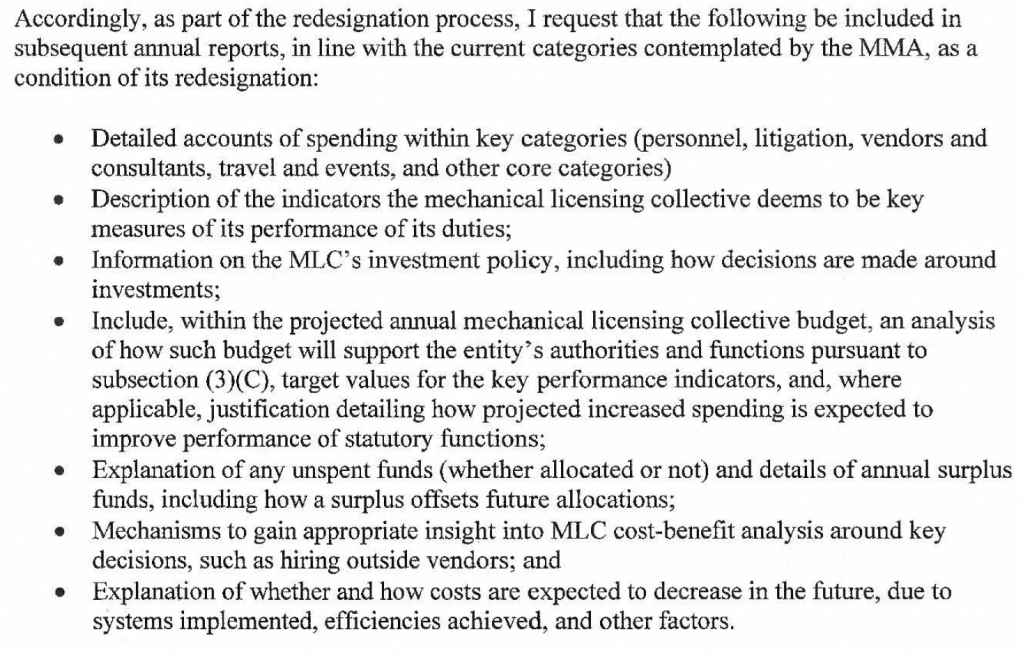
Further, questions remain regarding the MLC’s investment policy by which it may invest royalty and assessment funds. The MLC’s Investment Policy Statement provides little insight into how those funds are invested, their market risk, the revenue generated from those investments, and the percentage of revenue (minus fees) transferred to the copyright owner upon distribution of royalties. I would urge the Copyright Office to require more transparency into these investments as a condition of redesignation.

It should be obvious that The MLC, Inc.’s “investment policy” has taken on a renewed seriousness and can no longer be dodged.

Black Box

It should go without saying that fair distribution of unmatched funds starts with paying the right people.  Not “connect to collect” or “play your part” or any other sloganeering.  Tracking them down. Like orphan works, The MLC, Inc. needs to take active measures to find the people to whom they owe money, not wait for the people who don’t know they are owed to find out that they haven’t been paid.  

Although there are some reasonable boundaries on a cost/benefit analysis of just how much to spend on tracking down people owed small sums, it is important to realize that the extraordinary benefits conferred on digital services by the Music Modernization Act, safe harbors and all, justifies higher expectations of those same services in finding the people they owe money.  The MLC, Inc. is uniquely different than its counterparts in other countries for this reason.

I tried to raise the need for increased vigilance at the MLC during a Copyright Office roundtable on the MMA. I was startled that the then-head of DiMA (since moved on) had the brass to condescend to me as if he had ever paid a royalty or rendered a royalty statement.  I was pointing out that the MLC was different than any other collecting society in the world because the licensees pay the operating costs and received significant legal benefits in return. Those legal benefits took away songwriters’ fundamental rights to protect their interests through enforcing justifiable infringement actions which is not true in other countries. 

In countries where the operating cost of their collecting society is deducted from royalties, it is far more appropriate for that society to consider a more restrictive cost/benefit analysis when expending resources to track down the songwriters they owe. This is particularly true when no black box writer is granting nonmonetary consideration like a safe harbor whether they know it or not.

I got an earful from this person about how the services weren’t an open checkbook to track down people they owed money to (try that argument when failing to comply with Know Your Customer laws).  Grocers know more about ham sandwiches than digital services know about copyright owners. The general tone was that I should be grateful to Big Daddy and be more careful how I spend my lunch money. And yes I do resent this paternalistic response which I’m sorry to say was not challenged by the Copyright Office lawyer presiding who shortly thereafter went to work for Spotify.  Nobody ever asked for an open check.  I just asked that they make a greater effort than the effort that got Spotify sued a number of times resulting in over $50 million in settlements, a generous accommodation in my view. If anyone should be grateful, it is the services who should be grateful, not the songwriters.

And yet here we are again in the same place.  Except this time the services have a safe harbor against the entire world which I believe has value greater than the operating costs of the MLC.  I’d be perfectly happy to go back to the way it was before the services got everything they wanted and then some in Title I of the MMA, but I bet I won’t get any takers on that idea.

Instead, I have to congratulate Rep. Fitzgerald for truly excellent work product in his letter and for framing the issue exactly as it should be posed.  Failing to fix these major problems should result in no redesignation—fired for cause.

[This post first appeared in MusicTech.Solutions]

Who Will Get to the Bottom of The Hundreds of Millions of Black Box Money at MLC?

By Chris Castle

One of the most common questions we get from songwriters about the MLC concerns the gigantic level of “unmatched funds” that have been sitting in the MLC’s accounts since February 2021.  Are they really just waiting until The MLC, Inc. gets redesignated and then distributes hundreds of millions on a market share basis like the lobbyists drafted into the MMA?  

Not My Monkey

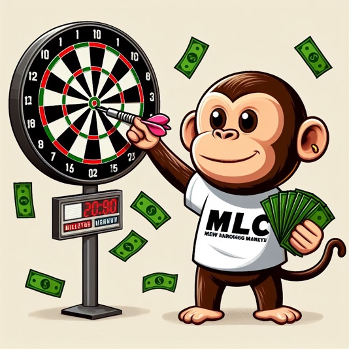
Nobody can believe that the MLC can’t manage to pay out several hundred million dollars of streaming mechanical royalties for over three years so far.  (Resulting in the MLC holding $804,555,579 in stocks as of the end of 2022 on its tax return, Part X, line 11.) The proverbial monkey with a dart board could have paid more songwriters in three years.  Face it—doesn’t it just sound illegal?  In my experience, when something sounds or feels illegal, it probably is.

What’s lacking here is a champion to extract the songwriters’ money.  Clearly the largely unelected smart people in charge could have done something about it by now if they wanted to, but they haven’t.  It’s looking more and more like nobody cares or at least nobody wants to do anything about it.  There is profit in delay.

Or maybe nobody is taking responsibility because there’s nobody to complain to.  Or is there? What if such a champion exists?  What if there were no more waiting?  What if there were someone who could bring the real heat to the situation?

Let’s explore one potentially overlooked angle—a federal agency called the Office of the Inspector General.  Who can bring in the OIG?  Who has jurisdiction?  I think someone does and this is the primary reason why the MLC is different from HFA.

Does The Inspector General Have MLC Jurisdiction?

Who has jurisdiction over the MLC (aside from its severely conflicted board of directors which is not setting the world on fire to pump the hundreds of millions of black box money back into the songwriter economy).  The Music Modernization Act says that the mechanical licensing collective operates at the pleasure of the Congress under the oversight of the U.S. Copyright Office and the OIG has oversight of the Copyright Office through its oversight of the Library of Congress.

But, hold on, you say.  The MLC, Inc. is a private company and the government typically does not have direct oversight over the operations of a private company.

The key concept there is “operates” and that’s the difference between the statutory concept of a mechanical licensing collective and the actual operational collective which is a real company with real employees and real board members.  Kind of like shadows on the wall of a cave for you Plato fans.  Or the magic 8 ball.

The MLC, Inc. is all caught up with the government.  It exists because the government allows it to, it collects money under the government’s blanket mechanical license, its operating costs are set by the government, and its board members are “inferior officers” of the United States.   Even though The MLC, Inc. is technically a private organization, it is at best a quasi-governmental organization, almost like the Tennessee Valley Authority or the Corporation for Public Broadcasting.  So it seems to me that The MLC, Inc. is a stand-in for the federal government.

But The MLC, Inc. is not the federal government.  When Congress passed the MMA and it charged the Copyright Office with oversight of the MLC.  Unfortunately, Congress does not appear to have appropriated funds for the additional oversight work it imposed on the Office.  

Neither did Congress empower the Office to charge the customary reasonable fees to cover the oversight work Congress mandated.  The Copyright Office has an entire fee schedule for its many services, but not MLC oversight.  

Even though the MLC’s operating costs are controlled by the Copyright Royalty Board and paid by the users of the blanket license through an assessment, this assessment money does not cover the transaction cost of having the Copyright Office fulfill an oversight role.

An oversight role may be ill suited to the historical role of the Copyright Office, a pre-New Deal agency with no direct enforcement powers—and no culture of cracking heads about wasteful spending like sending a contingent to Grammy Week.

In fact, there’s an argument that The MLC, Inc. should write a check to the taxpayer to offset the additional costs of MLC oversight.  If that hasn’t happened in five years, it’s probably not going to happen.  

Where Does the Inspector General Fit In?

Fortunately, the Copyright Office has a deep bench to draw on at the Office of the Inspector General for the Library of Congress, currently Dr. Glenda B. Arrington.  That kind of necessary detailed oversight is provided through the OIG’s subpoena power, mutual aid relationships with law enforcement partners as well as its own law enforcement powers as an independent agency of the Department of Homeland Security.  Obviously, all of these functions are desirable but none of them are a cultural fit in the Copyright Office or are a realistic resource allocation.

The OIG is better suited to overseeing waste, fraud and abuse at the MLC given that the traditional role of the Copyright Office does not involve confronting the executives of quasi-governmental organizations like the MLC about their operations, nor does it involve parsing through voluminous accounting statements, tracing financial transactions, demanding answers that the MLC does not want to give, and perhaps even making referrals to the Department of Justice to open investigations into potential malfeasance.  

Or demanding that the MLC set a payment schedule to pry loose the damn black box money.

One of the key roles of the OIG is to conduct audits.  A baseline audit of the MLC, its closely held investment policy and open market trading in hundreds of millions in black box funds might be a good place to start.  

It must be said that the first task of the OIG might be to determine whether Congress ever authorized MLC to “invest” the black box funds in the first place.  Congress is usually very specific about authorizing an agency to “invest” other people’s money, particularly when the people doing the investing are also tasked with finding the proper owners and returning that money to them, with interest. 

None of that customary specificity is present with the MLC.

For example, MLC CEO Kris Ahrens told Congress that the simple requirement that the MLC pay interest on “unmatched” funds in its possession (commonly called “black box”) was the basis on which the MLC was investing hundreds of millions in the open market.  This because he assumed the MLC would have to earn enough from trading securities or other investment income to cover their payment obligations.  That obligation is mostly to cover the federal short term interest rate that the MLC is required to pay on black box.

The Ghost of Grammy Week

The MLC has taken the requirement that the MLC pay interest on black box and bootstrapped that mandate to justify investment of the black box in the open market.  That is quite a bootstrap.

An equally plausible explanation would be that the requirement to pay interest on black box is that the interest is a reasonable cost of the collective to be covered by the administrative assessment.  The plain meaning of the statute reflects the intent of the drafters—the interest payment is a penalty to be paid by the MLC for failing to find the owners of the money in the first place, not an excuse to create a relatively secret $800 million hedge fund for the MLC.  

I say relatively secret because The MLC, Inc. has been given the opportunity to inform Congress of how much money they made or lost in the black box quasi-hedge fund, who bears the risk of loss and who profits from trading.  They have not answered these questions.  Perhaps they could answer them to the OIG getting to the bottom of the coverup.

We do not really know the extent of the MLC’s black box holdings, but it presumably would include the hundreds of millions invested under its stewardship in the $1.9 billion Payton Limited Maturity Fund SI (PYLSX). Based on public SEC filings brought to my attention, The MLC, Inc.’s investment in this fund is sufficient to require disclosure by PYLSX as a “Control Person” that owns 25% or more of PYLSX’s $1.9 billion net asset value. PYLSX is required to disclose the MLC as a Control Person in its fundraising materials to the Securities and Exchange Commission (Form N-1A Registration Statement filed February 28, 2023).  This might be a good place to start.

Otherwise, the MLC’s investment policy makes no sense.  The interest payment is a penalty, and the black box is not a profit center.

But you don’t even have to rely on The MLC, Inc.’s quasi governmental status in order for OIG to exert jurisdiction over the MLC.  It is also good to remember that the Presidential Signing Statement for the Music Modernization Act specifically addresses the role of the MLC’s board of directors as “inferior officers” of the United States:

Because the directors [likely both voting and nonvoting] are inferior officers under the Appointments Clause of the Constitution, the Librarian [of Congress] must approve each subsequent selection of a new director. I expect that the Register of Copyrights will work with the collective, once it has been designated, to ensure that the Librarian retains the ultimate authority, as required by the Constitution, to appoint and remove all directors.

The term “inferior officers” refers to those individuals who occupy positions that wield significant authority, but whose work is directed and supervised at some level by others who were appointed by presidential nomination with the advice and consent of the Senate. Therefore, the OIG could likely review the actions of the MLC’s board (voting and nonvoting members) as they would any other inferior offices of the United States in the normal course of the OIG’s activities.

Next Steps for OIG Investigation

How would the OIG at the Library of Congress actually get involved?  In theory, no additional legislation is necessary and in fact the public might be able to use the OIG whistleblower hotline to persuade the IG to get involved without any other inputs.  The process goes something like this:

  1. Receipt of Allegations: The first step in the OIG investigation process is the receipt of allegations. Allegations of fraud, waste, abuse, and other irregularities concerning LOC  programs and operations like the MLC are received from hotline complaints or other communications. 
  2. Preliminary Review: Once an allegation is received, it undergoes a preliminary review to determine if OIG investigative attention is warranted. This involves determining whether the allegation is credible and reasonably detailed (such as providing a copy of the MLC Congressional testimony including Questions for the Record). If the Office is actually bringing the OIG into the matter, this step would likely be collapsed into investigative action.
  3. Investigative Activity: If the preliminary review warrants further investigation, the OIG conducts the investigation through a variety of activities. These include record reviews and document analysis, witness and subject interviews, IG and grand jury subpoenas, search warrants, special techniques such as consensual monitoring and undercover operations, and coordination with other law enforcement agencies, such as the FBI, as appropriate.  That monitoring might include detailed investigation into the $500,000,000 or more in black box funds, much of which is traded on open market transactions like PYLSX.
  4. Investigative Outputs: Upon completing an investigation, reports and other documents may be written for use by the public, senior decision makers and other stakeholders, including U.S. Attorneys and Copyright Office management. Results of OIG’s administrative investigations, such as employee and program integrity cases, are transmitted to officials for appropriate action. 
  5. Monitoring of Results: The OIG monitors the results of those investigations conducted based on OIG referrals to ensure allegations are sufficiently addressed.

So it seems that the Office of the Inspector General is well suited to assisting the Copyright Office by investigating how the MLC is complying with its statutory financial obligations.  In particular, the OIG is ideally positioned to investigate how the MLC is handling the black box and its open market investments that it so far has refused to disclose to Members of Congress at a Congressional hearing as well as in answers to Questions for the Record from Chairman Issa.

This post previously appeared on MusicTech.Solutions

Search is Ripping Us Off Again, this time for AI

By Chris Castle

In case you think that infringement of copyrights in AI training happens only to rock stars, photographers, record companies or movie studios, let me give you a personal anecdote that might cause you to reconsider. I asked Bing’s Copilot AI tool to list the deal points in a record producer agreement, and this is what I got back:

Copilot

Certainly! When negotiating a producer agreement, several key points should be considered. Here are some common negotiation points from the artist’s perspective:

  1. Scope of Engagement:
    1. The producer is generally engaged for one album project at a time.
    2. Clarify the scope of work, including the number of songs or recordings to be produced.
  2. Budget and Compensation:
    1. Determine the budget for the project (e.g., $10,000 in your case).
    2. Agree on the producer’s compensation, which may include an upfront fee, points on sales, or a combination.
  3. Ownership and Rights:
    1. Address ownership of the master recordings:
      1. Will the artist own and control the masters?
      2. Does the producer retain any rights?
  4. Credits and Royalties:
    1. Specify how the producer will be credited on releases.
    2. Discuss any royalties or backend points for the producer.
  5. Recording Schedule:
    1. Set a timeline for recording sessions.
    2. Define the two-week period for your project.
  6. Logistics:
    1. Determine where the recordings will take place.
    2. Outline the artist’s approval process.
    3. Define the producer’s deliverables.
  7. Termination Clause:
    1. Include provisions for termination if either party breaches the agreement.
    2. Address payment for work completed up to that point.

Remember that each negotiation is unique, and it’s essential to tailor the agreement to your specific needs and circumstances. Legal advice is recommended to ensure compliance with local laws and industry standards1 3 4.

Source(s)

1. An Artist’s Guide to Negotiating Record Producer Agreements – Medium

2. Negotiating a Music Producer Agreement: 7 Key Issues

3. 5 Things to Look for in a Music Producer Agreement – Lawyer Drummer

4. How to Negotiate: Steps, Phrases & Tips to Win the Deal – Selling Signals

Notice that Copilot lists “Source(s)” and that source #1 is an article from the Medium website.

My article.

I’ve written a number of articles about negotiating producer agreements and I can categorically say I haven’t given permission or been asked to give permission for any of those articles to be scraped and used to train AI. So how did it come to be in Copilot’s training materials? 

My guess is that Medium (and probably a lot of other sites) were crawled by Bing’s spider and that copies of Medium pages were stored in Bing’s (or Microsoft’s) data centers. When Microsoft launched its Copilot AI tool, one could imagine that the temptation would have been strong to use those copies as part of the training tools for Copilot. In fact, the Verge reports that “companies around the web are using your site and its data to build massive sets of training data, in order to build models and products that may not acknowledge your existence at all.” Can you say Section 230 or DMCA? Maybe there will be a question at the April 11 House Energy & Commerce hearing on Section 230.

So Google-style “innovation” has a self-destructive flavor consistent with their oikophobic capitalism. Greater Silicon Valley’s view of culture in general and copyright in particular is as sources of wealth extracted by destruction–you know, creative destruction, permissionless innovation, etc. (It’s no wonder Google was inexorably attracted to defense contracting despite all the “don’t be evil” hoorah. After all, what creates massive wealth faster than convincing governments to pay big money to blow things up that must be replaced by ever more big money to blow even more things up.)

Are you surprised then that two of the biggest operators in the AI space are the search engine operators Google and Microsoft? This is another example of how Big Tech helps itself to your data and work product without you even knowing it’s happening. So now what? I now know I’m being ripped off, and I’m wondering if Medium is in on it.

The Verge tells us:

The ability to download, store, organize, and query the modern internet gives any company or developer something like the world’s accumulated knowledge to work with. In the last year or so, the rise of AI products like ChatGPT, and the large language models underlying them, have made high-quality training data one of the internet’s most valuable commodities. That has caused internet providers of all sorts to reconsider the value of the data on their servers, and rethink who gets access to what. 

Ya think?

The First Shot Across the Bow at the MLC’s “Redesignation” Proceeding #TheReup

We must always tell what we see. Above all, and this is more difficult, we must always see what we see.
Charles Peguy

By Chris Castle

The Reup is on! MTP readers will remember that The MLC, Inc. is in the beginning of its “redesignation” proceeding before the U.S. Copyright Office that we call “the rep,” because…because….well, you have to laugh at some point. Having appointed (or “designated”) The MLC, Inc. as the statutory mechanical licensing collective in 2019, the Copyright Office is required by statute to review The MLC, Inc. to see how they are doing with their exclusive monopoly over songwriter streaming mechanical collections.

It’s important to remember that the mechanical licensing collective (lower case) is a statutory body. Congress tasked the head of the Copyright Office with selecting an entity to actually do the work. In a shocker that rocked the industry, the Copyright Office selected (or “designated”) the favorite corporation of the National Music Publishers Association and the Nashville Songwriters Association International that styled itself “The MLC, Inc.” 

The MLC, Inc. then turned right around and selected the Harry Fox Agency as its data vendor to actually run the accounting part of the collective–another shocker. If you thought you were going to escape the hubris and incompetence of HFA under the glorious revolution of the Music Modernization Act, tough break. So it is now the Copyright Office’s decision to either redesignate The MLC, Inc. (and by default, HFA) for another five years of holding onto your money in their vast black box, or find someone else.

And just to be clear, these exclusive appointments or “designations” last for five years. Every five years, Congress required the Copyright Office to take a critical look at the wisdom of their prior decision and determine after soul-searching and self-criticism whether they should ratify their previous genius by extending the monopoly another five years. As Congress said in the legislative history narrative:

The Register [the head of the Copyright Office] is allowed to re-designate an entity to serve as the collective every 5 years after the initial designation. Although there is no guarantee of a continued designation by the collective, continuity in the collective would be beneficial to copyright owners so long as the entity previously chosen to be the collective has regularly demonstrated its efficient and fair administration of the collective in a manner that respects varying interests and concernsIn contrast, evidence of fraud, waste, or abuse, including the failure to follow the relevant regulations adopted by the Copyright Office, over the prior five years should raise serious concerns within the Copyright Office as to whether that same entity has the administrative capabilities necessary to perform the required functions of the collective. In such cases, where the record of fraud, waste, or abuse is clear, the Register should give serious consideration to the selection of a new entity even if not all criteria are met pursuant to section 115(d)(3)(B)(iii).

So the way this is going to go down according to the Copyright Office is that they will seek a kind of thesis defense from each of The MLC, Inc. and the MLC’s counterpart for the digital services called the Digital Licensee Coordinator or “the DLC” which we often forget is there. Then the public gets to comment on how things are going.

Let’s understand how this game is played. Nobody likes to open the kimono and have their operations examined. But opening the kimono is actually a much bigger deal for the MLC than for the DLC. The MLC has a lot of functionality that perpetuates the same old spaghetti code from HFA and the need to hide it from sunlight. In my view the sense of entitlement and hubris is overwhelmingly stronger at The MLC, Inc. than at the DLC. Remember, the DLC pretty much just writes the overpriced checks to keep MLC executives in the style to which they have become accustomed (see Trichordist “Know Your MLC 2022“).

We are starting to get a sense of how the DLC is going to approach the reup proceeding given a recent blog post by Graham Davies, the new head of the Digital Media Association. DiMA essentially is the DLC. Technically, the DLC’s mission is to represent all users of the blanket mechanical license, and I think perhaps for the first time, the DLC will represent all the users both large and small, not just DiMA members. Let’s take a look at some of the points Graham raised.

The Insult of Governance

But first, remember that the MMA created the first US mechanical licensing CMO. This was an event that had been coming for oh, say 100 years round numbers. The first difference between the US and most other countries is that in the US there is not equal board representation between publishers and songwriters. This is an insult to songwriters. 

That’s right–in the rest of the world, songwriters have at least equal representation. Just call it what it is, it’s an insult. And not a casual insult or the insult of low expectations. This insult is right in your face.

There will be a lot of rending of garments about the unfairness of the MLC’s board composition and that’s all fine, but know this: You will not change the board composition until you change the mindset that produced the board composition.

What is astonishing about how this happened is that before they get to Washington, all these publishers with board seats have good relations with songwriters and value their writers. Do we have arguments inside the family? Sure. But something happens to these publishers when they get to Washington, DC and they go rogue or they are encouraged to go rogue. 

So I would encourage these board members to come back to your values and what you hold dear and don’t listen to the bad advice. The bad advice didn’t build your companies; your relations with your songwriters did. Yet there is such hostility toward this board composition that it will take you years to overcome the insult and the distrust it produced. It didn’t have to happen that way and it should not be allowed to continue.

No Free Lunch

The next big difference is that the cost of standing up and operating the MLC is born by the licensees. There is a reason that this doesn’t happen in any other country–it is a bullshit idea. It OBVIOUSLY produced an inherent conflict of interest at the outset. Does it shovel money onto the kitchen tables of the insiders? Of course. Does it feed into salaries, bonuses and T&E of the MLC? Oh, yes. So let’s see what Graham Davies has to say about this one.

For starters, here’s a headline: THE MONEY IS NOT HAPPY. Get it? What do you think happens when the money is not happy? Maybe, just maybe, you think they might not want to keep paying? Maybe just maybe they gave you your lead for five years and let you get good and hooked before they started reeling you in?

As Graham says:

All around the world, it is the rightsholders who bear the cost of the collectives licensing their rights, and copyright offices or similar government bodies often have oversight powers over the collectives to ensure that royalties are distributed fairly and the collectives operate efficiently.  

In the US, unlike anywhere else in the world, legislators placed the burden of funding the collective’s operations on the licensees as opposed to the rightsholders. This particular arrangement was a feature of the statute, but means a collective’s traditional incentives for optimum performance are not inherently built in and may become skewed. [Now there’s a shocker.]

This structure makes it even more important that the Copyright Office ensures fair and efficient operation of the collective, including for those who fund it.

How can you read that and not realize that THE MONEY IS NOT HAPPY. See what you see. Anyone who believed that the licensees large and small would just go on writing the checks for absurd salaries and ridiculous travel and entertainment expenses must be from Washington.

Oversight Culture Clash

This goes hand-in-hand with the true problem with the entire megillah which is where Graham starts: Lack of oversight. Don’t blow past this. 

Remember, DiMA represents the biggest corporations in commercial history and make no mistake–they own Washington, DC. So when the DiMA members look at this oversight issue, from their point of view the government works for them and the government is falling down on the job. The money is not happy. See what you see.

Oversight is a key part of Graham’s complaint.

As we embark on the redesignation process, oversight of the mechanical licensing collective is a key issue. Collective licensing is common for many rights in the music sector, because it is a sensible solution for reducing transaction costs and improving efficiencies between rightsholders and licensees….

The MMA mandated that the MLC be run by a Board made up largely of music publishers and some songwriters. While it makes sense for rights holders to have oversight over a collective of their rights, it has become apparent in the five years since the MMA was passed, that this structure, without guardrails and robust oversight, provides little incentive for the collective to carefully weigh risks and conduct rigorous cost-benefit analysis of decisions before action. [Like any CMO conducts a “rigorous cost-benefit analysis”–try not to laugh, but you get the idea.] This is of great importance because without a clearly circumscribed remit for The MLC, the positions the collective takes can have significant consequences for the functioning of the US music market.

The record shows that in passing the MMA, Congress chose to establish a collective that would serve as the administrator of  the mechanical blanket license….Congress [did not] intend to write the collective a blank check.  Indeed, Congress was astute in requiring that streaming services be responsible only for the reasonable costs of the collective. Such reasonable costs relate to the collective’s core functions – such as work registration and matching. Where The MLC has focused on these core functions, there is good work [no there isn’t], particularly in the context of the relatively short window from designation to operation [already making excuses]. However, where The MLC has gone beyond its remit, there has been, and continues to be cause for concern. Reasonable costs of the collective cannot include everything from traveling to distant countries to conduct outreach to songwriters far beyond the U.S. licensing system, to suing one of the licensees that pays its costs — using licensee money to pursue its allegations against a licensee on a novel legal theory. [This is the Pandora lawsuit filed by The MLC, Inc. I was wondering how long that would take to get under the skin.]

I take Graham’s point and understand his frustration (and discretion in not calling out the ridiculous salaries). But it must also be said that only lobbyists in the Imperial City would have drafted Title I of the MMA to provide for oversight of a private company by a government agency. That’s just idiotic. First of all, it’s really unfair to expect the Copyright Office to supervise the MLC’s travel and entertainment expenses. They barely have the resources to manage their own operations much less have oversight on Kris Ahrend’s tips in transit. It’s also just not in the cerebral culture of the Copyright Office to have the kind of dressing down relationship with the MLC that would be necessary for financial oversight. 

I also have to call bullshit on this complaint about costs being framed as an oversight issue. Yeah, sure, I guess on some level everything is an oversight issue. But if anything, this is an issue for the board of directors at the MLC which includes the DLC. But in most companies it’s a management issue for the CEO and the CFO. So if Graham has a beef about T&E (which sounds like a legitimate beef and is not the first I’ve heard of it), he needs to take it up with the management. You know, the management that reports to the board the DLC sits on (nonvoting or not).

Alternatively, the operating budget of the MLC comes through the Copyright Royalty Board which approves the budget in the form of the “Administrative Assessment.” The DLC can raise these complaints about spending in that forum as well and really should.

So Graham raises some important points that we should be aware of as the MLC enters its all-important reup proceeding. Stay tuned for responses.

Show Me the Splits: Tiffany Red Illuminates Stealing Publishing

By Chris Castle
(A version of this post appeared on MusicTechPolicy and on Hypebot)

It’s unfortunately an old story, but that doesn’t make it right.

One of the most underpaid creatives in our business are songwriters who “just” write songs. “Just” is an odd word to use but it’s a common way to refer to those who give artists a voice because it really does all start with the song. And as Tiffany Red says in her video, the system is simply unjust.

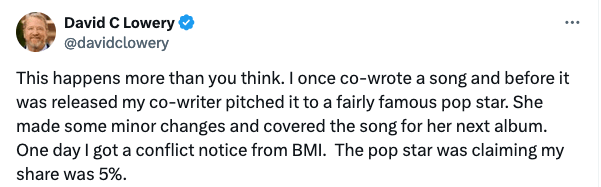
“The system” is what has always been called “stealing publishing”. This is when an artist or a producer (and it happens with producers but for different reasons) threatens songwriters who created a song the artist may record with not covering that song unless the artist gets a chunk of the publishing. The amount can range all over the place, but often is at least 25% of the copyright. So not only are they not entitled to song’s earnings as a financial interest, they are definitely not entitled to the copyright because they created nothing.

On top of it, songwriters often have to eat many costs in order to get the song written, demoed and pitched. (I can’t tell you the number of times the songwriter demo essentially becomes the arrangement of the final recording, so “demo” is relative.). There’s a bunch of opportunities along the way for people to write themselves into the song when all they did was a job that they were probably being paid to do anyway. I have even encountered producers whose managers demanded a piece of publishing for the producer to even listen to an artist’s demos. 

On the producer side, some producers want a piece of all publishing on the record and if they actually write they want their contributor share as a writer ON TOP of the publishing they are already stealing. Why? What possesses anyone to think they are entitled to do this? And “entitled” is exactly the right word. 

One reason they steal publishing is because the producer royalty is unlikely to even recoup the producer advance in a streaming reality unless the track is a huge hit. (Remember that a producer gets a percentage of what the artist gets, say 30%ish, and the artist gets somewhere around 50% of the fraction of a penny per stream.) This is especially true of producers who enjoyed a lifestyle in the pre-streaming era and are trying to keep it going. It’s understandable, but that doesn’t make it right. 

And remember, the songwriter isn’t getting an advance. On top of the insult of stealing publishing, the artist has no intention of paying for it because the songwriter should consider themselves lucky to get the cover–which often is a career making record for the artist opening up income streams the songwriter never participates in.

When faced with these overreaching demands, songwriters have to make some hard choices. Occasionally I get to tell the artist’s team to fuck off. More often though–as Tiffany says–songwriters acquiesce.

I think Tiffany is also hitting at a point that Merck Mercuriadis made at the last Artist Rights Symposium that David hosts at the University of Georgia:

Let’s face it—this is insulting.  If I sat down and explained to my decent Greek working class parents that this is how songwriters get paid, they’d be shocked.  If you went to your bank manager and explained how songwriters get paid, they’d be shocked.  Doctors, lawyers, everyone who has some understanding of the economics of the world or what drives an industry and what creates value for an industry would be shocked by how songwriters are paid. 

But nobody can bring the frustration home like a songwriter on the receiving end of this injustice. Watch Tiffany’s video. Take 15 minutes out of your life and watch it from beginning to end with no distractions. She’s absolutely correct that until the artists stop, until they let their team know that stealing publishing is not acceptable and if they do it they are not only not helping the artist, but they’ll be fired–then it will start to change. 

She’s right about something else, too. A songwriter shouldn’t need a gatekeeper to protect them in a situation that should not be happening in the first place. There’s a line that we all learn from parents, teachers, coaches, mentors, the line between acceptable and unacceptable treatment of other humans, right and wrong if you like although that’s a bit simplistic. Stealing publishing is wrong, stealing publishing is on the wrong side of that line. This is what I think whenever I have to deal with the situation–how do you sleep at night?

Watch the video. it’s not a rant, it’s the truth.

MTP Interview: We ask @Creators_ECSA President @Helienne Lindvall to Explain the European Parliament’s Streaming Economy Report from the Committee on Culture and Education

This post first appeared on MusicTechPolicy by Chris Castle.

The Culture and Education of the European Parliament issued an important report on the state of the creative economy. Our friend Helienne Lindvall, President of the European Composer and Songwriter Alliance, gives us some insights into the report and the context.

I know ECSA was involved in testifying for the EU cultural diversity report, can you tell us a little about the report, what prompted it and how does it help or hurt?

Streaming and the amount of issues it brought with it has been at the top of the agenda for European songwriters since the launch of Spotify. As an Ivors Academy Board Director, I was part of the inception of the UK #FixStreaming campaign which resulted in the UK Government calling for a complete overhaul of music streaming, and for the creation of music industry working groups to fix these problems. Meanwhile, similar lobbying efforts have been applied in Brussels by music creators across Europe. The EU has a fine history of promoting, supporting and protecting culture – in 2019, legislators proved it by adopting the DSM Copyright Directive. Now we need it to step up to help create a sustainable streaming environment. 

Rapporteur Iban Garcia del Blanco and his fellow CULT MEPs took their time to really listen to and understand the reality that music authors (ie songwriters and composers) face, and our proposed remedies, and I think the report reflects that.

Is the report designed to shape future legislation or rulemaking in the EU?

We look forward to seeing the European Commission work on such a strategy and take concrete actions to build a fair and sustainable music streaming ecosystem for all music creators.. 

MEP Garcia del Blanco said at the press conference that he would prefer if the industry stakeholders could sit down and fix these problems without further legislation, but judging from our experience in the UK, certain areas are easier to get a consensus on than others. The UK metadata working group has set parameters for improvements, which I believe can easily be adopted across Europe and beyond. However, when it comes to remuneration and making it fairer for songwriters and performers, we have met with resistance from labels and platforms – unsurprisingly, perhaps. Getting increased transparency has also proved more difficult. If this resistance remains we will keep pushing for Government intervention and legislation. 

The report calls for a comprehensive and ambitious strategy based on independent data and a structured dialogue with all stakeholders, and we stand ready to work with the entire music value chain towards a fairer distribution of revenues, and we support the establishment of a European Music Observatory to collect and analyse data.

I noticed this language in the report calling on EU parliament:  “Calls for action to be taken at the European Union level to guarantee the visibility and accessibility of European musical works, considering the overwhelming amount of content constantly growing on music streaming platforms and the lack of Union rules to regulate them in a harmonised manner”.  and algorithmic dominance? 

It may come as no surprise that American and major label records still dominate on streaming platforms.

Is this designed to keep local language artists from being overwhelmed by English language tracks due to algorithmic bias or Spotify’s stream discrimination plans?

The short answer is: yes. During our stakeholder testimonials in the EU Parliament, Spotify claimed that streaming has increased diversity. And, yes, it may be true that some European countries have seen plenty of local acts in their local charts, though by no means all countries have experienced this, but on an international level there’s still a huge dominance of Anglo-American repertoire. Then we have the issue of the dominance of legacy artists and catalogue albums, such as ABBA, Fleetwood Mac and Elton John. 

In a post-Brexit reality, does the report have any effect on the UK?

The EU doesn’t have any legislative powers when it comes to the UK, due to Brexit, but as streaming is cross-border, as is the music industry, an improvement in either would have an impact on both. Some EU members have already implemented their own versions of equitable remuneration, such as Belgium and Spain – and France is establishing a streaming tax to support local music – but we would like to see solutions and changes that help ALL music creators, in particular songwriters, who currently are at the bottom when it comes to their share of the streaming royalty “pie”, and are finding it next to impossible to survive on their music, despite getting millions of streams. 

Given the attention that the Bad Dog story is getting, would the metadata accuracy proposals in the report help to stop outright fraud and impersonation? 

Yes, it would. Overall, we need more transparency, accountability and accuracy to deal with fraud. These are all words that get thrown around the industry willy-nilly but are rarely truly abided by. In this industry, companies rarely make an effort when it comes to accuracy unless there is an incentive for them to do so. What is the incentive for distributors and platforms to clean up their act and make an effort to prevent bad actors from profiting from fraudulent streams when they still get a share of those streams? I make the comparison to physical stores: If a supermarket sold counterfeit products, they’d be in trouble with the law. Why not these platforms and distributors? And this is before we even get into what’s happening on TikTok, which is the wild west when it comes to unlicensed usage. 

Does the metadata accuracy help to enforce “know your customer” type minimum indentifiable data requirements?

Accurate metadata is vital for so many reasons. Not only because more than 20% of all song revenue is unallocable and won’t go to the rightful recipient, but it will help in the fight against fraud. The way I put it to legislators is: You wouldn’t be able to buy a tuna sandwich in the supermarket without being able to read EXACTLY what is in it on the package, or the trader knowing who to pay for those ingredients. So how can it be legal for streaming services to accept, display and charge for recordings without knowing who created the underlying composition? How can they collect money without having any information on who to pay it to? And, as we’ve discovered with cases such as the Bad Dog story and Swedish criminal gangs using Spotify streams to launder money, that money could even be funding drug and weapons trafficking. 

Anything else you think is important about the report? 

The report calls for action when it comes competition issues and the dominance of a handful of labels and platforms, issues that we believe suppresses our bargaining power. It also stresses that authors, performers and other rights holders should be allowed to reserve and license the rights for the use of their work for AI training, and it acknowledges that this requires transparency. Overall it’s an important report that aims to correct the imbalances that have led to the unsustainable situation music creators find themselves in, and to build a sustainable, thriving and diverse cultural future. It couldn’t come soon enough.