We’re about to experience an historical event—the U.S. government’s statutory mechanical rate for physical and permanent downloads will increase twice in 12 months. This is because the record companies agreed in “Phonorecords IV” to raise the statutory mechanical rate from 9.1¢ to 12¢ for physical and permanent downloads (with corresponding long-song royalties) effective January 1, 2023.
This is quite a change from the frozen rate that lasted for 17 years. Not only did the labels agree to increase the rate to 12¢, they agreed to index that increased rate to inflation annually starting in 2024.
Indexing requires increasing the 12¢ rate to current inflation based on a “COLA” or “cost of living adjustment” by applying an uplift formula to the 12¢ rate. That formula itself is a function of the Bureau of Labor Statistics Consumer Price Index which itself comes in a number of varieties. A common version of CPI that the record companies agreed to is the “Consumer Price Index for All Urban Consumers (U.S. City Average, all items),” or “CPI-U.” The CPI-U is weighted toward the cost of living for urban consumers. (Compare CPI-U to the “CPI-W” or Consumer Price Index for Urban Wage Earners and Clerical Workers which is used by Social Security, for example.)
We have experienced a time of high inflation for the last few years and given the indicators, we are likely to continue to suffer with inflation for years to come. So the labels’ agreement to a COLA protects the purchasing power of the hard-won mechanical royalty for physical and downloads and may end up being a critical deal point over the 5 year rate period covered by Phonorecords IV.
Annual rate adjustment. The Copyright Royalty Judges shall adjust the royalty rates in paragraph (a)(1) of this section each year to reflect any changes occurring in the cost of living as determined by the most recent Consumer Price Index for All Urban Consumers (U.S. City Average, all items) (CPI–U) published by the Secretary of Labor before December 1 of the preceding year. The calculation of the rate for each year shall be cumulative based on a calculation of the percentage increase in the CPI–U from the CPI–U published in November, 2022 (the Base Rate) and shall be made according to the following formulas: for the per-work rate, (1 + (Cy−Base Rate)/Base Rate) × 12¢, rounded to the nearest tenth of a cent; for the per-minute rate, (1 + (Cy−Base Rate)/Base Rate) × 2.31¢, rounded to the nearest hundredth of a cent; where Cy is the CPI–U published by the Secretary of Labor before December 1 of the preceding year. The Judges shall publish notice of the adjusted fees in the Federal Register at least 25 days before January 1. The adjusted fees shall be effective on January 1.
One must have the published CPI-U in order to make the COLA calculation. The CPI is published by Bureau of Labor Statistics (technically “by the Secretary of Labor”) on a regularly published schedule. If the regulations require that the relevant CPI-U must be published before December 1, that will be the CPI-U for October to be published next week on November 14 because the CPI-U for November won’t be published until December 12 (which of course is after December 1).
According to the Cleveland Federal Reserve, month over month inflation for November is projected to be pretty much the same as October. So based on the Phonorecords IV Subpart B formula, the minimum statutory rate will likely increase from 12¢ to approximately 12.41¢ starting January 1.
Keep an eye out for the October CPI-U next week when it is announced by BLS at 8:30am ET on November 14. The Copyright Royalty Board is to publish the new COLA-adjusted mechanical rate in the Federal Register, on or about December 8. And remember that the same calculation with then-current CPI-U will apply in December 2024, 2025, 2026 and 2027.
Remember, this COLA rate increase only applies to physical and permanent download configurations, not to streaming. This is because the services refused to engage on the topic. There’s really no good explanation for why the streaming services refused to give a COLA. A COLA really should be mandatory given that the government essentially takes away the songwriters’ ability to bargain for their inflation expectations during a five year rate period.
U.S. Representative Darrell Issa and the House Judiciary Subcommittee on Courts, Intellectual Property, and the Internet that he chairs will hold a field hearing on Tuesday, June 27, 2023, at 10:00 a.m. CT at Belmont University, Gabhart Student Center, in Nashville, Tennessee. The hearing, entitled “Five Years Later – The Music Modernization Act,” will focus on the entire blanket licensing regime added to the Copyright Act by the MMA to (1) administer blanket mechanical licenses for “covered activities” (largely streaming) and (2) to collect and distribute compulsory mechanical licensing royalties.
Most importantly, the IP Subcommittee website tells us that “[t]he hearing will also explore whether the legislation is operating as intended by Congress and consider reforms.” So why is this happening and why is it happening right now given everything else that Congress is dealing with.
Congress considers whether to renew The MLC, Inc.‘s designation as the mechanical licensing collective. If that sentence seems contradictory, remember those are two different things: the mechanical licensing collective is the statutory body that administers most of the compulsory license under Section 115 of the Copyright Act that was the entirety of Title I of the Music Modernization Act (aka the Harry Fox Preservation Act). The MLC, Inc. is the private company that was “designated” by Congress through its Copyright Office to do the work of the mechanical licensing collective. This is like the form of a body that performs a function (the mechanical licensing collective) and having to animate that form with actual humans (The MLC, Inc.). The MLC, Inc. was designated by the Copyright Office in 2019.
Congress reviews the work product of The MLC, Inc. every five years (17 USC §115(d)(3)(B)(ii)) to decide if Congress should allow The MLC, Inc. to continue another five years. That is, Congress has the right to fire The MLC, Inc. and find someone else if they fail to perform. Hence, “Five Years Later” in the title of the field hearing. This process is called “designation” or “redesignation” and is performed for Congress by the U.S. Copyright Office in their soft oversight role.
That five year period is actually up next year, so Congress may be getting an early start to identify performance benchmarks for The MLC, Inc. so that the Copyright Office doesn’t have to wing it. If you have some thoughts about what The MLC, Inc. could be doing better or is doing well, you have a chance to write to your representative or even members of the subcommittee before (or after) the June 27 hearing and let them know.
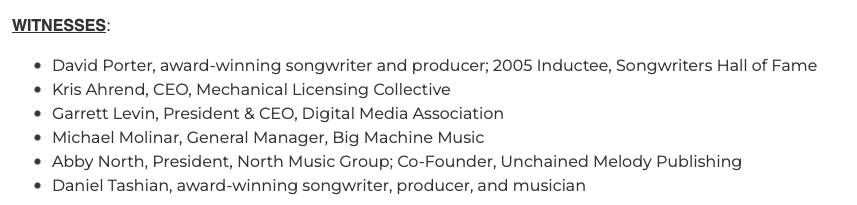
The witness list is well-chosen and seems unlikely to produce the usual propaganda from the controlled opposition that the lobbyists usually try to spoon feed to lawmakers:
I have a few concerns myself.
Investment Policy: According to its 2021 tax return, the MLC, Inc. was at that time holding more than $650 million in publicly traded securities. According to the MLC, Inc.’s annual report (at p. 4), this sum seems to include the $424 million of black box monies that the MLC, Inc. received in 2021. Congress is entitled to know exactly how this money is handled, where it resides and who is responsible for making investment decisions.
Congress should consider whether all black box sums and unspent operating costs advanced by blanket licensees should be held in a bank account controlled by the US government so that there is no confusion if Congress fires The MLC, Inc. or any successor.
Congress should also consider whether the same fiduciary duties apply to The MLC, Inc.’s management of the black box as would apply to a pension fund (under ERISA) or comparable duty. (There’s lots of pension funds and even banks with less than $600 million in assets and they are all regulated.) At least with a pension fund the fund trustees know who they owe money to; The MLC, Inc. seems like it should have an even higher responsibility to be good stewards of money it owes to the very unknown songwriters Congress tasked it with finding, thus cementing the moral hazard.
It goes without saying that the infamous “Hoffa Clause” in the MMA should be repealed (17 U.S.C. § 115 (d)(7)(C)). The Hoffa Clause allows the collective to dip into the black box to pay its expenses if the millions of the administrative assessment paid by the blanket licensees just isn’t quite enough.
Succession Plan: What if Congress did fire The MLC, Inc.? Is there a succession plan in place that would allow the seamless transfer to a new collective of databases, operating software, cash on hand, and of course the black box? If there is a succession plan in place, then perhaps Mr. Ahrend should bring it with him to Chairman Issa’s hearing for the records. If not, perhaps he could draft one. In any event, Mr. Ahrend should have ready answers to at least some questions about a succession plan should the Subcommittee ask him. After all, the lobbyists wrote the bill and the five year review language was written into the earliest drafts so he should expect a few questions about what happens. Particularly since the Subcommittee has announced that they want to know “…whether the legislation is operating as intended by Congress and consider reforms.”
Nondisclosure Agreements: I am struck by the fact that there have been no leaks of information about the black box, investment policy, or even life at The MLC, Inc. This usually means that there are nondisclosure agreements in place that scare people into silence–along with a healthy dose of intimidation in a small and incestuous industry when it’s likely that your employer is on the board of directors. Maybe not, but Congress may want to find out what these people are up to so it can decide if it wants to let them keep doing it. This may seem like a small issue, but either people aren’t talking because they have nothing to say or people are talking but nobody will print the story.
Songwriter Directorsand Geographical Diversity: The hearing may provide a good opportunity for the Subcommittee to look into how the collective’s controversial board composition is working out, not to mention the membership levels in the confusing by laws of The MLC, Inc. For example, I for one really see no reason to continue the concept of non-voting directors on the board, and Congress could just eliminate that role. One need only look to other collectives and PROs in the US and around the world for examples. A non-voting board member is a close analog to a “board observer” which is usually someone appointed by an investor to essentially spy on the board.
Similarly, it must be said that all the board members are either from New York, Nashville, Los Angeles or are lobbyists from the Imperial City. There are songwriters all over the country and internationally. Since the collective is really a quasi governmental organization, it is entirely in the remit of Congress to increase transparency and fairness as well as diversity. This could be accomplished by requiring an equal number of songwriter and publisher directors and having them come from states or regions with a big music contribution to America such as one of the reservations ,Atlanta, Chicago, Houston, Miami, New Orleans, Tulsa or Appalachia.
Revisit the Compulsory License: There is, of course, the threshold question of whether the compulsory license should be continued at all. This five year examination really should include this fundamental review rather than just blindly pushing forward with the compulsory license. (I discussed this in some detail in a separate post.) One songwriter has suggested that the Copyright Office reprise another study on the continued viability of the entire compulsory license system and I think he’s got a point there. Perhaps the Subcommittee could task the Copyright Office with conducting such a study as a finding of the field hearing. Those studies allow the public to comment without fear or favor which would be a breath of fresh air. Congress could then hear from more people whose jobs depend on the system working well resulting in the payments to songwriters that Congress wanted rather than the system just stumbling on resulting in high salaries to the operators and little to no transparency.
Let’s see what happens at the field hearing. You can watch it here courtesy of the YouTube monopoly.
Congress is considering whether to renew The MLC, Inc.‘s designation as the mechanical licensing collective. If that sentence seems contradictory, remember those are two different things: the mechanical licensing collective is the statutory body that administers the compulsory license under Section 115. The MLC, Inc. is the private company that was “designated” by Congress through its Copyright Office to do the work of the mechanical licensing collective. This is like the form of a body that performs a function (the mechanical licensing collective) and having to animate that form with actual humans (The MLC, Inc.), kind of like Plato’s allegory of the cave, shadows on the wall being what they are.
Congress reviews the work product of The MLC, Inc. every five years (17 USC §115(d)(3)(B)(ii)) to decide if The MLC, Inc. should be allowed to continue another five years. In its recent guidance to The MLC, Inc. about artificial intelligence, the Copyright Office correctly took pains to make that distinction in a footnote (footnote 2 to be precise. Remember–always read the footnotes, it’s often where the action is.). This is why it is important that we be clear that The MLC, Inc. does not “own” the data it collects (and that HFA as its vendor doesn’t own it either, a point I raised to Spotify’s lobbyist several years ago). Although it may be a blessing if Congress fired The MLC, Inc. and the new collective had to start from scratch.
But Congress likely would only re-up The MLC, Inc. if it had already decided to extend the statutory license and all its cumbersome and byzantine procedures, proceedings and prohibitions on the freedom of songwriters to collectively bargain. Not to mention an extraordinarily huge thumbs down on the scales in favor of the music user and against the interest of the songwriters. The compulsory license is so labyrinthine and Kafka-esque it is actually an insult to Byzantium, but that’s another story.
Rather than just deciding about who is going to get the job of administering the revenues for every songwriter in the world, maybe there should be a vote. Particularly because songwriters cannot be members of the mechanical licensing collective as currently operated. Congress did not ask songwriters what they thought when the whole mechanical licensing scheme was established, so how about now?
Before the Congress decides to continue The MLC, Inc. many believe strongly that the body should reconsider the compulsory license itself. It is the compulsory license that is the real issue that plagues songwriters and blocks a free market. The compulsory license really has passed its sell by date and it’s pretty easy to understand why its gone so sour. Eliminating the Section 115 license will have many implications and we should tread carefully, but purposefully.
Party Like it’s 1909
First of all, consider the actual history of the compulsory license. It’s over 100 years old, and it was established at a time, believe it or not, when the goal of Congress was to even the playing field between, music users and copyright owners. They were worried about music users being hard done by because of the anticompetitive efforts of songwriters and copyright owners. As the late Register Marybeth Peters told Congress, when Congress created the exclusive right to control reproduction and distribution in 1909, “…due to concerns about potential monopolistic behavior [by the copyright owners], Congress also created a compulsory license to allow anyone to make and distribute a mechanical reproduction of a nondramatic musical work without the consent of the copyright owner provided that the person adhered to the provisions of the license, most notably paying a statutorily established royalty to the copyright owner.”
Well, that ship has sailed, don’t you think?
This is kind of incredible when you think about it today because the biggest users of the compulsory license are those who torture the bejesus out of songwriters by conducting lawfare at the Copyright Royalty Board–the richest corporations in commercial history that dominate practically every moment of American life. In fact, the statutory license was hardly used at all before these fictional persons arrived on the scene and have been on a decades-long crusade to hack the Copyright Act through lawfare ever since. This is particularly true since about 2007 when Big Tech discovered Section 115. (And they’re about to do it again with AI–first they send the missionaries.)
If the purpose of the statutory scheme was to create a win-win situation that floats all boats, you would have expected to see songwriters profiting like never before, right? If the compulsory was so great, what we really needed was for everyone to use Section 115, right? Actually, the opposite has happened, even with decades of price fixing at 2¢ by the federal government. When hardly anyone used the compulsory license, songwriters prospered. When its use became widespread, songwriters suffered, and suffered badly.
Songwriters have been relegated to the bottom of the pile in compensation, a sure sign of no leverage because whatever leverage songwriters may have is taken–there’s that word again–by the compulsory license. I don’t think Google, a revanchist Microsoft, Apple, Amazon or Spotify need any protection from the anticompetitive efforts of songwriters. Google, Amazon, Apple, Microsoft, Spotify are only worried about “monopolistic behavior” when one of them does it to one of the others. The Five Families would tell you its nothing personal, it’s just business.
Yet these corporate neo-colonialists would have you believe that the first thing that happens when the writing room door closes is that songwriters collude against them. (Sounding very much like the Radio Music Licensing Committee–so similar it makes you wonder, speaking of collusion.)
The Five Year Plan
Merck Mercuriadis makes the good point that there is no time like the present to evolve: “In the United States, we have a position of stability for the next five years – at the highest rates paid to songwriters to date – in the evolution of the streaming economy. We are now working towards improving the songwriters’ share of the streaming revenue ‘pie’ yet further and, eventually, getting to a free market.” The clock is ticking on the next five years, a reference to the rate period set by the Copyright Royalty Board in the Phonorecords IV proceeding. (And that five years is a different clock than the five years clock on the MLC which is itself an example of the unnecessary confusion in the compulsory license.)
What would happen if the compulsory license vanished? Very likely the industry would continue its easily documented history of voluntary catalog licenses. The evidence is readily apparent for how the industry and music users handled services that did not qualify for a compulsory license like YouTube or TikTok. However stupid the deals were doesn’t change the fact that they happened in the absence of a compulsory license. That Invisible Hand thing, dunno could be good. Seems to work out fine for other people.
Let’s also understand that there is a cottage industry complete with very nice offices, pensions and rich salaries that has grown up around the compulsory license (or consent decrees for that matter). A cottage industry where collecting the songwriters’ money results in dozens of jobs paying more in a year than probably 95% of songwriters will make, maybe ever. (The Trichordist published an excerpt from a recent MLC tax return showing the highest compensated MLC employees.) Generations of lawyers and lobbyists have put generations of children through college and law school from legal fees charged in the pursuit of something that has never existed in the contemporary music business–a willing buyer and a willing seller. Those people will not want to abandon the very government policy that puts food on their tables, but both sides are very, very good at manufacturing excuses why the compulsory license really must be continued to further humanity.
The even sadder reality is that as much as we would like to simply terminate the compulsory license, there is a certain legitimacy to being clear-eyed about a transition. (An example is the proposals for transitioning from PRO consent decrees–ASCAP’s consent decree has been around a long time, too.) There would likely need to be a certain grandfathering in of services that were pre or post the elimination of the compulsory, but that’s easily done, albeit not without a last hurrah of legal fees and lobbyist invoices. Register Pallante noted in the well-received 2015 Copyright Office study (Copyright and the Music Marketplace at 5) “The Office thus believes that, rather than eliminating section 115 altogether, section 115 should instead become the basis of a more flexible collective licensing system that will presumptively cover all mechanical uses except to the extent individual music publishers choose to opt out.” An opt out is another acceptable stop along the way to liberation, or even perhaps a destination itself. David Lowery had a very well thought-out idea along these lines in the pre-MLC era that should be revisited.
X Day
However, while there is a certain attractiveness to having a plan that the dreaded “stakeholders” and their legions of lobbyists and lawyers agree with, it is crucially important for Congress to fix a date certain by which the compulsory license will expire. Rain or shine, plan or no plan, it goes away on the X Day, say five years from now as Merck suggests. So wakey, wakey.
That transparency drives a wedge into the process because otherwise millions will be spent in fees for profiting from moral hazard and surely the praetorians protecting the cottage industry wouldn’t want that. If you doubt that asking for a plan before establishing X Day would fail as a plan, just look at the Copyright Royalty Board and in particular the Phonorecords III remand. Years and years, multiple court rulings, and the rates still are not in effect. Perseveration is not perseverance, it’s compulsive repetition when you know the same unacceptable result will occur.
But don’t let people tell you that the sky will fall if Congress liberates songwriters from the government mandate. The sky will not fall and songwriters will have a generational opportunity to organize a collective bargaining unit with the right to say no to a deal.
Who can forget Sally Fields in Norma Rae?
The closest that Congress has come to a meaningful “vote” in the songwriting world is inviting public comments through interventions, rule makings, roundtables and the like–information gathering that is not controlled by the lobbyists. Indeed, it was this very process at the Copyright Royalty Board that resulted in many articulate comments by songwriters and publishers themselves that were clearly quite at odds with what the CRB was being fed by the lobbyists and lawyers. So much so that the Copyright Royalty Judges rejected not only the “Subpart B” settlement reached by the insiders but the very premise of that settlement. Imagine what might happen if the issue of the compulsory license itself was placed upon the table?
Now that songwriters have had a taste of how The MLC, Inc. has been handling their money, maybe this would be a good time to ask them what they think about how things are going. And whether they want to be liberated from the entire sinking ship that is designed to help Big Tech. And you can start by asking how they feel about the $500 million in black box money that is still sitting in the bank account of The MLC, Inc. and has not been paid–with an infuriating lack of transparency. Yet is being “invested” by The MLC, Inc. with less transparency than many banks with smaller net assets.
This “investment” is another result of the compulsory license which has no transparency requirements for such “investments” of other peoples’ money, perhaps “invested” in the very Big Tech companies that fund the The MLC, Inc. That wasn’t a question that was on the minds of Congress in 1909 but it should be today.
Attention Must Be Paid
Let’s face facts. The compulsory license has coexisted in the decimation of songwriting as a profession. That destruction has increased at an increasing rate roughly coincident with the time the Big Tech discovered Section 115 and sent their legions of lawyers to the Copyright Royalty Board to grind down publishers, and very successfully. That success is in large part due to the very mismatch that the compulsory license was designed to prevent back in 1909 except stood on its head waiting for loophole seekers to notice the potential arbitrage opportunity.
The Phonorecords III and IV proceedings at the Copyright Royalty Board tell Congress all they need to know about how the game is played today and how it has changed since 1909, or the 1976 revision of the Copyright Act for that matter. The compulsory license is no longer fit for purpose and songwriters should have a say in whether it is to be continued or abandoned.
We see the Writers Guild striking and SAG-AFTRA taking a strike authorization vote. When was the last time any songwriters voted on their compensation? Maybe never? Voting, hmm. There’s a concept. Now where have I heard that before?
SAG Actors: have you recently been presented with a contract that gives the employer rights to your image/voice for not just that project, but for any future project at all, in perpetuity? Screenshot that portion only and tag me.
Chris Castle says: If you are seeing contract language that allows the other side to use your name, image, likeness, voice, etc., take a close look at the rights granted. It may not be that obvious. Like all other configuration changes in the past, artists, producers and songwriters need to look at their existing agreements and see how old language will be interpreted to cover AI.
Example: Label will have (i) exclusive record artwork merchandising rights; and (ii) exclusive rights to sell merchandise embodying three (3) exclusive designs per contract period, alone and in conjunction with Artist’s names and approved pictures, likenesses and other identifications, subject to Artist’s approval with respect to such matters as product design and manufacturing.
“in conjunction with”, “other identifications” and “approval with respect to such matters as” each take on new meaning.
Example: Artist acknowledges that Label is the exclusive owner of all rights of copyright in Masters and Records embodying the results and proceeds of Artist’s recording services made pursuant to the Recording Agreement or during its term, including the exclusive right to copyright same as “sound recordings” in the name of Label, to renew and extend such copyrights (and all rights in and thereto are hereby assigned to Label), and to exercise all rights of the copyright proprietor thereunder as provided in the Recording Agreement.
Recordings “made pursuant to the Recording Agreement or during its term” could mean AI works.
Example: As used in this agreement, “Other Entertainment Services” shall mean any and all entertainment industry activity that are not otherwise provided for in this recording agreement, including, without limitation, the following: (a) the exploitation in any and all media of the name(s) likeness(es), visual representations, biographical material and/or logo(s) of or relating to Artist or any member of Artist (all of the intellectual properties relating to Artist referred to above are sometimes referred to herein collectively and individually as “Artist Properties”), either alone or in conjunction with other elements, including without limitation merchandise for sale at the site(s) of any and all live concert engagements performed by Artist or any member of Artist, premiums such as products which bear a third party’s trademarks or logos together with Artist Properties, tie-ins, “bounceback” merchandising, and fan club merchandise, whether or not in connection with Master Recordings, including, without limitation, exploitation by any Person other than Label of any rights granted in this recording agreement; (b) endorsements, special marketing arrangements, sponsorships (including tour sponsorships), strategic partnerships or other business relationships with third parties; (c) live performance engagements as a musician, vocalist and/or performer by the Artist or any member of Artist in all media, including but not limited to musical performances on tour, in concerts, on television broadcast or cable casts (including pay-per-view telecasts), radio, “webcast” and all other means.
[Editor Charlie sez this post first appeared on MusicTechPolicy]
Over the years I have had a number of posts about negotiating record producer agreements. These posts were based on topics, so one would be on royalties, another on recording costs, recoupment, credits, and so on. Readers have asked that I combine these into one topic and I finally did it for the Copyright Alliance and now am posting the combined article here–all 30 pages of it. The last page is a sample producer agreement check list which could be converted into a deal memo.
I’d encourage you to see if there’s anything important to you that I’ve left out, because when you write these things there’s almost always something you leave out. Since the business is changing rapidly, as soon as you sit down to write one of these things there’s some new configuration that becomes all the rage, so there will be some topics not included because you have to draw the line somewhere.
Feel free to post any comments. You can download the article here.
[Chris sez: It is not enough for a Silicon Valley company to have a good idea or a compelling product or service. No, no–like Elizabeth Holmes the convicted felon, or Google, who probably should be convicted felons, these people have to convince themselves that they are saving the world. Literally. This is true no matter how ordinary their accomplishments.
Like the self-hypnotist, they convince themselves that their powers of commerce are transcendent and otherworldly. History begins with them. Never should their revelatory accomplishments be compared to building a better mousetrap.
Spotify is no different, and they will damn well prove that their mission statement has no less than the predictive power of the oracle of Balaam. But of course they fail, flesh and blood being what it is in this time before the Singularity.
Tim Ingham fries up Spotify’s “mission statement” in this must read expose. (Read the post on Music Business Worldwide.) But realize this–you can rest assured that if Daniel Ek didn’t write this claptrap himself, he definitely must have approved it. So if you ever wondered whether Ek had a grip on reality, it appears that his grip is weak. But you know, in the beginning was the word, et cetera, et cetera.]
In Spotify’s words, Loud & Clear exists for one reason above any other: “[To] provide a valuable foundation for a constructive conversation”.
Thing is, it’s not the surface-level data on Loud & Clear – the data that Spotify wants you to pay attention to – that makes for the most “constructive conversation” about the music industry and where it’s headed.
To get to the good stuff, you’ve got to dig a little deeper than that….
Taken at face value, these figures point to the ever-widening base of artists earning decent payouts from the world’s largest subscription streaming platform.
Spotify obviously likes that narrative a lot. As its Loud & Clear site boasts: “More artists are sharing in today’s thriving music economy compared to the peak of the CD era.”
Thing is, any half-credible analysis of these numbers has to take into account how they’ve changed over time.
And when we start treading this path, these figures begin to take on a different nature – one that flies in the face of Spotify’s wonderfully earnest, but laughably silly, mission statement.
We are told that artificial intelligence is a powerful tool that may end up being either the end of humanity through automated super soldiers making autonomous decisions regarding their own AI devised rules of engagement, or life saving medical procedures and diagnostic tools like House meets HAL. As usual–both outcomes are probably equally likely if humanity doesn’t keep the deus in the machina. We really don’t want them thinking “Hell is other machines.”
The question I have is how will we keep humanity around when companies like Google are hell-bent on achieving the Singularity ASAP. This is particularly true of creators–let’s not kid ourselves that the Google Books project was some altruistic motivation to build the digital library of Alexandria rather than a massive digitization project to build a large language model to train artificial intelligence through corpus machine translation. And still is. As Kurt Sutter (show runner for Sons of Anarchy) taught us about Google, “[t]he truth is, they don’t give a shit about free speech, and are the antithesis of their own mantra, ‘Don’t be evil.’” That was 2014 and boy was he right. And he still is. It’s not just Google, but Google is emblematic of Silicon Valley.
One of the lessons we learned from the 1990s is the calvary is not coming. We have to take our own steps to work both cooperatively and defensively against a tech threat. The Human Artistry Campaign and its AI Principles effort is a hopeful indicator that the creative community and its partners are coming together to get ahead of both the threat and the promise of AI.
Let’s not forget that it’s not just about us, it’s also about the fan, our “consumers” if you will. The biggest threat to creators in my view is destroying the relationship of trust that exists between fans and creators. If AI can allow a machine to impersonate a creator, that deception harms the creator, surely. But it also harms the fan.
One of the AI principles from the Human Artistry Campaign jumped out at me as addressing this vital issue:
Trustworthiness and transparency are essential to the success of AI and protection of creators.
Complete recordkeeping of copyrighted works, performances, and likenesses, including the way in which they were used to develop and train any AI system, is essential. Algorithmic transparency and clear identification of a work’s provenance are foundational to AI trustworthiness. Stakeholders should work collaboratively to develop standards for technologies that identify the input used to create AI-generated output. In addition to obtaining appropriate licenses, content generated solely by AI should be labeled describing all inputs and methodology used to create it — informing consumer choices, and protecting creators and rightsholders.
Informing consumer choices. For a moment forget the artistic integrity, forget the human intervention, forget the free riding, just for a moment because these are all vital issues, too. At the core of the AI problem is deception and that issue is as old as time. You can’t essentially deceive fans about the origin of a work and you certainly can’t build a machine that does this all the livelong day and pretend you didn’t.
In Book 2 of Plato’s Republic, he uses the legend of a magic ring that turns the bearer invisible to illustrate a dialog on the nature of justice. The ring turns the wearer invisible so that they are capable of doing all manner of things while invisible–or anonymous–that would clearly be both unjust and punishable without the ring. Plato asks if an act is unjust solely because you get caught or is it unjust regardless of whether you are hidden from sight or apprehension. Yep, those Greeks were onto this early.
Deception is not genius. At the core of our concerns about AI is keeping them honest to protect our fans and the bedrock of the creator-fan relationship. Consumers should be able to rely on the reality of what appears to be an artist’s work that it actually does come from that artist.
We do this with almost any other product or service that is placed into commerce, so why not with creative works? After all, artist rights are human rights.
We were happy to endorse the AI principles and encourage you to find out more about it at the Human Artistry Campaign or Artist Rights Watch and sign the petition.
We are excited announce that Chris Castle will be moderating a panel on the future of the Copyright Royalty Board for songwriters (the “Phonorecords” proceedings) as part of the University of Texas School of Law Continuing Legal Education Artist Rights series.
The panelists are Mitch Glazier, RIAA, Clark Miller, Clark Miller Consulting, and Abby North of North Music Group.
The panel will be assessing both voluntary and statutory changes to make the Phonorecords process more representative and efficient and reprises the topic that David and Chris spoke on for the “Smartest People in the Room” series.
Silicon Valley’s answer to Charles Ponzi may be called StubHub or its parent company Viagogo. I’m sure you’ve run into the StubHub grift. A band releases tickets for a show, the bots descend and having grabbed the best seats turns to StubHub and its ilk to resell the ill-gotten tickets at ever higher prices. Everyone denies they did anything wrong, they had no idea where their tickets were coming from. Instead of being prosecuted for wire fraud and other bad juju, these ticket scalpers allow reselling of botted tickets on a grand scale. All the while decrying bots as an illegal practice while leaving out the “but we make money together” part. See Better Online Ticket Sales Act (“the BOTS Act”), 15 U.S.C. § 45c.
However vile is this grift, it’s kind of an old story. The only thing that’s breaking news about a Ponzi scheme is not the ghost of Charles Ponzi. Rather, its when smart people–you know, your betters–fall for it yet again. But StubHub revealed yesterday in the Georgia Legislature that they actually thought they would put one over on a wiley old committee chairman who just didn’t buy the huge helping of Smarm by the Bay when the Silicon Valley lobbyists oiled their way into the Georgia House of Representatives Regulated Industries Committee. You have to get up pretty early in the morning to fool and old fox and Valley Boys are not early risers.
The Chairman caught onto the con very quickly, and David Lowery helped to highlight the scalper scam. But the thing you always have to remember about our brilliant friend David is that he’s been known to pick up his pen and write the song that struggled to be written or the song that was not well received, but five years later be promoted as his best work. That’s why he’s got so many loyal fans. David takes know your customer to a whole new level, so was the perfect subject matter witness for the committee.
So here’s the new twist. What if you didn’t have a ticket but thought that you could get one, no problem once they went on sale–thanks to your friendly neighborhood ticket bot farmer. But what if StubHub made a market for people to buy the opportunity to buy a ticket at some point in the future. That’s right–selling the botted ticket itself isn’t enough for these people.
Now they want to sell bot futures.
The seller could not sell the ticket yet because there was no ticket available. But why leave money on the table?
The seller of these future contracts was confident enough to make a contract with someone of unknown business acumen or sophistication who they convince that the seller would have a ticket available by the time the underlying tickets went on sale. As a market maker, StubHub would bring buyers and sellers together in a supposedly arms length transaction–I guess, I mean how would you really know how arms length it was–and the seller sold the buyer a contract to deliver a future ticket. Let’s call these contracts “futures” or “naked call options”. Or perhaps we should call them “securities.”
So just like short sellers have to cover their shorts, when the tickets get released somebody has to come up with the real tickets. Somebody would have to be confident they could get the very ticket described in the option contract–like you would be if you were the beneficiary of botting. Which, as StubHub will tell you, is illegal. So I’m probably just being cynical.
Technically, “botting” is circumventing “a security measure, access control system, or other technological control or measure on an Internet website or online service that is used by the ticket issuer to enforce posted event ticket purchasing limits or to maintain the integrity of posted online ticket purchasing order rules.”
Personally I think it’s worth asking if the act of selling the futures contract is itself a violation of the BOTS Act as a circumvention of various elements. StubHub may have a legal opinion telling them this is outside the BOTS Act, but let’s ask the FTC, shall we?
On the other hand, if StubHub is selling securities, there’s a whole different regulatory agency that should be examining their business, or it could just be Silicon Valley’s answer to hawala.
So when is a ticket a security? One way we can determine this is through a U.S. Supreme Court case that gives us a pretty clear test. One way—and it’s just one way–that an option on a ticket might be regulated as a security is if it is determined to be an “investment contract” under the test in SEC v. W.J. Howey Co.[1]
The Howey test asks if:
1. there is an investment of money or some other consideration, [Yes]
2. in a common enterprise, [yes]
3. with a reasonable expectation of profits, [oh, yes]
4. to be derived from the efforts of others. [Mos Def]
So that’s pretty inclusive criteria. Before anyone brushes aside the possibility that the SEC could determine a futures contract to buy tickets to be a security, take a close look at those criteria because how the basic question is answered is one to discuss thoroughly with your securities litigation lawyer (or engage one). That advice may be a good idea whether you are either an issuer or an endorser of at the ticket or ticketing platform..
One might say that a one-off sale of a unique product—which is truly “nonfungible” in the sense that there is only one of the product in existence—may be less likely to be determined a “security” under the Howey test. But while any one ticket is a one-off, there are many tickets available to many shows as a general rule, so tickets probably are pretty fungible.
You really do have to get up early in the morning to put one over on a wiley old Georgia committee chairman. You can tell just by looking at the body language that he believes what another wise old bird told me as a youngster. If something feels illegal, it probably is.
[Chris Castle says: It’s like the antichrist without the morals. Voice over actors are being attacked by purveyors of artificial intelligence so that the actor’s voices can be re-used without consent or compensation even if they didn’t consent or at least didn’t object. Not only that, but voices can be used to train AI to speak in a completely different context. This is way worse that Netflix composer buyouts.
Check your name/image/likeness clauses folks–voice actors will not be the only ones caught up in the AI hellscape.]
AN OPEN LETTER FROM NAVA AND THE VOCAL VARIANTS TO THE VOICE OVER COMMUNITY
AI or Synthetic Voices are on the rise. We’re a group of concerned voiceactors working with union and non-union performers alike to make sure we don’t lose our voices forever by signing away our rights to various companies. Long story short, any contract that allows a producer to use your voice forever in all known media (and any new media developed in the future) across the universe is one we want to avoid.
So we have put together some things we can all do to avoid the decimation of our industry.





 The Trichordist
You must be logged in to post a comment.