As you probably already know, the statutory mechanical royalty rate for physical or downloads (not streaming) has increased as of January 1, 2025. This means that all floating rate licenses (e.g., not subject to controlled comp rates) should have increased as of January 1, 2025 from 12.4¢ to 12.7¢ due to the Phonorecords IV cost of living adjustment. (And of course should have increased in prior PR IV years in 24.). And of course we have Trichordist readers to thank for helping to persuade the Copyright Royalty Judges to reject the Phonorecords IV frozen mechanical rate settlement that led to the labels agreeing to an increase from 9.1¢ to 12¢ plus a cost of living adjustment on physical and downloads that rose to 12.4¢ in 2024 and now to 12.7¢ in 2025. (But remember there is no cost of living adjustment for streaming mechanicals like Spotify.)
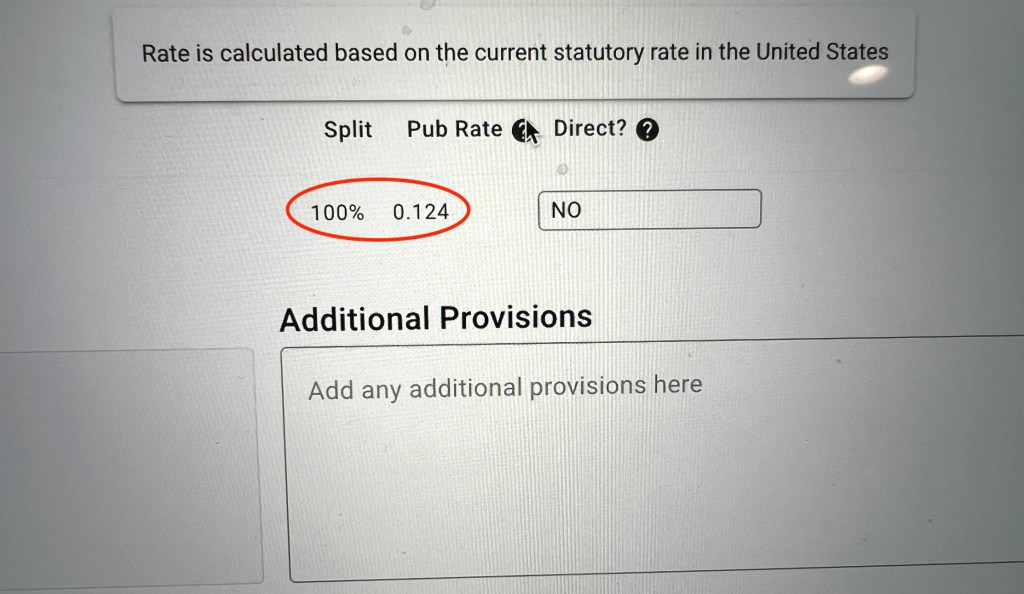
It’s probably just a glitch, but I understand that HFA hasn’t updated the 1/1/25 rates yet for “licensing out” in at least one instance (see screen capture below obtained this week). I’m inclined to believe that the issue is with the database and would not be a one-off, but I could be wrong. That suggests to me that every songwriter and publisher with either a newly issued license since 1/1/25 or a floating rate license in place during PR IV rate period (2023-2027) should probably confirm that the respective COLA escalations have been properly applied as of January 1 of 2024 and 2025. I would imagine that this isn’t an isolated incident, but maybe it is. No reason to let grass grow, however.
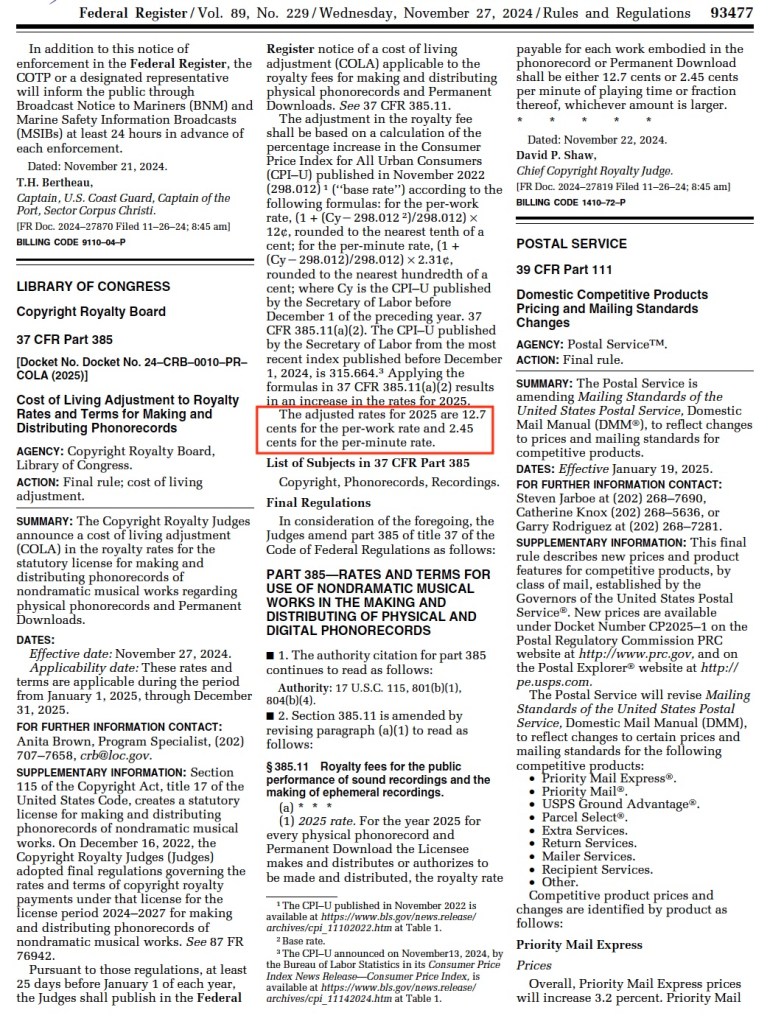
Here’s the Copyright Royalty Board’s timely notice of the new rate effective 1/1/25–which means that the HFA system does not appear to have been updated unless the screen capture reflects a one-off which seems doubtful to me.
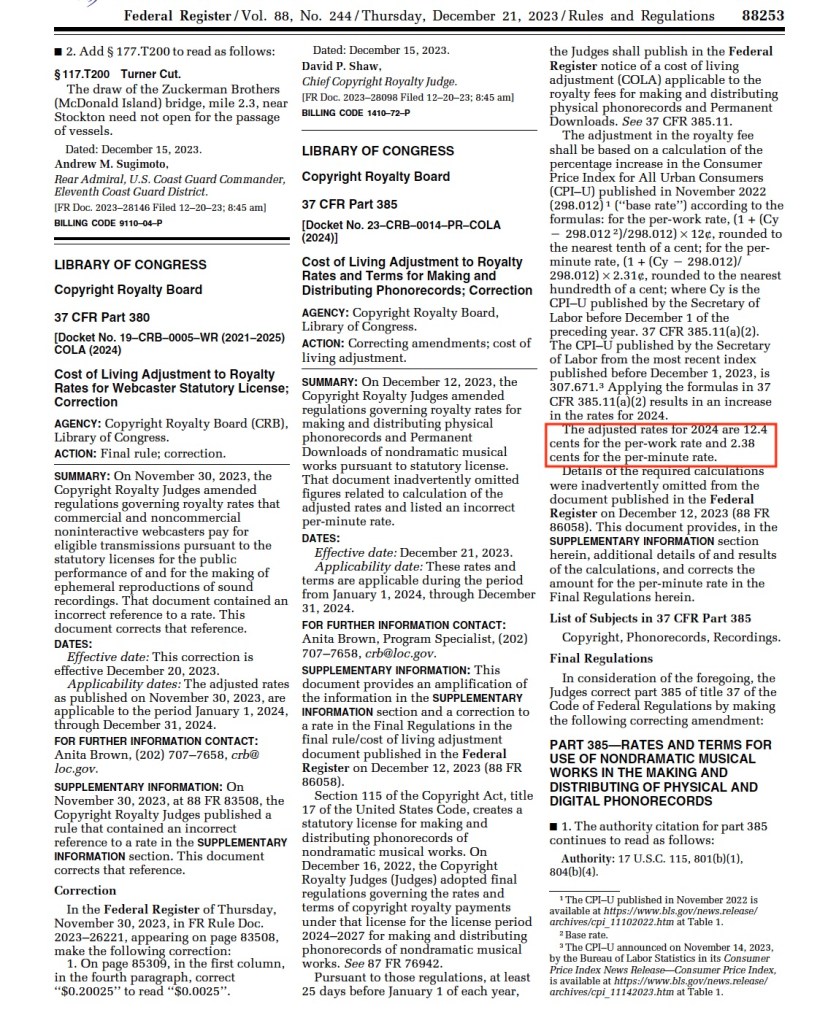
And for reference, this is the rate for 2024 with the COLA adjustment that may also have been misapplied–everyone would have to check to know if it was misapplied to them.
Summary: The fight over frozen mechanicals continues to pay off as songwriters log another cost of living increase for physical/downloads while streaming falls farther behind.
The Copyright Royalty Board adjusted the US statutory mechanical royalty for physical carriers like vinyl, CDs and downloads annually during the current rate period. This is entirely due to the success of public comments by the ad hoc songwriter bargaining group that persuaded the Copyright Royalty Judges to reject the terrible “frozen mechanicals” settlement negotiated with the NMPA, NSAI and RIAA.
As it turned out, once the judges rejected the freeze as unfair, the labels quickly agreed to a fair result that increased the physical/download rate from a 9.1¢ base rate to the 12¢ rate suggested by the Judges which went a long way to making up for the 15 year freeze at 9.1¢. In fact, if it had just been presented to the labels to begin with, a tremendous amount of agita could have been saved all round.
Crucially, not only did the base rate increase to 12¢, the judges also approved a prospective cost of living adjustment determined by a formula using the Consumer Price Index. The end result is that unlike streaming mechanicals paid by the streaming services like Spotify (i.e., not the labels) the value of the increase from 9.1¢ to 12¢ has been protected from inflation during the rate period (2023-2027).
Unfortunately, the streaming services were allowed to reject a cost of living for streaming mechanicals, notwithstanding the Judges’ and the services’ acceptance of an COLA-type adjustment to the multimillion dollar budget of the Mechanical Licensing Collective. That COLA is ased on a government measurement of inflation (the Employment Cost Index) comparable to the CPI-U that is used to increase the services’ financing of salaries and other costs at the Mechanical Licensing Collective. So those who are paid handsomely to collect and pay songwriters get a better deal than the songwriters they supposedly serve.
What is the increase in pennies this year for the physical/download mechanical rate? The Judges determine the inflation-adjusted rate every year during the five year rate period (2023-2027). The calculation is made in December for physical/download with reference to the CPI-U rate announced by the Bureau of Labor Statistics as of December 1, which means the rate published on November 11. The new rate goes into effect on January 1, 2025.
At this point, there does not seem to be any indication that there will be a large spike in inflation between now and November 11, so we can use the September rate (just announced in October) to make an educated guess as to what the 2025 statutory rate increase will be for physical/downloads (rounded down):
So we can safely project that the base rate will increase from 12.4¢ for 2024 to about 12.6¢ in 2025 without firing a shot. If you have a 10 x 3/4 rate controlled compositions clause, that means the U.S. controlled pool on physical will be approximately 94.5¢ instead of the old frozen rate of 68.25¢.
It’s important to note a couple things about the relevance of CPI-U as a metric for protecting royalty rates from the ravages of inflation. First of all, the CPI-U is a statistical smoothing of the specific rates for particular goods and services that it measures and doesn’t reflect the magnitude of changes of some components.
For example, the September CPI-U increased by 0.2% on a seasonally adjusted basis. However, the shelter index and the food index increased at higher rates:
The shelter index rose by 0.2%, and the food index increased by 0.4% Together, these two components contributed over 75% of the monthly increase in the all items index.
Chris Castle said, “These are good benchmarks to keep in mind as we head into a new rate setting period in a year or so when I expect songwriters to demand a COLA for streaming mechanicals. No more poormouthing from the services. If they can give it to MLC, they can give it to the songwriters, too.”



 The Trichordist
You must be logged in to post a comment.