United for Artists’ Rights: Amicus Briefs Filed in Vetter v. Resnik Support Global Copyright Termination for Songwriters and Authors: Brief by the National Society of Entertainment & Arts Lawyers

In Vetter v. Resnik, songwriter Cyril Vetter won his trial case in Baton Rouge allowing him to recover worldwide rights in his song “Double Shot of My Baby’s Love” after serving his 35 year termination notice on his former publisher, Resnik Music Group. The publisher appealed. The Fifth Circuit Court of Appeals will hear the case and currently is weighing whether U.S. copyright termination rights include “foreign” territories—a question that strikes at the heart of artists’ ability to reclaim their work worldwide (whatever “foreign” means).

Cyril’s attorney Tim Kappel explains the case if you need an explainer:

An astonishing number of friend of the court briefs were filed by many songwriter groups. We’re going to post them all and today’s brief is by the National Society of Arts & Entertainment Lawyers. The brief argues that the Copyright Act’s plain text and legislative history support a unified, comprehensive termination right that revokes all rights granted in a prior transfer, regardless of geographic scope. It rejects the notion of a “multiverse” of national copyrights, citing international treaties like the Berne Convention and longstanding U.S. policy favoring artist protection. Limiting terminations to U.S. territory, the brief warns, would gut the statute’s purpose, harm artists, and impose impossible burdens on creators seeking to reclaim their rights.

We believe the answer on appeal must be yes–affirm the District Court’s well-reasoned decision. Congress gave creators and their heirs the right a “second bite at the apple” to regain control of their work after decades, and that promise means little if global rights are excluded. The outcome of this case could either reaffirm that promise—or open the door for multinational publishers to sidestep it entirely.

That’s why we’re sharing friend of the court briefs from across the creative communities. Each one brings a different perspective—but all defend the principle that artists deserve a real, global right to take back what’s theirs, because as Chris said, Congress did not give authors a second bite at half the apple.

Read the brief below, watch this space for case updates.

United for Artists’ Rights: Amicus Briefs Filed in Vetter v. Resnik Support Global Copyright Termination for Songwriters and Authors: Brief by Music Artists Coalition, Black Music Action Coalition, Artists Rights Alliance, Songwriters Of North America, and Screen Actors Guild-American Federation Of Television And Radio Artists

In Vetter v. Resnik, songwriter Cyril Vetter won his trial case in Baton Rouge allowing him to recover worldwide rights in his song “Double Shot of My Baby’s Love” after serving his 35 year termination notice on his former publisher, Resnik Music Group. The publisher appealed. The Fifth Circuit Court of Appeals will hear the case and currently is weighing whether U.S. copyright termination rights include “foreign” territories—a question that strikes at the heart of artists’ ability to reclaim their work worldwide (whatever “foreign” means).

Cyril’s attorney Tim Kappel explains the case if you need an explainer:

An astonishing number of friend of the court briefs were filed by many songwriter groups. We’re going to post them all and today’s brief is by Music Artists Coalition, Black Music Action Coalition, Artists Rights Alliance, Songwriters Of North America, And Screen Actors Guild-American Federation Of Television And Radio Artists–that’s right, the SAG-AFTRA union is with us.

We believe the answer must be yes. Congress gave creators and their heirs the right a “second bite at the apple” to regain control of their work after decades, and that promise means little if global rights are excluded. The outcome of this case could either reaffirm that promise—or open the door for multinational publishers to sidestep it entirely.

That’s why we’re sharing friend of the court briefs from across the creative communities. Each one brings a different perspective—but all defend the principle that artists deserve a real, global right to take back what’s theirs, because as Chris said, Congress did not give authors a second bite at half the apple.

Read the latest amicus brief below, watch this space for more.

United for Artists’ Rights: Amicus Briefs Filed in Vetter v. Resnik Support Global Copyright Termination for Songwriters and Authors: The Authors Guild, Inc., Dramatists Legal Defense Fund, Inc., Novelists, Inc., Romance Writers Of America, Inc., Society Of Composers & Lyricists, Inc. and Songwriters Guild Of America, Inc.

In Vetter v. Resnik, songwriter Cyril Vetter won his trial case in Baton Rouge allowing him to recover worldwide rights in his song “Double Shot of My Baby’s Love” after serving his 35 year termination notice on his former publisher, Resnik Music Group. The publisher appealed. The Fifth Circuit Court of Appeals will hear the case and currently is weighing whether U.S. copyright termination rights include “foreign” territories—a question that strikes at the heart of artists’ ability to reclaim their work worldwide (whatever “foreign” means).

Cyril’s attorney Tim Kappel explains the case if you need an explainer:

An astonishing number of friend of the court briefs were filed by many songwriter groups. We’re going to post them all and today’s brief is by The Authors Guild, Inc., Dramatists Legal Defense Fund, Inc., Novelists, Inc., Romance Writers Of America, Inc., Society Of Composers & Lyricists, Inc. and Songwriters Guild Of America, Inc.

We believe the answer must be yes. Congress gave creators and their heirs the right to regain control of their work after decades, and that promise means little if global rights are excluded. The outcome of this case could either reaffirm that promise—or open the door for multinational publishers to sidestep it entirely.

That’s why we’re sharing friend of the court briefs from across the creative communities. Each one brings a different perspective—but all defend the principle that artists deserve a real, global right to take back what’s theirs, because as Chris said Congress did not give authors a second bite at half the apple.

Read the latest amicus brief below.

Hey Budweiser, You Give Beer a Bad Name

In a world where zero royalties becomes a brag, and one second of music is one second too far.

Let me set the stage: Cannes Lions is the annual eurotrash…to coin a phrase…circular self-congratulatory hype fest at which the biggest brands and ad agencies in the world if not the Solar System spend unreal amounts of money telling each other how wonderful they are. Kind of like HITS Magazine goes to Cannes but with a real budget. And of course the world’s biggest ad platform–guess who–has a major presence there among the bling and yachts of the elites tied up in Yachtville by the Sea. And of course they give each other prizes, and long-time readers know how much we love a good prize, Nyan Cat wise.

Enter the King of Swill, the mind-numbingly stupid Budweiser marketing department. Or as they say in Cannes, Le roi de la bibine.

Credit where it’s due: British Bud-hater and our friend Chris Cooke at CMU flagged this jaw-dropper from Cannes Lions, where Budweiser took home the Grand Prix for its “One‑Second Ad” campaign—a series of ultra-short TikTok clips that featured the one second of hooks from iconic songs. The gimmick? Tease the audience just long enough to trigger nostalgia, then let the internet do the rest. The beer is offensive enough to any right-thinking Englishman, but the theft? Ooh la la.

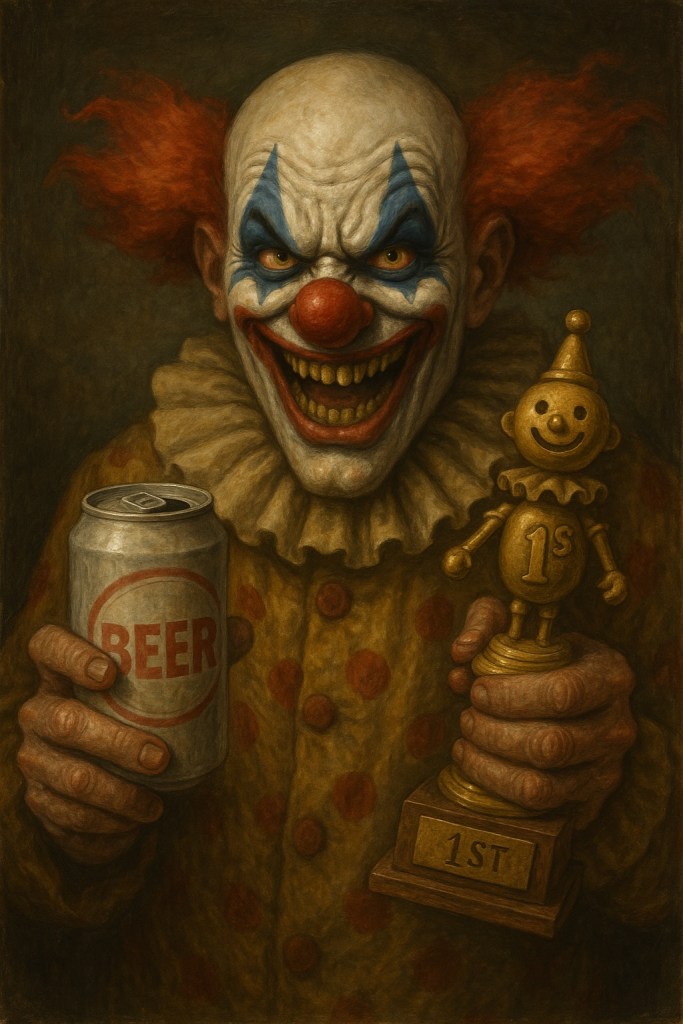
Cannes Clown

Budweiser’s award-winning brag? “Zero ads were skipped. $0 spent on music right$.” Yes, that’s correct–“right$”.

That quote should hang in a museum of creative disinformation.

There’s an old copyright myth known as the “7‑second rule”—the idea that using a short snippet of a song (usually under 7 seconds) doesn’t require a license. It’s pure urban legend. No court has ever upheld such a rule, but it sticks around because music users desperately want it to be true. Budweiser didn’t just flirt with the myth—it took the myth on a date to Short Attention Span Theater, built an ad campaign around it, and walked away with the biggest prize in advertising to the cheers of Googlers everywhere.

When Theft from artists Becomes a Business Model–again

But maybe this kind of stunt shouldn’t come as a surprise. When the richest corporations in commercial history are openly scraping, mimicking, and monetizing millions of copyrighted works to train AI models—without permission and without payment—and so far getting away with it, it sends a signal. A signal that says: “This isn’t theft, it’s innovation.” Yeah, that’s the ticket. Give them a prize.

So of course Budweiser’s corporate brethren start thinking: “Me too.

As Austin songwriter Guy Forsyth wrote in Long Long Time“Americans are freedom-loving people, and nothing says freedom like getting away with it.” That lyric, in this context, resonates like a manifesto for scumbags.

The Immorality of Virality

For artists and the musicians and vocalists who created the value that Budweiser is extracting, the campaign’s success is a masterclass in bad precedent. It’s one thing to misunderstand copyright; it’s another to market that misunderstanding as a feature. When global brands publicly celebrate not paying for music–in Cannes, of all places—the very tone-deaf foundation of their ad’s emotional resonance sends a corrosive signal to the entire creative economy. And, frankly, to fans.

Oops!… I Did It Again, bragged Budweiser, proudly skipping royalties like it’s Free Fallin’, hoping no one notices they’re just Smooth Criminals playing Cheap Thrills with other people’s work. It’s not Without Me—it’s without paying anyone—because apparently Money for Nothing is still the vibe, and The Sound of Silence is what they expect from artists they’ve ghosted.

Because make no mistake: even one second of a recording can be legally actionable particularly when the intentional infringing conspiracy gets a freaking award for doing it. That’s not just law—it’s basic respect, which is kind of the same thing. Which makes Budweiser’s campaign less of a legal grey area and more of a cultural red flag with a bunch of zeros. Meaning the ultimate jury award from a real jury, not a Cannes jury.

This is the immorality of virality: weaponizing cultural shorthand to score branding points, while erasing the very artists who make those moments recognizable. When the applause dies down in Yachtville, what’s left is a case study in how to win by stealing — not creating.

MTP Interview: Attorney Tim Kappel and Abby North Discuss Landmark Vetter v. Resnick case with Chris Castle

In a rare treat, Abby North and Chris Castle got to speak with New Orleans attorney Tim Kappel about his client’s case Vetter v. Resnick. The landmark case stands for winning the long-fought principle that termination rights in copyright cause the transfer of the worldwide copyright not just US rights as had been the business practice. The case is a major victory for songwriters and their heirs.

Cyril Vetter and Don Smith co-wrote the song “Double Shot (Of My Baby’s Love)” in 1962. They assigned all their interests in the song to Windsong Music Publishers. Vetter later served a termination notice on Resnick to recapture his rights under the U.S. Copyright Act, arguing that this termination applied globally, not just in the U.S. Resnick rejected Vetter’s global termination and Vetter sued for declaratory relief in the Middle District of Louisiana.

In a major win for songwriters and their heirs, Chief District Judge Shelly D. Dick agreed with Vetter, granting him worldwide rights to the song, which contradicted established but inequitable business practices in the U.S. music publishing industry. In the podcast, Chris Castle and Abby North discuss the case with Vetter’s attorney, Tim Kappel. These documents are referenced in the podcast.

Kim Dot Com Emerges from the Memory Hole

By Chris Castle

“If you get down on your knees and beg to be arrested, don’t be surprised if you are.”

That was what I told a TV news anchor in an interview I did in 2012 right after Kim Dot Com was arrested on his vast estate in New Zealand.  Dot Com’s arrest started a long running extradition proceeding between the United States and New Zealand that Dot Com and his team of lawyers somehow managed to drag out until this year.  That’s right—twelve years.  That puts him right up there with Roman Polanski and Meng Wanzhou.  So now Dot Com is subject to extradition back the US to face criminal charges, and yet nobody in New Zealand seems to be in a big hurry to arrest him and send him Stateside.

The first time I connected the dots on Dot Com’s piracy site Megaupload was when film maker Ellen Seidler launched a site called Pop Up Pirates.   Megaupload figured large in her site for a simple reason:  When you tried to access a film stored on Megaupload, it launched a popup with an ad.  At that time, many of those ads included a credit saying “Ads by Google.”  Ellen gave me a short clip of her launching the Mega popup in real time with a close up of that ad.  I played the clip on a panel with one of the Google charm offensive folks who I thought was going to vomit when he realized what I had just shown the audience.  I thought I conclusively demonstrated that Google profited from piracy and paid pirates—being Kim Dot Com aka “Defendant.”

Shortly after, I started posting about this obvious connection, which is how Dot Com and his confederates were getting rich from their the-Hong Kong-based pirate site.  And of course, I would find it hard to believe that anyone was operating a lucrative pirate site from Hong Kong without taking care of people if you know what I mean.  So there’s that.

Fast forward a year and I was in front of the National Association of Attorneys General demonstrating Google’s many, many connections to crime, terrorists, and general issue bad guys.  

Right about this time I got a call from a distinguished music industry executive who asked me whether I was seriously suggesting that a public company was involved in funding crime.  I said that’s exactly what I was saying.  If that were to happen today, nobody, and I mean nobody, would question that Google is the paymaster of the dark web.

Which leads me to the Dot Com indictment.  It turns out that we are not the only ones who made the connection between Google and massive piracy. The Department of Justice did, too, and describes the connection quite clearly in the indictment.

Adbright and Google were Sequoia investments and PartyGaming was one of the big donors to Creative Commons (and the whole Lessig/Nesson poker lobbying extravaganza).

So who had an interest in keeping Kim Dot Com out of an American jail in case he might negotiate a plea deal as did his confederate Andrus Nomm back in 2018? According to the New Zealand Herald:

While [Dot Com] and his co-accused have denied all charges, Nomm testified in support of the US case. As an insider, his testimony will be key to supporting prosecution arguments the so-called “Megaconspiracy” knew what it was doing, attacking any claim the accused were acting in the belief the website was lawful.

Nomm’s testimony was included in the case for extradition in New Zealand but documents showing how will not be made public until after the judge’s decision has been made. The Herald is unable to report the details of the US case that Nomm pleaded guilty to in the United States until then.

The press release from the U.S. Department of Justice tells us:

In court papers, Nomm agreed that the harm caused to copyright holders by the Mega Conspiracy’s criminal conduct exceeded $400 million.  He further acknowledged that the group obtained at least $175 million in proceeds through their conduct.  Megaupload.com had claimed that, at one time, it accounted for four percent of total Internet traffic, having more than one billion total visits, 150 million registered users and 50 million daily visitors.

In a statement of facts filed with his plea agreement, Nomm admitted that he was a computer programmer who worked for the Mega Conspiracy from 2007 until his arrest in January 2012.  Nomm further admitted that, through his work as a computer programmer, he was aware that copyright-infringing content was stored on the websites, including copyright protected motion pictures and television programs, some of which contained the “FBI Anti-Piracy” warning.  Nomm also admitted that he personally downloaded copyright-infringing files from the Mega websites.  Despite his knowledge in this regard, Nomm continued to participate in the Mega Conspiracy. 

An extradition hearing for co-defendants Kim Dotcom, Mathias Ortmann, Bram Van der Kolk and Finn Batato is currently scheduled for June 2015 in Auckland, New Zealand.  Co-defendants Julius Bencko and Sven Echternach remain at large.

This case is being investigated by the FBI’s Headquarters and Washington Field Office.  The case is being prosecuted by Senior Counsel Ryan K. Dickey and Brian L. Levine of the Criminal Division’s Computer Crime and Intellectual Property Section and Assistant U.S. Attorney Jay V. Prabhu of the Eastern District of Virginia.  The Criminal Division’s Office of International Affairs also provided significant assistance.

So if there was a “conspiracy”, it takes more than two to tango. That racketeering and money laundering conspiracy might have included the advertising companies that played an essential role in providing illicit revenue to the “Megaconspiracy”. Recall that Google got caught in a federal sting operation, paid a $500,000,000 fine and entered a nonprosecution agreement with the same DOJ for promoting the sale of illegal drugs online, all at roughly the same time as they appear to have been the paymaster for Mr. Dot Com. Why else were Adbright, Google and Partygaming mentioned in the indictment?

Stay tuned, boys and girls.  The plot sickens.

Press Release from @AmericanPublish: Appeals Court Affirms Decision Against Internet Archive for Copyright Infringement

[The defeat of Big Tech and the Internet Archive is one of the most important copyright cases in the last ten years. This press release is a good summary of the ruling from our allies at the Association of American Publishers.]

Today the United States Court of Appeals for the Second Circuit affirmed the District Court’s March 2023 opinion in favor of publishers Hachette Book Group, HarperCollins, John Wiley & Sons, and Penguin Random House, finding Internet Archive liable for copyright infringement and rejecting all four factors of Internet Archive’s fair use argument.

The Court squarely addressed the question of whether it is “fair use” for a nonprofit organization to scan copyright-protected print books in their entirety, and distribute those digital copies online, in full, for free, subject to an asserted one-to-one owned-to-loaned ratio between its print copies and the digital copies it makes available at any given time, without any authorization from the copyright owner.  In the Court’s words, “[a]pplying the relevant provisions of the Copyright Act, as well as binding Supreme Court and Second Circuit precedent, we conclude the answer is no.”

The following is a statement from Maria A. Pallante, President and CEO, Association of American Publishers:

“Today’s appellate decision upholds the rights of authors and publishers to license and be compensated for their books and other creative works and reminds us in no uncertain terms that infringement is both costly and antithetical to the public interest. Critically, the Court frontally rejects the defendant’s self-crafted theory of “controlled digital lending,” irrespective of whether the actor is commercial or noncommercial, noting that the ecosystem that makes books possible in fact depends on an enforceable Copyright Act.  If there was any doubt, the Court makes clear that under fair use jurisprudence there is nothing transformative about converting entire works into new formats without permission or appropriating the value of derivative works that are a key part of the author’s copyright bundle.”

Key Quotes the Court’s decision:

  • Within the framework of the Copyright Act, IA’s argument regarding the public interest is shortsighted. True, libraries and consumers may reap some short-term benefits from access to free digital books, but what are the long-term consequences?
  • If authors and creators knew that their original works could be copied and disseminated for free, there would be little motivation to produce new works. And a dearth of creative activity would undoubtedly negatively impact the public. It is this reality that the Copyright Act seeks to avoid.
  • Because IA’s Free Digital Library functions as a replacement for the originals, it is reasonable and logical to conclude not only that IA’s digital books currently function as a competing substitute for Publishers’ licensed editions of the Works, but also that, if IA’s practices were to become “unrestricted and widespread,” it would decimate Publishers’ markets for the Works in Suit across formats.
  • Were we to approve IA’s use of the Works, there would be little reason for consumers or libraries to pay Publishers for content they could access for free on IA’s website. . .Thus, we conclude it is ‘self-evident’ that if IA’s use were to become widespread, it would adversely affect Publishers’ markets for the Works in Suit.
  • IA does not perform the traditional functions of a library; it prepares derivatives of Publishers’ Works and delivers those derivatives to its users in full…Whether it delivers the copies on a one-to-one owned-to-loaned basis or not, IA’s recasting of the Works as digital books is not transformative.
  • [B]ecause IA’s Free Digital Library primarily supplants the original Works without adding meaningfully new or different features that avoid unduly impinging on Publishers’ rights to prepare derivative works, its use of the Works is not transformative.
  • Digitizing physical copies of written work is not transformative, because the act ‘merely transforms the material object embodying the intangible article that is the copyrighted original work.’
  • The Copyright Act protects authors’ works in whatever format they are produced.
  • IA’s Free Digital Library does not “improv[e] the efficiency of delivering content” without unreasonably encroaching on the rights of the copyright holder; it offers the same efficiencies as Publishers’ derivative works while greatly impinging on their exclusive right to prepare those works.
  • While IA claims that prohibiting its practices would harm consumers and researchers, allowing its practices would―and does―harm authors.

The full decision can be found here.

@CadeMetz @ceciliakang @sheeraf @stuartathompson @nicogrant: How Tech Giants Cut Corners to Harvest Data for A.I.


[This is a must-read, deeply researched, long form article about how Big Tech–mostly OpenAI, Google and Microsoft–are abrogating consumers trust and their promises to creators in a mad, greedy, frothing rush to some unknown payoff with AI. The Dot Bomb boom is dwarfed by the AI gold rush, but this article is a road map to just how bad it really is and how debased these people really are. Thanks to the destruction of the newsroom, only a handful of news outlets can deliver work of this quality, but thankfully the New York Times is still standing. How long is another story.]

OpenAI, Google and Meta ignored corporate policies, altered their own rules and discussed skirting copyright law as they sought online information to train their newest artificial intelligence systems….

OpenAI researchers created a speech recognition tool called Whisper. It could transcribe the audio from YouTube videos, yielding new conversational text that would make an A.I. system smarter.

Some OpenAI employees discussed how such a move might go against YouTube’s rules, three people with knowledge of the conversations said. YouTube, which is owned by Google, prohibits use of its videos for applications that are “independent” of the video platform.

Ultimately, an OpenAI team transcribed more than one million hours of YouTube videos, the people said….

Like OpenAI, Google transcribed YouTube videos to harvest text for its A.I. models, five people with knowledge of the company’s practices said. That potentially violated the copyrights to the videos, which belong to their creators.

Last year, Google also broadened its terms of service. One motivation for the change, according to members of the company’s privacy team and an internal message viewed by The Times, was to allow Google to be able to tap publicly available Google Docs, restaurant reviews on Google Maps and other online material for more of its A.I. products.

The companies’ actions illustrate how online information — news stories, fictional works, message board posts, Wikipedia articles, computer programs, photos, podcasts and movie clips — has increasingly become the lifeblood of the booming A.I. industry. 

Read the post on New York Times.

Bridgeport Music Files Notice of The MLC’s First Royalty Audit

[Editor Charlie sez: a royalty “audit” is a right of the song owner to look inside the books and records of the party paying royalties to confirm that all royalties were paid and that all royalties were paid correctly, usually during a specified period of time. This usually results in the song owner discovering an underpayment that would have gone unpaid without the audit.]

By Chris Castle

It is commonplace for artists to conduct a royalty examination of their record company, sometimes called an “audit.” Until the Music Modernization Act, the statutory license did not permit songwriters to audit users of the statutory license. The Harry Fox Agency “standard” license for physical records had two principal features that differed from the straight statutory license: quarterly accounting and an audit right. When streaming became popular, the services both refused to comply with the statutory regulations and also refused to allow anyone to audit because the statutory regulations they failed to comply with did not permit an audit. I brought this absurdity to the attention of the Copyright Office in 2011.

After much hoopla, the lobbyists wrote an audit right for copyright owners into the Music Modernization Act. However, rather than permitting copyright owners to audit music users as is long standing common practice on the record side, the lobbyists decided to allow copyright owners to audit the Mechanical Licensing Collective. At the expense of the copyright owner, of course, no matter how many mistakes the copyright owner discovered or how big the underpayment. This is consistent with the desire of services to distance themselves from those pesky songwriters by inserting the MLC in between the services and their ultimate vendors, the songwriters and copyright owners. The services can be audited by the MLC (whose salaries are paid by the services), but that hasn’t happened yet to my knowledge.

But the MLC has received what I believe is its first audit notice that was just published by the Copyright Office after receiving it on November 9. First up is Bridgeport Music, Inc. for the period January 1, 2021, through December 31, 2023. January 1, 2021 was the “license availability date” or the date that the MLC began accounting for royalties under the MMA’s blanket license.

Why Audit Now?

Bridgeport’s audit is wise. There are no doubt millions if not billions of streams to be verified. The MLC’s systems are largely untested, compared to other music users such as record companies that have been audited hundreds, if not thousands of times depending on how long they are operating. Competent royalty examiners will look under the hood and find out whether it’s even possible to render reasonably accurate accounting statements given the MLC’s systems. Maybe it’s all fine, but maybe it’s not. The wisdom of Bridgeport’s two year audit window is that two years is long enough to have a chance at a recovery but it’s not so long that you are drowned in data and susceptible to taking shortcuts. 

In other words, why wait around?

Auditing the Black Box

A big difference between the audit rules the lobbyists wrote into the MMA and other audits is that the MLC audit is based on payments, not statements. The relevant language in the statute makes this very clear (17 USC §115(d)(3)(L):

A copyright owner entitled to receive payments of royalties for covered activities from the mechanical licensing collective may, individually or with other copyright owners, conduct an audit of the mechanical licensing collective to verify the accuracy of royalty payments by the mechanical licensing collective to such copyright owner…The qualified auditor shall determine the accuracy of royalty payments, including whether an underpayment or overpayment of royalties was made by the mechanical licensing collective to each auditing copyright owner.

Royalty payments would include a share of black box royalties distributed to copyright owners. It seems reasonable that on audit a copyright owner could verify how this share was arrived at and whatever calculations would be necessary to calculate those payments, or maybe the absence of such payments that should have been made. Determining what is not paid that should have been paid is an important part of any royalty verification examination.

Systems Transparency

Information too confidential to be detected cannot be corrected.  It is important to remember that copyright owner audits of the MLC will be the first time an independent third party has had a look at the accounting systems and functional technology of The MLC. If those audits reveal functional defects in the MLC’s systems or technology that affects any output of The MLC, i.e., not just the royalties being audited, it seems to me that those defects should be disclosed to the public. Audit settlements should not be used as hush money payments to keep embarrassing revelations from being publicly disclosed.

Unsurprisingly, The MLC lobbied to have broadly confidential treatment of all audits. Realize that there may well be confidential financial information disclosed as part of any audit that both copyright owners and The MLC will want to keep secret. There is no reason to keep secrets about The MLC’s systems. To take an extreme example, if on audit the auditors discovered that The MLC’s systems added 2 plus 2 and got 5, that is a fact that others have a legitimate interest in having disclosed to include the Copyright Office itself that is about to launch a 5 year review of The MLC for redesignation. Indeed, auditors may discover systemic flaws that could arguably require The MLC to recalculate many if not all statements or at least explain why they should not. (Note that a royalty auditor is required to deliver a copy of the auditor’s final report to The MLC for review even before giving it to their client. This puts The MLC on notice of any systemic flaws in The MLC’s systems found by the auditor and gives it the opportunity to correct any factual errors.)

I think that systemic flaws found by an auditor should be disclosed publicly after taking care to redact any confidential financial information. This will allow both the Copyright Office and MLC members to fix any discovered flaws.

The “Qualified Auditor” Typo

It is important to realize that there is no good reason why a C.P.A. must conduct the audit; this is another drafting glitch in the MMA that requires both The MLC’s audited financial statements and royalty compliance examinations be conducted by a C.P.A, defined as a “qualified auditor” (17 USC § 115(e)(25)). It’s easy to understand why audited financials prepared according to GAAP should be opined by a C.P.A. but it is ludicrous that a C.P.A. should be required to conduct a royalty exam for royalties that have nothing to do with GAAP and never have. 

To be frank, I doubt seriously whether anyone involved in drafting the MMA had ever personally conducted or managed a royalty verification examination. That assessment is based on the fact that royalty verification examinations are one of the most critical parts of the royalty payment process and is the least discussed subject in the lengthy MMA; at the time, the lobbyists did not represent songwriters and tried very hard to keep songwriters inside the writer room and outside of the drafting room as you can tell from The MLC, Inc.’s board composition; and that the legislative history (at 20) has one tautological statement about copyright owner audits: ”Subparagraph L sets forth the verification and audit process for copyright owners to audit the collective, although parties may agree on alternate procedures.” Well no kidding, smart people. We’ll take some context if you got it.

As Warner Music Group’s Ron Wilcox testified to the Copyright Royalty Judges, “Because royalty audits require extensive technical and industry-specific expertise, in WMG’s experience a CPA certification is not generally a requirement for conducting such audits. To my knowledge, some of the. most experienced and knowledgeable royalty auditors in the music industry are not CPAs.” (Testimony of Ron Wilcox, In re Determination of Royalty Rates and Terms for Ephemeral Recording and Digital Performance of Sound Recordings (Web IV), Copyright Royalty Judges, Docket No. 14-CRB-0001-WR (Oct. 6, 2014) at 15.). 

I would add to Ron’s assessment that the need for “extensive technical and industry-specific expertise” has grown exponentially since he made the statement in 2014 due to the complexity and numerosity of streaming. I’m sure Ron would agree if he had a chance to revisit his remarks. But inside the beltway of the Imperial City, it ain’t that way and you can tell by reading their laws handed down by the descendants of Marcus Licinius Crassus. All accountants are CPAs, all accounting is according to GAAP, all the women are strong, all the men are good-looking, and all the children are above average and go to Sidwell Friends. In the words of London jazzman and club owner Ronnie Scott to an unresponsive audience, “And now, back to sleep.”

The “qualified auditor” defined term should be limited to the MLC’s financials and removed from the audit clauses. This was a point I made to Senate staff during the drafting of MMA, but was told that while they, too, agreed it was stupid, it’s what the parties wanted (i.e., what the lobbyists wanted). And you know how that can be. So now we sweep up behind the elephants in the circus of life. But then, I’m just a country lawyer from Texas, what do I know.

All praise to Bridgeport for stepping up.

This post first appeared on MusicTech.Solutions