Online Piracy Finally In the Crosshairs | William Buckley Jr. HuffPo

Written in 1998, with the intent of protecting both copyright holders and website owners, the Digital Millennium Copyright Act, quickly became a devastating problem for copyright holders. Not coincidentally, barely a year later, in 1999, Shawn Fanning launched Napster, marking the beginning of online piracy and over a decade of artist abuse.

Now, fifteen years later, most pirate sites are still operating under the protection provided by the DMCA’s Safe Harbor; a loop-hole that has enabled pirate sites to thrive in a quasi-legal gray area. A safe harbor from which online pirates claim compliance by engaging in what is commonly referred to as whack-a-mole, a process where infringing sites comply with take down notices by taking down the infringing content only to have the same content reposted almost immediately from another source.

The proposed change referred to as Stay Down strives to eliminate the safe harbor loop-hole. Copyright holders and administrators, while still responsible for policing their work, are only responsible for notifying a website operator one time. Once that is accomplished, the hosting site is now responsible for blocking the infringing content. A process that can be managed by software programs. If a service provider fails to comply they are in violation of the law.

READ THE FULL STORY AT HUFFPO:
http://www.huffingtonpost.com/william-buckley-jr/online-piracy-finally-in-_b_5086820.html

Everyone hates the DMCA | VOX INDIE

Unfortunately, rather than manage copyright, it’s provided a huge loophole through which a number of online pirate entrepreneurs sail blissfully through. Known as the “safe harbor” provision, this oft-abused language has served to shelter digital thieves at the expense of rights holders. ”Safe Harbor” has enabled the growth of a criminal cancer and it’s a cancer–that as of now–cannot be beaten, only kept (marginally) at bay. As Wikipedia notes, “The DMCA’s principal innovation in the field of copyright is the exemption from direct and indirect liability of internet service providers and other intermediaries.” As I’ve suggested previously, any update to the law should include a requirement that in order to qualify for the limitations to liability that safe-harbor offers, certain user-generated content sites must implement reasonable technology to mitigate content theft.

READ THE FULL POST AT VOX INDIE:
http://voxindie.org/everyone-hates-the-dmca

ISPs Can Be Forced To Block Piracy Sites, EU Court Rules | Forbes

In an endorsement of the UK’s anti-piracy policy, the European Court of Justice has ruled that EU states do have the right to order ISPs to block copyright-infringing websites.

The decision, which confirms an opinion late last year, follows a dispute between two movie companies – Germany’s Constantin Film Verleih and Austria’s Wega-Filmproduktionsgesellschaft – and internet provider UPC Telekabel Wien.

READ THE FULL POST AT FORBES:
http://www.forbes.com/sites/emmawoollacott/2014/03/27/isps-can-be-forced-to-block-piracy-sites-eu-court-rules/

Copyright “safe harbors” shrink in wake of MP3Tunes, other red flag rulings | GIGAOM

In case you missed it, a jury this week found that Michael Robertson, CEO of defunct music service MP3Tunes, was liable for copyright infringement. The jury concluded that Robertson, whose websites permitted users to upload songs and store them in “lockers,” had turned a blind eye to piracy — meaning that they forfeited the so-called “safe harbor” protections under copyright law that normally ensure that a website is not liable for the misdeeds of its users.

The significance of the case has little to do with MP3Tunes, which has long been closed, but instead stands as a strategic victory for copyright owners. That’s because the jury found Robertson liable on the basis of so-called “red flag” knowledge rather than “actual” knowledge. The distinction may sound arcane, but it’s one the studios have fought hard to establish as part of their strategy to change the level of proof needed to prove piracy.

READ THE FULL STORY AT GIGAOM:
http://gigaom.com/2014/03/21/copyright-safe-harbors-shrink-in-wake-of-mp3tunes-other-red-flag-rulings/

Slate’s Anti Copyright rant sounds like a letter from your psycho ex. | AdLand.Tv

The rationale by Silicon Valley that we already have the DMCA and it’s working just fine– seems positively Right Wing in its rabid belief system of law. Conservatives say much the same thing about guns. “We don’t need new laws, we need to enforce the existing ones.” It amusing to me that this backward sentiment is the same. Really though, it’s neither left nor right wing. It’s just pure cynicism by people who think we’re stupid.

To blame Hollywood copyright lobbyists for trying to influence law when google does the exact same thing is either ignorant or hypocritical. And to ignore the fact it isn’t just “Hollywood Copyright Lobbyists” but entire countries that are reacting to what they see is Big Tech run rampant, suggests once again the narrative is being controlled in Big Tech’s favor.

No surprise, really. The blog post was written by Marvin Ammori. He is a lawyer and Future Tense Fellow at New America. New America Foundation is a nonprofit and (ha-ha) nonpartisan public policy institute. Wanna guess who chairs the board of directors? Eric Schmidt, executive chairman of google.

READ THE FULL STORY:
http://adland.tv/adnews/slates-anti-copyright-rant-sounds-letter-your-psycho-ex/256965859#KdyGl5zIdACdgSvs.99

Victims of IP theft need better protection By Reps. Judy Chu and Tom Marino | The Hill

Stopping IP theft should not be this difficult, or so costly, to the individual artist, who is ultimately the victim.

In the first six months of 2013, the largest search engine received more than 100 million DMCA takedown notices. The numbers are staggering, but don’t reflect the reality that most indie and small creators struggle to keep up with issuing notices and have simply given up trying to prevent illegal profiting from their work. Independent artists cannot afford employing an entire legal department to monitor the unauthorized use of their content on a daily basis.

And the profits are staggering — a recent study by the Digital Citizens Alliance estimates that the top 596 pirate sites raked in $227 million in advertising revenues last year. These sites had a profit margin of between 80 and 94 percent. Content thieves rely on stealing the rights-protected work of others and distributing on low-cost sites. It’s a low-risk, high-reward business.

This week, the House Judiciary subcommittee on Intellectual Property will examine the “Notice and Takedown” process, and to us, it is clear that a very hard look is necessary.

READ THE FULL STORY AT THE HILL:
http://thehill.com/opinion/op-ed/200630-victims-of-ip-theft-need-better-protection

Sons of Anarchy Creator Kurt Sutter Responds to Google Shill Marvin Ammori, and boy is it good!

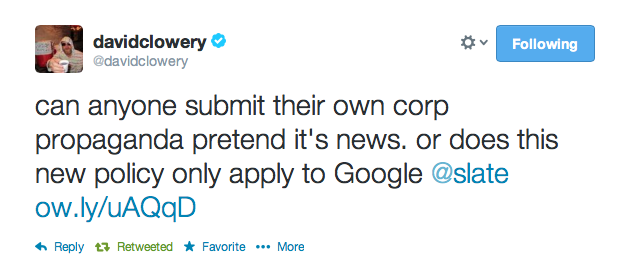
So Google shill Marvin Ammori wrote an Asperger’s ridden anti-copyright, anti-artist tirade on Slate. Of course in doing so Marvin failed to represent his past and current affiliations to Google. Slate, to their credit amended the rant with the following:

Update, March 11, 2014: Disclosure: The author represented Google and other companies fighting SOPA/PIPA in 2011 and 2012. He currently represents Google and other companies on several issues, including copyright reform. These views are his own.

googlepropagandaasnews

Of course, this isn’t the first time that those with a political agenda haven’t disclosed their affiliations. Who can forget Timothy B. Lee’s Epic Fail in the Washington Post on Piracy?

And so, we present the brilliant rebuttal to Google’s disingenuous attack on the rights of individual creators and artists by Kurt Sutter.

Not-So-Zen and the Art of Voluntary Agreements
Google’s anti-copyright stance is just a way to devalue content. That’s bad for artists and bad for consumers. By Kurt Sutter

It’s so absurd that Google is still presenting itself as the lovable geek who’s the friend of the young everyman. Don’t kid yourself, kids: Google is the establishment. It is a multibillion-dollar information portal that makes dough off of every click on its page and every data byte it streams. Do you really think Google gives a shit about free speech or your inalienable right to access unfettered content? Nope. You’re just another revenue resource Google can access to create more traffic and more data streams. Unfortunately, those streams are now pristine, digital ones of our work, which all flow into a huge watershed of semi-dirty cash. If you want to know more about how this works, just Google the word “parasite.” And if you think I’m exaggerating, ask yourself why Google spends tens of millions of dollars each year to hire lawyers and lobbyists (like Marv) whose sole purpose is to erode creative copyright laws.

Do they do this because they hate artists? No. They do it because they love money.

READ THE FULL STORY AT SLATE:
http://www.slate.com/articles/technology/technology/2014/03/sons_of_anarchy_creator_kurt_sutter_google_s_copyright_stance_is_bad_for.html

RELATED:

Google, Advertising, Money and Piracy. A History of Wrongdoing Exposed.|Trichordist

Why Google Really is Evil | Fox Business News

Google and Trichordist to debate piracy profits in London | Music Week

New Adventures in Copyright Enforcement @SXSW #SXSW

Friday, March 14 | 2:00PM – 3:00PM
New Adventures in Copyright Enforcement
Austin Convention Center | Room 17B | 500 E Cesar Chavez St

lthough debates about how to protect copyright online might seem so 2010, they certainly haven’t abated. The current conversations aren’t as contentious as the SOPA skirmishes, but that doesn’t necessarily mean consensus. Current attempts to address piracy are taking place outside of Congress, and include efforts to establish “best practices” between stakeholders. From the recently-minted Copyright Alert System to voluntary agreements meant to curb unauthorized activity within ad networks and payment processors, new experiments in rights protection abound. What’s the thinking behind the various approaches? What does a “win” look like, and what are the parameters for oversight? How can artists get involved?

MMODERATOR
Casey Rae
Interim Exec Dir – Future of Music Coalition

Sherwin Siy
VP, Legal Affairs- Public Knowledge

Jill Lesser
Exec Dir- Center For Copyright Information

David Lowery
Musician/Internet Content Provider – Cracker