Getting Copyrights, Right. David Lowery at Politico

Our own David Lowery makes a lot of compelling arguments in Politico on Monday morning, but this one in particular regarding a copyright registry and orphan works should be of interests to all consumers and individuals as well as all creators. Copyright effects everyone, not just musicians.

Register Your Family Albums

Both conservatives and liberals should be frightened by the “Principles’” attempt to “reformalize” effective copyright protection by encouraging Goodlatte to take away “rights and remedies” for those who do not register their works. Especially those works that the report deems to have “no commercial value”—as decided by the elites rather than the market, apparently.

So if one of the “users” the principles seem to think they represent — like me — posts a photo of my children on my Facebook page but I don’t register it, and somehow a company or individual then uses this picture commercially, or in some other vile manner, this report explicitly states that I would not have the same “rights and remedies” that I currently enjoy. In fact my reading of this report says I would have no remedies unless I were to win an argument that my family photos have commercial value — full employment for lawyers.

So are we all gonna have to register our family photos with Big Brother in order to keep control of them?

Read the full article here at Politico:
http://www.politico.com/story/2013/05/building-a-real-copyright-consensus-91231.html

Derek Khanna & Co. Continue Attack on Artists Rights at SXSWi Panel

The recent SXSW Interactive panel titled “Copyright & Disruptive Technologies” was merely another single point of view attack on artists, musicians and creators as artists rights are copyrights. It’s interesting that this panel offered no differing perspective from the view point of the artists and creators whose work is actually being exploited, without permission (or compensation).

On the panel were those who are advocating for “Permissionless Innovation” including Andrew Bridges, partner at Fenwick & West LLP, Ben Huh, CEO of the Cheezburger Network as well as a trio from Yale Law School’s Information Society Project including Wendy Seltzer, Margot Kaminski and Derek Khanna.

Glen Peoples at Billboard reported on the ongoing unilog of the copyleft attack on artists rights. The panel presented the usual anti-artist, anti-creator maximalist talking points which don’t believe in the artists right to grant consent for the exploitation of their work (and in many cases don’t believe in granting the creator compensation as well).

We’ve previously pointed out in some detail that Derek Khanna is wrong while highlighting all of the obvious fallacies and self created myths in his disavowed RSC “memo” on copyright. Now it appears that Derek himself is confused over the who may have even requested the memo. As our reader Jonathan Bailey (@plagiarismtoday) noted,

“Right now, we know who wrote the paper, but not who requested it, what supervision it was under and who, if anyone, approved its publication. This is not an acceptable way to interject a work into the public discourse.”

The persistent use of the meme “permissionless innovation” might just as well be called what they want it to really be, “permission to steal, and profit with immunity.” There is nothing innovative about stealing from or exploiting artists. In fact it’s a very, very old narrative sadly.

Panelist, Ben Huh complained that it might actually cost him money to track down rights holders whose work he is profiting from, how unfair right? Ben says…

“The cost of tracking down the rights owner is a minimum of $300 to $500 [per image]– if you’re successful.

Of course Mr. Huh went on to illustrate his problem in not paying creators in greater detail stating,

I have 23 million images, and I’m one of the smaller [online businesses] out there.

Yeah, what a drag to actually compensate the creators! So in simple math 23 Million multiplied by $500 equals $11.5 trillion dollars. One might determine that perhaps this is not a well thought out business model that requires such vast capital to support it’s inventory, if the cost of that inventory actually requires payment to the creators. Here again we see another internet business supported by advertising that earns revenue on marginal costs, but refuses to pay the creators fair compensation for their labor.

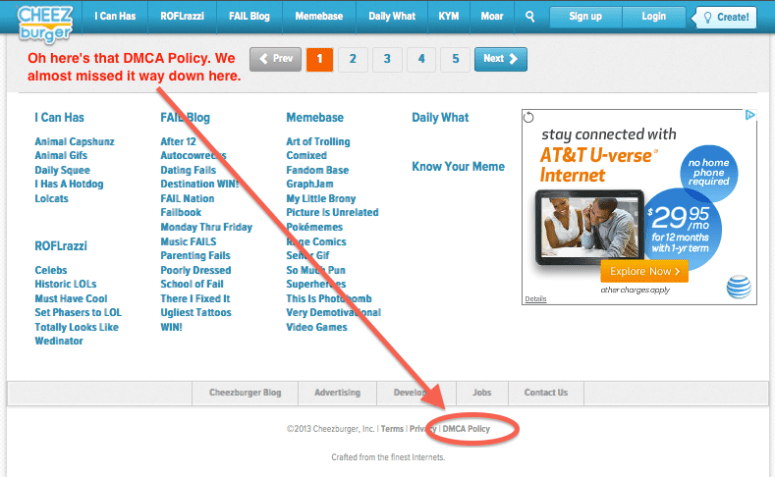
Of course, the site does provide a DMCA link, but we have to wonder how many rights holders are actually using it.
cheezburgeDMCA

What is clear is that the war on artists and creators which is now over a decade old continues to rage on by those who are profiting. Let’s once again be clear that this discussion is about money. It is about mass scale, enterprise level, commercial businesses profiting from the illegal exploitation of works by artists, photographers, musicians, filmmakers, authors and other creators.

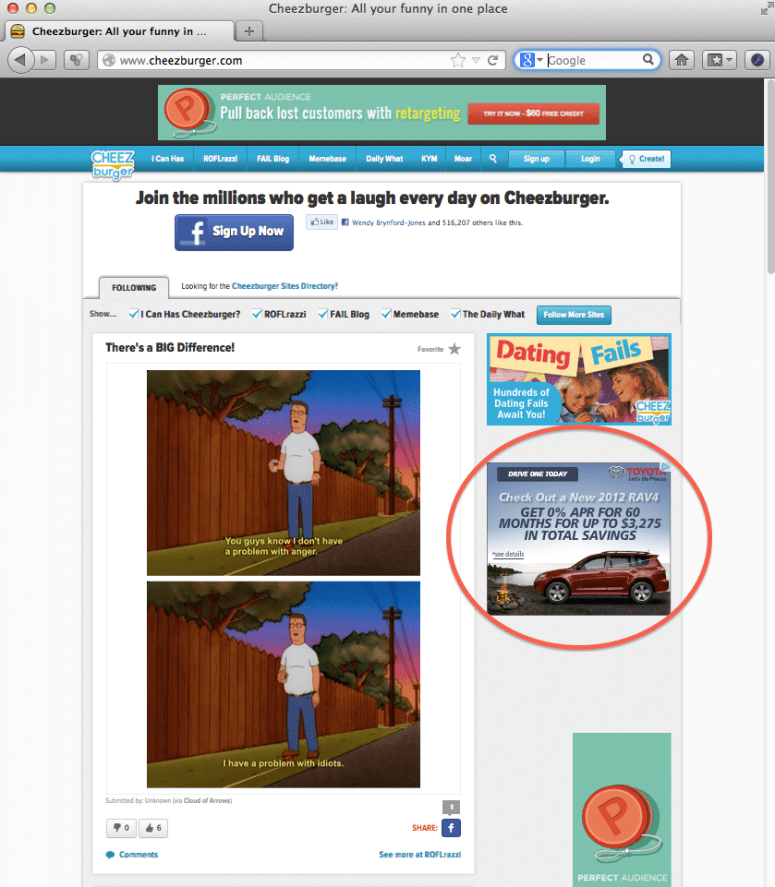
Just for fun, we went over to Mr.Huh’s website Cheezeburger dot com to see why he would be so invested in the battle against artists rights. Well, as it turns out the first two items we saw were the products of well known and beloved mainstream creators (you know, the companies the copyleft hates but can’t seem to live without).

In this first screenshot below we see images from Fox Tv’s “King Of The Hill” show. What we also see is that Toyota, one of the already identified 50 Brands Supporting Music Piracy paying the bills to Mr.Huh. Good work if you can get it, being able to monetize content of a major TV network without the pesky need to ask permission or to share in that advertising revenue.
chezburgerKingOfTheHillToyota

And, the second post we noticed were images from the Disney Pictures film “Up.” This time with advertising courtesy of Google and AT&T, also previously identified as two more of the 50 Brands Supporting Music Piracy.

cheezburgerDISNEYUP

And here’s the kicker from the man who doesn’t want to ask permission to monetize creators content for profit… hmmm… hypocrisy much?

http://corp.cheezburger.com/legal/api-terms-of-service/

(d) Pre-Approval Required. The license described in 1.1(a) above is contingent on you submitting all application-related materials that are requested by the Company and the Company subsequently approving your application. The Company may approve or reject your application in its sole discretion. The approval of your application by the Company shall not constitute an endorsement or legal review of your application.

But wait there’s more…

http://corp.cheezburger.com/legal/terms-of-service/

3. General Use of the Websites — Permissions and Restrictions
Cheezburger hereby grants you a revocable, non-transferable, and non-exclusive permission to access and use the Websites as set forth in these Terms of Service, provided that:
A. You agree not to distribute in any medium any part of the Websites, including but not limited to Content and User Submissions (each as defined below), without Cheezburger’s prior written authorization.
B. You agree not to alter or modify any part of the Websites, including but not limited to Cheezburger’s technologies.
C. You agree not to access User Submissions (defined below) or Content through any technology or means other than any as authorized by this Terms of Service or a written agreement between you and Cheezburger.
D. You agree not to use the Websites for any commercial use without the prior written authorization of Cheezburger. Prohibited commercial uses include, but are not limited to, any of the following actions taken without Cheezburger’s express approval:
1. Sale of access to the Websites, Content or services via another website or medium (such as a mobile application);
2. Use of the Websites, Content or services for the purpose of gaining advertising or subscription revenue;
3. The sale of advertising, on the Websites or any third-party website, targeted to the content of specific User Submissions or the Content;
4. Any use of the Websites, Content, User Submissions or services that Cheezburger finds, in its sole discretion, has the effect of competing with or displacing the market for the Websites, Content or User Submissions.

And it continues to go on from there into another set of rights, and restrictions. Wow. Ok then… well, so much for permissionless innovation afterall…

Whose Idea was the RSC Memo on Copyright? Don’t ask Derek Khanna

Derek Khanna has been on a media blitz lately following the White House’s endorsement of a “We the People” petition to “make cell phone unlocking legal”. Khanna — who considers himself a “copyright reform” advocate (but in our opinion could more accurately be called a “Derek Khanna” advocate) — created a moral panic over cell phone unlocking as the first step in a sustained “war” against artists and creators, the goal of which is to strip them of their already weak legal protections.

Khanna, you may recall, first stepped into the spotlight last November after he authored a memo for the Republican Study Committee that called for severe and regressive changes to copyright law. The memo was filled with historical and factual errors (as well as numerous typos) but was considered one of the most eloquent writings to come from the copyleft; it was quickly withdrawn from the RSC’s website.

Earlier, we had noted that Khanna himself has publicly admitted of the memo, “No one requested it. I just thought it was a good idea.”

khannareddit

Interesting. Because just a few days ago, Khanna spoke about the memo to Ezra Klein at the Washington Post. His story was a little bit different this time. According to Klein:

It was November 2012 and Derek Khanna was working as a staffer in the Republican Study Committee, which acts as a kind of think tank for the conservative wing of the House Republican Conference. Khanna, whose job was to follow issues pertaining to technology, homeland security and government oversight, was asked to draw up a short brief on copyright law — something the group could hand out to House Republicans in the hopes of getting some legislation moving. “The memo wasn’t my idea,” he says.

(Tip to Derek Khanna: if you want to get into politics, you have to make your flip-flops a little less obvious.)

…it will henceforth be very difficult to dislodge Smith and Telang’s conclusion that piracy does economic harm to content creators…

Copyright and Technology

Back in 2010, the Government Accountability Office (GAO) published a meta-study of the economic effects of intellectual property infringement (including counterfeit goods as well as copyrighted works).  The GAO concluded that IP infringement is a problem for the economy, but it’s not possible to quantify the extent of the damage — and may never be.  It looked at many existing studies and found bias or methodological problems in every one.

More recently, Michael Smith and Rahul Telang, two professors at Carnegie-Mellon University, published another meta-study that serves as a sort of rejoinder to the GAO study.  This was the subject of Prof. Smith’s talk at the recent Digital Book World (DBW) conference in NYC.

Assessing the Academic Literature Regarding the Impact of Media Piracy on Sales summarizes what has been a growing body of studies on the economic effects of so-called media piracy.  Their conclusion is that piracy does have…

View original post 391 more words

Two Simple Facts about Technology and Piracy : iTunes Vs. YouTube

Fact number one.

Unlike Google’s YouTube, Apple’s Itunes Store does not have a piracy problem, nor does it have an unmanageable issue with DMCA notices. This is often explained that this is because Apple does not allow user generated content from just anyone, therefore there is a barrier to entry that prevents such issues. But this is simply just not true, anyone can upload an album of music to Itunes using any one of the third party aggregation services such as Tunecore or CDbaby. And yet, there are not (as far as we know) hundreds or thousands of DMCA notices and content take downs on Itunes per day, as there are on YouTube. So why is this? In a word, intent.

If Apple, Spotify, Amazon and virtually every other legal and licensed distributor of digital music can put into place, the checks and balances that are capable of managing these rights effectively why is it so hard for Google to do the same YouTube? Think about it.

Fact number two.

YouTube can effectively filter content if it wants to. Since day one, we have never, ever seen any live porn on YouTube. Not a single live link to porn, ever. In debates in various online forums we have often proposed the challenge to anyone to present an active live link to full fledged porn on YouTube. It has NEVER happened. No one has EVER been able to present a live link to an active porn video on YouTube in the six plus years we and our friends have presented the challenge. Talk about a crowd sourcing FAIL.

What these two facts reveal is that rights management online, the protection of copyrights and the enforcement of Intellectual Property require nothing more than the intent and will to do so. But don’t take our word for it, listen to Google’s own Chief Economist Hal A Varian from his book “Information Rules” where he describes “Bitlegging.”

“Bitlegging” can’t be ignored: there’s no doubt that it can be a significant drag on profits.

Bitleggers have the same problem that any other sellers of contraband material have: they have to pet potential customers know how to find them. But if they advertise their location to potential customers, they also advertise their location to law enforcement authorities. In the contraband business it pays to advertise… but not too much.

This puts a natural limit on the size of for-profit illegal activities: the bigger they get, the more likely they are to get caught. Digital piracy can’t be eliminated, any more than any other kind of illegal activity, but it can be kept under control. All that is required is the political will to enforce intellectual property rights.

So Apple, Amazon, Spotify (and hundreds of others) can effectively manage digital distribution without triggering millions of DMCA notices. YouTube can effectively filter porn, and yet the internet is not broken as best as we can tell.

Maybe, just maybe this isn’t so complicated after all. That is unless one has a specific intent and motive from which they perhaps profit from the mass scale aiding of commercial level infringement.

Kim Dotcom’s “End Of Piracy”, that was easy…

In the anticipation of the announcement of the new Mega launch, Pat Pilcher at The New Zealand Herald wrote an article titled “Kim Dotcom on Ending Piracy” in which the journalist listed Mr.Dotcom’s five steps to ending piracy. Pilcher writes,

As ironic as that may sound, Kim Dotcom’s logic is inescapably robust. Here’s what his end to piracy manifesto says:

1. Create great stuff
2. Make it easy to buy
3. Same day worldwide release
4. Fair price
5. Works on any device

Looking at what Kim is saying, the 5 points seem pretty obvious, although each could quickly get bogged down once Hollywood gets involved.

So let’s look at these one by one.

1. Create Great Stuff
Well, that’s a no brainer. The content industries create the most prized and sought after “stuff” in the world including films such as Avatar, The Avengers, and The Dark Night Rises as well as franchises like Iron Man, Transformers, Harry Potter and others. Music artists include the likes of Adele, The Black Keys, Taylor Swift, The Beatles and countless others. Making great stuff has never been a problem.

2. Make It Easy To Buy
Another no brainer. Perhaps a decade plus ago this might have been an argument, but not today. There are over 500 legal and licensed music services alone. For the film industry there are services like Netflix, Vudu and Cinemanow as well as other direct to home video on demand providers that give consumers more access to more content across more platforms than at any time in history.

3. Same Day World Wide Release
For music this is more less the standard now and is also more and more common for feature film releases as well. This is a common practice for the largest and most anticipated releases of music and films, the “stuff” that is the most aggressively pirated. For smaller indie releases this may not always be possible but than again I’m not sure that the problem we are combating is in Nigeria on indie rock albums and movies that are more or less film festival darlings.

4. Fair price
Done. Netflix is $7.99 a month for unlimited access to it’s entire library of films and tv shows. Spotify is $9.99 for unlimited access to it’s entire library which consist of probably 95% of every known recording in print. Add to this the cost of a song download is 99 cents. Less than the cost of a candy bar. Renting a movie from a video on demand service ranges from 3.99 to 5.99. Price is no longer an issue and has not been for years.

5. Works on Any Device
Music is DRM free and has been for at least half a decade. Streaming Services such as Netflix and Spotify are also available on every major platform including not only Mac and PC computers, but also mobile devices such as smart phones and tablets by a variety of manufacturers. Additionally most new video game consoles and blu-ray players also include many of these same apps.

So there you have it, the end of piracy. Even Pat Pilcher at The New Zealand Herald agrees a referring to a similar response from the New Zealand record industry. He writes,

Well there it is, RIANZ’s response in full. I can’t argue with much that they’ve said, as they’ve pretty much complied with most of Kim’s 5 points.

So Kim Dotcom’s five suggestions have been fulfilled and yet, I don’t think we’ll see an end to piracy anytime soon. There is still one thing piracy offers that legal, licensed and legitimate services do not, and that is compensation to the artists, musicians, filmmakers and creators which requires that consumers actually do pay the fair price asked.

It’s all pretty simple and by Kim Dotcom’s own suggestions and admission it’s pretty clear where the problem is from here on out, and it’s not in his five suggestions…

And, of course, let us not forget this classic… Kim Dotcom Parody Video Appears on YouTube

“Maintain Choice For Everyone” Vint Cerf On Internet (and Google) Regulation #2013CES

Vint Cerf the man credited with being a co-creator of the internet spoke at CES today and was asked about internet regulation by and audience member. What is interesting about Cerf’s response is that it echoes the sentiments that artists, creators and rights holders have been arguing are important to have a fair, ethical and sustainable internet for all citizens that does not unfairly favor specific companies are corporate interests.

As reported by Ars Technica, Zero regulation for telcos could endanger neutrality, Internet co-creator says.

One audience member asked Cerf what kind of regulation is necessary to protect consumers from predatory practices on the Internet, and from companies favoring certain kinds of content over others. The audience member mentioned that the question is relevant to Google, Cerf’s employer.

Cerf answered, “With regard to the regulatory practices, what I am after more than anything else is to inhibit anti-competitive behavior. It’s necessary to make sure that people who control underlying resources don’t do so in such a way as to distort the market. If there is a distortion—and you have to demonstrate that if you want to take regulatory action—then… you need to do something about it to maintain choice for everyone and make sure the market is open for competition.”

We pretty much agree with everything Vint is saying above in bold as media piracy facilitated and aided by companies like Google appear to be distorting the market due to a lack of regulation and anti-competitive behavior.

Further more, as much so is our mantra, we find that we could not agree more with Vint’s observation that you need to maintain choice to ensure a fair and competitive market.

We’re encouraged by Mr. Cerf’s comments in that we can clearly see that he truly understands the need for regulated markets so that they can function fairly for all stakeholders. Unfortunately his comments are with respect to broadband access and not a fair and regulated internet that would address the market distortion created by media piracy whereby the choice of where to distribute their work is removed from creators without consent.

The Copyright Policy Reality Gap

We hear a lot from the free culture movement and the CopyTheft advocates about where they think Copyright and IP Protection should be headed, but it’s important to note what the actual values are for Copyright protection on Capital Hill. Perhaps there’s no place better to start than with the White House itself…
“”What’s more, we’re going to aggressively protect our intellectual property.  Our single greatest asset is the innovation and the ingenuity and creativity of the American people.  It is essential to our prosperity and it will only become more so in this century.  But it’s only a competitive advantage if our companies know that someone else can’t just steal that idea and duplicate it with cheaper inputs and labor. ” – President Barack Obama
“…piracy is theft. Clean and simple. It’s smash and grab. It ain’t no different than smashing a window at Tiffany’s and grabbing [merchandise].” – Vice President Joe Biden
Also, let’s be clear (as is noted below) that at this point there is nothing the least bit controversial about acknowledging the degree of the seriousness that online piracy presents to American jobs and the US economy.
“Let us be clear—online piracy is a real problem that harms the American economy, threatens jobs for significant numbers of middle class workers and hurts some of our nation’s most creative and innovative companies and entrepreneurs.  It harms everyone from struggling artists to production crews, and from startup social media companies to large movie studios. While we are strongly committed to the vigorous enforcement of intellectual property rights, existing tools are not strong enough to root out the worst online pirates beyond our borders. ” – whitehouse.gov

Artists and creators live a different lifestyle with many trade offs from conventional employment often working long odd hours for lower than minimum wage and without benefits. For artists and creators this is balanced out in the rights and protections granted in copyright that allow the artist a sustainable living. As a society we have granted these rights to creators as an incentive to produce a meaningful cultural economy. So effective have these protections been that America has the most profitable and most exported popular culture throughout the world.

“Recently, I’ve had a chance to read letters from award winning writers and artists whose livelihoods have been destroyed by music piracy. One letter that stuck out for me was a guy who said the songwriting royalties he had depended on to ‘be a golden parachute to fund his retirement had turned out to be a lead balloon.’ This just isn’t right.” – US Commerce Secretary Gary Locke

Now is the time to have a serious and meaningful conversation about the future of a fair and ethical internet that does not punish the innovative artists and creators who enrich our lives. Technology may change but principles do not. The internet and digital technology have opened up many new opportunities for artists, but it has also opened up new opportunities for those who wish to exploit those artists for personal or corporate gain.

We call upon the administration and both parties to protect the fundamental rights of artists and creators by adopting a fair and ethical set of principles for internet policy.

