
PaidContent/GigaOm writer Jeff John Roberts wrote a brief but on the mark editorial summarizing the work of economist Micheal D. Smith at the Tepper School of Business Carnegie Mellon University. The most important take away from the research is, as Roberts states, “how the piracy debate is still driven by ideology not facts.” Read the article [here].
Category: Copyright
Google Pro-Artist Policy Changes Challenge Allegations of “Net Censorship”
In the latest in a series of practices Google removes “Pirate Bay” from auto complete. There is a saying that the journey of a thousand miles begins with but one step, and Google has begun to take that journey. These moves should be celebrated by artists, musicians and creators – however we’d suggest some cautious optimism given Google’s history of appearances over actual meaningful change. None the less, this recent move can’t be seen as anything less than positive.
In addition to this latest change, Google has:
1) Created a (relatively) easy to use web form for de-listing up to 10,000 infringing links from Google Search in just one DMCA notice.
2) Begun to drop the rankings of sites identified as predominantly dedicated to infringing activity (as determined by the volume of accurate DMCA notices for de-listing).
3) Providing Content Management System (CMS) tools to individual artists, musicians, filmmakers and creators on YouTube.
The most important thing to take away from all of this is that these policies reinforce what we have always said, reducing online piracy is a question of will not capability. As Google implements more of these policies the shallow talking points of the freehadists become more diminished. Online piracy is about free beer, not free speech and we applaud Google for these early and hopefully meaningful baby steps towards an Ethical and Sustainable Internet for all citizens. And uhm, no Torrent Freak, it’s not censorship… let the screaming begin…
###
Originally posted in the Weekly Update for September 16th
The Trichordist Blogroll – Labor Day 2012
On this Labor Day, we’d like to thank everyone donating their labor and love to the issues concerning artists rights. Be sure to drop by each of these excellent sites to get insight and opinion from many different perspectives about the issues important to artists and creators online. Each of the blogs below is worthy of your attention.
- 300 Songs
- Ad Land
- Andreas Ekstrom
- Andrew Orlowski’s Excellent Column at The Register @regvulture
- Copy Like
- Copyhype
- Copyright Alliance
- Copyright And Technology
- Cynical Musician
- Dean’s List
- Ethical Fan
- Fareplay
- Helienne Lindvall’s Excellent Column at the Guardian @helienne
- I Buy My Music
- Jeremy Nicholl
- Ladies of the Canyon
- Popup Pirates–Ellen Seidler’s blog
- The Illusion Of More
- The Lonestar Rollergirls
- Unionosity
Principles for an Ethical and Sustainable Internet
Technology may change but principles do not. A society that encourages the creative spirit is rare in history and worth defending. The internet and digital technology have opened up many new opportunities for artists, but it has also opened up new opportunities for those who wish to exploit those artists.
We offer for discussion a set of principles as a guide for companies and policy makers to keep in mind. It is our hope that these principles will help build a sustainable online creative ecosystem, one that benefits creators, innovators, and the general public alike.
1. FAIR AND ETHICAL LABOR PRACTICES: RESPECT WORKERS’ RIGHTS
A fair and ethical internet is built on the respect and protection of the rights of individuals to determine who benefits from their labor and creations.
Since the rise of digital utopians in the 1990s, we’ve unfortunately seen many very old arguments surface as to why the economic benefits of a few big companies should be valued over the labor rights of many. This problem is what drives workers to organize to protect their labor and demand fair compensation. Not only are artist rights protected by the US Constitution, artist rights are also internationally recognized as human rights protected by many international treaties, including the Universal Declaration of Human Rights. Unfortunately, however, there are those who seek to capture the value of artist rights profit only for themselves by systematically violating these rights for commercial gain.
A free and open internet works best without overbearing regulation, but it will not work at all without protection for fundamental rights of working people.
2. CONSENT IS THE FOUNDATION OF CIVILIZATION: RESPECT ARTISTS’ INTEGRITY
Your right to swing your fist stops at the end of my nose. Your rights end where mine begin.
Rights secured by the Constitution are intended to protect the individual from hostile majority forces and the tyranny of the mob, particularly the corporate mob. This is especially true regarding copyright, which is itself a vehicle of the right of free expression for individuals, and protected by the Constitution.
Everyone understands the value of individual privacy in the digital age. The essence of the artist’s control over the integrity of their work is not that different. Individual consent should be required for a corporation to profit from taking any creative work (just like individual consent is required for taking personal information) because the creative work goes to the artist’s personhood. Protecting an individual’s right to their personhood and the protection of their free expression are building blocks in the foundation of civilization.
3. PROTECT INDIVIDUAL FREEDOM OF EXPRESSION: DON’T TRIVIALIZE CENSORSHIP
Freedom of speech requires freedom of expression. Copyright protects free expression. Together, they ensure a robust marketplace of ideas that advances truth, knowledge, and culture.
Let’s get this straight. Censorship is intolerable. You don’t have to look very far to see artists being censored by governments — there are many historical examples . No one understands this more than the scores of individual artists, musicians, painters, writers, poets, filmmakers and creators of all disciplines who have actually (and literally) have been persecuted, disappeared or assassinated for their views all over the world. Sadly, many confuse the actual freedom of expression with the mistaken idea that preventing the illegal exploitation of that very expression is the same thing. It’s not.
The copying and distribution of those expressions without the creators permission is simply exploitation without consent or compensation. Would you think that a car thief is being censored when they are prosecuted for stealing your car or a bank robber is being censored when they are prosecuted for stealing your money? Don’t trivialize “censorship”.
4. FAIR COMPENSATION: IF YOU DON’T LIKE IT, DON’T BUY IT
In any value chain where the individual creator’s work is exploited, the creator must be compensated.
Most fair and reasonable people embrace “Fair Trade” products to support and encourage fair compensation of labor. Unions have fought long hard-won battles for the protection of labor rights. As a society we recognize the individual’s right to fair compensation of labor as a fundamental cornerstone to an ethical and healthy society. The internet is inhabited by as many different varied participants as the physical world, and the respect for human labor should not be devalued simply because technology makes it possible to be unethical.
It’s very simple–the answer if you don’t like an artist’s work is not to steal it–just don’t buy it. They’ll get the message.
5. MUTUAL RESPECT: IT’S ABOUT GETTING IT RIGHT, NOT GETTING AWAY WITH IT
Mutual respect for the diversity of all online citizens is the cornerstone of a healthy and robust community.
The mutual respect granted by intellectual property rights allows individual creators the freedom to determine what permissions they wish to grant and at what price. No one has to pay that price, but the creator is entitled to set it. Denying these freedoms to creators because the mob or a public company wants to overrun a musician, author, illustrator or photographer violates the very protections against mob rule that the Constitution is intended to secure. Sadly, this is largely how individual rights are viewed today by some online corporate interests.
6. PARASITIC EXPLOITATION IS NOT INNOVATION: FREE AND OPEN SHOULD BE FAIR AND HONEST
The illegal exploitation of individuals for commercial gain is not innovation, it is techno-thuggery and cyberbullying.
We see many companies on the internet illegally exploiting the work, labor, innovation and creations of others simply because they can get away with it. We’re often told that innovation requires the unauthorized exploitation of creators in some kind of technological determinism that rejects the innovation of creators because it“scales”. That is just another way of using “convenience” as an excuse for theft. Any business that requires the illegal exploitation of individuals to be profitable is not a business but rather is a parasitic engine of oppression.
7. SUSTAINABLE INNOVATION SOLVES PROBLEMS: FAIR NOT FAKE
Sustainable innovation is best represented by solving problems, not creating them by adding intentional opaque layers of obfuscation.
The organized and deliberate complexity of some online ad networks, pirate site operations, and other businesses creates an impenetrable black box to protect illicit money flows and give the participants plausible deniability. Then we are told to “follow the money” through advertising networks, down a rabbit hole to a maze followed by another rabbit hole. That’s not innovation. It is old school wire fraud. This should not be a badge of honor for the online community but rather a point of embarrassment that the Internet—one of the greatest technological achievements of all time–is trivialized by making it nothing more than a safe house for many illegitimate businesses profiting at the expense of honest citizens.
8. COMMON GOALS, BEST PRACTICES AND SOLUTIONS:
There are centuries of mutual ground between creators, commerce and rights holders. Let’s not throw this away.
Let’s not set a goal of building a large database for clearances of all copyrights and do nothing until it is operational. That solution almost guarantees that there won’t be many new works to put in that database. Such a database has never existed and is incredibly complex. A transparent rights clearinghouse is a possible solution, but the lack of one it is definitely not an excuse for bad behavior.

Jared Leto Exploited by Rapidshare, VW, Go Pro, LG, Emirates Airlines, Adobe, Ford and Target
In this round we find advertisers exploiting Jared Leto‘s band 30 Seconds To Mars by Volkswagon, Go Pro cameras, LG electronics and appliances, Emirates Airlines, Adobe software, Ford and Target. It’s also interesting to note that in this series of screen shots the infringing links appear to be hosted on Rapidshare. This is the same Rapidshare that has been offended by being put on a piracy watch list. It seems to us that if Rapidshare wants to champion best practices for cyberlockers, they would do well to clean up their own business first.
The hits just keep on coming… How much money do we have to follow before there is some accountability on behalf of the brands and advertising networks? Let us be clear about this. Piracy is being financed by advertising dollars, originating with major brands, trusted to advertising agencies and then ultimately distributed to questionable online advertising networks and then to the pirate sites themselves.
This is not about free speech. This is not about censorship. It’s about money. It’s about a lot of money. It’s about a lot of money being made by advertising networks and pirate sites and not paying artists a penny. This is the exploitation economy where anyone and everyone can profit from a creators work, except the creator themselves.
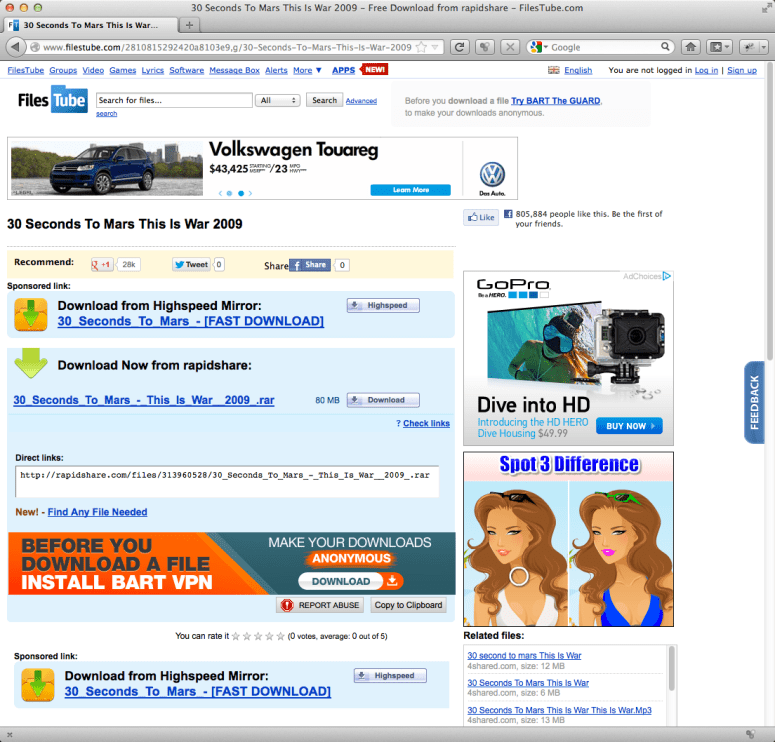

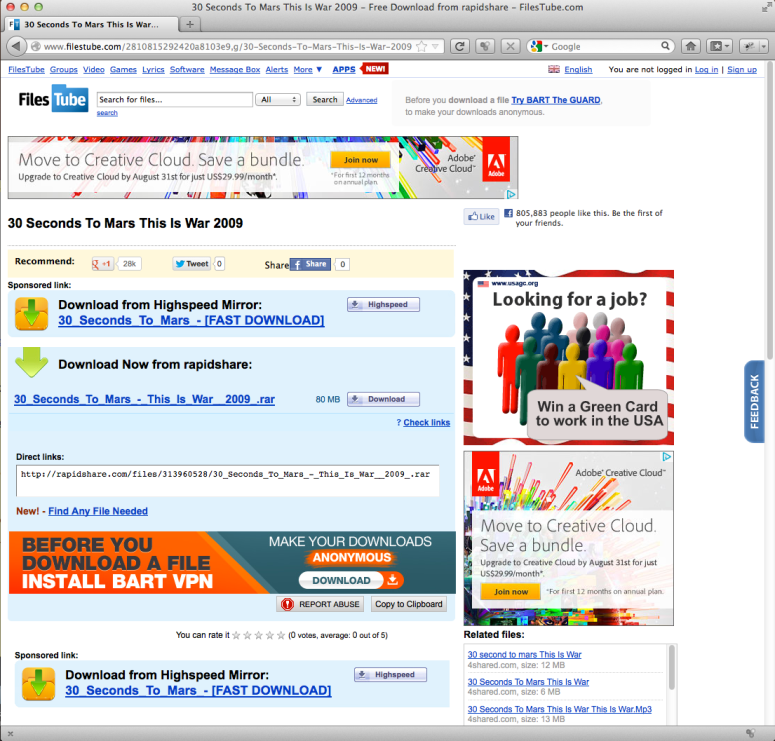


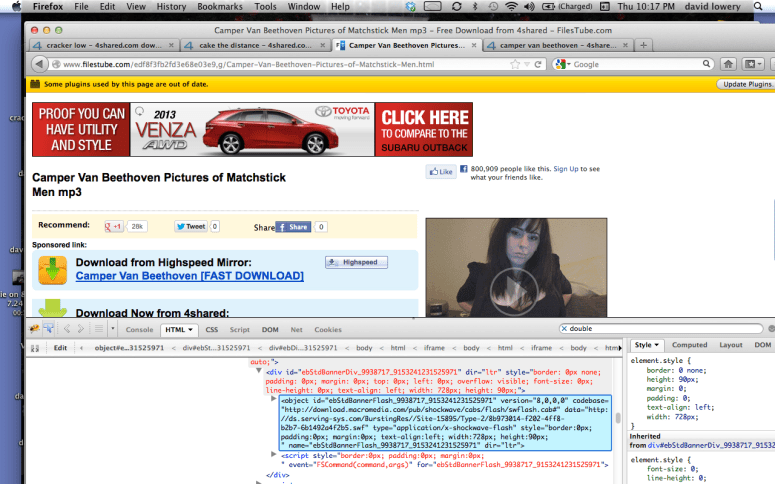
FilesTube points to Rapidshare as a host of infringing uploads of artists work. Also not the Adobe advertising. Wouldn’t be ironic if users searched FilesTube and RapidShare for Adobe software products?

How to DMCA : Google Web Search, De-Listing Infringing Links
WARNING! The following is for informational purposes only and does not constitute legal advice. We strongly recommend seeking the advice of a lawyer.
Find below easy to follow step by step instructions to de-list your infringing links from Google Web Search. As you scroll down the page and make your selections, more questions will appear. Just keep scrolling down the page and making your selections as shown below.
###
Start Here:
http://support.google.com/bin/static.py?hl=en&ts=1114905&page=ts.cs
Step One – Select “Web Search” from the options. This is how to get your links to infringing material hidden from the Google search return results.

Step Two – Google does not make de-listing links easy by describing it as such. Make sure you select the box, “I have a legal issue not mentioned above.”
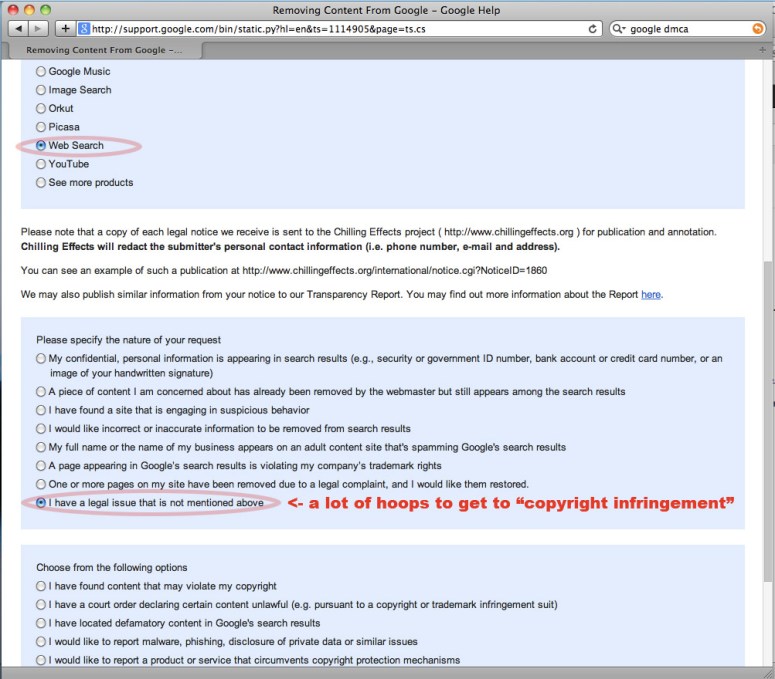
Step Three -Select the box that says, “I have found content that may violate my copyright.”
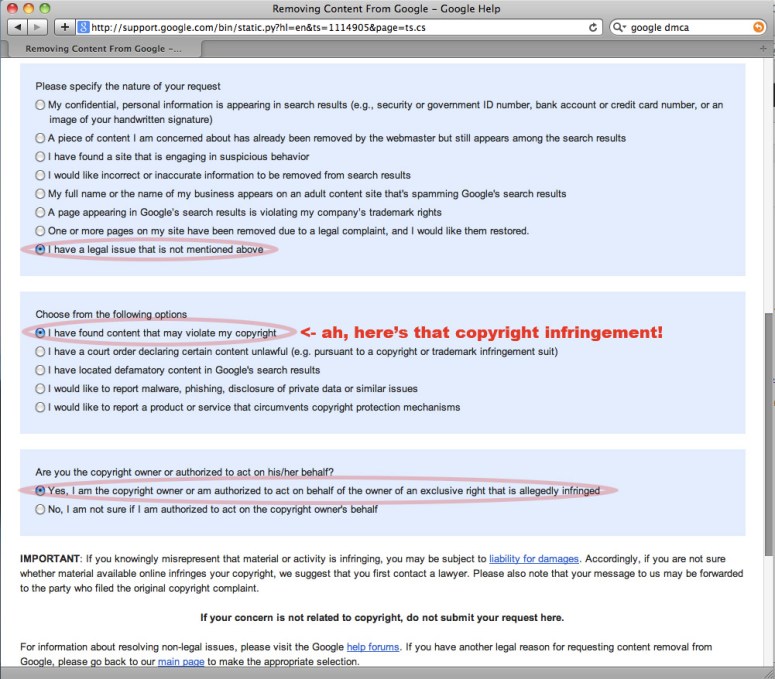
Step Four – It goes without saying that if you are working to de-list infringing works from Google Search, please make sure you are authorized to do so by either owning/controlling the rights to the material being infringed, or working under the authority and direction of those who do. Then select the box, “Yes, I am the copyright owner or am authotized to act on behalf of the owner of an exclusive right that is allegedly infringed. “
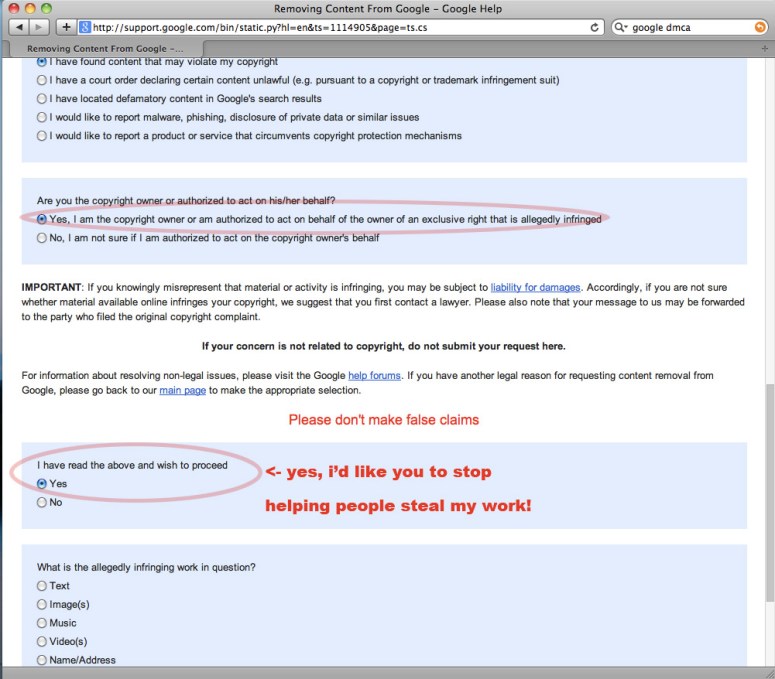
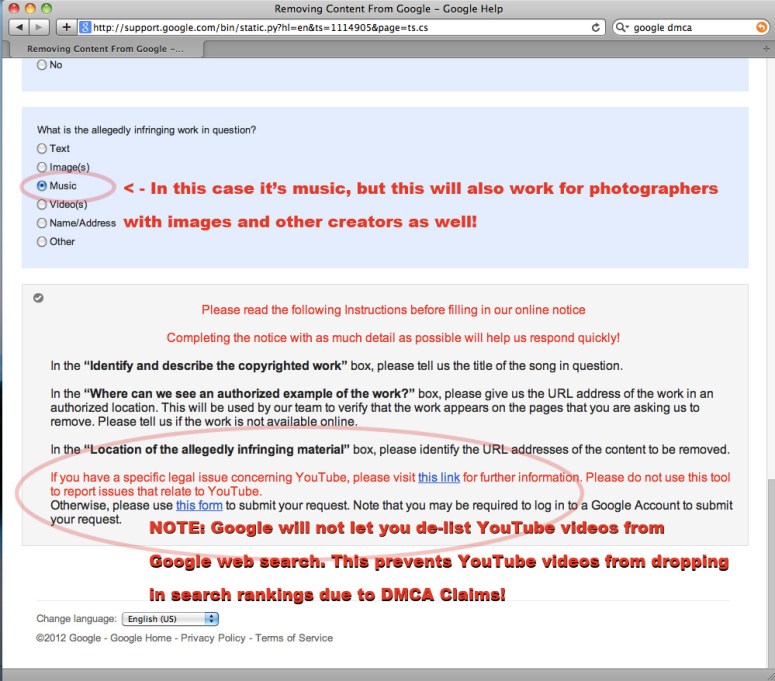
Step Five – Select the box that says “Music.” This process can be used to de-list links to images, text, videos (other than YouTube), etc.
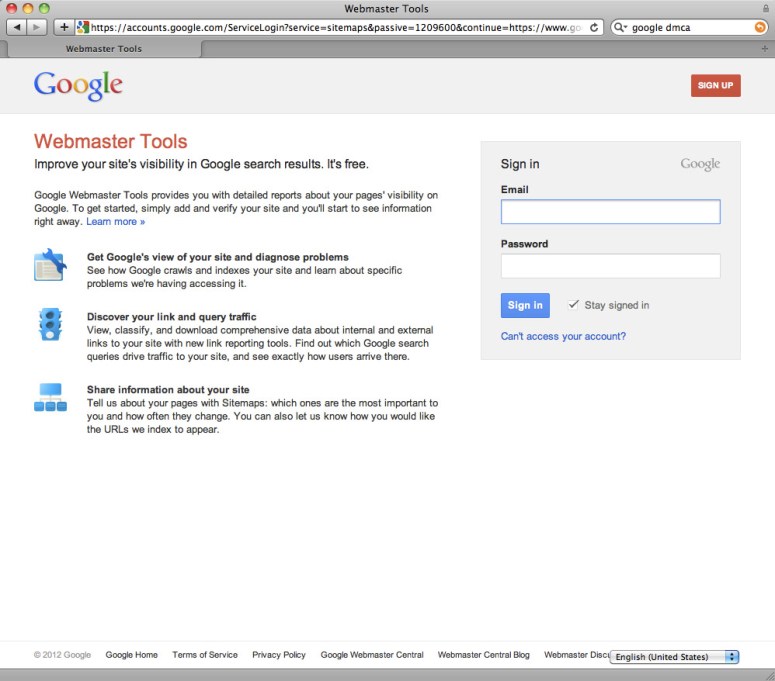
Step Six – At this point you will be prompted to log into your Gmail account or create one. We suggest you create a dedicated Gmail account just for your DMCA Claims Tracking. Eventually, you’ll have a webtools dashboard to track all of your link submissions.
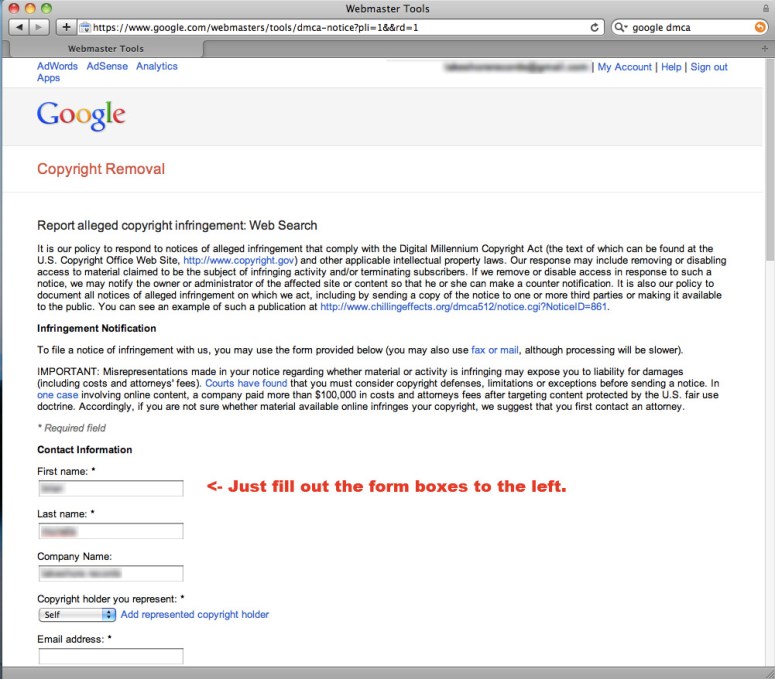
Step Seven – Just fill out the boxes with your information. Note that this information will become publicly available on Chilling Effects. DMCA notices are a legal process and should not be done lightly or without clarity over the allegedly infringing rights.
Step Eight – Just keep filling out the form, you’re almost there…
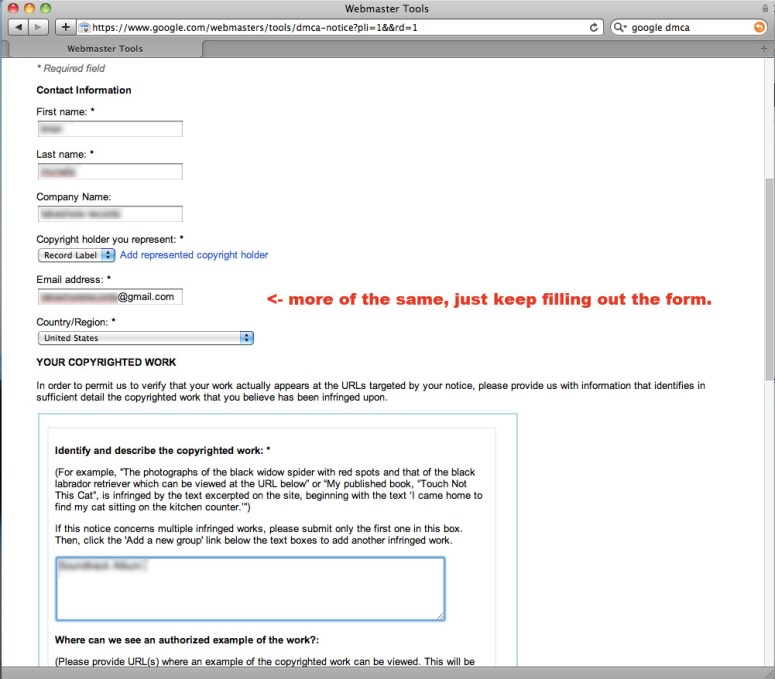
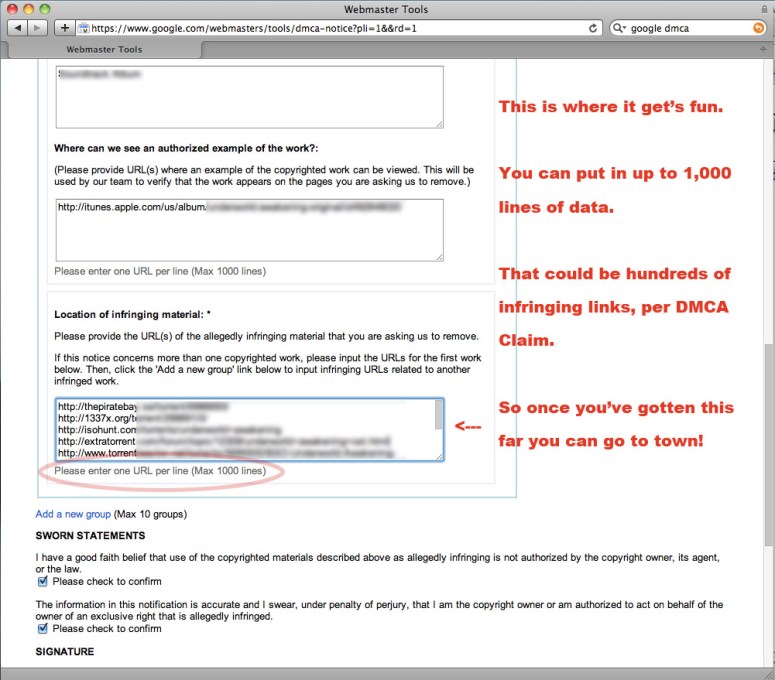
Step Nine – Fill out the three boxes. This is where it gets fun. Box One, describe the work being infringed, such as “Record Album by <insert artist/s name>.” Box Two, provide a link where a legal version of this item exists. We usually use link from either Itunes or Amazon as they are the most common and easy to find. Box Three, you can copy/paste in as many as 1,000 infringing links! And it get’s better, you can add nine more boxes of 1,000 infringing links each.
In a single DMCA request form you can submit up to ten thousand (10,000) infringing links!
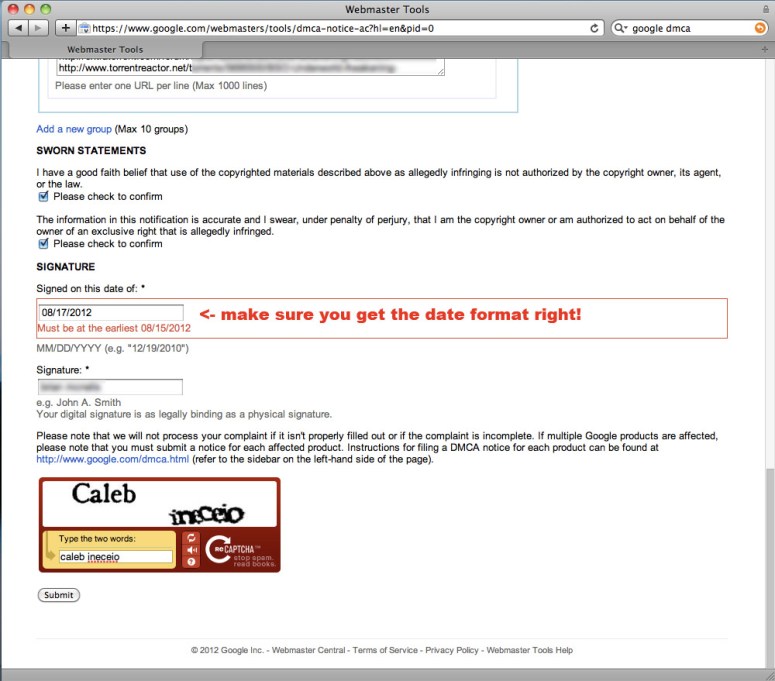
Step Ten – Make sure all the fields are filled out correctly. You will get errors if you make a mistake.
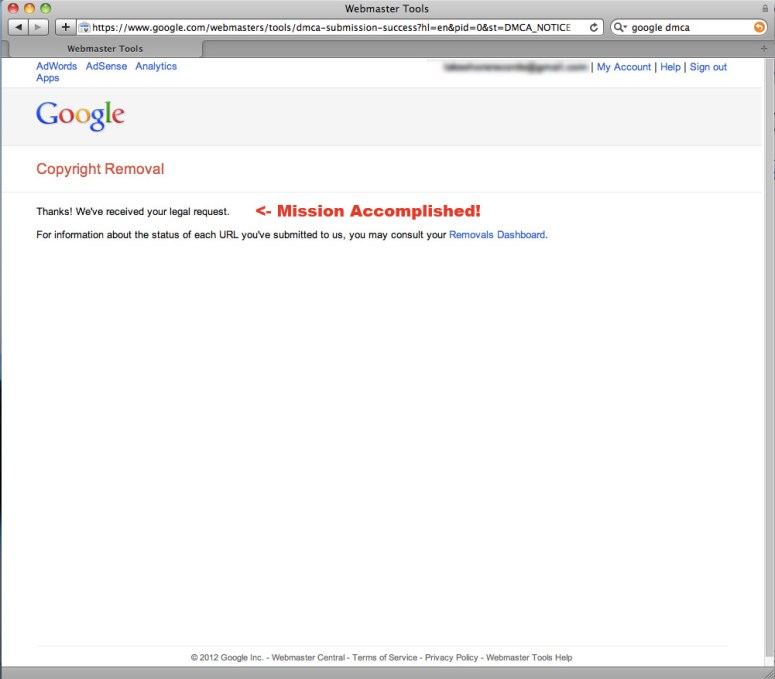
Step Eleven – Google will tell you that you have successfully submitted your links.
Step Twelve – Monitor the activity of your claims in your “Removal Dashboard for Web Search.”
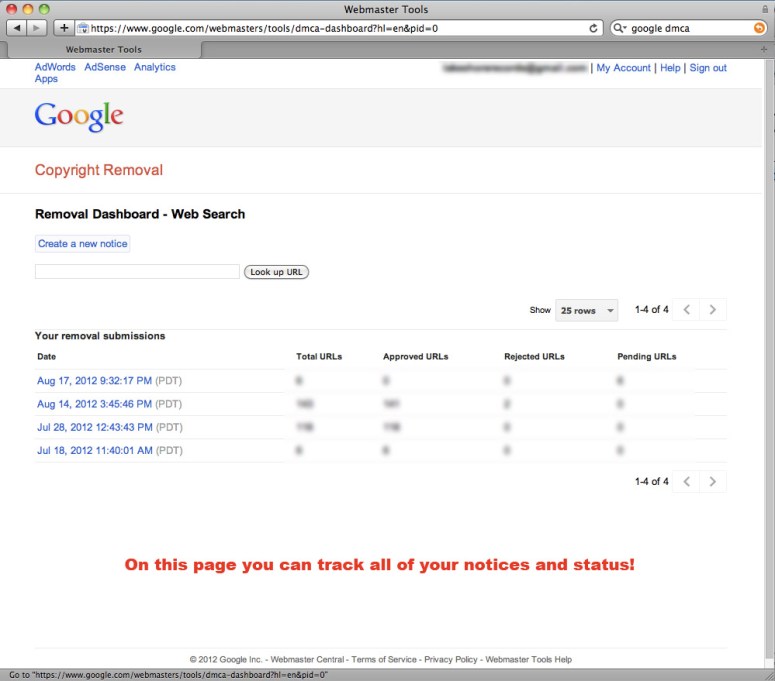
That’s it. Happy hunting. We usually compile all of the infringing links into a word document or spreadsheet before filling out the form. Using a spread sheet is a great way to log all of your infringing links by line so that they can be cut and pasted into the submission boxes in the Google form.
We applaud Google for making this form available as up until recently they only excepted DMCA Claims for Web Search from Mail and Fax as shown in this current claim page for Google Docs.
WARNING! The preceeding is for informational purposes only and does not constitute legal advice. We strongly recommend seeking the advice of a lawyer.
MegaUpload (MegaVideo) Smoking Gun? Did the site illegally charge for Streaming Movies?
These screen shots appear to show that Kim Dotcom’s Megaupload was selling streaming movies that it did not have the rights to sell.
Megaupload was allegedly paid uploaders per stream from files they uploaded to Megaupload. That is why there were so many links that Google autopopulated Megavideo after you entered Star Wars in the search field.

Then Google estimated that there were 4.3 million web pages that had the words “star wars megavideo” on them. Legitimate file locker sites like Dropbox, don’t allow any public links to copyrighted content. In fact Dropbox just banned Boxopus, a torrent tool from using its API.

Megavideo let you play the first 45 minutes of Star Wars and thousands of other movies for free (after they had served you and profited from dozens ads) . . .


But then, to watch past 45 minutes, you had to enter your credit card and pay $9.99 a month to keep watching.


Carpathia Hosting, the CDN that the FBI raided because it was getting paid for caching these illegal movies for Megaupload. Here is data from a packet analysis we ran in August 2011. 86% of the first 45 minutes of the Star Wars stream captured above came from IP address 173.245.127.21, who ARIN says is assigned to Carpathia Hosting.
| IP 173.245.127.21 |
Packets 39,908 |
Bytes 60,314,666 | IP Assigned To: Carpathia Hosting, Inc. |
% of Total Packets 86.2% |
Uh Toyota… didn’t you get the memo? Why are you advertising on unauthorized sites that exploit my music?
We recently ran a story about American Express advertising on Filestube, the site that infringes my copyrights while suggesting porno links next to my brand. The American Express ad was served by Google’s DoubleClick ad network presumably at the behest of Ogilvy & Mather.
Yesterday a Google spokesperson told us that they had disabled “self serve” advertising for this site. We weren’t really sure if that meant no more DoubleClick on FilesTube, or if it was some kind of semantic dodge. We’ve had a bunch of those dodging semantics on this issue. However we monitored FilesTube yesterday and we see no sign of DoubleClick. We applaud Google for taking this action!
Now not to look a gift horse in the mouth but we’d love to see Google disable advertising for all those sites that they know are infringing copyright. The ones they mentioned in this handy press release. See it seems a little disingenuous to lower these sites rankings but at the same time to continue doing advertising business with them? (And yes we are already monitoring advertising on these sites!!)
American Express is another matter. We have not heard back from American Express. We’d love to hear what American Express has to say about their company helping to finance copyright infringement–not just mine, but all of the artists. We’d love to know how that happened and if they intend to continue advertising on these sites. Cause it doesn’t seem like a very good idea for an iconic American Brand.
Now I’ve lost my handy pocket version of the RICO statute. People are always borrowing it! But I’m almost certain that it says something about making plans to profit from copyright infringement as a RICO “predicate”. I’m no lawyer but if I were a big company like American Express I wouldn’t want to get anywhere near a website that even had the potential to get wrapped up in a RICO investigation. Especially one based in Moldova.
Today FilesTube looks like a wasteland of QuiBid ads, MacKeeper popups and click shoot ads. Pretty low grade. Seems like it’s not just American Express which got the memo.
Toyota however did not get the memo! So now it’s Toyota’s turn to answer the question? Why are you advertising on this site?
Mullets, Platform Shoes, Mack Daddies and Public Knowledge
Written by Chris Castle
“[W]hen it comes to the internet, there’s always someone in the middle, especially when it comes to handling the money.” Wired Magazine
Call me cynical, but I always keep an eye on Friday afternoon press releases–Friday afternoons are the great graveyard of bad news.
Google announced on August 10 (Friday) that they are doing something I understand they have been doing increasingly over the last few months: Pushing sites down in search results if Google gets a lot of takedown notices for those sites. (This is a version of what Google promised to content licensors for Google Video–and of course no one believed them like you don’t believe a street drunk that they’re really going to buy food with your $5.)
Remember–Google has announced in its rather untransparent Transparency Report that it gets millions–millions–of takedown notices annually. A Google lobbyist told the House Judiciary Committee that Google had “processed” five million DMCA notices as of November 2011 and had “processed” over three million in 2010. (As usual, Google doesn’t use a good verb like “received” instead of the ambiguous “processed”.)
That five million number seems to have taken a big jump, and I doubt it suddenly happened in the last 10 months. According to the Wall Street Journal, “The company on Friday said it is now receiving more than a million copyright notices related to its search engine per week.” (When exactly is “now”? Before or after Google’s testimony to the Congress?)
That is on track for over 50 million notices a year for search alone.
Understand this–it is highly likely that every notice Google received was for a link on a page for which Google served–or profited from–at least one ad. It’s also likely that those ads were from brands to which Google had promised that it would not serve ads on sites with infringing content. And guess what happens when Google charges an advertiser for serving an ad in violation of its contract with an advertiser.
It’s called a rebate.
If even half of the notices for which Google has received a DMCA notice–bearing in mind that is a US-based remedy–also have advertising served by Google, then Google may well be on the hook for rebates for millions upon millions of ads for years and years and years. You would never have thought about this rebate exposure if you relied on Google’s investor disclosures. If Google stockholders want to blame anyone, they should take a close look at whoever did the legal analysis on setting up the Google advertising platform in the first place. (Hint: He now works at Spotify.)

I would suggest that what is happening is the beginning of something along the lines of the market solution I have advocated for a long time–a site-based rating system based on the raw number of DMCA notices received. This would be along the lines of the restaurant rating system that LA County has in place and would provide a useful feedback to the Congress as well as consumers. Disclose the information to the market and see what happens. (Of course, Google doesn’t count DMCA notices sent to YouTube or the Blogger cesspools–but that’s another story addressed by Searchengineland.)
Actually giving effect to such a system would be a step toward ending the advertising supported organized crime that is a large part of the “hybrid economy” on the Internet. Assuming Google really does what they say they will, this announcement may signal the beginning of the end of this dark fashion.
Not surprisingly, we see this press release from Public Knowledge:
For Immediate Release August 10, 2012
Public Knoweldge [sic] Raises Concerns About Changes to Google Search Algorithm
The following statement may be attributed to John Bergmayer, Senior Staff Attorney:
“It may make good business sense for Google to take extraordinary steps, far beyond what the law requires, to help the media companies it partners with. That said, its plan to penalize sites that receive DMCA notices raises many questions.
“Sites may not know about, or have the ability to easily challenge, notices sent to Google. And Google has set up a system that may be abused by bad faith actors who want to suppress their rivals and competitors. Sites that host a lot of content, or are very popular, may receive a disproportionate number of notices (which are mere accusations of infringement) without being disproportionately infringing. And user-generated content sites could be harmed by this change, even though the DMCA was structured to protect them.
“Google needs to make sure this change does not harm Internet users or the Internet ecosystem.”
This might be a faintly interesting comment except for one thing: it’s not. According to Politico’s reporting:
Google said Friday it has received more than 4.3 million copyright removal requests in the past month — about 97 percent of which are valid. Many of the domains that are targets of the most requests are file-sharing and torrent sites. (emphasis mine)
It’s not surprising that Public Knowledge doesn’t get it. Companies are increasingly aware that their valuable brands are being trashed by association with all manner of sketchy or outright illegal sites with advertising for illegal drugs, human trafficking, financial products and–yes, copyright infringement, but not just copyright infringement. This at the same time as Google is trying to get into the mainstream entertainment business with Google Fiber and its various other products.
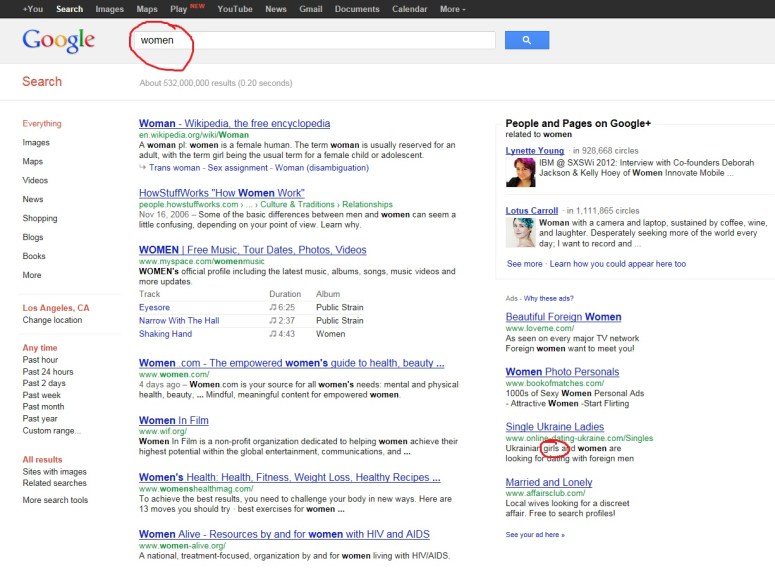
When fashion turns, it leaves all those people with mullets, platform shoes and superwide ties in the lurch. A closet full of crap and a brain full of mush, weird hair and no dates.
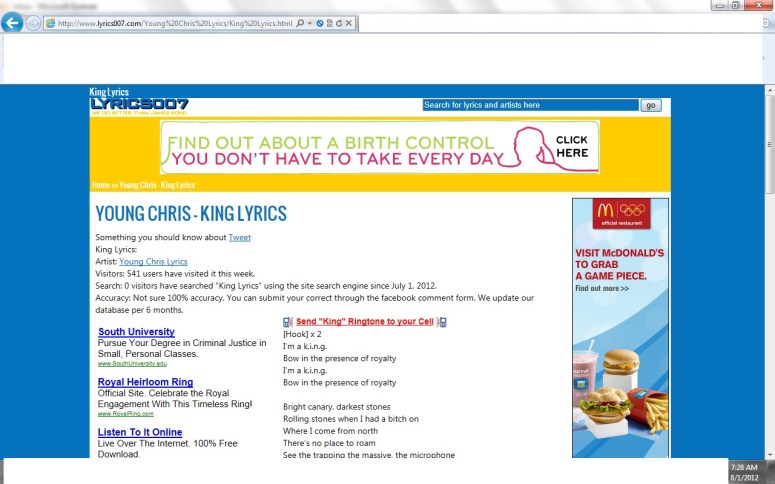
It’s the economics, stupid. Who in their right mind could imagine that the world could continue to look this way? Who would really think that many, many artists and media companies have anything but public and private contempt of the first order for Google? An ontological level of distrust?
And who would really think that the brands that also court relationships with top athletes, musicians, artists and actors would continue to get ripped off by having their advertising served on millions of unsavory sites. And guess what–when a big brand picks up the phone, they don’t want to hear about how Google is trying to bust another union or wants every link on every page to be adjudicated an infringer before they take action while reposting disabled links in near real time in the cesspool regions of Blogger. Google’s excuses have nothing to do with the brands. If brands don’t want their ads on site X, then the ads won’t go on site X. End of discussion. And Internet users will be the better for it. Unless they’re trying to buy a bride or score some oxy.
And I have to believe that Attorney Bergmayer knows this. He surely can’t be that sheltered.
Time for a haircut and spring cleaning.

- Google offers the Mack Daddy special.
- (A version of this post previously appeared on the Music Tech Policy blog)

Why Does YouTube Apologize to People Who Have Illegally Uploaded my Content?
By Larry Cane of Tape OP Magazine
(repost by permission, copyright in the author)
I politely asked Youtube to remove a song by my old band that someone had posted without permission. They took it down but then apologized “sorry about that” and ran my business name as if “blaming me” for removing content. Really? Wow. Pretty damn impartial, huh?

 The Trichordist
You must be logged in to post a comment.