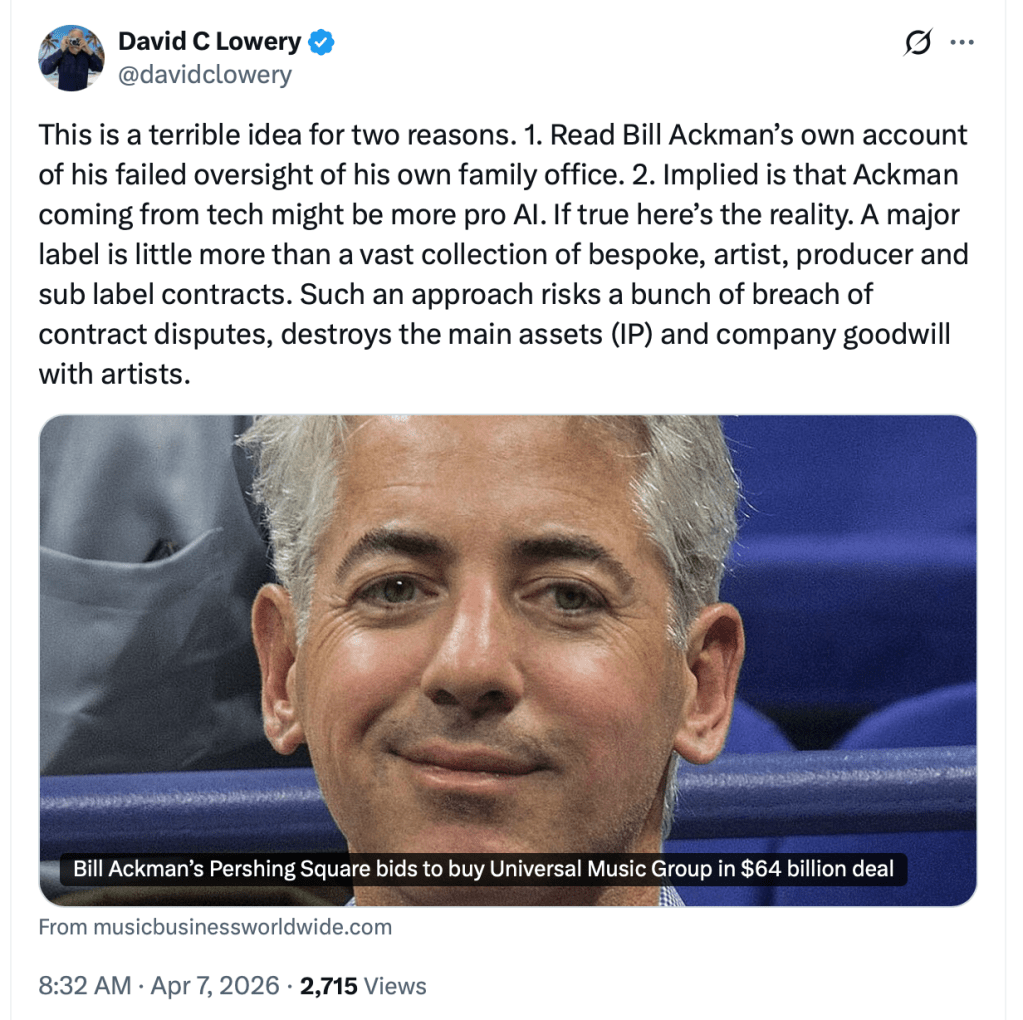
This is a terrible idea for two reasons. 1. Read Bill Ackman’s own account of his failed oversight of his own family office. 2. Implied is that Ackman coming from tech might be more pro AI. If true here’s the reality. A major label is little more than a vast collection of…
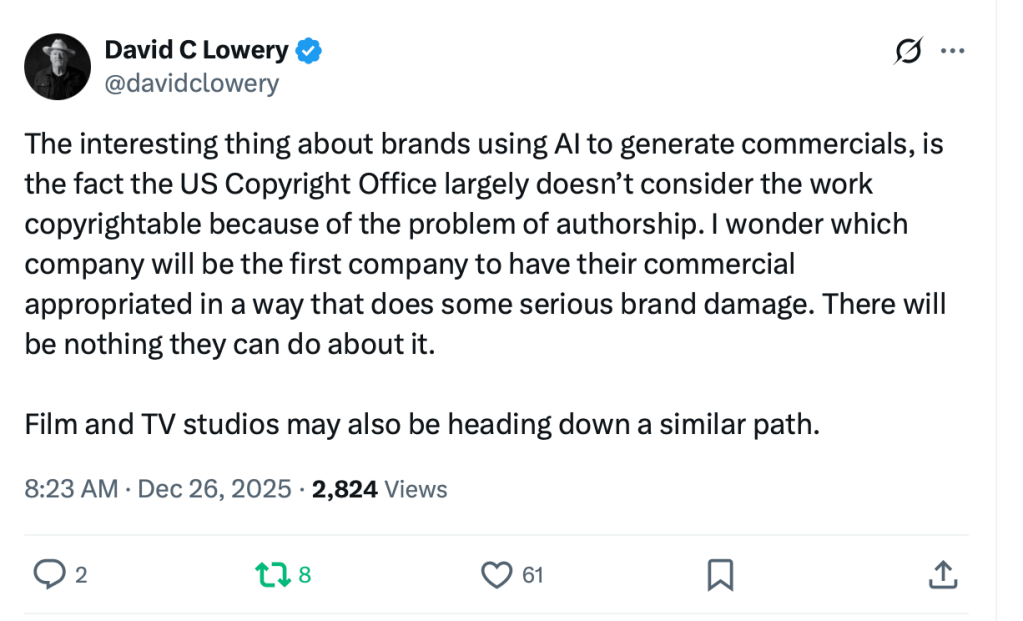
David is pointing to a quiet but serious problem hiding behind the rush to use generative AI in advertising, film, and television: copyright law protects authorship, not outputs. AI muddies or even erases authorship altogether in some cases
Under current U.S. Copyright Office guidance, works generated primarily by AI are often not registrable in the Copyright Office because they lack a human author exercising creative control. That means a brand that relies on AI to generate a commercial may not actually own exclusive rights in the finished work. If someone copies, remixes, or repurposes that ad, even in a way that damages the brand, the company may have little or no legal recourse under copyright law.
The Copyright Office guidance says:
In the Office’s view, it is well-established that copyright can protect only material that is the product of human creativity. Most fundamentally, the term “author,” which is used in both the Constitution and the Copyright Act, excludes non-humans. The Office’s registration policies and regulations reflect statutory and judicial guidance on this issue….If a work’s traditional elements of authorship were produced by a machine, the work lacks human authorship and the Office will not register it For example, when an AI technology receives solely a prompt from a human and produces complex written, visual, or musical works in response, the “traditional elements of authorship” are determined and executed by the technology—not the human user
David has not identified a theoretical risk. Copyright is the backbone of brand control in media. It’s what allows companies to stop misuse, dilution, parody-turned-weapon, or hostile appropriation. In the US, a copyright registration is required to protect those rights. Remove that protection, and brands are left relying on weaker tools like trademark or unfair competition law, which are narrower, slower, and often ill-suited to digital remix culture.
David’s warning extends beyond ads. Film and TV studios experimenting with AI-generated scripts, scenes, music, or visuals may be undermining their own ability to control, license, or defend those works. In trying to save money upfront, they may be giving up the legal leverage that protects their brand, reputation, and long-term value.
David Lowery sits down with John Patrick Gatta at Jambands for a wide-ranging conversation that threads 40 years of Camper Van Beethoven and Cracker through the stories behind David’s 3 disc release Fathers, Sons and Brothers and how artists survive the modern music economy. Songwriter rights, road-tested bands, or why records still matter. Read it here.
David Lowery toured this year with a mix of shows celebrating the 40th anniversary of Camper Van Beethoven’s debut, Telephone Free Landslide Victory, duo and band gigs with Cracker, as well as solo dates promoting his recently-released Fathers, Sons and Brothers.
Fathers, the 28-track musical memoir of Lowery’s personal life explored childhood memories, drugs at Disneyland and broken relationships. Of course, it tackles his lengthy career as an indie and major label artist who catalog highlights include the alt-rock classic “Take the Skinheads Bowling” and commercial breakthrough of “Teen Angst” and “Low.” The album works as a selection of songs that encapsulate much of his musical history— folk, country and rock—as well as an illuminating narrative that relates the ups, downs, tenacity, reflection and resolve of more than four decades as a musician.
Save the Date! September 18 Artist Rights Roundtable in Washington produced by Artist Rights Institute/American University Kogod Business & Entertainment Program. Details at this link!
Save the Date! September 18 Artist Rights Roundtable in Washington produced by Artist Rights Institute/American University Kogod Business & Entertainment Program. Details at this link!
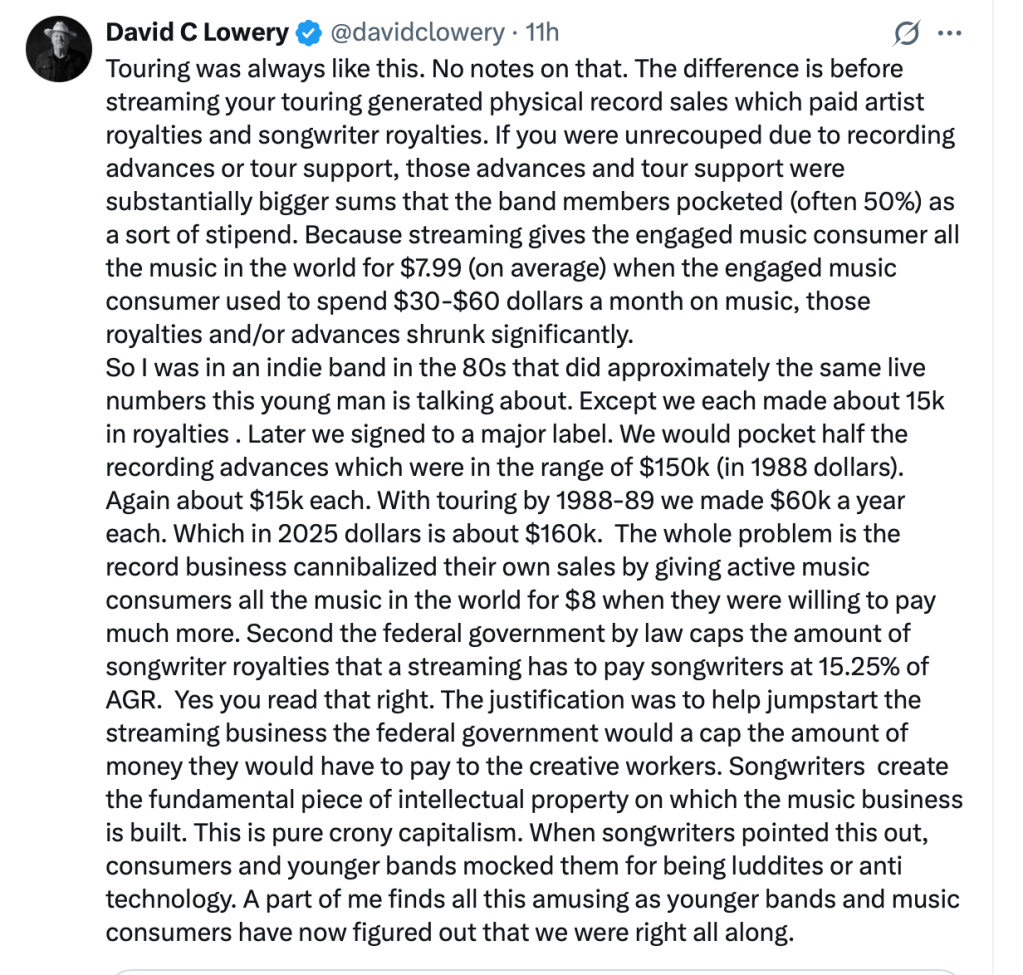
Streaming Economics
@nickgillespie and @davidclowery: Streaming is a Regulated Monopoly (Reason Magazine/Nick Gillespie)
The Artist Rights Watch podcast returns for another season! First episode is Tim Kappel discussing the Vetter v. Resnik landmark copyright termination case. Follow us wherever you get your podcasts.
New Survey for Songwriters: We are surveying songwriters about whether they want to form a certified union. Please fill out our short Survey Monkey confidential survey here! Thanks!
We will be posting excerpts from the Artist Rights Institute’s comment in the UK’s Intellectual Property Office proceeding on AI and copyright. That proceeding is called a “consultation” where the Office solicits comments from the public (wherever located) about a proposed policy.
In this case it was the UK government’s proposal to require creators to “opt out” of AI data scraping by expanding the law in the UK governing “text and data mining” which is what Silicon Valley wants in a big way. This idea produced an enormous backlash from the creative community that we’ll also be covering in coming weeks as it’s very important that Trichordist readers be up to speed on the latest skulduggery by Big Tech in snarfing down all the world’s culture to train their AI (which has already happened and now has to be undone). For a backgrounder on the “text and data mining” controversy, watch this video by George York of the Digital Creators Coalition speaking at the Artist Rights Institute in DC.
In this section of the comment we offer a simple rule of thumb or policy guideline by which to measure the Government’s rules (which could equally apply in America): Can an artist file a criminal complaint against someone like Sam Altman?
If an artist is more likely to be able to get the police to stop their car from being stolen off the street than to get the police to stop the artist’s life’s work from being stolen online by a heavily capitalized AI platform, the policy will fail
Why Can’t Creators Call 999 [or 911]?
We suggest a very simple policy guideline—if an artist is more likely to be able to get the police to stop their car from being stolen off the street than to get the police to stop the artist’s life’s work from being stolen online by a heavily capitalized AI platform, the policy will fail. Alternatively, if an artist can call the police and file a criminal complaint against a Sam Altman or a Sergei Brin for criminal copyright infringement, now we are getting somewhere.
This requires that there be a clear “red light/green light” instruction that can easily be understood and applied by a beat copper. This may seem harsh, but in our experience with the trillion-dollar market cap club, the only thing that gets their attention is a legal action that affects behavior rather than damages. Our experience suggests that what gets their attention most quickly is either an injunction to stop the madness or prison to punish the wrongdoing.
As a threshold matter, it is clear that AI platforms intend to continue scraping all the world’s culture for their purposes without obtaining consent or notifying rightsholders. It is likely that the bigger platforms already have. For example, we have found our own writings included in CoPilot outputs. Not only did we not consent to that use, but we were also never asked. Moreover, CoPilot’s use of these works clearly violates our terms of service. This level of content scraping is hardly what was contemplated with the “data mining” exceptions.
Yes, it’s kismet in the legislature–the sketchy ticket resellers are redoubling their efforts to normalize “speculative tickets.” They have found a willing partner in gaslighting with an organization called “ALEC”.
The American Legislative Exchange Council (hence “ALEC“) is a nonprofit organization that brings together private sector representatives and relatively conservative state legislators to draft (and pass) “model legislation” that pushes a particular narrative. (That private sector representation is led by Netchoice, aka, Big Tech.) Unlike other model legislation with a social benefit like say the Uniform Partnership Act, ALEC’s “model legislation” pushes a particular agenda. Examples would be “stand your ground” gun laws, Voter ID laws, and “right to work” laws.
Netchoice Members (Netchoice leads ALEC’s Private Enterprise Advisory Council)
ALEC’s many successfully-passed “model” laws are intended to be passed by state legislatures as-written. Like Al Capone’s green beer, it ain’t meant to be good it’s meant to be drunk. A cynic–not mentioning the names of any particular cynics–might say that the ALEC strategy is an end-run around federal legislation (like the fake library legislation that was shot down in New York). If ALEC can get a critical mass of states to pass one of their “model bills” as-drafted on any particular subject, then the need for federal legislation on that topic may become more muted. In fact, if federal legislation becomes inevitable, the ALEC model bills then provide guidance for federal legislation, or new federal legislation has to draft around the states that adopt the model bill.
So much for Justice Louis Brandeis’ concept of states as laboratories of democracy (New State Ice Co. v. Liebmann, 285 U.S. 262 (1932)), unless that lab belongs to Dr. Frankenstein. ALEC’s mission claims to promote principles of limited government, free markets, and federalism; I will leave you to decide if it’s more about checkbook federalism.
Ticketing Panel, Artist Rights Symposium 11/20/24, Washington DC L-R: Chris Castle (Artist Rights Institute), Dr. David Lowery (Univ. of Georgia, Terry College of Business), Mala Sharma (Georgia Music Partners), Stephen Parker (National Independent Venue Association), Kevin Erickson (Future of Music Coalition)
Like so many of these bills, ALEC’s Live Event Ticketing Consumer Protection & Reform Act disguises its true objective with a bunch of gaslighting bromides that they evidently believe to be persuasive and then when you’re not looking they slip in the knife. Then when the knife is protruding from your back you discover the true purpose. I think this section of the bill is the true purpose:
This is an odd construct. The model bill starts out by requiring positive behavior of a primary seller (which would be the band on fan club sales or other direct to fan sales). That positive behavior immediately turns to using the ticket purchaser into an enforcer of the values beneficial to the ticket reseller. This is done by forcing a purchaser to be able to resell their ticket without regard to any restrictions placed on reselling by the artist.
And you know that’s the intention because the section also requires there to be no maximum or minimum price. While the model bill doesn’t require any particular restriction on the platforms, it has enough in it that it can look like a consumer protection bill, but what it is really doing and apparently was designed to accomplish is eliminate an artist’s a ability to set prices.
ALEC is serious about violations of the act, including civil penalties. Their model ticketing legislation can be enforced by both the Federal Trade Commission and state attorneys general. Penalties can include fines of up to $15,000 per day of violation and $1,000 per event ticket advertised or sold. One problem with the model bill is that it appropriates jurisdiction already available to federal agencies like the FTC which is already failing to enforce the existing BOTS Act and other property theft laws.
The main targets seem to be Stubhub’s competitors like “Primary Ticket Merchants,” These are the original sellers of event tickets, such as event organizers or venues. “Secondary Ticket Merchants” may also be prosecuted as well as individuals.
We continue to study the proposed model legislation, but I tend to agree with Stephen Parker (NIVA) and Kevin Erickson (Future of Music) on my Artist Rights Institute panel in DC yesterday. The better model bill may be their bill passed in Maryland, recently signed into law by Maryland governor Wes More.
Key differences between Maryland and the ALEC bill I could spot:
Scope of Penalties: The Maryland bill specifies fines for speculative ticket sales, while the ALEC bill includes broader penalties for various violations.
Refund Policies: The Maryland bill explicitly requires refunds for counterfeit tickets, canceled events, or mismatched tickets, whereas the ALEC bill focuses more on transparency and restrictive practices.
Study on Resale Impact: The Maryland bill includes a provision for studying the impact of resale price caps, which is not present in the ALEC bill.
It appears that the Live Event Ticketing Consumer Protection & Reform Act will be introduced at the ALEC meeting on December 5, 2024. This is where ALEC members, including state legislators and private sector representatives, will discuss and vote on the model policy.




 The Trichordist
You must be logged in to post a comment.