
Remember that BMI sale? And how they said they’d bonus all their writers and publishers with $100 million of the billion dollar plus sale price?

Remember that BMI sale? And how they said they’d bonus all their writers and publishers with $100 million of the billion dollar plus sale price?
[T Editor sez: Remember how we have all fought alongside #IRespectMusic, Blake Morgan and MusicFirst to get artists paid for radio play of their recordings on terrestrial radio? Remember how iHeartMedia and the rest of the National Association of Broadcasters used their lobbying muscle to block our heroes in Congress like Reps. Jerry Nadler, Ted Deutch, and Darrell Issa and Senators Marsha Blackburn and Alex Padilla from passing the American Music Fairness Act? And are blocking it to this day? Well, adding insult to injury, the broadcasters who apparently own BMI, the for-profit PRO, are making serious bank for selling their shares to Google and private equity fund New Mountain. You know, Broadcast(er) Music, Inc.? Thus screwing songwriters, but screwing artist/songwriters TWICE. Who are they? According to the most recent BMI annual report we could find they are probably the same companies with board seats which are these smiling faces:
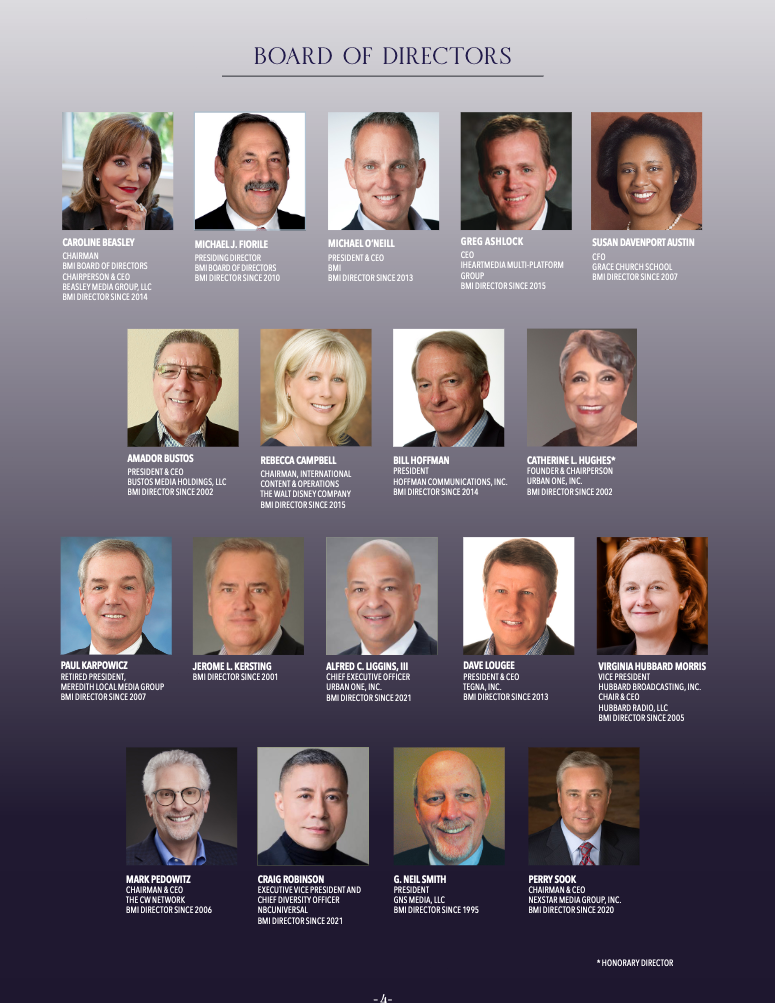
Bruce Hougton at Hypebot fills us in on the details of just how profitable the sale for Google’s blood money really is for one stockholder owner of BMI, iHeart Media (formerly Clear Channel). iHeart is, of course, the largest radio station owner in the US and poster child for media consolidation and screwing artists. iHeart profits from blood money stealing from artists and then does it again stealing from songwriters. And if iHeart is doing it, the rest of the BMI owners are, too. Of course you can complain to your songwriter-board member of BMI…oh wait, you don’t have any. Unlike ASCAP and SoundExchange. Of course, the question is whether those Members of Congress who worked so hard on the American Music Fairness Act and its predecessors will exercise their oversight role and investigate the sale. As well as the series of moves that lead to Google acquiring songwriter personal data that we don’t think belonged to BMI in the first place. It may not just be insulting, it may also be illegal. And answer the musical question, how big is your black box?]
In an ironic twist, iHeart Media, the largest owner of broadcast radio stations in the US, will receive $100 million from the sale of BMI to New Mountain Capital [and Google’s CapitalG venture fund]. The windfall is a result of iHeartMedia’s equity interest in BMI.
By Chris Castle
What’s a better way to hide a story than a Friday news dump? A long weekend news dump. (Remember when The MLC announced that they had “decided” to pick the Harry Fox Agency as their principal vendor after jerking chains for months?).
So I’m not surprised that the BMI sale got a turkey press release on the Thanksgiving long weekend. BMI’s press release is remarkable for what it doesn’t do. For example, it doesn’t announce the financial terms of the deal in favor of the bright and shiny object of a $100,000,000 tip to its 1.4 million “affiliates” which works out to about $71 each. Want to bet that BMI’s shareholders and executive team are pocketing a bit more on the deal?
Which is fine—it’s their company, they can decide how they want to share the sale price windfall. But if you’re going to be a capitalist, be a capitalist and don’t try to sugar coat the fact that you got rich(er) selling data that doesn’t belong to you and trading on the efforts of songwriters. In the great tradition of streaming that we’ve become accustomed to from Big Tech, songwriters get the shortest end of the stick. Oh, and don’t overlook how BMI intends to distribute that $100 million—my bet is that 90% of BMI songwriters won’t even net anything like $71.
But here’s the line that BMI definitely buried in the very last sentence of their press release: “As part of New Mountain’s investment, CapitalG will also invest a passive minority stake in BMI.”
Now who might CapitalG be? CapitalG is a side venture fund owned by Google. So that’s right—after 20 years of fighting the biggest copyright offender in the history of commerce, a seller of advertising on pirate sites like Megavideo, BMI has invited them inside the wire.
“Passive” normally means the party does not participate in the management decisions of a company they have invested in. However, without knowing the terms of the investment, there’s really no way to know what that means. “Minority” typically means that the party holds less than 50% plus one of the outstanding voting shares of the target company on an as-converted basis, in this case the BMI shares following the closing of the sale transaction. Again, without seeing the post-money capitalization table, you really have no way of knowing what “passive minority stake” really means.
So that leads me to look at the public statements of CapitalG, such as on its website. Here’s a couple of examples:
“CapitalG is Alphabet’s (Google’s) independent growth fund.”
“By maintaining a small, concentrated portfolio, we are able to invest heavily in each company’s success, fueling them with recurring, significant capital and consistent, hands-on operational and strategic support.”
What this sounds like is what you would expect—a very engaged, Silicon Valley style venture investment. It is inevitable that this investment will result in at least one board seat or “board observer” which is even worse from the company’s point of view. And that investment style is confirmed by another statement on CapitalG’s website:
“3000 Googlers have advised 4500 portfolio employees. Hands-on go-to-market, people & talent, and product & engineering support, often producing multimillion-dollar value within the first year.”
What that means is that Google will be all up in your grill, BMI folk. Get ready for it, because they will now be able to push you around for real with your jobs on the line because THEY OWN YOU.
What is worse than Boston Consulting Group telling you what you ought to do? Google telling you what you must do. And they will.
Why do they do it?
“16 IPOs and 9 M&A exits. Laser focused on each company’s success–with the track record to prove it.”
“Each company’s success” means the exit. That’s all it means. All those smiling people are smiling for a reason. They don’t care about songs, songwriters, writer relations or anything else. They are about the data, the tech, and all their hairbrained ideas about how the music business really should work in their utopia. Assuming “owning” the MLC and BMI passes antitrust scrutiny at President Biden’s FTC.
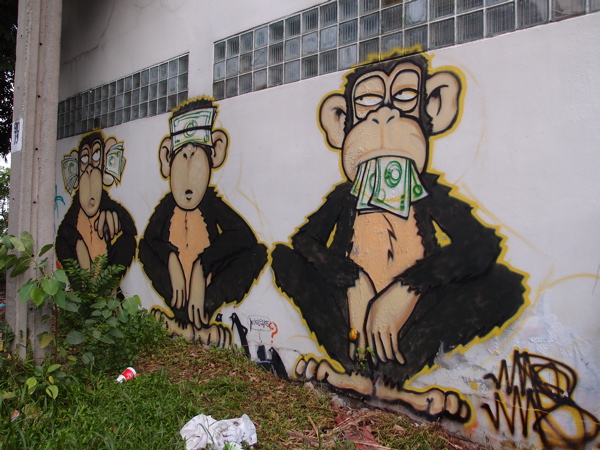
In other words, they are going to pump you up and sell your ass. And they’ll do it with the blood money they made by ripping us off for decades. That’s one way to get a job at Google.
So—as long as we understand each other. Something to think about when your writers and publishers start firing you.
[This post first appeared on MusicTechPolicy]
According to Billboard, Complete Music Update, and the awesome MusicAlly, nobody appears to be buying what they’re selling over to the BMI. For what seems like the second time in less than 30 days, Artist Rights Alliance, Black Music Action Coalition, Music Artists Coalition, SAG-AFTRA and Songwriters of North America rejected the hummina, hummina, hummina happy talk from BMI’s comms shop which comes out to trickle down mixed with a rising tide.
It’s really a shame because it would have been so easy to provide concrete answers if for no other reason than SAG-AFTRA is on a war footing already and is likely not going to back down. And with SAG-AFTRA comes the AFL-CIO which for BMI’s benefit are unions, see, unions that have been down this path before and are…oh, yes…on strike right now. How close are we to signs like this showing up outside of BMI HQ in New York? It’s OK, Larry and Sergey didn’t think they’d get one, either. Thank goodness we have the smart people to guide us. But BMI should look closely at this picture of a Google labor action and think about what they’d do if it happened to them.

When the CEO is trying to sell the company, in a very real sense they are auditioning for continued employment. Do you think this helps or hurts? Friends don’t let friends become a closing condition.
[This post first appeared on MusicTechPolicy]
Greed is good!! Or not.
We’ve all looked on in horror as executives at BMI are structuring a way to extract the value that generations of songwriters have bestowed on the broadcasters’ PRO. Because BMI had operated as a nonprofit corporation since 1939, extracting that value in the form of a sale of BMI was a bit of a problem because nonprofits have pretty extensive restrictions on who they can sell to (most prominently, other non profits and not the for profits who have the money) not to mention the responsibility of board members and no stock ownership by board members, liquidation preferences, etc. Some songwriter advocacy groups sent a letter asking a number of questions to BMI’s head honcho Mike O’Neil. You can read the letter and O’Neil’s non-answer on Music Business Worldwide. After reading the nonanswer see if you have the same reaction a lot of people have had–yep, it’s bullshit.
Enter the team that BMI and their broadcaster board plays for: The White Shoes of Wall Street with their notorious manager Goldman “Shifty” Sachs. As we know, the most dangerous geography in the world is the conflict zone between Shifty Sachs and fees not yet doing the english shift into Shifty’s pockets. So unsurprisingly, BMI did some kind of rollout (aka the Delaware two step) that presto changeo turned BMI into a for profit company ready for serving up on Shifty’s fees menu. And extracting songwriter value for BMI executives with tips all round for Shifty and his White Shoes.
And they’re getting away with it by the look of things. Are you surprised?
One reason they are getting away with it is that the rumored competitive offer from a songwriter buyer group hasn’t materialized yet. But the main reason they are getting away with it is because somehow a firm that has no connection to the music business (North Mountain Capital) seems to be interested in forking over a rumored $1.7 billion price tag for BMI. And that’s a lot of streams.
Because North Mountain have no detectable connection to the music business (aside from a valuation firm which to our knowledge hasn’t humped a trap case in quite a while) they are not really focused on a songwriter revolt against a business whose core asset is rented songs. We say “rented” because any BMI songwriter or publisher agreement can be unilaterally terminated by the songwriter or publisher. Even though that termination can be delayed a while, we wonder if Shifty has really taken that into account.
Of course, North Mountain itself may have some investors who are familiar with the music business. We can’t help noticing that the MLC invests hundreds of millions of other peoples black box money and they may very well have put some of your millions into North Capital as they have with mutual funds in which they are a “controlling person.” Since MLC refuses–under oath–to disclose their investments for the ludicrous reason that they might move markets…sheesh…and since the Copyright Office doesn’t compel the MLC to disclose those investments, we have no idea what they are up to. (There may be a simple explanation for this lack of spine given the Copyright Office’s past revolving door activities.) But we cannot rule out that the black box might be used to fund, albeit indirectly, an acquisition that the songwriters don’t want. In fact, there’s nothing to say that MLC has not already either directly invested in a takeover fund or made loans of black box money to publishers or their buddies who want to buy catalogs.
Unless something’s changed this morning, the BMI sale still isn’t done yet, but we have every confidence in Shifty and the White Shoes.
Because as Gordon Gekko taught us, greed is good.

By Chris Castle
For the moment, songwriters are in a holding pattern but with the wind at their backs. I’m still looking forward to an explanation of why Google, Pandora, Clear Channel and a host of other giant multinational corporations with hundreds if not thousands of lobbyists need the awesome power of the U.S. Government to protect them from…songwriters.
By Steve Winogradsky and Chris Castle, all rights reserved.
The recent ruling by the U.S. Department of Justice in the ASCAP and BMI consent decrees sent everyone scratching their heads as to what do we do now? The authors provide a helpful chart for songwriters, motion picture and television producers and other music users to see how bad it really is.
via A Guide to the Department of Justice Ruling on “100% Licensing” — MUSIC • TECHNOLOGY • POLICY
[Chris Castle says: We’re pleased to have another outstanding guest post by Stephen Carlisle, an entertainment lawyer with over 25 years experience in private practice in the State of Florida. The post first appeared on the Nova Southeastern University Office of Copyright site where Mr. Carlisle is the university’s first Copyright Officer. Reblogged from MusicTechPolicy, posted with permission of the author.]
My previous blog post detailed all the reasons why the U.S. Department of Justice could not do what it had announced it was going to do: rule without any hearing, court order or rule-making procedure that ASCAP and BMI were required to engage in 100% licensing. 1 Now, we have seen the written ruling, and you can read along if you wish. 2 With all apologies to author Judith Viorst for stealing the title of her book 3 (which I read to my sons many times), what happened last week was a terrible, horrible, no good, very bad decision by the DOJ, which, in truth, is an unmitigated assault on the rights of composers by their own government.
What this decision represents is a thoroughly dishonest explanation of what is in fact a gross violation of due process. So, let’s take these one at a time.
PART I
The DOJ claims:
“First, the plain text of the decrees cannot be squared with an interpretation that allows fractional licensing: the consent decrees require ASCAP to offer users the ability to perform all ‘works’ in its repertory and BMI’s licenses to offer users the ability to perform all ‘compositions’ in its repertory.” 4
No, the consent decrees fully endorse fractional licensing. Here is what the 2001 revision to ASCAP’s consent decree says:
“ASCAP shall not restrict the right of any member to withdraw from membership in ASCAP…provided that any writer or publisher member who resigns from ASCAP and whose works continue to be licensed by ASCAP by reason of continued membership of a co-writer, writer or publisher of any such works, may elect to continue receiving distribution for such works on the same basis and with the same elections as a member would have, so long as the resigning member does not license the works to any other performing rights organization for performance in the United States.” 5
So, ASCAP cannot, by the very plain text of the consent decree, continue to license and collect the share of a former member who has licensed his share to another PRO. Yet, this is exactly what the DOJ says that ASCAP must now do:
“[F]or a song co-written by one ASCAP member and one BMI member, the co-writers might designate the ASCAP member to collect all revenues from the licensing of public performance rights to the song and require that the ASCAP member distribute a share of the revenues to the BMI member.” 6
Did you read your own consent decree, DOJ? You just suggested what the plain text of the consent decree states unequivocally is prohibited conduct!
The DOJ tries to wiggle out of these consequences by stating:
“Under these circumstances, the song would not be included in BMI’s repertory.” 7
No, you can’t go there either. Because your rationale for reading into the consent decrees the 100% licensing rule is that a PRO writer agrees to license everything in which they have an ownership interest to their PRO. Here is the direct quote from your ruling, DOJ:
“Similarly, a songwriter affiliating with BMI grants to BMI the right to license non-dramatic public performances of ‘all musical compositions . . . composed by [the member] alone or with one or more co-writers’ and promises that ‘no performing rights in [these compositions] have been granted to or reserved by others except as specifically set forth therein in connection with Works heretofore written or co-written by [the author].’ BMI Writer Agreement, available at http://www.bmi.com/forms/affiliation/bmi_writer_kit.pdf.” 8
Followed by this threat:
“In the process of clarifying the works that ASCAP and BMI are able to continue to license under a full-work licensing requirement, the PROs may remind their members that the members made grants of rights to their PRO to license all works of which a member is a partial or complete owner and warranted that there were no other agreements that would prevent licensing on the basis described in the grant of rights.” 9
In other words, DOJ, you’ve just recommended that composers breach their licensing agreements with their own PRO’s.
So, let’s recap the loopy logic of the DOJ’s argument:
So, this reading of the consent decrees is inconsistent with not only the plain text of the consent decrees, but the plain text of your own opinion.
PART II
Next, the DOJ attempts to say that the Courts have consistently ruled in favor of 100% licensing. Of course, it’s no surprise they have never said such a thing. The DOJ contends:
“[T]he Supreme Court explained that the ASCAP and BMI blanket license ‘allows the licensee immediate use of covered compositions, without the delay of prior individual negotiations, and great flexibility in the choice of musical material’… If the licenses were fractional, they would not provide immediate use of covered compositions; users would need to obtain additional licenses before using many of the covered compositions.” 11
This is, in fact, the time honored practice of taking a quote out of context. What the SCOTUS is explaining here is why the blanket license is not an anti-trust violation, not that fractional licensing is not allowed in the blanket license system. Because, without the blanket license, the broadcaster would have to perform thousands of individual negotiations, a net benefit to the broadcaster.
Here are the sentences that immediately precede the language quoted by the DOJ:
“This substantial lowering of costs, which is of course potentially beneficial to both sellers and buyers, differentiates the blanket license from individual use licenses. The blanket license is composed of the individual compositions plus the aggregating service. Here, the whole is truly greater than the sum of its parts; it is, to some extent, a different product.” 12
And the sentences which immediately follow the DOJ quote:
“Many consumers clearly prefer the characteristics and cost advantages of this marketable package, and even small-performing rights societies that have occasionally arisen to compete with ASCAP and BMI have offered blanket licenses. Thus, to the extent the blanket license is a different product, ASCAP is not really a joint sales agency offering the individual goods of many sellers, but is a separate seller offering its blanket license, of which the individual compositions are raw material ASCAP, in short, made a market in which individual composers are inherently unable to compete fully effectively.” 13
Quite a different thing, isn’t it? Nothing in this opinion says anything about fractional shares.
Next, the DOJ asserts:
“Similarly, the Second Circuit has held that ASCAP is ‘required to license its entire repertory to all eligible users,’ and that the repertory includes ‘all works contained in the ASCAP repertory…’ Accordingly, the consent decrees must be read as requiring full-work licensing.” 14
Baloney. Again the quote is taken out of context. The Second Circuit isn’t ruling on anything in the quote, it’s just providing factual background. In fact, all the Court is doing here is directly quoting from the consent decree! Here’s the complete quote, which, by the way, is contained in a section of the opinion labeled “Background:”
“The core operative provision of AFJ2 provides, in pertinent part, that ASCAP must ‘grant to any music user making a written request therefor a non-exclusive license to perform all of the works in the ASCAP repertory.’ AFJ2 § VI. The decree defines ‘ASCAP repertory’ as ‘those works the right of public performance of which ASCAP has or hereafter shall have the right to license at the relevant point in time.’ Id. § II(C). ‘Right of public performance’ is defined, in pertinent part, as ‘the right to perform a work publicly in a nondramatic manner.’ Id. § II(Q).” 15
The Court’s ruling here was whether ASCAP could withdraw “subsets” of their license, particularly digital broadcast rights. The Court concluded it could not. It did not rule that the consent decrees require 100% licensing. No Court has ever said that or anything close to that.
The DOJ is just making this up.
PART III
Then there’s this doozy of an explanation:
“This statement seeks to explain the bases for the Division’s determination and describe why an express recognition that ASCAP and BMI do currently and must continue to offer full-work licenses should not meaningfully disrupt the status quo in the licensing of public performance rights. As discussed below, the Division encourages the industry to use the next year, during which the Division will forgo enforcement of the full-work licensing requirement, to transition to a common understanding regarding the scope of the ASCAP and BMI licenses. This period should allow stakeholders to resolve any practical challenges relating to complying with the fullwork licensing requirement, including the identification of songs that can no longer be included in ASCAP’s or BMI’s repertories because they cannot be offered on a full-work basis or the voluntary renegotiation of contractual agreements between co-owners to allow ASCAP or BMI to provide a full-work license to the song.” 16
Let me get this straight:
If this were not bad enough, here’s the kicker:
““[T]he Division will not take any enforcement action based on any purported fractional licensing by ASCAP and BMI for one year, as long as ASCAP and BMI proceed in good faith to ensure compliance with the requirements of the consent decrees.” 17
Gee. You might as well get out your signet ring and hot wax, my liege. 18
Words cannot convey how much I resent being threatened by my own government. Because they won’t enforce their “new rule that’s not a new rule” for the next year, only if ASCAP and BMI knuckle under to their heavy handed violation of my due process rights as a composer. So, if the PRO’s go to Court to challenge this “new rule that’s not a new rule” (which BMI has already started 19), is the DOJ is going to drop the hammer on them?
You seriously call yourself the “Justice Department?”
PART IV
It’s an unconstitutional taking under the 5th Amendment.
Says the DOJ:
“In the unlikely event that a user sought to depart from this practice by relying on a single PRO license as a basis to perform all co-owned works, the Division anticipates that the user would see an increase in the license fee corresponding to that portion of the works it is no longer paying for through a different PRO, as well as an additional administrative fee to cover the PRO’s costs associated with the license (which may include the cost of contracting with other PROs to make payments to those PROs’ members).” 20
Except there’s only one problem with this thinking. In the event of a dispute, the “rate court” gets to decide what ASCAP and BMI charge. Surely you remember, DOJ. You participated as amicus curae in the suit by Pandora Media against ASCAP on those very grounds. 21 So, the rate for thousands of licensees is already set(like Pandora), the result being that the PRO’s will be unable to charge any extra “administrative fees” as you so blithely indicate. This means the PRO’s will in fact earns less money, which turns into songwriters getting less money.
You cannot do this under the 5th amendment, namely, impose costly new regulations without “due process of law,” which you have utterly failed to do. Which, of course, is why the DOJ continues to insist that this is not a new rule, when it clearly is a new rule.
And what about SESAC? They are not a party to any consent decree. But this “new rule that’s not a new rule” makes them a party to the consent decrees if their writer has co-written with an ASCAP or BMI writer. What happened to their due process rights?
As explained before, this is really rule-making. 22 This would require all sorts of notices and procedures, and yes, due process that the DOJ doesn’t want to do.
PART V
Finally, don’t kid yourselves, folks. It’s going to be chaos.
The Copyright Office, in opposing the interpretation of 100% licensing, listed the numerous ways in which the current, very effective, licensing system would be damaged, not only in a practical basis but an economic basis: http://copyright.gov/policy/pro-licensing.pdf.
It’s already started. The Songwriters of North America have released the following statement:
“Based upon the marketplace uncertainty the DOJ’s proposal is likely to cause, some music licensees have already insinuated that they intend to withhold payments from ASCAP and BMI and rely upon an application for a license to continue to use our works free of potential infringement.” 23
This is because under section VI of the consent decree, ASCAP must give a license to anyone who requests one. They don’t have to pay what ASCAP wants. If there is a disagreement, they can then go to the “rate court” under section IX, under which ASCAP has the burden of proof. So, the music goes on playing, but the user stops paying.
And what about restrictive agreements between co-writers? At least the DOJ acknowledges that it cannot invalidate them.
“Of course, the obligation under the consent decrees that ASCAP and BMI offer full-work licenses binds only the two PROs and not any individual songwriter. Co-writers of songs remain free to split up their joint rights by contract in a way that makes their songs unlicensable (sic) by ASCAP or BMI… If co-owners decline to grant ASCAP and/or BMI the right to license the song on a full-work basis, the PROs will not be able to license that song.” 24
David Lowery over at The Trichordist has already suggested a civil disobedience strategy that will make the DOJ’s new interpretation unworkable.
How Songwriters Could Legally Strike and Bring the Entire Music Licensing System Down
A further complicating factor is that many times in this day and age, one becomes a co-writer of a song without a conscious collaboration to do so. This happens when a song gets sampled without permission, or in some cases, stolen.
It happened to a client of mine. Another writer completely ripped off my client’s song to serve as the verses for his song. Of course we caught him, but the problem was, the song was a hit. A Top Ten Billboard hit, in fact. So the smart thing to do was take ownership of part of the copyright of the new song, and not deep-six a song that was a hit. But, being the cautious attorney that I am, in the agreement, I provided that neither writer could license the song without the consent of the other. So, up to this point, we all assumed that BMI had one share and ASCAP had the other.
What happens now? Neither writer can grant full rights to ASCAP or BMI by themselves that the DOJ says they must have. So, if the other writer declines, or my writer declines, this song vanishes out of their catalogs. And this song is still popular, I just worked out placing it into a TV show. (And please note, the production company cleared both ends of the song without asking if it was necessary.) But now, the network that wants to show it, can’t, because neither ASCAP of BMI hold the necessary rights.
See? This “new rule that’s not a new rule” really isn’t going to cause any problems at all.
So, does either ASCAP or BMI know about our restrictive agreement? Nope. How could they? I guess the DOJ is going to insist that they send out letters to the composers of several million musical compositions to try and find out if there are any restrictive covenants between writers that they need to know about.
See? This “new rule that’s not a new rule” really isn’t going to cause any problems at all.
Further consider that “[i]n jurisdictions outside the United States, the default rule is that individual co-authors may license only their fractional share in a work (absent an agreement by all co-authors to the contrary). See 1 Nimmer on Copyright § 6.10 (“[I]n foreign jurisdictions, a license will not be valid unless all joint owners are party to it.”). 25
So, did you co-write a song with Max Martin, who is a resident of Sweden? Whose law applies, DOJ? Perhaps we’re going to see his 21 Billboard #1 hits 26 vanish from the airwaves?
See? This “new rule that’s not a new rule” really isn’t going to cause any problems at all.
Finally, consider that this “new rule that’s not a new rule” is likely to cause writers to remove their works from ASCAP and BMI, maybe taking them to SESAC, and maybe taking them to Irving Azoff’s GMR.
And then the fun really starts.
Consider an artist like Billy Joel. He single-handedly wrote all the music and all the lyrics to virtually every song he recorded. 27 What if he pulls his catalog and takes it to GMR? That means no Billy Joel gets played anywhere, unless you pay what he wants. If you do, you get a lawsuit by return mail. What if others do the same?
Chaos, that’s what will happen.
Which is what we’re going to get with this terrible, horrible, no good, very bad decision by the DOJ.
Notes:


 The Trichordist
You must be logged in to post a comment.