A New Twist in the AM Radio Debate: Why Tying AM Mandates to AMFA Is a Game-Changer #IRespectMusic

The latest twist in the long-running AM radio saga comes from a new alliance: cars and music. Automaker trade groups Alliance for Automotive Innovation, Consumer Technology Association, and Zero Emission Transportation Association are shoulder to shoulder with the musicFIRST Coalition and SoundExchange in urging Congress to link the “AM Radio in Every Vehicle Act” with the American Music Fairness Act (AMFA). If we’re going to mandate AM radios be placed in new cars then music played on those radios should pay the people who made that music. It’s unfair and fundamentally inconsistent to require one without the other, so broadcasters should pay artists.

What Is the American Music Fairness Act?

If you haven’t run across it yet, AMFA is bipartisan legislation sponsored by our champion Senator Marsha Blackburn in the Senate and our long-time ally Rep. Darrell Issa in the House of Representatives that would finally require AM/FM radio stations to pay performance royalties to recording artists and performers when their recordings are played over the air. Currently, the U.S. remains the only democracy that allows terrestrial radio to make billions from music without compensating performers.

Why Artists Get Left Out

As incredible as it may seem, under U.S. copyright law, terrestrial radio must pay songwriters and publishers—but not performers or sound recording rights holders. That means backup singers, session musicians, and producers receive zero compensation, even when their work drives–literally–billions in broadcast revenue. This is what allows the National Association of Broadcasters shillery to claim “we pay for music” and then try to pit artists against songwriters. That dog won’t hunt, but that never stops them from trying.

The musicFIRST Coalition, including SoundExchange and tons of artists and creators, has been front and center pushing Congress to close this loophole for years and we have been right there with them along with our friend Blake Morgan and his #IRespectMusic campaign.


“Mandating AM radio without addressing the performance royalty issue would perpetuate an inequity that denies hundreds of millions of dollars in compensation to countless recording artists every year. Congress should not pass a mandate for radio without ensuring appropriate royalties for artists… They deserve to have their hard work respected and valued with fair compensation — like they receive in every other industrialized country.”
SoundExchange CEO Michael Huppe


The Math on AMFA

  • U.S. radio plays over 240 million songs annually without compensating performers
  • The music industry could gain an estimated $200–300 million annually if Americans were paid for domestic and foreign broadcast plays 
  • Aligns U.S. copyright with global norms—terrestrial radio already pays performers in virtually every other developed nation.

What is to be done

If Congress is going to mandate AM radio in every car, it can’t ignore the rights of the very artists who create the content. By demanding performance royalties through AMFA, we can preserve public safety benefits while ensuring creators are paid for their work. This is a rare chance for Congress to get it right—fairness and infrastructure can go hand-in-hand.

If you believe artists deserve fairness when their music plays on the radio, now is the time to act:

  1. Sign the letter to Congress. The musicFIRST Action Center has made it easy—just a few clicks to add your name. 
  2. Call your Senator and Representative and tell them to support both:
    • American Music Fairness Act (H.R. 861 / S. 326)
    • AM Radio in Every Vehicle Act—(S. 315 / H.R. 979–but only inclusive of performance royalties
  3. Spread the word on social media with tags like #PassAMFA#FairPayForArtists#IRespectMusic

@SoundExchange CEO @mikehuppe Nails NAB Hypocrisy on Artist Pay for Radio Play–#IRespectMusic — Artist Rights Watch

The hearing on Groundhog Day (Feb. 2) for the American Music Fairness Act (or “AMFA”) was a fantastic opportunity for artists to be heard on the 100 year free ride the government has given broadcast radio. We know it went well because the National Association of Broadcasters sputtered like they do when they’ve got nothing to say.

But what’s really hysterical was how they talked out of both sides of their mouths in two different hearings–which makes you think that NAB president Curtis LeGeyt was doing his impression of Punxsutawney Phil. Yes, when it came to broadcasters getting paid by Big Tech, the broadcasters wanted their rights respected and to be paid fairly. But when the shoe was on the other foot, not so much. In the Senate, the NAB asked for more money for broadcasters in a hearing for the Journalism Competition and Preservation Act–to protect the mega radio broadcasters from the mega tech oligarchs. And if broadcasters don’t get more money, they want to be exempt from the antitrust laws so they can pull their content. Just like artists do to them…NOT.

Then the NAB comes over to the House Judiciary Committee–on the same day being Groundhog Day–and asks the government to continue their 100 year free ride. We call bullshit.

SoundExchange CEO Mike Huppe nailed this in his Billboard post:

The AMFA witnesses didn’t ask for an antitrust exemption, like the broadcasters did. They simply asked that recording artists be granted similar copyrights as others.

They didn’t ask for more money, like the broadcasters did. They simply asked for at least some payment, since they now receive none when broadcast radio stations air their music.

They didn’t ask for special treatment, like the broadcasters did. Rather they asked that they be treated the same as all other artists around the world, and even the same as artists on virtually all other media platforms in the U.S.

And they didn’t ask for rigts to negotiate and withhold content, like the broadcasters did. Under AMFA, radio stations would still be allowed to play music as they please. Artist advocates simply asked that the biggest-of-the-big stations pay a modest royalty set according to market rates. Stations making less than $1.5 million per year would pay a flat, annual royalty of $500 (less than $1.40 per day) for as much music as they choose to air. And the smallest stations’ payments would drop all the way down to $10.

No station is going to go bankrupt over these royalties.

Huppe has a very strong point here. This legislation has been picked over for years. AMFA bends over backwards to protect community radio and small broadcasters and repects everyone’s contribution to radio’s success.

But that’s the point–it respects everyone‘s contribution.

You can watch the hearing here:

@theblakemorgan: American middle-class musicians are worth fighting for #IRespectMusic–Artist Rights Watch

[Editor Charlie sez: Our friend and supporter Blake Morgan has an important opinion post on the bi-partisan American Music Fairness Act (AMFA) in The Hill, a long-time and influential DC insider journal. Blake tells the human story of why artists need the AMFA legislation and the #IRespectMusic campaign.]

This image has an empty alt attribute; its file name is amfa-156.jpeg
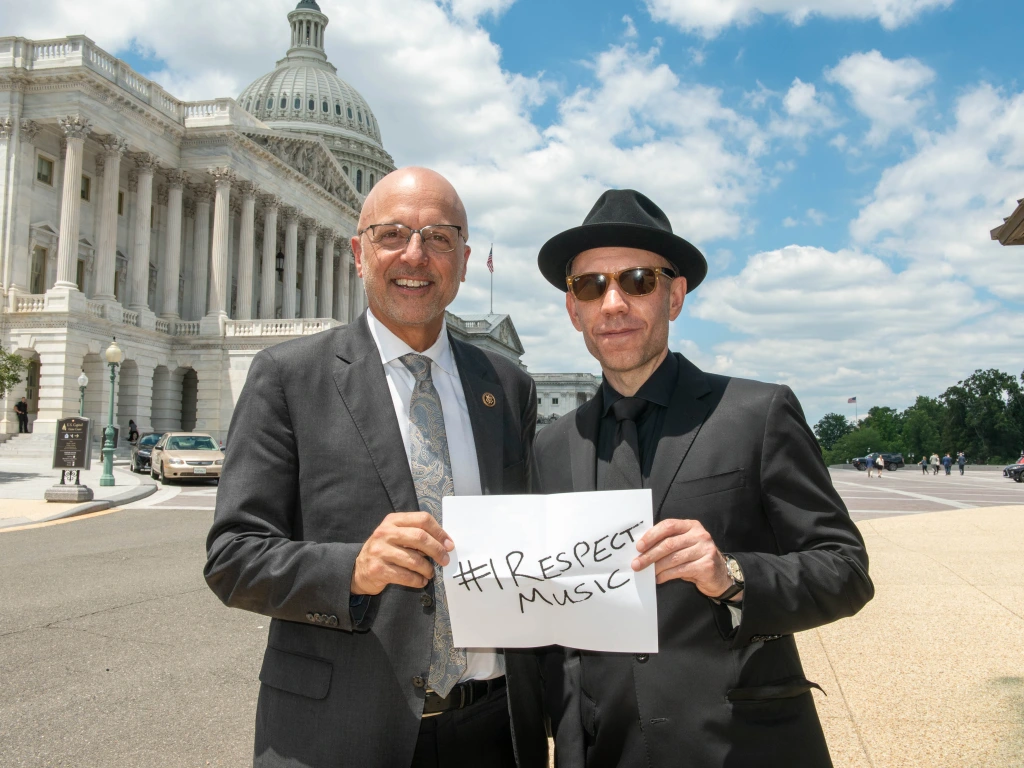
Rep. Ted Deutch and Blake Morgan

We musicians are used to fighting. For our livelihoods, our families, our dreams. In recent years we’ve fought battles we’ve neither sought nor provoked, against powerful corporate forces devaluing music’s worth. Streaming companies, music pirates, and AM/FM radio broadcasters who, in the United States, pay nothing––zero––to artists for radio airplay.

It’s shocking, but true: The United States is the only democratic country in the world where artists don’t get paid for radio airplay. Only Iran, North Korea, and China stand with the United States in this regard. ADVERTISEMENT

Broadcasters make billions of dollars each year off our music, and artists don’t earn a penny. This impacts not only the artist, but session musicians, recording engineers, songwriters. Virtually everyone in music’s economy. 

Isn’t being paid fairly for one’s work a bedrock American value?

Read Blake’s post on The Hill and sign the #IRespectMusic campaign and tell Congress you want fairness for artists!

Guest Post: #FairTradeofMusic Initiative Goes After $330 million in the New Reciprocity Campaign for Artist Rights (#irespectmusic)–Artist Rights Watch

Guest Post by Chris Castle (cross posted from Artist Rights Watch)

I cannot tell you the number of times U.S. artists have said to me, “I don’t need to join SoundExchange, I’m already a member of BMI.”  (Or ASCAP.)  Then I have to explain to them why SoundExchange collects an entirely different royalty–for the performance of the sound recording not the song.  It’s SoundExchange for recordings, PROs for songs.  Say it like a mantra.  It is a testament to the decades of propaganda from the National Association of Broadcasters and especially SiriusXM that has kept U.S. artists in the dark.

Strangely–and I’m being sarcastic–I never get this question from artists who are not Americans.  They are very aware of the performance royalty for sound recordings.

What neither the US nor the UK artists know very often is that when an American artist is played in the UK, the US artist receives no royalty due to decades-old trade rules.  But when a UK artist is played in the US, the UK artist receives their full royalty from SoundExchange as a matter of law.  A new organization called the Fair Trade of Music campaign  wants to change that so that artists are treated the same in the UK regardless of where they call home.

Why do we care?

We care because Fair Trade of Music estimates that U.S. artists lose about $330,000,000 each year due to this lack of fairness and reciprocal treatment.

FTOM Logo
Fair Trade of Music

We care because due to COVID-19, live music income has collapsed to zero or near zero.  Public performance income from SoundExchange is one of the few income streams left that American artists can count on.  And this is not a Yank thing.  The idea that American artists are generating income that is denied to them because of ancient trade laws is just as maddening to their sisters and brothers among artists in the UK as it is to the Americans.

We care because fixing this inequity is not a zero sum game.  UK artists should not make a penny less if US artists get their rightful share.  The money is already being paid and the rates are already determined–it’s just that the payment of the money for US artists must be redirected.

We care because we have a chance to fix the ancient trade rules that perpetuate this inequity.  There are a lot of trade rules about many different products and services including the rules for these payments to American artists.  Those rules can be changed by vehicles like the upcoming UK/US trade agreement.

Right now the focus is on the UK because we have a vehicle to take a big step toward fixing this treatment (which is true in many other countries, too).  That vehicle takes the form of the upcoming UK/US trade agreement which may be signed in the next few months.  Even if it isn’t actually signed it will be negotiated, and the outlines of the UK/US deal will likely be much better defined before the end of the year. (This “bilateral” trade agreement with the UK must be put in place due to the UK leaving the European Union.)

We need to be at that table.  Now is the time to take action.

If you want to sound off to the powers that be about fixing this loophole, you can sign a petition to support fair treatment at the Fair Trade of Music site.  I don’t often ask you guys to do something like this, but I really think you should sign up.

As Ann Richards said, if you’re not at the table, you’re on the menu.