@ArtistRights Institute Newsletter 3/17/25

This image has an empty alt attribute; its file name is ari-basic-logo-3.jpg

The Artist Rights Institute’s news digest Newsletter

Take our new confidential survey for publishers and songwriters!

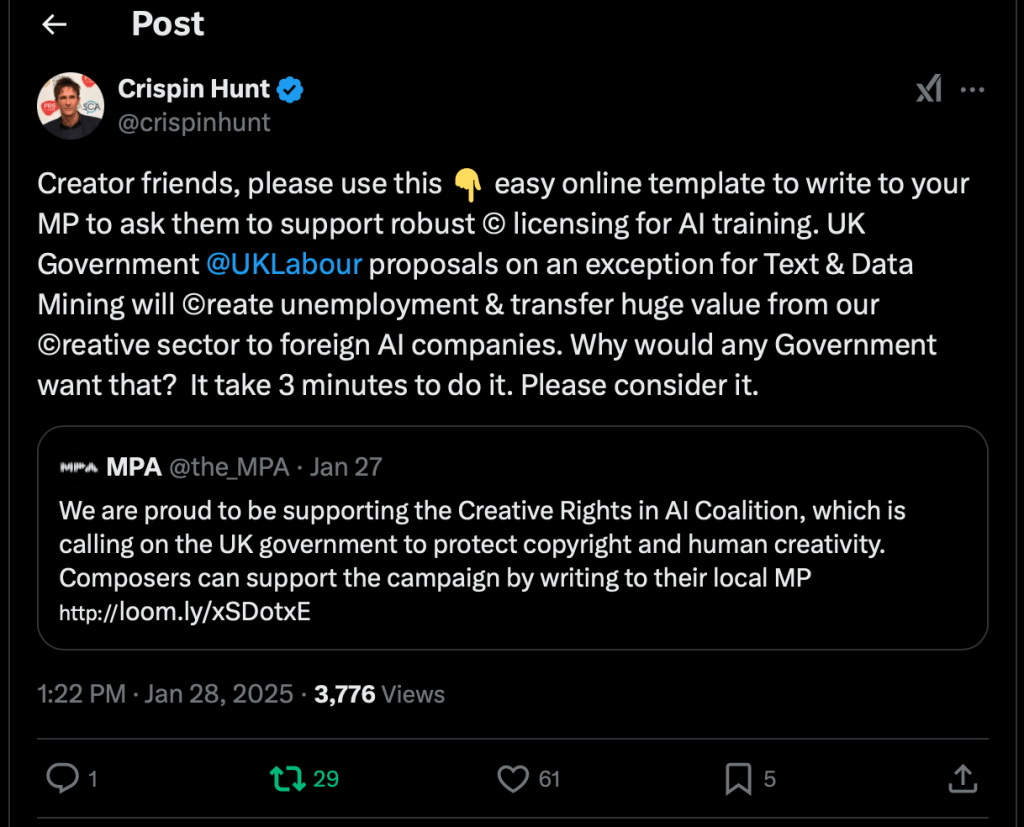
UK AI Opt-Out Legislation

UK Music Chief Calls on Ministers to Drop Opposition Against Measures to Stop AI Firms Stealing Music

Human Rights and AI Opt Out (Chris Castle/MusicTechPolicy) 

Ticketing

New Oregon bill would ban speculative ticketing, eliminate hidden ticket sale fees, crack down on deceptive resellers (Diane Lugo/Salem Statesman Journal-USA Today)

AI Litigation/Legislation

French Publishers and Authors Sue Meta over Copyright Works Used in AI Training (Kelvin Chan/AP);

AI Layoffs

‘AI Will Be Writing 90% of Code in 3-6 Months,’ Says Anthropic’s Dario Amodei (Ankush Das/Analytics India)

Amazon to Target Managers in 2025’s Bold Layoffs Purge (Anna Verasai/The HR Digest)

AI Litigation: Kadrey v. Meta

Authors Defeat Meta’s Motion to Dismiss AI Case on Meta Removing Watermarks to Promote Infringement

Judge Allows Authors AI Copyright Infringement Lawsuit Against Meta to Move Forward (Anthony Ha/Techcrunch)

America’s AI Action Plan Request for Information

Google and Its Confederate AI Platforms Want Retroactive Absolution for AI Training Wrapped in the American Flag (Chris Castle/MusicTechPolicy)

Google Calls for Weakened Copyright and Export Rules in AI Policy Proposal (Kyle Wiggers/TechCrunch) 

Artist Rights Institute Submission

@ArtistRights Institute’s UK Government Comment on AI and Copyright: Why Can’t Creators Call 911?

We will be posting excerpts from the Artist Rights Institute’s comment in the UK’s Intellectual Property Office proceeding on AI and copyright. That proceeding is called a “consultation” where the Office solicits comments from the public (wherever located) about a proposed policy.

In this case it was the UK government’s proposal to require creators to “opt out” of AI data scraping by expanding the law in the UK governing “text and data mining” which is what Silicon Valley wants in a big way. This idea produced an enormous backlash from the creative community that we’ll also be covering in coming weeks as it’s very important that Trichordist readers be up to speed on the latest skulduggery by Big Tech in snarfing down all the world’s culture to train their AI (which has already happened and now has to be undone). For a backgrounder on the “text and data mining” controversy, watch this video by George York of the Digital Creators Coalition speaking at the Artist Rights Institute in DC.

In this section of the comment we offer a simple rule of thumb or policy guideline by which to measure the Government’s rules (which could equally apply in America): Can an artist file a criminal complaint against someone like Sam Altman?

If an artist is more likely to be able to get the police to stop their car from being stolen off the street than to get the police to stop the artist’s life’s work from being stolen online by a heavily capitalized AI platform, the policy will fail

Why Can’t Creators Call 999 [or 911]?

We suggest a very simple policy guideline—if an artist is more likely to be able to get the police to stop their car from being stolen off the street than to get the police to stop the artist’s life’s work from being stolen online by a heavily capitalized AI platform, the policy will fail.  Alternatively, if an artist can call the police and file a criminal complaint against a Sam Altman or a Sergei Brin for criminal copyright infringement, now we are getting somewhere.

This requires that there be a clear “red light/green light” instruction that can easily be understood and applied by a beat copper.  This may seem harsh, but in our experience with the trillion-dollar market cap club, the only thing that gets their attention is a legal action that affects behavior rather than damages.  Our experience suggests that what gets their attention most quickly is either an injunction to stop the madness or prison to punish the wrongdoing. 

As a threshold matter, it is clear that AI platforms intend to continue scraping all the world’s culture for their purposes without obtaining consent or notifying rightsholders.  It is likely that the bigger platforms already have.  For example, we have found our own writings included in CoPilot outputs.  Not only did we not consent to that use, but we were also never asked.  Moreover, CoPilot’s use of these works clearly violates our terms of service.  This level of content scraping is hardly what was contemplated with the “data mining” exceptions. 

Faux “Data Mining” is the Key that Picks the Lock of Human Expression

The Artist Rights Institute filed a comment in the UK Intellectual Property Office’s consultation on Copyright and AI that we drafted. The Trichordist will be posting excerpts from that comment from time to time.

Confounding culture with data to confuse both the public and lawmakers requires a vulpine lust that we haven’t seen since the breathless Dot Bomb assault on both copyright and the public financial markets. 

We strongly disagree that all the world’s culture can be squeezed through the keyhole of “data” to be “mined” as a matter of legal definitions.  In fact, a recent study by leading European scholars have found that data mining exceptions were never intended to excuse copyright infringement:

Generative AI is transforming creative fields by rapidly producing texts, images, music, and videos. These AI creations often seem as impressive as human-made works but require extensive training on vast amounts of data, much of which are copyright protected. This dependency on copyrighted material has sparked legal debates, as AI training involves “copying” and “reproducing” these works, actions that could potentially infringe on copyrights. In defense, AI proponents in the United States invoke “fair use” under Section 107 of the [US] Copyright Act [a losing argument in the one reported case on point[1]], while in Europe, they cite Article 4(1) of the 2019 DSM Directive, which allows certain uses of copyrighted works for “text and data mining.”

This study challenges the prevailing European legal stance, presenting several arguments:

1. The exception for text and data mining should not apply to generative AI training because the technologies differ fundamentally – one processes semantic information only, while the other also extracts syntactic information

2. There is no suitable copyright exception or limitation to justify the massive infringements occurring during the training of generative AI. This concerns the copying of protected works during data collection, the full or partial replication inside the AI model, and the reproduction of works from the training data initiated by the end-users of AI systems like ChatGPT….[2] 

Moreover, the existing text and data mining exception in European law was never intended to address AI scraping and training:

Axel Voss, a German centre-right member of the European parliament, who played a key role in writing the EU’s 2019 copyright directive, said that law was not conceived to deal with generative AI models: systems that can generate text, images or music with a simple text prompt.[3]

Confounding culture with data to confuse both the public and lawmakers requires a vulpine lust that we haven’t seen since the breathless Dot Bomb assault on both copyright and the public financial markets.  This lust for data, control and money will drive lobbyists and Big Tech’s amen corner to seek copyright exceptions under the banner of “innovation.”  Any country that appeases AI platforms in the hope of cashing in on tech at the expense of culture will be appeasing their way towards an inevitable race to the bottom.  More countries can be predictably expected to offer ever more accommodating terms in the face of Silicon Valley’s army of lobbyists who mean to engage in a lightning strike across the world.  The fight for the survival of culture is on.  The fight for survival of humanity may literally be the next one up.  

We are far beyond any reasonable definition of “text and data mining.”  What we can expect is for Big Tech to seek to distract both creators and lawmakers with inapt legal diversions such as trying to pretend that snarfing down all with world’s creations is mere “text and data mining”.  The ensuing delay will allow AI platforms to enlarge their training databases, raise more money, and further the AI narrative as they profit from the delay and capital formation.


[1] Thomson-Reuters Enterprise Centre GMBH v. Ross Intelligence, Inc., (Case No. 1:20-cv-00613 U.S.D.C. Del. Feb. 11, 2025) (Memorandum Opinion, Doc. 770 rejecting fair use asserted by defendant AI platform) available at https://storage.courtlistener.com/recap/gov.uscourts.ded.72109/gov.uscourts.ded.72109.770.0.pdf (“[The AI platform]’s use is not transformative because it does not have a ‘further purpose or different character’ from [the copyright owner]’s [citations omitted]…I consider the “likely effect [of the AI platform’s copying]”….The original market is obvious: legal-research platforms. And at least one potential derivative market is also obvious: data to train legal AIs…..Copyrights encourage people to develop things that help society, like [the copyright owner’s] good legal-research tools. Their builders earn the right to be paid accordingly.” Id. at 19-23).  See also Kevin Madigan, First of Its Kind Decision Finds AI Training Is Not Fair Use, Copyright Alliance (Feb. 12, 2025) available at https://copyrightalliance.org/ai-training-not-fair-use/ (discussion of AI platform’s landmark loss on fair use defense).

[2] Professor Tim W. Dornis and Professor Sebastian Stober, Copyright Law and Generative AI Training – Technological and Legal Foundations, Recht und Digitalisierung/Digitization and the Law (Dec. 20, 2024)(Abstract) available at https://papers.ssrn.com/sol3/papers.cfm?abstract_id=4946214

[3] Jennifer Rankin, EU accused of leaving ‘devastating’ copyright loophole in AI Act, The Guardian (Feb. 19, 2025) available at https://www.theguardian.com/technology/2025/feb/19/eu-accused-of-leaving-devastating-copyright-loophole-in-ai-act

@Abbie_Llewelyn: UK Government defeated in House of Lords over protecting copyright from AI data scraping

Good news on the AI fight posted by the @artistrights Institute’s ArtistRightsWatch.com]

The Government has been defeated in the Lords over measures to protect creatives from having their copyrighted work used to train AI models without permission or remuneration. [The House of Lords is the “upper chamber” of the UK Parliament, similar to the US Senate.]

Peers [Members of the House of Lords] voted 145 to 126, majority 19, in favour of a package of amendments to the Data (Use and Access) Bill aiming to tackle the unauthorised use of intellectual property by big tech companies scraping data for AI.

Proposing the amendments, digital rights campaigner Baroness Kidron said they would help enforce existing property rights by improving transparency and laying out a redress procedure.

The measures would explicitly subject AI companies to UK copyright law, regardless of where they are based, reveal the names and owners of web crawlers that currently operate anonymously and allow copyright owners to know when, where and how their work is used.

Read the post on PA Media

Updates for Nov. 20 @ArtistRights Symposium at @AmericanU @KogodBiz in Washington DC

We are announcing the time schedule and speakers for the 4th annual Artist Rights Symposium on November 20. The symposium is supported by the Artist Rights Institute and was founded by Dr. David C. Lowery, Lecturer at the University of Georgia Terry College of Business.

This year the symposium is hosted in Washington, DC, by American University’s Kogod School of Business at American’s Constitution Hall, 4400 Massachusetts Avenue, NW, Washington, DC 20016.  We are also pleased to have a Kogod student presentation on speculative ticketing as part of the speaker lineup.

Admission is free, but please reserve a spot with Eventbrite, seating is limited!

The symposium starts at 8:30 am and ends with a reception at 4:30pm. The symposium will be recorded as an audiovisual presentation for distribution at a later date, but will not be live-streamed. If you attend, understand that you may be filmed in any audience shots, questions from the floor or still images. The symposium social media hashtag is #ArtistRightsKogod.

Schedule

8:30 — Doors open, networking coffee.

9:00-9:10 — Welcome remarks by David Marchick, Dean, Kogod School of Business

9:10-9:15 — Welcome remarks by Christian L. Castle, Esq., Director, Artist Rights Institute

9:15-10:15 — THE TROUBLE WITH TICKETS:  The Challenges of Ticket Resellers and Legislative Solutions:

Kevin Erickson, Director, Future of Music Coalition, Washington DC
Dr. David C. Lowery, Co-founder of Cracker and Camper Van Beethoven, University of Georgia
  Terry College of Business, Athens, Georgia
Stephen Parker, Executive Director, National Independent Venue Association, Washington DC
Mala Sharma, President, Georgia Music Partners, Atlanta, Georgia

Moderator:  Christian L. Castle, Esq., Director, Artist Rights Institute, Austin, Texas

10:15-10:30: NIVA Speculative Ticketing Project Presentation by Kogod students

10:30-10:45: Coffee break

10:45-11:00: OVERVIEW OF CURRENT ISSUES IN ARTIFICIAL INTELLIGENCE LITIGATION: Kevin Madigan, Vice President, Legal Policy and Copyright Counsel, Copyright Alliance

11:00-12 pm: SHOW ME THE CREATOR – Transparency Requirements for AI Technology:

Danielle Coffey, President & CEO, News Media Alliance, Arlington, Virginia
Dahvi Cohen, Legislative Assistant, U.S. Congressman Adam Schiff, Washington, DC
Ken Doroshow, Chief Legal Officer, Recording Industry Association of America, Washington DC 

Moderator: Linda Bloss-Baum, Director of the Kogod School of Business’s Business & Entertainment Program

12:00-12:30: Lunch break

12:30-1:30: Keynote: Graham Davies, President and CEO of the Digital Media Association, Washington DC.

1:30-1:45: Coffee break

1:45-2:45: CHICKEN AND EGG SANDWICH:  Bad Song Metadata, Unmatched Funds, KYC and What You Can Do About It

Richard James Burgess, MBE, President & CEO, American Association of Independent Music, New York
Helienne Lindvall, President, European Composer & Songwriter Alliance, London, England
Abby North, President, North Music Group, Los Angeles
Anjula Singh, Chief Financial Officer and Chief Operating Officer, SoundExchange, Washington DC

Moderator:  Christian L. Castle, Esq, Director, Artist Rights Institute, Austin, Texas

2:45-3:15: Reconvene across street to International Service Founders Room for concluding speakers and reception

3:15-3:30: OVERVIEW OF INTERNATIONAL ARTIFICIAL INTELLIGENCE LEGISLATION: George York, Senior Vice President International Policy from RIAA.

3:30-4:30: NAME, IMAGE AND LIKENESS RIGHTS IN THE AGE OF AI:  Current initiatives to protect creator rights and attribution

Jeffrey Bennett, General Counsel, SAG-AFTRA, Washington, DC
Jen Jacobsen, Executive Director, Artist Rights Alliance, Washington DC
Jalyce E. Mangum, Attorney-Advisor, U.S. Copyright Office, Washington DC

Moderator
John Simson, Program Director Emeritus, Business & Entertainment, Kogod School of Business, American University

4:30-5:30: Concluding remarks by Linda Bloss-Baum, Director of the Kogod School of Business’s Business & Entertainment Program and reception.

CHICKEN AND EGG SANDWICH:  Bad Song Metadata, Unmatched Funds, KYC and What You Can Do About It: Speaker Update for Nov. 20 @ArtistRights Symposium at @AmericanU @KogodBiz in Washington DC

We’re pleased to announce additional speakers for the 4th annual Artist Rights Symposium on November 20, this year hosted in Washington, DC, by American University’s Kogod School of Business at American’s Constitution Hall, 4400 Massachusetts Avenue, NW, Washington, DC 20016.  The symposium is also supported by the Artist Rights Institute and was founded by Dr. David Lowery, Lecturer at the University of Georgia Terry College of Business.

The Symposium has four panels and a lunchtime keynote. Panels will begin at 8:30 am and end by 5 pm, with lunch and refreshments. More details to follow. Contact the Artist Rights Institute for any questions.

Admission is free, but please reserve a spot with Eventbrite, seating is limited! (Eventbrite works best with Firefox)

Keynote: Graham Davies, President and CEO of the Digital Media Association, Washington DC.  Graham will speak around lunchtime.

We have confirmed speakers for another topic! 

CHICKEN AND EGG SANDWICH:  Bad Song Metadata, Unmatched Funds, KYC and What You Can Do About It

Richard James Burgess, MBE, President & CEO, American Association of Independent Music, New York
Helienne Lindvall, President, European Composer & Songwriter Alliance, London, England
Abby North, President, North Music Group, Los Angeles
Anjula Singh, Chief Financial Officer and Chief Operating Officer, SoundExchange, Washington DC

Moderator:  Christian L. Castle, Esq, Director, Artist Rights Institute, Austin, Texas

Previously confirmed panelists are:

SHOW ME THE CREATOR – Transparency Requirements for AI Technology:

Danielle Coffey, President & CEO, News Media Alliance, Arlington, Virginia
Dahvi Cohen, Legislative Assistant, U.S. Congressman Adam Schiff, Washington, DC
Ken Doroshow, Chief Legal Officer, Recording Industry Association of America, Washington DC 

Moderator: Linda Bloss-Baum, Director of the Kogod School of Business’s Business & Entertainment Program

THE TROUBLE WITH TICKETS:  The Economics and Challenges of Ticket Resellers and Legislative Solutions:

Kevin Erickson, Director, Future of Music Coalition, Washington DC
Dr. David C. Lowery, Co-founder of Cracker and Camper Van Beethoven, University of Georgia
  Terry College of Business, Athens, Georgia
Stephen Parker, Executive Director, National Independent Venue Association, Washington DC
Mala Sharma, President, Georgia Music Partners, Atlanta, Georgia

Moderator:  Christian L. Castle, Esq., Director, Artist Rights Institute, Austin, Texas

@human_artistry Press Release: Senators Introduce COPIED Act to Combat AI Deepfakes

Senators Cantwell, Blackburn, and Heinrich introduce the Content Origin Protection and Integrity from Edited and Deepfaked Media Act (COPIED Act), Giving Artists New Tools to Protect Against Deepfakes
“Deepfakes pose an existential threat to our culture and society, making it hard to believe what we see and hear and leaving individual creators vulnerable as tech companies use our art without consent while AI-generated content leads to confusion about what is real. Requiring transparency is a meaningful step that will help protect us all – ensuring that nonconsensual, harmful content can be removed quickly and providing a clear origin when our life’s work has been used.” 
– Dr. Moiya McTier, Human Artistry Campaign Senior Advisor
With widespread creative community support from organizations including the Artist Rights Alliance, SAG-AFTRA, the Recording Academy, RIAA, NMPA, NSAI, and more, the bill would set new federal transparency guidelines for marking, authenticating and detecting AI-generated content, protect journalists, actors and artists against AI-driven theft, and hold violators accountable for abuses.  

Creates Transparency Standards: Requires the National Institute of Standards and Technology (NIST) to develop guidelines and standards for content provenance information, watermarking and synthetic content detection. These standards will promote transparency to identify if content has been generated or manipulated by AI, as well as where AI content originated. The bill also directs NIST to develop cybersecurity measures to prevent tampering with provenance and watermarking on AI content. 

Puts Journalists, Artists and Musicians in Control of Their Content: Requires providers of AI tools used to generate creative or journalistic content to allow owners of that content to attach provenance information to it and prohibits its removal. The bill prohibits the unauthorized use of content with provenance information to train AI models or generate AI content. These measures give content owners—journalists, newspapers, artists, songwriters, and others—the ability to protect their work and set the terms of use for their content, including compensation. 

Gives Individuals a Right to Sue Violators: Authorizes the Federal Trade Commission (FTC) and state attorneys general to enforce the bill’s requirements.  It also gives newspapers, broadcasters, artists, and other content owners the right to bring suit in court against platforms or others who use their content without permission.

Prohibits Tampering with or Disabling AI Provenance Information: Currently, there is no law that prohibits removing, disabling, or tampering with content provenance information. The bill prohibits anyone, including internet platforms, search engines and social media companies, from interfering with content provenance information in these ways.  

@human_artistry: Scarlett Johansson calls for federal protections against generative AI

Reality is that this could happen to anyone, but like other online pirates they come for the famous people first to free ride on their brand.