The Word “If” is for Losers: Gene Simmons Nails It on American Music Fairness Act

Senator Marsha Blackburn and Gene Simmons testified today at the Senate Judiciary Committee on fixing artist pay for radio play with the American Music Fairness Act—both knocked it out of the park. As Senator Blackburn said very clearly, corporate radio wants to be treated as a special and protected class for no good reason. As she said, the creative community has waited a very long time for fair treatment.

Now Gene Simmons…lived up to his billing. Absolutely charming and emphatic about driving AMFA through the tape. Has to be seen to be believed and absolutely electrifying. As he said, artists need radio and radio needs artists. “Let’s get with it” NAB.

You can watch the entire hearing above or Gene’s written testimony and highlight reel below.

Gene Simmons and the American Music Fairness Act

Gene Simmons is receiving Kennedy Center Honors with KISS this Sunday, and is also bringing his voice to the fair pay for radio play campaign to pass the American Music Fairness Act (AMFA).

Gene will testify on AMFA next week before the Senate Judiciary Committee. He won’t just be speaking as a member of KISS or as one of the most recognizable performers in American music. He’ll be showing up as a witness to something far more universal: the decades-long exploitation of recording artists whose work powers an entire broadcast industry and that has never paid them a dime. Watch Gene’s hearing on December 9th at 3pm ET at this link, when Gene testifies alongside SoundExchange CEO Mike Huppe.

As Gene argued in his Washington Post op-ed, the AM/FM radio loophole is not a quirky relic, it is legalized taking. Everyone else pays for music: streaming services, satellite radio, social-media platforms, retail, fitness, gaming. Everyone except big broadcast radio, which generated more than $13 billion in advertising revenue last year while paying zero to the performers whose recordings attract those audiences.

Gene is testifying not just for legacy acts, but for the “thousands of present and future American recording artists” who, like KISS in the early days, were told to work hard, build a fan base, and just be grateful for airplay. As he might put it, artists were expected to “rock and roll all night” — but never expect to be paid for it on the radio.

And when artists asked for change, they were told to wait. They “keep on shoutin’,” decade after decade, but Congress never listened.

That’s why this hearing matters. It’s the first Senate-level engagement with the issue since 2009. The ground is shifting. Gene Simmons’ presence signals something bigger: artists are done pretending that “exposure” is a form of compensation.

AMFA would finally require AM/FM broadcasters to pay for the sound recordings they exploit, the same way every other democratic nation already does. It would give session musicians, backup vocalists, and countless independent artists a revenue stream they should have had all along. It would even unlock international royalties currently withheld from American performers because the U.S. refuses reciprocity.

And let’s be honest: Gene Simmons is an ideal messenger. He built KISS from nothing, understands the grind, and knows exactly how many hands touch a recording before it reaches the airwaves. His testimony exposes the truth: radio isn’t “free promotion” — it’s a commercial business built on someone else’s work.

Simmons once paraphrased the music economy as a game where artists are expected to give endlessly while massive corporations act like the only “god of thunder,” taking everything and returning nothing. AMFA is an overdue correction to that imbalance.

When Gene sits down before the Senate Judiciary Committee, he won’t be wearing the makeup. He won’t need to. He’ll be carrying something far more powerful: the voices of artists who’ve waited 80 years for Congress to finally turn the volume up on fairness.

Don’t Let Congress Reward the Stations That Don’t Pay Artists

As we’ve been posting about for years—alongside Blake Morgan and the #IRespectMusic movement that you guys have been so good about supporting—there’s still a glaring failure at the heart of U.S. copyright law: performing artists and session musicians receive no royalty for AM/FM radio airplay. Every other developed country (and practically every other country) compensates performers for broadcast use, yet the United States continues to exempt terrestrial radio from paying the people who record the music.

Now Congress is preparing to pass the AM Radio in Every Car Act, a massive government intervention that would literally install the instrument of unfairness into every new car at significant cost to consumers. It’s a breathtaking example of how far the National Association of Broadcasters (NAB) will go to preserve its century-old free ride—by lobbying for public subsidies while refusing to pay artists a penny. This isn’t public service; it’s policy cruelty dressed up as nostalgia.

Hundreds of artists have already spoken out in a letter to Congress demanding fairness through the American Music Fairness Act (AMFA). Their action matters—and yours does too.

👉 Here’s what you can do:

Don’t let Washington hard-wire injustice into every dashboard. Demand that Congress fix the problem before it funds the next generation of unfairness.

Dear Speaker Johnson, Leader Jeffries, Leader Thune, and Leader Schumer:

Earlier this year, we wrote urging that you take action on the American Music Fairness Act (S.253/H.R.791), legislation that will require that AM/FM radio companies start paying artists for their music. We are grateful for your attention to ensuring America’s recording artists are finally paid for use of our work.

As you may know, some members of Congress are currently seeking to pass legislation that will require every new vehicle manufactured in the United States come pre-installed with AM radio. The passage of the AM Radio for Every Vehicle Act (S.315/H.R.979) would mark another major windfall for the corporate radio industry that makes $13.6 billion each year in advertising revenue while refusing to compensate the performers whose songs play 240 million times each year on AM radio stations. Every year, recording artists lose out on hundreds of millions of dollars in royalties in the U.S. and abroad because of this hundred-year-old loophole.

This is wrong. In the United States of America, every person deserves to be paid for the use of their work. But because of the power held by giant radio corporations in Washington, artists, both big and small, continue to be overlooked, even as every other music delivery platform, including streaming services and satellite radio, pays both the songwriter and performer.

We are asking today that you insist that any legislation that includes the AM Radio for Every Vehicle Act also include the American Music Fairness Act. We do not oppose terrestrial radio. In fact, we appreciate the role that radio has played in our careers and within society, but the 100-year-old argument of promotion that radio continues to hide behind does not ring true in 2025.

When you save the radio industry by mandating its technology remain in cars, we ask that you save the musician too and allow us to be paid fairly when our music is played.

Thank you again for your consideration of this much-needed legislation.

Sincerely,

Barry Manilow

Boyz II Men

Carole King

Cyndi Lauper

Debbie Gibson

Def Leppard

Gloria Gaynor

Kool and the Gang

Lee Ann Womack

Lil Jon

Mike Love

Nancy Wilson

Peter Frampton

Sammy Hagar

Smokey Robinson

TLC

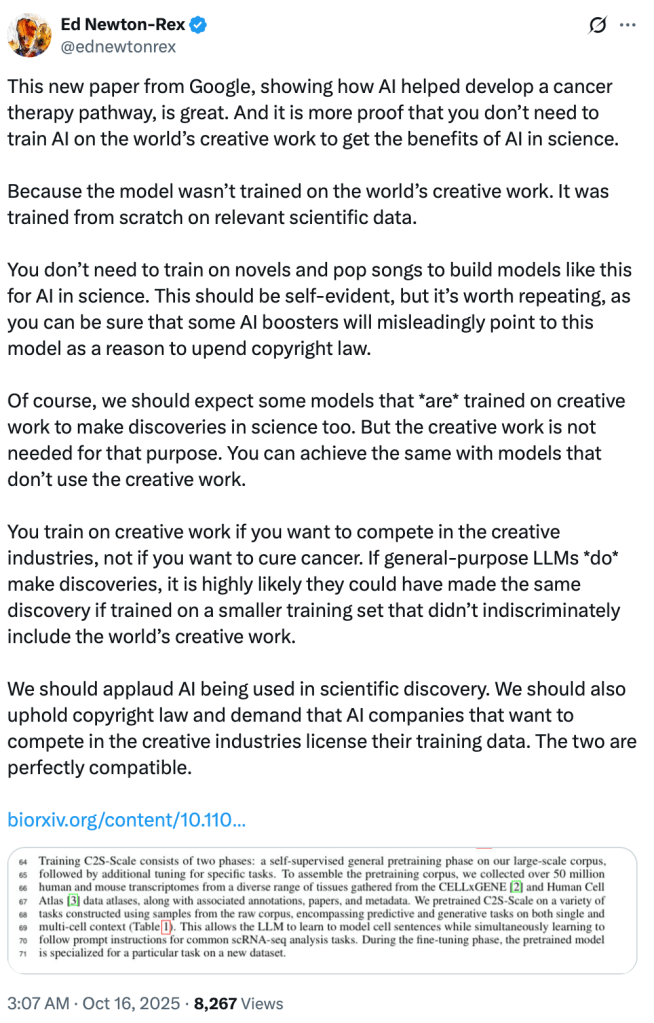
“You don’t need to train on novels and pop songs to get the benefits of AI in science” @ednewtonrex


You Don’t Need to Steal Art to Cure Cancer: Why Ed Newton-Rex Is Right About AI and Copyright

Ed Newton-Rex said the quiet truth out loud: you don’t need to scrape the world’s creative works to build AI that saves lives. Or even beat the Chinese Communist Party.

It’s a myth that AI “has to” ingest novels and pop lyrics to learn language. Models acquire syntax, semantics, and pragmatics from any large, diverse corpus of natural language. That includes transcribed speech, forums, technical manuals, government documents, Wikipedia, scientific papers, and licensed conversational data. Speech systems learn from audio–text pairs, not necessarily fiction; text models learn distributional patterns wherever language appears. Of course, literary works can enrich style, but they’re not necessary for competence: instruction tuning, dialogue data, and domain corpora yield fluent models without raiding copyrighted art. In short, creative literature is optional seasoning, not the core ingredient for teaching machines to “speak.”

Google’s new cancer-therapy paper proves the point. Their model wasn’t trained on novels, lyrics, or paintings. It was trained responsibly on scientific data. And yet it achieved real, measurable progress in biomedical research. That simple fact dismantles one of Silicon Valley’s most persistent myths: that copyright is somehow an obstacle to innovation.

You don’t need to train on Joni Mitchell to discover a new gene pathway. You don’t need to ingest John Coltrane to find a drug target. AI used for science can thrive within the guardrails of copyright because science itself already has its own open-data ecosystems—peer-reviewed, licensed, and transparent.

The companies like Anthropic and Meta insisting that “fair use” covers mass ingestion of stolen creative works aren’t curing diseases; they’re training entertainment engines. They’re ripping off artists’ livelihoods to make commercial chatbots, story generators, and synthetic-voice platforms designed to compete against the very creators whose works they exploited. That’s not innovation—it’s market capture through appropriation.

They do it for reasons old as time—they do it for the money.

The ethical divide is clear:

  • AI for discovery builds on licensed scientific data.
  • AI for mimicry plunders culture to sell imitation.

We should celebrate the first and regulate the second. Upholding copyright and requiring provenance disclosures doesn’t hinder progress—it restores integrity. The same society that applauds AI in medical breakthroughs can also insist that creative industries remain human-centered and law-abiding. Civil-military fusion doesn’t imply that there’s only two ingredients in the gumbo of life.

If Google can advance cancer research without stealing art, so can everyone else and so can Google keep different rules for the entertainment side of their business or investment portfolio. The choice isn’t between curing cancer and protecting artists—it’s between honesty and opportunism. The repeated whinging of AI labs about “because China” would be a lot more believable if they used their political influence to get the CCP to release Hong Kong activist Jimmy Lai from stir. We can join Jimmy and his amazingly brave son Sebastian and say “because China”, too. #FreeJimmyLai

Hey Budweiser, You Give Beer a Bad Name

In a world where zero royalties becomes a brag, and one second of music is one second too far.

Let me set the stage: Cannes Lions is the annual eurotrash…to coin a phrase…circular self-congratulatory hype fest at which the biggest brands and ad agencies in the world if not the Solar System spend unreal amounts of money telling each other how wonderful they are. Kind of like HITS Magazine goes to Cannes but with a real budget. And of course the world’s biggest ad platform–guess who–has a major presence there among the bling and yachts of the elites tied up in Yachtville by the Sea. And of course they give each other prizes, and long-time readers know how much we love a good prize, Nyan Cat wise.

Enter the King of Swill, the mind-numbingly stupid Budweiser marketing department. Or as they say in Cannes, Le roi de la bibine.

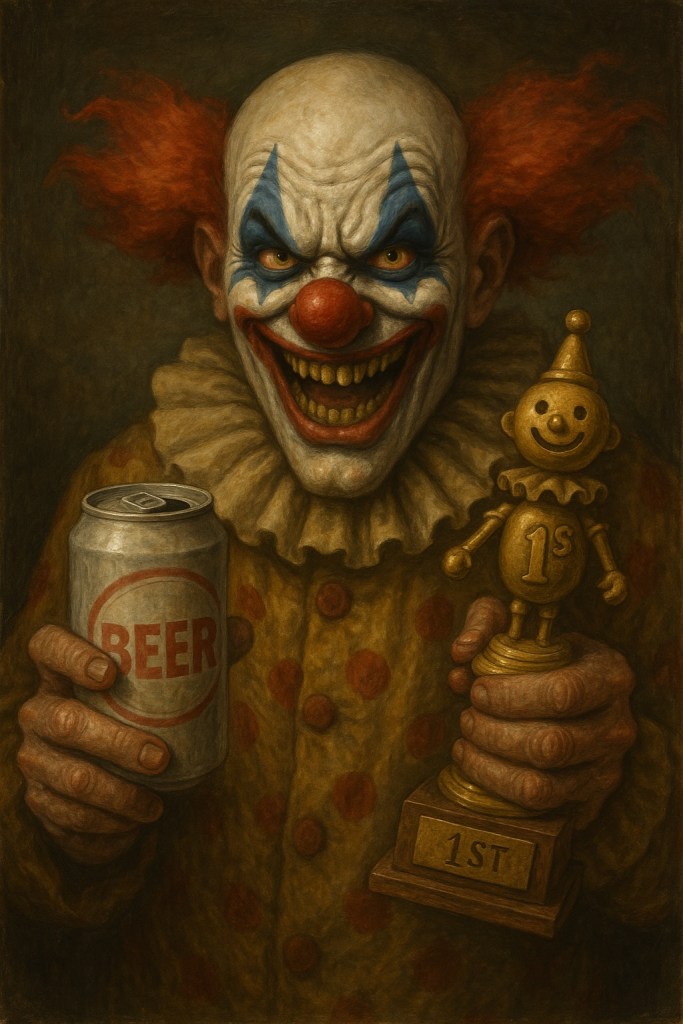
Credit where it’s due: British Bud-hater and our friend Chris Cooke at CMU flagged this jaw-dropper from Cannes Lions, where Budweiser took home the Grand Prix for its “One‑Second Ad” campaign—a series of ultra-short TikTok clips that featured the one second of hooks from iconic songs. The gimmick? Tease the audience just long enough to trigger nostalgia, then let the internet do the rest. The beer is offensive enough to any right-thinking Englishman, but the theft? Ooh la la.

Cannes Clown

Budweiser’s award-winning brag? “Zero ads were skipped. $0 spent on music right$.” Yes, that’s correct–“right$”.

That quote should hang in a museum of creative disinformation.

There’s an old copyright myth known as the “7‑second rule”—the idea that using a short snippet of a song (usually under 7 seconds) doesn’t require a license. It’s pure urban legend. No court has ever upheld such a rule, but it sticks around because music users desperately want it to be true. Budweiser didn’t just flirt with the myth—it took the myth on a date to Short Attention Span Theater, built an ad campaign around it, and walked away with the biggest prize in advertising to the cheers of Googlers everywhere.

When Theft from artists Becomes a Business Model–again

But maybe this kind of stunt shouldn’t come as a surprise. When the richest corporations in commercial history are openly scraping, mimicking, and monetizing millions of copyrighted works to train AI models—without permission and without payment—and so far getting away with it, it sends a signal. A signal that says: “This isn’t theft, it’s innovation.” Yeah, that’s the ticket. Give them a prize.

So of course Budweiser’s corporate brethren start thinking: “Me too.

As Austin songwriter Guy Forsyth wrote in Long Long Time“Americans are freedom-loving people, and nothing says freedom like getting away with it.” That lyric, in this context, resonates like a manifesto for scumbags.

The Immorality of Virality

For artists and the musicians and vocalists who created the value that Budweiser is extracting, the campaign’s success is a masterclass in bad precedent. It’s one thing to misunderstand copyright; it’s another to market that misunderstanding as a feature. When global brands publicly celebrate not paying for music–in Cannes, of all places—the very tone-deaf foundation of their ad’s emotional resonance sends a corrosive signal to the entire creative economy. And, frankly, to fans.

Oops!… I Did It Again, bragged Budweiser, proudly skipping royalties like it’s Free Fallin’, hoping no one notices they’re just Smooth Criminals playing Cheap Thrills with other people’s work. It’s not Without Me—it’s without paying anyone—because apparently Money for Nothing is still the vibe, and The Sound of Silence is what they expect from artists they’ve ghosted.

Because make no mistake: even one second of a recording can be legally actionable particularly when the intentional infringing conspiracy gets a freaking award for doing it. That’s not just law—it’s basic respect, which is kind of the same thing. Which makes Budweiser’s campaign less of a legal grey area and more of a cultural red flag with a bunch of zeros. Meaning the ultimate jury award from a real jury, not a Cannes jury.

This is the immorality of virality: weaponizing cultural shorthand to score branding points, while erasing the very artists who make those moments recognizable. When the applause dies down in Yachtville, what’s left is a case study in how to win by stealing — not creating.

A New Twist in the AM Radio Debate: Why Tying AM Mandates to AMFA Is a Game-Changer #IRespectMusic

The latest twist in the long-running AM radio saga comes from a new alliance: cars and music. Automaker trade groups Alliance for Automotive Innovation, Consumer Technology Association, and Zero Emission Transportation Association are shoulder to shoulder with the musicFIRST Coalition and SoundExchange in urging Congress to link the “AM Radio in Every Vehicle Act” with the American Music Fairness Act (AMFA). If we’re going to mandate AM radios be placed in new cars then music played on those radios should pay the people who made that music. It’s unfair and fundamentally inconsistent to require one without the other, so broadcasters should pay artists.

What Is the American Music Fairness Act?

If you haven’t run across it yet, AMFA is bipartisan legislation sponsored by our champion Senator Marsha Blackburn in the Senate and our long-time ally Rep. Darrell Issa in the House of Representatives that would finally require AM/FM radio stations to pay performance royalties to recording artists and performers when their recordings are played over the air. Currently, the U.S. remains the only democracy that allows terrestrial radio to make billions from music without compensating performers.

Why Artists Get Left Out

As incredible as it may seem, under U.S. copyright law, terrestrial radio must pay songwriters and publishers—but not performers or sound recording rights holders. That means backup singers, session musicians, and producers receive zero compensation, even when their work drives–literally–billions in broadcast revenue. This is what allows the National Association of Broadcasters shillery to claim “we pay for music” and then try to pit artists against songwriters. That dog won’t hunt, but that never stops them from trying.

The musicFIRST Coalition, including SoundExchange and tons of artists and creators, has been front and center pushing Congress to close this loophole for years and we have been right there with them along with our friend Blake Morgan and his #IRespectMusic campaign.


“Mandating AM radio without addressing the performance royalty issue would perpetuate an inequity that denies hundreds of millions of dollars in compensation to countless recording artists every year. Congress should not pass a mandate for radio without ensuring appropriate royalties for artists… They deserve to have their hard work respected and valued with fair compensation — like they receive in every other industrialized country.”
SoundExchange CEO Michael Huppe


The Math on AMFA

  • U.S. radio plays over 240 million songs annually without compensating performers
  • The music industry could gain an estimated $200–300 million annually if Americans were paid for domestic and foreign broadcast plays 
  • Aligns U.S. copyright with global norms—terrestrial radio already pays performers in virtually every other developed nation.

What is to be done

If Congress is going to mandate AM radio in every car, it can’t ignore the rights of the very artists who create the content. By demanding performance royalties through AMFA, we can preserve public safety benefits while ensuring creators are paid for their work. This is a rare chance for Congress to get it right—fairness and infrastructure can go hand-in-hand.

If you believe artists deserve fairness when their music plays on the radio, now is the time to act:

  1. Sign the letter to Congress. The musicFIRST Action Center has made it easy—just a few clicks to add your name. 
  2. Call your Senator and Representative and tell them to support both:
    • American Music Fairness Act (H.R. 861 / S. 326)
    • AM Radio in Every Vehicle Act—(S. 315 / H.R. 979–but only inclusive of performance royalties
  3. Spread the word on social media with tags like #PassAMFA#FairPayForArtists#IRespectMusic

Martina McBride’s Plea for Artist Protection from AI Met with a Congressional Sleight of Hand

This week, country music icon Martina McBride poured her heart out before the Senate Judiciary Subcommittee on Privacy, Technology, and the Law. Her testimony in support of the bipartisan NO FAKES Act was raw, earnest, and courageous. Speaking as an artist, a mother, and a citizen, she described the emotional weight of having her voice—one that has offered solace and strength to survivors of domestic violence—exploited by AI systems to peddle messages she would never endorse. Her words echoed through the chamber with moral clarity: “Give me the tools to stop that kind of betrayal.”

The NO FAKES Act aims to create a federal property right over an individual’s name, image, and likeness (NIL), offering victims of AI-generated deepfakes a meaningful path to justice. The bill has drawn bipartisan support and commendation from artists’ rights advocates, child protection organizations, and even some technology companies. It represents a sincere attempt to preserve human dignity in the age of machine mimicry.

And yet, while McBride testified in defense of authenticity and integrity, Congress was quietly advancing legislation that was the opposite.

At the same time her testimony was being heard, lawmakers were moving forward with a massive federal budget package ironically called the “Big Beautiful Bill” that includes an AI safe harbor moratorium—a sweeping provision that would strip states of their ability to enforce NIL protections against AI through existing state laws. The so-called “AI Safe Harbor” effectively immunizes AI developers from accountability under most current state-level right-of-publicity and privacy laws, not to mention wire fraud, wrongful death and RICO. It does so in the name of “innovation,” but at the cost of silencing local democratic safeguards and creators of all categories.

Worse yet, the economic scoring of the “Big Beautiful Bill” is based on economic assumptions that rely on productivity gains from AI ripping off all creators from grandma’s baby pictures to rock stars.

The irony is devastating. Martina McBride’s call for justice was sincere and impassioned. But the AI moratorium hanging over the very same legislative session would make it harder—perhaps impossible—for states like Florida, Tennessee, Texas, or California to shield their citizens from the very abuses McBride described. The same Congress that applauded her courage is in the process of handing Silicon Valley a blank check to continue the vulpine lust of its voracious scraping and synthetic exploitation of human expression.

This is not just hypocrisy; it’s the personification of Washington’s two-faced AI policy. On one hand, ceremonial hearings and soaring rhetoric. On the other, buried provisions that serve the interests of the most powerful AI platforms in the world. Oh, and the AI platforms also wrote themselves into the pork fest for $500,000,000 of taxpayers money (more likely debt) for “AI modernization” whatever that is. At a time that the bond market is about to dump all over the U.S. economy. Just another day in the Imperial City.

Let’s be honest: the AI safe harbor moratorium isn’t about protecting innovation. It’s about protecting industrialized theft. It codifies a grotesque and morbid fascination with digital kleptomania—a fetish for the unearned, the repackaged, the replicated.

In that sense, the AI Safe Harbor doesn’t just threaten artists. It perfectly embodies the twisted ethos of modern Silicon Valley, a worldview most grotesquely illustrated by the image of a drooling Sam Altman—the would-be godfather of generative AI—salivating over the limitless data he believes he has a divine right to mine.

Martina McBride called for justice. Congress listened politely. And then gave her to the wolves.

They have a chance to make it right—starting with stripping the radical and extreme safe harbor from the “Big Beautiful Bill.”

[This post first appeared on MusicTechPolicy]

A Long-Overdue Win for Artists: CRB’s Web VI Rates Mark Major Step Toward Fairer @SoundExchange Streaming Royalties

In a landmark development for recording artists, the Copyright Royalty Board (CRB) has proposed new royalty rates under the “Web VI” proceeding, covering the period 2026 through 2030. These rates govern how much commercial broadcasters must pay for streaming sound recordings under the statutory licenses set forth in Sections 112 and 114 of the U.S. Copyright Act.

The new rates reflect the culmination of years of advocacy by SoundExchange and artist-rights groups and represent another meaningful upward adjustments in royalty rates. The Copyright Royalty Judges have adopted a meaningful schedule of increases—both in per-stream royalties and in the minimum annual fees webcasters must pay—designed to better align statutory streaming compensation with market realities. (Unlike streaming mechanical rates, webcasting royalties are a penny rate per play.)

A Clear Victory in Numbers

YearWeb V Per-Performance RateWeb VI Per-Performance Rate% Increase Over Web VWeb V Min. Annual FeeWeb VI Min. Annual Fee / % Increase
2026$0.0021$0.0028+33.33%$1,000$1,100 / +10.00%
2027$0.0021$0.0029+38.10%$1,000$1,150 / +15.00%
2028$0.0021$0.0030+42.86%$1,000$1,200 / +20.00%
2029$0.0021$0.0031+47.62%$1,000$1,250 / +25.00%
2030$0.0021$0.0032+52.38%$1,000$1,250 / +25.00%

These increases aren’t merely arithmetic; they represent a philosophical shift in how creators are valued in the digital economy.

Structural Adjustments

Beyond the rate hikes, the CRB has adopted operational changes proposed by SoundExchange to royalty reporting and distribution. For example:

– The late fee for audit-based underpayments is reduced from 1.5% to 1.0% per month, capped at 75% of the total underpayment.
– Starting in 2027, webcasters using third-party vendors must obtain transmission and usage data or contractually guarantee its delivery.
– If a commercial broadcaster fails to file a report of use, SoundExchange may now distribute royalties based on proxy data.

These tweaks aim to close loopholes and increase reliability in royalty tracking—critical steps toward a more transparent system.

The Road Ahead

While the Web VI proposal rule will be final after June 16, 2025, it is already being hailed as a pivotal win by artist advocates. For too long, streaming-era economics have undervalued creators in favor of platforms and intermediaries.

This ruling is a recognition—long overdue and hard-won. When finalized, the Web VI clear and easy to understand rates and terms will not only ensure a greater financial contribution for featured and nonfeatured recording artists and rights holders, but also reassert the foundational principle that creators should be paid fairly when their work fuels billion-dollar platforms.

For artists and musicians navigating a shifting industry, the law is catching up with the market it governs on the side of the creators who drive the business.

Of course, don’t forget that some of these same broadcasters who pay under the statutory license for streaming do not pay anything to artists for over the air broadcast of terrestrial radio for the exact same plays of the exact same records–another reason that Congress must finally pass the American Music Fairness Act. That’s why we support the #IRespectMusic campaign and the MusicFirst Coalition. Ask Congress to support musicians here.

Tell Congress to Honor Aretha, Pass #AMFA #IRespectMusic

It’s time.

We join our friends Blake Morgan, #IRespectMusic, SoundExchange, the National Independent Talent Organization (NITO) and many, many others in asking you to join the fight to support artist pay for radio play by passing the American Music Fairness Act. Find out how you can help here, or find your representative in Congress here.