Has the MLC Become a $1.2 billion Hedge Fund?

It’s becoming increasingly clear that the MLC has little to no oversight. The Copyright Office is tasked by Congress with oversight authority over this quasi-governmental organization under the Music Modernization Act. Yet there is nothing happening in the way of guardrails. The Copyright Office haven’t even concluded their mandated five-year review of the MLC that started a year ago. Not only has no one responded to Congressman Fitzgerald’s inquiries about the MLC’s oddball finances, the Copyright Office hasn’t responded to the many public comments demanding answers on the MLC’s sketchy finances as demonstrated on their tax returns.

The MLC’s 2023 tax return shows the quango is holding $1,212,282,220 invested in publicly traded securities–that’s $1.2 BILLION. That’s a fortune for an organization that makes no money–because as we were told ad nauseum the services pay it’s operating costs and bloated salaries-and has no profits because it is not an operating company. But it does hold several fortunes in unmatched royalties it does not seem to be in a hurry to match and pay out to songwriters.

The Supplement to the MLC’s 2023 tax return includes this language:

In our Form 990 for 2023, we provided information regarding funds we were holding in banks and investments as of the beginning of 2023 and the end of 2023. These included assessment funds that we subsequently use to fund our operations; royalty funds we were not yet able to distribute and on which we are required to earn interest in accordance with the Music Modernization Act (MMA) of 2018; and royalty funds we were holding pending distribution.

What the MMA actually says in the black box penalty language of 17 USC §115 (d)(3)(H)(ii) is:

Interest-bearing account.—Accrued royalties for unmatched works (and shares thereof) shall be maintained by the mechanical licensing collective in an interest-bearing account that earns monthly interest—

(I) at the Federal, short-term rate; and

(II) that accrues for the benefit of copyright owners entitled to payment of such accrued royalties.

The black box penalty in 17 USC §115 (d)(3)(H)(ii) is similar to the late fee charged to licensees. The code creates an incentive for the MLC to pay out unmatched funds quickly to avoid the market share distribution of black box which could happen any minute now (particularly since the Copyright Office hasn’t completed the five-year review it started over a year ago).

This language of 17 USC §115 (d)(3)(H)(ii) does not “require” the MLC to “earn interest”, it requires them to PAY interest. Because it is inextricably tied to job performance, it would not be a payment borne by the licensees as part of the administrative assessment as part of the “collective total costs.”

That’s why it’s a penalty. It is, in my view, absolutely false and misleading to state in a matter under the jurisdiction of the federal government that the MLC is in compliance with a code section that does not say what they say it says. And it’s not just this one time, the CEO has said almost these exact words in testimony to the House IP Subcommittee and in supplemental written testimony to answer questions for the record from the Subcommittee.

Even if you want to be generous and accept the MLC’s argument–and it’s just an argument–that the MMA “requires” the MLC to “earn” interest, an “interest bearing account” simply does not contemplate “investing” other people’s money–your money–in publicly traded securities by a stock broker. When asked direct questions about who bears the downside and who gets the ups on their stock trading, the MLC has never answered the question. 

The closest to an answer we get from the plain statutory language is that the MLC is required to pay interest on unmatched funds at the “federal short term rate” which is approximately 4.23%. Does that mean that if the MLC makes more than a 4.23% return they keep the upside? Or if the stock brokers don’t achieve that return, does that mean the licensees cough up the difference in additional administrative assessment contributions? Unlikely, so would the MLC’s board members pass the hat? I’ll believe that when I see it.

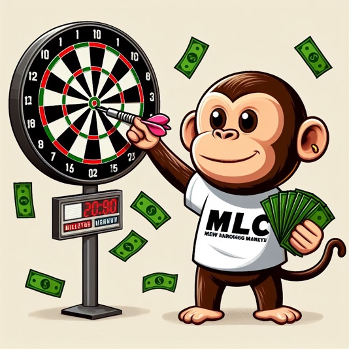
While the MLC refuses to answer who participates in the benefits or downside of the investment policy, the amount invested in publicly traded securities over 12 months has radically increased from $804,555,579 at the beginning of 2023. As of the end of 2023, the MLC’s holdings in publicly traded securities alone increased to $1,212,282,220, approximately a 50% gain over 12 months. What we don’t know is if that gain is due to slick stock trading, monkey with a dartboard or the addition of new money, Madoff-style. (And of course if they do manage to “blow up the compulsory” which is the latest from the smart people, who knows who gets to keep the black box?)

The MLC offers this explanation:

At the beginning of 2023, we were holding $138.8 million in “Savings and temporary cash investments.” By the end of 2023, we had moved $131.1 million of these funds to “Investments – publicly traded securities,” leaving the remaining $7.7 million in “Savings and temporary cash investments.” At the beginning of 2023, we were holding $804.6 million in “Investments – publicly traded securities.” By the end of 2023, the amount of funds we were holding in this category increased to $1.2 billion. This year-end amount included the $131.1 million we had moved from “Savings and temporary cash investments”
into this category during the year.

Realize that this language explains nothing. Not only do they round down by $12,282,220, they simply describe movements of cash without explaining why it happened.

So once again, we are presented with a document that avoids the key issue at best and is misleading at worst. But what is clear is that the MLC has more in holdings that approximately 130 regional banks that have substantial disclosure obligations. It’s looking more and more like a hedge fund.

Artist Rights Institute: Estimated 2025 Inflation Adjustment for Physical and Vinyl Mechanicals

A backgrounder for artists and songwriters from the Artist Rights Institute

Summary: The fight over frozen mechanicals continues to pay off as songwriters log another cost of living increase for physical/downloads while streaming falls farther behind.

The Copyright Royalty Board adjusted the US statutory mechanical royalty for physical carriers like vinyl, CDs and downloads annually during the current rate period. This is entirely due to the success of public comments by the ad hoc songwriter bargaining group that persuaded the Copyright Royalty Judges to reject the terrible “frozen mechanicals” settlement negotiated with the NMPA, NSAI and RIAA. 

As it turned out, once the judges rejected the freeze as unfair, the labels quickly agreed to a fair result that increased the physical/download rate from a 9.1¢ base rate to the 12¢ rate suggested by the Judges which went a long way to making up for the 15 year freeze at 9.1¢. In fact, if it had just been presented to the labels to begin with, a tremendous amount of agita could have been saved all round.

Crucially, not only did the base rate increase to 12¢, the judges also approved a prospective cost of living adjustment determined by a formula using the Consumer Price Index. The end result is that unlike streaming mechanicals paid by the streaming services like Spotify (i.e., not the labels) the value of the increase from 9.1¢ to 12¢ has been protected from inflation during the rate period (2023-2027). 

Unfortunately, the streaming services were allowed to reject a cost of living for streaming mechanicals, notwithstanding the Judges’ and the services’ acceptance of an COLA-type adjustment to the multimillion dollar budget of the Mechanical Licensing Collective. That COLA is ased on a government measurement of inflation (the Employment Cost Index) comparable to the CPI-U that is used to increase the services’ financing of salaries and other costs at the Mechanical Licensing Collective. So those who are paid handsomely to collect and pay songwriters get a better deal than the songwriters they supposedly serve.

What is the increase in pennies this year for the physical/download mechanical rate? The Judges determine the inflation-adjusted rate every year during the five year rate period (2023-2027). The calculation is made in December for physical/download with reference to the CPI-U rate announced by the Bureau of Labor Statistics as of December 1, which means the rate published on November 11. The new rate goes into effect on January 1, 2025.

At this point, there does not seem to be any indication that there will be a large spike in inflation between now and November 11, so we can use the September rate (just announced in October) to make an educated guess as to what the 2025 statutory rate increase will be for physical/downloads (rounded down):

So we can safely project that the base rate will increase from 12.4¢ for 2024 to about 12.6¢ in 2025 without firing a shot. If you have a 10 x 3/4 rate controlled compositions clause, that means the U.S. controlled pool on physical will be approximately 94.5¢ instead of the old frozen rate of 68.25¢.

It’s important to note a couple things about the relevance of CPI-U as a metric for protecting royalty rates from the ravages of inflation. First of all, the CPI-U is a statistical smoothing of the specific rates for particular goods and services that it measures and doesn’t reflect the magnitude of changes of some components.

For example, the September CPI-U increased by 0.2% on a seasonally adjusted basis. However, the shelter index and the food index increased at higher rates:

The shelter index rose by 0.2%, and the food index increased by 0.4% Together, these two components contributed over 75% of the monthly increase in the all items index.

Moreover, the MLC itself receives an increase that is tied to the lesser of 3% or the Employment Cost Index (which was approximately 4.5% for the trailing 12 months ending June 30):

Chris Castle said, “These are good benchmarks to keep in mind as we head into a new rate setting period in a year or so when I expect songwriters to demand a COLA for streaming mechanicals. No more poormouthing from the services. If they can give it to MLC, they can give it to the songwriters, too.”

Who Will Get to the Bottom of The Hundreds of Millions of Black Box Money at MLC?

By Chris Castle

One of the most common questions we get from songwriters about the MLC concerns the gigantic level of “unmatched funds” that have been sitting in the MLC’s accounts since February 2021.  Are they really just waiting until The MLC, Inc. gets redesignated and then distributes hundreds of millions on a market share basis like the lobbyists drafted into the MMA?  

Not My Monkey

Nobody can believe that the MLC can’t manage to pay out several hundred million dollars of streaming mechanical royalties for over three years so far.  (Resulting in the MLC holding $804,555,579 in stocks as of the end of 2022 on its tax return, Part X, line 11.) The proverbial monkey with a dart board could have paid more songwriters in three years.  Face it—doesn’t it just sound illegal?  In my experience, when something sounds or feels illegal, it probably is.

What’s lacking here is a champion to extract the songwriters’ money.  Clearly the largely unelected smart people in charge could have done something about it by now if they wanted to, but they haven’t.  It’s looking more and more like nobody cares or at least nobody wants to do anything about it.  There is profit in delay.

Or maybe nobody is taking responsibility because there’s nobody to complain to.  Or is there? What if such a champion exists?  What if there were no more waiting?  What if there were someone who could bring the real heat to the situation?

Let’s explore one potentially overlooked angle—a federal agency called the Office of the Inspector General.  Who can bring in the OIG?  Who has jurisdiction?  I think someone does and this is the primary reason why the MLC is different from HFA.

Does The Inspector General Have MLC Jurisdiction?

Who has jurisdiction over the MLC (aside from its severely conflicted board of directors which is not setting the world on fire to pump the hundreds of millions of black box money back into the songwriter economy).  The Music Modernization Act says that the mechanical licensing collective operates at the pleasure of the Congress under the oversight of the U.S. Copyright Office and the OIG has oversight of the Copyright Office through its oversight of the Library of Congress.

But, hold on, you say.  The MLC, Inc. is a private company and the government typically does not have direct oversight over the operations of a private company.

The key concept there is “operates” and that’s the difference between the statutory concept of a mechanical licensing collective and the actual operational collective which is a real company with real employees and real board members.  Kind of like shadows on the wall of a cave for you Plato fans.  Or the magic 8 ball.

The MLC, Inc. is all caught up with the government.  It exists because the government allows it to, it collects money under the government’s blanket mechanical license, its operating costs are set by the government, and its board members are “inferior officers” of the United States.   Even though The MLC, Inc. is technically a private organization, it is at best a quasi-governmental organization, almost like the Tennessee Valley Authority or the Corporation for Public Broadcasting.  So it seems to me that The MLC, Inc. is a stand-in for the federal government.

But The MLC, Inc. is not the federal government.  When Congress passed the MMA and it charged the Copyright Office with oversight of the MLC.  Unfortunately, Congress does not appear to have appropriated funds for the additional oversight work it imposed on the Office.  

Neither did Congress empower the Office to charge the customary reasonable fees to cover the oversight work Congress mandated.  The Copyright Office has an entire fee schedule for its many services, but not MLC oversight.  

Even though the MLC’s operating costs are controlled by the Copyright Royalty Board and paid by the users of the blanket license through an assessment, this assessment money does not cover the transaction cost of having the Copyright Office fulfill an oversight role.

An oversight role may be ill suited to the historical role of the Copyright Office, a pre-New Deal agency with no direct enforcement powers—and no culture of cracking heads about wasteful spending like sending a contingent to Grammy Week.

In fact, there’s an argument that The MLC, Inc. should write a check to the taxpayer to offset the additional costs of MLC oversight.  If that hasn’t happened in five years, it’s probably not going to happen.  

Where Does the Inspector General Fit In?

Fortunately, the Copyright Office has a deep bench to draw on at the Office of the Inspector General for the Library of Congress, currently Dr. Glenda B. Arrington.  That kind of necessary detailed oversight is provided through the OIG’s subpoena power, mutual aid relationships with law enforcement partners as well as its own law enforcement powers as an independent agency of the Department of Homeland Security.  Obviously, all of these functions are desirable but none of them are a cultural fit in the Copyright Office or are a realistic resource allocation.

The OIG is better suited to overseeing waste, fraud and abuse at the MLC given that the traditional role of the Copyright Office does not involve confronting the executives of quasi-governmental organizations like the MLC about their operations, nor does it involve parsing through voluminous accounting statements, tracing financial transactions, demanding answers that the MLC does not want to give, and perhaps even making referrals to the Department of Justice to open investigations into potential malfeasance.  

Or demanding that the MLC set a payment schedule to pry loose the damn black box money.

One of the key roles of the OIG is to conduct audits.  A baseline audit of the MLC, its closely held investment policy and open market trading in hundreds of millions in black box funds might be a good place to start.  

It must be said that the first task of the OIG might be to determine whether Congress ever authorized MLC to “invest” the black box funds in the first place.  Congress is usually very specific about authorizing an agency to “invest” other people’s money, particularly when the people doing the investing are also tasked with finding the proper owners and returning that money to them, with interest. 

None of that customary specificity is present with the MLC.

For example, MLC CEO Kris Ahrens told Congress that the simple requirement that the MLC pay interest on “unmatched” funds in its possession (commonly called “black box”) was the basis on which the MLC was investing hundreds of millions in the open market.  This because he assumed the MLC would have to earn enough from trading securities or other investment income to cover their payment obligations.  That obligation is mostly to cover the federal short term interest rate that the MLC is required to pay on black box.

The Ghost of Grammy Week

The MLC has taken the requirement that the MLC pay interest on black box and bootstrapped that mandate to justify investment of the black box in the open market.  That is quite a bootstrap.

An equally plausible explanation would be that the requirement to pay interest on black box is that the interest is a reasonable cost of the collective to be covered by the administrative assessment.  The plain meaning of the statute reflects the intent of the drafters—the interest payment is a penalty to be paid by the MLC for failing to find the owners of the money in the first place, not an excuse to create a relatively secret $800 million hedge fund for the MLC.  

I say relatively secret because The MLC, Inc. has been given the opportunity to inform Congress of how much money they made or lost in the black box quasi-hedge fund, who bears the risk of loss and who profits from trading.  They have not answered these questions.  Perhaps they could answer them to the OIG getting to the bottom of the coverup.

We do not really know the extent of the MLC’s black box holdings, but it presumably would include the hundreds of millions invested under its stewardship in the $1.9 billion Payton Limited Maturity Fund SI (PYLSX). Based on public SEC filings brought to my attention, The MLC, Inc.’s investment in this fund is sufficient to require disclosure by PYLSX as a “Control Person” that owns 25% or more of PYLSX’s $1.9 billion net asset value. PYLSX is required to disclose the MLC as a Control Person in its fundraising materials to the Securities and Exchange Commission (Form N-1A Registration Statement filed February 28, 2023).  This might be a good place to start.

Otherwise, the MLC’s investment policy makes no sense.  The interest payment is a penalty, and the black box is not a profit center.

But you don’t even have to rely on The MLC, Inc.’s quasi governmental status in order for OIG to exert jurisdiction over the MLC.  It is also good to remember that the Presidential Signing Statement for the Music Modernization Act specifically addresses the role of the MLC’s board of directors as “inferior officers” of the United States:

Because the directors [likely both voting and nonvoting] are inferior officers under the Appointments Clause of the Constitution, the Librarian [of Congress] must approve each subsequent selection of a new director. I expect that the Register of Copyrights will work with the collective, once it has been designated, to ensure that the Librarian retains the ultimate authority, as required by the Constitution, to appoint and remove all directors.

The term “inferior officers” refers to those individuals who occupy positions that wield significant authority, but whose work is directed and supervised at some level by others who were appointed by presidential nomination with the advice and consent of the Senate. Therefore, the OIG could likely review the actions of the MLC’s board (voting and nonvoting members) as they would any other inferior offices of the United States in the normal course of the OIG’s activities.

Next Steps for OIG Investigation

How would the OIG at the Library of Congress actually get involved?  In theory, no additional legislation is necessary and in fact the public might be able to use the OIG whistleblower hotline to persuade the IG to get involved without any other inputs.  The process goes something like this:

  1. Receipt of Allegations: The first step in the OIG investigation process is the receipt of allegations. Allegations of fraud, waste, abuse, and other irregularities concerning LOC  programs and operations like the MLC are received from hotline complaints or other communications. 
  2. Preliminary Review: Once an allegation is received, it undergoes a preliminary review to determine if OIG investigative attention is warranted. This involves determining whether the allegation is credible and reasonably detailed (such as providing a copy of the MLC Congressional testimony including Questions for the Record). If the Office is actually bringing the OIG into the matter, this step would likely be collapsed into investigative action.
  3. Investigative Activity: If the preliminary review warrants further investigation, the OIG conducts the investigation through a variety of activities. These include record reviews and document analysis, witness and subject interviews, IG and grand jury subpoenas, search warrants, special techniques such as consensual monitoring and undercover operations, and coordination with other law enforcement agencies, such as the FBI, as appropriate.  That monitoring might include detailed investigation into the $500,000,000 or more in black box funds, much of which is traded on open market transactions like PYLSX.
  4. Investigative Outputs: Upon completing an investigation, reports and other documents may be written for use by the public, senior decision makers and other stakeholders, including U.S. Attorneys and Copyright Office management. Results of OIG’s administrative investigations, such as employee and program integrity cases, are transmitted to officials for appropriate action. 
  5. Monitoring of Results: The OIG monitors the results of those investigations conducted based on OIG referrals to ensure allegations are sufficiently addressed.

So it seems that the Office of the Inspector General is well suited to assisting the Copyright Office by investigating how the MLC is complying with its statutory financial obligations.  In particular, the OIG is ideally positioned to investigate how the MLC is handling the black box and its open market investments that it so far has refused to disclose to Members of Congress at a Congressional hearing as well as in answers to Questions for the Record from Chairman Issa.

This post previously appeared on MusicTech.Solutions

Better than Cats: The Copyright Office Seeks Public Comment on Periodic Review of the Designations of the Mechanical Licensing Collective and Digital Licensee Coordinator aka #TheReup

In case you missed it, the MLC, Inc. was handed a five year contract in 2019 to operate the mechanical licensing collective. This contract was worth millions and millons of dollars, but more importantly guaranteed that the Harry Fox Agency would have a job for at least another five years. The salty arrangement was the brainchild of the lobbyists, the controlled opposition and the Copyright Office–and has resulted in The MLC, Inc. sitting on hundreds of millions of other peoples money. 

The Copyright Office has posted a notice letting us know that the time has come for the circular admiration society also known as the 5 year review of the MLC and the DLC as required by Title I of the oh so modern Music Modernization Act (yet we keep comeing back to these age-old problems that are not modern at all). This is all conducted by the Copyright Office which in a meaningful way is simply reviewing how well the Copyright Office did with the designation of the MLC, Inc. as much as how well the MLC met expectations.

After suffering through establishing some regulations for the MLC that largely favored the services, the head lawyer at the Copyright Office threw down the pretenses and became employed as a lobbyist for Spotify. Another went to work for the National Association of Broadcasters to screw artists our of a performance right for sound recordings. Can’t wait to congratulate current Copyright Office staff on their employment futures after we get through this important reup for the MLC, Inc. and the lobbyists. I hear the chief butterfly killers have openings for copyright lawyers trained on the public purse.

The comment period in this vitally important review is divided into at least two parts: The special people, i.e., The MLC, Inc. quango and the DLC get to go first, and then the hoi polloi (that’s you and me). You’ll find this language buried at the very bottom of the Reup notice:

Interested members of the public are encouraged to comment on the topics addressed in the designees’ [i.e., the DLC or the MLC’s] submissions or raised by the Office in this notification of inquiry. Commenters may also address any topics relevant to this periodic review of the MLC and DLC designations. Without prejudice to its review of the current designations, the Office hopes that this proceeding will serve as an opportunity for any songwriter, publisher, or DMP who wishes to express concerns, satisfaction, or priorities with respect to the administration of the MMA’s blanket licensing regime to do so, and that any designated MLC or DLC will use that feedback to continually improve its services.

Bite your tongue now.

The Copyright Office Sends Modernized Regrets

As we reported in a prior post about George Johnson’s grass roots effort to ask the Copyright Office to review that status of the compulsory license which is the raison d’être for the existence of their Mechanical Licensing Collective, the US Copyright Office turned him down. The Office has refused to look into a study on the continued viability of the compulsory license in the United States as part of the five year review of their Mechanical Licensing Collective. The five year review is the perfect opportunity to consider whether the compulsory license itself is fit for purpose.

This is particularly true after the near-fiasco of the MLC’s testimony to the House IP Subcommittee which is well worth watching, particularly the Subcommittee’s “show me the money” questioning about what the MLC is doing with the hundreds of millions that the MLC is “investing”. The only reason the MLC has these hundreds of millions is because of the compulsory license. This requires an explanation that nobody seems interested in making to the songwriters like George Johnson.

It seems to us impossible to consider one without the other and we appreciate George Johnson taking the time to make that argument to the Copyright Office. In coming days we will have some additional thoughts about the continued viability of the compulsory and look forward to a robust debate on the topic. We may have to conduct that conversation outside of the Imperial City, but that’s OK. There are many international interests involved as well as motivated constituents all around this country.

Here is the Copyright Office rejection letter. There are a number of assumptions it makes, such as the negotiation of Title I of the MMA was a free and open process and not a star chamber for the insiders. We’ll get to these in coming days.

Dear George,

Thank you for your letter requesting a study concerning repealing the section 115 compulsory license.  As you know, the section 115 license was previously explored by the Office and it was recently amended by Congress as part of the Music Modernization Act (MMA).  As the changes made to the license through the MMA have been effective only for the past two and a half years, the Office believes that it would be premature at this time to engage in a new study of the section 115 license.

To briefly recap this history, in 2015, the Copyright Office issued its policy report “Copyright and the Music Marketplace,” which reviewed the then-current conditions affecting the U.S. music marketplace and made various suggestions for reform, including with respect to the section 115 license.  The report was built on input we received from organizations and individuals, including yourself, who shared their insights and experiences in written comments and in roundtable discussions. 

With respect to the section 115 license, the report observed that “[m]any parties have called for either the complete elimination or modernization of section 115, citing issues such as the administrative challenges of the license, the inaccuracy and slowness of the ratesetting process, and frustration with government-mandated rates.”  Ultimately, however, the Office recommended modernizing, but not repealing, the section 115 license.  While the Office was sympathetic to arguments in favor of repealing the license, it was also concerned that eliminating the license would cause extraordinary difficulties associated with negotiating individual licenses for the millions of musical works offered on digital music providers’ services.

Three years later, Congress updated the section 115 license as a part of the MMA—an Act that Senator Grassley referred to as “the product of long and hard negotiations and compromise.”  One of the Act’s cornerstones was the new compulsory blanket section 115 license, which became available on January 1, 2021.  

Although we do not intend to undertake a new study of the section 115 license at this time, we want to remind you that the Office welcomes input from stakeholders and members of the public to better inform our decision-making.  I would like to thank you again for your letter and any additional views that you may wish to provide to the Office in the future.

Sincerely,

Suzy Wilson

General Counsel and Associate Register of Copyrights

U.S. Copyright Office

Copyright Office Rejects George Johnson’s Request for a new Study of the Effectiveness of the Compulsory License as Part of MLC Five Year Review

Before we get to George’s letter, a little context. If you’re coming to this subject for the first time, mechanical royalties are paid to songwriters (and their publishers) for the mechanical reproduction of their songs. The federal government established a compulsory license for this purpose and corresponding royalty rates starting in 1909. The license has evolved over time and now includes physical configurations like vinyl (paid by record companies) and digital transmissions like streaming (paid by DSPs like Spotify).

Until the Music Modernization Act, songs were licensed on a song-by-song basis notice-based system except for catalog licenses. Or at least theoretically–pre-MMA most of the streaming services didn’t take advantage of the statutory license they were entitled to because they couldn’t be bothered. (Until David’s class action called them out. We note that the Copyright Office, in particular a former lawyer at the Office now representing Big Tech against songwriters, allowed the streamers to get away with tens of millions of flawed “address unknown NOIs” that a cynic might say was a catastrophe with a purpose. Chris has an article about this fiasco that went largely unreported except by Hypebot.)

Fast forward to today. Every five years the Copyright Office is required to review the company that the Office has designated to run the Mechanical Licensing Collective. Currently that entity is The MLC, Inc. designated by the Copyright Office on July 8, 2019. Remember that The MLC, Inc. was independently chosen by the Copyright Office as the best in breed of all applicants after a rather odd beauty contest. This is their thing, and the MLC, Inc. is their idea. So do you think that creates an incentive to create a five year review that everything is peachy and they were geniuses for creating this dumpster fire?

Even though the first five year review is set to happen next year, Congress has already held a hearing about the MLC, Inc. which frankly did not go well for the company. Nobody got their ears nailed to the barn door, but the hearing was not the usual love fest. The review is to be conducted by the Copyright Office, so there’s a question as to why Congress decided that the House Judiciary Committee IP Subcommittee should conduct the first of what may be multiple hearings.

Everyone assumed that the Copyright Office would choose the first MLC as the NMPA-backed entry, The MLC, Inc. That company was so confident of winning the contract their confidence made people ask why anyone else bothered to try out. And when the next charade resulted in The MLC, Inc. choosing the former NMPA affiliate the Harry Fox Agency as their data vendor, everyone knew there was definitely gambling at Rick’s. All paid for by Big Tech (or maybe we should say Really Big Tech) because not even the taxpayer is stupid enough to fall for this BS. After all, nothing blew up and nobody died.

So the lobbyists and lawyers and the Copyright Office were busily building up a new bureaucracy to drive mechanical licensing back to the future and essentially preserve the 1909 compulsory license that George refers to. Because what they didn’t do was throw out the compulsory license and come up with an alternative more in keeping with streaming. You know, modernization.

In fact, they never really considered how one might implement mechanical licensing without the compulsory part. And that’s probably because there is a cottage industry of lobbyists, lawyers, and government clerks built up around compulsory licensing that would simply be out of a job if the compulsory were rejected. But they will get out the green eyeshades and the furrowed brow and tell you that mere songwriters cannot appreciate the complexity of getting rid of the compulsory license that governs their lives and has done for over a century.

But then there’s this five year review. What is the review reviewing if it never takes into account the compulsory license itself. Are we to just assume that the compulsory lasts forever? Are they just to review how The MLC, Inc. and HFA are doing administering a law that itself doesn’t work? Where does the failure of one start and the other begin?

The effectiveness of the statute itself really must be part of the five year review as well as a review of the MLC.

Enter George Johnson. George is a songwriter who has effectively represented himself at the Copyright Royalty Board and is fighting hard for increased songwriter royalty rates, holding up a mirror to the emperor in the Imperial City of Washington, DC. Needless to say, George has made no new friends among the grandees and courtiers who all see the advantage in complementing the emperor on his new clothes and complain that George does not shut up and let his betters run things the way they like. Billboard did an extensive profile on George during the frozen mechanicals crisis in which he played a major part.

George has written a timely letter to the Copyright Office anticipating the need for a review of the compulsory license statute itself from which spring all these problems for the obvious reason that you can’t really talk about the MLC with out talking about that statute (17 USC §115). (You may want to take a look at a proposal that David made a few years ago for a US version of extended collective licensing.) Just remember that it’s not really that difficult to transition off of song-by-song licensing to a blanket license administered by the MLC fiasco compared to extended collective licensing with an opt-in for songwriters who want to get away from HFA and the compulsory licesne.

Spoiler alert–the Copyright Office rejected George’s request. Their rejection does not mean George was wrong, it just means that the right person didn’t ask the question,

Following is George’s letter to the Copyright Office and we will later post the Copyright Office response. You can read George’s white paper here.

Monday, June 12, 2023

Via Email 

Attn:  Ms. Shira Perlmutter,

Register of Copyrights and Director

U.S. Copyright Office

101 Independence Ave. S.E.

Washington, D.C., 20559-6000

Re:  Study to Repeal §115 Compulsory License & Ex Parte Meetings to benefit Congress and all U.S. Songwriters and Music Publishers

Dear Register Perlmutter,

For the benefit of all American songwriters and music publishers “bound by” 1 the 114 year old §115 compulsory license, and to benefit Congress in their upcoming 2 decision making processes involving intellectual property law and music copyright policy, I respectfully request that the Copyright Office please initiate a compulsory license study and roundtables regarding it’s full repeal, including ex parte meetings.

The century old compulsory license is no longer an incentive or profitablefor all U.S. songwriters and music publishers, and there are many problems arising from it’s use, and misuse, not intended by Congress, the Constitution, and copyright law.

The 1909 compulsory license was designed for a different time, for the local sale of piano rolls and not contemplated to be used by the largest trillion-dollar corporations in the history of the world, with teams of attorneys, with no sale, by “access”, on “computers” or telephones, distributed digitally, through the air, and all for free from songwriters and publishers?  Now, with no COLA for streaming. 

Former Register Ms. Marybeth Peters initiated several studies 3 that questioned the continued necessity of the compulsory license, and for it’s full repeal or full reform 4. Unfortunately, those studies are now outdated and considering the vast changes in the delivery of musical works and sound recordings, experts 5 6 now think a new study would be very helpful in updating Congress on how the license is functioning post Music Modernization Act (MMA), to benefit their 2024 MLC review, but primarily so Congress can make an informed decision on full repeal or full reform?

While my comments here are my own and separate from my participation in the current Phonorecords III & IV proceedings at the Copyright Royalty Board, please feel free to notify me if there is any conflict or other legal protocol to be followed.

Other than the obvious economic arguments to finally pay songwriters the true value of their copyrights, the primary reason I believe compulsory license roundtables are necessary and so dire is the 3 major record labels’ current anticompetitive misuse of the compulsory license 7 at the CRB (See #1, 2, 3 in the attached white paper) that I’ve experienced as a 4 time CRB participant and appellant in Sound Exchange v. CRB 8 and Johnson v. CRB 9.   The 3 major labels’ misuse of the license is the #1 issue including several dozen other serious issues.

The license, the rate-structure, and the CRB process are all truly broken in almost every way and must be fixed immediately or completely abandoned.  All rational market actors who currently use private collective blanket licensing providers would certainly switch, proving no need for federal licensing to operate efficiently.

We all could really benefit from the Copyright Office’s input, ideas, and legal opinions on these extremely important issues since each and every songwriter cannot compete with RIAA and NMPA counsel, nor 25 years of their regulatory capture. 

We songwriters truly need Congress and the Copyright Office’s help and guidance.

We pray the Copyright Office 11 will initiate a study with roundtables, in addition to ex parte communications and meetings to benefit Congress, and all American songwriters and music publishers “subject to”11 the license — for these good reasons, good cause, and those contained in the following white paper attached below.

Thank you for your time and thoughtful consideration. 

Respectfully,

George D. Johnson

Singer/Songwriter

PO Box 22091

Nashville, TN, 37202

@georgejohnson

cc: Librarian of Congress                                                 

     General Counsel of the Copyright Office   

     U.S. House Judiciary Committee

     U.S. Senate Judiciary Committee

     Office of the TN Attorney General

1.  https://www.federalregister.gov/documents/2022/03/30/2022-06691/determination-of-royalty-rates-and-terms-for-making-and-distributing-phonorecords-phonorecords-iv  March 30, 2022 Withdrawal of Subpart B Final Rule by the Copyright Royalty Board.  Referencing §801(b)(7)(A) “That provision directs the Judges to provide those who would be bound by the negotiated rates and terms an opportunity to comment on the agreement.” Page 3 (emphasis added)

2.  Upcoming 5 year work product review of the Music License Collective (“MLC”) by Congress in 2024.

3.  https://www.copyright.gov/newsnet/2022/981.html  September 30, 2022 — In Memory of Marybeth Peters.  “Her leadership of the Office also included the generation of several landmark studies, such as those on statutory licenses…”

4.    To me, a full overhaul in dollars of the “nano-penny” rate-structure in §385 Subpart C streaming.

5. https://musictechpolicy.com/2023/04/05/should-the-copyrightoffice-begin-at-the-beginning-with-the-mlcs-first-five-year-review/  April 5, 2023 — by attorney and Phonorecords IV Commenter Mr. Chris Castle.  Should the Copyright Office Begin at the Beginning With The MLC’s First Five year Review “The continued need for a song compulsory license is just the kind of information that Reps. Jordan and Issa could use in case they were inclined to just get rid of it. It would be a great topic for the Copyright Office to study and hold round tables on, this time preferably lead by a Copyright Office lawyer who was not being recruited by Spotify.”

6.  https://musictechpolicy.com/2023/05/28/should-the-compulsory-license-be-re-upped/ May 28, 2023, Should the Compulsory License Be Re-Upped? by music attorney and official CRB Commenter Mr. Chris Castle.

7. …through NMPA’s, et al. re-writing all laws and definitions, and MMA, to fit label business models, not U.S. songwriters.  This is also in no way the Judges fault, they have to deal with it too, so reform would help them.   The Judges are great and not to blame when I say the process is broken.

8.  https://www.cadc.uscourts.gov/internet/opinions.nsf/8AE80A6C0FBDFB7B8525830C004D863A/$file/16-1159-1751123.pdf  SoundExchange, Inc. v. Copyright Royalty Board and Librarian of Congress, Case No. 16-1159, consolidated with 16-1162 (DC Cir. Sept. 18, 2018) (Srinivasan, J)

9.  https://www.cadc.uscourts.gov/internet/opinions.nsf/720464D843B0D6C7852585C10074B11B/$file/19-1028-1856124.pdf  George Johnson v. Copyright Royalty Board and Librarian of Congress, Case No. 19-1028, (D.C. Cir. Aug. 7, 2020) (Henderson, Garland, and Millett)

10.  https://www.govinfo.gov/content/pkg/FR-2023-02-17/pdf/2023-03392.pdf Ex parte.

11.  https://app.crb.gov/document/download/3715  September 29, 2016, SDARS III Order Denying Services’ Motion To Dismiss George D. Johnson d/b/a Geo Music Group.  “The Services’ reliance on the Librarian’s decision in PSS II—a decision that involved neither a copyright owner nor a copyright user—is misplaced because it is based on an erroneous premise. Unlike the party in PSS II, GEO is subject to the license at issue…and GEO would have no say in the matter—that is the essence of a statutory license.  For the forgoing reasons, the Judges DENY the Services’ Motion.” 

@NorthMusicGroup Testimony to The IP Subcommittee Hearing on The Mechanical Licensing Collective

HEARING BEFORE THE UNITED STATES HOUSE OF REPRESENTATIVES
COMMITTEE ON THE JUDICIARY
Select Subcommittee on Courts, Intellectual Property, and the Internet


June 27, 2023
Testimony of Abby North
SUMMARY STATEMENT
Mr. Chairman, Members of the Subcommittee:

My name is Abby North. I am an independent music publisher and publishing administrator. I am a songwriter advocate. I am a technologist. I am a small business owner.

I began my career writing music, engineering and mixing recordings and ultimately created a
production music library. The library introduced me to music publishing.

My husband’s father was a film composer and songwriter named Alex North. When our family
had a worldwide reversion of rights in Alex’s song “Unchained Melody,” I wanted to learn about
global music publishing. “Unchained Melody” is a “standard” that has been recorded by thousands of artists but is best known as a recording by The Righteous Brothers in 1965. It is an “American Songbook” composition: one of the great songs of the 20th Century. Together, my family and the family of “Unchained Melody” lyricist Hy Zaret formed Unchained Melody Publishing LLC in 2013, and I began to administer our jointly owned copyright.

Unchained Melody Publishing then joined various foreign collective management organizations
(CMOs) and in doing so, I was able to identify incorrect or missing work and party metadata. By
correcting that metadata, I significantly increased our royalty collections. This is partly because
once I corrected our CMO registrations, our metadata stayed corrected over time.
Soon, other legacy songwriters and their families asked if I would administer their works as well.

As a music publishing administrator, I am responsible for accurately and comprehensively
maintaining metadata related to the musical works owned and created by my songwriter and
composer clients, their families and heirs. I must accurately and comprehensively register their
works with collective management organizations around the world.

These global CMOs rely on their music publisher affiliates to deliver works registrations that
clearly identify information about the musical works, about the songwriters and their publishing
entities, about the shares of the works that we own and collect, and about sound recordings that embody these songwriter’s works.

If we publishers do not register our works, we do not get paid and neither do our songwriters. It’s a simple equation: accurate, comprehensive metadata equals accurate, comprehensive royalty distribution.

THE MUSIC MODERNIZATION ACT
When I first heard about the Music Modernization Act and the possibility of a mechanical blanket license administered by one central CMO, I was pleased and hopeful. The previous method of one-off mechanical licensing was inefficient, unscalable, and absolutely
not meant for the digital distribution of music and the limitless supply of sound recordings being delivered to the Digital Service Providers. Blanket licenses can create efficiencies if based on authoritative and complete metadata.

In fact, every other CMO I am aware of outside of the United States has been blanket licens
mechanical rights for years. How exciting to see the United States catch up to the rest of the world’s CMOs!

That the Music Modernization Act was wholeheartedly supported by every sector of the music
business: songwriters, publishers, labels, artists and producers seemed like a modern-day miracle. We all have competing interests, but we came together, and the Music Modernization Act passed. I believed (and was promised) that the intention of the MMA was for a new authoritative database to be engineered and created, with closely interrogated and vetted, accurate, authoritative, comprehensive musical work, songwriter, publisher, performer and even sound recording data.

The music industry was told that The MLC’s data set was going to be the gold star standard that every global CMO could access and rely on.

Songwriters need this, and that’s what we were promised.

And, we were promised that the DSPs would pay for The MLC to perform this fundamental
obligation.

THE MECHANICAL LICENSING COLLECTIVE
The MLC Inc. won the assignment to be the first Mechanical Licensing Collective as created by
the MMA. We were told that after interviewing many competitors, The MLC, Inc. opted to engage the Harry Fox Agency as its data and back-end operations and administration vendor for an “unprecedented and truly revolutionary project.”

HFA has been integral to the music business since 1927. But the industry is well-aware that like
every other collective, HFA’s data is incomplete and sometimes inaccurate. Incomplete accounting by HFA was one driver of the push for the MLC in the first place.

One data set is not enough for the Herculean task of creating the best-in-class musical works
database. Based on my experience as a publishing administrator and technologist, I think that The MLC must license data from many providers, including HFA, Music Reports, SX Works/CMRRA, Xperi, and others.

Thus far, to my knowledge, the promised newly-created MLC database and new data set do not
exist.

When The MLC launched, it used slogans like “Play Your Part” to drive music publishers and
self-administered songwriters to sign up with The MLC, register their works and confirm the
completeness of The MLC’s data, often manually and on a song-by-song basis. But, it seems that “Playing Our Part” means doing The MLC’s job and devoting our own resources to the tasks the DSPs pay The MLC to do. Publishers have to go to The MLC to search for their works, one-by-one to see if the data and shares are correct. Publishers have to slowly and painstakingly search through the MLC’s Matching Tool to find unmatched recordings of their works.

MATCHING SOUND RECORDING TO MUSICAL WORK

Publishers and songwriters receive statutory mechanical royalties when recordings of their works are streamed or downloaded.

A significant part of The MLC’s mandated role is to match sound recordings to musical works in
its database. If a sound recording is not matched to a musical work, the publisher and songwriter do not receive mechanical royalties for that recording’s streams and downloads.
As an example of one kind of problem I’ve experienced with The MLC’s data, per The MLC,
“Unchained Melody” has been recorded by more than 30,000 performers. I would like to diligence those recordings by comparing The MLC’s data to my own data to confirm and track payments.

As part of my due diligence, I asked The MLC for a list of those sound recordings that The MLC
claims to have matched to the “Unchained Melody” composition. That type of list should be
exportable by The MLC for copyright owners and is available from other CMOs. However, The
MLC told me it was not possible for The MLC to export such a list. I was told if I had access to
the MLC’s vast data dump, then I could go find the information for my one song.
In order for publishers to perform mechanical royalty income tracking exercises, we must know
the International Standard Recording Code (ISRC) of the sound recording so we may confirm we have accurately been paid for the correct number of streams or downloads.

With a song like “Unchained Melody” and other very important and iconic American Songbook
songs, there are possibly hundreds, or thousands of new cover recordings released every year.
Publishers use various sources to identify and track royalties received (or not received) for streams and downloads of those recordings.

Fortunately, I do have access to The MLC’s data dump. I paid tens of thousands of dollars to create tech that allows me to compare data from The MLC and other sources in order to identify data gaps and errors. In order to get a sense of the quality of The MLC’s data, I queried The MLC data on behalf of various clients. For one well-known legacy song, 11% of the sound recording to composition matches were incorrect. For another, 20% of the sound recording to composition matches were incorrect. This is why I wanted to export a list of sound recording matches made by The MLC. I can’t be the only publisher who needs a streamlined, efficient way to access, view and analyze The MLC’s data.

THE BLACK BOX
Prior to the inception of The MLC, the DSPs held approximately $424,000,000—that we know
of–in unallocated royalties, otherwise known as Black Box money. After the MMA passed, the
DSPs transferred that money to The MLC, which has held those monies and even more unallocated sums for years.

If I licensed my works to DSPs pre-MMA and if I now register my works with The MLC, my
money should not be in that Black Box. But sometimes I have co-publishers who deliver different data about our shared works that overwrites data I delivered. Sometimes I am unaware of a recording of my work, perhaps because it’s in a foreign language, or perhaps because as in Jamaica where “Unchained Melody” is popularly known as “Unchanged Melody” the recording has a known title permutation inconsistent with the US song title.

Foreign songwriters or songwriters from within the United States who are not affiliated with
established CMOs and/or who are unfamiliar with the registration process undoubtedly have
money in that Black Box. This is especially likely for songwriters who create in languages other
than English, such as Spanish-language songwriters.

Foreign language characters such as accents or tildes often come across as jumbled data on
reporting statements from The MLC. Asian characters may be extremely difficult to translate.
It is understandable that all collectives have some unidentified works and parties from time to time, but by statute, The MLC is mandated to aggressively work and create technology to reduce that Black Box significantly. The world is experiencing rapid growth and development of Artificial Intelligence talent and technology. AI and machine learning technology utilized and trained well could assist in making composition to sound recording matches and identification of works and their parties.

Some of the money that is referred to as “Black Box” is actually claimed and matched but has been held as The MLC awaits the final decision regarding CRB Phonorecords III rates and terms. These 2018 – 2022 royalties apparently will soon be distributed by The MLC. We must prevent the wrong parties from receiving these royalties. As per above, my own research showed recordings matched to the wrong musical works.

The MLC must develop or license and utilize the best technology, the best and most comprehensive data and extremely attentive human beings to improve its quality of data.

AGGREGATORS OPENING FLOODGATES OF BAD DATA

Another example of a recurring problem I have with the MLC involves misclaimed copyright
shares by independent, DIY artists, of which there are thousands. Sound recording distribution aggregators such as Tunecore and CDBaby have lowered the barrier for delivery to DSPs in a dramatic way. Today, approximately 100,000 recordings per day are distributed to the various DSPs.

However, in creating the unfettered opportunity for anyone to distribute a sound recording, these aggregators have also flooded the CMOs with incorrect musical work data.
It is an honor and a blessing to control a song that so many performers choose to record. However, it is time-consuming to constantly police the erroneous data provided by so many of these performers. This is particularly frustrating when I have already corrected the same data.
In order to deliver a sound recording via an aggregator, the label or independent artist is required to provide information regarding the musical works embodied in the sound recordings to be distributed. Even if that artist has no idea who the writer or publishers are, that artist must provide some data.

Giving them the benefit of the doubt, many of these independent artists are unfamiliar with the
fact that the sound recording copyright is different from the composition copyright, and they
regularly identify themselves as writer and copyright owner when they are neither, and then falsely assign publishing administration to the aggregator’s publishing services. The aggregator’s publishing administration provider then executes its administrative role and attempts to collect this infringing share.

At least on a monthly basis. I must play whack-a-mole, searching The MLC’s portal to find new
registrations of “Unchained Melody” that make no mention of Alex North as composer, Hy Zaret as lyricist, or of our publishing entities.

We, as an industry, must force some vetting and validation mechanism in between the aggregators and The MLC (and other CMOs) and the DSPs. Musical work data must not be delivered into the music ecosystem until it has been vetted and validated. Every American Songbook and most frequently covered song I have reviewed at The MLC has the same problem with infringing data delivered on behalf of unknowing independent artists, and
we need a solution.

When I claim these infringing registrations at The MLC, my underlying registration of “Unchained Melody” goes into suspense. Meaning, “Unchained Melody” is iconic and well-known worldwide, and our data is easily searchable at other CMOs who do know who the writers and publishers are.

Unfortunately, music publishers have to repeatedly fight for our rights and our data at The MLC.
This is not the gold standard. With all the promise and hope of The MLC, I expected that the US
collective would be at least as good as, if not better than, the best foreign CMO.

I suggest that some iconic musical works should have flags preventing the wrong parties from
making claims. For example, if the song was a hit written and performed by a band, that song’s
writers are widely known, and no other person should be able to submit a registration claiming
that work. If I try to claim I am a writer of the Mancini/Mercer composition, “Moon River,” The
MLC should be aware I have no rights to that work. Our precious American Songbook treasures
and their songwriters must be protected.

The MLC was presented as a savior to songwriters. With the passing of the MMA, songwriters
were promised they’d finally receive all the mechanical royalties they are entitled to. Protecting
the works created by songwriters is a powerful step in this direction.
It’s been three years and the MLC is a long way from best in class. In fact, US publishers are
engaging the Canadian collective CMRRA, for a fee, to fix their data problems at The MLC. In
my experience, I have never heard of one CMO cleaning another CMO’s data. And, the publishers are paying for this service despite promises to the contrary.

CLAIM OVERLAP/DISPUTE RESOLUTION
To make the above even more complicated, there is no claim overlap/dispute resolution portal
within The MLC’s website.

With tens of millions of dollars paid by the DSPs to The MLC for operations and technology
development, The MLC has the opportunity to create truly innovative products, including at least a basic claim overlap/dispute resolution portal. Other collectives, such as SoundExchange and CMRRA have functional claiming portals.

A claiming overlap/dispute resolution tool could allow the parties to upload documents
substantiating claims, could allow the parties to directly communicate via the portal and facilitate resolution.

In the “Moon River” example above, this claiming portal could have information about “Moon
River” and its writers and parties that alerts others they have no right to claim this work, and also indicates to The MLC that it must block the infringing new claim. Preventing the infringing claims from occurring in the first place would also prevent “Moon River’s” mechanical royalties from going into suspense.

MLC CREATING BUSINESS RULES THAT CONTRADICT EXISTING LAW AND
REGULATIONS AND CREATE DOUBLE STANDARDS

The US copyright law permits authors or their heirs, under certain circumstances, to terminate the exclusive or non-exclusive grant of a transfer or license of an author’s copyright in a work.
The ability to recapture rights via the United States copyright termination system truly provides
composers, songwriters and recording artists and their heirs, a “second bite of the apple.” Many of my clients exercise this right and subsequently become the original publisher in the United States.
The unilateral decision made by The MLC that rights held at the inception of the new blanket
license might remain, in perpetuity, with the original copyright grantee was frightening. Not
recognizing that the derivative work exception does not apply in the context of the mechanical
blanket license would unquestionably have benefited the major publishers who control the bulk of legacy copyrights. It would have harmed songwriters and their families.

Fortunately, the US Copyright Office stepped in clarify that the appropriate payee under the
mechanical blanket license to whom the MLC must distribute royalties in connection with a
statutory termination is the copyright owner at the time the work is used.


The MLC has made unilateral decisions regarding how it treats public domain works. It invoices
the DSPs for streams of recordings that embody these public domain works, but no publisher is
entitled to these royalties. That means the MLC may collect money it may not pay out. This
makes little sense.

CONCLUSION
Music publishing administration and collective management of rights are very challenging
businesses. I control one of the most iconic of all of the American Songbook works, but I am truly an independent publisher. I work for my family and the other heirs who use the royalties we receive from our musical works to pay for mortgages, college educations, and food. I realize that The MLC considers me to be annoying and difficult, but I am responsible for the livelihood of others, and I am responsible for keeping alive the legacies of Alex North, Hy Zaret and the many other legacy songwriters I represent.

As such, I will continue to push for The MLC to meet the promises made by the MMA.
As a songwriter advocate, it is so important to me that songwriters collect every penny they are
due. Without songwriters and the songs they create, there is no music business. Songs connect people, define eras and bring joy.

The MLC must use its resources to perform its mandated duty to create a truly authoritative,
accurate, comprehensive database. It must use its resources to identify unidentified works and
parties. And it must make sure the wrong parties do not receive songwriter royalties.
The MLC must not make unilateral decisions that affect the lives of songwriters and music
publishers. If there is a question regarding a law, regulation or internal policy, the US Copyright
Office must be consulted and must participate in the decision- or rule-making process to take
corrective action or refer a matter to someone who can.

The MMA does not authorize The MLC to make legal decisions. The MLC is not judge, not jury,
and not arbiter. Rather, it was created to be a neutral mechanical royalty pass-through entity.
On behalf of songwriters who were told The MLC was going to get them paid, The MLC must
engage every resource, every data set, every technique and technology available in order to identify the unidentified and the misidentified. The MLC has the money and it has the staffing.

The MLC simply must do the job the DSPs are paying it to do. Until these tasks are completed, songwriters are not only being ill-served, songwriters are being harmed.

@RepDarrellIssa Holds a Hearing on the Mechanical Licensing Collective

By Chris Castle

U.S. Representative Darrell Issa and the House Judiciary Subcommittee on Courts, Intellectual Property, and the Internet that he chairs will hold a field hearing on Tuesday, June 27, 2023, at 10:00 a.m. CT at Belmont University, Gabhart Student Center, in Nashville, Tennessee. The hearing, entitled “Five Years Later – The Music Modernization Act,” will focus on the entire blanket licensing regime added to the Copyright Act by the MMA to (1) administer blanket mechanical licenses for “covered activities” (largely streaming) and (2) to collect and distribute compulsory mechanical licensing royalties. 

Most importantly, the IP Subcommittee website tells us that “[t]he hearing will also explore whether the legislation is operating as intended by Congress and consider reforms.”  So why is this happening and why is it happening right now given everything else that Congress is dealing with.

Congress considers whether to renew The MLC, Inc.‘s designation as the mechanical licensing collective. If that sentence seems contradictory, remember those are two different things: the mechanical licensing collective is the statutory body that administers most of the compulsory license under Section 115 of the Copyright Act that was the entirety of Title I of the Music Modernization Act (aka the Harry Fox Preservation Act). The MLC, Inc. is the private company that was “designated” by Congress through its Copyright Office to do the work of the mechanical licensing collective. This is like the form of a body that performs a function (the mechanical licensing collective) and having to animate that form with actual humans (The MLC, Inc.). The MLC, Inc. was designated by the Copyright Office in 2019.

Congress reviews the work product of The MLC, Inc. every five years (17 USC §115(d)(3)(B)(ii)) to decide if Congress should allow The MLC, Inc. to continue another five years. That is, Congress has the right to fire The MLC, Inc. and find someone else if they fail to perform. Hence, “Five Years Later” in the title of the field hearing. This process is called “designation” or “redesignation” and is performed for Congress by the U.S. Copyright Office in their soft oversight role.

That five year period is actually up next year, so Congress may be getting an early start to identify performance benchmarks for The MLC, Inc. so that the Copyright Office doesn’t have to wing it. If you have some thoughts about what The MLC, Inc. could be doing better or is doing well, you have a chance to write to your representative or even members of the subcommittee before (or after) the June 27 hearing and let them know.

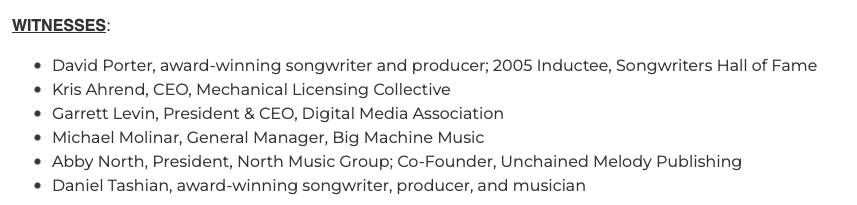
The witness list is well-chosen and seems unlikely to produce the usual propaganda from the controlled opposition that the lobbyists usually try to spoon feed to lawmakers:

I have a few concerns myself. 

  1. Investment Policy: According to its 2021 tax return, the MLC, Inc. was at that time holding more than $650 million in publicly traded securities. According to the MLC, Inc.’s annual report (at p. 4), this sum seems to include the $424 million of black box monies that the MLC, Inc. received in 2021. Congress is entitled to know exactly how this money is handled, where it resides and who is responsible for making investment decisions.

    Congress should consider whether all black box sums and unspent operating costs advanced by blanket licensees should be held in a bank account controlled by the US government so that there is no confusion if Congress fires The MLC, Inc. or any successor.

    Congress should also consider whether the same fiduciary duties apply to The MLC, Inc.’s management of the black box as would apply to a pension fund (under ERISA) or comparable duty. (There’s lots of pension funds and even banks with less than $600 million in assets and they are all regulated.) At least with a pension fund the fund trustees know who they owe money to; The MLC, Inc. seems like it should have an even higher responsibility to be good stewards of money it owes to the very unknown songwriters Congress tasked it with finding, thus cementing the moral hazard.  

    It goes without saying that the infamous “Hoffa Clause” in the MMA should be repealed (17 U.S.C. § 115 (d)(7)(C)). The Hoffa Clause allows the collective to dip into the black box to pay its expenses if the millions of the administrative assessment paid by the blanket licensees just isn’t quite enough.
  2. Succession Plan: What if Congress did fire The MLC, Inc.? Is there a succession plan in place that would allow the seamless transfer to a new collective of databases, operating software, cash on hand, and of course the black box? If there is a succession plan in place, then perhaps Mr. Ahrend should bring it with him to Chairman Issa’s hearing for the records. If not, perhaps he could draft one. In any event, Mr. Ahrend should have ready answers to at least some questions about a succession plan should the Subcommittee ask him. After all, the lobbyists wrote the bill and the five year review language was written into the earliest drafts so he should expect a few questions about what happens. Particularly since the Subcommittee has announced that they want to know “…whether the legislation is operating as intended by Congress and consider reforms.”
  3. Nondisclosure Agreements: I am struck by the fact that there have been no leaks of information about the black box, investment policy, or even life at The MLC, Inc. This usually means that there are nondisclosure agreements in place that scare people into silence–along with a healthy dose of intimidation in a small and incestuous industry when it’s likely that your employer is on the board of directors. Maybe not, but Congress may want to find out what these people are up to so it can decide if it wants to let them keep doing it. This may seem like a small issue, but either people aren’t talking because they have nothing to say or people are talking but nobody will print the story.
  4. Songwriter Directors and Geographical Diversity: The hearing may provide a good opportunity for the Subcommittee to look into how the collective’s controversial board composition is working out, not to mention the membership levels in the confusing by laws of The MLC, Inc. For example, I for one really see no reason to continue the concept of non-voting directors on the board, and Congress could just eliminate that role. One need only look to other collectives and PROs in the US and around the world for examples. A non-voting board member is a close analog to a “board observer” which is usually someone appointed by an investor to essentially spy on the board.  

    Similarly, it must be said that all the board members are either from New York, Nashville, Los Angeles or are lobbyists from the Imperial City. There are songwriters all over the country and internationally. Since the collective is really a quasi governmental organization, it is entirely in the remit of Congress to increase transparency and fairness as well as diversity. This could be accomplished by requiring an equal number of songwriter and publisher directors and having them come from states or regions with a big music contribution to America such as one of the reservations ,Atlanta, Chicago, Houston, Miami, New Orleans, Tulsa or Appalachia.  
  5. Revisit the Compulsory License: There is, of course, the threshold question of whether the compulsory license should be continued at all. This five year examination really should include this fundamental review rather than just blindly pushing forward with the compulsory license. (I discussed this in some detail in a separate post.) One songwriter has suggested that the Copyright Office reprise another study on the continued viability of the entire compulsory license system and I think he’s got a point there. Perhaps the Subcommittee could task the Copyright Office with conducting such a study as a finding of the field hearing. Those studies allow the public to comment without fear or favor which would be a breath of fresh air. Congress could then hear from more people whose jobs depend on the system working well resulting in the payments to songwriters that Congress wanted rather than the system just stumbling on resulting in high salaries to the operators and little to no transparency.

    Let’s see what happens at the field hearing.  You can watch it here courtesy of the YouTube monopoly.


    This post first appeared in MusicTechPolicy

Should the Compulsory License be Re-Upped?

By Chris Castle

[This post first appeared on MusicTechPolicy]

The wisest of those among you learn to read your portents well
There’s no need to hurry, it’s all downhill to Hell…

Don’t Stand Still, written by The Original Snakeboy, performed by Guy Forsyth

Congress is considering whether to renew The MLC, Inc.‘s designation as the mechanical licensing collective. If that sentence seems contradictory, remember those are two different things: the mechanical licensing collective is the statutory body that administers the compulsory license under Section 115. The MLC, Inc. is the private company that was “designated” by Congress through its Copyright Office to do the work of the mechanical licensing collective. This is like the form of a body that performs a function (the mechanical licensing collective) and having to animate that form with actual humans (The MLC, Inc.), kind of like Plato’s allegory of the cave, shadows on the wall being what they are.

Congress reviews the work product of The MLC, Inc. every five years (17 USC §115(d)(3)(B)(ii)) to decide if The MLC, Inc. should be allowed to continue another five years. In its recent guidance to The MLC, Inc. about artificial intelligence, the Copyright Office correctly took pains to make that distinction in a footnote (footnote 2 to be precise. Remember–always read the footnotes, it’s often where the action is.). This is why it is important that we be clear that The MLC, Inc. does not “own” the data it collects (and that HFA as its vendor doesn’t own it either, a point I raised to Spotify’s lobbyist several years ago). Although it may be a blessing if Congress fired The MLC, Inc. and the new collective had to start from scratch.

But Congress likely would only re-up The MLC, Inc. if it had already decided to extend the statutory license and all its cumbersome and byzantine procedures, proceedings and prohibitions on the freedom of songwriters to collectively bargain. Not to mention an extraordinarily huge thumbs down on the scales in favor of the music user and against the interest of the songwriters. The compulsory license is so labyrinthine and Kafka-esque it is actually an insult to Byzantium, but that’s another story.

Rather than just deciding about who is going to get the job of administering the revenues for every songwriter in the world, maybe there should be a vote. Particularly because songwriters cannot be members of the mechanical licensing collective as currently operated. Congress did not ask songwriters what they thought when the whole mechanical licensing scheme was established, so how about now?

Before the Congress decides to continue The MLC, Inc. many believe strongly that the body should reconsider the compulsory license itself. It is the compulsory license that is the real issue that plagues songwriters and blocks a free market. The compulsory license really has passed its sell by date and it’s pretty easy to understand why its gone so sour. Eliminating the Section 115 license will have many implications and we should tread carefully, but purposefully.

Party Like it’s 1909

First of all, consider the actual history of the compulsory license. It’s over 100 years old, and it was established at a time, believe it or not, when the goal of Congress was to even the playing field between, music users and copyright owners. They were worried about music users being hard done by because of the anticompetitive efforts of songwriters and copyright owners. As the late Register Marybeth Peters told Congress, when Congress created the exclusive right to control reproduction and distribution in 1909, “…due to concerns about potential monopolistic behavior [by the copyright owners], Congress also created a compulsory license to allow anyone to make and distribute a mechanical reproduction of a nondramatic musical work without the consent of the copyright owner provided that the person adhered to the provisions of the license, most notably paying a statutorily established royalty to the copyright owner.”

Well, that ship has sailed, don’t you think? 

This is kind of incredible when you think about it today because the biggest users of the compulsory license are those who torture the bejesus out of songwriters by conducting lawfare at the Copyright Royalty Board–the richest corporations in commercial history that dominate practically every moment of American life. In fact, the statutory license was hardly used at all before these fictional persons arrived on the scene and have been on a decades-long crusade to hack the Copyright Act through lawfare ever since. This is particularly true since about 2007 when Big Tech discovered Section 115. (And they’re about to do it again with AI–first they send the missionaries.)

If the purpose of the statutory scheme was to create a win-win situation that floats all boats, you would have expected to see songwriters profiting like never before, right? If the compulsory was so great, what we really needed was for everyone to use Section 115, right? Actually, the opposite has happened, even with decades of price fixing at 2¢ by the federal government. When hardly anyone used the compulsory license, songwriters prospered. When its use became widespread, songwriters suffered, and suffered badly.

Songwriters have been relegated to the bottom of the pile in compensation, a sure sign of no leverage because whatever leverage songwriters may have is taken–there’s that word again–by the compulsory license. I don’t think Google, a revanchist Microsoft, Apple, Amazon or Spotify need any protection from the anticompetitive efforts of songwriters. Google, Amazon, Apple, Microsoft, Spotify are only worried about “monopolistic behavior” when one of them does it to one of the others. The Five Families would tell you its nothing personal, it’s just business. 

Yet these corporate neo-colonialists would have you believe that the first thing that happens when the writing room door closes is that songwriters collude against them. (Sounding very much like the Radio Music Licensing Committee–so similar it makes you wonder, speaking of collusion.) 

The Five Year Plan

Merck Mercuriadis makes the good point that there is no time like the present to evolve: “In the United States, we have a position of stability for the next five years – at the highest rates paid to songwriters to date – in the evolution of the streaming economy. We are now working towards improving the songwriters’ share of the streaming revenue ‘pie’ yet further and, eventually, getting to a free market.” The clock is ticking on the next five years, a reference to the rate period set by the Copyright Royalty Board in the Phonorecords IV proceeding. (And that five years is a different clock than the five years clock on the MLC which is itself an example of the unnecessary confusion in the compulsory license.)

What would happen if the compulsory license vanished? Very likely the industry would continue its easily documented history of voluntary catalog licenses. The evidence is readily apparent for how the industry and music users handled services that did not qualify for a compulsory license like YouTube or TikTok. However stupid the deals were doesn’t change the fact that they happened in the absence of a compulsory license. That Invisible Hand thing, dunno could be good. Seems to work out fine for other people.

Let’s also understand that there is a cottage industry complete with very nice offices, pensions and rich salaries that has grown up around the compulsory license (or consent decrees for that matter). A cottage industry where collecting the songwriters’ money results in dozens of jobs paying more in a year than probably 95% of songwriters will make, maybe ever. (The Trichordist published an excerpt from a recent MLC tax return showing the highest compensated MLC employees.) Generations of lawyers and lobbyists have put generations of children through college and law school from legal fees charged in the pursuit of something that has never existed in the contemporary music business–a willing buyer and a willing seller. Those people will not want to abandon the very government policy that puts food on their tables, but both sides are very, very good at manufacturing excuses why the compulsory license really must be continued to further humanity.

The even sadder reality is that as much as we would like to simply terminate the compulsory license, there is a certain legitimacy to being clear-eyed about a transition. (An example is the proposals for transitioning from PRO consent decrees–ASCAP’s consent decree has been around a long time, too.) There would likely need to be a certain grandfathering in of services that were pre or post the elimination of the compulsory, but that’s easily done, albeit not without a last hurrah of legal fees and lobbyist invoices. Register Pallante noted in the well-received 2015 Copyright Office study (Copyright and the Music Marketplace at 5) “The Office thus believes that, rather than eliminating section 115 altogether, section 115 should instead become the basis of a more flexible collective licensing system that will presumptively cover all mechanical uses except to the extent individual music publishers choose to opt out.”  An opt out is another acceptable stop along the way to liberation, or even perhaps a destination itself. David Lowery had a very well thought-out idea along these lines in the pre-MLC era that should be revisited.

X Day

However, while there is a certain attractiveness to having a plan that the dreaded “stakeholders” and their legions of lobbyists and lawyers agree with, it is crucially important for Congress to fix a date certain by which the compulsory license will expire. Rain or shine, plan or no plan, it goes away on the X Day, say five years from now as Merck suggests. So wakey, wakey. 

That transparency drives a wedge into the process because otherwise millions will be spent in fees for profiting from moral hazard and surely the praetorians protecting the cottage industry wouldn’t want that. If you doubt that asking for a plan before establishing X Day would fail as a plan, just look at the Copyright Royalty Board and in particular the Phonorecords III remand. Years and years, multiple court rulings, and the rates still are not in effect.  Perseveration is not perseverance, it’s compulsive repetition when you know the same unacceptable result will occur.

But don’t let people tell you that the sky will fall if Congress liberates songwriters from the government mandate. The sky will not fall and songwriters will have a generational opportunity to organize a collective bargaining unit with the right to say no to a deal. 

Who can forget Sally Fields in Norma Rae?

The closest that Congress has come to a meaningful “vote” in the songwriting world is inviting public comments through interventions, rule makings, roundtables and the like–information gathering that is not controlled by the lobbyists. Indeed, it was this very process at the Copyright Royalty Board that resulted in many articulate comments by songwriters and publishers themselves that were clearly quite at odds with what the CRB was being fed by the lobbyists and lawyers. So much so that the Copyright Royalty Judges rejected not only the “Subpart B” settlement reached by the insiders but the very premise of that settlement. Imagine what might happen if the issue of the compulsory license itself was placed upon the table?

Now that songwriters have had a taste of how The MLC, Inc. has been handling their money, maybe this would be a good time to ask them what they think about how things are going. And whether they want to be liberated from the entire sinking ship that is designed to help Big Tech. And you can start by asking how they feel about the $500 million in black box money that is still sitting in the bank account of The MLC, Inc. and has not been paid–with an infuriating lack of transparency. Yet is being “invested” by The MLC, Inc. with less transparency than many banks with smaller net assets.

This “investment” is another result of the compulsory license which has no transparency requirements for such “investments” of other peoples’ money, perhaps “invested” in the very Big Tech companies that fund the The MLC, Inc. That wasn’t a question that was on the minds of Congress in 1909 but it should be today.

Attention Must Be Paid

Let’s face facts. The compulsory license has coexisted in the decimation of songwriting as a profession. That destruction has increased at an increasing rate roughly coincident with the time the Big Tech discovered Section 115 and sent their legions of lawyers to the Copyright Royalty Board to grind down publishers, and very successfully. That success is in large part due to the very mismatch that the compulsory license was designed to prevent back in 1909 except stood on its head waiting for loophole seekers to notice the potential arbitrage opportunity. 

The Phonorecords III and IV proceedings at the Copyright Royalty Board tell Congress all they need to know about how the game is played today and how it has changed since 1909, or the 1976 revision of the Copyright Act for that matter. The compulsory license is no longer fit for purpose and songwriters should have a say in whether it is to be continued or abandoned.

We see the Writers Guild striking and SAG-AFTRA taking a strike authorization vote. When was the last time any songwriters voted on their compensation? Maybe never? Voting, hmm. There’s a concept. Now where have I heard that before?

Copyright Office Authorized a Star Chamber at the MLC to Hold Your Money

We knew this would happen. The Copyright Office has empowered the Mechanical Licensing Collective to decide whether a song (or a sound recording) can be copyrighted all under the guise of AI. If the MLC–not the Copyright Office–decides that your song is not capable of being registered for copyright, the MLC can hold your money essentially forever.

Where’s the regulation on this important subject? Did you get a chance to comment on these crucial regulations and precedent?

Ah…no. You didn’t miss any notices in the Federal Register. No, we know this because of this cozy “guidance letter” to MLC CEO Kris Ahrend from the general counsel of the Copyright Office. That’s right, a letter that we just happened to run across. That letter states:

More specifically, the Office advises that a work that appears to lack sufficient human authorship is appropriately treated by The MLC as an “anomal[y],” consistent with its Guidelines for Adjustments, and The MLC should “place [associated] Royalties in Suspense while it researches and analyzes the issue.” Such research could include corresponding with the individual or entity claiming ownership of the work or [could include] inquiring whether the Office has registered the work and whether there are any disclaimers or notes in the registration record.

If The MLC subsequently concludes that the work qualifies for copyright protection and the section 115 license, it should distribute any royalties and interest in suspense to the copyright owner. Alternatively, if The MLC believes that the work does not qualify for copyright protection following its research and analysis, it should notify the individual or entity claiming ownership of the work of its determination and that associated royalties will be subject to an adjustment. This conclusion and adjustment may be challenged by initiating an “Adjustment Dispute” consistent with The MLC’s policies. If legal proceedings are initiated to challenge The MLC’s actions, the disputed royalties and interest should remain suspended until those proceedings are resolved.

So just in one paragraph, the Copyright Office has effectively delegated its role in the U.S. government to a private corporation controlled by the largest music publishers and financed by the largest tech companies in the world (actually the largest corporations in the history of commerce). If the MLC decides that your song “appears to lack sufficient human authorship” The MLC can hold your money while they research the issue.

Note this doesn’t say who makes that decision, it doesn’t say when they have to notify you, it doesn’t say they have to give you an opportunity to be heard, it places no timeline on how long all this may take. “The MLC” (whoever that is) could sit on your money for years without ever telling you they are doing it and also keep invoicing the DSPs for your royalties while they “research and analyze the issue”.

The only time they have to give you notice if they “believe” (whatever that means) “that the work does not qualify for copyright protection” then “it should” (not the mandatory “shall”, but the permissive “should”) notify you of that determination. You can then file an “adjustment dispute” based on the MLC’s own guidelines which you will not be surprised to learn places no disclosure obligations on them, imposes no timeline and cannot be appealed.

Note that this guidance from the Copyright Office pretty expressly contemplates that the MLC may dispute a work that has already been registered for copyright without qualification–which raises the question of what a copyright registration actually means, and where is it written that the MLC has the authority to challenge a conformed Copyright Office registration.

It also places the MLC in a superior position to the Copyright Office because it allows the MLC to initiate a dispute resolution system outside of the Copyright Office channels. Is this written somewhere besides a burning bush on Mount Horeb?

The letter does seem to suggest that you can always sue the MLC or that the MLC could be prosecuted for state law crimes, perhaps, like conversion, but it would help to know who at the MLC is actually responsible.

This also raises the question of why the MLC is invoicing the DSPs in the first place and what happens to the money every step along the path. Because of the idiotic streaming mechanical royalty calculation, it seems inevitable that the royalty pool will be overstated or understated if the MLC is claiming works that are not subject to copyright (like it would for public domain works it invoiced).

Ever wonder what prompts letters like this to get written?

Play your part, dude. Go back to sleep.