Has the MLC Become a $1.2 billion Hedge Fund?

It’s becoming increasingly clear that the MLC has little to no oversight. The Copyright Office is tasked by Congress with oversight authority over this quasi-governmental organization under the Music Modernization Act. Yet there is nothing happening in the way of guardrails. The Copyright Office haven’t even concluded their mandated five-year review of the MLC that started a year ago. Not only has no one responded to Congressman Fitzgerald’s inquiries about the MLC’s oddball finances, the Copyright Office hasn’t responded to the many public comments demanding answers on the MLC’s sketchy finances as demonstrated on their tax returns.

The MLC’s 2023 tax return shows the quango is holding $1,212,282,220 invested in publicly traded securities–that’s $1.2 BILLION. That’s a fortune for an organization that makes no money–because as we were told ad nauseum the services pay it’s operating costs and bloated salaries-and has no profits because it is not an operating company. But it does hold several fortunes in unmatched royalties it does not seem to be in a hurry to match and pay out to songwriters.

The Supplement to the MLC’s 2023 tax return includes this language:

In our Form 990 for 2023, we provided information regarding funds we were holding in banks and investments as of the beginning of 2023 and the end of 2023. These included assessment funds that we subsequently use to fund our operations; royalty funds we were not yet able to distribute and on which we are required to earn interest in accordance with the Music Modernization Act (MMA) of 2018; and royalty funds we were holding pending distribution.

What the MMA actually says in the black box penalty language of 17 USC §115 (d)(3)(H)(ii) is:

Interest-bearing account.—Accrued royalties for unmatched works (and shares thereof) shall be maintained by the mechanical licensing collective in an interest-bearing account that earns monthly interest—

(I) at the Federal, short-term rate; and

(II) that accrues for the benefit of copyright owners entitled to payment of such accrued royalties.

The black box penalty in 17 USC §115 (d)(3)(H)(ii) is similar to the late fee charged to licensees. The code creates an incentive for the MLC to pay out unmatched funds quickly to avoid the market share distribution of black box which could happen any minute now (particularly since the Copyright Office hasn’t completed the five-year review it started over a year ago).

This language of 17 USC §115 (d)(3)(H)(ii) does not “require” the MLC to “earn interest”, it requires them to PAY interest. Because it is inextricably tied to job performance, it would not be a payment borne by the licensees as part of the administrative assessment as part of the “collective total costs.”

That’s why it’s a penalty. It is, in my view, absolutely false and misleading to state in a matter under the jurisdiction of the federal government that the MLC is in compliance with a code section that does not say what they say it says. And it’s not just this one time, the CEO has said almost these exact words in testimony to the House IP Subcommittee and in supplemental written testimony to answer questions for the record from the Subcommittee.

Even if you want to be generous and accept the MLC’s argument–and it’s just an argument–that the MMA “requires” the MLC to “earn” interest, an “interest bearing account” simply does not contemplate “investing” other people’s money–your money–in publicly traded securities by a stock broker. When asked direct questions about who bears the downside and who gets the ups on their stock trading, the MLC has never answered the question. 

The closest to an answer we get from the plain statutory language is that the MLC is required to pay interest on unmatched funds at the “federal short term rate” which is approximately 4.23%. Does that mean that if the MLC makes more than a 4.23% return they keep the upside? Or if the stock brokers don’t achieve that return, does that mean the licensees cough up the difference in additional administrative assessment contributions? Unlikely, so would the MLC’s board members pass the hat? I’ll believe that when I see it.

While the MLC refuses to answer who participates in the benefits or downside of the investment policy, the amount invested in publicly traded securities over 12 months has radically increased from $804,555,579 at the beginning of 2023. As of the end of 2023, the MLC’s holdings in publicly traded securities alone increased to $1,212,282,220, approximately a 50% gain over 12 months. What we don’t know is if that gain is due to slick stock trading, monkey with a dartboard or the addition of new money, Madoff-style. (And of course if they do manage to “blow up the compulsory” which is the latest from the smart people, who knows who gets to keep the black box?)

The MLC offers this explanation:

At the beginning of 2023, we were holding $138.8 million in “Savings and temporary cash investments.” By the end of 2023, we had moved $131.1 million of these funds to “Investments – publicly traded securities,” leaving the remaining $7.7 million in “Savings and temporary cash investments.” At the beginning of 2023, we were holding $804.6 million in “Investments – publicly traded securities.” By the end of 2023, the amount of funds we were holding in this category increased to $1.2 billion. This year-end amount included the $131.1 million we had moved from “Savings and temporary cash investments”
into this category during the year.

Realize that this language explains nothing. Not only do they round down by $12,282,220, they simply describe movements of cash without explaining why it happened.

So once again, we are presented with a document that avoids the key issue at best and is misleading at worst. But what is clear is that the MLC has more in holdings that approximately 130 regional banks that have substantial disclosure obligations. It’s looking more and more like a hedge fund.

Fired for Cause:  @RepFitzgerald Asks for Conditional Redesignation of the MLC

By Chris Castle

U.S. Representative Scott Fitzgerald joined in the MLC review currently underway and sent a letter to Register of Copyrights Shira Perlmutter on August 29 regarding operational and performance issues relating to the MLC.  The letter was in the context of the five year review for “redesignation” of The MLC, Inc. as the mechanical licensing collective.  (That may be confusing because of the choice of “The MLC” as the name of the operational entity that the government permits to run the mechanical licensing collective.  The main difference is that The MLC, Inc. is an entity that is “designated” or appointed to operationalize the statutory body.  The MLC, Inc. can be replaced.  The mechanical licensing collective (lower case) is the statutory body created by Title I of the Music Modernization Act) and it lasts as long as the MMA is not repealed or modified. Unlikely, but we live in hope.)

I would say that songwriters probably don’t have anything more important to do today in their business beyond reading and understanding Rep. Fitzgerald’s excellent letter.

Rep. Fitzgerald’s letter is important because he proposes that the MLC, Inc. be given a conditional redesignation, not an outright redesignation.  In a nutshell, that is because Rep. Fitzgerald raises many…let’s just say “issues”…that he would like to see fixed before committing to another five years for The MLC, Inc.  As a member of the House Judiciary Subcommittee on Courts, Intellectual Property, and the Internet, Rep. Fitzgerald’s point of view on this subject must be given added gravitas.

In case you’re not following along at home, the Copyright Office is currently conducting an operational and performance review of The MLC, Inc. to determine if it is deserving of being given another five years to operate the mechanical licensing collective.  (See Periodic Review of the Mechanical Licensing Collective and the Digital Licensee Coordinator (Docket 2024-1), available at https://www.copyright.gov/rulemaking/mma-designations/2024/.)

The redesignation process may not be quickly resolved.  It is important to realize that the Copyright Office is not obligated to redesignate The MLC, Inc. by any particular deadline or at all.  It is easy to understand that any redesignation might be contingent on The MLC, Inc. fixing certain…issues…because the redesignation rulemaking is itself an operational and performance review.  It is also easy to understand that the Copyright Office might need to bring in some technical and operational assistance in order to diligence its statutory review obligations.  This could take a while.

Let’s consider the broad strokes of Rep. Fitzgerald’s letter.

Budget Transparency

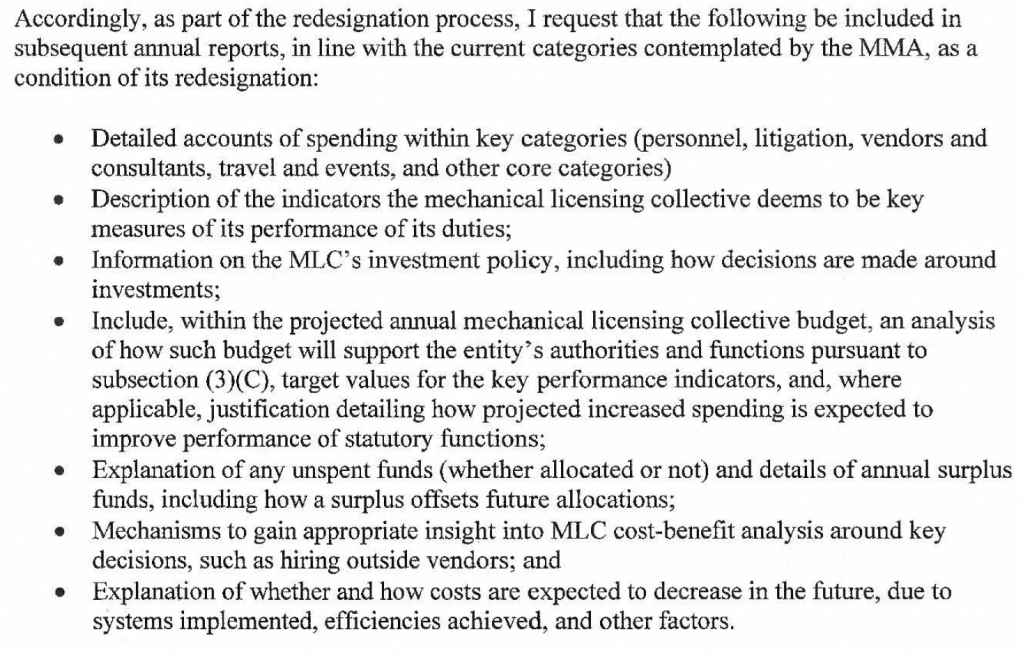
Rep. Fitzgerald is concerned with a lack of candor and transparency in The MLC, Inc.’s annual report among other things. If you’ve read the MLC’s annual reports, you may agree with me that the reports are long on cheerleading and short on financial facts.  It’s like The MLC, Inc. thought they were answering the question “How can you tolerate your own awesomeness?”   That question is not on the list.  Rep. Fitzgerald says “Unfortunately, the current annual report lacks key data necessary to examine the MLC’s ability to execute these authorities and functions.”  He then goes on to make recommendations for greater transparency in future annual reports.

I agree with Rep. Fitzgerald that these are all important points.  I disagree with him slightly about the timing of this disclosure.  These important disclosures need not be prospective–they could be both prospective and retroactive. I see no reason at all why The MLC, Inc. cannot be required to revise all of its four annual reports filed to date (https://www.themlc.com/governance) in line with this expanded criteria.  I am just guessing, but the kind of detail that Rep. Fitzgerald is focused on are really just data that any business would accumulate or require in the normal course of prudently operating its business.  That suggests to me that there is no additional work required in bringing The MLC, Inc. into compliance; it’s just a matter of disclosure.

There is nothing proprietary about that disclosure and there is no reason to keep secrets about how you handle other people’s money.  It is important to recognize that The MLC, Inc. only handles other people’s money.  It has no revenue because all of the money under its management comes from either royalties that belong to copyright owners or operating capital paid by the services that use the blanket license.  It should not be overlooked that the services rely on the MLC and it has a duty to everyone to properly handle the funds. The MLC, Inc. also operates at the pleasure of the government, so it should not be heard to be too precious about information flow, particularly information related to its own operational performance. Those duties flow in many directions.

Board Neutrality

The board composition of the mechanical licensing collective (and therefore The MLC, Inc.) is set by Congress in Title I.  It should come as no surprise to anyone that the major publishers and their lobbyists who created Title I wrote themselves a winning hand directly into the statute itself.  (And FYI, there is gambling at Rick’s American Café, too.)  As Rep. Fitzgerald says:  

Of the 14 voting members, ten are comprised of music publishers and four are songwriters. Publishers were given a majority of seats in order to assist with the collective’s primary task of matching and distributing royalties. However, the MMA did not provide this allocation in order to convert the MLC into an extension of the music publishers.

I would argue with him about that, too, because I believe that’s exactly what the MMA was intended to do by those who drafted it who also dictated who controlled the pen.  This is a rotten system and it was obviously on its way to putrefaction before the ink was dry.

For context, Section 8 of the Clayton Act, one of our principal antitrust laws, prohibits interlocking boards on competitor corporations.  I’m not saying that The MLC, Inc. has a Section 8 problem–yet–but rather that interlocking boards is a disfavored arrangement by way of understanding Rep. Fitzgerald’s issue with The MLC, Inc.’s form of governance:

Per the MMA, the MLC is required to maintain an independent board of directors. However, what we’ve seen since establishing the collective is anything but independent. For example, in both 2023 and 2024, all ten publishers represented by the voting members on the MLC Board of Directors were also members of the NMPA’s board.  This not only raises questions about the MLC’s ability to act as a “fair” administrator of the blanket license but, more importantly, raises concerns that the MLC is using its expenditures to advance arguments indistinguishable from those of the music publishers-including, at times, arguments contrary to the positions of songwriters and the digital streamers.

Said another way, Rep. Fitzgerald is concerned that The MLC, Inc. is acting very much like HFA did when it was owned by the NMPA.  That would be HFA, the principal vendor of The MLC, Inc. (and that dividing line is blurry, too).

It is important to realize that the gravamen of Rep. Fitzgerald’s complaint (as I understand it) is not solely with the statute, it is with the decisions about how to interpret the statute taken by The MLC, Inc. and not so far countermanded by the Copyright Office in its oversight role.  That’s the best news I’ve had all day.  This conflict and competition issue is easily solved by voluntary action which could be taken immediately (with or without changing the board composition).  In fact, given the sensitivity that large or dominant corporations have about such things, I’m kind of surprised that they walked right into that one.  The devil may be in the details, but God is in the little things.

Investment Policy

Rep. Fitzgerald is also concerned about The MLC, Inc.’s “investment policy.”  Readers will recall that I have been questioning both the provenance and wisdom of The MLC, Inc. unilaterally deciding that it can invest the hundreds of millions in the black box in the open market.  I personally cannot find any authority for such a momentous action in the statute or any regulation.  Rep. Fitzgerald also raises questions about the “investment policy”:

Further, questions remain regarding the MLC’s investment policy by which it may invest royalty and assessment funds. The MLC’s Investment Policy Statement provides little insight into how those funds are invested, their market risk, the revenue generated from those investments, and the percentage of revenue (minus fees) transferred to the copyright owner upon distribution of royalties. I would urge the Copyright Office to require more transparency into these investments as a condition of redesignation.

It should be obvious that The MLC, Inc.’s “investment policy” has taken on a renewed seriousness and can no longer be dodged.

Black Box

It should go without saying that fair distribution of unmatched funds starts with paying the right people.  Not “connect to collect” or “play your part” or any other sloganeering.  Tracking them down. Like orphan works, The MLC, Inc. needs to take active measures to find the people to whom they owe money, not wait for the people who don’t know they are owed to find out that they haven’t been paid.  

Although there are some reasonable boundaries on a cost/benefit analysis of just how much to spend on tracking down people owed small sums, it is important to realize that the extraordinary benefits conferred on digital services by the Music Modernization Act, safe harbors and all, justifies higher expectations of those same services in finding the people they owe money.  The MLC, Inc. is uniquely different than its counterparts in other countries for this reason.

I tried to raise the need for increased vigilance at the MLC during a Copyright Office roundtable on the MMA. I was startled that the then-head of DiMA (since moved on) had the brass to condescend to me as if he had ever paid a royalty or rendered a royalty statement.  I was pointing out that the MLC was different than any other collecting society in the world because the licensees pay the operating costs and received significant legal benefits in return. Those legal benefits took away songwriters’ fundamental rights to protect their interests through enforcing justifiable infringement actions which is not true in other countries. 

In countries where the operating cost of their collecting society is deducted from royalties, it is far more appropriate for that society to consider a more restrictive cost/benefit analysis when expending resources to track down the songwriters they owe. This is particularly true when no black box writer is granting nonmonetary consideration like a safe harbor whether they know it or not.

I got an earful from this person about how the services weren’t an open checkbook to track down people they owed money to (try that argument when failing to comply with Know Your Customer laws).  Grocers know more about ham sandwiches than digital services know about copyright owners. The general tone was that I should be grateful to Big Daddy and be more careful how I spend my lunch money. And yes I do resent this paternalistic response which I’m sorry to say was not challenged by the Copyright Office lawyer presiding who shortly thereafter went to work for Spotify.  Nobody ever asked for an open check.  I just asked that they make a greater effort than the effort that got Spotify sued a number of times resulting in over $50 million in settlements, a generous accommodation in my view. If anyone should be grateful, it is the services who should be grateful, not the songwriters.

And yet here we are again in the same place.  Except this time the services have a safe harbor against the entire world which I believe has value greater than the operating costs of the MLC.  I’d be perfectly happy to go back to the way it was before the services got everything they wanted and then some in Title I of the MMA, but I bet I won’t get any takers on that idea.

Instead, I have to congratulate Rep. Fitzgerald for truly excellent work product in his letter and for framing the issue exactly as it should be posed.  Failing to fix these major problems should result in no redesignation—fired for cause.

[This post first appeared in MusicTech.Solutions]

Press Release: Indie Songwriter Groups Thank @RepFitzgerald For His Letter to @CopyrightOffice Urging Improvements to the US Mechanical Licensing Collective

The Songwriters Guild of America (SGA), the Society of Composers & Lyricists (SCL) and the Music Creators North America (MCNA) coalition –on behalf of over ten thousand US songwriter and composer members and their heirs and with the support of tens of thousands more represented by our organizations’ affiliated International Council of Music Creators (CIAM)– offer our sincerest thanks and support to US Congressman Scott Fitzgerald (R-WI) for his stalwart efforts in seeking to protect our rights through much needed operational and structural improvements to the US Mechanical Licensing Collective (MLC). The MLC collects and distributes hundreds of millions of dollars in royalties to songwriters and composers through their music publishing administrators each year.

Following the filing by our coalition in May, 2024 of comments expressing conditional support for re-designation by the US Copyright Office of the current MLC if –and only if– certain reforms are instituted to improve its transparency, operational fairness and accuracy in distributions (https://www.songwritersguild.com/site/potential-re-designation-mlc-and-dlc) Representative Fitzgerald came forward with his own letter to the Copyright Office dated August 29, 2024 asserting the need for reforms in full basic harmony with our own positions. His Congressional office is one of many with whom our groups have had impactful and productive discussions concerning the need for closer governmental oversight of the MLC process in order to protect American music creator rights, as clearly intended by Congress in the Music Modernization Act enacted five years ago.

Among the urgently required reforms addressed in Congressman Fitzgerald’s letter are:

–greater MLC budgetary transparency,

–improved outreach and accuracy in identifying and contacting owners of unmatched “black box” royalties (potentially approaching one billion dollars in unmatched and/or undistributed funds by 2025), and

–improved MLC board neutrality, balance and fairness.

As to this latter issue, the Congressman was forthright in acknowledging that the MLC board has conducted itself more as an advocate solely for the corporate music publishing industry rather than, as Congressionally intended, an unbiased body charged principally with protecting creator’ rights and royalties.

There are several problems related to the presence on the MLC board of only four songwriter/composer directors as compared to ten music publisher representatives (a unique imbalance compared to all other music royalty collectives around the world), including the fact that “permanently” unmatched royalties are to be distributed by the MLC on a “market share”
basis.

That construct means that music publisher board members stand to benefit by NOT properly identifying and distributing royalties to their actual creator-owners, the very task legislatively assigned to the MLC at the time of its Congressional creation. Moreover, the alleged songwriter organizations’ representative appointed as the non-voting board overseer for music creator interests has proven to be nothing more than a rubber stamp for corporate interests in direct opposition to the creators’ interests it purports to safeguard. We are aware of no other American music creator group that supports continuation of this facade of creator “representation.”

Our groups appreciate the consistent outreach and earnest work of MLC chief executive officer
Kris Ahrend, but we join Congressman Fitzgerald and his supporting colleagues in the House and Senate in insisting that the enumerated reforms cited in our Copyright Office submissions must be considered essential prerequisites to MLC re-designation (including endorsement by the MLC Board of Congressional action to equalize board representation between music creators on the one hand and their corporate copyright owners and administrators on the other). Our coalition will meanwhile continue its work on Capitol Hill and with the Copyright Office advocating for genuine protections of independent, individual music creator rights by the MLC.

Read Rep. Fitzgerald’s letter here.

The Intention of Justice:  In Which The MLC Loses its Way on a Copyright Adventure

by Chris Castle

ARTHUR

Let’s get back to justice…what is justice?  What is the intention of justice?  The intention of justice is to see that the guilty people are proven guilty and that the innocent are freed.  Simple, isn’t it?  
Only it’s not that simple.

From And Justice for All, screenplay written by Valerie Curtin and Barry Levinson

Something very important happened at the MLC on July 9:  The Copyright Office overruled the MLC on the position the MLC (and, in fairness, the NMPA) took on who was entitled to post-termination mechanical royalties under the statutory blanket license.  What’s important about the ruling is not just that the Copyright Office ruled that the MLC’s announced position was “incorrect”—it is that it corrected the MLC’s position that was in direct contravention of prior Copyright Office guidance.  (If this is all news to you, you can get up to speed with this helpful post about the episode on the Copyright Office website or read John Barker’s excellent comment in the rulemaking.)

“Guidance” is a kind way to put it, because the Copyright Office has statutory oversight for the MLC.  That means that on subjects yet to be well defined in a post-Loper world (the Supreme Court decision that reversed “Chevron deference”), I think it’s worth asking whether the Copyright Office is going to need to get more involved with the operations of the MLC.  Alternatively, Congress may have to amend Title I of the Music Modernization Act to fill in the blanks.  Either way, the Copyright Office’s termination ruling is yet another example of why I keep saying that the MLC is a quasi-governmental organization that is, in a way, neither fish nor fowl.  It is both a private organization and a government agency somewhat like the Tennessee Valley Authority.  Whatever it is ultimately ruled to be, it is not like the Harry Fox Agency which in my view has labored for decades under the misapprehension that its decisions carry the effect of law.  Shocking, I know.  But whether it’s the MLC or HFA, when they decide not to pay your money unless you sue them, it may as well be the law.

The MLC’s failure to follow the Copyright Office guidance is not a minor thing.  This obstreperousness has led to significant overpayments to pre-termination copyright owners (who may not even realize they were getting screwed).  This behavior by the MLC is what the British call “bolshy”, a wonderful word describing one who is uncooperative, recalcitrant, or truculent according to the Oxford Dictionary of Modern Slang.  The word is a pejorative adjective derived from Bolshevik.  “Bolshy” invokes lawlessness.

In a strange coincidence, the two most prominent public commenters supporting the MLC’s bolshy position on post-termination payments were the MLC itself and the NMPA, which holds a nonvoting board seat on the MLC’s board of directors.  This stick-togetherness is very reminiscent of what it was like dealing with HFA when the NMPA owned it.  It was hard to tell where one started and the other stopped just like it is now.  (I have often said that a nonvoting board seat is very much like a “board observer” appointed by investors in a startup to essentially spy on the company’s board of directors.  I question why the MLC even needs nonvoting board seats at all given the largely interlocking boards, aside from the obvious answer that the nonvoters have those seats because the lobbyists wrote themselves into Title I of the MMA—you know, the famous “spirit of the MMA”.)

Having said that, the height of bolshiness is captured in this quotation (89 FR 58586 (July 9, 2024)) from the Copyright Office ruling about public comments which the Office had requested (at 56588):

The only commenter to question the Office’s authority was NMPA, which offered various arguments for why the Office lacks authority to issue this [post-termination] rule. None are persuasive. [Ouch.]

NMPA first argued that the Office has no authority under section 702 of the Copyright Act or the MMA to promulgate rules that involve substantive questions of copyright law. This is clearly incorrect. [Double ouch.]

The Office ‘‘has statutory authority to issue regulations necessary to administer the Copyright Act’’ and ‘‘to interpret the Copyright Act.’’  As the [Copyright Office notice of proposed rulemaking] detailed, ‘‘[t]he Office’s authority to interpret [the Copyright Act]  in the context of statutory licenses in particular has long been recognized.’’

Well, no kidding.

What concerns me today is that wherever it originated, the net effect of the MLC’s clearly erroneous and misguided position on termination payments is like so many other “policies” of the MLC:  The gloomy result always seems to be they don’t pay the right person or don’t pay anyone at all in a self-created dispute that so far has proven virtually impossible to undo without action by the Copyright Office (which has other and perhaps better things to do, frankly).  The Copyright Office, publishers and songwriters then have to burn cycles correcting the mistake.  

In the case of the termination issue, the MLC managed to do both: They either paid the wrong person or they held the money.  That’s a pretty neat trick, a feat of financial gymnastics for which there should be an Olympic category.  Or at least a flavor of self-licking ice cream.

The reason the net effect is of concern is that this adventure in copyright has led to a massive screwup in payments illustrating what we call the legal maxim of fubar fugazi snafu.  And no one will be fired.  In fact, we don’t even know which person is responsible for taking the position in the first place.  Somebody did, somebody screwed up, and somebody should be held accountable.

Mr. Barker crystalized this issue in his comment on the Copyright Office termination rulemaking, which I call to your attention (emphasis added):

I do have a concern related to the current matter at hand, which translates to a long-term uneasiness which I believe is appropriate to bring up as part of these comments. That concern is, how did the MLC’s proposed policies [on statutory termination payments] come in to being in the first place? 

The Copyright Office makes clear in its statements in the Proposed Rules publication that “…the MLC adopted a dispute policy concerning termination that does not follow the Office’s rulemaking guidance.”, and that the policy “…decline(d) to heed the Office’s warning…”. Given that the Office observed that “[t]he accurate distribution of royalties under the blanket license to copyright owners is a core objective of the MLC”, it is a bit alarming that the MLC’s proposed policies got published in the first place. 

I am personally only able to come up with two reasons why this occurred. Either the MLC board did not fully understand the impact on termination owners and the future administration of those royalties, or the MLC board DID realize the importance, and were intentional with their guidelines, despite the Copyright Office’s warnings

Both conclusions are disturbing, and I believe need to be addressed.

Mr. Barker is more gentlemanly about it than I am, and I freely admit that I have no doubt failed the MLC in courtesy.  I do have a tendency to greet only my brothers, the gospel of Matthew notwithstanding.  Yet it irks me to no end that no one has been held accountable for this debacle and the tremendous productivity cost (and loss) of having to fix it.  Was the MLC’s failed quest to impose its will on society covered by the Administrative Assessment?  If so, why?  If not, who paid for it?  And we should call the episode by its name—it is a debacle, albeit a highly illustrative one. 

But we must address this issue soon and address it unambiguously.  The tendency of bureaucracy is always to grow and the tendency of non-profit organizations is always to seek power as a metric in the absence of for-profit revenue.  Often there are too many people in the organization who are involved in decision-making so that responsibility is too scattered.  

When something goes wrong as it inevitably does, no one ever gets blamed, no one ever gets fired, and it’s very hard to hold any one person accountable because everything is too diffused.  Instead of accepting that inevitable result and trying to narrow accountability down to one person so that an organization is manageable and functioning, the reflex response is often to throw more resources at the problem when more resources, aka money, is obviously not the solution.  The MLC already has more money than they know what to do with thanks to the cornucopia of cash from the Administrative Assessment.  That deep pocket has certainly not led to peace in the valley.

Someone needs to get their arms around this issue and introduce accountability into the process.  That is either the Copyright Office acting in its oversight role, the blanket license users acting in their paymaster role through the DLC, or a future litigant who just gets so fed up with the whole thing that they start suing everyone in sight.   

Saint Thomas Aquinas wrote in Summa Theologica that a just war requires a just cause, a rightful intention and the authority of the sovereign (SummaSecond Part of the Second Part, Question 40).  So it is with litigation.  We have a tendency to dismiss litigation as wasteful or unnecessary with a jerk of the knee, yet that is overbroad and actually wrong.  In some cases the right of the people to sue to enforce their rights is productive, necessary, inevitable and—hopefully—in furtherance of a just cause like its historical antecedents in trial by combat.  

It is also entirely in keeping with our Constitution.  The just lawsuit allows the judiciary to right a wrong when other branches of government fail to act, or as James Madison wrote in Federalist 10, so the government by “…its several constituent parts may…be the means of keeping each other in their proper places.”  

That’s a lesson the MLC, Inc. had to learn the hard way.  Let’s not do that again, shall we not?

This post first appeared on the MusicTech.Solutions blog.

Are You Better Off Today Than You Were Five Years Ago? Selected comments on the MLC Redesignation: American Association of Independent Music (A2IM)

The Copyright Office is soliciting public comments about how things are going with the MLC to help the Office decide whether to permit The MLC, Inc. to continue to operate the Collective (see this post for more details on the “redesignation” requirement). We are impressed with the quality of many of the comments filed in the “Initial Comments” at the Copyright Office. As there will be an opportunity to comment again, including to comment on the comments, we will be posting selected Initial Comments to call to your attention. You can read all the comments at this link. If you are hearing about this for the first time, you have until June 28 to file a “reply comment” with the Copyright Office at this link.

You will see that there is a recurring theme with the comments. Many commenters say that they wish for The MLC, Inc. to be redesignated BUT…. They then list a number of items that they object to about the way the Collective has been managed by The MLC, Inc. usually accompanied by a request the The MLC, Inc. change the way it operates.

That structure seems to be inconsistent with a blanket ask for redesignation. Rather, the commenters seem to be making an “if/then” proposal that if The MLC, Inc. improves its operations, including in some cases operating in an opposite manner to its current policies and practices, then The MLC, Inc. should be redesignated. Not wishing to speak for any commenter, let it just be said that this appears to be a conditional proposal for redesignation. Maybe that is not what the commenters were thinking, but it does appear to be what many of them are saying. Perhaps this conditional aspect will be refined in the Reply Comments.

For purposes of these posts, we may quote sections of comments out of sequence but in context. We recommend that you read the comments in their entirety.

Today’s featured comment is from A2IM, the American Association of Independent Music. You can read the entire comment here. A2IM raises some good points including suggesting that the redesignation be conditioned on The MLC, Inc. meeting beneficial targets. We have emphasized parts of the quote for impact but that emphasis is not in the original.

Distribution of Unmatched Royalties
A2IM is deeply concerned with the processes around the so-called royalty “black box” and finds the present searchability of unmatched royalty data to be insufficient. The Copyright Office should consider conditioning MLC redesignation on further delay in the distribution of these funds, presently estimated at over $300 million, until the MLC fully implements improvements to the system that result from this periodic review.

Under the Act and subsequent regulation, if the MLC is unable to locate the rightful copyright owner of a particular work, the MLC will deposit accrued but undistributed royalties in the black box, and after three years, the funds may be released to music publishers based on market share. A2IM strongly supports all efforts to fully distribute digital audio mechanical royalties to rights holders, and commends the MLC for seeking to improve the enormous amounts of unmatched royalties present at the time of the Act because the DSPs were not able to match and pay to the respective copyright owners.

The distribution of unmatched royalties, however, currently follows a dubious formula.
This policy clearly benefits the major music publishers and penalizes smaller songwriters/publishers. Failure to match occurs for numerous reasons, but many are related to scale. Lesser-known songs from genres with less broad commercial appeal, songs with titles in foreign languages, and songs tied to digital files with less robust data all can lead to unmatched royalties, and all these factors are more likely to occur with musical works from the independent sector, and from publishers with smaller market share. At present, there remain too few options and too many hurdles for matching and claiming works, meaning that barriers to entry in freeing royalties from the black box pool persist to an unacceptable extent.

Furthermore, the current matching tool is not versatile enough to effectively match many titles, leaving a significant number of songs unmatched and contributing royalties to the black box. The present system fails to account well for partially matched songs, meaning instances of works authored by multiple songwriters represented by multiple publishers matched to one or more entities with royalty rights, but not to all such creators. The MLC often cites numbers of matched royalties without specifying the percentage of titles that are fully matched versus partially matched. It is crucial for the MLC to provide clear statistics on fully matched, partially matched, and unmatched titles to ensure transparency and build trust among rights holders.

There are also many instances of royalties being mismatched, and there is no easy recourse for rights holders to resolve these issues. The MLC must acknowledge this problem and establish a straightforward process for rights holders to report and correct mismatches. Moreso, the MLC must invest in improving the matching tool to enhance its accuracy, efficiency, and ease of use so that those most impacted (predominantly independent artists and writers) can claim their royalties.

Addressing unmatched royalties requires an all-hands-on-deck approach. Many legacy songwriters suffer because their publishers do not prioritize entering or updating relevant data. One easy improvement would be for the MLC to create a mechanism providing songwriters with recourse in this situation.