Has the MLC Become a $1.2 billion Hedge Fund?

It’s becoming increasingly clear that the MLC has little to no oversight. The Copyright Office is tasked by Congress with oversight authority over this quasi-governmental organization under the Music Modernization Act. Yet there is nothing happening in the way of guardrails. The Copyright Office haven’t even concluded their mandated five-year review of the MLC that started a year ago. Not only has no one responded to Congressman Fitzgerald’s inquiries about the MLC’s oddball finances, the Copyright Office hasn’t responded to the many public comments demanding answers on the MLC’s sketchy finances as demonstrated on their tax returns.

The MLC’s 2023 tax return shows the quango is holding $1,212,282,220 invested in publicly traded securities–that’s $1.2 BILLION. That’s a fortune for an organization that makes no money–because as we were told ad nauseum the services pay it’s operating costs and bloated salaries-and has no profits because it is not an operating company. But it does hold several fortunes in unmatched royalties it does not seem to be in a hurry to match and pay out to songwriters.

The Supplement to the MLC’s 2023 tax return includes this language:

In our Form 990 for 2023, we provided information regarding funds we were holding in banks and investments as of the beginning of 2023 and the end of 2023. These included assessment funds that we subsequently use to fund our operations; royalty funds we were not yet able to distribute and on which we are required to earn interest in accordance with the Music Modernization Act (MMA) of 2018; and royalty funds we were holding pending distribution.

What the MMA actually says in the black box penalty language of 17 USC §115 (d)(3)(H)(ii) is:

Interest-bearing account.—Accrued royalties for unmatched works (and shares thereof) shall be maintained by the mechanical licensing collective in an interest-bearing account that earns monthly interest—

(I) at the Federal, short-term rate; and

(II) that accrues for the benefit of copyright owners entitled to payment of such accrued royalties.

The black box penalty in 17 USC §115 (d)(3)(H)(ii) is similar to the late fee charged to licensees. The code creates an incentive for the MLC to pay out unmatched funds quickly to avoid the market share distribution of black box which could happen any minute now (particularly since the Copyright Office hasn’t completed the five-year review it started over a year ago).

This language of 17 USC §115 (d)(3)(H)(ii) does not “require” the MLC to “earn interest”, it requires them to PAY interest. Because it is inextricably tied to job performance, it would not be a payment borne by the licensees as part of the administrative assessment as part of the “collective total costs.”

That’s why it’s a penalty. It is, in my view, absolutely false and misleading to state in a matter under the jurisdiction of the federal government that the MLC is in compliance with a code section that does not say what they say it says. And it’s not just this one time, the CEO has said almost these exact words in testimony to the House IP Subcommittee and in supplemental written testimony to answer questions for the record from the Subcommittee.

Even if you want to be generous and accept the MLC’s argument–and it’s just an argument–that the MMA “requires” the MLC to “earn” interest, an “interest bearing account” simply does not contemplate “investing” other people’s money–your money–in publicly traded securities by a stock broker. When asked direct questions about who bears the downside and who gets the ups on their stock trading, the MLC has never answered the question. 

The closest to an answer we get from the plain statutory language is that the MLC is required to pay interest on unmatched funds at the “federal short term rate” which is approximately 4.23%. Does that mean that if the MLC makes more than a 4.23% return they keep the upside? Or if the stock brokers don’t achieve that return, does that mean the licensees cough up the difference in additional administrative assessment contributions? Unlikely, so would the MLC’s board members pass the hat? I’ll believe that when I see it.

While the MLC refuses to answer who participates in the benefits or downside of the investment policy, the amount invested in publicly traded securities over 12 months has radically increased from $804,555,579 at the beginning of 2023. As of the end of 2023, the MLC’s holdings in publicly traded securities alone increased to $1,212,282,220, approximately a 50% gain over 12 months. What we don’t know is if that gain is due to slick stock trading, monkey with a dartboard or the addition of new money, Madoff-style. (And of course if they do manage to “blow up the compulsory” which is the latest from the smart people, who knows who gets to keep the black box?)

The MLC offers this explanation:

At the beginning of 2023, we were holding $138.8 million in “Savings and temporary cash investments.” By the end of 2023, we had moved $131.1 million of these funds to “Investments – publicly traded securities,” leaving the remaining $7.7 million in “Savings and temporary cash investments.” At the beginning of 2023, we were holding $804.6 million in “Investments – publicly traded securities.” By the end of 2023, the amount of funds we were holding in this category increased to $1.2 billion. This year-end amount included the $131.1 million we had moved from “Savings and temporary cash investments”
into this category during the year.

Realize that this language explains nothing. Not only do they round down by $12,282,220, they simply describe movements of cash without explaining why it happened.

So once again, we are presented with a document that avoids the key issue at best and is misleading at worst. But what is clear is that the MLC has more in holdings that approximately 130 regional banks that have substantial disclosure obligations. It’s looking more and more like a hedge fund.

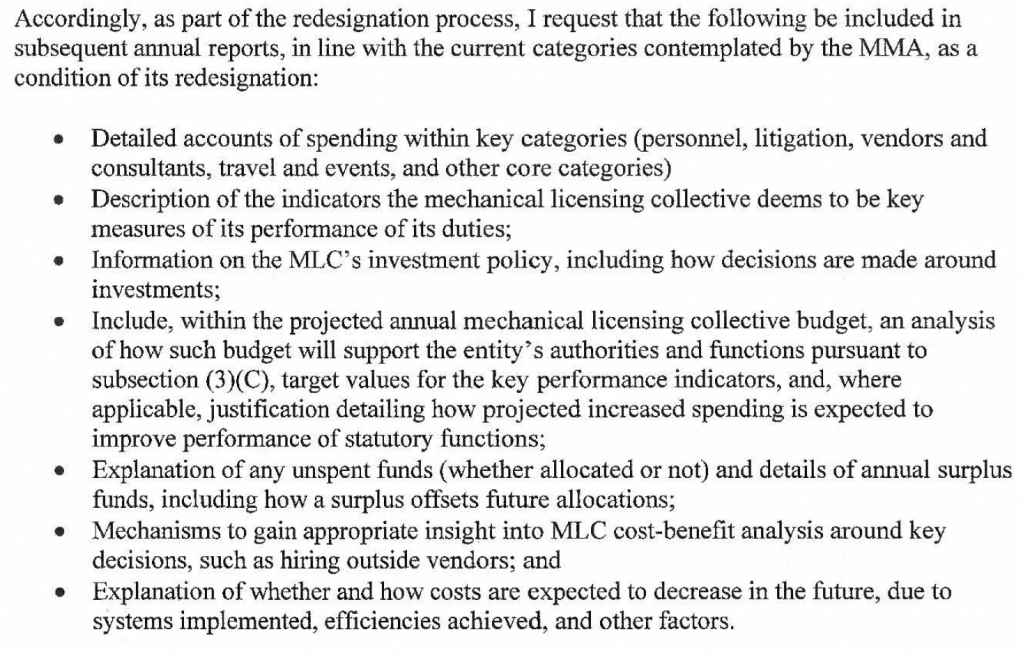
Fired for Cause:  @RepFitzgerald Asks for Conditional Redesignation of the MLC

By Chris Castle

U.S. Representative Scott Fitzgerald joined in the MLC review currently underway and sent a letter to Register of Copyrights Shira Perlmutter on August 29 regarding operational and performance issues relating to the MLC.  The letter was in the context of the five year review for “redesignation” of The MLC, Inc. as the mechanical licensing collective.  (That may be confusing because of the choice of “The MLC” as the name of the operational entity that the government permits to run the mechanical licensing collective.  The main difference is that The MLC, Inc. is an entity that is “designated” or appointed to operationalize the statutory body.  The MLC, Inc. can be replaced.  The mechanical licensing collective (lower case) is the statutory body created by Title I of the Music Modernization Act) and it lasts as long as the MMA is not repealed or modified. Unlikely, but we live in hope.)

I would say that songwriters probably don’t have anything more important to do today in their business beyond reading and understanding Rep. Fitzgerald’s excellent letter.

Rep. Fitzgerald’s letter is important because he proposes that the MLC, Inc. be given a conditional redesignation, not an outright redesignation.  In a nutshell, that is because Rep. Fitzgerald raises many…let’s just say “issues”…that he would like to see fixed before committing to another five years for The MLC, Inc.  As a member of the House Judiciary Subcommittee on Courts, Intellectual Property, and the Internet, Rep. Fitzgerald’s point of view on this subject must be given added gravitas.

In case you’re not following along at home, the Copyright Office is currently conducting an operational and performance review of The MLC, Inc. to determine if it is deserving of being given another five years to operate the mechanical licensing collective.  (See Periodic Review of the Mechanical Licensing Collective and the Digital Licensee Coordinator (Docket 2024-1), available at https://www.copyright.gov/rulemaking/mma-designations/2024/.)

The redesignation process may not be quickly resolved.  It is important to realize that the Copyright Office is not obligated to redesignate The MLC, Inc. by any particular deadline or at all.  It is easy to understand that any redesignation might be contingent on The MLC, Inc. fixing certain…issues…because the redesignation rulemaking is itself an operational and performance review.  It is also easy to understand that the Copyright Office might need to bring in some technical and operational assistance in order to diligence its statutory review obligations.  This could take a while.

Let’s consider the broad strokes of Rep. Fitzgerald’s letter.

Budget Transparency

Rep. Fitzgerald is concerned with a lack of candor and transparency in The MLC, Inc.’s annual report among other things. If you’ve read the MLC’s annual reports, you may agree with me that the reports are long on cheerleading and short on financial facts.  It’s like The MLC, Inc. thought they were answering the question “How can you tolerate your own awesomeness?”   That question is not on the list.  Rep. Fitzgerald says “Unfortunately, the current annual report lacks key data necessary to examine the MLC’s ability to execute these authorities and functions.”  He then goes on to make recommendations for greater transparency in future annual reports.

I agree with Rep. Fitzgerald that these are all important points.  I disagree with him slightly about the timing of this disclosure.  These important disclosures need not be prospective–they could be both prospective and retroactive. I see no reason at all why The MLC, Inc. cannot be required to revise all of its four annual reports filed to date (https://www.themlc.com/governance) in line with this expanded criteria.  I am just guessing, but the kind of detail that Rep. Fitzgerald is focused on are really just data that any business would accumulate or require in the normal course of prudently operating its business.  That suggests to me that there is no additional work required in bringing The MLC, Inc. into compliance; it’s just a matter of disclosure.

There is nothing proprietary about that disclosure and there is no reason to keep secrets about how you handle other people’s money.  It is important to recognize that The MLC, Inc. only handles other people’s money.  It has no revenue because all of the money under its management comes from either royalties that belong to copyright owners or operating capital paid by the services that use the blanket license.  It should not be overlooked that the services rely on the MLC and it has a duty to everyone to properly handle the funds. The MLC, Inc. also operates at the pleasure of the government, so it should not be heard to be too precious about information flow, particularly information related to its own operational performance. Those duties flow in many directions.

Board Neutrality

The board composition of the mechanical licensing collective (and therefore The MLC, Inc.) is set by Congress in Title I.  It should come as no surprise to anyone that the major publishers and their lobbyists who created Title I wrote themselves a winning hand directly into the statute itself.  (And FYI, there is gambling at Rick’s American Café, too.)  As Rep. Fitzgerald says:  

Of the 14 voting members, ten are comprised of music publishers and four are songwriters. Publishers were given a majority of seats in order to assist with the collective’s primary task of matching and distributing royalties. However, the MMA did not provide this allocation in order to convert the MLC into an extension of the music publishers.

I would argue with him about that, too, because I believe that’s exactly what the MMA was intended to do by those who drafted it who also dictated who controlled the pen.  This is a rotten system and it was obviously on its way to putrefaction before the ink was dry.

For context, Section 8 of the Clayton Act, one of our principal antitrust laws, prohibits interlocking boards on competitor corporations.  I’m not saying that The MLC, Inc. has a Section 8 problem–yet–but rather that interlocking boards is a disfavored arrangement by way of understanding Rep. Fitzgerald’s issue with The MLC, Inc.’s form of governance:

Per the MMA, the MLC is required to maintain an independent board of directors. However, what we’ve seen since establishing the collective is anything but independent. For example, in both 2023 and 2024, all ten publishers represented by the voting members on the MLC Board of Directors were also members of the NMPA’s board.  This not only raises questions about the MLC’s ability to act as a “fair” administrator of the blanket license but, more importantly, raises concerns that the MLC is using its expenditures to advance arguments indistinguishable from those of the music publishers-including, at times, arguments contrary to the positions of songwriters and the digital streamers.

Said another way, Rep. Fitzgerald is concerned that The MLC, Inc. is acting very much like HFA did when it was owned by the NMPA.  That would be HFA, the principal vendor of The MLC, Inc. (and that dividing line is blurry, too).

It is important to realize that the gravamen of Rep. Fitzgerald’s complaint (as I understand it) is not solely with the statute, it is with the decisions about how to interpret the statute taken by The MLC, Inc. and not so far countermanded by the Copyright Office in its oversight role.  That’s the best news I’ve had all day.  This conflict and competition issue is easily solved by voluntary action which could be taken immediately (with or without changing the board composition).  In fact, given the sensitivity that large or dominant corporations have about such things, I’m kind of surprised that they walked right into that one.  The devil may be in the details, but God is in the little things.

Investment Policy

Rep. Fitzgerald is also concerned about The MLC, Inc.’s “investment policy.”  Readers will recall that I have been questioning both the provenance and wisdom of The MLC, Inc. unilaterally deciding that it can invest the hundreds of millions in the black box in the open market.  I personally cannot find any authority for such a momentous action in the statute or any regulation.  Rep. Fitzgerald also raises questions about the “investment policy”:

Further, questions remain regarding the MLC’s investment policy by which it may invest royalty and assessment funds. The MLC’s Investment Policy Statement provides little insight into how those funds are invested, their market risk, the revenue generated from those investments, and the percentage of revenue (minus fees) transferred to the copyright owner upon distribution of royalties. I would urge the Copyright Office to require more transparency into these investments as a condition of redesignation.

It should be obvious that The MLC, Inc.’s “investment policy” has taken on a renewed seriousness and can no longer be dodged.

Black Box

It should go without saying that fair distribution of unmatched funds starts with paying the right people.  Not “connect to collect” or “play your part” or any other sloganeering.  Tracking them down. Like orphan works, The MLC, Inc. needs to take active measures to find the people to whom they owe money, not wait for the people who don’t know they are owed to find out that they haven’t been paid.  

Although there are some reasonable boundaries on a cost/benefit analysis of just how much to spend on tracking down people owed small sums, it is important to realize that the extraordinary benefits conferred on digital services by the Music Modernization Act, safe harbors and all, justifies higher expectations of those same services in finding the people they owe money.  The MLC, Inc. is uniquely different than its counterparts in other countries for this reason.

I tried to raise the need for increased vigilance at the MLC during a Copyright Office roundtable on the MMA. I was startled that the then-head of DiMA (since moved on) had the brass to condescend to me as if he had ever paid a royalty or rendered a royalty statement.  I was pointing out that the MLC was different than any other collecting society in the world because the licensees pay the operating costs and received significant legal benefits in return. Those legal benefits took away songwriters’ fundamental rights to protect their interests through enforcing justifiable infringement actions which is not true in other countries. 

In countries where the operating cost of their collecting society is deducted from royalties, it is far more appropriate for that society to consider a more restrictive cost/benefit analysis when expending resources to track down the songwriters they owe. This is particularly true when no black box writer is granting nonmonetary consideration like a safe harbor whether they know it or not.

I got an earful from this person about how the services weren’t an open checkbook to track down people they owed money to (try that argument when failing to comply with Know Your Customer laws).  Grocers know more about ham sandwiches than digital services know about copyright owners. The general tone was that I should be grateful to Big Daddy and be more careful how I spend my lunch money. And yes I do resent this paternalistic response which I’m sorry to say was not challenged by the Copyright Office lawyer presiding who shortly thereafter went to work for Spotify.  Nobody ever asked for an open check.  I just asked that they make a greater effort than the effort that got Spotify sued a number of times resulting in over $50 million in settlements, a generous accommodation in my view. If anyone should be grateful, it is the services who should be grateful, not the songwriters.

And yet here we are again in the same place.  Except this time the services have a safe harbor against the entire world which I believe has value greater than the operating costs of the MLC.  I’d be perfectly happy to go back to the way it was before the services got everything they wanted and then some in Title I of the MMA, but I bet I won’t get any takers on that idea.

Instead, I have to congratulate Rep. Fitzgerald for truly excellent work product in his letter and for framing the issue exactly as it should be posed.  Failing to fix these major problems should result in no redesignation—fired for cause.

[This post first appeared in MusicTech.Solutions]

Press Release: Indie Songwriter Groups Thank @RepFitzgerald For His Letter to @CopyrightOffice Urging Improvements to the US Mechanical Licensing Collective

The Songwriters Guild of America (SGA), the Society of Composers & Lyricists (SCL) and the Music Creators North America (MCNA) coalition –on behalf of over ten thousand US songwriter and composer members and their heirs and with the support of tens of thousands more represented by our organizations’ affiliated International Council of Music Creators (CIAM)– offer our sincerest thanks and support to US Congressman Scott Fitzgerald (R-WI) for his stalwart efforts in seeking to protect our rights through much needed operational and structural improvements to the US Mechanical Licensing Collective (MLC). The MLC collects and distributes hundreds of millions of dollars in royalties to songwriters and composers through their music publishing administrators each year.

Following the filing by our coalition in May, 2024 of comments expressing conditional support for re-designation by the US Copyright Office of the current MLC if –and only if– certain reforms are instituted to improve its transparency, operational fairness and accuracy in distributions (https://www.songwritersguild.com/site/potential-re-designation-mlc-and-dlc) Representative Fitzgerald came forward with his own letter to the Copyright Office dated August 29, 2024 asserting the need for reforms in full basic harmony with our own positions. His Congressional office is one of many with whom our groups have had impactful and productive discussions concerning the need for closer governmental oversight of the MLC process in order to protect American music creator rights, as clearly intended by Congress in the Music Modernization Act enacted five years ago.

Among the urgently required reforms addressed in Congressman Fitzgerald’s letter are:

–greater MLC budgetary transparency,

–improved outreach and accuracy in identifying and contacting owners of unmatched “black box” royalties (potentially approaching one billion dollars in unmatched and/or undistributed funds by 2025), and

–improved MLC board neutrality, balance and fairness.

As to this latter issue, the Congressman was forthright in acknowledging that the MLC board has conducted itself more as an advocate solely for the corporate music publishing industry rather than, as Congressionally intended, an unbiased body charged principally with protecting creator’ rights and royalties.

There are several problems related to the presence on the MLC board of only four songwriter/composer directors as compared to ten music publisher representatives (a unique imbalance compared to all other music royalty collectives around the world), including the fact that “permanently” unmatched royalties are to be distributed by the MLC on a “market share”
basis.

That construct means that music publisher board members stand to benefit by NOT properly identifying and distributing royalties to their actual creator-owners, the very task legislatively assigned to the MLC at the time of its Congressional creation. Moreover, the alleged songwriter organizations’ representative appointed as the non-voting board overseer for music creator interests has proven to be nothing more than a rubber stamp for corporate interests in direct opposition to the creators’ interests it purports to safeguard. We are aware of no other American music creator group that supports continuation of this facade of creator “representation.”

Our groups appreciate the consistent outreach and earnest work of MLC chief executive officer
Kris Ahrend, but we join Congressman Fitzgerald and his supporting colleagues in the House and Senate in insisting that the enumerated reforms cited in our Copyright Office submissions must be considered essential prerequisites to MLC re-designation (including endorsement by the MLC Board of Congressional action to equalize board representation between music creators on the one hand and their corporate copyright owners and administrators on the other). Our coalition will meanwhile continue its work on Capitol Hill and with the Copyright Office advocating for genuine protections of independent, individual music creator rights by the MLC.

Read Rep. Fitzgerald’s letter here.

The Intention of Justice:  In Which The MLC Loses its Way on a Copyright Adventure

by Chris Castle

ARTHUR

Let’s get back to justice…what is justice?  What is the intention of justice?  The intention of justice is to see that the guilty people are proven guilty and that the innocent are freed.  Simple, isn’t it?  
Only it’s not that simple.

From And Justice for All, screenplay written by Valerie Curtin and Barry Levinson

Something very important happened at the MLC on July 9:  The Copyright Office overruled the MLC on the position the MLC (and, in fairness, the NMPA) took on who was entitled to post-termination mechanical royalties under the statutory blanket license.  What’s important about the ruling is not just that the Copyright Office ruled that the MLC’s announced position was “incorrect”—it is that it corrected the MLC’s position that was in direct contravention of prior Copyright Office guidance.  (If this is all news to you, you can get up to speed with this helpful post about the episode on the Copyright Office website or read John Barker’s excellent comment in the rulemaking.)

“Guidance” is a kind way to put it, because the Copyright Office has statutory oversight for the MLC.  That means that on subjects yet to be well defined in a post-Loper world (the Supreme Court decision that reversed “Chevron deference”), I think it’s worth asking whether the Copyright Office is going to need to get more involved with the operations of the MLC.  Alternatively, Congress may have to amend Title I of the Music Modernization Act to fill in the blanks.  Either way, the Copyright Office’s termination ruling is yet another example of why I keep saying that the MLC is a quasi-governmental organization that is, in a way, neither fish nor fowl.  It is both a private organization and a government agency somewhat like the Tennessee Valley Authority.  Whatever it is ultimately ruled to be, it is not like the Harry Fox Agency which in my view has labored for decades under the misapprehension that its decisions carry the effect of law.  Shocking, I know.  But whether it’s the MLC or HFA, when they decide not to pay your money unless you sue them, it may as well be the law.

The MLC’s failure to follow the Copyright Office guidance is not a minor thing.  This obstreperousness has led to significant overpayments to pre-termination copyright owners (who may not even realize they were getting screwed).  This behavior by the MLC is what the British call “bolshy”, a wonderful word describing one who is uncooperative, recalcitrant, or truculent according to the Oxford Dictionary of Modern Slang.  The word is a pejorative adjective derived from Bolshevik.  “Bolshy” invokes lawlessness.

In a strange coincidence, the two most prominent public commenters supporting the MLC’s bolshy position on post-termination payments were the MLC itself and the NMPA, which holds a nonvoting board seat on the MLC’s board of directors.  This stick-togetherness is very reminiscent of what it was like dealing with HFA when the NMPA owned it.  It was hard to tell where one started and the other stopped just like it is now.  (I have often said that a nonvoting board seat is very much like a “board observer” appointed by investors in a startup to essentially spy on the company’s board of directors.  I question why the MLC even needs nonvoting board seats at all given the largely interlocking boards, aside from the obvious answer that the nonvoters have those seats because the lobbyists wrote themselves into Title I of the MMA—you know, the famous “spirit of the MMA”.)

Having said that, the height of bolshiness is captured in this quotation (89 FR 58586 (July 9, 2024)) from the Copyright Office ruling about public comments which the Office had requested (at 56588):

The only commenter to question the Office’s authority was NMPA, which offered various arguments for why the Office lacks authority to issue this [post-termination] rule. None are persuasive. [Ouch.]

NMPA first argued that the Office has no authority under section 702 of the Copyright Act or the MMA to promulgate rules that involve substantive questions of copyright law. This is clearly incorrect. [Double ouch.]

The Office ‘‘has statutory authority to issue regulations necessary to administer the Copyright Act’’ and ‘‘to interpret the Copyright Act.’’  As the [Copyright Office notice of proposed rulemaking] detailed, ‘‘[t]he Office’s authority to interpret [the Copyright Act]  in the context of statutory licenses in particular has long been recognized.’’

Well, no kidding.

What concerns me today is that wherever it originated, the net effect of the MLC’s clearly erroneous and misguided position on termination payments is like so many other “policies” of the MLC:  The gloomy result always seems to be they don’t pay the right person or don’t pay anyone at all in a self-created dispute that so far has proven virtually impossible to undo without action by the Copyright Office (which has other and perhaps better things to do, frankly).  The Copyright Office, publishers and songwriters then have to burn cycles correcting the mistake.  

In the case of the termination issue, the MLC managed to do both: They either paid the wrong person or they held the money.  That’s a pretty neat trick, a feat of financial gymnastics for which there should be an Olympic category.  Or at least a flavor of self-licking ice cream.

The reason the net effect is of concern is that this adventure in copyright has led to a massive screwup in payments illustrating what we call the legal maxim of fubar fugazi snafu.  And no one will be fired.  In fact, we don’t even know which person is responsible for taking the position in the first place.  Somebody did, somebody screwed up, and somebody should be held accountable.

Mr. Barker crystalized this issue in his comment on the Copyright Office termination rulemaking, which I call to your attention (emphasis added):

I do have a concern related to the current matter at hand, which translates to a long-term uneasiness which I believe is appropriate to bring up as part of these comments. That concern is, how did the MLC’s proposed policies [on statutory termination payments] come in to being in the first place? 

The Copyright Office makes clear in its statements in the Proposed Rules publication that “…the MLC adopted a dispute policy concerning termination that does not follow the Office’s rulemaking guidance.”, and that the policy “…decline(d) to heed the Office’s warning…”. Given that the Office observed that “[t]he accurate distribution of royalties under the blanket license to copyright owners is a core objective of the MLC”, it is a bit alarming that the MLC’s proposed policies got published in the first place. 

I am personally only able to come up with two reasons why this occurred. Either the MLC board did not fully understand the impact on termination owners and the future administration of those royalties, or the MLC board DID realize the importance, and were intentional with their guidelines, despite the Copyright Office’s warnings

Both conclusions are disturbing, and I believe need to be addressed.

Mr. Barker is more gentlemanly about it than I am, and I freely admit that I have no doubt failed the MLC in courtesy.  I do have a tendency to greet only my brothers, the gospel of Matthew notwithstanding.  Yet it irks me to no end that no one has been held accountable for this debacle and the tremendous productivity cost (and loss) of having to fix it.  Was the MLC’s failed quest to impose its will on society covered by the Administrative Assessment?  If so, why?  If not, who paid for it?  And we should call the episode by its name—it is a debacle, albeit a highly illustrative one. 

But we must address this issue soon and address it unambiguously.  The tendency of bureaucracy is always to grow and the tendency of non-profit organizations is always to seek power as a metric in the absence of for-profit revenue.  Often there are too many people in the organization who are involved in decision-making so that responsibility is too scattered.  

When something goes wrong as it inevitably does, no one ever gets blamed, no one ever gets fired, and it’s very hard to hold any one person accountable because everything is too diffused.  Instead of accepting that inevitable result and trying to narrow accountability down to one person so that an organization is manageable and functioning, the reflex response is often to throw more resources at the problem when more resources, aka money, is obviously not the solution.  The MLC already has more money than they know what to do with thanks to the cornucopia of cash from the Administrative Assessment.  That deep pocket has certainly not led to peace in the valley.

Someone needs to get their arms around this issue and introduce accountability into the process.  That is either the Copyright Office acting in its oversight role, the blanket license users acting in their paymaster role through the DLC, or a future litigant who just gets so fed up with the whole thing that they start suing everyone in sight.   

Saint Thomas Aquinas wrote in Summa Theologica that a just war requires a just cause, a rightful intention and the authority of the sovereign (SummaSecond Part of the Second Part, Question 40).  So it is with litigation.  We have a tendency to dismiss litigation as wasteful or unnecessary with a jerk of the knee, yet that is overbroad and actually wrong.  In some cases the right of the people to sue to enforce their rights is productive, necessary, inevitable and—hopefully—in furtherance of a just cause like its historical antecedents in trial by combat.  

It is also entirely in keeping with our Constitution.  The just lawsuit allows the judiciary to right a wrong when other branches of government fail to act, or as James Madison wrote in Federalist 10, so the government by “…its several constituent parts may…be the means of keeping each other in their proper places.”  

That’s a lesson the MLC, Inc. had to learn the hard way.  Let’s not do that again, shall we not?

This post first appeared on the MusicTech.Solutions blog.

Are You Better Off Today Than You Were Five Years Ago? Selected comments on the MLC Redesignation: Songwriters Guild of America, the Society of Composers & Lyricists, and Music Creators North America Joint Comment

The Copyright Office solicited public comments about how things are going with the MLC to help the Office decide whether to permit The MLC, Inc. to continue to operate the Collective (see this post for more details on the “redesignation” requirement). We are impressed with the quality of many of the comments filed at the Copyright Office. While comments are now closed, you can read all the comments at this link.

For context, the “redesignation” is a process of review by the Copyright Office required every five years under the Music Modernization Act. Remember, the “mechanical licensing collective” is a statutory entity that requires someone to operate it. The MLC, Inc. is the current operator (which makes it confusing but there it is). If the Copyright Office finds the MLC, Inc. is not sufficiently fulfilling its role or is not up to the job of running the MLC, the head of the Copyright Office can “fire” the MLC, Inc. and find someone else to hopefully do a better job running the MLC. Given the millions upon millions that the music users have invested in the MLC, and the hundreds of millions of songwriter money held by the MLC in the black box, firing the MLC, Inc. will be a big deal. Given how many problems there are with the MLC, firing the MLC, Inc. that runs the collective

The next step in this important “redesignation” process is that The MLC, Inc. and the Digital Licensee Coordinator called “the DLC” (the MLC’s counterpart that represents the blanket license music users) will be making “reply comments” due on July 29. The Copyright Office will post these comments for the public shortly after the 29th. These reply comments will likely rebut previously filed public comments on the shortcomings of the MLC, Inc. or DLC (which were mostly directed at the MLC, Inc.) and expand upon comments each of the two orgs made in previous filings. If you’re interested in this drama, stay tuned, the Copyright Office will be posting them next week.

If you have been reading the comments we’ve posted on Trichordist (or if you have gone to the filings themselves which we recommend), you will see that there is a recurring theme with the comments. Many commenters say that they wish for The MLC, Inc. to be redesignated BUT…. They then list a number of items that they object to about the way the Collective has been managed by The MLC, Inc. usually accompanied by a request that the The MLC, Inc. change the way it operates.

That structure seems to be inconsistent with a blanket ask for redesignation. Rather, the commenters seem to be making an “if/then” proposal that if The MLC, Inc. improves its operations, including in some cases operating in an opposite manner to its current policies and practices, then The MLC, Inc. should be redesignated. Not wishing to speak for any commenter, let it just be said that this appears to be a conditional proposal for redesignation. Maybe that is not what the commenters were thinking, but it does appear to be what many of them are saying.

Today’s comment is jointly filed by the Songwriters Guild of America (SGA), the Society of Composers & Lyricists (SCL), and Music Creators North America (MCNA), who advocate for independent songwriters in contrast to the powers that be. (For clarity, the three groups in their comment refer to themselves together as the “Independent Music Creators”.)

For purposes of these posts, we may quote sections of comments out of sequence but in context. We recommend that you read their thoughtful and detailed joint comments in their entirety. You can read the joint comment at this link.

[The Current Crisis with Spotify]

Prior to proceeding to the presentation of our Comments, we are compelled by recent events and circumstances to issue the following, important caveat. Just days ago, the National Music Publishers Association (“NMPA”) announced its apparent intention to seek fundamental legislative changes to the US Copyright Act in regard to the statutory mechanical licensing system established under the Music Modernization Act (“MMA”) (the legislation that resulted in the creation of the MLC and the DLC). This complete reversal in NMPA policy is the result of repugnant actions on the part of the digital music distributor “Spotify” to minimize its royalty payment obligations by identifying and exploiting alleged loopholes in what many view as the unevenly negotiated and drafted Phonorecords IV settlement. The Independent Music Creators previously voiced formal opposition to the details of that settlement prior to its ratification and adoption by the US Copyright Royalty Board at NMPA’s urging in December, 2022.

This morass, which threatens to deprive music creators of hundreds of millions of dollars in royalties over the next five years, is made even more complex by the fact that both NMPA and the MLC are served by the same team of legal advisors. Those same legal advisors also counseled NMPA on the negotiation of the Phonorecords IV settlement, which the MLC (albeit through another set of litigators) is now seeking to enforce against Spotify in federal court (an action we support), and which NMPA is now essentially seeking to vacate through Congressional action to eliminate statutory mechanical licensing via an opt-out system (which predictably favors the major music publishing conglomerates over creators and small music publishers).
 
The general idea of eliminating statutory mechanical licensing, the revival of which movement may now unfortunately be viewed as a fig leaf to camouflage poor NMPA decision-making and execution regarding the Phonorecords IV settlement, is one that the Independent Music Creators and many members of the music publishing sector have long believed should receive serious consideration. We will support such legislative reforms if fairly framed and developed with meaningful independent music creator input, along with pursuing our own legislative proposals expressed below. For now, however, this entire situation could hardly be less transparent or conducive to quick resolution than it currently remains.

In short, neither the Independent Music Creators nor any other groups of interested parties can possibly develop complete and cogent opinions on the issue of re-designation of the MLC and DLC without having greater access to the full body of facts surrounding this crucial new development regarding Spotify. These Comments, therefore, must be viewed against the backdrop of an unresolved and economically crucial dispute, the fallout from and resolution of which may completely alter the views expressed herein in the immediate future. As such, we look forward to making further comments on this issue as additional facts are disclosed concerning the Spotify/MLC/NMPA relationships and conflicts (past and present).

MLC Board Composition: It bears further re-emphasis that most if not all of these suggested changes have been necessitated by the actions of the corporate-dominated MLC board, including the structure established by the MMA that allocates ten board seats to corporate music publishing entities (which in practice automatically grants control of the MLC board and of the entire organization to the three “major” publishers that together administer more than two-thirds of the world’s musical composition copyrights) compared with just four music creator board member seats. Under such circumstances, music creator board members are virtually powerless to effect influence over the board’s actions and MLC policy, and are relegated to serving merely as an amen chorus in support of every MLC-related music publisher action and demand. This system of publisher majority rule is contrary to the structures and rules of government-sanctioned royalty collectives everywhere else in the world. To our knowledge, no similar royalty and licensing collective in the world is controlled by a board with less than fifty percent music creator representation.

The sound of this figurative rubber stamp within the MLC boardroom is further amplified by the fact that since inception, the non-voting seat set aside for music creator organizational input has been occupied by a non-creator whose organization’s allegiance to following in lock step with the music publishing industry is so obvious as to be beyond rational dispute. Thus, the current reality is total, corporate music publisher influence and domination of MLC’s rules and policies. This, despite the fact that the MMA as codified in section 115 of the US Copyright Act specifically mandates that the music creator organizational seat be occupied by the representative of “a nationally recognized nonprofit trade association whose primary mission is advocacy on behalf of songwriters in the United States.” This situation must change.

Are You Better Off Today Than You Were Five Years Ago? Selected comments on the MLC Redesignation: Gwendolyn Seale

The Copyright Office solicited public comments about how things are going with the MLC to help the Office decide whether to permit The MLC, Inc. to continue to operate the Collective (see this post for more details on the “redesignation” requirement). We are impressed with the quality of many of the comments filed at the Copyright Office. While comments are now closed, you can read all the comments at this link.

For context, the “redesignation” is a process of review by the Copyright Office required every five years under the Music Modernization Act. Remember, the “mechanical licensing collective” is a statutory entity that requires someone to operate it. The MLC, Inc. is the current operator (which makes it confusing but there it is). If the Copyright Office finds the MLC, Inc. is not sufficiently fulfilling its role or is not up to the job of running the MLC, the head of the Copyright Office can “fire” the MLC, Inc. and find someone else to hopefully do a better job running the MLC. Given the millions upon millions that the music users have invested in the MLC, and the hundreds of millions of songwriter money held by the MLC in the black box, firing the MLC, Inc. will be a big deal. Given how many problems there are with the MLC, firing the MLC, Inc. that runs the collective

The next step in this important “redesignation” process is that The MLC, Inc. and the Digital Licensee Coordinator called “the DLC” (the MLC’s counterpart that represents the blanket license music users) will be making “reply comments” due on July 29. The Copyright Office will post these comments for the public shortly after the 29th. These reply comments will likely rebut previously filed public comments on the shortcomings of the MLC, Inc. or DLC (which were mostly directed at the MLC, Inc.) and expand upon comments each of the two orgs made in previous filings. If you’re interested in this drama, stay tuned, the Copyright Office will be posting them next week.

If you have been reading the comments we’ve posted on Trichordist (or if you have gone to the filings themselves which we recommend), you will see that there is a recurring theme with the comments. Many commenters say that they wish for The MLC, Inc. to be redesignated BUT…. They then list a number of items that they object to about the way the Collective has been managed by The MLC, Inc. usually accompanied by a request that the The MLC, Inc. change the way it operates.

That structure seems to be inconsistent with a blanket ask for redesignation. Rather, the commenters seem to be making an “if/then” proposal that if The MLC, Inc. improves its operations, including in some cases operating in an opposite manner to its current policies and practices, then The MLC, Inc. should be redesignated. Not wishing to speak for any commenter, let it just be said that this appears to be a conditional proposal for redesignation. Maybe that is not what the commenters were thinking, but it does appear to be what many of them are saying.

Today’s comment is by music lawyer Gwendolyn Seale who makes a number of excellent points in her filing including questioning whether the compulsory license itself is fit for purpose and what might happen if the MLC, Inc. is not redesignated. In particular, she addresses an alarming trend in the MLC, Inc.’s public messaging about the black box that has grown more cloudy as the size of the black box at the MLC has grown into the hundreds of millions.

For purposes of these posts, we may quote sections of comments out of sequence but in context. We recommend that you read the comments in their entirety. You can read Gwen Seale’s comment at this link.

Words Matter: The MLC Must Improve Its Presentation of Information

Confusion Regarding the Term, “Match Rate”

Upon reviewing the MLC’s 2021 Interim Annual Report in early 2022, I noticed reference to the
MLC having attained an 86% match rate. This metric seemed impressive, however, upon
learning the MLC’s definition of “match rate” (which I only learned by asking the MLC), I was
baffled. When the term, “match” is used alone, it refers to the matching of a sound recording
from a DSP report to a particular musical work. The Copyright Office’s NOI indicates the same
regarding the term, “match.”

Please describe how the Mechanical Licensing Collective has worked to improve automated and manual matching since the blanket license became available and plans to further enhance such matching over the next 5 years, including with respect to the matching of reported sound recordings to musical works as well as the matching of those musical works to identified and located copyright owners.

Being that a “match” constitutes pairing a sound recording with a particular musical work, it is
logical to deduce the “match rate” as being the percentage of sound recordings in DSP reports
which are matched to musical works registered at the MLC. However, that is not the case and
instead the term “match rate” as used by the MLC refers to the total amount of royalties matched
to musical works registered at the MLC over a given period. This definition was not provided to
the public so far as I can tell until June 30, 2022, in its final 2021 Annual Report.

As the most popular musical works are the ones generating the bulk of mechanical royalties over
a given month and are typically owned and/or controlled by the major music publishers with the
resources and capabilities to constantly monitor activities concerning their clients’ musical works
and engage in manual matching, the current definition of match rate (i.e., the royalty-based
definition) does not mean very much by itself. It would be useful for the MLC to also provide the
monthly match rate on a recordings-to-musical works-matched basis (hereinafter, “works-based
calculation”). Doing so would shine a light on the efficacy of the MLC’s and its vendors’
matching technology and would help to ensure the musical works of countless self-published
songwriters are being matched to reported sound recordings. I understand that there are issues
with catalog “fluff” and some sound recordings do not generate a single stream over a month’s
time. Thus, a works-based calculation could be tailored in a manner where recordings with less
than x streams per month or that generate less than x cents in mechanical royalties are omitted
from the calculation. Input from the Copyright Office regarding match rate terminology would
be helpful as well.

Historical Royalties: Eliminate  Illuminate = Obfuscate

The impetus behind establishing the MLC was to ensure that songwriters and publishers could
finally collect the nearly half billion dollars in historical royalties5 owed by the DSPs from the
early 2000s through the end of 2020. The task of the MLC was to eliminate the historical
royalties by ensuring that sound recordings could be matched to registered works in the MLC
database from this period. The MLC stated that eliminating these royalties was its goal:

The MLC cannot stress enough that its goal is to eliminate unclaimed accrued royalties, and that it has developed a realistic plan to pursue this goal.


Over time, the MLC shifted the language from eliminating to “illuminating” the historical royalties, beginning with the 2022 MLC Annual report:

Together, we will not only illuminate the “black box,” but also seek to eliminate it entirely!

At present, the MLC no longer references “elimination” of the historical royalties and purports
the job is done since the historical royalties have been “illuminated:”

Is there still a Black Box of Mechanical Royalties With The MLC?
No, the data on all unmatched uses is posted and available to be searched by Members. This includes all data for historical and blanket unmatched uses. All of these remaining unmatched uses are available to be searched by Members in The MLC’s Matching Tool. With this unprecedented transparency, The MLC has illuminated the so-called “black box” of streaming mechanical royalties for the first time.

The MLC started by moving the goalposts and concluded with eliminating them altogether. This
obfuscation of language is problematic. It misleads the public about the MLC’s performance and
gaslights those with knowledge about matching works and distributing royalties. Words matter.

This issue can be quickly solved by the MLC removing that particular FAQ above, and by providing monthly data regarding the total amount of unmatched, unclaimed, and on-hold
royalties (historical + blanket) in the MLC’s possession in a place that is easy to find on its
website.


.

Are You Better Off Today Than You Were Five Years Ago? Selected comments on the MLC Redesignation: John Guertin of ClearRights

The Copyright Office is soliciting public comments about how things are going with the MLC to help the Office decide whether to permit The MLC, Inc. to continue to operate the Collective (see this post for more details on the “redesignation” requirement). We are impressed with the quality of many of the comments filed in the “Initial Comments” at the Copyright Office. As there will be an opportunity to comment again, including to comment on the comments, we will be posting selected Initial Comments to call to your attention. You can read all the comments at this link. If you are hearing about this for the first time, you have until June 28 to file a “reply comment” with the Copyright Office at this link.

You will see that there is a recurring theme with the comments. Many commenters say that they wish for The MLC, Inc. to be redesignated BUT…. They then list a number of items that they object to about the way the Collective has been managed by The MLC, Inc. usually accompanied by a request the The MLC, Inc. change the way it operates.

That structure seems to be inconsistent with a blanket ask for redesignation. Rather, the commenters seem to be making an “if/then” proposal that if The MLC, Inc. improves its operations, including in some cases operating in an opposite manner to its current policies and practices, then The MLC, Inc. should be redesignated. Not wishing to speak for any commenter, let it just be said that this appears to be a conditional proposal for redesignation. Maybe that is not what the commenters were thinking, but it does appear to be what many of them are saying. Perhaps this conditional aspect will be refined in the Reply Comments.

For purposes of these posts, we may quote sections of comments out of sequence but in context. We recommend that you read the comments in their entirety.

Today’s featured comment is from John Guertin, the highly knowledgeable independent publishing administrator who operates ClearRights in Austin, Texas. He works with many Texas artists whose music represents generations of Texas music vital to the Texas economy such as Marcia Ball, Guy Forsyth, Vallejo, Quiet Company and the South Austin Moonlighters.

Like other commenters, Mr. Guertin focuses on The MLC, Inc.’s failures to adopt world-class metadata standards. He offers insight to the Copyright Office similar to information the Office could get if they actually did a proactive deep dive on the MLC standards and practices rather than wait for commenters to get so disillusioned that they will sit down and write up their grievances when their frustration exceeds their fear of retaliation.

If Mr. Guertin is correct about bad old HFA data populating the MLC’s data, one consequence arises when the MLC, Inc. distributes its data feed to dozens of users. Does this mean that anyone who uses the MLC’s mediocre HFA data also has error-ridden data? What is the plan to unwind that one?

Lack of transparency
How does the automated matching process work and what is the logic for a match? We submit quite a bit of data to The MLC, yet titles go unmatched. It is hard to understand how a match does not happen when the system has been provided the song title, writers, isrc and supplementary data such as iswc, recording artist etc. It begs the question, what is the matching logic? If the song title, isrc and songwriter match 100%, how is a match not created? Having worked in the digital music space in the early 2000s at the onset of online digital subscription and download services, there was a fuzzy logic matching employed to help clear thousands of songs at a time. A fuzzy logic matching criteria would have to require a certain percentage of a given data field to match and thus enable matches to be made when there was punctuation or additional wording in the sound recording title such as “Live”. It’s hard to understand how so many line items go unmatched at The MLC when there are small variations in titles etc. Is a fuzzy logic protocol being employed, and if so, is it too tight?

New System , Same Old Player
The forward-facing organization we see is The MLC and its staff, however the vendor(s) used by the MLC is the same player, The Harry Fox Agency. The MLC data is often powered by and supplied by HFA. The HFA system, being a for profit, proprietary system, has been known for years to have old, outdated and/or incorrect data. One can often find the same song registered two, three or more times in the system. In most cases the publisher/owner is different or variant. This “bad data” has been allowed to proliferate the MLC system and has basically resulted in the same issues of old.

Having said vendor(s) also operating as match makers raises several concerns/questions, especially when incorrect matches are made based on this bad or outdated data. When an incorrect match is made (again how does this happen if the titles and songwriters don’t match yet publisher submitted data matches 100% and a match isn’t made?), the publisher is paid royalties.

The burden then falls upon the recipient to find the incorrect match, and then take action to remedy it by either returning monies to the MLC or having it deducted from future payments for other, non-related publishers and songs.

In some cases, the dollar amount of monies is significant and results in the publisher and/or songwriter being debited for the amount all at one time and unable to earn future royalties until the debited amount has been recouped. This can result in financial burden and distress for the publisher/songwriter. The publisher/songwriter may be dependent on these royalties to live on and due to no fault of their own, are subjected to a recoupment process for something they did not initiate. Why is this and why do we think this methodology works? Additionally, we are often told to contact the other party and get the money from them.

Lots of matches, yet even more unclaimed monies
An 80-85% match rate seems impressive until you look at the amount of money that remains unmatched each month. Approx $20 million in monies each month go unmatched and/or unclaimed. That’s over $200 million in a year. How and when is this going to be addressed? Yes, it’s much easier to ignore that and simply distribute that money via market share. But does artist/songwriter X really need more limos and vacation homes when the large majority of these royalties are indie songwriters that either don’t know about this, don’t understand it, or have been frustrated over the years and trained to think that they get micro-pennies for their efforts? We can’t blame this segment for not being totally engaged or not being educated on the complexities of the music industry. If we can put a man on the moon, why can’t we figure this out?

Lack of innovative strategy to clear the back-log of unmatched line items
What exactly is the process used to currently address this [old mediocre HFA data] and how is it being measured? We are told that outside vendors are contracted to perform this function, yet we see approx. $20 million each month in unmatched royalties. Clearly this strategy is not reducing the amount of “black box” monies at a fast enough rate and raises several concerns.

The first is that our senior songwriters and publishers are not getting younger by the day. They do not have time to wait 5 or 10 years for this to be straightened out. Many depend on the fruits of their past labor to live on. They deserve better.

With regard to the apparent inability to make matches and reduce the unmatched royalties, there seems to be other ways to approach this, which may currently be employed but we don’t really know due to the lack of transparency. Many of these unmatched recordings are songs that are registered at PROs. Those PROs have the songwriters and publishers, along with any recording data submitted by the songwriters and publishers. This is a good source of data which also has the contact info for those entities. A strategic partnership with other industry organizations, such as the PROs, should be made to help share and communicate data to bridge the gap with missing data which would allow matches to happen.

Also, where is the data that is being used to match coming from? Most indie artists use aggregators such as CD Baby, TuneCore, Distrokid etc. to distribute to dsps. This is the source of data that feeds to dsps. Such aggregators allow the input of inaccurate data without verification. All one must do is write something in the required data column (i.e. songwriters) and it goes through the system and starts populating everywhere. So bad data in results in bad data going out and reducing the likelihood matches can be made. Industry wide cooperation is required if we are to streamline these processes and make things efficient.

Read the entire comment at this link.

Are You Better Off Today Than You Were Five Years Ago? Selected comments on the MLC Redesignation: Abby North, North Music Group

The Copyright Office is soliciting public comments about how things are going with the MLC to help the Office decide whether to permit The MLC, Inc. to continue to operate the Collective (see this post for more details on the “redesignation” requirement). We are impressed with the quality of many of the comments filed in the “Initial Comments” at the Copyright Office. As there will be an opportunity to comment again, including to comment on the comments, we will be posting selected Initial Comments to call to your attention. You can read all the comments at this link. If you are hearing about this for the first time, you have until June 28 to file a “reply comment” with the Copyright Office at this link.

You will see that there is a recurring theme with the comments. Many commenters say that they wish for The MLC, Inc. to be redesignated BUT…. They then list a number of items that they object to about the way the Collective has been managed by The MLC, Inc. usually accompanied by a request the The MLC, Inc. change the way it operates.

That structure seems to be inconsistent with a blanket ask for redesignation. Rather, the commenters seem to be making an “if/then” proposal that if The MLC, Inc. improves its operations, including in some cases operating in an opposite manner to its current policies and practices, then The MLC, Inc. should be redesignated. Not wishing to speak for any commenter, let it just be said that this appears to be a conditional proposal for redesignation. Maybe that is not what the commenters were thinking, but it does appear to be what many of them are saying. Perhaps this conditional aspect will be refined in the Reply Comments.

For purposes of these posts, we may quote sections of comments out of sequence but in context. We recommend that you read the comments in their entirety. Today’s featured comment is by Abby North, who owns the independent music publisher and administrator North Music Group. Abby was kind enough to participate as a panelist at the 3rd Annual Artist Rights Symposium that David hosts at the University of Georgia Terry College of Business, and also testified at the House Judiciary Committee IP Subcommittee hearing held in Nashville to grade the MLC, Inc. (read Emmanuel Legrand’s reporting on that hearing at this link).

Abby has a number of ideas about meaningful changes that the MLC, Inc. ought to make to its operations and its approach to its fundamental job–timely and accurately accounting for all the money it receives.

Read Abby’s full comment at this link.

MLC BUSINESS RULES THAT CONTRADICT LAW
During the IP Subcommittee hearing held by Chairman Issa,6 the Chairman cautioned MLC, Inc. CEO Kris Ahrend, “…no question at all, what you’ve been making looks a lot like rules.”

The US copyright law permits authors or their heirs, under certain circumstances, to terminate the exclusive or non-exclusive grant of a transfer or license of an author’s copyright in a work. The ability to recapture rights via the United States copyright termination system truly provides
composers, songwriters and recording artists and their heirs, a “second bite of the apple.” Many of my clients exercise this right and subsequently become the original publisher in the United States.

The MLC had made a unilateral determination that rights held at the inception of the new blanket license might remain, in perpetuity, with the original copyright grantee. The MLC initially ignored that the derivative work exception does not apply in the context of the mechanical blanket license.

Fortunately, the US Copyright Office stepped in to clarify that the appropriate payee under the mechanical blanket license to whom the MLC must distribute royalties in connection with a statutory termination is the copyright owner at the time the work is used. When The MLC envisions a new policy, members should be provided a mechanism to provide input related to this policy, prior to it being adopted.

Members must be given a greater voice in business rules and operations of The MLC. Hands-on music publishing administrators have deep insights into workflows, efficiencies and UI/UX. Members need to be consulted with and given opportunities to drive the future of The MLC’s
website and technologies.

The MLC has made unilateral decisions regarding how it treats public domain works. It invoices the DSPs for streams of recordings that embody these public domain works, but no publisher is entitled to these royalties. That means the MLC may collect money it may not pay out. What rule gives The MLC the right to collect but not distribute?

COMMITMENT TO ISWC AS GLOBALLY UNIQUE IDENTIFIER FOR MUSICAL
WORK

Recently, the PRS (the UK-based Performance Rights Organization) completed a proof of concept that allowed record labels to request assignment of an ISWC to identify a musical work embedded in that label’s recording.

This proof of concept provides a necessary step in helping CMOs identify musical works, contributing parties and recordings of these works.

It also firmly demonstrates the global CMO ecosystem’s commitment to the ISWC as the globally unique identifier for the musical work. Every music publisher and every CMO…other than The MLC…relies on the ISWC to identify a musical work.

Instead, The MLC relies on the HFA Song Code, now also known as the MLC Song Code. The only societies in the world that use these codes are HFA and The MLC. Every other society identifies musical works with an ISWC, which unlike the HFA Song Code or MLC Song Code,
functionally acts as a bridge to the International Party Identifier (IPI) and now, the International Standard Recording Code (ISRC).


For The MLC to some day truly be the gold standard in CMOs, it must follow the rest of the world’s lead and require and include the ISWC whenever the ISWC exists. The MLC Song Code may be used as a disambiguator, but it must be used in conjunction with an ISWC. This is how the other societies work: they have their own proprietary identifier, which accompanies the ISWC to allow positive identification of works.

In addition to ISWC as the work identifier shared by the world’s music publishing and rights management community, IPI is the global identifier for the songwriter and publisher. The MLC must commit to including the IPI for any writer or publisher that has been assigned an IPI.

SPEED OF CLAIMING AND MATCHING
According to The MLC in its redesignation comments, “Finally, The MLC has already established itself as a leader in the industry, setting high standards for speed, volume, transparency, efficiency, outreach and member support.”

As of this writing, works I claimed manually in the claiming portal 73 days ago still have not been processed.

Unless I am misunderstanding the process, this means The MLC has already missed two distribution periods.

This is too much time. If there is an issue with the claims, there should be some human communication from The MLC explaining the issues.

If there are no issues, what could possibly be the cause of such a delay?

The oversight body must provide guidelines for The MLC regarding reasonable times from delivery of a match or claim by a member to processing by The MLC.

I also recommend the addition of an interface in the MLC portal for communication between The MLC and the member. For example, if every time I log in, I see a red flag in the interface indicating action is required on my part, I could potentially assist in speeding up the time The MLC takes to process my data. I also would be aware of any potential issues.

SONGWRITER PORTAL
The MLC’s website says it has distributed to “publishers and songwriters.” However, it must be clarified that the only songwriters that directly receive royalties from The MLC are selfpublished, self-administered songwriters that a) are aware of The MLC; b) have become members; and c) have delivered data to The MLC regarding their works and recordings of their works.

Songwriters that are either published or administered by a publisher have no mechanism with which to deliver corrections or missing data regarding their works. Instead, a songwriter that may have had one or many previous deals typically has no relationship with the previous publishers. Even songwriters in current publishing deals may not be able to get their calls returned much less convince their publishers to add or correct data in a timely manner.

Consequently, as many advocates have suggested since the roundtables that occurred prior to the inception of The MLC, The MLC must provide a portal within its website for published and/or administered songwriters to deliver data regarding their works. This data must then be reviewed by The MLC for accuracy, and then The MLC must communicate with the publishers to confirm
accuracy and add the missing or corrected data to the public portal.

It is simply unfair that songwriters have no way to guarantee The MLC has the necessary data to pay these songwriters’ publishers if they are willing to do the matching work at their own expense.

According to the USCO’s website FAQs regarding Title 1 of The Musical Works Modernization Act, “Once established, the MLC will establish and administer a process by which copyright owners can claim ownership of musical works (and shares of such works).” In fact, even though an administered songwriter is the legal copyright owner of his/her musical works, The MLC provides no process by which that songwriter/copyright owner can claim ownership of musical
works.

OVERCLAIMS TOOL
The MLC recently added an Overclaims Tool – only for registrations made within the last 90 days. If you submit a registration and it conflicts with a work that’s older than 90 days, that conflict will not appear in your portal.

According to The MLC:

“Please note: A work can only go into overclaim if shares are added to the
work within 90 days of the work’s registration, based on the “Creation Date”
in the work details.

If you are attempting to claim shares over 100% on a work that was created
more than 90 days prior, you will need to reach out to The MLC Support
team here.”

As a publisher/administrator of works registered decades ago, how would I know if someone has attempted to claim my legacy work and created an overclaim?

I do not recall receiving any announcement seeking publishers to participate in working groups to provide input related to the Overclaims Tool. Experienced hands-on administrators should be given the opportunity to provide insights into functionalities of proposed additions to the MLC portal prior to development of the technology.

Are You Better Off Today Than You Were Five Years Ago? Selected comments on the MLC Redesignation: Spirit Music Group

The Copyright Office is soliciting public comments about how things are going with the MLC to help the Office decide whether to permit The MLC, Inc. to continue to operate the Collective (see this post for more details on the “redesignation” requirement). We are impressed with the quality of many of the comments filed in the “Initial Comments” at the Copyright Office. As there will be an opportunity to comment again, including to comment on the comments, we will be posting selected Initial Comments to call to your attention. You can read all the comments at this link. If you are hearing about this for the first time, you have until June 28 to file a “reply comment” with the Copyright Office at this link.

You will see that there is a recurring theme with the comments. Many commenters say that they wish for The MLC, Inc. to be redesignated BUT…. They then list a number of items that they object to about the way the Collective has been managed by The MLC, Inc. usually accompanied by a request the The MLC, Inc. change the way it operates.

That structure seems to be inconsistent with a blanket ask for redesignation. Rather, the commenters seem to be making an “if/then” proposal that if The MLC, Inc. improves its operations, including in some cases operating in an opposite manner to its current policies and practices, then The MLC, Inc. should be redesignated. Not wishing to speak for any commenter, let it just be said that this appears to be a conditional proposal for redesignation. Maybe that is not what the commenters were thinking, but it does appear to be what many of them are saying. Perhaps this conditional aspect will be refined in the Reply Comments.

For purposes of these posts, we may quote sections of comments out of sequence but in context. We recommend that you read the comments in their entirety.

Today’s featured comment is from the well-regarded independent music publisher Spirit Music Group. Spirit makes a number of comments about important issues with the MLC, Inc.’s handling of metadata and other operational issues. If you are not immersed in metadata issues, it is easy to blow past these comments such as the MLC making data available in the common csv format (i.e., not only DDEX) is actually a serious complaint about a significant operational issue.

While you have to put Spirit down as an unambiguous supporter of redesignation, it is important to focus on how best to get the MLC, Inc. to implement the many commenters’ operational suggestions. We will see some of these comments confirmed with other commenters.

We would also point out a theme that will come up repeatedly–The MLC, Inc. knows who to take care of and who to respond to quickly. That is not the same thing as having methods and systems that take care of all members which the MLC can certainly afford given the tens of millions of dollars that the services spend on The MLC, Inc.

[T]he MLC has certainly met the minimum responsibilities under the MMA and has endeavored to provide additional functionality so rightsholders can receive their entitled royalties from DMS and has completed significant development in a short period. They are very receptive of our concerns and respond promptly and clearly. We look forward their continued development.

3:II.B. Member Tools
1. Development and Implementation of Tools and Functionality
The implementation of the Matching and Claiming tools and offering the bulk data (at a cost to the recipient) gives rightsholders the visibility to identify omissions in payments; These tools are the first offered by a CMO in the United States and should set an example to the others.

For publishers with large catalogs, who are not one of the majors like ourselves, have the greatest obstacles. We represent significant works by The Who, Chicago, Billy Squier, Salt N Peppa, and many others. While the Matching and Claiming tools are great for self-published writers and the bulk data for majors, indie publishers do not have the means to maximize the use of these resources. We hope the MLC offers improvements to extract data in csv format from the Matching and Claiming tools.

We would also like to see more details in Match History to understand why certain claims are rejected.

2. Matching Methodology
The MLC still uses the ISRC as the primary identify for matching. Expanding the identification process using song titles and CISAC codes, i.e., the IPI and ISWC can enhance matching, improve results, and reduce unmatched recordings.

Adjustments: The MLC’s adjustment policy does not allow for debits and credits of rightsholders in the event of an error. Additionally, credits to the entitled rightsholder are not delivered unless the funds are received from the party paid in error. CMOs around the world have policies in place to handle adjustments and the MLC should have similar procedures in place.

Criterion 3:IV. Investments in Resources and Vendor Engagement
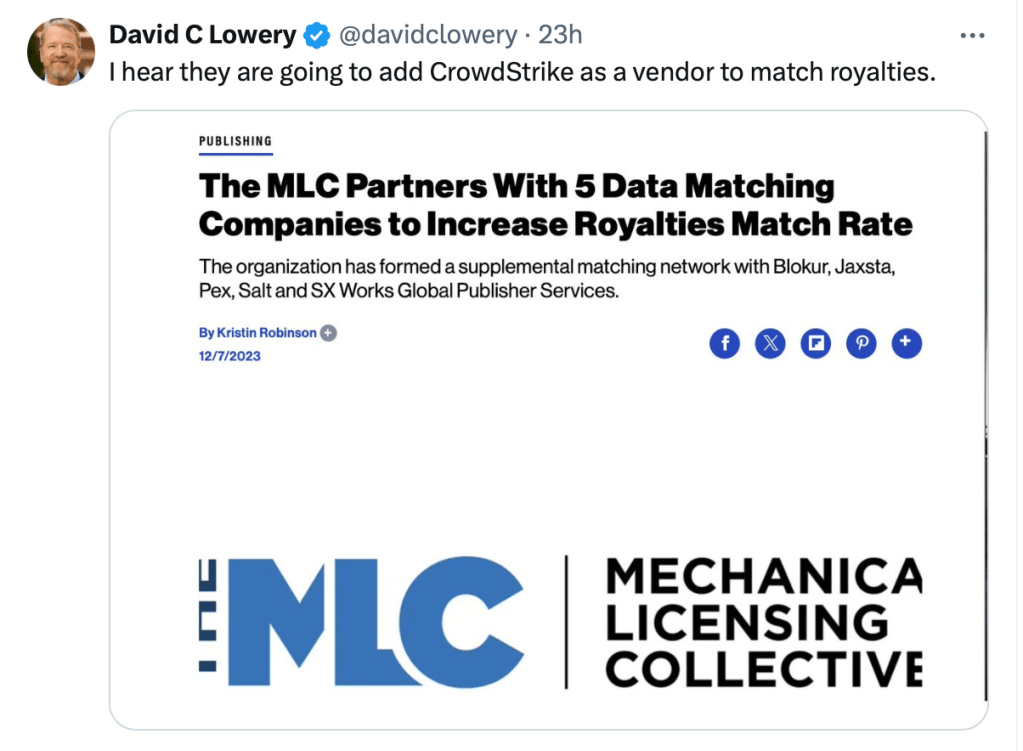
3:IV.B. Subpplemental Matching Network

The USCO asks the MLC to “…provide additional information about these (Blokur, Jaxsta, Pex, Salt, SX Works) relationships, including the specific functions that they perform, or have been asked to perform, the vendors’ relevant experience with clients and projects involving similar scale and type, or their industry-specific knowledge.” The MLC only satisfies a portion of this request by providing details about each of these companies functions. However, it does not provide the tasks they have been asked to preform or how the MLC plans to use these companies to improve the royalties that will ultimately be paid to the rightsholders.

Read the entire comment at this link.