
What YouTube Really Pays… Makes Spotify Look Good! #sxsw

Is this the future of music? We continue to look at more artist revenue streams.

We’ve been waiting for someone to send us this kind of data. This info was provided anonymously by an indie label (we were provided screenshots but anonymized this info to a spreadsheet). Through the cooperative and collaborative efforts of artists such as Zoe Keating and The Cynical Musician we hope to build more data sets for musicians to compare real world numbers.

In our on going quest for openness and transparency on what artists are actually getting paid we’d love to hear from our readers if their numbers and experience are consistent with these numbers below. At the very least, these numbers should be the starting point of larger conversations for artists to share their information with each other.

Remember, no music = no business.

whatyoutubereallypaysFor whatever reason there appear to be a lot of unmonetized views in the aggregate. So let’s just focus on the plays earning 100% of the revenue pool in the blue set. These are videos where the uploader retains 100% of the rights in the video including the music, the publishing and the video content itself.

Plays  Earnings  Per Play
2,023,295 $3,611.84 $0.00179
1,140,384 $2,155.69 $0.00189
415,341 $624.54 $0.00150
240,499 $371.47 $0.00154
221,078 $313.47 $0.00142
TOTALS TOTALS AVERAGE
4,040,597 $7,077.01 $0.00175

So it appears that YouTube is currently paying $1,750 per million plays gross.

We understand that people reading this may report other numbers, and that’s the point. There is no openness or transparency from either Spotify or YouTube on what type of revenue artists can expect to earn and under what specific conditions. So until these services provide openness and transparency to musicians and creators, “sharing” this type of data is going to be the best we’re going to be able to do as East Bay Ray comments in his interview with NPR.

As we’re now in a world where you need you need a million of anything to be meaningful here’s a benchmark of where YouTube ranks against Spotify.

Service  Plays  Per Play  Total  Notes 
Spotify To Performers/Master Rights 1,000,000 0.00521 $5,210.00 Gross Payable to Master Rights Holder Only
Spotify To Songwrtiers / Publishers This revenue is for the same 1m Plays Above 0.000521 $521.00 Gross Payable to Songwriter/s & Publisher/s (estimated)
YouTube Artist Channel 1,000,000 0.00175 $1,750.00 Gross Payable for All Rights Video, Master & Publishing
YouTube CMS (Adiam / AdRev) ** 1,000,000 0.00032 $321.00 Gross Payable to Master Rights Holder Only

The bottom line here is if we want to see what advertising supported free streaming looks like at scale it’s YouTube. And if these are the numbers artists can hope to earn with a baseline in the millions of plays it speaks volumes to the unsustainability of these models for individual creators and musicians.

Meet the New Boss: YouTube’s Monopoly on Video | MTP

It’s also important to remember that the pie only grows with increased revenue which can only come from advertising revenue (free tier) and subscription fees (paid tier). But once the revenue pool has been set, monthly, than all of the streams are divided by that revenue pool for that month – so the more streams there are, the less each stream is worth.

All adrev, streaming and subscription services work on the same basic models as YouTube (adrev) and Spotify (adrev & subs). If these services are growing plays but not revenue, each play is worth less because the services are paying out a fixed percentage of revenue every month divided by the number of total plays. Adding more subscribers, also adds more plays which means that there is less paid per play as the service scales in size.

This is why building to scale, on the backs of musicians who support these services, is a stab in the back to those very same artists. The service retains it’s margin, while the artists margin is reduced.

[** these numbers from a data set of revenue collected on over 8 million streams via CMS for an artist/master rights holder]

RELATED:
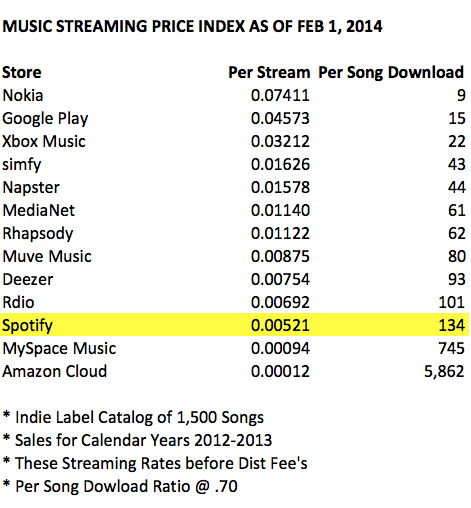
Streaming Price Index Updated 2014 : Per Stream Pay Rates

Music Streaming Math, Can It All Add Up?

YouTube Shares Ad Revenue With Musicians, But Does It Add Up? | NPR

Reality for Indie Artists : Zoë Keating’s Annual Music Sales & Streaming Data @SXSW #SXSW

Zoë Keating released her Annual Music Sales & Streaming Data Spreadsheet a little bit ago and we stayed out of the fray, although we did also publish an update of the Music Streaming Price Index for 2014 as well.

This quote from Zoë in a follow up post about her open and transparent sharing of information on Hypebot got our attention.

I want you to know that I don’t release these numbers as a marketing tool. I’ve always tabulated stuff as part of doing my annual accounting and last year I decided to make a portion of them public. Music commentators were saying, over and over, that artists are not making a living selling music, they make all their money touring, etcetera etcetera. I noted that in my case that wasn’t true and never had been. In the commentary I wasn’t seeing a lot of actual numbers from artists and thought I’d offer some details of how it all works for me: a non-labeled artist whose career has existed entirely in the internet-age.

It’s curious to us that someone would insinuate the motivation behind sharing information in an open, human and transparent way was an attempt at self serving marketing. Shame on those who have made such comments. Zoë should be celebrated for doing what the interweb companies claim to do, and ask others to do, but do not do themselves.

We also found the following statement to be true of our experience of the vast number of artists we hear from who report similar experiences with streaming services ranging from Spotify to YouTube. These services only financially serve the very large artists and the very large labels. In other words, Spotify, YouTube and the like have not empowered artists towards financial freedom and very well appear to be achieving the very opposite.

Meanwhile yes, the big money is to be made at the top of the tail…and therein lies the promise of commercial music streaming services. It will be financially valuable to those who make hits and those who aggregate legions of artists. For a single artist like me commercial streaming will never be more than promo. I accept that. But will keep talking about it until streaming companies do more to make that promo more useful (i.e data).

But there appears to be more to this story. In this recently posted video clip by “Unsound” documentary  filmmaker Mikeal Eldridge, Zoë reveals that she has dug a bit deeper into the realities of streaming economics noting that the more streams that are served, the less the artists makes per stream. Again, this is consistent with her observation that “the promise of commercial music streaming services… will be financially valuable to those who make hits and those who aggregate legions of artists.”

We’ve yet to see anyone propose how streaming can actually scale and be sustainable for artists. We love streaming services, what we don’t like are the economics.

92% of Zoë’s recording income is from transactional digital sales. If these streaming businesses are claiming to be the future, the question to ask is whose future?

Downloads Streams Total % Downloads
$75,341 $6,380 $81,721 92%

RELATED:

Music Streaming Math, Can It All Add Up?

Why Spotify is not Netflix (But Maybe It Should Be)

Musicians POV: Spotify Isn’t Good for You – Full Post

On Spotify (and Why I’m not a Conspiracy Theorist After All) | Tape Op

The real reason why the major labels love Spotify | Guardian UK

What ASCAP Members Need to Know About the Songwriter Equity Act and What You Can Do | ASCAP

Songwriters, composers and music publishers earn royalty income through two separate rights: the right to publicly perform their music works, and the right to make reproductions of those works and distribute those reproductions.

However, two outdated portions of the Copyright Act, Section 114(i) and Section 115, prevent songwriters and composers from receiving royalty rates that reflect fair market value for the use of their intellectual property. This has created inequity in the marketplace that harms America’s songwriters, composers and music publishers in the digital age. Now is the time to fix it.

READ THE FULL POST AT ASCAP:
http://www.ascap.com/playback/2014/02/action/songwriter-equity-act.aspx

Why Streaming Music Isn’t Like Bottled Water… | Digital Music News

Streaming music is just like bottled water, right?  Not all, actually.

1. People happily pay outrageous premiums for bottled water (a glass of tap water costs about $0.001).
Relatively few people actually pay for streaming music.

2.  People are convinced that there’s a difference between bottled water and tap water.
Not enough people feel there’s a difference between ad-based (free) streaming and premium (paid) streaming.

3. Sometimes, tap water tastes funny.
Free streaming always tastes good!  You just have to wait for it a little longer.

4. Bottled water is a proven, $100 billion industry that’s been around for decades.
Streaming music isn’t a profitable industry, hasn’t been around for more than a decade, and remains financially speculative.

READ THE REST OF THE 11 POINT LIST AT DIGITAL MUSIC NEWS:
http://www.digitalmusicnews.com/permalink/2014/02/26/bottledwaterstreaming

Homegrown Music: The Challenges Of Running A Record Label in D.C. | DC Music Download

“I don’t think people understand the idea that music is someone else’s property because it’s just in digital bits,” Feigenbaum says. “It’s intangible. People who feel music has no value and want to steal from you will steal from you. It’s so ubiquitous—it’s so easy”.

“I have people come up to me and tell me how much they love what I do, and I’ll be like, ‘That’s great, where do you buy it?’” notes Feigenbaum. “And you can see they weren’t expecting that and they start to stammer. It’s like, ‘You’re not helping me. You’re not a fan-you’re a leech.’”

“I could go on and on about the things I don’t like about iTunes,” he says, “But they do pay. It’s not my favorite business model, but I get paid from them.” Spotify, however, is another matter.

“They don’t pay shit,” he says. “The only people who make money off of Spotify is Spotify. We were getting thousands of listens on Spotify, which added up to literally one and a quarter pennies. So we opted out.”

READ THE FULL STORY AT DC MUSIC DOWNLOAD:
http://dcmusicdownload.com/2014/02/12/homegrown-music-the-challenges-of-running-a-record-label-in-d-c/

The Tyranny of Legality | The Cynical Musician

Music piracy is a subject that has been talked to death over the past decade. So much, in fact, that it seems scarce conceivable that we could say anything more of interest on the subject.

The fundamental point I’d like you to take away from this is: it’s a lot more important to keep a watchful eye on ostensibly legal services – recall that both Pandora and (perhaps to a lesser extent) YouTube are legit – than to agonize over overt piracy.

That pirate services should be hunted to as close to extinction as is feasible goes without saying, but we mustn’t lose sight of the fact that nobody deserves a medal for going legit. It’s what you’re f-ing supposed to do.

READ THE FULL POST AT THE CYNICAL MUSICIAN:
http://thecynicalmusician.com/2014/01/the-tyranny-of-legality/

How You’re Murdering the Music Industry. | unEARTH Music Hub

Oddly, few people are talking about how much money they are actually making through Spotify, but it’s estimated that the average play is worth an abysmal $0.005. That’s half a cent…if you’re getting anything at all. An artist needs to rack up 200 plays to make $1. How are we letting this happen?! Is the general population truly oblivious to the tremendous effort and cost involved in making music?

Surprise! Songs don’t just pop out of artists like perfectly polished Easter eggs. These creative humans have dedicated a large amount of their time, money and soul to create a tangible piece of art for your listening pleasure. Studio time is expensive! Rehearsal space is expensive! Gas is expensive! Instruments are expensive! Craft beer is expensive!!! Strike that last one.

But seriously guys, when you buy music, you’re not just paying for a song, you’re supporting the artist and the process.

READ THE FULL STORY AT unEARTH MUSIC Hub:
http://unearthmusichub.com/articles/streaming-music/

Digital albums overtake CDs in the US, but iTunes music revenues down | Music Ally

We’re more interested in its estimates for the revenue growth in 2013 of the various content categories in iTunes: apps up 105%, video up 19%, but music downloads down 14% of the year.

Streaming music’s impact isn’t a surprise, but it’s good to have more data to quantify what’s happening – albeit without the corresponding global increase in revenues from streaming services.

READ THE FULL STORY AT MUSIC ALLY:
http://musically.com/2014/02/12/digital-albums-overtake-cds-in-the-us-but-itunes-music-revenues-down/

Spotify seeks to hire U.S. filings expert as bankers eye IPO | Reuters

* Move adds to speculation about IPO

* Senior banker says firm to be valued at $7-8 bln

* Spotify doubled revenue but registered loss in 2012

STOCKHOLM, Feb 17 (Reuters) – Online music streaming service Spotify is recruiting a U.S. financial reporting specialist, adding to speculation that the Swedish start-up is preparing for a share listing, which one banker said could value the firm at as much as $8 billion.

Meeting U.S. Securities and Exchange Commission (SEC) standards for filing financial disclosures is essential for any firm planning to go public and bankers and lawyers said they inferred from the job ad that the company is getting ready for an initial public share offering (IPO), possibly next year.)

READ THE FULL STORY AT REUTERS:
http://www.reuters.com/article/2014/02/17/spotify-idUSL6N0LM2E520140217

RELATED:

If Spotify is saving Swedish music sales, why aren’t indies celebrating?

While Artists are Bitching About Spotify Royalties… Google, YouTube and Grooveshark are in the Getaway Car…

Get Ready For The Streaming-Music Die-Off