We’ve been keeping track of those who are for freezing the statutory mechanical royalty rate for physical and permanent downloads for another five years out to 2027. The issue is currently part of the rate setting proceeding before the Copyright Royalty Board–which froze the same rate at 9.1¢ in 2006 and was first extended in 2009.
Here is the current list of those for and against freezing mechanicals on these categories for a total of 21 years:
The twist here is that if the CRB approves the private settlement at the request of “the parties” and doesn’t take into account the views and evidence of people who actually write songs and have to earn a living from songwriting, it will be grotesquely unfair and possibly unconstitutional wage and price control. The CRB will have frozen the mechanical rate for physical and downloads at the 2006 rate when inflation alone has eaten away the buying power of that royalty by approximately 30%. This would be like the Minerals Management Service adopting a settlement written by Exxon.
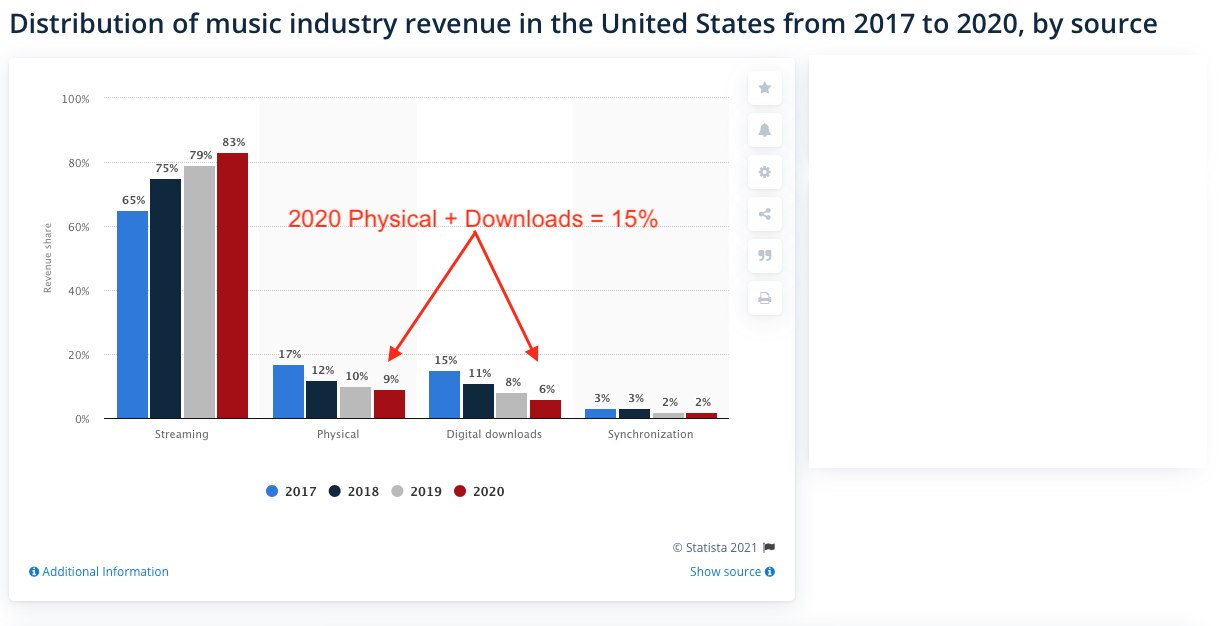
On average–on average–the physical and download configuration make up 15% of billing for the majors and for some artists vinyl is a welcome change from fractions of a penny on streaming. And then there’s Record Store Day–hello? These are a couple of the many reasons anyone who is paying attention should reject the terms of the settlement.
The Coalition had a simple ask: Let the public comment:
In the interests of justice and fairness, we respectfully implore the CRB to adopt and publicize a period and opportunity for public comment on the record in these and other proceedings,especially in regard to so-called proposed “industry settlements” in which creators and other interested parties have had no opportunity to meaningfully participate prior to their presentation to the CRB for consideration, modification or rejection. In the present case, hundreds of millions of dollars of our future royalties remain at stake, even in a diminished market for traditional, mechanical uses of music. To preclude our ability to comment on proposals that ultimately impact our incomes, our careers, and our families, simply isn’t fair.
The Copyright Royalty Board responded! According to our sources, the Copyright Royalty Board said that they would publish the private settlement in the Federal Register and give the pubic the chance to comment. This is great news!
But we will see what they actually do. The Copyright Royalty Board does not have a great track record in understanding songwriter interests in raising the mechanical rates as we can see in this except from their final rule freezing mechanicals again in 2009:
Copyright Owners’ argument with respect to this objective is that songwriters and music publishers rely on mechanical royalties and both have suffered from the decline in mechanical income. Under the current rate, they contend, songwriters have difficulty supporting themselves and their families. As one songwriter witness explained, “The vast majority of professional songwriters live a perilous existence.” [Rick] Carnes [Testimony] at 3. [Rick Carnes signed the Coalition letter as President of the Songwriters Guild of America.] We acknowledge that the songwriting occupation is financially tenuous for many songwriters. However, the reasons for this are many and include the inability of a songwriter to continue to generate revenue-producing songs, competing obligations both professional and personal, the current structure of the music industry, and piracy. The mechanical rates alone neither can nor should seek to address all of these issues.
We simply do not accept that the Founders put the Copyright Clause in the Constitution so creators could have a side hustle for their Uber driving which is exactly where frozen mechanicals take you, particularly after the structural unemployment in the music business caused by the COVID lockdowns.
Here is a summary of who is for and who is against frozen mechanicals.
Against Frozen Mechanicals
Proposing Frozen Mechanicals
Songwriters Guild of America
National Music Publishers Association
Society of Composers and Lyricists
Nashville Songwriters Association International
Alliance for Women Film Composers
Songwriters Association of Canada
Screen Composers Guild of Canada
Music Creators North America
Music Answers
Alliance of Latin American Composers & Authors
Asia-Pacific Music Creators Alliance
European Composers and Songwriters Alliance
Pan African Composers and Songwriters Alliance
Which side are you on? If you want to write your own comment to the Copyright Royalty Board about frozen mechanicals, send your comment to crb@loc.gov
[Editor T says this is a letter from a coalition of US and international songwriter groups to the Copyright Royalty Board about the frozen mechanical issue. If you want to write your own comment to the Copyright Royalty Board about frozen mechanicals, send your comment to crb@loc.gov]
MUSIC CREATORS NORTH AMERICA
May 17, 2021
Via Electronic Delivery
Chief Copyright Royalty Judge Jesse M. Feder Copyright Royalty Judge David R. Strickler Copyright Royalty Judge Steve Ruwe US Copyright Royalty Board 101 Independence Ave SE / P.O. Box 70977 Washington, DC 20024-0977
To Your Honors:
As a US-led coalition representing hundreds of thousands of songwriters and composers from across the United States and around the world, we are writing today to express our deep concerns over the “Notice of Settlement in Principle” recently filed by parties to the proceedings before the Copyright Royalty Board concerning its Determination of Royalty Rates and Terms for Making and Distributing Phonorecords (Phonorecords IV) (Docket No. 21–CRB–0001–PR<(2023–2027)). For reasons explained below, several highly conflicted parties to this proceeding have apparently agreed to propose a rolling forward to the year 2027 of the current US statutory mechanical royalty rate for the use of musical compositions in the manufacture and sale of physical phonorecords (such as CDs and vinyl records). This proposal (and related industry agreements yet to be disclosed by the parties— see, https://app.crb.gov/document/download/23825) should neither be acted upon nor accepted by the CRB without the opportunity for public comment, especially by members of the broad community of music creators for whom it is financially unfeasible to participate in these proceedings as interested parties. It is our livelihoods that are at stake, and we respectfully ask to be heard even though we lack the economic means to appear formally as parties. If procedures are already in place to accommodate this request, we look forward receiving the CRB’s instructions as to how to proceed.
The current U.S statutory mechanical rate for physical phonorecords is 9.1 cents per musical composition for each copy manufactured and distributed. That rate has been in effect since January 1, 2006. It represents the high-water mark for US mechanical royalty rates applicable to physical products, a rate first established in 1909 at 2 cents. That 2-cent royalty rate, in one of the most damaging and egregious acts in music industry history, remained unchanged for an astonishing period of sixty-nine years, until 1978. Nevertheless, the recording industry now seeks to repeat that history by freezing the 9.1 cent rate for an era that will have exceeded twenty years by the end of the Phonorecords IV statutory rate setting period.
Inflation has already devalued the 9.1 cent rate by approximately one third. By 2027, 9.1 cents may be worth less than half of what it was in 2006. How can the US music publishing industry’s trade association, and a single music creator organization (which represents at most only a tiny sliver of the music creator community) have agreed to such a proposal?
The answer to that question is an easy one to surmise. The three major record companies who negotiated the deal on one side of the table have the same corporate parents as the most powerful members of the music publishing community ostensibly sitting on the other side of the table. Songwriter, composer and independent music publisher interests in these “negotiations” were given little if any consideration, and the proposed settlement was clearly framed without any meaningful consultation with the wider independent music creator and music publishing communities, both domestically and internationally.
How on earth can these parties be relied upon to present a carefully reasoned, arms-length “Settlement in Principle” proposal to the CRB under such circumstances, fraught as they are with conflicts of interest, without at least an opportunity for public comment? Further, how can these parties be relied upon in the future to argue persuasively that mechanical royalty rates applicable to on-demand digital distribution need to be increased as a matter of economic fairness (which they most certainly should be), when they refuse to seriously conduct negotiations on rates applicable to the physical product the distribution of which is still controlled by record companies (who not so incidentally also receive the lion’s share of music industry revenue generated by digital distribution of music)?
The ugly precedent of frozen mechanical royalty rates on physical product has, in fact, already served as the basis for freezing permanent digital download royalty rates since 2006. Is this the transparency and level playing field the community of songwriters and composers have been promised by Congress through legislation enacted pursuant to Article I, Section 8 of the Constitution?
The trade association for the US music publishing industry is supported by the dues of its music publisher members, the costs of which are often in large part passed along to the music creators affiliated with such publishers. It is thus mainly the songwriter and composer community that pays for the activities of that publisher trade association, a reality that has existed since that organization’s inception. Still, the genuine voice of those songwriters and composers is neither being sought nor heard. Further in that regard, we wish to make it emphatically clear that regardless of how the music publishing industry and its affiliated trade associations may present themselves, they do not speak for the interests of music creators, and regularly adopt positions that are in conflict with the welfare of songwriters and composers. Their voice is not synonymous with ours.
Unfortunately, the music creator community lacks the independent financial resources –in the age of continuing undervaluation of rights, rampant digital piracy and pandemic-related losses–to rectify these inequities by expending millions more dollars to achieve full participation in CRB legal and rate-setting proceedings. Clearly, such an inequitable situation is antithetical to sound Governmental oversight in pursuit of honest and equitable policies and results.
In the interests of justice and fairness, we respectfully implore the CRB to adopt and publicize a period and opportunity for public comment on the record in these and other proceedings,especially in regard to so-called proposed “industry settlements” in which creators and other interested parties have had no opportunity to meaningfully participate prior to their presentation to the CRB for consideration, modification or rejection. In the present case, hundreds of millions of dollars of our future royalties remain at stake, even in a diminished market for traditional, mechanical uses of music. To preclude our ability to comment on proposals that ultimately impact our incomes, our careers, and our families, simply isn’t fair.
Finally, we request that this letter be made a part of the public record of the Phonorecords IV proceedings. We extend our sincere thanks for your attention to this very difficult conundrum for music creators, and further note that your consideration is very much appreciated.
Respectfully submitted,
Rick Carnes President, Songwriters Guild of America
Ashley Irwin President, Society of Composers and Lyricists Officer, Music Creators North America Co-Chair, Music Creators North America
cc: Ms. Carla Hayden, US Librarian of Congress Ms. Shira Perlmutter, US Register of Copyrights Mr. Alfons Karabuda, President, International Music Council Mr. Eddie Schwartz, President, MCNA and International Council of Music Creators (CIAM) The MCNA Board of Directors The Members of the US Senate and House Sub-Committees on Intellectual Property Charles J. Sanders, Esq.
If you’re not a lawyer, you may not be that familiar with law clerks. The title sounds very…well, clerical. But make no mistake, they are very powerful people who are largely unknown to clients but who are in the room with their judges, often every step of the way. As Wikipedia tells us:
A law clerk or a judicial clerk is an individual—generally an attorney—who provides direct assistance and counsel to a judge in making legal determinations and in writing opinions by researching issues before the court. Judicial clerks often play significant roles in the formation of case law through their influence upon judges’ decisions.
Yet, we know virtually nothing about them from the outside. If your case is heard, wouldn’t you want to know about everyone who was influencing the outcome of your case?
During your clerkship, you will provide valuable assistance as your judge resolves disputes that are of great importance to the parties, and often to the public. The parties and the public accept judges’ rulings because they trust the system to be fair and impartial. Maintaining this trust is crucial to the continued success of our courts. That’s why, although you have many responsibilities that demand your attention, you must never lose sight of your ethical obligations.
While that all sounds good, how would anyone ever know exactly what the story is with the clerks who are writing opinions with their judge or justice that directly affect the outcome of your case. As the ethical rules clearly state:
Although many of your obligations are the same as those of other federal judicial employees, certain restrictions are more stringent because of your special position in relation to the judge. Some obligations continue after your service to the court concludes.
But again–how would you ever know? If you go to the bible of the revolving door, Open Secrets, you’ll notice someone is missing…the entire judicial branch of our government.
Let’s take the easy one: Conflicts of interest. When does a law clerk have a conflict of interest? The rulebook tells us:
Canon 3F(1) of the Code of Conduct advises judicial employees, including law clerks, to avoid conflicts of interest. Conflicts arise when you—or your spouse or other close relative—might be so personally or financially affected by a matter that a reasonable person would question your impartiality.
Note the disjunct: “personally or financially affected.” Either can give rise to a conflict or a question as to the clerk’s impartiality.
Conflicts come in several flavors, but two biggies are actual conflicts and potential conflicts, very routine inquiries in any conflict check. The ethical rules for clerks give examples of each: For example, an actual conflict is “The firm where you plan to work after your clerkship serves as counsel in a matter before your judge”. “Firm” in this case presumably applies to the situation where a company where the clerk plans to work appears before the judge.
A potential conflict includes “An attorney you met and talked with at a social function appears to argue a motion before your judge.” It’s not a far reach to think that the example would include a former professor, amicus, or author of an amicus brief filed or to be filed in a case before your judge.
But the point is, how would the litigants ever know any of these situations were an issue. Who keeps track of who knows whom among the clerks cloistered away in the ivory tower?
Joshua Revesz (Yale 2017/Garland) will be clerking for Justice Kagan in OT 2020. If his distinctive surname rings a bell, perhaps you’ve heard of his famous father: Professor Richard “Ricky” Revesz, former Dean of NYU Law School, and a former Supreme Court clerk (OT 1984/Marshall).
Readers of ARW may also recognize the name from a different place: The deep and abiding controversy over the American Law Institute’s failing Restatement of Copyright project. Professor Revesz joined the ALI in 2014 right after the noted Lowery insulter, Spotify lawyer, Lessig mentee and all round anti-copyright advocate Christopher Jon Sprigman joined the NYU faculty in 2013, presumably under then-Dean Richard Revesz.
Somehow–we don’t know exactly how–of all the lawyers in all the world, how ALI Director Revesz chose Professor Sprigman to run the Restatement of Copyright project, an undertaking that by all reports is devoted to weakening copyright and expanding loopholes for Big Tech. How do we know this? Because Sprigman pitched Revesz on the idea very soon after Revesz took over at ALI.
And the rest is history with everyone from authors to the Congress criticizing the very idea of a Restatement of Copyright; indeed, Professor Peter Menell of the UC Berkeley law school and Professor Shyamkrishna Balganesh of Columbia law school wrote an extensive critique that “explains why perfunctory extension of the common law Restatement model to copyright law produces incoherent, misleading and seemingly biased results that risks undermining the legitimacy of the eventual product.” (“The Curious Case of the Restatement of Copyright“). In other words–it’s bad.
It will come as no surprise that I would go further–I think that is exactly the purpose of the Restatement (and Professor Samuelson’s Copyright Principles Project it descends from).
Hold on, you say–what does this have to do with Clerk Revesz and his judge, Supreme Court Justice Elena Kagan, the former Dean of Harvard Law School (whose remarks at the 10 year anniversary celebration of the Berkman Center are illuminating (home to both Lessig and poker aficionado and alleged counsel to copyright infringer Mr. Tennenbaum, Charles Nesson)). Maybe nothing.
But isn’t it the kind of thing you might want to know about someone who was in close contact with someone who was deciding the outcome of your case? Or was in close contact with other clerks who were deciding the outcome of your case? How would you ever know what contacts the clerks had with anyone who might be influencing their case or who had donated money to an institution that benefited the family member of someone who had influence over your case? Either directly, over cocktail party conversation or the dinner table? I am not implying any skulduggery here, it could all have been very innocent or appear so as conflicts often do.
While their judges are obligated to public financial disclosures, clerks do not have such obligations to litigants, much less to the public. Disposition of conflicts disclosed by clerks seem to be handled in chambers without consulting the litigants.
Given the number of clerks in chambers across the country, the possibility for conflicts are significant. When a lawyer has a conflict of interest that is waivable, she must give the client the option to waive the conflict with informed consent. But if the conflict is not waivable or the client refuses to waive, the lawyer must decline the representation.
Is there a corollary for law clerks? There definitely are rules and there definitely are processes. But are the litigants ever asked if they consent to a conflicted clerk working on their case?
I’ve never heard of it. Maybe there should be such a process.
[A bit of context: With all the riches being made from streaming, session musicians and vocalists make zero. And don’t forget that music made Daniel Ek a billionaire.]
Broken Record Campaign
Ivors Academy
Musicians Union
April 20, 2021
The Rt Hon Boris Johnson MP Prime Minister 10 Downing Street W1A 2AA
Dear Prime Minister,
We write to you on behalf of today’s generation of artists, musicians and songwriters here in the UK.
For too long, streaming platforms, record labels and other internet giants have exploited performers and creators without rewarding them fairly. We must put the value of music back where it belongs – in the hands of music makers.
Streaming is quickly replacing radio as our main means of music communication. However, the law has not kept up with the pace of technological change and, as a result, performers and songwriters do not enjoy the same protections as they do in radio.
Today’s musicians receive very little income from their performances – most featured artists receive tiny fractions of a US cent per stream and session musicians receive nothing at all.
To remedy this, only two words need to change in the 1988 Copyright, Designs and Patents Act. This will modernise the law so that today’s performers receive a share of revenues, just like they enjoy in radio. It won’t cost the taxpayer a penny but will put more money in the pockets of UK taxpayers and raise revenues for public services like the NHS.
There is evidence of multinational corporations wielding extraordinary power and songwriters struggling as a result. An immediate government referral to the Competition and Markets Authority is the first step to address this. Songwriters earn 50% of radio revenues, but only 15% in streaming. We believe that in a truly free market the song will achieve greater value.
Ultimately though, we need a regulator to ensure the lawful and fair treatment of music makers. The UK has a proud history of protecting its producers, entrepreneurs and inventors. We believe British creators deserve the same protections as other industries whose work is devalued when exploited as a loss-leader.
By addressing these problems, we will make the UK the best place in the world to be a musician or a songwriter, allow recording studios and the UK session scene to thrive once again, strengthen our world leading cultural sector, allow the market for recorded music to flourish for listeners and creators, and unearth a new generation of talent.
We urge you to take these forward and ensure the music industry is part of your levelling-up agenda as we kickstart the post-Covid economic recovery.
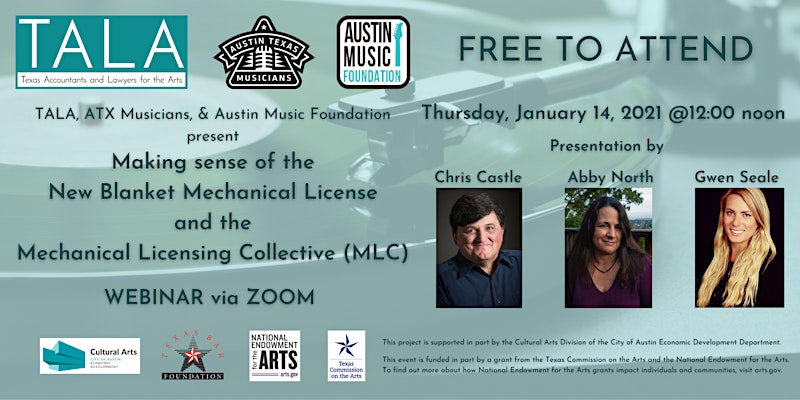
I’m grateful to Texas Accountants and Lawyers for the Arts, Austin Texas Musicians and the Austin Music Foundation for hosting an information webinar next week on the impact of the new blanket mechanical license under the Music Modernization Act on independent songwriters. We will also cover the nuts and bolts of dealing with The MLC, Inc. and a unit on the Digital Licensee Coordinator.
I couldn’t be happier to have two great panelists in music publisher and song data solver Abby North and my fellow Austin music lawyer Gwen Seale.
While this panel has an Austin origin, the topics are not Austin-centric and will apply to all songwriters in the world just like the MLC does.
Please RSVP to Eventbrite if you think you might attend at this link and also take a moment to complete the anonymous 10 question MLC Awareness Questionnaire on Survey Monkey at this link. The Zoom code to join will be posted through Eventbrite.
I’ll be posting some other materials, but for those who want the more nitty gritty background, you can read this package of documents at this link.
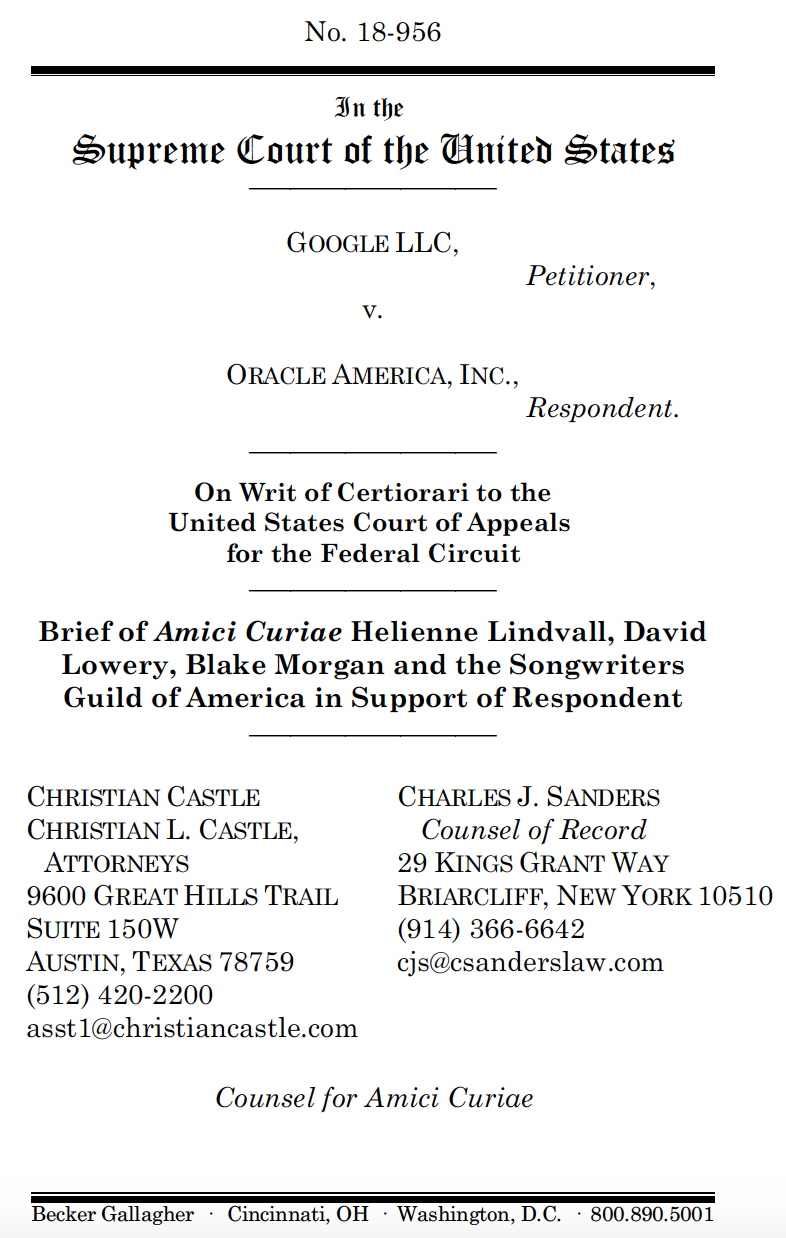
Google’s appeal of its major loss to Oracle on fair use is shaping up to be the most important copyright case of the year, if not the decade. It could set fair use standards for years to come. We’re going to be posting installments from the friend of the court brief that David, Helienne, Blake and The Songwriters Guild filed in the U.S. Supreme Court supporting Oracle in the Google v. Oracle fair use case. This is the last installment. We decided to omit the footnotes for this posting, but you can read the whole brief here.
Moreover, Amici believe that Google’s fair use expansion campaigns are designed to serve as a honeypot for Google’s data scraping business model that feeds its outsized profits from ads. Google likewise seems to promote expansion of the fair use doctrine as way to easily keep more videos on YouTube, while providing material support to its partners that allows them to outlast any songwriter or artist in the game of whack-a-mole under its copyright strike policies. No one is giving creators a shadowy milliondollar fund to defend against the misapplication of fair use.
Amicus Mr. Lowery summed it up in his 2014 testimony to the House Judiciary Committee:
I am not concerned with parody, commentary, criticism, documentary filmmakers, or research. These are legitimate fair use categories. I am concerned with the illegal copy that masquerades as fair use, but is really just a copy. This masquerade trivializes legitimate fair use categories and creates conflict where there need be none.
Scope of Fair Use at 22.
Unfortunately, Google manipulates fair use to extract value by monetizing verbatim copies to the great disadvantage of creators who can little afford to fight back against the multi-national, trillion dollar corporation, and usually do not. Thus, independents
are caught without leverage in cases that rarely get to court.
The end result is that even where its use is “free,” Google’s interests are steadfastly commercial. Accordingly, the Federal Circuit was correct in finding that the nature and purpose of Google’s use was entirely commercial in nature.
III. GOOGLE’S PRIVATE INTERESTS ARE NOT THE PUBLIC INTEREST.
The ultimate question in a fair use analysis is “whether, and how powerfully, a finding of fair use would serve or disserve the objectives of the copyright.” Leval at 1110–1111; see also Harper & Row, 471 U.S. at 546 (noting purpose of copyright is to give creators
“a fair return for their labors”).
Google’s only response to whether its use furthers the public interest—i.e., in promoting an effective system of copyright—is that allowing it to copy verbatim Oracle’s declaring code and structure would be “promoting software innovation.” Such verbatim copying is a “facile use of the scissors.” Folsom v. Marsh, 9 F. Cas. 342, 345 (C.C.D. Mass 1841) (Story, J.).
Yet what is good for Google is not synonymous with what is good for the public—no more than “[w]hat’s good for General Bullmoose is good for the USA.” Johnny Mercer and Gene De Paul, Li’l Abner (1956). In fact, a ruling for Google would be “promoting” software innovation only in that the purported “innovation” would be furthering Google’s private
interest—i.e., using works without permission or a license fee.
This case again appears to be the latest in Google’s long-term strategy to use its market dominance and overwhelming commercial power to continually distort copyright exceptions, thereby artificially depressing the market price of copyrighted works. Google’s proposed outcome would be yet another distortion. Were Google to prevail here, Amici expect Google (and its proxies) to throw its full weight behind such a ruling, far beyond the confines of its text. This case would become another totemic faux license or safe harbor that Google could use as a cudgel against creators and copyright owners.
Left unchecked, eventually the copyright distortions they seek—including in the case at bar—could nullify copyright, particularly for those who cannot afford to fight back or fear retaliation for doing so. Under the Google anti-copyright regime, exceptions would devour the rules of protection in whole, digesting art and culture along with them.
CONCLUSION
Amici respectfully suggest that the Court should consider whether a decision in favor of Google would merely “unleash” yet another weapon for Google’s private benefit, and whether Google’s infringement of Oracle’s declaring code and structure constitutes
“simple piracy” for which the company should most certainly be held accountable.
This Court should affirm the decision of the Federal Circuit below.
Respectfully submitted,
CHARLES J. SANDERS
Counsel of Record
29 KINGS GRANT WAY
BRIARCLIFF, NEW YORK 10510
(914) 366-6642
cjs@csanderslaw.com
CHRISTIAN CASTLE
CHRISTIAN L. CASTLE, ATTORNEYS
9600 GREAT HILLS TRAIL
SUITE 150W
AUSTIN, TEXAS 78759
(512) 420-2200
asst1@christiancastle.com
Counsel for Amici Curiae
It’s becoming more apparent with each passing day that TikTok is about to get shut down by the U.S. Government for any one of a variety of crimes like it has been in India and other countries. Which means that they are a perfect candidate for an “NMPA Special” which is where a handful of insiders decide on the terms and a pool of money is paid by the infringer to the NMPA for what amounts to a promise not to sue the infringer by the insiders and whatever useful idiots the NMPA can get to opt in to their deal. (Or at least the deal they tell you about–and remember that some running dogs are more equal than others.)
Then some impenetrable claiming portal is set up for the average dog to “claim” a share of a revenue pool they had nothing to do with negotiating while being forced to give up any rights to sue (because the last thing that the NMPA wants is getting shown up again by a David Lowery, Melissa Ferrick, Randall Wixen or anyone represented by Richard Busch), and then the money just kind of disappears. The amount of the pool is always so low it makes you wonder if that’s all there is, but in any event it has a distorting effect on the market place to drive down the rates paid to songwriters.
In a world where Cox Communications, a stupid but largely legitimate company, pays $1 billion for copyright infringement on a handful of copyrights, TikTok should pay $1 billion to get a meeting. And if the FBI is right that TikTok is a front for the Chinese Communist Party, they could easily pay $1 billion for a meeting. Anyone want to bet the over/under that the NMPA settlement is less than $1 billion?
How much the NMPA gets to keep out of the gross on the front end or the unclaimed after the claiming period expires is never disclosed and as you will see, the NMPA deal with TikTok, like all other NMPA deals, only applies to NMPA members. So if you want to participate, you most likely will have to join the NMPA and pay a fee (sometimes based on market share). And as came up in The MLC designation, The NMPA members may have a large market share of revenue but not necessarily on the number of songs.
Here’s the twist: TikTok has no way to track what music has been used, much less account for it. TikTok has no Content-ID type technology or control over what music is used so has no way to count or monitor what uses are made of which songs. So unless that gets fixed, it’s a bit unclear exactly what you would be claiming from the NMPA’s claiming portal Based on the NMPA’s YouTube and Spotify settlement portals, this one is almost certainly going to be absolute shite.
The deal “accounts for TikTok’s past use of musical works and sets up a forward-looking partnership” according to the announcement.
“This new partnership will give NMPA members the ability to opt-in to a licensing framework that allows them to benefit from their works included on TikTok and is effective retroactively as of May 1, 2020.”
The deal comes a day after TikTok announced a licensing deal with independent distributor Believe, and its TuneCore subsidiary.
“We are pleased to find a way forward with TikTok which benefits songwriters and publishers and offers them critical compensation for their work,” said NMPA boss David Israelite.
“Music is an important part of apps like TikTok which merge songs with expression and popularise new music while also giving new life to classic songs. This agreement respects the work of creators and gives them a way to be paid for their essential contributions to the platform.”
That might be true–but remember, there’s nothing in it for anyone who is not an NMPA member. And a lot of people are not NMPA members regardless of what they tell judges. So what happens to the great unwashed who are not NMPA members? Unclear, but NMPA has likely set the market rate for TikTok settlements, so unless you plan on suing, they’ll just jam that deal down your throat. Which works out well for TikTok.
But some lobbyist at TikTok has a friend when they are in need.
A performance metric one hears from the digerati is the term “conversion rate.” “Conversion rate” for a streaming service usually means the rate at which users of an ad-supported free service are “converted” to paying users. That motivation is usually because they are so fed up with the advertising they are willing to pay. (This was one of the many failed pitches from Spotify before people stopped trying to justify hanging on until the IPO riches flowed in.)
YouTube, of course, has never been too terribly interested in anything that moves users away from advertising. That resistance (and potential internal competition between the massive ad sales team and the ever changing YouTube managers), may explain the many failed efforts at launching a YouTube subscription service by a company that knows more about user behavior than anyone in history. They just couldn’t seem to get it right for the longest time. You don’t suppose that YouTube’s apparent lack of interest in getting large numbers of users to substitute away from free to subscription was because YouTube made a lot more money from the ads than they ever would from the subscriptions?
One of the ways that YouTube (and Google) makes money from advertising is by taking money that is not theirs to take (sometimes called “monetizing” content). The civil law calls that act a claim of “conversion” and the criminal law calls it the crime of “theft”. Conversion and theft are two sides of the same coin and often one implies the other, albeit with different burdens of proof.
YouTube’s Content ID tool is a way for copyright owners to block or permit advertising on user-generated content that includes their copyrights, often music. Users of Content ID will tell you that it works just well enough that Google can say it is an effective tool, but even with Content ID music still gets through (and is often monetized by YouTube) for a variety of reasons. This requires time consuming and costly manual searches. Companies like AdRev make it a bit easier, but are essentially third party Content ID users. These companies are compensated with a commission on infringing works they find on YouTube that they convert–there’s that word again–from infringing to monetized, which means that YouTube now splits the advertising revenue with the copyright owners who in turn split their share with an AdRev.
But see what happened there? If you have Content ID, you can block on the upload some of the time, or you can do a search. If you don’t have Content ID (see Maria Schneider’s class action) then you can’t block on the upload only chase the infringements manually. But quite rightly from an economic perspective, companies like AdRev are not that interested in doing that work on a rev share basis if there’s no rev share when you block.
Here’s the point–you have a property right in your copyright. You have a property right to license that copyright. Any revenue derived from exploitations of that copyright is your money. YouTube uses its monopoly power to impose a deal to monetize your copyright (under duress, of course, due to whack a mole DMCA). That deal involves a revenue share. (Let’s just assume you decide to take the King’s shilling and accept Google’s deal under duress which you shouldn’t have to do and which may not even be enforceable.)
The question is, when should that revenue share attach–when they start exploiting your copyright in violation of your property rights or when you catch them doing it. And if (1) you catch them violating your property rights and (2) agree to monetize, when should they pay you your agreed upon share of the revenue from monetizing? Should they pay retroactively to the first exploitation? Or only prospectively after you catch them?
The correct answer is they should pay retroactively. But they don’t. They just keep the money. For millions of infringements. And they get away with it because of their monopoly power, which leaves one choice most artists won’t make, which is to sue them like Maria has.
Remember–Content ID operates largely like any other fingerprinting tool. (Psychoacoustic fingerprinting is old technology–remember Jonesy in “The Hunt for Red October”? That’s fingerprinting. A “fingerprint” is simply a mathematical rendering of the waveform of an audio file.)
There is a reference databases of recordings that are “known knowns” (which is why it is important to be included in the Content ID database as Maria Schneider correctly points out in her class action.) The fingerprinting tool encounters a new file, takes a fingerprint, then looks for a match in the reference database and reports a result that triggers an action. Typically, fingerprinting tools are binary: match or no match. What happens after the tool finds a match is entirely in the control of the operator. (So while the tool could have a match rate of 90%, the operator could report a random number of matches or a fixed number of matches, like one every ten, or one every 1000. That means 90% accuracy could turn into a much lesser percentage of reported matches. It’s important to know how many matches trigger an action.)
Having had some experience with audio fingerprints, I think you will find that once a fingerprint is in the reference database, the recognition tool (Content ID in this case) will spot the reference fingerprint a very, very high percentage of the time. The fingerprinting tool I’m most aware of caught matches over 90% of the time. I can’t imagine that a tool developed by the biggest technology company in commercial history would do less–unless they wanted it to. Remember, this is not taking into account re-records unless the re-record is itself in the database, or pitch bends. This is an exact match which is very common use of Content ID. (See Maria’s class action complaint, and Kerry Muzzey has a great description of this in his recent Senate testimony.)
If Content ID is actually missing matches to known knowns on the upload (assuming exact matching is possible), I find it very odd that Content ID is missing much. Maybe it’s not, but one way to find out is to force Google to reveal the inner workings through discovery in the class action case.
But if Content ID does miss exact matches, it would be interesting to know what percentage of those misses end up being monetized, and of those, what percentage end up getting caught later by a subsequent use of Content ID or a manual investigative process. This will give an idea of the scale of the retroactive payment issue.
As Maria rightly points out, it is virtually impossible for an artist or film maker without Content ID to catch YouTube monetizing infringing works. But I think the analysis has to go a step further–even if you have Content ID, at the moment you catch YouTube monetizing illegal versions, you are in no different position than the artist who lacks access to the Content ID tool.
Both have the same problem–YouTube is profiting from illegal copies. If when you catch them you then elect to monetize, YouTube will pay you going forward, i.e., prospectively. But I do not believe they will pay you retroactivelyfor the illegal use. (There is a rumor that some music publishers do get paid retroactively under some settlement, but that needs to be confirmed.)
That means that YouTube is directly profiting from piracy for the retroactive views which could total into the hundreds of millions per day given the massive number of daily views on YouTube. If you elect to monetize due to YouTube’s monopoly power, you are essentially releasing them from liability under duress. Ifyou catch them.
So YouTube takes your property, monetizes it, and refuses to pay you for how much they made before you caught them if you ever do catch them. They dare you to sue them because you would be taking on the biggest company in commercial history that controls 90% of the access to information in the world and routinely defies governments. Not everyone has the spine of Maria Schneider.
Failing to license at all or failing to pay retroactively means that YouTube profits from piracy by converting your property to their own. And as Maria rightly points out, Google scrapes user data through non-display uses in the background even if YouTube is not monetizing overtly which they then use to compile user profiles in “millions of buckets” (which dribbled out before Judge Koh in the Gmail litigation (In Re: Google, Inc. Gmail Litigation, Case No. 13-MD-02430-LHK, (U.S.D.C. N.D. California, San Jose Division, Sept. 26, 2013)).
In either case, the value of the amount converted or stolen should rightly include the value of these user profiles scraped in the background, as well as the advertising revenue.
And don’t forget that Google is controlled by Larry Page, Sergei Brin, and Eric Schmidt through their “supervoting” shares of stock. It’s hard to believe that this YouTube policy was created without their blessing.
The simplest move for Google would be to simply pay both retroactively and (if the copyright owner elects to monetize) prospectively. Otherwise, it seems like a huge number of crimes are going on in a very planned and organized way dreamed up by YouTube and Google employees. “Dreamed up” is also called a conspiracy, and if there’s an actual conspiracy it’s not a theory (which came up in an interesting trade secret misappropriation RICO case against Google they managed to wriggle out of, at least for the moment).
The law has another word for organized theft at scale–we sometimes call it “racketeering.”
Google and YouTube have managed to create a scam that has gone both largely undetected and largely unpunished for a decade–illicit activity that can be both seen and quantified through the sale of advertising and is also unseen and unquantified through data scraping in the background. (I leave it to you to speculate which is more valuable.)
Google has also faced down civil RICO claims for racketeering through the theft of intellectual property. The last reported RICO case against Google offers a checklist for how to make a civil RICO claim stick against the Leviathan of Mountain View. I like the YouTube case a lot better than the inventor’s case they beat back.
But most of the time Google just keeps the money when they get caught. A prime example is YouTube’s standard practice of refusing to pay a revenue share retroactively after you catch them infringing your work using Content ID. That unjust enrichment creates an incentive to sharply limit the number of artists or songwriters who get access to Content ID in the first place. I think this is why Google massively overreacted to Mississippi Attorney General Jim Hood’s Civil Investigate Demand and subpoena that they never did respond to. Maybe they were covering up the same crimes that got them prosecuted in Rhode Island and they did not want to go through that again.
And therein lies the rub and our topic today: If Google never gets caught, Google quietly keeps all the money. For our world, this happens because they’ve artificially limited the tools that independent creators can use to catch the massive infringements. And even if the majors and a handful of independents get the Content ID tool, YouTube still has the incentive to make Content ID just good enough that they can say it works, but not so good as to actually stop the infringement before it starts.
The majors using Content ID have to employ still other means to catch them, sometimes manually, at great cost. In fact, you have to wonder if net-net the total costs of administering the YouTube deals actually exceeds the minimum guarantee and royalty payable. Those tools are simply beyond the reach of the creators, even the few who YouTube grants access to Content ID.
And of course, any user of Content ID (big or small) has to sign up to the take-it or leave-it shakedown deal that limits what you can do about it when you catch them. Which is just another form of the protection rackets.
This criminal enterprise comes in two flavors (at least): Ad sales for illegal products (like the drugs, counterfeit tickets and the like), and selling legitimate advertising around content that Google knows or should have known was illegal (like YouTube’s monetization of infringing works). And, of course, Google scrapes data in the background on all these criminal activities to its great–and secret–profit.
As we saw with the drugs case, Google knew exactly what it was doing, and I’m not willing to believe their rudderless ad sales teams don’t also know exactly what they are doing (remember Google’s ad sales team gave credit terms to infringers, and the drugs sting operation also shows that they brainstormed many criminal dodges to deceive Google’s own best practices team).
What little evidence we can lay hands on in the open source demonstrates that Google must know very well that it engages in criminal behavior–why else was Eric Schmidt advised by then-counsel David Drummond to refuse to answer Senator John Cornyn’s questions regarding the drugs case when Schmidt testified before a 2011 Senate Antitrust Subcommittee hearing? (Also known as “taking the Fifth.”) After engaging in a weak attempt at misdirection. Did they think this question wouldn’t come up so didn’t prepare for it? I doubt that very much. (If they cooked up this story without the lawyers, this might well have been a conspiracy. Attorneys take note: Crime/fraud execution?)
Eric Schmidt Takes the Fifth on drugs case to Senator John Cornyn: ” I have been advised — unfortunately, I’m not allowed to go into any of the details and I apologize, Senator”
Now that the U.S. Senate is investigating the effectiveness of the safe harbors under DMCA, this would be a good time for the Department of Justice to investigate Google’s business practices and potential criminal activities. Smells like RICO to me.
My name is Kerry Muzzey, and I am a film and television and modern classical composer.
I am one of the very few independent artists who has access to YouTube’s Content ID system; and most of my experience with notice and takedown has been on YouTube. Content ID has become a core piece of my licensing business: it is the x-ray that reveals the theft of my music to me. This is why I am also nervous about speaking out today – because I fear retaliation by YouTube and Google. I am concerned that they may take Content ID away from me for raising my concerns publicly. The technology behind Content ID is nothing short of brilliant, and I don’t want to lose access to it.
Growing up, my mom always said: “You’re not allowed to complain unless you’re gonna do something about it.” Senators, my being here today is my “doing something about it.” Today, I have the most unique opportunity I have ever had in my lifetime. I have the opportunity to ask Members of my United States Senate to fix a broken law.
Let’s also not forget the way Google is governed (as is Facebook, Spotify and many others). Larry Page, Sergei Brin and Eric Schmidt hold a special class of “supervoting” shares, what SEC Commissioner Robert Jackson has called “corporate royalty”.
These insiders get 10 votes for every one share they own of a special class of supervoting stock. This means that the insiders control over 60% of the voting stock and win all shareholder votes—including votes to appoint the board of directors.
Supervoting shares give insiders absolute control of Google–one of the most successful public companies in commercial history. Because they control every aspect of Google’s operations, Google truly is their “alter ego.” One purpose of Google’s lobbying spend must be to keep the corporate royalty out of prison.
These supervoting Google Class B shares are not available to the public. The public can buy two classes of stock: GOOGL shares are Class A (one vote per share) and GOOG shares are Class C (no votes per share). (GOOG shares were issued in a dividend to GOOGL holders.) GOOGL shares typically trade slightly higher than GOOG which may demonstrate that the market has priced in a lack of meaningful voting rights in GOOGL.
It should not be surprising that Google shareholder meetings are a one-way communication event. The supervoting corporate royalty tell the other shareholders how things are going to be and vote down any move by GOOGL holders to change the status quo—like converting supervoting shares into one share one vote. As Floyd Norris reported in his New York Times “Economix” column, “Rarely has a shareholder vote been less suspenseful.”
So Google’s profit from evil is not an accident. If Congress wants to fix the DMCA, let’s fix all of it. And as U.S. Attorney Peter Neronha discovered ten years ago, that requires a grand jury.







 The Trichordist
You must be logged in to post a comment.