Google’s appeal of its major loss to Oracle on fair use is shaping up to be the most important copyright case of the year, if not the decade. It could set fair use standards for years to come. We’re going to be posting installments from the friend of the court brief that David, Helienne, Blake and The Songwriters Guild filed in the U.S. Supreme Court supporting Oracle in the Google v. Oracle fair use case. This is the last installment. We decided to omit the footnotes for this posting, but you can read the whole brief here.
Moreover, Amici believe that Google’s fair use expansion campaigns are designed to serve as a honeypot for Google’s data scraping business model that feeds its outsized profits from ads. Google likewise seems to promote expansion of the fair use doctrine as way to easily keep more videos on YouTube, while providing material support to its partners that allows them to outlast any songwriter or artist in the game of whack-a-mole under its copyright strike policies. No one is giving creators a shadowy milliondollar fund to defend against the misapplication of fair use.
Amicus Mr. Lowery summed it up in his 2014 testimony to the House Judiciary Committee:
I am not concerned with parody, commentary, criticism, documentary filmmakers, or research. These are legitimate fair use categories. I am concerned with the illegal copy that masquerades as fair use, but is really just a copy. This masquerade trivializes legitimate fair use categories and creates conflict where there need be none.
Scope of Fair Use at 22.
Unfortunately, Google manipulates fair use to extract value by monetizing verbatim copies to the great disadvantage of creators who can little afford to fight back against the multi-national, trillion dollar corporation, and usually do not. Thus, independents
are caught without leverage in cases that rarely get to court.
The end result is that even where its use is “free,” Google’s interests are steadfastly commercial. Accordingly, the Federal Circuit was correct in finding that the nature and purpose of Google’s use was entirely commercial in nature.
III. GOOGLE’S PRIVATE INTERESTS ARE NOT THE PUBLIC INTEREST.
The ultimate question in a fair use analysis is “whether, and how powerfully, a finding of fair use would serve or disserve the objectives of the copyright.” Leval at 1110–1111; see also Harper & Row, 471 U.S. at 546 (noting purpose of copyright is to give creators
“a fair return for their labors”).
Google’s only response to whether its use furthers the public interest—i.e., in promoting an effective system of copyright—is that allowing it to copy verbatim Oracle’s declaring code and structure would be “promoting software innovation.” Such verbatim copying is a “facile use of the scissors.” Folsom v. Marsh, 9 F. Cas. 342, 345 (C.C.D. Mass 1841) (Story, J.).
Yet what is good for Google is not synonymous with what is good for the public—no more than “[w]hat’s good for General Bullmoose is good for the USA.” Johnny Mercer and Gene De Paul, Li’l Abner (1956). In fact, a ruling for Google would be “promoting” software innovation only in that the purported “innovation” would be furthering Google’s private
interest—i.e., using works without permission or a license fee.
This case again appears to be the latest in Google’s long-term strategy to use its market dominance and overwhelming commercial power to continually distort copyright exceptions, thereby artificially depressing the market price of copyrighted works. Google’s proposed outcome would be yet another distortion. Were Google to prevail here, Amici expect Google (and its proxies) to throw its full weight behind such a ruling, far beyond the confines of its text. This case would become another totemic faux license or safe harbor that Google could use as a cudgel against creators and copyright owners.
Left unchecked, eventually the copyright distortions they seek—including in the case at bar—could nullify copyright, particularly for those who cannot afford to fight back or fear retaliation for doing so. Under the Google anti-copyright regime, exceptions would devour the rules of protection in whole, digesting art and culture along with them.
CONCLUSION
Amici respectfully suggest that the Court should consider whether a decision in favor of Google would merely “unleash” yet another weapon for Google’s private benefit, and whether Google’s infringement of Oracle’s declaring code and structure constitutes
“simple piracy” for which the company should most certainly be held accountable.
This Court should affirm the decision of the Federal Circuit below.
Respectfully submitted,
CHARLES J. SANDERS
Counsel of Record
29 KINGS GRANT WAY
BRIARCLIFF, NEW YORK 10510
(914) 366-6642
cjs@csanderslaw.com
CHRISTIAN CASTLE
CHRISTIAN L. CASTLE, ATTORNEYS
9600 GREAT HILLS TRAIL
SUITE 150W
AUSTIN, TEXAS 78759
(512) 420-2200
asst1@christiancastle.com
Counsel for Amici Curiae
Google’s appeal of its major loss to Oracle on fair use is shaping up to be the most important copyright case of the year, if not the decade. It could set fair use standards for years to come. We’re going to be posting installments from the friend of the court brief that David, Helienne, Blake and The Songwriters Guild filed in the U.S. Supreme Court supporting Oracle in the Google v. Oracle fair use case. This is part 4. We decided to omit the footnotes for this posting, but you can read the whole brief here.
Cover Page of Friend of the Court Brief
ARGUMENT
II. GOOGLE’S USE IS CLEARLY COMMERCIAL.
Against this backdrop, Amici agree wholeheartedly with the Federal Circuit that “the fact that Android is free of charge does not make Google’s use of the Java API packages noncommercial.” Oracle Am., Inc. v. Google, LLC, 886 F.3d 1179, 1197 (Fed. Cir. 2018) (“Oracle II”). In arriving at this conclusion, the Federal Circuit cited evidence that Google generated over $42 billion from Android through advertising. Id. at 1187, 1197.
Google concedes that its creation of Android was “a commercial endeavor,” but argues more amorphously that its copying of Oracle’s code and organization served the noncommercial purpose of “promoting software innovation.” Pet. Br. at 43-44. Likewise,
Google’s amici argue that because Android was offered to consumers for free, its copyright cannot be commercial. See Copyright Scholars Br. At 12.
Yet contrary to the views of Google’s amici, the Federal Circuit properly found that Google’s use was commercial and properly weighed such a commerciality finding in the fair use inquiry. Just because Google did not sell Android to consumers does not mean its
copying did constitute commercial use. In fact, the $42 billion figure cited by the Federal Circuit is likely only the tip of the iceberg.
A. Google’s Market Dominance Lowers the “Customary Price” of Copyrighted Works.
As this Court stated in Harper & Row, whether a use is commercial “is not whether the sole motive of the use is monetary gain but whether the user stands to profit from exploitation of the copyrighted material without paying the customary price.” 471 U.S. at 562 (emphasis added). In other words, a commercial use is found where a defendant is “[g]iving customers for free something they would ordinarily have to buy.” Oracle II, 886 F.3d at 1197 (quoting A&M Records, Inc. v. Napster, Inc., 239 F.3d 1004, 1015 (9th Cir. 2001)).
The Federal Circuit is in accord with the other Courts of Appeals that have considered this proposition. See, e.g., Soc’y of Holy Transfiguration Monastery, Inc. v. Gregory, 689 F.3d 29, 61 (2d Cir. 2012) (“‘Profit,’ in this context, is thus not limited simply to dollars and coins; instead, it encompasses other non-monetary calculable benefits or advantages.”); Weissmann v. Freeman, 868 F.2d 1313, 1324 (2d Cir. 1989) (factor one disfavored use where professor’s benefit in academic prestige and recognition was “ill-measured in dollars”); A&M Records, 239 F.3d at 1015 (“Direct economic benefit is not required to
demonstrate a commercial use.”); see generally Nimmer on Copyright 13.05 “Commercial uses’ are extremely broad.”).
Here, there should be no question that the purpose of offering a mobile platform was commercial in nature: Google simply wanted to maintain its ad sales dominance. See Oracle II, 886 F.3d at 1210.
One thing that content creators have grown to understand is that Google is not a tech company—it is an advertising company. When one sees this, all is revealed. See Jake Swearingen, Can Google Be More Than an Advertising Company? New York Magazine
(Feb. 5, 2019) (“Of the $39 billion [Google’s parent Alphabet] brought in [during Q4 2018], $32.6 billion of it was in advertising revenue — that’s 83 percent of its total revenue.”). Google has become enormously successful, though not always transparently.
Moreover, Google dominates the market for online advertising, with disturbing implications for privacy.
As is well-known by now, Google extracts value from its users through selling advertising on works that Google makes available at no charge to the user, and through scraping user data in the background that Google then adds to its ballooning behavioral knowledge database through highly complex user profiling. Google extracts this value by selling targeted advertising, often in connection with verbatim copies of works generally offered for free to users on YouTube. There are untold riches in running the
internet of other people’s things.
The reason is this: free is critical to Google’s model, which depends on the en masse exploitation of copyrighted content. This business model is the sort that this Court has analyzed as commercial:
[Defendants] make money by selling advertising space, by directing ads to the screens of computers employing their software. As the record shows, the more the software is used, the more ads are sent out and the greater the advertising revenue becomes. Since the extent of the software’s use determines the gain to the distributors, the commercial sense of their enterprise turns on high-volume use, which the record shows is infringing.
See Grokster, 545 U.S. at 940. Likewise, Google’s business model enables staggering profits with little to no direct commercial transactions between it and the
end-user, particularly on YouTube. See Jason Fitzpatrick, If You’re Not Paying for It; You’re the Product, Lifehacker (Nov. 23, 2010).
Google’s evangelists have even coined a term to describe such takings: “permissionless innovation.” See Adam Thierer and The Mercatus Center, Permissionless Innovation and Public Policy: A 10 Point Program at 12 (2016). Vinton G. Cerf, Keep the Internet Open, N.Y. Times (May 24, 2012) https://www.nytimes.com/2012/05/25/opinion/keep-theinternet-
open.html.
Yet “permissionless innovation” is just another term for what polite creators call the underpinning of the infamous “value gap” currently plaguing the global community of music creators and artists. In fact, the disparity between artists’ royalties and Google’s
enormous ad-based music distribution profits off of their music has become its own market phenomenon and largely led to the adoption of the European Copyright Directive in 2019 which seeks to address the devastating value gap by requiring Google to
operate on a more level playing field for creators.
In order to achieve and maintain permissionless innovation in the United States, accused infringers in contrast continue to lean on burden-shifting regimes like the DMCA safe harbors to impose the costs of policing infringement onto copyright owners while
giving Google leverage in licensing negotiations.
From a copyright perspective, permissionless innovation relies on a system of risk shifting safe harbors and forces artists into an unsustainable game of whack-a-mole to which Google’s amorphous interpretation of fair use is tightly bound. Google leverages this commercial windfall into exerting dominance at scale. For example, while Google makes much of the purported (and unsubstantiated) “lock in” effect that would result from Oracle’s vindication of its copyrights, see Pet. Br. 40, Google itself locks in creators to coerce their agreement to commercial deals with YouTube. For example and
as further discussed below, contracting with YouTube’s subscription service was a condition of access to YouTube’s infamous Content ID system28 a linkage that
continues to draw scrutiny.
Any revenue that copyright owners receive, then, must price in the transaction costs of dealing with Google’s unpredictable policies. The aggregate revenue from Google after deducting transaction costs is a long way from a “customary price.”
Google’s appeal of its major loss to Oracle on fair use is shaping up to be the most important copyright case of the year, if not the decade. It could set fair use standards for years to come. We’re going to be posting installments from the friend of the court brief that David, Helienne, Blake and The Songwriters Guild filed in the U.S. Supreme Court supporting Oracle in the Google v. Oracle fair use case. This is part 3. We decided to omit the footnotes for this posting, but you can read the whole brief here.
Cover Page of Friend of the Court Brief
ARGUMENT
I. INDEPENDENT ARTISTS AND SONGWRITERS RELY ON COPYRIGHT
PROTECTION AND CLEAR FAIR USE STANDARDS TO DEFEND THEMSELVES
IN THE MARKET (continued from Part 2).
Google interacts with the music industry in a variety of ways, but primarily through its YouTube video platform. YouTube is by far the world’s most popular music streaming service, with over 1.9 billion registered users as of June 2018. It is much, much
larger than subscription-based services like Spotify (with 160 million users) or Apple Music (with 45 million users). According to the International Federation of the Phonographic Industry, nearly half of all streaming users consume music on YouTube. It is hard to be in the music business online and not do business with YouTube.
And in turn, music is a large part of YouTube’s business. As of Jan 2020, 93% of the most-watched videos were music videos.” Kit Smith, 54 Fascinating and Incredible YouTube Statistics, Brandwatch (Jan. 17, 2020) available at https://www.brandwatch.com/blog/youtube-stats/; “47% of time spent listening to on-demand music is on YouTube,” Music Consumer Insight Report, International Federation of the Phonographic Industry (IFPI) at 13 (2018). This revenue accrues to Google’s great benefit, with its parent company Alphabet reporting more than $15 billion in revenue from YouTube last year alone.
Unfortunately, despite YouTube’s market success, revenue does not proportionately flow back to copyright owners. In the aggregate, advertising-supported free streaming services (of which YouTube is by far the largest) contributed one-third of all streams in 2018, but only 8% of total revenue. See Recording Industry Association of America, RIAA 2018 Year End Music Revenue Report (Feb. 2019). YouTube’s royalty rates are consistently lowest among the top digital music services. In fairness, Google does contract with aggregators representing independents to collect YouTube royalties, such as Audiam.
However, in Amici’s experience, YouTube is the primary music service that actually incorporates an ad hoc and arbitrary exploitation of copyright safe harbors
and exceptions like fair use as a part of its largely advertising-supported business model which is grounded substantially on “user-generated content” or “UGC.”
Therefore, YouTube is incentivized to unfairly attempt over and again to utilize narrow, statutory exceptions to copyright protection, including the fair use doctrine, on a seemingly ad hoc and extremely expansive basis to undermine the very protections that
creators rely on. This unpredictable fiat guides YouTube’s partners toward monetizing their UGC—which generates a reward of revenue that YouTube shares with the partner. Google’s exploitation of fair use as a business significantly increases the transaction cost of dealing with YouTube beyond what independents like Amici can reasonably afford. It sure costs a lot of money to give things away for free.
This is particularly true since independents cannot credibly use litigation as leverage against a commercial giant. Examples of these costs include engaging services to identify infringements and send takedown notices under the Digital Millennium Copyright Act (hereinafter DMCA) for infringing links in search or on YouTube, or analyzing fair use claims in counternotifications. See 17 U.S.C. §§ 512(c)(1)(C), 512(g). Nor are these costs common across other ad-supported digital music services. For example, Amici
do not bear these high transaction costs with other ad-supported digital music services such as Spotify’s free version.
It appears to Amici that Google’s business model, both with YouTube and with its verbatim copying in Android, are prime examples of what one of Google’s
amici has repeatedly proclaimed to be the “fair use industries.”
Amici—like most creators—do not think of fair use as the basis for an “industry” whose “rights” can be asserted separately from authorship furthered by reliable rules of copyright protection and narrow exceptions under individualized, special circumstances.
If fair use were an “industry,” Amici would be rendered into both the unlicensed input and the royalty-free output of that economic sector, destroying the market balance that has developed under copyright regimes over a period of centuries. Rather, fair use is a
statutory defense that permits creators to use copyrighted materials for well-defined and generally noncommercial or noncompeting purposes. Without copyright, of course, there is no fair use. At best, the notion of “fair use industries” and its protection is a non-sequitur. At worst, it is a destroyer of markets and eventually of national cultures.
In short, the “fair use industries” spin is Google’s attempt to invent cover for its extremely predatory market practices against creators. Amici are concerned that “fair use industries” are merely those markets in which Google’s monopoly power permits it to simply ignore the copyright interests of other market actors (including and especially independent creators) and call its conduct fair use, safe in the knowledge that challenging Google in court is a nonstarter for most independents. This spin is bolstered through funding academic research as well as outright lobbying and strategic litigation that consistently weakens copyright and undermines creators. Even Google’s amici in this appeal include individuals paid by or otherwise associated with Google. See Br. of 83 Computer Scientists at A1 n.1.
In fact, Google reportedly said as much to former Prime Minister David Cameron when lobbying him in 2011 to amend UK copyright laws to remove “barriers to new internet-based business models” raised by the “costs of obtaining permissions from existing rightsholders.” Adam Sherwin, David Cameron’s “Google-Model” Vision for Copyright Under Fire, The Guardian (March 14, 2011) (“[Prime Minister Cameron’s announcement] was greeted with unalloyed delight at Google’s California HQ—and left the music industry, ravaged by web piracy, with that all too familiar sinking feeling.”).
Of course, Google’s responses are essentially the same each time—as they are [in the Oracle case]. Google wields a variety of weaponized copyright exceptions on top of rhetoric that is both deceptively public-spirited (letting Google win is “promoting innovation”) and ominous (impeding Google would “break the internet”). Google further seeks to justify these exceptions by trying to hide behind small players. It engages in astroturfing tactics to give the impression that it has more public support than it does.
All of this is on display in Google’s brief and its many amicus briefs. See, e.g., Pet. Br. 44 (“Android is an open source initiative that benefits hundreds of device manufacturers, millions of developers, and more than a billion consumers around the world.”), 45
(Android “enabled Java developers to unleash their creativity” by using Google’s platform), 49 (“Android benefitted Oracle”); 50 (finding against Google “would
disrupt the ongoing development of modern, interoperable computer software”).
[To be continued: Google’s Use Is Clearly Commercial]
Google’s appeal of its major loss to Oracle on fair use is shaping up to be the most important copyright case of the year, if not the decade. It could set fair use standards for years to come. We’re going to be posting installments from the friend of the court brief that David, Helienne, Blake and The Songwriters Guild filed in the U.S. Supreme Court supporting Oracle in the Google v. Oracle fair use case. This is part 2. We decided to omit the footnotes for this posting, but you can read the whole brief here.
Cover Page of Friend of the Court Brief
ARGUMENT
I. INDEPENDENT ARTISTS AND SONGWRITERS RELY ON COPYRIGHT
PROTECTION AND CLEAR FAIR USE STANDARDS TO DEFEND THEMSELVES
IN THE MARKET.
Copyright is of critical importance to independent creators and artists. It is not empty rhetoric to say that without the statutory and constitutional protections of copyright, professional creators could not earn their livings and simply would not produce new works, and the world would be poorer for it. The reason is simple but profound: copyright protection allows for a vibrant creative environment in which artists can predictably recover the gains of their creative labors. See U.S. Const. Art. I, § 8, cl. 8; see also Harper & Row Publishers, Inc. v. Nation Enters., 471 U.S. 539, 558 (1985) (“By establishing a marketable right to the use of one’s expression, copyright supplies the economic incentive to create and disseminate ideas.”). Because Congress has codified this incentive structure through centuries of copyright legislation, independent artists
and songwriters regularly rely on the exercise of their exclusive rights by creating, reproducing, distributing and publicly performing their works.
Importantly, these rights are not just abstractions. They tangibly alter the licensing negotiations vital to a modern creative ecosystem. An exclusive right to exploit a creative work (such as a musical composition or a sound recording) can be the only backstop against markets where the marginal cost to digitally create perfect copies of an original is nil. See Metro-Goldwyn-Mayer Studios Inc. v. Grokster, Ltd., 545 U.S. 913, 928 (2005) (noting “digital distribution of copyrighted material threatens copyright holders as never before, because every copy is identical to the original [and] copying is easy”). These burdens do not fall solely on creators of sound recordings or musical compositions, but extend across copyrightable subject matter, including visual arts, motion pictures, and literary works such as novels or software. See 17 U.S.C. §§ 101, 102(a).
To be sure, independent creators may also benefit from uses that fall under the category of fair use. Fair use helps disseminate the artist’s work to the larger culture, and increases the amplitude and quality of discourse within and surrounding the work—all without compromising the work’s value. See Campbell v. Acuff-Rose Music, Inc., 510 U.S. 569, 578 (1994) (noting fair use must be analyzed “in light of thepurposes of copyright”); Pierre N. Leval, Toward a Fair Use Standard, 103 Harv. L. Rev. 1105, 1107 (1990). (“[f]air use should be perceived . . . as a rational, integral part of copyright, whose observance is
necessary to achieve the objectives of that law.”). It is therefore not surprising that a significant number of fair use cases arise in the music business. See, e.g., Campbell v. Acuff-Rose Music, 510 U.S. 569 (1994); Estate of Smith v. Graham, No. 19-28 (2d Cir. Feb. 3,
2020); Capitol Records, LLC v. ReDigi Inc., No. 16-2321 (2d Cir. Dec. 12, 2018); Lennon v. Premise Media Corp., 556 F. Supp. 2d 310 (S.D.N.Y. 2008); Fisher v. Dees, 794 F.2d 432 (9th Cir. 1986); Elsmere Music, Inc. v. Nat’l Broad. Co., 482 F. Supp. 741 (S.D.N.Y.), aff’d, 632
F.2d 252 (2d Cir. 1980).
Yet these fair use benefits only accrue when the analysis is predictable, consistent, and respectful of the underlying existing copyright incentives for original creation. Under such market conditions, independent creators nearly always stand ready to license their works at a fair market rate to those who respect their rights. This is how fair use works effectively within the creative industries. On the other hand, the more amorphous and unreasonably expansive the analysis and application of the fair use doctrine, the harder it becomes to establish the value of the copyrighted work during licensing negotiations that are the lifeblood of the creative ecosystem.
In the modern music business, such licensing negotiations are intricate and delicate. The exclusive rights guaranteed by the U.S. Copyright Act have allowed independent songwriters, recording artists and labels to contract with distributors such as Audiam, CD
Baby, INgrooves, Merlin Network, The Orchard and TuneCore. These aggregators in turn sublicense collectively to interactive, on-demand digital delivery services like Amazon Music, Apple Music, Deezer, iTunes, Google Play Music, Pandora, and Spotify in return for royalties that the aggregators pay to their songwriter or artist licensees.
SoundExchange, for example, administers the limited statutory performance license for
noninteractive exploitations of sound recordings. See 17 U.S.C. § 114. Through this statutory scheme, SoundExchange oversees the statutory license of sound recordings used by many noninteractive services such as Pandora, SiriusXM, iHeart Radio and other Internet radio services as well as business establishments. Meanwhile, performing rights organizations like ASCAP, BMI, Global Music Rights and SESAC collectively license the public performance of the corresponding compositions.
Artists and songwriters rely on this intricate market system of licensing that is entirely based on the exclusive rights of copyright owners and the traditionally reasonable application of the fair use doctrine. These market practices have, over the past two decades, undergone a metamorphosis, as new customs evolved in the digital age, emerging once again into a predictable licensing landscape. The exclusive rights that independents enjoy as copyright owners allow them to compete with the licensing, distribution and marketing operations of major labels and music publishers—when those rights are respected.
And that is where Google’s seemingly perpetual campaign for fair use expansion becomes a major hindrance in the equitable and efficient functioning of
the marketplace.
Google’s appeal of its major loss to Oracle on fair use is shaping up to be the most important copyright case of the year, if not the decade. It could set fair use standards for years to come. We’re going to be posting installments of the friend of the court brief that David, Helienne, Blake and The Songwriters Guild filed in the U.S. Supreme Court supporting Oracle in the Google v. Oracle fair use case. You can read the whole brief here.
Cover Page of Friend of the Court Brief
SUMMARY OF ARGUMENT
Independent creators rely on copyright protection to safeguard their works. This is true not just of songwriters and composers, but of countless creators, including recording artists, photographers, filmmakers, visual artists, and software developers. Copyright is,
in fact, of existential importance to such creators, who would be utterly lacking in market power and the ability to earn their livings without it.
Google’s business model is a prime example of the need for strong copyright protection. Since Google’s founding, Amici have experienced, observed and believe that Google has used its unprecedented online footprint to dictate the terms of the market for creative works. By tying together a set of limited exceptions and exclusions within the U.S. Copyright Act and analogous laws in other countries, and then advocating for the
radical expansion of those exceptions, Google has amplified its own market power to the great detriment of copyright owners. Thus, where fair use is meant to be a limited defense to infringement founded on the cultural and economic good for both creators and the public, Google has throttled it into a business model: what its amicus brazenly refers to as the bedrock on which rests the fictitious “fair use industries.”
There is no shortage of amici exhorting this Court to weigh carefully the implications of this case’s fair use issues, and their resolutions. Amici today simply join the chorus of those seeking to illustrate Google’s longstanding pattern of integrating willful copyright
infringement into its business model. Google does so, as it did here, by advocating for fair use exceptions so broad as to include its wholesale, verbatim copying of Oracle’s declaring code and structure without a license. Google’s flagrant disregard of original expression in order to make a larger profit—by taking without authority the works belonging to others—compromises any argument that its use is non-commercial,
transformative, or in any sense “fair.”
Accordingly, the Federal Circuit was correct in finding that the nature and purpose of Google’s unlicensed use of Oracle’s code and program organization was to create a commercial substitute in the form of Android. It is abundantly clear that this
unauthorized substitution is not in the public interest. Here, Google’s claim to be, “promoting software innovation” is just a code word for promoting Google’s
interest in extracting higher profit margins out of the pockets of creators. Given that its interest in doing so is antithetical to incentives to create original works, finding fair use would clearly not serve the constitutional and statutory purposes of copyright.
[Tomorrow: Independent Artists and Songwriters rely on copyright protection and clear fair use standards to defend themselves in the market.]
It’s becoming more apparent with each passing day that TikTok is about to get shut down by the U.S. Government for any one of a variety of crimes like it has been in India and other countries. Which means that they are a perfect candidate for an “NMPA Special” which is where a handful of insiders decide on the terms and a pool of money is paid by the infringer to the NMPA for what amounts to a promise not to sue the infringer by the insiders and whatever useful idiots the NMPA can get to opt in to their deal. (Or at least the deal they tell you about–and remember that some running dogs are more equal than others.)
Then some impenetrable claiming portal is set up for the average dog to “claim” a share of a revenue pool they had nothing to do with negotiating while being forced to give up any rights to sue (because the last thing that the NMPA wants is getting shown up again by a David Lowery, Melissa Ferrick, Randall Wixen or anyone represented by Richard Busch), and then the money just kind of disappears. The amount of the pool is always so low it makes you wonder if that’s all there is, but in any event it has a distorting effect on the market place to drive down the rates paid to songwriters.
In a world where Cox Communications, a stupid but largely legitimate company, pays $1 billion for copyright infringement on a handful of copyrights, TikTok should pay $1 billion to get a meeting. And if the FBI is right that TikTok is a front for the Chinese Communist Party, they could easily pay $1 billion for a meeting. Anyone want to bet the over/under that the NMPA settlement is less than $1 billion?
How much the NMPA gets to keep out of the gross on the front end or the unclaimed after the claiming period expires is never disclosed and as you will see, the NMPA deal with TikTok, like all other NMPA deals, only applies to NMPA members. So if you want to participate, you most likely will have to join the NMPA and pay a fee (sometimes based on market share). And as came up in The MLC designation, The NMPA members may have a large market share of revenue but not necessarily on the number of songs.
Here’s the twist: TikTok has no way to track what music has been used, much less account for it. TikTok has no Content-ID type technology or control over what music is used so has no way to count or monitor what uses are made of which songs. So unless that gets fixed, it’s a bit unclear exactly what you would be claiming from the NMPA’s claiming portal Based on the NMPA’s YouTube and Spotify settlement portals, this one is almost certainly going to be absolute shite.
The deal “accounts for TikTok’s past use of musical works and sets up a forward-looking partnership” according to the announcement.
“This new partnership will give NMPA members the ability to opt-in to a licensing framework that allows them to benefit from their works included on TikTok and is effective retroactively as of May 1, 2020.”
The deal comes a day after TikTok announced a licensing deal with independent distributor Believe, and its TuneCore subsidiary.
“We are pleased to find a way forward with TikTok which benefits songwriters and publishers and offers them critical compensation for their work,” said NMPA boss David Israelite.
“Music is an important part of apps like TikTok which merge songs with expression and popularise new music while also giving new life to classic songs. This agreement respects the work of creators and gives them a way to be paid for their essential contributions to the platform.”
That might be true–but remember, there’s nothing in it for anyone who is not an NMPA member. And a lot of people are not NMPA members regardless of what they tell judges. So what happens to the great unwashed who are not NMPA members? Unclear, but NMPA has likely set the market rate for TikTok settlements, so unless you plan on suing, they’ll just jam that deal down your throat. Which works out well for TikTok.
But some lobbyist at TikTok has a friend when they are in need.
A performance metric one hears from the digerati is the term “conversion rate.” “Conversion rate” for a streaming service usually means the rate at which users of an ad-supported free service are “converted” to paying users. That motivation is usually because they are so fed up with the advertising they are willing to pay. (This was one of the many failed pitches from Spotify before people stopped trying to justify hanging on until the IPO riches flowed in.)
YouTube, of course, has never been too terribly interested in anything that moves users away from advertising. That resistance (and potential internal competition between the massive ad sales team and the ever changing YouTube managers), may explain the many failed efforts at launching a YouTube subscription service by a company that knows more about user behavior than anyone in history. They just couldn’t seem to get it right for the longest time. You don’t suppose that YouTube’s apparent lack of interest in getting large numbers of users to substitute away from free to subscription was because YouTube made a lot more money from the ads than they ever would from the subscriptions?
One of the ways that YouTube (and Google) makes money from advertising is by taking money that is not theirs to take (sometimes called “monetizing” content). The civil law calls that act a claim of “conversion” and the criminal law calls it the crime of “theft”. Conversion and theft are two sides of the same coin and often one implies the other, albeit with different burdens of proof.
YouTube’s Content ID tool is a way for copyright owners to block or permit advertising on user-generated content that includes their copyrights, often music. Users of Content ID will tell you that it works just well enough that Google can say it is an effective tool, but even with Content ID music still gets through (and is often monetized by YouTube) for a variety of reasons. This requires time consuming and costly manual searches. Companies like AdRev make it a bit easier, but are essentially third party Content ID users. These companies are compensated with a commission on infringing works they find on YouTube that they convert–there’s that word again–from infringing to monetized, which means that YouTube now splits the advertising revenue with the copyright owners who in turn split their share with an AdRev.
But see what happened there? If you have Content ID, you can block on the upload some of the time, or you can do a search. If you don’t have Content ID (see Maria Schneider’s class action) then you can’t block on the upload only chase the infringements manually. But quite rightly from an economic perspective, companies like AdRev are not that interested in doing that work on a rev share basis if there’s no rev share when you block.
Here’s the point–you have a property right in your copyright. You have a property right to license that copyright. Any revenue derived from exploitations of that copyright is your money. YouTube uses its monopoly power to impose a deal to monetize your copyright (under duress, of course, due to whack a mole DMCA). That deal involves a revenue share. (Let’s just assume you decide to take the King’s shilling and accept Google’s deal under duress which you shouldn’t have to do and which may not even be enforceable.)
The question is, when should that revenue share attach–when they start exploiting your copyright in violation of your property rights or when you catch them doing it. And if (1) you catch them violating your property rights and (2) agree to monetize, when should they pay you your agreed upon share of the revenue from monetizing? Should they pay retroactively to the first exploitation? Or only prospectively after you catch them?
The correct answer is they should pay retroactively. But they don’t. They just keep the money. For millions of infringements. And they get away with it because of their monopoly power, which leaves one choice most artists won’t make, which is to sue them like Maria has.
Remember–Content ID operates largely like any other fingerprinting tool. (Psychoacoustic fingerprinting is old technology–remember Jonesy in “The Hunt for Red October”? That’s fingerprinting. A “fingerprint” is simply a mathematical rendering of the waveform of an audio file.)
There is a reference databases of recordings that are “known knowns” (which is why it is important to be included in the Content ID database as Maria Schneider correctly points out in her class action.) The fingerprinting tool encounters a new file, takes a fingerprint, then looks for a match in the reference database and reports a result that triggers an action. Typically, fingerprinting tools are binary: match or no match. What happens after the tool finds a match is entirely in the control of the operator. (So while the tool could have a match rate of 90%, the operator could report a random number of matches or a fixed number of matches, like one every ten, or one every 1000. That means 90% accuracy could turn into a much lesser percentage of reported matches. It’s important to know how many matches trigger an action.)
Having had some experience with audio fingerprints, I think you will find that once a fingerprint is in the reference database, the recognition tool (Content ID in this case) will spot the reference fingerprint a very, very high percentage of the time. The fingerprinting tool I’m most aware of caught matches over 90% of the time. I can’t imagine that a tool developed by the biggest technology company in commercial history would do less–unless they wanted it to. Remember, this is not taking into account re-records unless the re-record is itself in the database, or pitch bends. This is an exact match which is very common use of Content ID. (See Maria’s class action complaint, and Kerry Muzzey has a great description of this in his recent Senate testimony.)
If Content ID is actually missing matches to known knowns on the upload (assuming exact matching is possible), I find it very odd that Content ID is missing much. Maybe it’s not, but one way to find out is to force Google to reveal the inner workings through discovery in the class action case.
But if Content ID does miss exact matches, it would be interesting to know what percentage of those misses end up being monetized, and of those, what percentage end up getting caught later by a subsequent use of Content ID or a manual investigative process. This will give an idea of the scale of the retroactive payment issue.
As Maria rightly points out, it is virtually impossible for an artist or film maker without Content ID to catch YouTube monetizing infringing works. But I think the analysis has to go a step further–even if you have Content ID, at the moment you catch YouTube monetizing illegal versions, you are in no different position than the artist who lacks access to the Content ID tool.
Both have the same problem–YouTube is profiting from illegal copies. If when you catch them you then elect to monetize, YouTube will pay you going forward, i.e., prospectively. But I do not believe they will pay you retroactivelyfor the illegal use. (There is a rumor that some music publishers do get paid retroactively under some settlement, but that needs to be confirmed.)
That means that YouTube is directly profiting from piracy for the retroactive views which could total into the hundreds of millions per day given the massive number of daily views on YouTube. If you elect to monetize due to YouTube’s monopoly power, you are essentially releasing them from liability under duress. Ifyou catch them.
So YouTube takes your property, monetizes it, and refuses to pay you for how much they made before you caught them if you ever do catch them. They dare you to sue them because you would be taking on the biggest company in commercial history that controls 90% of the access to information in the world and routinely defies governments. Not everyone has the spine of Maria Schneider.
Failing to license at all or failing to pay retroactively means that YouTube profits from piracy by converting your property to their own. And as Maria rightly points out, Google scrapes user data through non-display uses in the background even if YouTube is not monetizing overtly which they then use to compile user profiles in “millions of buckets” (which dribbled out before Judge Koh in the Gmail litigation (In Re: Google, Inc. Gmail Litigation, Case No. 13-MD-02430-LHK, (U.S.D.C. N.D. California, San Jose Division, Sept. 26, 2013)).
In either case, the value of the amount converted or stolen should rightly include the value of these user profiles scraped in the background, as well as the advertising revenue.
And don’t forget that Google is controlled by Larry Page, Sergei Brin, and Eric Schmidt through their “supervoting” shares of stock. It’s hard to believe that this YouTube policy was created without their blessing.
The simplest move for Google would be to simply pay both retroactively and (if the copyright owner elects to monetize) prospectively. Otherwise, it seems like a huge number of crimes are going on in a very planned and organized way dreamed up by YouTube and Google employees. “Dreamed up” is also called a conspiracy, and if there’s an actual conspiracy it’s not a theory (which came up in an interesting trade secret misappropriation RICO case against Google they managed to wriggle out of, at least for the moment).
The law has another word for organized theft at scale–we sometimes call it “racketeering.”
Google and YouTube have managed to create a scam that has gone both largely undetected and largely unpunished for a decade–illicit activity that can be both seen and quantified through the sale of advertising and is also unseen and unquantified through data scraping in the background. (I leave it to you to speculate which is more valuable.)
Google has also faced down civil RICO claims for racketeering through the theft of intellectual property. The last reported RICO case against Google offers a checklist for how to make a civil RICO claim stick against the Leviathan of Mountain View. I like the YouTube case a lot better than the inventor’s case they beat back.
But most of the time Google just keeps the money when they get caught. A prime example is YouTube’s standard practice of refusing to pay a revenue share retroactively after you catch them infringing your work using Content ID. That unjust enrichment creates an incentive to sharply limit the number of artists or songwriters who get access to Content ID in the first place. I think this is why Google massively overreacted to Mississippi Attorney General Jim Hood’s Civil Investigate Demand and subpoena that they never did respond to. Maybe they were covering up the same crimes that got them prosecuted in Rhode Island and they did not want to go through that again.
And therein lies the rub and our topic today: If Google never gets caught, Google quietly keeps all the money. For our world, this happens because they’ve artificially limited the tools that independent creators can use to catch the massive infringements. And even if the majors and a handful of independents get the Content ID tool, YouTube still has the incentive to make Content ID just good enough that they can say it works, but not so good as to actually stop the infringement before it starts.
The majors using Content ID have to employ still other means to catch them, sometimes manually, at great cost. In fact, you have to wonder if net-net the total costs of administering the YouTube deals actually exceeds the minimum guarantee and royalty payable. Those tools are simply beyond the reach of the creators, even the few who YouTube grants access to Content ID.
And of course, any user of Content ID (big or small) has to sign up to the take-it or leave-it shakedown deal that limits what you can do about it when you catch them. Which is just another form of the protection rackets.
This criminal enterprise comes in two flavors (at least): Ad sales for illegal products (like the drugs, counterfeit tickets and the like), and selling legitimate advertising around content that Google knows or should have known was illegal (like YouTube’s monetization of infringing works). And, of course, Google scrapes data in the background on all these criminal activities to its great–and secret–profit.
As we saw with the drugs case, Google knew exactly what it was doing, and I’m not willing to believe their rudderless ad sales teams don’t also know exactly what they are doing (remember Google’s ad sales team gave credit terms to infringers, and the drugs sting operation also shows that they brainstormed many criminal dodges to deceive Google’s own best practices team).
What little evidence we can lay hands on in the open source demonstrates that Google must know very well that it engages in criminal behavior–why else was Eric Schmidt advised by then-counsel David Drummond to refuse to answer Senator John Cornyn’s questions regarding the drugs case when Schmidt testified before a 2011 Senate Antitrust Subcommittee hearing? (Also known as “taking the Fifth.”) After engaging in a weak attempt at misdirection. Did they think this question wouldn’t come up so didn’t prepare for it? I doubt that very much. (If they cooked up this story without the lawyers, this might well have been a conspiracy. Attorneys take note: Crime/fraud execution?)
Eric Schmidt Takes the Fifth on drugs case to Senator John Cornyn: ” I have been advised — unfortunately, I’m not allowed to go into any of the details and I apologize, Senator”
Now that the U.S. Senate is investigating the effectiveness of the safe harbors under DMCA, this would be a good time for the Department of Justice to investigate Google’s business practices and potential criminal activities. Smells like RICO to me.
My name is Kerry Muzzey, and I am a film and television and modern classical composer.
I am one of the very few independent artists who has access to YouTube’s Content ID system; and most of my experience with notice and takedown has been on YouTube. Content ID has become a core piece of my licensing business: it is the x-ray that reveals the theft of my music to me. This is why I am also nervous about speaking out today – because I fear retaliation by YouTube and Google. I am concerned that they may take Content ID away from me for raising my concerns publicly. The technology behind Content ID is nothing short of brilliant, and I don’t want to lose access to it.
Growing up, my mom always said: “You’re not allowed to complain unless you’re gonna do something about it.” Senators, my being here today is my “doing something about it.” Today, I have the most unique opportunity I have ever had in my lifetime. I have the opportunity to ask Members of my United States Senate to fix a broken law.
Let’s also not forget the way Google is governed (as is Facebook, Spotify and many others). Larry Page, Sergei Brin and Eric Schmidt hold a special class of “supervoting” shares, what SEC Commissioner Robert Jackson has called “corporate royalty”.
These insiders get 10 votes for every one share they own of a special class of supervoting stock. This means that the insiders control over 60% of the voting stock and win all shareholder votes—including votes to appoint the board of directors.
Supervoting shares give insiders absolute control of Google–one of the most successful public companies in commercial history. Because they control every aspect of Google’s operations, Google truly is their “alter ego.” One purpose of Google’s lobbying spend must be to keep the corporate royalty out of prison.
These supervoting Google Class B shares are not available to the public. The public can buy two classes of stock: GOOGL shares are Class A (one vote per share) and GOOG shares are Class C (no votes per share). (GOOG shares were issued in a dividend to GOOGL holders.) GOOGL shares typically trade slightly higher than GOOG which may demonstrate that the market has priced in a lack of meaningful voting rights in GOOGL.
It should not be surprising that Google shareholder meetings are a one-way communication event. The supervoting corporate royalty tell the other shareholders how things are going to be and vote down any move by GOOGL holders to change the status quo—like converting supervoting shares into one share one vote. As Floyd Norris reported in his New York Times “Economix” column, “Rarely has a shareholder vote been less suspenseful.”
So Google’s profit from evil is not an accident. If Congress wants to fix the DMCA, let’s fix all of it. And as U.S. Attorney Peter Neronha discovered ten years ago, that requires a grand jury.
We wanted to post this press release from the Songwriters Guild regarding its reply comments to the Copyright Office public consultation on regulating the Mechanical Licensing Collective.
The Guild generously raises some very helpful issues and also is concerned about David’s departure from the MLC. Unfortunately, the Guild’s comment is still not available on the Regulations.gov website, so Artist Rights Watch linked to a copy of it. We’re not quite sure why the Copyright Office hasn’t gotten around to posting the Guild’s comment (or David’s yet for that matter) along with the 32 others they have posted before the Christmas break, but we’ll keep you informed on their progress. Hopefully that’s just an oversight that we noticed because we’re back to work now.
Here’s the press release.
New York, December 20, 2019– The Songwriters Guild of America (SGA), the longest established and largest music creator advocacy and copyright administrative organization in the United States run solely by and for songwriters, composers and their heirs, has submitted a series of comments and requests to the US Copyright Office regarding oversight of the newly-formed Mechanical Licensing Collective (MLC). Its comments were filed on December 20, 2019 at the invitation of the Register of Copyrights, pursuant to the duties assigned to the Librarian of Congress and the Copyright Office under the Music Modernization Act of 2018 (MMA). SGA’s comment is here.
“Due to the inherent and sometimes unavoidable conflicts of interest surrounding the formation and activities of the MLC under the law,” states SGA president and songwriter Rick Carnes, “the music creator community believes that the highest degree of scrutiny must be applied by the US Government in overseeing MLC activities. Hundreds of millions of dollars in songwriter and composer royalties will be at stake on an annual basis, and to protect us from conflicts of interest within the MLC in regard to such issues as matching currently unclaimed royalties to their proper owners, Congress wisely placed the responsibility of evaluating MLC activities for fairness, transparency and accuracy to the US Copyright Office. SGA fully supports the efforts of the Register of Copyrights to formulate regulations that protect the rights of music creators as Congress intends, and will work with the Office to help ensure it is enabled to vigorously and effectively perform its oversight functions.”
Specifically, the comments filed by SGA include requests for regulations governing the MLC that mandate:
Recognition of the obvious and overwhelming necessity for inclusion of songwriter and composer information in the MLC Musical Works Database;
Adoption of internal MLC rules requiring adherence by board and committee members to strict conflict of interest policies;
Inclusion in the MLC by-laws of a process for replacing music creator board and committee members that includes meaningful music creator community participation in the selection process without music publisher interference, and review and approval by the USCO and the Librarian of Congress of all such music creator candidates and appointees. (“To do otherwise,” states Carnes, “would be akin to empowering the wolves to select the watchdogs that purportedly guard the sheep”);
The immediate compilation, calculation and publication of the aggregate amounts of unmatched royalties being held or already transferred to the MLC by digital music distributors, and to update such information on an ongoing basis;
The allocation of sufficient funds specifically enumerated in the MLC budget to be utilized solely for mounting a bona fide, global effort to identify unmatched royalties.
SGA also applauded the recent appointment of Maria Strong to serve as Acting US Register of Copyrights, and urged the Librarian of Congress to select as permanent Register a person especially knowledgeable about and sympathetic to the rights and needs of the creator and author community, and without conflicts of interest in regard to prior affiliation with digital distributors, big tech, and/or corporate copyright owners (and their respective trade associations).
Finally, SGA suggested that the Copyright Office exercise diligent oversight in reviewing certain recent MLC initiatives, including the awarding of contracts to potentially controversial third parties such as The Harry Fox Agency and ConsenSys, and in investigating the sudden withdrawal from participation on the MLC Unclaimed Royalties Oversight Committee of songwriter, recording artist and music creator rights activist David Lowery.
“SGA’s intended role in this process,” concludes Carnes “is to serve as an independent monitor of MLC activities, working with the US Copyright Office and other US Government agencies in ensuring that the rights and interests of music creators under the MMA are fully observed. We have operated as an organization for over 85 years with a two-word mission statement: Protect Songwriters. And that is exactly what we intend to do in this case.”
Ever heard the expression, “you’re making my argument?”
You may have seen the book reviews of “Spotify Untold” (or in Swedish “Spotify Inifrån”). The book is currently only available in Swedish and has not been released in the US, but in a new marketing twist the authors are on a book tour in the US promoting their book in Swedish to an English language audience. Must be nice.
The writers not only seemed to have missed the streaming gentrification part, which is of great consequence to artists, songwriters, and especially MP/TV composers–but those groups are pretty clearly not the authors’ audience. They are also peddling a ghoulish yarn about Steve Jobs that gives far more insight into Daniel Ek’s midnight of the soul than anything else. A simple fact check should have made one inquire further in my view.
If their interview with Variety is any indicator, the story line of “Spotify Untold” revolves around (1) music is a commodity (with no discussion of Spotify’s role in the commoditization of what is now openly called “streaming friendly music” not unlike “radio friendly” music–both equally loathed by artists whose name does not begin with “Justin”; and (2) Daniel Ek is a heroic genius (despite the resemblance to Damian in his teen pictures they are also handing out–he thankfully shaves his head).
But most importantly (3) Ek was pursued by Steve Jobs, the evil giant whose company he just happens to have filed a competition complaint against who was aided by the equally evil Sony and Universal as they were all in on it to keep our hero from entering the fabled land of Wall Street. Yes, a yarn straight out of Norse mythology as retold by Freud; perhaps a little too much so.
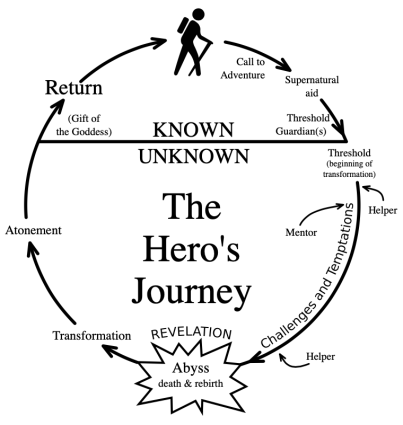
But the book may also be a corporatized version of Joseph Campbell’s hero’s journey from The Hero With A Thousand Faces aka Star Wars). You can plug Daniel Ek into the hero’s role pretty easily:
Barely a page into the book “Spotify Untold,” Swedish authors Jonas Leijonhufvud…and Sven Carlsson paint an odd scene. The year is 2010 and Spotify co-founder and CEO Daniel Ek [the hero] is facing a succession of obstacles [the Threshold Guardians] gaining entry into the U.S. market [the region of supernatural wonder] — or, more specifically, infiltrating the tightly-networked and often nepotistic to a fault music industry. [Unwelcoming of the stranger from Asgard, so unlike Silicon Valley.] As stress sets in [Challenges and Temptations], Ek becomes convinced that Apple’s Steve Jobs is calling his phone just to breathe deeply on the other end of the line, he purportedly confesses to a colleague[a Helper].
There’s a saying, “don’t speak ill of the dead.” That’s probably a bit superstitious for the authors, but is good advice. It’s unbecoming and Spotify should denounce it, although it’s highly unlikely that they will given their fatal attraction to PR disasters.
There’s also a saying, “don’t mock the afflicted,” so before you laugh hysterically at the story, realize that Steve Jobs caring enough about Daniel Ek to do such a thing (which assumes Steve knew Daniel Ek existed) was something that was very important to Daniel Ek. Or in a word–is Daniel Ek more Loki than Thor?
What is really objectively and factually odd about the authors’ 2010 Steve Jobs story about heavy breathing phone calls is that Steve got a liver transplant in 2009 and was very, very sick throughout 2010–the year they say these calls occurred.
Steve left Apple for good in August 2011 and passed in October 2011. It is implausible to me that he was even paying attention to Daniel Ek in 2010, assuming that Steve even knew or cared who Daniel Ek was. Aside from the fact that at that time Spotify was small potatoes, Steve had many more important things on his mind like staying alive. Plus, in my experience if Steve was going to leave you a testy voicemail or phone call, you knew exactly who it was. Exactly.
I for one think that the entire anecdote simply does not scan and is unsubstantiated by the authors’ own admission. Bizarre. Freudian. Not to mention a crass and thoughtless smear against a man who really did change the world. Who can’t defend himself because he is dead.
Variety reports that the authors were not able to confirm this rather insulting and perverse allegation. But don’t let that stop anyone from publishing gossip.
What Variety does report is this statement from the authors:
To us, Ek’s claim is as a reflection of how paranoid and anxious he must have felt in 2010, when Spotify was being denied access to the U.S. market, in large part due to pressure from Apple. The major record companies seem to have been quite loyal to the iTunes Music Store, and to Jobs personally….Because Spotify was hindered by Steve Jobs [it’s called competition], it forced the company to sweeten its deals with the record companies [also called competition]….Spotify is challenging Apple on a legal level right now.We address Spotify’s constant struggle with Apple in our book. If Ek were to talk about such sensitive topics in book form, [Spotify would] do it in their own way with full control.
The first thing I thought of when reading the story of “Spotify Untold” was that very competition claim that Spotify is pursuing in Europe right now. That claim appears to have been scripted–Spotify pursued it with the Obama competition authorities a few years ago. And then of course there was the New York and Connecticut state competition claim that curiously came out the same time as Apple Music launched in the US, apparently manipulated by Spotify’s very own Clintonista lobbying operative who was a political ally of Eric Schneiderman the former (ahem) New York Attorney General. (Spotify tried to drag Universal into that one, too–so this is a movie script that Spotify pulls down every so often for a polish and sometimes changes the supporting characters.)
While the authors claim that they spoke to many Spotify executives but not Ek, the book still has curious timing–as does the authors’ disclaimer that the book is not connected to Spotify directly, the plausible deniability that is the hallmark of black bag operations.
And if you believe as I do that Daniel Ek actually hates the major labels (read the Spotify DPO filing and you’ll get the idea), it’s only natural that he would try to twist Sony and Universal into the story. He just didn’t know that his major label negotiation experience was garden variety stuff and not unusual in any way. They didn’t get stock in iTunes so they damn well would in everything that came after iTunes. Daniel Ek was not singled out–rather, he opted in.
I would be very curious to know why the authors of “Spotify Inifrån” came away from their research thinking that the major labels were “quite loyal” to iTunes and to Steve Jobs. While that may have been true of certain executives, the reason that the labels required licensees to sell in Windows Media DRM (i.e., the format nobody wanted) was because they wanted to encourage competition with iTunes.
The labels eventually ended that failed policy after Steve called them out and suggested that they drop the DRM part (about which I strongly agreed in one of the first posts on MusicTechPolicy in 2006). Even after the labels dropped that failed idea, record companies large and small did not want a single digital retailer dominating the online market. So the idea that they colluded with Steve Jobs and Apple to make life difficult for a poor little hacker boy from Sweden is so inconsistent with reality to be laughable.
In fact, one could argue that were it not for Steve asking for more competition with iTunes Music Store (and in fairness, sell more iPods and later iPhones), there may never have been a Spotify at all. What that does not include is the accelerating failing belief in one of Spotify’s major selling point–the free service converts users from piracy to a paid service. That didn’t happen at anything like the rates that Spotify sold, nobody believes it anymore and it was unbelievable in the first place. But exactly what you’d expect a hacker to say.
And here’s some other research that got left out: Spotify’s psychographic data profiling is largely based on the work of Dr. Michael Kosinski, whose work also inspired the techniques of Cambridge Analytica and the Internet Research Agency. See Kosinski et al, The Song Is You: Preferences for Musical Attribute Dimensions Reflect Personality (2016). More on this influence another time.
So why would these authors be slinging this unlikely brew? It’s possible that the book is an answer to “Spotify Teardown,” funded by a grant and published (in English) earlier in 2019 with a much less mythological and much more recognizable approach to a Spotify reality according to an NPR review:
[“Spotify Teardown”] argues that Spotify isn’t a media company per se – and…asserts that it’s structurally much closer to a Facebook or Google, particularly in its digital business model. Indeed, Spotify was never really so much a music company as an Internet brand. “Spotify’s business model never benefited all musicians in the same manner but rather appeared — and still appears — highly skewed toward major stars and record labels, establishing a winner-takes-all market familiar from the traditional media industries.”
You won’t find that in a corporate bio. That sounds like the streaming gentrification reality and definitely wasn’t written by anyone named Justin. So while I don’t know what motivated the “Spotify Inifrån” authors, I do think that there’s a definite whiff of Astroturf in a book that tells a story that fits almost perfectly with the hero’s journey that Spotify would like to be telling competition authorities. I think the authors are aware of this, hence their disclaimers.
And I’m still waiting for the last leg of Daniel Ek’s hero’s arc, the transformation and atonement. Which is the part that makes the hero a hero. As the authors tell us, “[Spotify] would probably rather tell their story themselves than have us do it for them, but I think they understand our role as journalists.”
I just bet they do.
But look–credit where credit’s due. Ek used the music to make himself rich and he changed the economics of the music industry to keep making himself even richer. He gets million dollar performance bonuses when he doesn’t meet his performance targets. There are a growing number of niche and cultural artists who hate him. He’s also changed the way that fans interact with music online through the use of personality traits and data profiling instead of genre or artist based selection. And he invented “streaming friendly music” to the great joy of elevator operators everywhere.
For all his idiosyncrasies, Steve is largely revered and recognized as someone who really did change the world. Or as Daniel Ek tweeted when Jobs passed in 2011–after supposedly being harassed by Steve:
“Thank you Steve. You were a true inspiration in so many parts of my life, both personal and professional. My hat off to our time’s Da Vinci.”
Exactly. That Danny is a complex little man.
Remember those Mac/PC ads? You could just as easily run the same ad campaign for Spotify/Apple Music with only a few tweaks. And when it comes to marketing, what should be keeping Ek up at night is not devising sick stories he can tell about Steve Jobs but rather very justified fear of what will happen when Apple turns its marketing team loose on Spotify. He ain’t seen nothing yet.
If you think this is paranoid, watch this video from the distinguished journalist Sharyl Attkisson. Let’s just say I don’t put anything past these guys.






 The Trichordist
You must be logged in to post a comment.