Hear from SoundExchange President and CEO @mikehuppe on the Tech Talks Daily Podcast, hosted by @neilchughes, discussing advancements in music tech and our continued fight for fair protections for all creators around the world.
— SoundExchange (@SoundExchange) July 7, 2025
đ§: https://t.co/KeP8pBpyrH
Category: SoundExchange
Does AFM/SAG-AFTRA Fund Have Money for You?
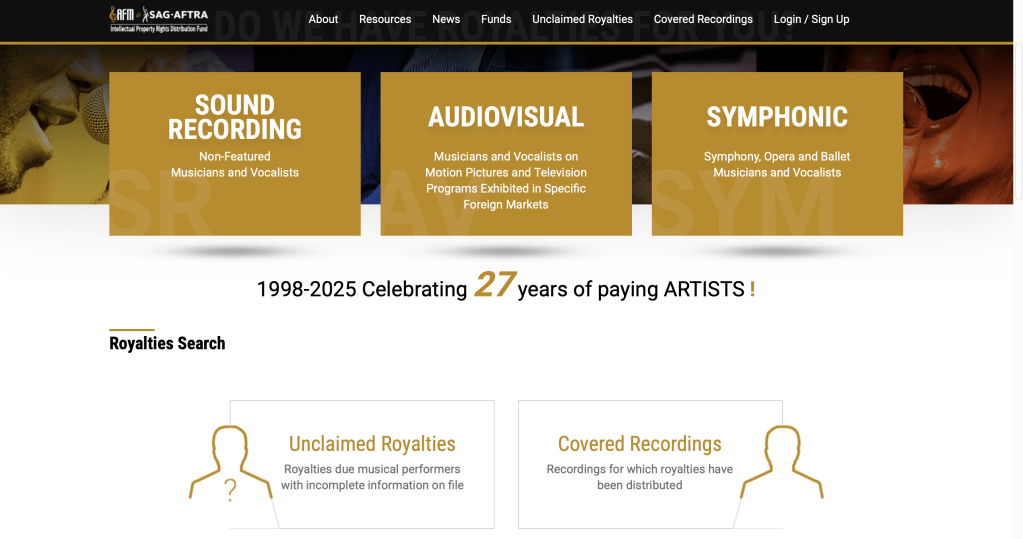
Remember, 5% of 100% of SoundExchange royalties are paid to the AFM/SAG-AFRA Intellectual Property Rights Distribution Fund. The Fund in turn pays a share of that royalty payment to the nonfeatured musician and vocalist performers. You need to check if the Fund is holding any royalties for you through their searchable index here.
A Long-Overdue Win for Artists: CRB’s Web VI Rates Mark Major Step Toward Fairer @SoundExchange Streaming Royalties
In a landmark development for recording artists, the Copyright Royalty Board (CRB) has proposed new royalty rates under the “Web VI” proceeding, covering the period 2026 through 2030. These rates govern how much commercial broadcasters must pay for streaming sound recordings under the statutory licenses set forth in Sections 112 and 114 of the U.S. Copyright Act.
The new rates reflect the culmination of years of advocacy by SoundExchange and artist-rights groups and represent another meaningful upward adjustments in royalty rates. The Copyright Royalty Judges have adopted a meaningful schedule of increasesâboth in per-stream royalties and in the minimum annual fees webcasters must payâdesigned to better align statutory streaming compensation with market realities. (Unlike streaming mechanical rates, webcasting royalties are a penny rate per play.)
A Clear Victory in Numbers
| Year | Web V Per-Performance Rate | Web VI Per-Performance Rate | % Increase Over Web V | Web V Min. Annual Fee | Web VI Min. Annual Fee / % Increase |
| 2026 | $0.0021 | $0.0028 | +33.33% | $1,000 | $1,100 / +10.00% |
| 2027 | $0.0021 | $0.0029 | +38.10% | $1,000 | $1,150 / +15.00% |
| 2028 | $0.0021 | $0.0030 | +42.86% | $1,000 | $1,200 / +20.00% |
| 2029 | $0.0021 | $0.0031 | +47.62% | $1,000 | $1,250 / +25.00% |
| 2030 | $0.0021 | $0.0032 | +52.38% | $1,000 | $1,250 / +25.00% |
These increases aren’t merely arithmetic; they represent a philosophical shift in how creators are valued in the digital economy.
Structural Adjustments
Beyond the rate hikes, the CRB has adopted operational changes proposed by SoundExchange to royalty reporting and distribution. For example:
– The late fee for audit-based underpayments is reduced from 1.5% to 1.0% per month, capped at 75% of the total underpayment.
– Starting in 2027, webcasters using third-party vendors must obtain transmission and usage data or contractually guarantee its delivery.
– If a commercial broadcaster fails to file a report of use, SoundExchange may now distribute royalties based on proxy data.
These tweaks aim to close loopholes and increase reliability in royalty trackingâcritical steps toward a more transparent system.
The Road Ahead
While the Web VI proposal rule will be final after June 16, 2025, it is already being hailed as a pivotal win by artist advocates. For too long, streaming-era economics have undervalued creators in favor of platforms and intermediaries.
This ruling is a recognitionâlong overdue and hard-won. When finalized, the Web VI clear and easy to understand rates and terms will not only ensure a greater financial contribution for featured and nonfeatured recording artists and rights holders, but also reassert the foundational principle that creators should be paid fairly when their work fuels billion-dollar platforms.
For artists and musicians navigating a shifting industry, the law is catching up with the market it governs on the side of the creators who drive the business.
Of course, don’t forget that some of these same broadcasters who pay under the statutory license for streaming do not pay anything to artists for over the air broadcast of terrestrial radio for the exact same plays of the exact same records–another reason that Congress must finally pass the American Music Fairness Act. That’s why we support the #IRespectMusic campaign and the MusicFirst Coalition. Ask Congress to support musicians here.
MTP Interview: Attorney Tim Kappel and Abby North Discuss Landmark Vetter v. Resnick case with Chris Castle
In a rare treat, Abby North and Chris Castle got to speak with New Orleans attorney Tim Kappel about his client’s case Vetter v. Resnick. The landmark case stands for winning the long-fought principle that termination rights in copyright cause the transfer of the worldwide copyright not just US rights as had been the business practice. The case is a major victory for songwriters and their heirs.
Cyril Vetter and Don Smith co-wrote the song “Double Shot (Of My Baby’s Love)” in 1962. They assigned all their interests in the song to Windsong Music Publishers. Vetter later served a termination notice on Resnick to recapture his rights under the U.S. Copyright Act, arguing that this termination applied globally, not just in the U.S. Resnick rejected Vetter’s global termination and Vetter sued for declaratory relief in the Middle District of Louisiana.
In a major win for songwriters and their heirs, Chief District Judge Shelly D. Dick agreed with Vetter, granting him worldwide rights to the song, which contradicted established but inequitable business practices in the U.S. music publishing industry. In the podcast, Chris Castle and Abby North discuss the case with Vetter’s attorney, Tim Kappel. These documents are referenced in the podcast.
@MikeHuppe: Protecting the Creative Class
Guest post By Mike Huppe
President & CEO at SoundExchange
Creators â whether they be writers, actors, or musicians â are the heart of the entertainment industry. They inspire us with their words, move us with their performances, and get our blood pumping with their beats.
Now two of the major unions representing creators â the Writers Guild of America (WGA) and the Screen Actors Guild (SAG-AFTRA) â have gone on strike to make the case for better pay and residuals, improved working conditions, fairer treatment in the age of streaming, and protections against the widespread use of artificial intelligence to replace creators.
This is the first time that writers and actors have gone on strike at the same time since 1960, and it has brought the movie and TV industry to a virtual standstill. After cable increased content to fill a new crop of channels, streaming platforms fueled an explosion of new series and features to feed a new business model. Now, production has ground to a halt and the availability of new movies and shows will dwindle in the coming days, weeks, and months.
At its core, this dispute is about ensuring that, even as business models evolve and change, creators are treated fairly so they can continue to do the work that brings meaning to them and joy to us.
At SoundExchange, we love creators. We champion their work. Weâve seen the music industry go through technology-driven disruption (just as the motion picture industry is now), and we were created to ensure that streaming music business models enable creators to make a living doing what they do best. Weâve been fighting for 20 years to build a fairer, simpler, and more efficient music industry â by successfully increasing royalty rates across a variety of platforms; by holding accountable those who seek to cheat creators; by increasing the speed and transparency of payments, and by scoring a big win for music creators with the Music Modernization Act in 2018 (which provide comprehensive music licensing reform).
And we continue to fight these battles.
As streaming matures and new royalty models are debated, and as technology platforms evolve in Web3 and the metaverse, SoundExchange will remain a strong and vocal voice to ensure creators are fairly compensated. As artificial intelligence improves and matures at an astounding rate, SoundExchange became a founding member of the Human Artistry CampAIgn to demand that the rights of human creators are at the center of any copyright and intellectual property decisions, and we are proud that both SAG-AFTRA and the Writers Guild of America (WGA) are among the coalitionâs members.
And itâs worth noting that music performers are still not compensated â at all — for their work when played on AM/FM broadcast radio. For this reason, SoundExchange is a driving force in the effort to convince Congress to act on the American Music Fairness Act, which would require multi-billion-dollar radio corporations to pay performance royalties like digital streaming platforms do.
So, to the creators out there on strike, we say this. We stand with you and hope that these disputes can be resolved quickly in a way that supports fair treatment, compensation, and protections for creators. And for those of you who are registered with SoundExchange, we will continue to work every day to make sure that you receive the digital royalties that you are due in a timely manner.
We know this mission matters more now than ever.
[This post first appeared on LinkedIn]
@repdarrellissa on #AMFA: The right number is not zero #IRespectMusic
Starting with Frank Sinatra on December 12, 1988–nearly 34 years ago to the day–artists have campaigned for fair treatment in line with the rest of the world and get a performance royalty for broadcast radio. The House Judiciary Committee led by the stalwart Rep. Jerry Nadler moved that goal a little closer this week by passing HR 4130, the American Music Fairness Act, out of committee.
Almost as significant as the vote was the comments by Rep. Jim Jordan and Rep. Darrell Issa (the remaining author of the bill after the wonderful Rep. Ted Deutch announced he would not run for reelection). Given the party change in the House next session, Rep. Jordan is the front runner for Chair of the House Judiciary Committee. He was very clear that the committee will be taking up the bill if it doesn’t pass in the lame duck, because it is time to resave this unfairness. Rep. Darrell Issa summed it up: It is time for bipartisan compromise so that America is not in the same category as North Korea, Cuba and Iran, and whatever the right number is it is not zero.
This is not where we needed up before on prior versions of the legislation. We are in a much, much better place than before. I would say that’s for two reasons. First, because the legislation itself addresses radio’s objections and makes the NAB’s mean-spirited lobbying tactics ring hollow and cheap. That dog just won’t hunt anymore.
The other reason is because of a superb messaging effort by the MusicFirst Coalition under new management. MusicFirst under Joe Crowley took their job seriously and understood their job to be very simple: We win, they lose. Too often, lobbyists view their job as perpetuating the conflict so the money keeps flowing. You can tell when you are in one of those because the organization doesn’t seem to quite get it that when you have fewer points when the clock runs out, we call that losing. Even in Washington.
Turning this beast around was a tough job and the entire MusicFirst team deserves recognition and appreciation. We’re not done–there may still be some magic tricks left in this session. But as Congressmen Jordan and Issa said, if the bill doesn’t pass this session, they are committed to taking it up early next session and getting it passed in the House.
Godspeed to everyone who has worked so hard for so long to make this a reality for all of our artists and musicians who need it. It’s what Frank would do.
San Antonio Musicians: Texas Public Radio Presents the Music Artist Forum TODAY
Get more info and materials here
TPR Music Artist Forum | In Partnership with SLATT Management
Musicians of all ages are invited to a networking workshop and panelist discussion dedicated to understanding the future of music technology, copyright law, entertainment law, obtaining royalties, and navigation of music streaming services.
Address:
321 W. Commerce St, San Antonio, TX 78205
Doors open at 6:30pm.Â
Panelist discussion will take place at 7:00pm.
Guest Panelists:
Ondrejia Scott | 7:00pm – 7:10pm
Chris Castle | 7:10pm – 7:20pm
Krystal Jones | 7:20pm – 7:30pm
Dr. Steven Parker | 7:30pm – 7:40pm
Linda Bloss-Baum | 7:40pm – 7:50pm
Food and drinks will be provided.
Musicians are welcome to submit an original track to be featured on our TPR Music Artist Forum playlist:
Professional headshots will be offered free of charge by Oscar Moreno.
We will be ending out the night with a special live performance by J. Darius live in the MalĂș and Carlos Alvarez Theater.
RSVP here to reserve your spot for this free event!
@SoundExchange CEO @mikehuppe Nails NAB Hypocrisy on Artist Pay for Radio Playâ#IRespectMusic â Artist Rights Watch

The hearing on Groundhog Day (Feb. 2) for the American Music Fairness Act (or âAMFAâ) was a fantastic opportunity for artists to be heard on the 100 year free ride the government has given broadcast radio. We know it went well because the National Association of Broadcasters sputtered like they do when theyâve got nothing to say.
But whatâs really hysterical was how they talked out of both sides of their mouths in two different hearingsâwhich makes you think that NAB president Curtis LeGeyt was doing his impression of Punxsutawney Phil. Yes, when it came to broadcasters getting paid by Big Tech, the broadcasters wanted their rights respected and to be paid fairly. But when the shoe was on the other foot, not so much. In the Senate, the NAB asked for more money for broadcasters in a hearing for the Journalism Competition and Preservation Actâto protect the mega radio broadcasters from the mega tech oligarchs. And if broadcasters donât get more money, they want to be exempt from the antitrust laws so they can pull their content. Just like artists do to themâŠNOT.
Then the NAB comes over to the House Judiciary Committeeâon the same day being Groundhog Dayâand asks the government to continue their 100 year free ride. We call bullshit.
SoundExchange CEO Mike Huppe nailed this in his Billboard post:
The AMFA witnesses didnât ask for an antitrust exemption, like the broadcasters did. They simply asked that recording artists be granted similar copyrights as others.
They didnât ask for more money, like the broadcasters did. They simply asked for at least some payment, since they now receive none when broadcast radio stations air their music.
They didnât ask for special treatment, like the broadcasters did. Rather they asked that they be treated the same as all other artists around the world, and even the same as artists on virtually all other media platforms in the U.S.And they didnât ask for rigts to negotiate and withhold content, like the broadcasters did. Under AMFA, radio stations would still be allowed to play music as they please. Artist advocates simply asked that the biggest-of-the-big stations pay a modest royalty set according to market rates. Stations making less than $1.5 million per year would pay a flat, annual royalty of $500 (less than $1.40 per day) for as much music as they choose to air. And the smallest stationsâ payments would drop all the way down to $10.
No station is going to go bankrupt over these royalties.
Huppe has a very strong point here. This legislation has been picked over for years. AMFA bends over backwards to protect community radio and small broadcasters and repects everyoneâs contribution to radioâs success.
But thatâs the pointâit respects everyoneâs contribution.
You can watch the hearing here:
The Copyright Royalty Board Gets It Right: New Increased Inflation-Adjusted Royalty Rates for Webcasting–MusicTechPolicy
[This post first appeared on the MusicTechPolicy blog]
by Chris Castle
The Copyright Royalty Board has announced its decision on webcasting rates under §114 for 2021-25 and it’s good news for non-featured artists, featured artists and sound recording copyright owners. The rates are set for 2021, paid retroactively to January 1.
| Service | New Rate Per Performance 2021 | Old Rate Per Performance 2020 | Increase |
| Commercial Nonsubscription | $0.0021 | $0.0018 | +17% |
| Commercial Subscription | $0.0026 | $0.0024 | +8% |
| Noncommercial Webcaster (Non-educational) | $1000 per station or channel up to 159,140 Aggregate Tuning Hours/month Overage at $0.0021 per performance | $500 per station or channel up to 159,140 Aggregate Tuning Hours/month. Overage at $0.0018 per performance | Per-station: +100% Overage: +17% |
After 2022, these rates are adjusted by the Consumer Price Index (CPI-U for the geeks).
The Copyright Royalty Judges shall adjust the royalty fees each year to reflect any changes occurring in the cost of living as determined by the most recent Consumer Price Index for All Urban Consumers (U.S. City Average, all items) (CPI-U) published by the Secretary of Labor before December 1 of the preceding year.
So it is clear that the CRB can come up with reasonable rates when they’re asked. It’s also a great example of the power of strong bargaining groups including SoundExchange, the unions, indie and major record companies, and a broad cross-section of music users.
Rates for noncommercial educational webcasters, satellite radio, audio for business establishments and some others â are decided in a different process. Their 2021 rates for these service are on the SoundExchange website.


You must be logged in to post a comment.