@ArtistRights Institute Newsletter 5/5/25

The Artist Rights Watch podcast returns for another season! This week’s episode features Chris Castle on An Artist’s Guide to Record Releases Part 2. Download it here or subscribe wherever you get your audio podcasts.

New Survey for Songwriters: We are surveying songwriters about whether they want to form a certified union. Please fill out our short Survey Monkey confidential survey here! Thanks!

Texas Scalpers Bill of Rights Legislation

Can this Texas House bill help curb high ticket prices? Depends whom you ask (Marcheta Fornoff/KERA News)

Texas lawmakers target ticket fees and resale restrictions in new legislative push (Abigail Velez/CBS Austin)

@ArtistRights Institute opposes Texas Ticketing Legislation the “Scalpers’ Bill of Rights” (Chris Castle/Artist Rights Watch)

Streaming

Spotify’s Earnings Points To A “Catch Up” On Songwriter Royalties At Crb For Royalty Justice (Chris Castle/MusicTechPolicy)

Streaming Is Now Just As Crowded With Ads As Old School TV (Rick Porter/Hollywood Reporter)

Spotify Stock Falls On Music Streamer’s Mixed Q1 Report (Patrick Seitz/Investors Business Daily)

Economy

The Slowdown at Ports Is a Warning of Rough Economic Seas Ahead (Aarian Marshall/Wired)

What To Expect From Wednesday’s Federal Reserve Meeting (Diccon Hyatt/Investopedia)

Spotify Q1 2025 Earnings Call: Daniel Ek Talks Growth, Pricing, Superfan Products, And A Future Where The Platform Could Reach 1bn Subscribers (Murray Stassen/Music Business Worldwide)

Artist Rights and AI

SAG-AFTRA National Board Approves Commercials Contracts That Prevent AI, Digital Replicas Without Consent (JD Knapp/The Wrap)

Generative AI providers see first steps for EU code of practice on content labels (Luca Bertuzzi/Mlex)

A Judge Says Meta’s AI Copyright Case Is About ‘the Next Taylor Swift’ (Kate Knibbs/Wired)

Antitrust

Google faces September trial on ad tech antitrust remedies (David Shepardson and Jody Godoy/Reuters)

TikTok

Ireland fines TikTok 530 million euros for sending EU user data to China (Ryan Browne/CNBC)

Spotify Makes Kate Nash’s Argument With the Usual Blame Game

Daniel Ek is indifferent to whether the economics of streaming causes artists to give up or actually starve to actual death. He’s already got the tracks and he’ll keep selling them forever like an evil self-licking ice cream cone.

Kate Nash is the latest artist to slam Spotify’s pathetic royalty payments even after the payola and the streaming manipulation with the Orwellian “Discovery Mode” as discovered by Liz Pelly. According to Digital Music News, Kate Nash says: 

“‘Foundations’ has over 100 million plays on Spotify — and I’m shocked I’m not a millionaire when I hear that! I’m shocked at the state of the music industry and how the industry has allowed this to happen,” said Nash. “We’re paid very, very, very poorly and unethically for our recorded music: it’s like 0.003 of a penny per stream. I think we should not only be paid fairly, but we should be paid very well. People love music and it’s a growing economy and there are plenty of millionaires in the industry because of that, and our music.”

But then she said the quiet part out loud that will get them right in their Portlandia hearts:

She added: “And what they’re saying to artists from non-rich privileged backgrounds, which is you’re not welcome here, you can’t do this, we don’t want to hear from you. Because it’s not possible to even imagine having a career if you don’t have a privileged background or a privileged situation right now.”

This, of course, comes the same time that Spotify board members have cashed out over $1 billion in stock including hundreds of millions to Daniel Ek personally, speaking of privilege.

Using forks and knives to eat their bacon

Spotify responds with the same old whine that starts with the usual condescending drivel, deflection and distraction:

“We’re huge fans of Kate Nash. For streams of her track ‘Foundations’ alone — which was released before Spotify existed — Spotify has paid out around half a million pounds in revenue to Kate Nash’s rights holders,” reads Spotify’s statement.

“Her most streamed songs were released via Universal Music Group. Spotify has no visibility over the deals that Kate signed with her rights holders. Therefore, we have no knowledge of the payment terms that were agreed upon between her and her partners.”

This is a very carefully worded statement–notice that they switch from the specific to the general and start talking about “her rights holders”. That means no doubt that they are including the songwriters and publishers of the compositions, so that’s bullshit for starters. But notice how they are making Kate’s own argument here by trying to get you to focus on the “big check” that they wrote to Universal.

Well, last time I checked in the world of arithmetic, “around half a million pounds” (which means less than, but OK) divided by 100,000,000 streams is…wait for it…shite. £0.005 per stream–at the Universal level but all-in by the sound of it, i.e., artist share, label share, songwriters and publishers. This is why Spotify is making Kate’s argument at the same time they are trying to deflect attention onto Universal.

Then–always with an eye on the DCMS authorities in the UK and the UK Parliament, Spotify says:

“We do know that British artists generated revenues of over £750 million on Spotify alone in 2023 — a number that is on the rise year on year — so it’s disappointing to hear that Spotify’s payments are not making it through to Kate herself,” the company concluded.

Oh, so “disappointed.” Please spare us. What’s disappointing is that the streaming services participate in this charade where their executives make more in one day of stock trading than the company’s entire payments to UK artists and songwriters.

This race to the bottom is not lost on artists.  Al Yankovic, a card-carrying member of the pantheon of music parodists from Tom Leher to Spinal Tap to The Rutles, released a hysterical video about his “Spotify Wrapped” account.  

Al said he’d had 80 million streams and received enough cash from Spotify to buy a $12 sandwich.  This was from an artist who made a decades-long career from—parody.  Remember that–parody.

Do you think he really meant he actually got $12 for 80 million streams?  Or could that have been part of the gallows humor of calling out Spotify Wrapped as a propaganda tool for…Spotify?  Poking fun at the massive camouflage around the Malthusian algebra of streaming royalties gradually choking the life out of artists and songwriters? Gallows humor, indeed, because a lot of artists and especially songwriters are gradually collapsing as the algebra predicted.

The services took the bait Al dangled, and they seized upon Al’s video poking fun at how ridiculously low Spotify payments are to make a point about how Al’s sandwich price couldn’t possibly be 80 million streams and if it were, it’s his label’s fault.  Just like Spotify is blaming Universal rather than take responsibility for once in their lives. 

Nothing if not on message, right? As Daniel Ek told MusicAlly, “There is a narrative fallacy here, combined with the fact that, obviously, some artists that used to do well in the past may not do well in this future landscape, where you can’t record music once every three to four years and think that’s going to be enough.” This is kind of like TikTok bragging about how few children hung themselves in the latest black out challenge compared to the number of all children using the platform. Pretty Malthusian. It’s not a fallacy; it’s all too true.

I’d suggest that Al and Kate Nash were each making the point–if you think of everyday goods, like bacon for example, in terms of how many streams you would have to sell in order to buy a pound of bacon, a dozen eggs, a gallon of gasoline, Internet access, or a sandwich in a nice restaurant, you start to understand that the joke really is on us. The best way to make a small fortune in the streaming business is to start with a large one. Unless you’re a Spotify executive, of course.

@Artist Rights Institute Newsletter 4/7/25

The Artist Rights Institute’s news digest Newsletter

The Artist Rights Watch podcast returns for another season!  First episode is Tim Kappel discussing the Vetter v. Resnik landmark copyright termination case. Follow us wherever you get your podcasts.

New Survey for Songwriters: We are surveying songwriters about whether they want to form a certified union. Please fill out our short Survey Monkey confidential survey here! Thanks!

Streaming Meltdown

White Noise Is Hugely Popular on Streaming Services. Should It Be Devalued? (Kristin Robinson/Billboard) (Subscription)

Polly Pockets Strikes Again: DANIEL EK POCKETS ANOTHER $27.6M FROM SELLING SPOTIFY SHARES – CASHING OUT OVER $750M SINCE 2023 (Mandy Daludgug/MusicBusinessWorldwide)

THY ART IS MURDER Vocalist Quits Over Finances: “I Can’t Live Like This Anymore” (Robert Pasbani/Metal Injection)

AI Litigation

U.S. District Judge Sidney Stein order in New York Times et al v. Microsoft, OpenAI et al

NYT v MSFT-OpenAI MTDDownload

Judge explains order for New York Times in OpenAI copyright case (Blake Brittan/Reuters)

OpenAI, Google reject UK’s AI copyright plan (Joseph Bambridge/Politico EU)

Mechanical Licensing Collective

Shhh…It’s a Secret! How is the MLC “Hedge Fund” Performing in the Global Market Crash (Chris Castle/MusicTechPolicy)

Ticketing

If it Looks Like a Duck and Quacks Like a Duck, Deny Everything: The ALEC Ticketing Bill Surfaces in Texas to Rip Off Artists (Chris Castle/MusicTechPolicy)

Tickets to Beyonce’s ‘Cowboy Carter’ Shows Bottoming Out at $25 In LA, New Jersey (Ashley King/Digital Music News)

TikTok Divestment

TikTok Extended Again (Chris Castle/MusicTech.Solutions)

And After All That, TikTok Could Still Go Poof (Paul Resnikoff/Digital Music News)

Books

Understanding the China Threat by Lianchao Han and Bradley A. Thayer

Brookings experts’ reading list on US-China strategic relations

Global Soft Power Index 2024 by Konrad Jagodzinski/Brand Finance

Does it have an index? @LizPelly’s Must-Read Investigation in “Mood Machine” Raises Deep Questions About Spotify’s Financial Integrity

Spotify Playlist Editors

By Chris Castle

If you don’t know of Liz Pelly, I predict you soon will. I’ve been a fan for years but I really think that her latest work, Mood Machine: The Rise of Spotify and the Costs of the Perfect Playlist, coming in January by One Signal Publishers, an imprint of Atria Books at Simon & Schuster, will be one of those before and after books. Meaning the world you knew before reading the book was radically different than the world you know afterward. It is that insightful. And incriminating.

We are fortunate that Ms. Pelly has allowed Harper’s to excerpt Mood Machine in the current issue. I want to suggest that if you are a musician or care about musicians, or if you are at a record label or music publisher, or even if you are in the business of investing in music, you likely have nothing more important to do today than read this taste of the future. 

The essence of what Ms. Pelly has identified is the intentional and abiding manipulation of Spotify’s corporate playlists. She explains what called her to write Mood Machine:

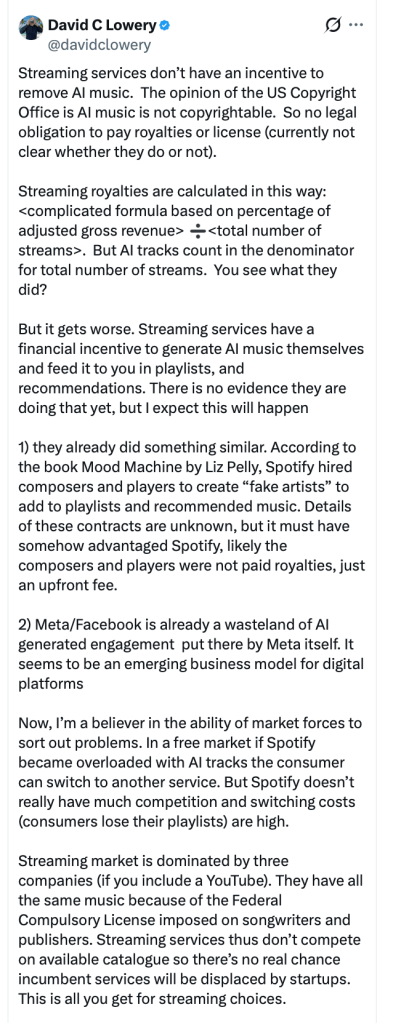
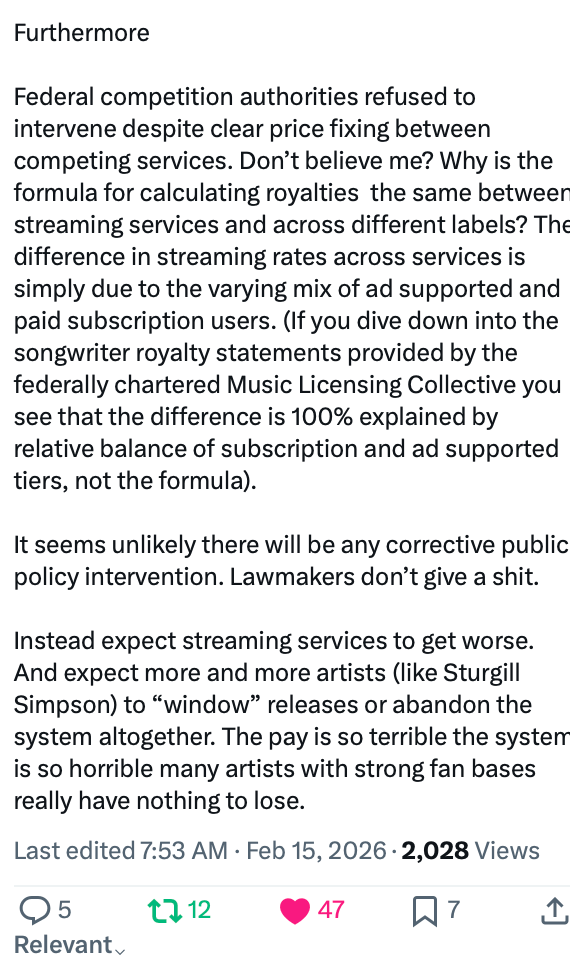
Spotify, the rumor had it, was filling its most popular playlists with stock music attributed to pseudonymous musicians—variously called ghost or fake artists—presumably in an effort to reduce its royalty payouts. Some even speculated that Spotify might be making the tracks itself. At a time when playlists created by the company were becoming crucial sources of revenue for independent artists and labels, this was a troubling allegation.

What you will marvel at is the elaborate means Ms. Pelly has discovered–through dogged reporting worthy of the great deadline artists–that Spotify undertook to deceive users into believing that playlists were organic. And, it must be said, to deceive investors, too. As she tells us:

For years, I referred to the names that would pop up on these playlists simply as “mystery viral artists.” Such artists often had millions of streams on Spotify and pride of place on the company’s own mood-themed playlists, which were compiled by a team of in-house curators. And they often had Spotify’s verified-artist badge. But they were clearly fake. Their “labels” were frequently listed as stock-music companies like Epidemic, and their profiles included generic, possibly AI-generated imagery, often with no artist biographies or links to websites. Google searches came up empty.

You really must read Ms. Pelly’s except in Harper’s for the story…and did I say the book itself is available for preorder now?

All this background manipulation–undisclosed and furtive manipulation by a global network of confederates–was happening while Spotify devoted substantial resources worthy of a state security operation into programming music in its own proprietary playlists. That programmed music not only was trivial and, to be kind, low brow, but also essentially at no cost to Spotify. It’s not just that it was free, it was free in a particular way. In Silicon Valley-speak, Ms. Pelly has discovered how Spotify disaggregated the musician from the value chain.

What she has uncovered has breathtaking implications, particularly with the concomitant rise of artificial intelligence and that assault on creators. The UK Parliament’s House of Commons Digital, Culture, Media & Sport Committee’s Inquiry into the Economics of Music Streaming quoted me as saying “If a highly trained soloist views getting included on a Spotify “Sleep” playlist as a career booster, something is really wrong.” That sentiment clearly resonated with the Committee, but was my feeble attempt at calling government’s attention to then-only-suspected playlist grift that was going on at Spotify. Ms. Pelly’s book is a solid indictment–there’s that word again–of Spotify’s wild-eyed, drooling greed and public deception. 

Ms. Pelly’s work raises serious questions about streaming payola and its fellow-travelers in the annals of crime. The last time this happened in the music business was with Fred Dannen’s 1991 book called Hit Men that blew the lid off of radio payola. That book also sent record executives running to unfamiliar places called “book stores” but for a particular reason. They weren’t running to read the book. They already knew the story, sometimes all too well. They were running to see if their name was in the index.

Like the misguided iHeart and Pandora “steering agreements” that nobody ever investigated which preceded mainstream streaming manipulation, it’s worth investigating whether Spotify’s fakery actually rises to the level of a kind of payola or other prosecutable offense. As the noted broadcasting lawyer David Oxenford observed before the rise of Spotify:

The payola statute, 47 USC Section 508, applies to radio stations and their employees, so by its terms it does not apply to Internet radio (at least to the extent that Internet Radio is not transmitted by radio waves – we’ll ignore questions of whether Internet radio transmitted by wi-fi, WiMax or cellular technology might be considered a “radio” service for purposes of this statute). But that does not end the inquiry.Note that neither the prosecutions brought by Eliot Spitzer in New York state a few years ago nor the prosecution of legendary disc jockey Alan Fried in the 1950s were brought under the payola statute. Instead, both were based on state law commercial bribery statutes on the theory that improper payments were being received for a commercial advantage. Such statutes are in no way limited to radio, but can apply to any business. Thus, Internet radio stations would need to be concerned.

Ms. Pelly’s investigative work raises serious questions of its own about the corrosive effects of fake playlists on the music community including musicians and songwriters. She also raises equally serious questions about Spotify’s financial reporting obligations as a public company.

For example, I suspect that if Spotify were found to be using deception to boost certain recordings on its proprietary playlists without disclosing this to the public, it could potentially raise issues under securities laws, including the Sarbanes-Oxley Act (SOX). SOX requires companies to maintain accurate financial records and disclose material information that could affect investors’ decisions.

Deceptive practices that mislead investors about the company’s performance or business practices could be considered a violation of SOX. Additionally, such actions could lead to investigations by regulatory bodies like the Securities and Exchange Commission (SEC) and potential legal consequences.

Publicly traded companies like Spotify are required to disclose “risk factors” in their public filings which are potential events that could significantly impact Spotify’s business, financial condition, or operations. Ms. Pelly’s reporting raises issues that likely should be addressed in a risk factor. Imagine that risk factor in Spotify’s next SEC filing? It might read something like this:


Risk Factor: Potential Legal and Regulatory Actions

Spotify is currently under investigation for alleged deceptive practices related to the manipulation of Spotify’s proprietary playlists. If these allegations are substantiated, Spotify could face significant legal and regulatory actions, including fines, penalties, and enforcement actions by regulatory bodies such as the Securities and Exchange Commission (SEC) and the Federal Trade Commission (FTC). Such actions could result in substantial financial liabilities, damage to our reputation, and a loss of user trust, which could adversely affect our business operations and financial performance.


[A version of this post first appeared in MusicTech.Solutions]

The Madness of Amazon’s Song Royalty Refund Demand

You can check out any time you like, but you can never leave.
Hotel California, written by Don Felder, Glenn Frey and Don Henley

There’s no opt-out in either the Hotel California or the compulsory song license. And Amazon’s demand for a royalty refund from songwriters demonstrates once again the madness of the Copyright Royalty Board rate-setting procedures. Whether it creates enough ripples in the booming business around buying out songwriter royalties remains to be seen.

How did we get to this point in the circus act? You may have noticed that sliced bread is in close competition with fire and the wheel for second place behind Greatest Human Accomplishments. Both fire and the wheel are yielding to streaming mechanical royalty rates in the Phonorecords III remand negotiations.  Yes, the so-called “headline rates” in Phonorecords III (or “PR III”) are a Nobel-worthy accomplishment.  At least according to the press agents.

And yet something curious has happened.  I’m told that Amazon, through its agent Music Reports (MRI), has posted what is essentially a demand letter in the MRI user portal.  This demand letter instructs publishers who have directly licensed songs to Amazon to pay up because of an overpayment of streaming mechanicals due to the adjustment required by the new-ish Phonorecords III remand rates that finally set the streaming mechanical rates for the industry.  Something similar may be happening at the MLC; we’ll come to that below in just a bit.

In a testament to just how whack the Copyright Royalty Board system actually is, the PR III remand concerns royalties paid from 2018 through 2022.  That’s right—starting six years ago.  This is largely due to the failure of the publishers to obtain a waiver of the PR III decision as a negotiating chip when they gave away the rest of the farm in Title I of the Music Modernization Act (also hailed as a great gift to songwriters). But I’d say it is primarily due to the desire of digital music services like Amazon—including the largest corporations in commercial history—to crush the kitchen tables of songwriters.  Because judging by the massive overlawyering in the Copyright Royalty Board, that sure looks like the motive.

And when it comes to the services crushing the little people, money is no object, even if they spend more on litigation than the royalty increase cost them.  Evidently the sadistic psychic benefit greatly exceeds the cost.

But Amazon evidently has discovered that even after all the shenanigans with PR III, it appears that they paid too much and now they want it back.  That’s right—Amazon shamelessly wants you to cut them a check.  Because a market value over $2,000,000,000,000 is just not enough. I wonder which buffoon advised Mr. Bezos that was a good idea.

Here’s what it looks like on MRI:

A few questions come to mind.  First, realize what Amazon is saying.  They were evidently accounting to publishers at the rates for Phonorecords II during the several years that the PR III rates were on appeal and then re-litigated before the Copyright Royalty Board.  The final PR III rates (sometimes called “remand rates”) issued in August of last year (2023) were supposed to be an improvement over the PR II rates don’t you know.  At least according to the braying that accompanied the announcement.  In fact, the PR III remand rates where it all ended up were themselves supposed to be an improvement, meaning that publishers were to be paid more under PR III than under PR II. Maybe that’s the difference between an increase in the payable rates compared to an increase in the payable royalties.

So if that’s true, and if Amazon paid PR II rates during the lengthy PR III appeal, why is there now an overpayment by Amazon?  An overpayment that they now want you to pay back? Wouldn’t you expect to see the true-up on new rates result in publishers receiving a credit for increased rates?  Especially if the stream counts and subscriber totals stayed the same on these previously-issued accounting statements? (Not to mention this may be happening at other services, too.)

Some of these PR III statements pre-date and overlap with the MLC’s creation and the “license availability date” for the 2021 blanket license established under Title I of the MMA.  That means that if you or your publisher had a direct deal with Amazon during the PR III rate period, there may be overlapping periods when the MLC took over Amazon’s accountings.

It has long been the standard industry practice that overpayments are just debited to your royalty account.  Nobody asks you to cut a check. Debiting your account is not much better–you still have to pay them back, and the so-called “overpayment” will still potentially zero out your MLC accounts, too. If you did a royalty buyout that included an assumption that these royalties would be paid, your financier may come up short under either direct license or MLC.

This is particularly true for publishing administrators.  If a service were to debit an administrator’s account, that might result in the administrator having to go out of pocket in order to pay some of their publishers for the amount of the demand. If that overpayment is large enough, that administrator may owe royalties to publishers that did not have the benefit of the overpayment. This is pretty elementary math, 2 plus 2 being what it is. You don’t even have to carry the 1.

However, great news!  Amazon will give you an interest-free payday loan so you can pay down your new debt over six months. Or before they send it to collection.

Now the MLC—it’s entirely possible that Amazon is pulling the same stunt under the statutory license. However, it appears that MLC is doing what is normally done in these situations and will be debiting and crediting as necessary.  If you’re concerned, it would be worth checking and asking for an explanation from the MLC.

Even so, it does not change anything about why there is an overpayment in the first place.  If there were ever a situation that cried out for an intensive royalty compliance exam, this is it.  It is hard to believe that all this to-ing and fro-ing with your royalty payments across multiple rates in multiple accounting periods hasn’t resulted in mistakes.  No crime, it’s complex.  That’s why we have audits. At a minimum, Amazon needs to provide publishers with a detailed breakdown of how the repayment was determined along with an explanation of where the rates changed that caused the overpayment.

That’s why Amazon and any other similarly situated service should welcome an extensive audit.  In fact, the MLC should just include the true-up (or true-down in Amazon’s case) in their already-noticed audit of Amazon. This episode also raises the question of who else is going to pull the same stunt.

This slice of life demonstrates once again how unworkable the entire Copyright Royalty Board system is for streaming mechanical royalties. The services get to drag out appeals forever, and songwriters pay the consequences. But like the man said, you can never leave. And the Music Modernization Act just got every one locked in even deeper.

[A version of this post first appeared on MusicTechPolicy]

MTP Interview: We ask @Creators_ECSA President @Helienne Lindvall to Explain the European Parliament’s Streaming Economy Report from the Committee on Culture and Education

This post first appeared on MusicTechPolicy by Chris Castle.

The Culture and Education of the European Parliament issued an important report on the state of the creative economy. Our friend Helienne Lindvall, President of the European Composer and Songwriter Alliance, gives us some insights into the report and the context.

I know ECSA was involved in testifying for the EU cultural diversity report, can you tell us a little about the report, what prompted it and how does it help or hurt?

Streaming and the amount of issues it brought with it has been at the top of the agenda for European songwriters since the launch of Spotify. As an Ivors Academy Board Director, I was part of the inception of the UK #FixStreaming campaign which resulted in the UK Government calling for a complete overhaul of music streaming, and for the creation of music industry working groups to fix these problems. Meanwhile, similar lobbying efforts have been applied in Brussels by music creators across Europe. The EU has a fine history of promoting, supporting and protecting culture – in 2019, legislators proved it by adopting the DSM Copyright Directive. Now we need it to step up to help create a sustainable streaming environment. 

Rapporteur Iban Garcia del Blanco and his fellow CULT MEPs took their time to really listen to and understand the reality that music authors (ie songwriters and composers) face, and our proposed remedies, and I think the report reflects that.

Is the report designed to shape future legislation or rulemaking in the EU?

We look forward to seeing the European Commission work on such a strategy and take concrete actions to build a fair and sustainable music streaming ecosystem for all music creators.. 

MEP Garcia del Blanco said at the press conference that he would prefer if the industry stakeholders could sit down and fix these problems without further legislation, but judging from our experience in the UK, certain areas are easier to get a consensus on than others. The UK metadata working group has set parameters for improvements, which I believe can easily be adopted across Europe and beyond. However, when it comes to remuneration and making it fairer for songwriters and performers, we have met with resistance from labels and platforms – unsurprisingly, perhaps. Getting increased transparency has also proved more difficult. If this resistance remains we will keep pushing for Government intervention and legislation. 

The report calls for a comprehensive and ambitious strategy based on independent data and a structured dialogue with all stakeholders, and we stand ready to work with the entire music value chain towards a fairer distribution of revenues, and we support the establishment of a European Music Observatory to collect and analyse data.

I noticed this language in the report calling on EU parliament:  “Calls for action to be taken at the European Union level to guarantee the visibility and accessibility of European musical works, considering the overwhelming amount of content constantly growing on music streaming platforms and the lack of Union rules to regulate them in a harmonised manner”.  and algorithmic dominance? 

It may come as no surprise that American and major label records still dominate on streaming platforms.

Is this designed to keep local language artists from being overwhelmed by English language tracks due to algorithmic bias or Spotify’s stream discrimination plans?

The short answer is: yes. During our stakeholder testimonials in the EU Parliament, Spotify claimed that streaming has increased diversity. And, yes, it may be true that some European countries have seen plenty of local acts in their local charts, though by no means all countries have experienced this, but on an international level there’s still a huge dominance of Anglo-American repertoire. Then we have the issue of the dominance of legacy artists and catalogue albums, such as ABBA, Fleetwood Mac and Elton John. 

In a post-Brexit reality, does the report have any effect on the UK?

The EU doesn’t have any legislative powers when it comes to the UK, due to Brexit, but as streaming is cross-border, as is the music industry, an improvement in either would have an impact on both. Some EU members have already implemented their own versions of equitable remuneration, such as Belgium and Spain – and France is establishing a streaming tax to support local music – but we would like to see solutions and changes that help ALL music creators, in particular songwriters, who currently are at the bottom when it comes to their share of the streaming royalty “pie”, and are finding it next to impossible to survive on their music, despite getting millions of streams. 

Given the attention that the Bad Dog story is getting, would the metadata accuracy proposals in the report help to stop outright fraud and impersonation? 

Yes, it would. Overall, we need more transparency, accountability and accuracy to deal with fraud. These are all words that get thrown around the industry willy-nilly but are rarely truly abided by. In this industry, companies rarely make an effort when it comes to accuracy unless there is an incentive for them to do so. What is the incentive for distributors and platforms to clean up their act and make an effort to prevent bad actors from profiting from fraudulent streams when they still get a share of those streams? I make the comparison to physical stores: If a supermarket sold counterfeit products, they’d be in trouble with the law. Why not these platforms and distributors? And this is before we even get into what’s happening on TikTok, which is the wild west when it comes to unlicensed usage. 

Does the metadata accuracy help to enforce “know your customer” type minimum indentifiable data requirements?

Accurate metadata is vital for so many reasons. Not only because more than 20% of all song revenue is unallocable and won’t go to the rightful recipient, but it will help in the fight against fraud. The way I put it to legislators is: You wouldn’t be able to buy a tuna sandwich in the supermarket without being able to read EXACTLY what is in it on the package, or the trader knowing who to pay for those ingredients. So how can it be legal for streaming services to accept, display and charge for recordings without knowing who created the underlying composition? How can they collect money without having any information on who to pay it to? And, as we’ve discovered with cases such as the Bad Dog story and Swedish criminal gangs using Spotify streams to launder money, that money could even be funding drug and weapons trafficking. 

Anything else you think is important about the report? 

The report calls for action when it comes competition issues and the dominance of a handful of labels and platforms, issues that we believe suppresses our bargaining power. It also stresses that authors, performers and other rights holders should be allowed to reserve and license the rights for the use of their work for AI training, and it acknowledges that this requires transparency. Overall it’s an important report that aims to correct the imbalances that have led to the unsustainable situation music creators find themselves in, and to build a sustainable, thriving and diverse cultural future. It couldn’t come soon enough.