
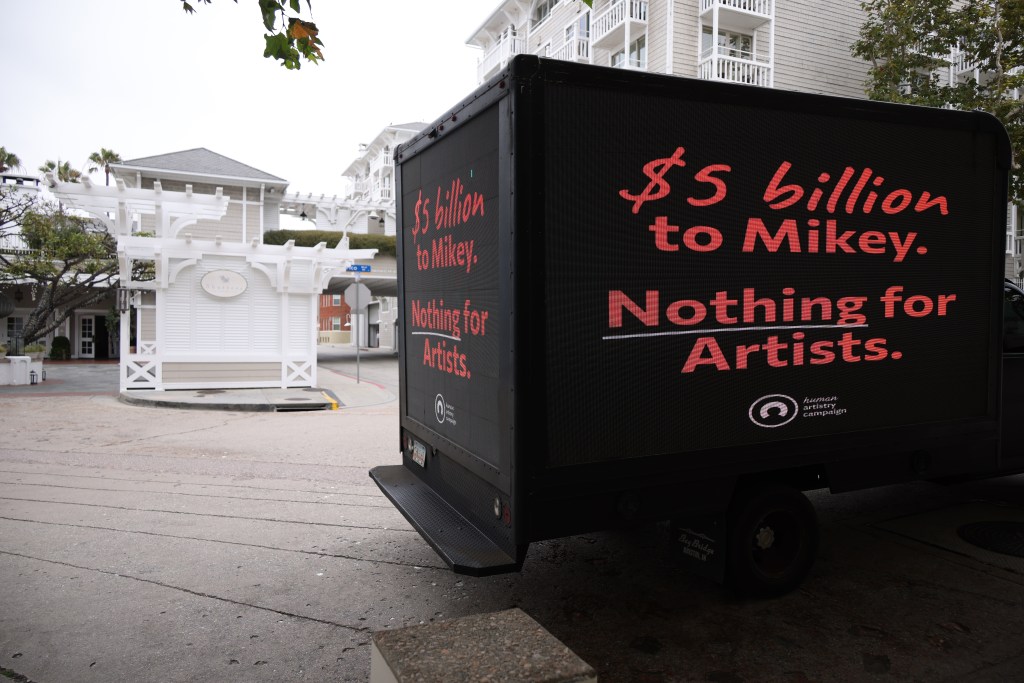
As Suno Celebrated a $5.4 Billion Valuation, Artists Took Their Message Directly to Wall Street

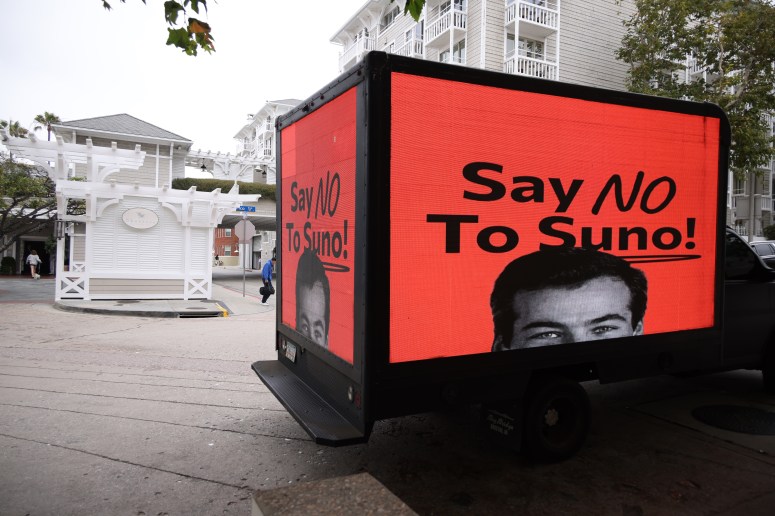
SANTA MONICA, CALIFORNIA – JUNE 03: A mobile billboard sponsored by Human Artistry protesting Suno’s use of AI is pictured on display during Suno’s annual meeting on June 03, 2026 in Santa Monica, California. (Photo by Anna Webber/Getty Images for Human Artistry Campaign)

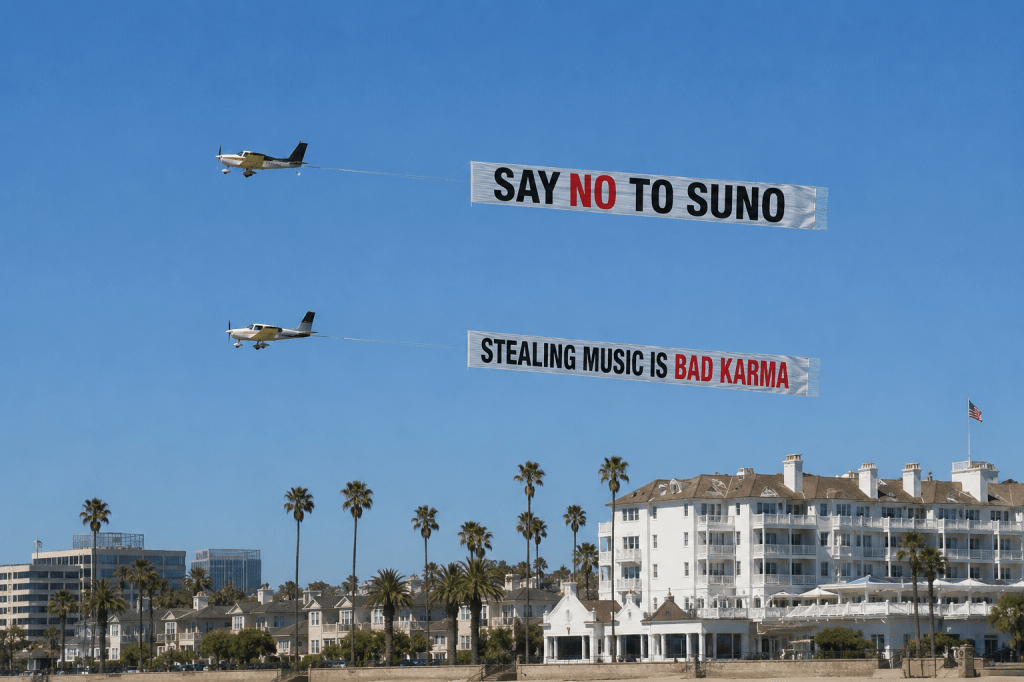
On June 3, 2026, as investors and technology executives gathered at the UBS AI in Entertainment Summit at Shutters on the Beach in Santa Monica, a plane circled overhead carrying a simple message: “SAY NO TO SUNO.” A second banner could just as easily have read, “Stealing Music Is Bad Karma.” The scene was more than a protest against a single AI music company. It was a reminder that technology itself is neither good nor evil; what matters is how humans choose to use it. Throughout history, some of the most transformative technologies have been driven by the same motivations that power every bully: greed and fear. Fear of being left behind. Fear of missing out. Greed for market share, dominance, and wealth and crushing anyone who gets in the way. The generative AI race increasingly appears to be driven—and corroded—by both.


That is why the protest above Santa Monica was about more than music. It connected directly to a broader national backlash against the infrastructure being built to support the AI economy. Across the United States, communities are fighting data centers, transmission lines, water consumption, tax subsidies, and industrial development projects that many believe are being imposed without meaningful public consent. Residents from Texas to Georgia to Louisiana are asking the same basic question: who benefits, and who pays the price?

In the case of generative AI, artists argue that they are among those paying the price.

The Human Artistry Campaign demonstration took place on the same day that Suno announced a funding round exceeding $400 million at a valuation of approximately $5.4 billion. Let it not be said that music has no value and that Suno is not free riding on a thriving market to extract their absurd valuation.

While Silicon Valley investors celebrated another milestone in AI’s rapid expansion, the protest highlighted an uncomfortable reality: much of the value being created by generative AI companies originates from extracting human expression while paying no regard whatsoever to those humans. Whether the source material is music, visual art, photography, authors, voice performances, or other creative works, creators continue to ask how their contributions found their way into commercial AI systems and demand the right to say no to Suno.

SANTA MONICA, CALIFORNIA – JUNE 03: A plane sponsored by Human Artistry protesting Suno’s use of AI is pictured on display during Suno’s annual meeting on June 03, 2026 in Santa Monica, California. (Photo by Anna Webber/Getty Images for Human Artistry Campaign)

The narrative that the AI labs want you to focus on is often framed as a conflict between innovation and regulation. That framing misses the point. The real question is whether innovation requires the abandonment of consent, compensation, and accountability. Human Artistry’s message was not anti-technology. Rather, it was that technology should serve human beings rather than treating them as raw material for extraction.
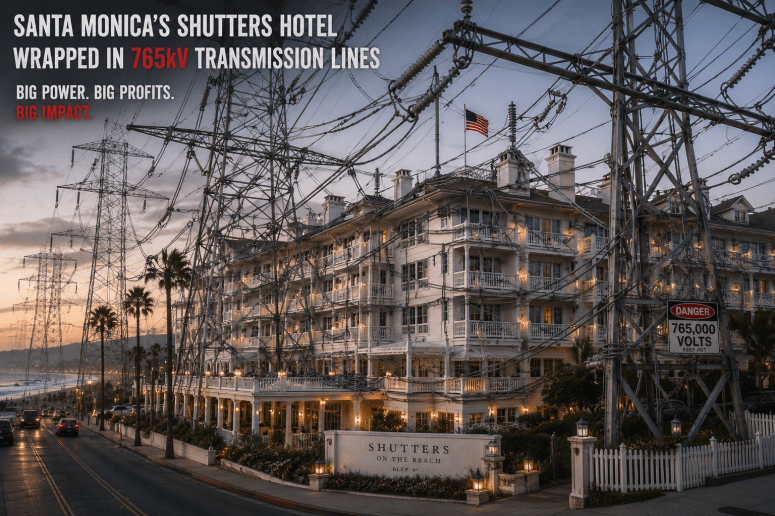
That concern increasingly links artist-rights advocates with communities opposing AI infrastructure projects using eminent domain powers to seize homes and compel residents to acept 765kV transmission lines. Both groups are confronting different manifestations of the same phenomenon: the concentration of economic gains among a relatively small number of companies while costs are dispersed across creators, workers, taxpayers, ratepayers, and local communities. One side sees its creative works absorbed into training datasets. The other sees land, water, energy resources, and public subsidies redirected toward facilities designed to power those systems.

Viewed through that lens, the protest at Shutters on the Beach becomes part of a much larger story. The controversy surrounding generative AI is no longer confined to copyright litigation or entertainment-industry politics. It now reaches questions of energy policy, infrastructure planning, local governance, environmental impact, and economic fairness.

The image of a protest banner flying above an investor summit captures that convergence perfectly. Below, financiers discussed the future of artificial intelligence and celebrated millions of dollars in new investment while licking their IPO chops in drooling anticipation of getting richer still on the backs of humanity. Above, artists and advocates posed a simpler question: if the future is being built on human creativity, shouldn’t the humans who created it have a meaningful voice in how that future is constructed?

That question is impossible to ignore. As billions continue to flow into AI companies and the infrastructure supporting them, the debate is no longer merely about technology. It is about power, consent, and who gets to decide how the benefits of human creativity and expression are captured by the Big Tech kleptocrats.

Synthetic Emotion from The Music Department: Suno’s Unsettling Ad Campaign and the Return of Orwell’s Machine-Made Culture from 1984

In George Orwell’s 1984, the “versificator” was a machine designed to produce poetry, songs, and sentimental verse synthetically, without human thought or feeling. Its purpose was not artistic expression but industrial-scale cultural production—filling the air with endless, disposable content to occupy attention and shape perception. Nearly a century later, the comparison to modern generative music systems such as Suno is difficult to ignore. While the technologies differ dramatically, the underlying question is strikingly similar: what happens when music is produced by machines at scale rather than by human experience?

Orwell’s versificator was built for scale, not meaning (reminding you of anyone?). It generated formulaic songs for the masses, optimized for emotional familiarity rather than originality. Suno, by contrast, uses sophisticated machine learning trained on vast corpora of human-created music to generate complete recordings on demand that would be the envy of Big Brother’s Music Department. Suno can reportedly generate millions of tracks per day, a level of output impossible in any human-centered musical economy. When music becomes infinitely reproducible, the limiting factor shifts from creation to distribution and attention—precisely the dynamic Orwell imagined.

Nothing captures the versificator analogy more vividly than Suno’s own dystopian-style “first kiss” advertisingcampaign. In one widely circulated spot, the product is promoted through a stylized, synthetic emotional narrative that emphasizes instant, machine-generated musical cliche creation untethered from human musicians, vocalists, or composers. The message is not about artistic struggle, collaboration, or lived expression—it is about mediocre frictionless production. The ad unintentionally echoes Orwell’s warning: when culture can be manufactured instantly, expression becomes simulation. And on top of it, those ads are just downright creepy.

The versificator also blurred authorship. In 1984, no individual poet existed behind the machine’s output; creativity was subsumed into a system. Suno raises a comparable question. If a system trained on thousands or millions of human performances produces a new track, where does authorship reside? With the user who typed a prompt? With the engineers who built the model? With the countless musicians whose expressive choices shaped the training data? Or nowhere at all? This diffusion of authorship challenges long-standing cultural and legal assumptions about what it means to “create” music.

Another parallel lies in standardization. The versificator produced content that was emotionally predictable—pleasant, familiar, subservient and safe. Generative music systems often display a similar gravitational pull toward stylistic averages embedded in their training data that has been averaged into pablum. The result can be competent, even polished output that nevertheless lacks the unpredictability, risk, and individual voice associated with human artistry. Orwell’s concern was not that machine-generated culture would be bad, but that it would be flattened—replacing lived expression with algorithmic imitation. Substitutional, not substantial.

There is also a structural similarity in scale and economics. The versificator’s value to The Party lay in its ability to replace human labor in cultural production and to force the creation of projects that humans would find too creepy. Suno and similar systems raise analogous questions for modern musicians, particularly session players and composers whose work historically formed the backbone of recorded music. When a single system can generate instrumental tracks, arrangements, and stylistic variations instantly, the economic pressure on human contributors becomes obvious. Orwell imagined machines replacing poets; today the substitution pressure may fall first on instrumental performance, arrangement, sound designer, and production roles.

Yet the comparison has limits, and those limits matter. The versificator was a tool of centralized control in a dystopian state, designed to narrow human thought. Suno operates in a pluralistic technological environment where many artists themselves experiment with AI as a creative instrument. Unlike Orwell’s machine, generative music systems can be used collaboratively, interactively, and sometimes in ways that expand rather than suppress creative exploration. The technology is not inherently dystopian; its impact depends on how institutions, markets, and creators choose to shape it.

A deeper difference lies in intention. Orwell’s versificator was never meant to create art; it was meant to simulate it. Modern generative music systems are often framed as tools that can assist, augment, or inspire human creativity. Some artists use AI to prototype ideas, explore unfamiliar styles, or generate textures that would be difficult to produce otherwise. In these contexts, the machine functions less like a replacement and more like a new instrument—one whose cultural role is still evolving.

Still, Orwell’s versificator is highly relevant to understanding Suno’s corporate direction. When cultural production becomes industrialized, quantity can overwhelm meaning. The risk is not merely that machine-generated music exists, but that its scale reshapes attention, value, and recognition. If millions of synthetic tracks flood listening environments as is happening with some large DSPs, the signal of individual human expression may become harder to perceive—even if human creativity continues to exist beneath the surface.

The comparison between Suno and the versificator symbolizes the moment when technology challenges the boundaries of authorship, creativity, and cultural labor. Orwell warned of a world where machines produced endless culture without human voice. Today’s question is subtler: can society integrate generative systems in ways that preserve the distinctiveness of human expression rather than dissolving it into algorithmic slop?

The answer will not come from technology alone. It will depend on choices—legal, cultural, and economic—about how machine-generated music is labeled, valued, and integrated into the broader creative ecosystem. Orwell imagined a future where the machine replaced the poet. The task now is to ensure that, even in an age of generative AI, the humans remains audible.