When Iggy Pop can’t live off his art, what chance do the rest have? | The Globe and Mail

But a new reality has tripped him up and it’s the same one shafting artists all across the world: Namely, that everyone wants to listen, and no one wants to pay. This week, Iggy gave a lecture for the British Broadcasting Corp. called Free Music in a Capitalist Society. Artists have always been ripped off by corporations, he said; now the public is in on the free ride, too: “The cat is out of the bag and the new electronic devices, which estrange people from their morals, also make it easier to steal music than to pay for it.”

To keep skinny body and maverick soul together, Iggy’s become a DJ, a car-insurance pitchman and a fashion model. If he had to live off royalties, he said, he’d have to “tend bars between sets.” As I listened to his enthusiastic stoner Midwestern drawl, I thought: If Iggy Pop can’t make it, what message does that send to all the baby Iggys out there? In a society where worth is judged by price, for better or worse, what are you saying to someone when you won’t pay for the thing he’s crafted?

READ THE FULL STORY AT:
http://www.theglobeandmail.com/globe-debate/when-iggy-pop-cant-live-off-his-art-what-chance-do-the-rest-have/article21154663/

This Weekend in NYC : Benefit for Content Creators Coalition (c3): Defend Artists’ Rights: Economic Justice in the Digital Domain! w/ Marc Ribot, John Zorn, and friends

A Benefit Concert for c3

Featuring John Zorn, Eric Slick (Dr Dog), Steve Coleman, Marc RibotHenry Grimes, Marina RosenfeldTrevor Dunn, Brandon SeabrookSatomi Matsuzaki (Deerhoof), Amir ElSaffar, and more!

The event will also feature a short screening of highlights from Michael Count Eldridge’s upcoming documentary film “Unsound”.

General Admission: $20 pre-sale (ends at noon on 10/18) $25 at Doors

Special Artist Rights Supporter tickets include reserved balcony seating and access to a one hour meet and greet prior to the show // Doors at 7pm

TICKETS :
https://web.ovationtix.com/trs/pe/9950804

MORE INFORMATION:
http://roulette.org/events/benefit-content-creators-coalition-c3-defend-artists-rights-economic-justice-digital-domain-w-marc-ribot-john-zorn-friends/


Streaming Is the Future, Spotify Is Not. Let’s talk Solutions.

It’s not that streaming can’t work. It can. It’s that Spotify is a bad business model that has unsustainable economics and exploits artists because it is a wall street financial instrument and not a music company.

We’ve previously published a couple posts on streaming music where we explore how access models and windowing are working for the film industry and could serve as a guide to the record business. We’ve also shown how transactional music purchases have made legal music consumption the best value in the history of recorded music.

The key to building streaming business models that make sense and are sustainable is to increase the subscription fees, utilize well thought-out windowing models and experiment with new pricing tiers for access based services.

Historically the music business has employed the use of special markets such record clubs  (remember 11 CD’s for one penny). It’s not that record clubs were bad, in fact numerous studies found them to be great source of additional revenue if managed in a way that did not cannibalize front line sales. (Remember 12 month record club holdbacks?) Now we need to strike the same balance with streaming services.

So let’s get real, the Spotify business model and streaming math just does not work and can not work in it’s current form.

Here are five suggestions to get music streaming back on track as a viable business model.

1) Minimum Payment Per Play

You want to give your service away? Fine, but artists and rights holders are not going to subsidize your business by devaluing our work. No plays without a minimum royalty–including the “free service”–and all plays pay at paid subscription rates. If you can’t sustain your business doing this, then you need to rethink how your business works. Your bad business model is not our problem. Maybe an unlimited, non-graduated free tier is a really, really, really bad idea. 30 Day trial offer, ok. Virtually unlimited free access, no.

2) Windowing

The music business must embrace windowing to maximize revenues across all distribution channels and platforms. It’s so basic we can’t believe artists and labels are not utilizing this to greater effect. The first 30 days of a new release could be limited to transactional streaming access by the day, week, or the month at different price points. Likewise, perhaps only two songs from an album are made available on streaming platforms for the first year of release. There are many unexplored variations and options.

3) Transactional Streaming

The music business needs to embrace new models such as “transactional streaming” much like VOD exists for film versus transactional downloads or physical product. There is no reason why streaming distributors should have every title, ever released, for one fixed, flat price. Again, new releases in particular should be priced as transactional streams where the consumer can chose between low cost limited access to a new release, or pay more for a transactional download.

4) Tiered Pricing based on Access and Consumer Value Proposition

Just like cable tv and SiriusXM, one possible solution is to create price tiers based on access. For example, catalogs can be curated into genre and lifestyle packages. Creating bundled packages adds value to both the end user and the streaming service. Individual packages can be as little as $4.99 a month, and complete access could priced at $49.99 a month. Again, there are many unexplored variations and options.

5) Move Beyond Stockholm Syndrome

The answer to every attempt to introduce real world economics to the marketplace can not be met with “or else they’ll steal it.” We already know that. They have been stealing it for over a decade (thank you Mr. Ek for your contributions to uTorrent). The film industry is not approaching streaming with a gun to it’s head offering every title ever made on every platform for one low monthly fee. Itunes is the single most successful dedicated online music business ever, and it doesn’t have a “free-tier”.

Isn’t it odd that companies like Pandora and Spotify that are not profitable and don’t support artists are thought to behold some kind of gnostic wisdom of economics that defies all logic and reason? Last year Twitter lost $645 million dollars. Record labels have been profitable for over half a century with a sustainable ecosystem that invests in artists and new talent, while also creating hits and stars. It’s time to leave the rainbow unicorn school of economics and faith healing behind and develop real business models based on real economics.

Anyone remember the dot com bubble? Where is mp3.com now? Things can and do change fast in web/tech. Any talk of the “record industry” without MySpace in 2004 and you would have been laughed out to the room. Where is MySpace now? Spotify can (and very well may) quickly become MySpace. So let us all focus on how to make streaming actually work for all stakeholders and not only those with equity… it’s just math.

RELATED:

Who will be the First Fired Label Execs over Spotify Fiasco & Cannibalization?

Why Spotify is not Netflix (But Maybe It Should Be)

Mythbusting : Music Is Too Expensive!?

Marc Ribot Talks Respecting Artists’ Rights | The Talk House

We’re organizing to fight back. We’re going to give value to the ineffable, uncountable and immeasurable beauty being destroyed. We’re going to give voice to the creators whose work — and lives — are being devalued by tech-corporate greed. We’re going to fight for the sustainability of the culture we all enjoy. We don’t have the lobbying millions of the tech-corporate giants, but we’re going to win. Because the truth is a powerful slingshot.

Editor’s note: If you’re in the New York area, by all means go to “Benefit for Content Creators Coalition (c3): Defend Artists’ Rights: Economic Justice in the Digital Domain!” on Saturday, October 18, 2014 at Roulette.  The show features: John Zorn, Eric Slick (Dr. Dog), Steve Coleman, Marc Ribot, Henry Grimes, Marina Rosenfeld, Trevor Dunn, Brandon Seabrook, Satomi Matsuzaki (Deerhoof), Amir ElSaffar and more. You can buy tickets here.

READ THE FULL INTERVIEW HERE:
http://thetalkhouse.com/music/talks/marc-ribot-talks-respecting-artists-rights/

Who will be the First Fired Label Execs over Spotify Fiasco & Cannibalization?

We don’t know if the rumors are true, but we’re hearing rumblings from the upper echelons of the music business that top management is very unhappy with the cannibalization of the transactional business that is being accelerated in a death spiral towards a $3b record industry.

Did you guys get this headline on the midyear sales figures, U.S. Music Revenues Down Nearly 5%, Says RIAA. Early end of year estimates are that 2014 could see a double digit year to year drop by as much as 12%. As we’ve said before (and others are catching up) it’s just math.

We’re also hearing panicked and desperate distribution executives wanting to double down on streaming by reducing the subscription fees to accelerate scale (not everything Apple says is good for you, remember?).

So we have to ask, are you kidding us? The only thing that is going to accelerate is how fast you lose your job as you kill what’s left of the transactional business.

If you own a calculator, let’s just do the math one more time, real slow and simple like…

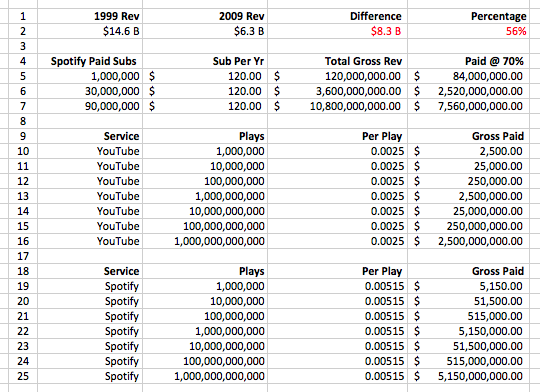
1) Spotify and former uTorrent CEO Daniel Ek says Spotify only needs 40m paid subscribers for streaming to be sustainable for artists. But that math just doesn’t work.

2) $10 per month subscription = $120 per year per subscriber

3) $120 per year, per subscriber paying out 70% of gross to rights holders equals $84 per subscriber, per year.

4) $84 per subscriber, per year x’s 40 million subscribers equals $3.4b per year in top line gross revenue to ALL rights holders. That’s $3.4b for labels, artists, publishers and songwriters combined.

5) $3.4b per year is HALF of the current revenue of $7b per year where the domestic business has been flat lined.

6) Assuming you could DOUBLE the subscription base to 80m PAID in the USA within two years by dropping the price in HALF to $5 per subscriber per month you still only gross (wait for it…) $3.4b a year in revenue.

We know this is shocking to the math impaired, but doubling scale (imagined as it is) while cutting the subscription fees in half, actually nets you the same amount of money. Shocking the things one can learn with a calculator or a spreadsheet.

Do you know how else you can achieve scale faster? Free. Free scales fast.

Free scaled fast for Napster.

Free scaled fast for Grockster.

Free scaled fast for Kazaa.

Free scaled fast for Limewire.

Free scaled fast for BitTorrent.

Free scaled fast for The Pirate Bay.

Free scaled fast for YouTube.

All of these have three  things in common.

1) Infringement as a business.

2) Fast scale.

3) Subsidized by artists and rights holders who are not compensated.

The con men have been conned and the only way out is an exit strategy that is so disconnected from the monetization of music that there is literally no longer a connection between the artist and the revenue they create.

So how realistic is that magic number of 40m paid Spotify subscribers in the US?

Here’s what subscription based services look like right now. Netflix only has 36m subscribers in the US, no free tier, and massive limitations on available titles of both catalog and new releases. Sirius XM, 26.3m in the US as a non-interactive curated service installed in homes, cars and accessible online. Premium Cable has 56m subscribers in the US paying much more than $10 a month and also with many limitations. Spotify… 3m paid subscribers in the US after four years. Tell us again about this strategy of “waiting for scale.” Three Million Paid… Three…

* 3m Spotify Subs Screen Shot
* 26.3m Sirius XM Subs Screen Shot
* 36m Netflix Subs Screen Shot
* 56m Premium Cable Subs Screen Shot
* $7b Music Business Screen Shot

Given the above it’s not surprising that what we’re hearing is that the adults have let the children play with their Silicon Valley toys and they have been left alone along long enough to see the house burn down. And adding insult to injury, Spotify has been a complete artist relations disaster.

We’ve got bad news for digital distribution/ label folk.  The Silicon Valley lifeboat doesn’t have that much room in it for ex-record company executives who are bad at simple math. We know five guys who are not concerned about the future of the record industry and their names are Jimmy, Dre, Trent, Ian and Dave… the rest of you are probably not going to be so lucky.

What is perhaps the greatest irony in all of this is that the great rock & roll swindle has been on the record industry instead of by the record industry, but that’s another post.

So who’s head is going to be on the block when the year end head count reductions start? Hmmm…

Remember kids, It’s just math…

streamingmath


RELATED:

Spotify Doesn’t Kill Music Sales like Smoking Doesn’t Cause Cancer…


Why Spotify is not Netflix (But Maybe It Should Be)


Spotify’s Daniel Ek is Really Bad At Simple Math, “Artists Will Make a Decent Living Off Streaming In Just a Few Years”


c3 ‪”#thatsongwhen 10k people listened, the artist got paid $60 and the major labels got stock options.”

c3, The Content Creators Coalition is enlisting musicians and songwriters to share their true stories of Spotify plays, payments and thoughts to raise awareness around unsustainable digital service royalty structures. Join in.

If you care about the economic rights of artists in the digital domain, join us in hijacking Spotify’s new twitter hashtag campaign. Got your own numbers to share? Like so: Fun with new Spotify hashtag campaign: “#thatsongwhen 10k people listened, the artist got paid $60 and the major labels got stock options.”

We do believe in digital. But current rates are not sustainable. Spotify is using our music like venture capital and promising better returns later while they pay their employees and hire expensive ad firms to create the above hashtag campaign.

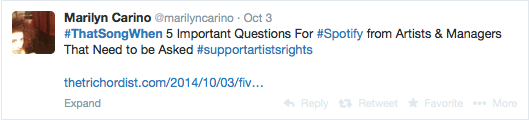
thatsongwhenSarahManningthatsongwhenTessaMakesLove thatsongwhenMarilynCarino

FOLLOW c3 ON FACEBOOK:
https://www.facebook.com/ContentCreatorsCoalition
https://www.facebook.com/pages/ccc-nycorg/

* BREAKING * Spotify Launches Secret ‘Information Tour’ to Convince Top Artists… | DMN

Breaking from Digital Music News:

Currently, we know of three confirmed dates in the US: October 6th (ie, today) at the Soho Club in New York, October 8th at City Winery in Nashville, and October 10th at a private residence in Los Angeles (complete details on these dates below).  The US-based sessions that we know about are being coordinated through the Music Managers’ Forum (MMF), with the Featured Artists’ Coalition (FAC) potentially bringing serious, high-wattage superstars to the table.

TO ATTEND PLEASE RSVP TO: fiona@thefac.org

READ THE FULL POST AT:
http://www.digitalmusicnews.com/permalink/2014/10/06/spotify-launches-information-tour-convince-top-artists

RELATED:

Five Important Questions For Spotify from Artists and Managers

A Tale of Two Pirates? Daniel Ek (uTorrent) and Kim Dotcom (Megaupload)


Music Streaming Math, Can It All Add Up?

A Tale of Two Pirates? Daniel Ek (uTorrent) and Kim Dotcom (Megaupload)

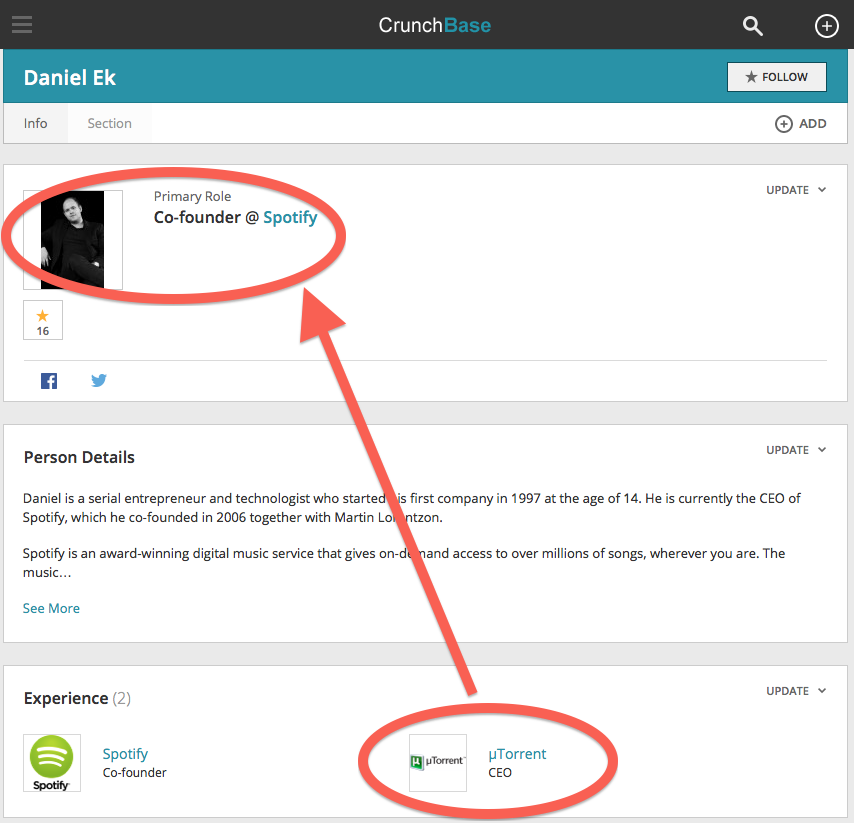
Perhaps it is ironic that Kim Dotcom is the arch nemesis of the record industry while Spotify CEO Daniel Ek is celebrated as the former Co-Founder and CEO of uTorrent. uTorrent is described as “the world’s most popular BitTorrent client with more than 100 million downloads” on Mr. Ek’s Wikipedia page.

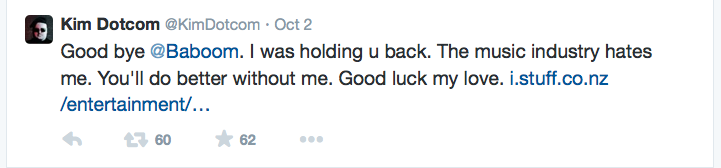
This week the embattled Dotcom is said to have given up his stake (and shares) in his much ballyhooed digital music company Baboom.

DotcomBaboomOVER

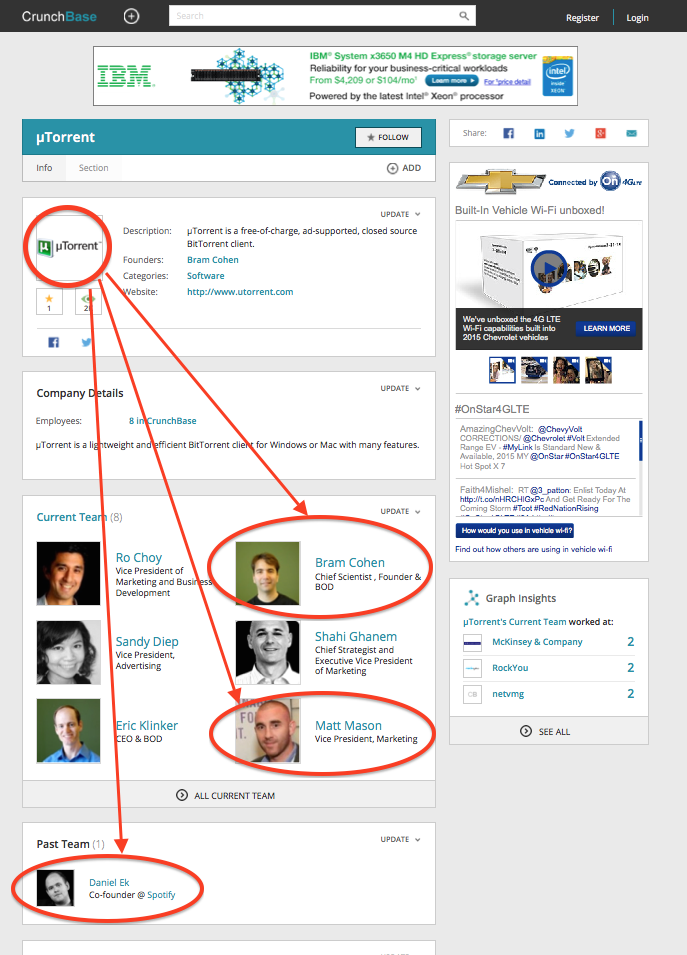
In the screen shot below from the TechCrunch, “CrunchBase” we see the BitTorrent cast of characters we’ve gotten to know so well sharing duties at uTorrent.  Here we have Bram Cohen, Matt Mason and of course former uTorrent Co-Founder and CEO Daniel Ek (still prominently displayed).

utorrent

In many ways both Ek and Dotcom represent the same devaluation and destruction of the arts by building personal fortunes as the result of monetizing the work of creators, without paying those creators for their work.

The cost of music is not in the distribution of music, the cost of music is in the creation of music.

Megaupload and uTorrent have monetized the mass scale distribution of infringing works for profit. In other words, infringement as a business model where the cost of goods goes unpaid and creators are uncompensated. uTorrent is self described as “a free-of-charge, ad-supported, closed source BitTorrent Client.” Megaupload and uTorrent have both relied heavily on advertising for revenue.

Mr. Ek like his previous cohorts Bram Cohen and Matt Mason would like to say that BitTorrent is not a piracy platform, however multiple independent studies have repeatedly concluded that 99% or more of the files being distributed via BitTorrent are in fact, infringing.

All of this of course points to the fact that Megaupload and BitTorrent have hidden behind  the DMCA, which has failed at it’s intent to protect artists. It could be argued that uTorrent and Megaupload have participated in business models enabling one of the largest transfers of wealth in history from individual creators to Silicon Valley companies and operatives.

Daniel Ek is reported to have a net personal wealth valued at $400 Million Dollars. Kim Dotcom’s fortune has been recently estimated to be $200 Million Dollars.

“The main reason music streaming services are winning over millions of consumers is the fact that they require no payment unless the user desires to pay.” – Music Streaming vs. Music Piracy | Medium.Com

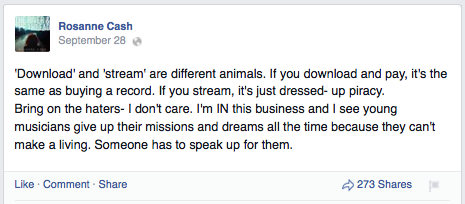
Right now there is little functional difference to most musicians between music streaming and music piracy. This realization should not come as a surprise to musicians when they learn that the CEO of the largest and most used on demand streaming company was both the Co-Founder and CEO of uTorrent, “the world’s most popular BitTorrent client with more than 100 million downloads.”

RosanneCashStreaming

If Spotify wants musicians to take it seriously, perhaps it’s time for a CEO musicians can respect. The record industry might also want to reconsider who it chooses as friend and foe as well. More on that later…

EkuTorrentSpotify


Music Streaming is “just dressed-up piracy” says Rosanne Cash| Hypebot

Hypebot noticed this Facebook post from Rosanne Cash which echoes the sentiments of many artists, that streaming in it’s current form and economics is pretty much legitimized piracy…

RosanneCashStreaming

READ THE FULL POST AT HYPEBOT:
http://www.hypebot.com/hypebot/2014/10/streaming-is-just-dressed-up-piracy-says-rosanne-cash.html

RELATED:

Five Important Questions For Spotify from Artists and Managers

Music Streaming Math, Can It All Add Up?

Streaming Isn’t Saving the Music Industry After All, Data Shows…