Astroturf Spotting: “The People’s Bid for TikTok”

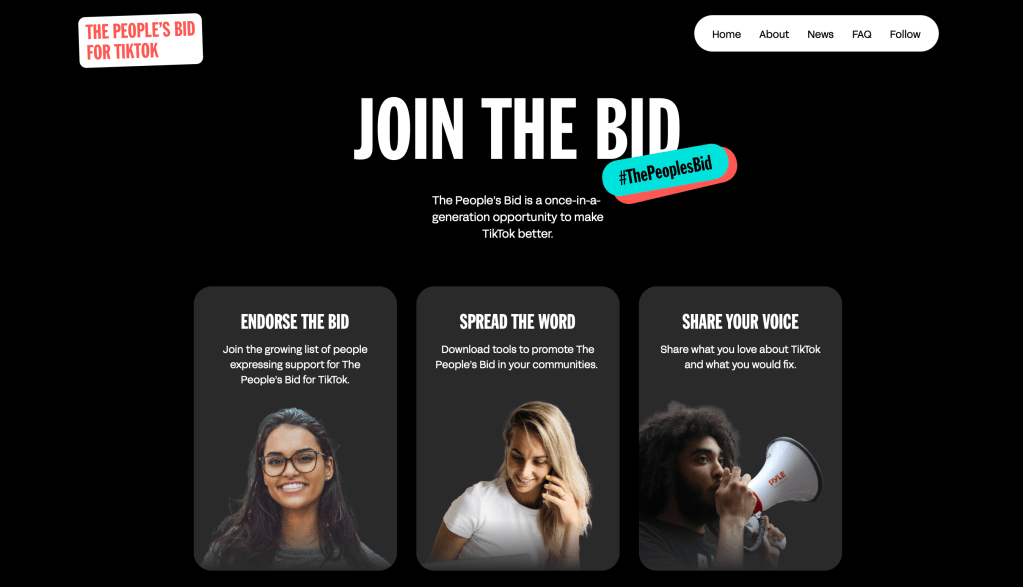
We’ve had a pretty good track record over years of spotting astroturf operations from the European Copyright Directive to ad-supported piracy. Here’s what we believe is the latest–“the People’s Bid for TikTok,” pointed out to us by one of our favorite artists.

The first indication that something is fake–we call these “clues”–is in the premise of the campaign. Remember that the key asset of TikTok is the company’s algorithm. That algorithm is apparently responsible for curating the content users see on their feeds. This algorithm is highly sophisticated and is considered a key factor in TikTok’s success. The U.S. government has argued that the algorithm could be manipulated by the government of the People’s Republic of China to influence what messaging is promoted or suppressed.

In April, President Joe Biden signed a law requiring TikTok’s PRC-based parent company ByteDance to sell TikTok or face a ban in the U.S. by mid-January 2025. This law was the culmination of years of Congressional scrutiny and debate over the app’s potential risks.

At the core of President Biden’s concerns about TikTok is the algorithm. Not surprisingly, the People’s Republic of China has made it very clear that the algorithm is not for sale. This position was confirmed when TikTok itself admitted that the Chinese government would not allow the sale of its algorithm. China’s Commerce Minister Wang Wentao indicated that officials would seek to block any transfer of the app’s technology, stating that the country would “firmly oppose” a forced sale. That likely means that even if ByteDance were to sell TikTok–to “the people” or otherwise–the algorithm would remain under Chinese control, which undermines the U.S. government’s objective.
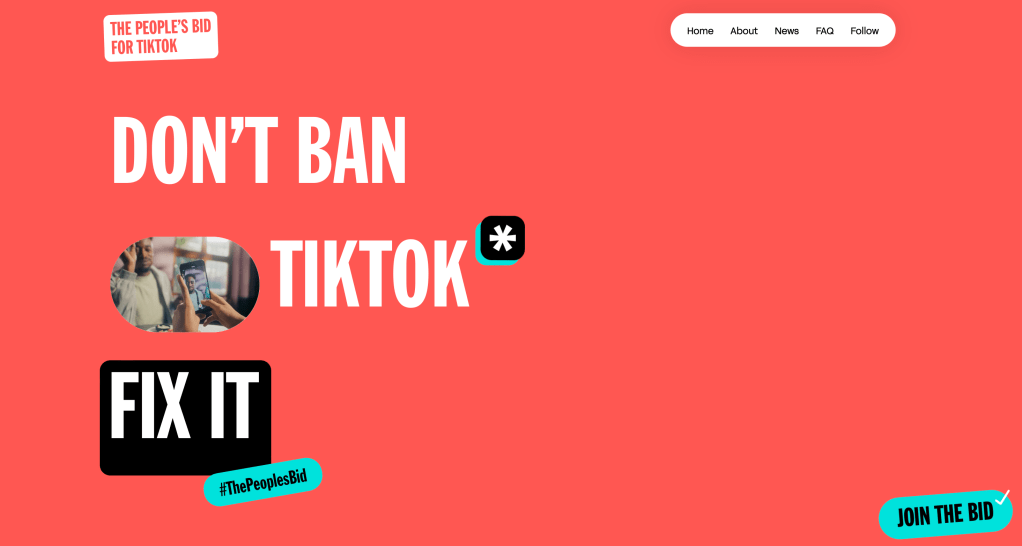
So–who is behind the “People’s Bid” since given that the “People’s Bid” seems to be making a proposal that will only be acceptable to the People’s Republic of China? We say that because of this FAQ on the People’s Bid site disclaiming any interest in acquiring the algorithm that PRC has essentially claimed as a state secret for some reason:

The People’s Bid has no interest in acquiring TikTok’s algorithm [which is nice since the algo is not for sale]. This is not an attempt to rinse and repeat the formula that has allowed Big Tech companies to reap enormous profits by scraping and exploiting user data. The People’s Bid will ensure that TikTok users control their data and experience by using the app on a rebuilt digital infrastructure that gives more power to users.

Oh no, The People’s Bid has no interest in that tacky algorithm which wasn’t for sale anyway. Good of them. So who is “them”? It appears, although it isn’t quite clear, that the entity doing the acquiring isn’t “The People’s Bid” at all, it’s something called “Project Liberty.”

The FAQ tells us a little bit about Project Liberty:

Project Liberty builds solutions that help people take back control of their digital lives. This means working to ensure that everyone has a voice, choice, and stake in the future of the Internet. Project Liberty has invested over half a billion dollars to develop infrastructure and alliances that will return power to the people.

They kind of just let that “half a billion dollars” drop in the dark of the FAQ. What that tells us is that somebody has a shit-ton of money who is interested in stopping the TikTok ban. So who is involved with this “Project Liberty”? The usual suspects, starting with Lawrence Lessig, Jonathan Zittrain and a slew of cronies from Berkman, Stanford, MIT, etc. Color us shocked, just shocked.

But these people never spend their own money and probably aren’t working for free, so who’s got the dough? Someone who doesn’t seem to care about acquiring the TikTok algorithm from the Chinese Communist Party?

Forbes tells us that this transaction is just a little bit different than what “The People’s Bid” or even the “Liberty Project” would have you believe if all you knew about it was from information on their website. The money seems to be coming in part, maybe in very large part, from one Frank McCourt whom you may remember as a former owner of the Los Angeles Dollars…sorry, Dodgers. In fairness, McCourt isn’t exactly making his plans a secret. He had his Project Liberty issue a press release as “The People’s Bid for TikTok”, which is actually Frank McCourt’s bid for TikTok as far as we can tell and as reported by Forbes:

Billionaire investor and entrepreneur Frank McCourt is organizing a bid to buy TikTok through Project Liberty, an organization to which he’s pledged $500 million that aims to fight for a safe, healthier internet where user data is owned by users themselves rather than by tech giants like TikTok parent ByteDance, Meta and Alphabet.

That’s more like it. We knew there was a sugar daddy in there somewhere. That’s much more in the Lessig style. Big favor, little bad mouth.

Of course, users owning their data is not the entire story by a long shot. Authors owned their books and Google still used the vast Google Books project to train AI.

Forbes adds this insight about Mr. McCourt:

Best known as the former owner of the Los Angeles Dodgers, McCourt spent most of the past decade focused on investing the approximately $850 million in proceeds from the team’s 2012 sale via his company McCourt Global. 

He sprinkled money into sports, real estate, technology, media and an investment firm focused on private credit. In January 2023, McCourt stepped down as CEO of McCourt Global to focus on Project Liberty but remains executive chairman and 100% owner. 

McCourt’s assets are worth an estimated $1.4 billion, landing him on Forbes’ billionaires list for the first time this year—though his wealth is a far cry from the estimated $220 billion valuation of ByteDance.

Which brings us to ByteDance. Is there another Silicon Valley money funnel with an interest in ByteDance? One is Sequoia Capital, which was also an original investor in Google which was an original investor in Professor Lessig and his various enterprises including Creative Commons. Sequoia’s ByteDance investment came in the form of one Neil Shen who runs Sequoia’s China operation recently spun off from the mothership. If you don’t recognize Neil Shen, he’s the former member (until 2023) of the Chinese People’s Political Consultative Conference, an arm of the Chinese Communist Party and its United Front Work operation. (According to a Congressional investigative report, The United Front operation is a strategic effort to influence and control various groups and individuals both within China and internationally. This strategy involves a mix of engagement, influence activities, and intelligence operations aimed at shaping political environments to favor the CCP’s interests. United front work includes “America Changle Association, which housed a secret PRC police station in New York City that was raided by the FBI in October 2022.”)

)

In plainer terms, it’s about the money. According to CNN:

McCourt said he is working with the investment firm Guggenheim Securities and the law firm Kirkland & Ellis to help assemble the bid, adding that the push is backed by Sir Tim Berners-Lee, the inventor of the World Wide Web [OMG, it must be legit!].

McCourt joins a host of other would-be suitors angling to pick up a platform used by 170 million Americans. Former Treasury Secretary Steven Mnuchin announced in March he’s assembling a bid, as well as Kevin O’Leary, the Canadian chairman of the private venture capital firm O’Leary Ventures.

TikTok, meanwhile, has indicated that it’s not for sale and the company has instead begun to mount a fight against the new law. The company sued to block the law earlier this month, saying that spinning off from its Chinese parent company is not feasible and that the legislation would lead to a ban of the app in the United States starting in January of next year.

But it’s the people‘s bid, right? Don’t be evil, ya’ll.

Let’s boil it down: TikTok would have been, up until President Biden signed the sell-or-ban bill into law, a HUGE IPO. It’s also a big chunk of ByteDance’s valuation, which means it’s a big chunk of Neil Shen’s carried interest in all likelihood. TikTok is no longer a huge IPO, in fact, it probably won’t be an IPO at all in its current configuration, particularly since the CCP has told the world that TikTok doesn’t own its core asset, the very algorithm that has so many people addicted (and addiction which is what a buyer is really buying).

So the astroturf is not the Liberty Project of the People’s Bid. Whatever “the People’s Bid” really is, it’s much more likely to be as the financial press has described it–Frank McCourt’s bid. But only for the most high-minded and pure-souled reasons.

It’s about the money. Stay tuned, we’ll be keeping an eye on this one.

How Do TikTok Executives Sleep at Night?

Read the post on Music Business Worldwide and Associated Press “Former Bytedance executive says Chinese Communist Party tracked Hong Kong protesters via data” (Bytedance is the parent company of TikTok.)

Press Release: Texas Governor Abbott Announces Statewide Plan Banning Use Of TikTok — Artist Rights Watch

“Owned by a Chinese company that employs Chinese Communist Party members, TikTok harvests significant amounts of data from a user’s device, including details about a user’s internet activity.”

Governor Greg Abbott today announced a statewide model security plan for Texas state agencies to address vulnerabilities presented by the use of TikTok and other software on personal and state-issued devices. Following the Governor’s directive, the Texas Department of Public Safety and the Texas Department of Information Resources developed this model plan to guide state agencies on managing personal and state-issued devices used to conduct state business. Each state agency will have until February 15, 2023 to implement its own policy to enforce this statewide plan.

“The security risks associated with the use of TikTok on devices used to conduct the important business of our state must not be underestimated or ignored,” said Governor Abbott. “Owned by a Chinese company that employs Chinese Communist Party members, TikTok harvests significant amounts of data from a user’s device, including details about a user’s internet activity. Other prohibited technologies listed in the statewide model plan also produce a similar threat to the security of Texans. It is critical that state agencies and employees are protected from the vulnerabilities presented by the use of this app and other prohibited technologies as they work on behalf of their fellow Texans. I thank the Texas Department of Public Safety and Texas Department of Information Resources for their hard work helping safeguard the state’s sensitive information and critical infrastructure from potential threats posed by hostile foreign actors.”

To protect Texas’ sensitive information and critical infrastructure from potential threats, the model plan outlines the following objectives for each agency:

  • Ban and prevent the download or use of TikTok and prohibited technologies on any state-issued device identified in the statewide plan. This includes all state-issued cell phones, laptops, tablets, desktop computers, and other devices of capable of internet connectivity. Each agency’s IT department must strictly enforce this ban.
  • Prohibit employees or contractors from conducting state business on prohibited technology-enabled personal devices.
  • Identify sensitive locations, meetings, or personnel within an agency that could be exposed to prohibited technology-enabled personal devices. Prohibited technology-enabled personal devices will be denied entry or use in these sensitive areas.
  • Implement network-based restrictions to prevent the use of prohibited technologies on agency networks by any device.
  • Work with information security professionals to continuously update the list of prohibited technologies.

In December 2022, Governor Abbott directed state agency leaders to immediately ban employees from downloading or using TikTok on any government-issued devices. The Governor also informed Lieutenant Governor Dan Patrick and Speaker Dade Phelan that the Executive Branch is ready to assist in codifying and implementing any necessary cybersecurity reforms passed during the current legislative session, including passing legislation to make permanent the Governor’s directive to state agencies.

Governor Abbott has taken significant action to combat threats to Texas’ cybersecurity, including signing the Lone Star Infrastructure Protection Act in 2021 to fortify certain physical infrastructure against threats that include hostile foreign actors.

View the statewide model security plan here.

Press Release: Texas Governor Abbott Announces Statewide Plan Banning Use Of TikTok — Artist Rights Watch–News for the Artist Rights Advocacy Community

@cgartenberg: Reddit CEO says TikTok is ‘fundamentally parasitic,’ cites privacy concerns

[Editor Charlie sez: Artists and songwriters should consider how their music is used for child data exploitation and Internet addiction. Not surprising that Europeans are investigating TikTok for data protections for children under 13 and the transfer of personal data by TikTok to China military-civil authorities likely under Articles 7 and 14 of China’s National Intelligence Law.]

Reddit CEO and co-founder Steve Huffman called TikTok “fundamentally parasitic” due to concerns over privacy during an appearance at the Social 2030 venture capital conference this week (via TechCrunch). Huffman specifically called out TikTok’s practice of fingerprinting to track devices as being of particular concern. 

“Maybe I’m going to regret this, but I can’t even get to that level of thinking with [TikTok],” Huffman said at the event, “because I look at that app as so fundamentally parasitic, that it’s always listening, the fingerprinting technology they use is truly terrifying, and I could not bring myself to install an app like that on my phone.”

Read the post on The Verge

Notes and Materials on TikTok from MusicBiz Conference

By Chris Castle

I was pleased to moderate a panel on TikTok’s situation for the Music Business Association with an all-star panel of experts on September 25. You can access our voluminous panel materials here including the panelists biographies.

The following is my opening statement followed by the panel outline with some page number cross references to the panel materials.

Opening Statement

TikTok has become a major marketing tool for artists in the music business.  It has also been accused of some pretty serious consumer issues as well as massive copyright infringement.  We care what happens to TikTok for many of the same reasons we cared about what happened to Napster—ideally we would bring TikTok into a professional business reality that is safe for fans and where artists and songwriters can be paid.  In other words, we come here to save TikTok, not to bury it.

It appears that a potential deal with TikTok could be unraveling.  See your materials at p. 92 for a summary of deal points.  It’s a bit cloudy to decipher the positions of the parties without pre and post money cap tables, but we try.  

What we know is that the Commerce Department has delayed the ban on downloading new versions of TikTok until midnight Sunday.  TikTok has asked a federal court to block the download ban, and DC District Court Judge Carl Nichols told the US Government yesterday that it has until 2:30 pm ET to show cause why they need the ban or the Court will hold a hearing Sunday morning.  TikTok’s official statement is a p. 91 in your materials. UPDATE: After the MusicBiz panel, Judge Nichols granted a preliminary injunction allowing TikTok to be downloaded and holding that TikTok’s operations fit in a loophole. Read the order here.

In China, the Chinese government recently changed its technology export controls to cover TikTok.  TikTok is required to obtain government approval of the deal by the Beijing Municipal Bureau of Commerce which it has not yet granted.  The Chinese Communist Party has “slammed the deal as ‘dirty and unfair’” and “modern piracy” according to the Wall Street Journal.   

So there’s that.

TikTok is the subject of a review by the Committee on Foreign Investment in the US (or “CFIUS”) which is a cabinet level group that reviews M&A activity from a national security perspective.  CFIUS was established by Congress in 1988 as an amendment to the Defense Production Act of 1950. (See p. 83 of the panel materials)

As a matter of process, CFIUS conducts a review of a covered transaction and makes a recommendation to the President about whether the transaction should be approved or unwound based on national security concerns, including data security.  

CFIUS review can be also be done before an acquisition, but Bytedance elected not to request a pre-acquisition review by CFIUS which created substantial investment risk for Bytedance shareholders as we have seen play out with TikTok.

CFIUS has required divestment of various acquisitions in the past decades, such as Aixtron, Ralls, Mamco, StayInTouch, Qualcomm, PatientsLikeMe, Grindr, and Moneygram.  

CFIUS review of Bytedance is based on the company’s 2017 acquisition of Musical.ly.  CFIUS concluded that the acquisition “threatens to impair the national security of the United States” and recommended divestiture.  The CFIUS review began November 1, 2019, which resulted in two executive orders requiring the divestiture of Musical.ly or substantial mitigation to satisfy CFIUS requirements (extensively covered in Sec. 2 of the August 14 Executive Order.  (p. 76 of materials).  

There has been some negotiation of a potential sale of TikTok which is premised on two opposing views:  The US will not permit TikTok to operate in the US unless it is controlled by 

Americans, all data is hosted in the U.S. meeting CFIUS inspections, and US companies have access to all TikTok’s technology.  The position of the government of the Chinese Communist Party is essentially the opposite of the U.S. view.

If a resolution cannot be reached, the President has the power to stop Americans from engaging in transactions of any kind with TikTok under the International Emergency Economic Powers Act which would apply to employees, vendors, advertisers and users.  (Cited in 8/14 Executive Order and discussed at p. 65)

And even if TikTok can get past the CFIUS problems, it still has to deal with its failure to license substantial numbers of copyrights, and that implicates a foreign infringer’s ability to use various safe harbors to copyright.  The copyright infringement issues will extend outside of the U.S. and we will discuss implications for Canadian artists and potential class actions against TikTok.

It must also be noted that there is currently a class action against TikTok in Illinois for child endangerment and violations of child privacy protections through TikTok’s biometric data collection.  Of course, TikTok already paid the largest fine in FTC history for violations of Children’s Online Privacy Protection Act.  We won’t discuss this topic today, but relevant documents are included in your materials at p. 177.

There’s also the potential for a TikTok IPO to be blocked because China refuses to comply with US public company accounting standards based on national security concerns (which essentially means any government contract).  This makes it impossible to compare Chinese and all other public companies, and opens the door to financial fraud such as with Luckin Coffee.  The Senate has passed the “Holding Foreign Companies Accountable Act” and the bill is sponsored in the House by Rep. Brad Sherman.  (At p 105 in the materials).  It is doubtful that the Chinese government would allow TikTok to comply with that US law either.

Closer to home, commenters have asked whether TikTok should be permitted to operate without implementing infringement controls at least as strong as YouTube’s Content ID and a transparent repeat infringer policy.  But first, we will discuss the functionality of TikTok and how we got to this place.

Panel Topics

1.  TikTok Data Functionality:  Trent Teyema and Chris (10 mins) (p. 83)

–What about TikTok creates a national security problem for a CFIUS review?

—What is the connection between Bytedance, TikTok and the Chinese government?

—How does China’s National Intelligence Law create requirements of TikTok executives to disclose user data?

—What is involved in a CFIUS pre-clearance?

2.  The TikTok Executive Orders:  Rick Lane and Chris (10 mins) (p. 75) (TikTok statement p. 91)

—What is the legal authority for the EO?

—Does the Oracle and Walmart investment solve TikTok’s data security problem?

—Has TikTok already engaged in or promoted election interference?

—What safe harbors does TikTok benefit from under US law?  Section 230 and DMCA

3.  Copyright Infringement on TikTok: Chris and Gwen Seale (10 mins) (p. 130)

—What is the functionality that creates copyright infringement on TikTok?

—Is TikTok eligible for the new blanket mechanical?

—Is TikTok eligible for DMCA protection?

—How does TikTok’s DMCA takedown process work?  

—How extensive are TikTok’s licenses?

—Should TikTok be allowed to continue operations without implementing a system at least as effective as YouTube’s Content ID and CMS?

—How does TikTok’s infringement problem compare to Napster? To Spotify class action?

4.  Copyright Infringement Class Actions in the US and Canada: Chris and David Sterns (10 mins) (p. 138)

—Compare US copyright infringement class action in Lowery v. Spotify to TikTok

—Discuss Canada’s UGC exception, non-commercial and moral rights issues

—Compare US vs. Canadian class actions for copyright infringement

5. Discussion:

—Impact of allowing foreign companies using safe harbors like 230 and DMCA in US.  US/UK bilateral US/EU bilateral.

—Can a US TikTok IPO be blocked based on accounting standards, see Public Company Accounting Oversight Board, SOX, and Holding Foreign Companies Accountable Act

Crouching Tiger, Hidden Dragon: Broad and Antiquated CDA 230 Immunity for TikTok Could Aid China’s Secret Efforts to Undermine U.S. Cyber-Security: Guest Post by Rick Lane

I believe there are only two public policy issues that President Trump and Vice President Biden agree upon: The status quo of Section 230 of the 1996 Telecommunication Act is no longer acceptable; TikTok is a threat to our cyber and national security.

Interesting enough, these two issues are interlinked. Section 230 of the Communications Decency Act (CDA 230) gives free reign to Internet platforms operating in the United States to act with impunity as it relates to user generated content. Predictably, this has led to unintended and destructive consequences. But, left unsaid is what Big Tech doesn’t want anybody to realize – CDA 230 also unwittingly shields China as America’s top geopolitical adversary challenges U.S. national and economic security right here at home.

According to Bloomberg, Chinese-controlled “ByteDance/TikTok, led by Zhang Yiming, is becoming a viable rival to the dominant American online behemoths, Facebook Inc. and Alphabet Inc..” Last year, TikTok’s net profit was approximately $3 billion and the company estimates that it has about 80 million monthly active users in the United States, 60% of whom are female and 80% fall between the ages of 16 and 34. Of particular concern is that 60% of TikTok users are Gen Z, which is the largest generational cohort in American history and will include 74 million people next year.

As a champion of free markets, I would normally be among the first to applaud an upstart bringing a competitive “A” game to challenge dominant incumbent players no matter where they are based. But we have learned from experience that homegrown social networking companies like Facebook/Instagram, Google, and Twitter exert dominant and controversial influence in U.S. public policy debates – what sort of foreign influence should we expect TikTok to exert on this year’s election.

Lately, I’ve found myself asking should I really be concerned?

A recent article by Larry Magid was the tipping point for me in this debate. The headline of the article was, “How A 51-Year-Old Grandmother and Thousands of Teens Used TikTok to Derail A Trump Rally & Maybe Save Lives.” Magid lays out the series of events illustrating how attendance at a Trump rally was manipulated by a viral video of a grandmother from Iowa. It sounds innocent enough until you realize that the inflated numbers of expected attendees started when fans of K-pop, the popular Korean music genre, ordered free rally tickets from the Trump campaign with no intention of actually attending. Next, according to the article, the “grandmother from Iowa” posted a video on TikTok urging her mostly young viewers to “Google two phrases, ‘Juneteenth’ and ‘Black Wall Street,’” before also suggesting that they register for two free tickets to the Trump rally. Her video post went viral and motivated young TikTok users to request hundreds of thousands of tickets.

After reading this, I was left with a simple question: Whether Trump or Biden, doesn’t it bother anyone else that a Chinese-controlled social network was used to interfere with an American presidential campaign event at the same time that tensions between our two countries are escalating? Even Vice President Biden has banned TikTok from campaign phones and computers. As Mr. Magid’s article acknowledges, “(i)t’s long been known that social media can have a huge impact on politics. That’s why Russia tasked a state-run agency to flood social media with posts and ads to get Donald Trump elected.”

Two additional facts build on the story told by Magid. Another recent article, titled “Anonymous Hackers Target TikTok: ‘Delete This Chinese Spyware Now,” states that TikTok is “a data collection service that is thinly veiled as a social network. If there is an API to get information on you, your contacts, or your device, they’re using it.” The other fact to connect is that the key driver for algorithms and artificial intelligence, especially when dealing with human behavior, is vast data on human interaction. It is one of the main reasons that Microsoft is so interested in buying TikTok.

So now we are confronted with a Chinese based “social networking” site growing more rapidly than any homegrown US competitor and collecting more data on our youngest and most easily influenced demographic at the same time that China, Russia, and Iran are using social networks to undermine our democracy. Let’s not forget that this social networking site has been proven not to be secure and agreed to pay $5.7 million to settle Federal Trade Commission (FTC) allegations that it illegally collected personal information from children, the largest civil penalty ever obtained by the FTC in a children’s privacy case.

But most alarming is that TikTok is protected by CDA 230 and cannot be held accountable for the actions of its “users” even if those “users” happen to be foreign governments. For example, if the Chinese government is leveraging TikTok for its own strategic advantage, the US government has no recourse against TikTok for these activities. The impunity provided by CDA 230 to TikTok, as well as Chinese and other hostile governments, directly threatens our democratic process. Even more troubling is the fact that TikTok, along with Facebook and other social networking sites, cannot be held responsible for illegal conduct occurring on their platforms – even when they know about it.

Besides the potential of interfering with our elections, TikTok also continues to facilitate the sale of illegal drugs. Below are three screenshots of illicit activity being perpetrated on TikTok. The first two images show illegal drug sales of opioids and the other shows illegal drug sales of steroids. Remember, TikTok’s core demographic and the intended audience for these posts consists primarily of members of Gen Z, those born between 1995 and 2012 –our children.  [Similar to Google’s near-indictment and $500,000,000 fine for violating the Controlled Substances Act.]

(Screenshots Provided by Eric Feinberg)

I will leave you with a quote from a recent speech at the Hudson Institute by FBI Director Christopher Wray. He stated:

“The Chinese government is engaged in a broad, diverse campaign of theft and malign influence, and it can execute that campaign with authoritarian efficiency. They’re calculating. They’re persistent. They’re patient. And they’re not subject to the righteous constraints of an open, democratic society or the rule of law… China, as led by the Chinese Communist Party, is going to continue to try to misappropriate our ideas, influence our policymakers, manipulate our public opinion, and steal our data. They will use an all-tools and all-sectors approach—and that demands our own all-tools and all-sectors approach in response.”

For addressing this clear and present danger, the United States must modify CDA 230 and ensure that we have all the tools necessary to hold TikTok accountable for criminal activity that occurs by “others” on their platform. Importantly, this includes illegal actions taken by the Chinese government to misappropriate the site, and the massive amounts of data it collects, in order to inflict harm on the US and its allies. Finally, we must avoid inadvertently making this problem worse by spreading the excessively broad and antiquated immunity of CDA 230 through trade agreements with other countries.

Rick Lane is the founder and CEO of IGGY Ventures. IGGY advises and invests in technology startups and public policy initiatives that can have a positive societal impact. Rick served for 15 years as the Senior Vice President of Government Affairs of 21st Century Fox. Before joining Fox, Rick was the Director of Congressional Affairs focusing on e-Commerce and Internet public policy issues for the United States Chamber of Commerce.