Guest post by Alan Graham
This is a long piece. I’m warning you in advance, because these days our short attention spans generally peter out after…well about now. But if you are a professional creator, emerging artist, or rights owner on this planet, you should read this, and the piece that will follow it. It is not simply a call to action, but hopefully an opportunity to open minds to what the creative class is truly facing.
Disrupt: throw into confusion, throw intodisorder, throw into disarray,
cause confusion/turmoil in, play havoc with; disturb, interfere with,
upset, unsettle; obstruct, impede, hold up, delay, interrupt, suspend;
informal throw a (monkey) wrench into the works of.
The word disruption is often worn as a merit badge amongst tech circles. The negative connotations have been twisted into a positive. This arose from the obstruction of progress that tech often faced from legacy businesses, who generally held all the keys to all the doors and often refused to share. I have personally experienced this myself, and still see it happening to this day. In the past I use to use “disruptive” quite often in a positive context, up until I began a project in the music industry. Beginning from the ground up, you see the industry for what it actually is, passionate creative people, not just some amorphous entity encapsulated by the words “music industry”.
I realized that any more technological “disruption” will equal death. And not just the death of old inefficient systems, but the actual freedom that this age of technology had promised to deliver the creative class if you just came along for the ride. You believe you have freedom of choice, but as I’ll point out a bit later, it is an illusion. What good are a thousand different choices that are owned by the same handful of people?
We need something better than disruption. We need something that belongs to you.
I don’t need to tell you your very livelihood is at stake, but based on those I meet in the music industry, you are ill equipped and not ready for what is coming. I know you think you know what is happening, but you don’t. These days there is a lot of talk about things like “transparency” which are general abstractions that point towards a lack of clarity and openness between record labels, the deals they make, and royalties. It has become the subject du jour. I cannot speak to those issues. However, what I want to call attention to is that while you and the media are all focusing on those issues, which are of course important, it also serves as a bit of misdirection for issues on the horizon which are much larger problems.
Technology is about to take away your power to enforce your rights. While it joins your chorus and lauds the need for more transparency, it will simultaneously make things more opaque, obfuscating how your creations are used, where they are used, etc. Infringement and piracy is about to get worse than ever before, moral rights will soon disappear, and the DMCA provisions that gave you some semblance of control, will lose all their teeth. While your tech friends get you to focus on the lack of openness from within your own industry and work towards making it more accountable, they are already making that issue moot. You just don’t see it yet. This is exactly what they want. And if you think copyright is going to save you, it already may be too late for that, unless we solve these issues rapidly. The new flag flying in tech is “privacy,” and while it is easy to get everyone on board with that idea, it will render copyright unenforceable.
Privacy always trumps copyright.
I’m going to look into this in detail in the second part of this piece (although I’ll hint at it here), but in order to get there, we need to start by understanding how we got where we are right now.
You May Ask Yourself – Well How Did I Get Here?
“Media companies are running scared these days. Their failure to embrace technology has put them in a delicate position. For the first time in history, the bread and butter of the media enterprises like music, film, and television are faced with the fact that they may no longer be in control of their business.”
Hard to believe I wrote those words 12 years ago, since it feels like I could have written those same words today.
Back then, I was furious at the heavy handed tactics of the RIAA and the political clout they seemed to wield on Capital Hill. It was clear that their all out onslaught against file sharing was taking a scorched earth approach towards everything that only made the music industry look petty, while clearly trying to deny that the pace of technology would eclipse them in a very short time. Turned out to be very short indeed. Last time I checked, torrents, downloads, and streaming are thriving as the preferred methods of media delivery these days. And yet here we are, trying the same old strategies.
For many years I was fully on the side of tech, whose intentions back then seemed pure in its desire to truly improve the lives of people through the democratization of information. Who couldn’t get behind the idea of “don’t be evil?” The entire technology sector is marketed to us every day with positive affirmations of change and hope. Who wouldn’t love a company that names its OS releases after candy?
In that piece I was essentially writing a call to action of sorts as well, that if technology didn’t want to find itself at the mercy of big media, it needed to start getting savvy when it came to political influence. We needed to even the playing field.
Letting The Days Go By
Wow, that was fast. We see today’s youth idolizing tech giants more than rock stars, with teens even building startups from their bedrooms. There are major motion pictures with both protagonists and antagonists from tech. “Silicon Valley”, a show that is a remarkably accurate parody of the delusional echo chamber that
is Silicon Valley, is somehow adored by those
in Silicon Valley who obviously don’t seem to see the
absurdity.
Since I wrote my original technology call to action, Google’s lobbying fees have gone from $80k a year to a yearly peak of $18M in 2012, with cumulative lobbying expenditures projected out just five years from now looking to top well over $100M. From just one company! In
political influence, the tech industry has eclipsed media and is on track to surpass Oil and Gas.
This doesn’t even begin to count all the
astroturfing that goes on in the guise of “grassroots” campaigns. That’s not to say that big media doesn’t employ the same tactics, but as you can see, the tech sector is a quick study, and in fact, they
build all the grassroots tools. Deploying a hundred “cause sites” (as I call them) that garner 100k signatures over a weekend is trivial.
“Legalize sharing,” urge press releases issued by Peers, another tech astroturfing outfit launched in 2013. Peers is the “grassroots” organization launched by “sharing economy” companies like the transportation app Lyft and the home subletting site Airbnb, the latter of which paid a PR group to create Peers.
All of these organizations have one common link: venture capitalist Ron Conway. Conway’s invested in Peers member companies like Airbnb and the online course web site Skillshare, and he’s a founding member of FWD.us and sf.citi, whose Affordable Housing Committee is headed up by none other than SPUR’s Gabriel Metcalf.
FWD.us as you might recall is led by
Mark Zuckerberg, and in case you are curious of the type of power you are up against and all of the
connections and ties to tools and services you use every day, look no further. Even the creative industries much lauded
Patreon has ties to Facebook, not to mention it also has investment from the above mentioned Ron Conway, AKA
The Godfather, who has made over 650 investments over the years. These include BuzzFeed, Digg, Facebook, Google, Napster, PayPal, Pinterest, Reddit, Square, and Twitter. There isn’t likely a single creative industry tool or service that you use that doesn’t likely have some direct investment connection to Silicon Valley. Somehow, whether you like it or not, you are always going to be paying part of your earnings to someone in northern California. Meet the new boss…
We always think of monopolies as corporate entities, but what about investors? This isn’t a many headed hydra, this is an all encompassing blob. As I mentioned at the beginning of this piece, with a little misdirection, we are focusing our discussions on only one area where transparency is desired, yet where we need it most is unlocking and questioning
all these connections within investment circles and their impact on your lives.
While I support the general idea of investment, this isn’t the Internet I signed up for, where power is consolidated into a small group of people residing in a 25 square mile area in
California. Not to mention there are many like me who never believed that the mantra adopted (and misunderstood by many) that information should be free meant that it had no cost. For many of us, the intent was that information should be able to move freely, with little friction, but somewhere along the line, wires got crossed and the message was corrupted.
While there are many people, like Robert Levine, who have done
much more research on how we got here, I have plenty of anecdotal evidence having lived through the deluge of “free” as a writer, and it is clear that the monetization of free media through advertising, venture capital, and acquisitions has left professional creators in a precarious state, reducing the value of creative content to what you can get it for with an upfront advance or the lowest bid for it on a Cost Per Click (CPC) basis. Considering how much of tech is funded and subsidized by the previous, we are simply one economic hiccup away from a serious problem. So if you put a lot of eggs in those baskets…you are one mixed metaphor from a house of cards.
CPC’s have been dropping year after year, while volume continues to increase. Essentially, we just keep moving the same money around from platform to platform. Moving music or videos to Facebook doesn’t magically create new money, it just takes it from someone else.
Into The Blue Again, After The Money’s Gone
Tech has done a remarkable job of rebranding itself into the victim, but the victim of what exactly? Success? Practically everything driving the internet economy falls under copyright, all of it provided and fed into their platforms by creators of all kinds (professionals and regular citizens). All of it serves the purpose of providing immense value to tech platforms by which many established companies are generating massive revenue. Take two of the top platforms out there and you’ll find revenues that far surpass those of the entire global music business. Even market valuations of newly minted startups are almost impossible to fathom. Snapchat’s current valuation is higher than the entire music industries revenue. Now compare that with an indie record label with a 20+ year catalogue of respected works that can no longer sell them, because you can get them for free on some web platform that’s literally minutes old. A life’s work disrupted by companies whose existence in months can be counted on fingers and toes.
WTF is going on? Have we collectively lost our goddamn minds?
Same As It Ever Was…Same As It Ever Was
If we look back at the turbulent start of YouTube, it was clear that the modus operandi was Superius Augmentum Omnia or “growth above everything”, something for startups that is still true to this day (maybe more so), generally driven by hopes of acquisition or IPO. Due to the Viacom lawsuit, we got some insight into just how serious they took copyright infringement with internal missives from YouTube employees like:
“technically we shouldn’t allow it . . . but we’re not going to take it off until the person that holds the copyright. . . is lìke . . . you shouldnt have that. . . then we’ll take it off .”
and
“…but we can leave this up until someone bitches.”
The latter of which has actually become Silicon Valley’s legal position and business model, one backed up by Safe Harbor provisions. This is a model that is supported voraciously by organizations like the once laudable EFF, whose constant push to erode copyright laws ultimately benefits those who they get most of their funding from, at the expense of the citizens they strive to protect. Their
boards are tech and law heavy, creator light. In fact, between boards and staff, I count over 30 lawyers.
Forget commercial media copyright issues for a second. In an age where information is more valuable than gold or oil, can you think of a civil right more important to citizens than their own copyright? Yet these groups want you to voluntarily work on their behalf,
while donating money, to take those rights away while they fight on to protect your “privacy”. The same organization that has tutorial after tutorial on opting-out of things, by default signs you up to their mailings when you sign a petition.

Say what you will about the complexities or unfair exploitation of copyright by media corporations, the moment you actually kill copyright, is the moment that technology companies will take the exploitation of your ideas, thoughts, feelings, and creative works to entirely new heights. These plans are already being devised in the seedy dungeons where EULAs are crafted by legal minds trained in the darkest of arts. Don’t believe me? It has already begun. And what’s the EFF doing about it?
…while the Electronic Frontier Foundation’s intellectual property director Corynne McSherry confirmed that “it doesn’t appear that Flickr is doing anything wrong”.
So in the end, just how useful is that Creative Commons license?
But I digress.
YouTube’s post acquisition solution to the problem of infringement was to create ContentID, an anomalous band-aid built to appease rights owners. It was a Faustian deal created out of the need to bring some sense of control (even if it were the illusion of control) to the Wild West of infringement. I don’t blame the music industry for making this deal, because they had very few options at the time. But due to a lack of technical solutions, instead of building direct relationships with citizens, the music industry was forced to choose platforms over people, thus putting a middle man in-between them. Guess who actually has the meaningful relationship with the customer? The result being that ContentID and ad sharing revenue essentially created a system by which people are rewarded for bad behavior, and there are really no repercussions. I doubt even YouTube knows the full scale of rights violations on their platform, and possibly why after all these years, they still refuse to disclose how much money in revenue they generate.
Because if artists only knew just how much money is made and yet missing…
However, the promise of YouTube being a phenomenal tool of promotion for selling music, has in fact had the opposite effect in that it actually created the most popular “free” music platform on earth. While I was busy buying music like a dumbass (plus a paid Rhapsody user since 2006), I failed to see that coming. But it turns out I may be stupidly paying Netflix as well, as YouTube is a great unmonetized free tv and movie platform as well. If the MPAA and others think they’ve got this under control…
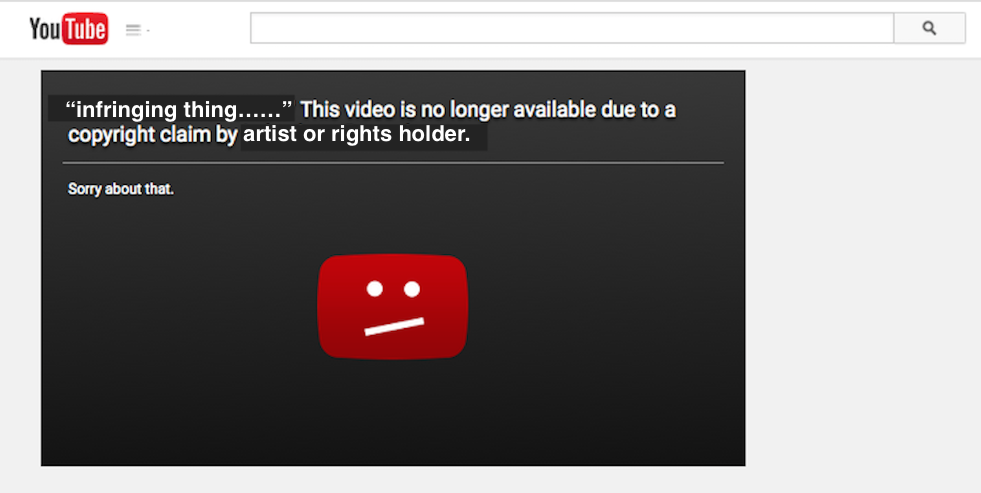
Many videos on YouTube today are simply the title of a popular piece of media, but to avoid a piracy takedown or to sidestep ContentID, are in fact several minutes of silence plus a link to an outside site where the pirated media sits, making it nearly impossible to find or remove. Due to the scale of postings to YouTube, managing this and other copyright issues is a near impossibility. Here’s an example of this on YouTube right now. Just search for a popular TV show.
If you follow the
link in the description you can get to the external site and even read their laughable DMCA notice which is as follows:
“It should be noted that is a simple search engine of videos available at a wide variety of third party websites.
Any videos shown on third party websites are the responsibility of those sites and not . We have no knowledge of whether content shown on third party websites is or is not authorized by the content owner as that is a matter between the host site and the content owner. does not host any content on its servers or network.”
Ah, Safe Harbor in action. Hey startups, here’s how to maximize its use:
1. We’re just simply a search engine/web platform. Check
2. We have no responsibility for infringing material of others. Check
3. Hosted in a foreign country. Bonus Check
Good luck suing us!
Half-assed English legalese, with most of its traffic coming from the US, no information on the domain registrant. Seems legit.
Am I Right? Am I Wrong?
Irony of ironies, now YouTube stars, who often found themselves at the other end of a music takedown (for improperly using music) and decried the heavy handed tactics used against them (
we’re giving you free promotion!), have now found themselves in their own piracy hell. Via a practice known as “freebooting,” they are now finding their works essentially stolen and reposted on other platforms that either make the infringer money or simply are diluting the value of the views these stars need to keep their fledgling stars shining. One “victim” of this is Grant Thompson, of the YouTube channel, The King of Random. Grant sometimes repurposes ideas he finds around the web into videos which may include Creative Commons music, that he then monetizes. He’s
understandably frustrated (careful not to drink any beverages while reading this):
“The worst thing is just the shock of how viral they go on Facebook compared to the ones I post on YouTube,” Thompson said of his videos. “Some of these videos I’ve been working on for years. It makes me wonder why I want to keep doing this.”
Guys…can you imagine? What must that be like, I wonder, slaving on something for years, only to have it stolen and enjoyed for free again and again? Somebody should do something. Anyone?
Hank Green, a self-described
Internetainerpreneur (seriously?), recently wrote a piece on the
seriousness of freebooting and how Facebook is essentially a liar. Again, you might want to take precautions to avoid a spit take.
“I’m a professional YouTube creator. Some people think that this is some kind of joke but I have 30 employees. All of them work in the online video industry, about half of them work directly on producing videos for our educational YouTube channels. We’re a small, profitable business.”
Re: Facebook “But there are a few things that make me wary, not of their ability to grow my business, but of whether they give a shit about creators, which is actually pretty important to me.“
and my favorite:
“What to do? Well, the lack of searchability on Facebook makes it impossible for creators to discover when their content is being freebooted, so if you see suspect content, please reach out to the creator so they can take action. If you have any legal or technical solutions you think might work, please post those as responses to this. And above all, just know that this is an issue and share what you can with who you can. Facebook won’t hold itself accountable, but maybe they will if we make them.“
Citizens, can you please help them? We need to make Facebook accountable for the seriousness that is freebooting. Theft of intellectual property is a big deal and….god I just can’t believe the fucking balls of these guys! Is this really happening, YouTubers complaining their content is being stolen after all the shit they gave music rights owners for trying to enforce the exact same rules? Don’t worry about these guys though, they’ve got over 6,000 patrons on Patreon paying a total of $31k a month. They’ll manage.
And yeah…it’s the same guy who said about using a Calvin Harris song illegally in his video:
“this was a blatant violation of copyright, I just stole it, but somehow, that’s okay”
Do you find this delivery charming or smug?
His explanation in August 2014 is essentially that it is okay to take something…wait, let me just use his word…it is okay to steal something, as long as there is some monetization engine in place in which the rights owner can get paid. Now things like asking permission or paying for an actual sync license or just using music that is in the Creative Commons, is for idiots, because stealing is okay when it is your stuff (music artists), but when it is my stuff (YouTube star):
But most creators have responded, thus far, the same way as me. By shrugging our shoulders and saying “What am I gonna do about it…it’s Facebook, they’re massive.”
But that’s exactly what makes it so awful.
This all sounds so very familiar. Where have I heard this argument before?
Regarding their freebooting issue…aren’t freebooters in fact just giving them free promotion?
¯\_(ツ)_/¯
This Is Not My Beautiful House
Paraphrasing the late great Bill Hicks who once said if you
advertised a product you are off the artistic roll call forever, these days you don’t have the luxury anymore of not being a shill for a product. For example, if your music illegally appears on a Hank Green
Internetainerpreneur Educational video about how artists can go fuck themselves, perhaps you have to accept that Nespresso will Awaken Your Senses. Yes, artists have simply become products, exploited to sell other products. I’m pretty sure when Bob Dylan was singing “If your time to you, is worth savin’” he clearly was speaking about the importance of keeping my Mac clean with CleanMyMac 3 (the current ad I see on YouTube). The times really are a changin. You know what’s blowin in the wind? These nifty 3D T-Shirts by Clothing Monster. George Harrison’s Guitar may be gently weeping, but you don’t have to cry if you switch over to Gmail.
Sadly, YouTube has turned even Bill Hicks into a pitch man for a sugary food marketed towards children. If you know his work, this is the irony of ironies.
I remember an age where we actually lost respect for any artist who was associated with a brand. Now I’m happy to see them able to make any money at all, even if it requires ads loading around their art or them pitching some product. However, I recently began employing ad blocking because my computer is often choking on the resources required to load even a single web page. Seriously, should it require 30+ calls to third party ad trackers and 3GB of RAM to read an article? And the tech industries answer to the upcoming ad blocking explosion of doom (you remember ads, the things musicians now make money from) is that they believe the problem is that they
just aren’t creating enough ads people want to see.
Um…yeah…right, that’s the reason.
I mean why should you worry, it is only $6B of what might also be your money that was “lost”.
BTW, while listening to the entire Imogen Heap album, “Sparks,” on YouTube, how about cooking up a batch of Uncle Ben’s rice for dinner? Or how about buying a new Chromecast device from Google, for just £30? Courtesy of an unauthorized upload of Zoe Keating’s song Frozen Angels.
Yes, Google is happy to promote its own products on infringing content, from a woman they tried to bully into accepting their “take it or leave it” terms. That’s some fucking hubris right there.
It is likely (judging by YouTube’s own released statistics) that the majority of infringing use on YouTube goes completely unmonetized (between low volume video views and ad blocking). And while music has found a way to carve out some form of payment through ad sharing, other rights owners have been caught with no options for monetization at all. If you are a professional photographer, illustrator, or digital artist, and any of your work is somewhere online, it could be found on some video on YouTube, yet how would you in fact know? Sorry, there’s no ContentID for you. I have easily found videos with upwards of a hundred copyright violations (in just 4 minutes of video), with no remuneration for visual artists. So while the music industry might have found a way to monetize improper use of music online (through audio fingerprinting), many other digital artist whose work appears in those videos, get nothing. Is this not a class action lawsuit waiting to happen? Hello, photographers? Deep pockets over there.
And while everyone knows what I’ve outlined above, all of that pales in comparison to what’s coming very soon, which we’ll explore in more detail in part two of this piece.
Where Does That Highway Go To?
In a 2013
Billboard interview with Universal Music head Lucian Grainge, he was asked about power, and part of his response was:
“Power is the ability to stop new services. Power is the ability to create new services. That’s power.”
While I get the larger point put forward by Mr. Grainge (and we certainly need a tough stance), the problem when it comes to the music industry is the belief that what you have is more valuable than what the other side has. While that might have seemed the case many years ago, if you were to ask people today if they had a choice to give up social media or music, would you really want to know their answer?
Snapchat alone has taught the coming generation that the ephemeral is more important than the past. So what’s the value of deep catalogue? What is more important than the “now”? Snapchat was even able to bypass negotiating with the music industry for music use by simply enabling music recording in snaps via using the speaker and microphone of a smartphone. I mean it is only 10 seconds of your song, so that has like…no value, right? No records, no auditing, no rights, no royalties, no evidence. Hey…it’s Safe Harbor…what are you gonna do about it? Plus, everything on their platform is deleted after 24 hours. How could Snapchat possibly know what people are doing on their platform, because um, privacy!
This idea of “power” is fleeting, because we have entered into a waiting game. Tech has the capital and resources to wait out creative industries, while they build alternate ways to create and deliver media. Tech is beginning to get heavily invested in not simply delivering media, but generating it, monetizing it, and even
collecting royalties on it. So ask yourselves…in 5-10 years,
what do they need any of you for?Once In A Lifetime
Are you angry yet? Frustrated? Motivated? You should be.
I wrote the above as a precursor to a second piece. This serves as a framework whereby I want to illustrate what has been happening so I could talk about what is about to happen. I want to delve deeper into actual technologies that will have a profound effect on the livelihood of creators. For the past two years I’ve been warning people in the creative industries of upcoming developments that make these issues of the past look like tinker toys. With all of the efforts put into strengthening copyright laws or protections for rights owners, none of what is currently proposed will do any good whatsoever, unless we find a way to strike a balance between creative and tech, and that means creative needs to start pulling together.
What is needed is a new approach that does not solely rely on solutions provided through legal means. No, what has to happen is that the creative industries need to start building their own technology that belongs to them and serves their greater good and that the tech industry has to use. The politics have got to stop. Majors vs indies, it’s a battle they want you to be fighting, because out of left field will come disruption. Yet working together to solve many of the issues and problems facing creators is no longer something we can just pay lip service to, it is a moral imperative.
Technology doesn’t care about borders, regions, laws, rules, or fairness. It cares about results…and it is time the creative industries started delivering some.
“We’re largely unconscious,” Byrne says. “You know, we operate half awake or on autopilot and end up, whatever, with a house and family and job and everything else, and we haven’t really stopped to ask ourselves, ‘How did I get here?‘ “
More importantly, the question to answer now is, where are we going?
Alan Graham is the co-founder of OCL







 The Trichordist
You must be logged in to post a comment.