Uber’s attempt to enter the Austin market is becoming the proverbial cautionary tale for what can happen to an otherwise cool, live and let live city’s way of life when Silicon Valley’s tech bully boys descend on the town. And decide to spend whatever it takes to get their way.
Early voting begins today on a ballot initiative paid for by Uber and Lyft, and it’s becoming blatantly apparent that Lyft may have the wrong style mustache on their cars (h/t Mike Godwin). The ballot initiative would replace a duly enacted regulation of the Austin City Council to require fingerprinting of Uber and Lyft drivers with a new regulation drafted by the billion dollar corporations that would strike the fingerprinting requirement.
According to the Austin-American Statesman, taxi drivers, limo drivers and other public transportation operators also have to undergo fingerprint-based background checks.
The list of outsider big money special interests that fared poorly after running into local Austin resident groups with staying power and grassroots clout is long and distinguished.
Even so, the radical change in Austin’s skyline bear mute witness to just how futile is resistance against determined multinationals. If you’ve ever experienced a Google Fiber rep trying to force his way into your back yard, you know what I’m talking about.
Uber and Lyft are using surge pricing of political influence to run headlong into this conflict as the brogrammers pour millions into a ballot measure to rewrite local laws to their benefit and finance the brinksmanship between the commoditizer and the commoditized that we are all too accustomed to.
Peter Mensch gave voice to what many in the music business believe as reported by the BBC:
“YouTube, they’re the devil,” [Peter Mensch] told a BBC Radio 4 documentary on the music business. “We don’t get paid at all.”
He said the site’s business model, in which artists make money by placing ads around their music, was unsustainable.
“If someone doesn’t do something about YouTube, we’re screwed,” he said. “It’s over. Someone turn off the lights.”
YouTube’s reaction? It’s not them, it’s the labels, the “gatekeepers”. YouTube pays high royalties for music, it’s that it’s not getting to the artists because it’s being siphoned off by “gatekeepers”. According to YouTube’s Chief Business Officer–the Suit of Suits–Robert Kyncl:
“There are middle-men – whether it’s collection societies, publishers or labels – and what they do is they give advances and they want those recouped. So it’s really hard when there’s no…
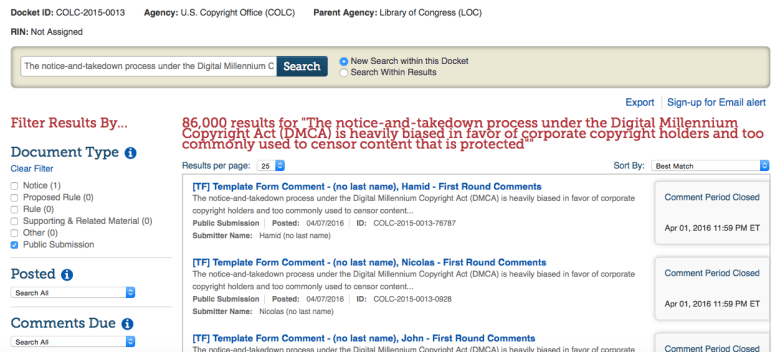
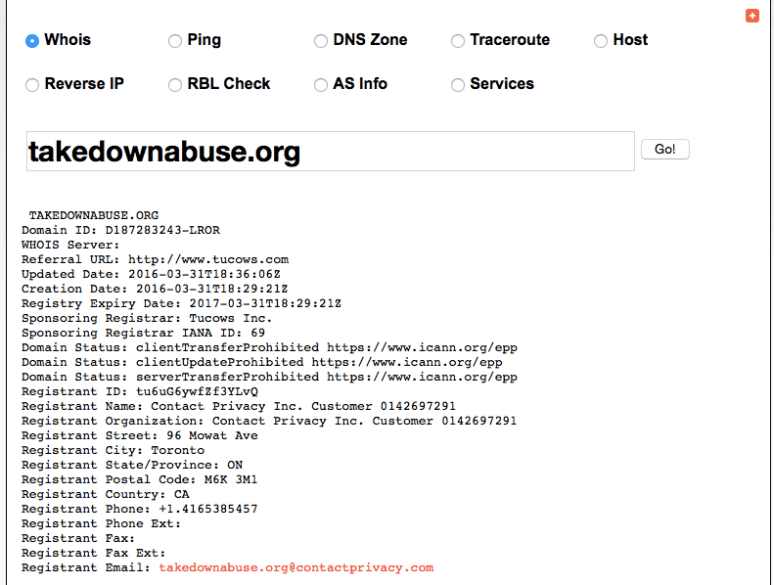
Comment bots? What comment bots? Exactly 86,000 identical comments filed to regulations.gov website? Since the Takedownabuse.org website wasn’t even created until march 31st 2:29pm New York time, that is at least 40 comments a minute. But even that is likely an underestimate. How long did it take to build the website and code a web form to comment bomb the regulations.gov site?
The Copyright Office has posted the results of the comment gathering process on the DMCA “Takedown and Notice” provision 512 (i). The Takedown and Notice process is an important (if weak) tool available to copyright owners to combat copyright infringement on the web. Basically the Takedown and Notice provision forces musicians and songwriters to police the entire web (at considerable expense) and send a notice for each and every infringing file on the web. The tech behemoths that host this material are granted a “safe harbor” from the infringement generated by their users if they respond in a timely fashion to these notices and remove the files. However virtually every one of these tech behemoths allows users to simply immediately upload the file again. This “whack-a-mole” system has been very profitable for tech companies. Google owned YouTube generates significant revenue (8 Billion dollars according to Morgan Stanley) from the “user generated content” supported platform.
In the case of my catalogue most of this user generated content on YouTube isn’t really generated by users at all. It’s simply album art and ripped audio that I own, none of which was “generated” by the users. Further the repetition of certain key phrases in the profiles of these “users” suggest that much of this style of mass infringement is committed by an organized group. Yes, I am arguing RICO laws apply. It seems odd that a company that claims its mission is to “organize the worlds information” would not be able to write a simple algorithm to flag this type of behavior that appears to be criminal. But then again that would give them “red flag” knowledge and they could no longer Sgt. Shultz (“I see nothing!”) the problem. And then there is the matter of all those billions of views they’d actually have to pay royalties on…
So naturally when the Copyright Office decided to review the Notice and Takedown provisions everyone in the creative community expected pushback from Google and astroturf proxies like www.fightforthefuture.org. (AstroTurf? What sort of grassroots organizations can hire a DC lobbyist like Pale Blue?) What no one expected was for proxies like Fight For The Future to apparently violate the law in their pushback.
Violate the law? Yes. Fight For The Future created a “comment bot” that bombed the Regulations.gov website with identical, anonymous and most likely fraudulent multiple comments to the Copyright Office. Consider the following:
Fight for the Future bragged to it’s supporters that their “campaign” (actually a comment bot) crashed the Copyright Office website. If this claim is true how is this not a “denial of service” attack on a federal government server?
If this claim is false, why is FFTF asking for donations using this false claim? False advertising?
The rules for submission of comments to the Regulations.gov website clearly state that comments must be made to their website, not made to the FFTF website and then submitted by robots to the regulations.gov website.
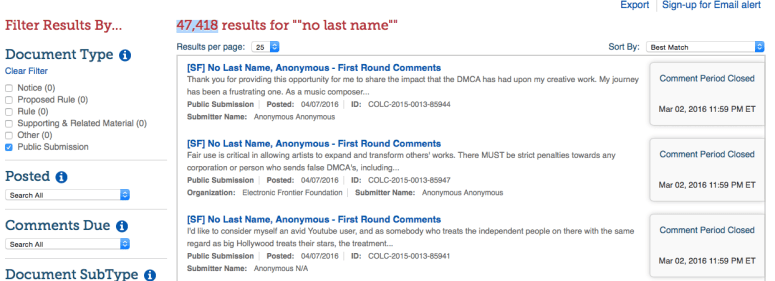
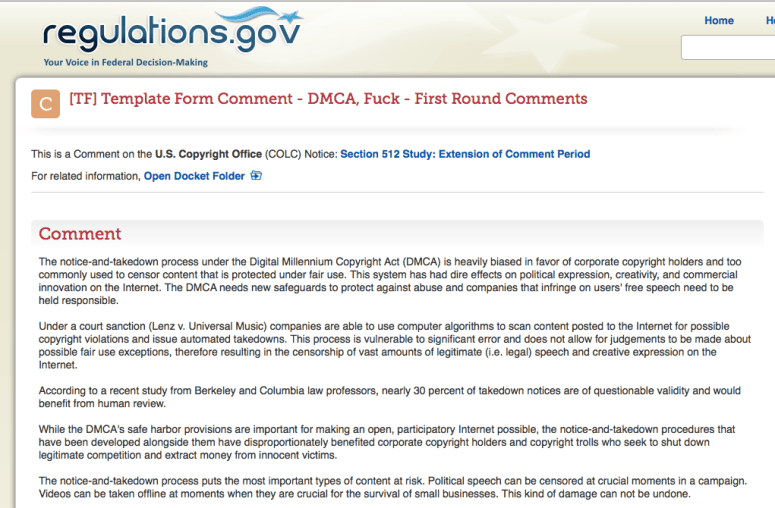
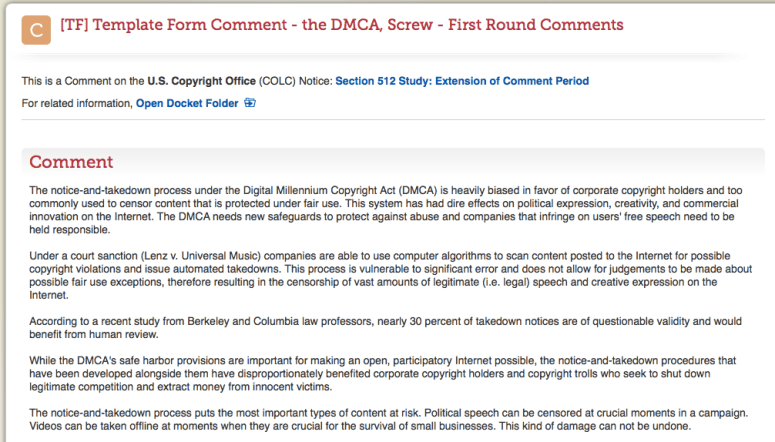
47,418 of the comments submitted by FFTF to the regulations.gov website did not disclose first and last name as required. Many are anonymous and clearly fake names like “Fuck DMCA” or “Screw DMCA.” Why did regulations.gov post these comments? These do not meet the requirements. (see screenshots).
FFTF partnered with Channel Awesome on YouTube to generate comments. This channel is largely oriented to teens and pre-teens. This was essentially a political advertisement to children. The FTC has generally required much higher standards when it comes to exaggerations and dubious claims when ads are directed to children. Even if this is not illegal (I’m not an expert), I think it is totally insane (and creepy) to push hysterical misinformation on a channel directed at children and then direct them to make comments on a third party website that then posts these comments to government website where they are required to identify themselves! What kind of people get minors involved in something that may turn out to be an illegal activity? Where are the grownups?
My test of the FFTF comment bot indicated that it accepted comments from IP addresses outside of the United States.
My test of the FFTF comment bot indicated that one could simply reload the page and post over and over again. Thus allowing fraudulent multiple comments.
My test of the FFTF comment bot indicated that it did not verify email addresses or names of those commenting and yet posted these comments to the regulations.gov website.
A suspiciously round number of comments were identical (86,000) and used the FFTF template (see screenshots). Sure that’s not proof of bots, but it is weird. And the OMB (manages regulations.gov) should really look into this.
47,418 comments filed and accepted by Regulations.gov website fail to properly identify person posting comment. Almost all of these comments appear to have been submitted using the FFTF comment bot. (Contained template text).
Fake name example 1
Fake name example 2
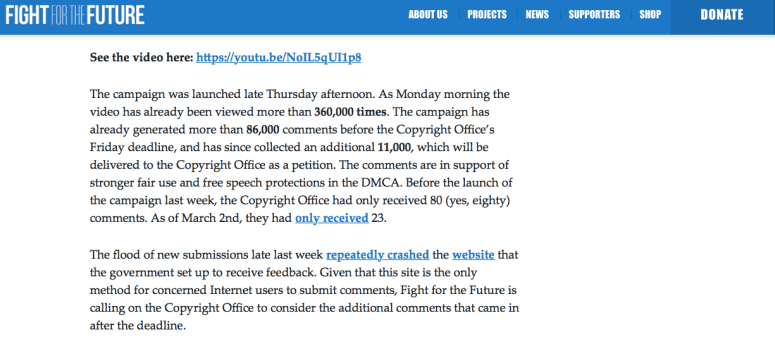
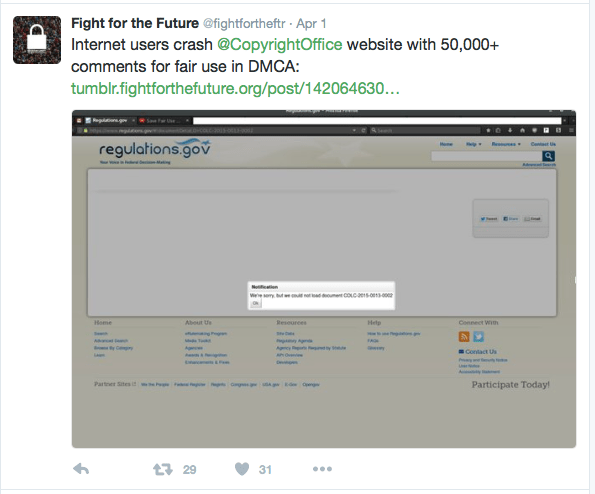
Fight For The Future bragging about repeatedly crashing Copyright Office’s servers while soliciting donations for their organization. Also notice the “more than 86,000 comments.” They really like that number.
The Children’s Crusade: Fight For The Future partnered with teen oriented YouTube Channel Awesome in comment bombing of copyright office.
Website was created March 31st at 2:29 NY Time.
Corrections: We did the math on the daylight savings time backwards. It was actually 2:29 pm Eastern when the website was created. Not 12:29 as previously stated. An earlier version of this post said “did verify email addresses” when in fact we meant “did not verify email addresses”.
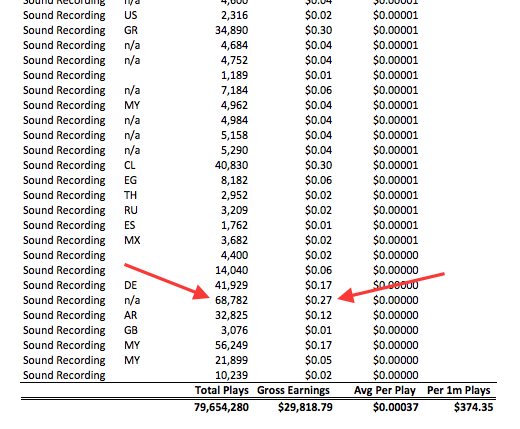
We’ve been supplied nearly a year’s worth of Content ID data from a mid-sized indie label. Over the course of about a year here’s what the data shows:
After nearly a year and 80 million plays, the net average per play amounts to less than $375.00 per MILLION Plays on YouTube. Ok, that’s just for the sound recording, there are two other parts to the uploaded copyright, the musical composition and the video content itself. Assuming each of the three parts earns an equal share (why would they not, but how would we know given YouTube’s usual secrecy sauce?), then the full amount payable by YouTube for 1 Million plays via Content ID would be $1,125, or $.001125 per play (on average).
We know that on directly uploaded videos where the creator or rights holder is claiming all three copyrights they are being paid more than $1,125 per million plays on…
Chris Castle asks why the US compulsory licenses don’t require services to display songwriters as this is clearly required by treaties to which the US is a party.
It also begs the question: By failing to obtain names of writers and display them are services violating Article 27, Universal Declaration of Human Rights which requires the protection of “moral and material interests resulting from any scientific, literary or artistic production of which he is the author?” Attribution being the most important of these rights.
In Washington, DC yesterday, I was honored to participate in a symposium on the subject of “moral rights” sponsored by the U.S. Copyright Office and the George Mason University School of Law’s Center for the Protection of Intellectual Property. The symposium’s formal title was “Authors, Attribution and Integrity” and was at the request of Representative John J. Conyers, Jr., the Ranking Member of the House Judiciary Committee. (The agenda is linked here. For an excellent law review article giving the more or less current state of play on moral rights in the U.S., see Justin Hughes’ American Moral Rights and Fixing the Dastar Gap.)
The topic of “attribution” or as it is more commonly thought of as “credit” is extraordinarily timely as it is on the minds of every music creator these days. Why? Digitial music services have routinely refused to display any credits beyond…
Press release from Radiohead’s publicity firm Nasty Little Man.
Ouch! Still it is better than being called “a lying sack of shit.”
Brian Message has been pedaling his pro-Spotify and Google nonsense under the pretense of being “Radiohead’s Manager” for years. Frankly it’s shocking that he’s been able to get away with it for so long.
Check out some of the links I turned up in 15 seconds.
Scalia accepts book from his former law clerk Lawrence Lessig
It’s Monday. Let’s have a little fun here and try to figure which presidential candidate would be most likely to nominate copyleft demagogue (and former Democratic presidential candidate) Lawrence Lessig to the Supreme Court. After losing at the Supreme Court twice on copyright issues you’d know he’d jump at the opportunity to be nominated.
Hillary Clinton
The super creepy logo of Groundwork, the secretive Eric Schmidt big data operation backing Hillary Clinton.
While Hilary Clinton’s close connections to Hollywood would on the surface make it seem unlikely that she would support a Supreme Court nominee so hostile to the interests of creators, she seems awfully close to Eric Schmidt CEO of Alphabet/Google. And the admiration is mutual, Eric Schmidt is backing the Hilary campaign with a massive data operation. As QZ reports:
“An under-the-radar startup funded by billionaire Eric Schmidt has become a major technology vendor for Hillary Clinton’s presidential campaign, underscoring the bonds between Silicon Valley and Democratic politics. The Groundwork, according to Democratic campaign operatives and technologists, is part of efforts by Schmidt—the executive chairman of Google parent-company Alphabet—to ensure that Clinton has the engineering talent needed to win the election. And it is one of a series of quiet investments by Schmidt that recognize how modern political campaigns are run, with data analytics and digital outreach as vital ingredients that allow candidates to find, court, and turn out critical voter blocs.”
This is particularly clever as the shadowy organization claims to be a “vendor” of the Clinton campaign, but as the QZ article goes on to suggest the Clinton campaign is essentially being undercharged for these services because an even more shadowy and opaque group “Timshel” is really subsidizing the salaries of the data engineers doing the heavy lifting.
“Schmidt did not respond to several requests for comment. But several Democratic political operatives and technologists, who would only speak anonymously to avoid offending Schmidt and the Clinton campaign, confirmed that the Groundwork is funded at least in part by the Alphabet chairman.”
If this is true, this is an extremely crafty way for Google and Schmidt to disguise what are in effect campaign contributions to the Clinton campaign. So what better way to pay back Schmidt for his help than to nominate the piracy defending Harvard Law Professor to the Supreme Court? You think YouTube abuses section 512 of the DMCA now? Lessig on the Supreme Court would make pretty much anything “Fair Use.”
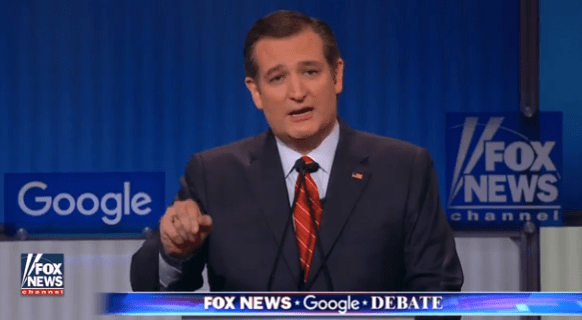
Ted Cruz at the Google sponsored Republican debate.
Ted Cruz
While it seems unlikely that the conservative candidate would nominate a progressive Democrat for Supreme Court, remember Ted Cruz lobbied on behalf of Google in an Texas Anti-Trust investigation. As Yahoo News reported in March of last year:
“Facing the threat of an antitrust lawsuit from the state attorney general, Google hired Cruz to represent its interests before the agency where Cruz himself had worked just over two years earlier and where his mentor, Abbott, still called the shots. The future political star met with a top Abbott deputy on Google’s behalf in August 2010, and Cruz then accompanied a team of antitrust lawyers from Google and a Palo Alto, Calif.-based law firm to three additional meetings at the agency, according to a Cruz spokesman and visitors’ logs for the Texas attorney general’s office.”
Lessig’s copyleft stances on YouTube and in defense of piracy would be very good for Google’s core advertising businesses. See ad supported piracy here.
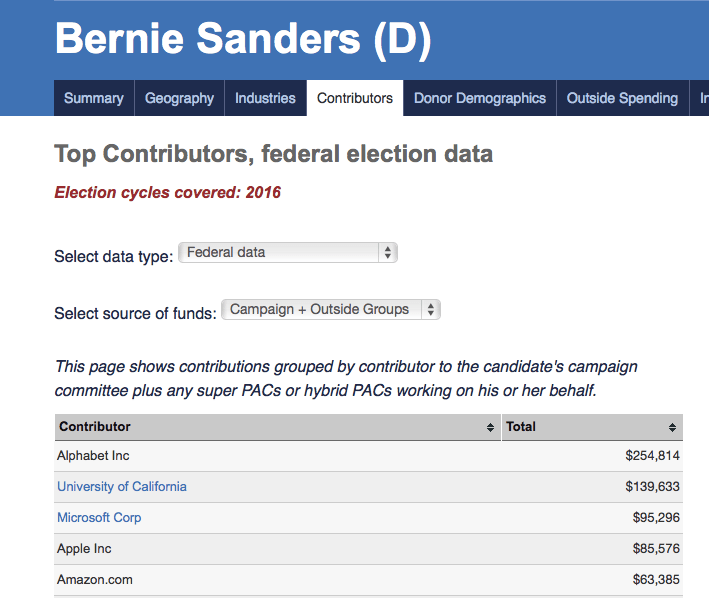
Top contributors to Bernie Sanders by company. Alphabet is new corporate parent of Google.
Bernie Sanders. Democratic Socialist? That seems like he would be good for the rights of the little gal/guy right? I mean surely a progressive like Sanders would see copyright for what it is: an individual right that empowers individual creators and forces large corporations to pay creators for use of their works. However if he turns out to be anything like his fellow progressives and European Democratic Socialist counterparts he will probably weaken copyright further. Remember in April of 2015 the UK Green Party came out in favor of greater “sharing” of copyrighted material and limit copyright to 14 years. The same length copyright was in 1710, when the average lifespan was less than 40 years. Talk about buggy whips!
The French Socialists challenged the constitutionality of the French anti-piracy law HADOPI. And the Socialist Party of the USA platform simply states: “We call for the repeal of all existing copyright laws.”
Progressives are fond of proclaiming that many poor Americans seem to vote against their economic interests by supporting conservative candidates. Less often noted is that something similar happens with progressives and left wing political candidates. They have a habit of attacking the entertainment industry and robust copyright laws that support these industries. Funny because the entertainment industry is a largely a unionized industry that overwhelming supports left of center candidates. Meanwhile many of these same progressive candidates suck up to the libertarians of Silicon Valley. Go figure.
Donald Trump: A friend of mine refers to Donald Trump as the “Manchurian Candidate.” This is a reference to the classic political thriller by Richard Condon, in which an American Korean War hero is actually a communist “sleeper agent.” The point is that Donald Trump and Lawrence Lessig seem to share an extreme ideological flexibility. They are thus a perfect for each other:
You can’t make this up. Law 360 is reporting that the International Trade Commission (ITC) has been denied authority over digital goods.
The Federal Circuit said Thursday that it wouldn’t reconsider its decision that the International Trade Commission lacks the authority to block the import of digital files, drawing a lengthy dissent from one of its judges.
Keep in mind, the same people now opposed to the ITC having this authority are the same who argued in favor of the the ITC doing so as an alternative to SOPA called the Open Act.
When advocating for the OPEN Act as a good alternative to SOPA and the PROTECT IP Act, the bill’s sponsors touted the ITC as being a great venue for tackling the problems of foreign rogue sites. Among the claimed virtues were its vast experience, transparency, due process protection, consistency, and independence:
For well over 80 years, the independent International Trade Commission (ITC) has been the venue by which U.S. rightsholders have obtained relief from unfair imports, such as those that violate intellectual property rights. Under Section 337 of the Tariff Act of 1930 – which governs how the ITC investigates rightsholders’ request for relief – the agency already employs a transparent process that gives parties to the investigation, and third party interests, a chance to be heard. The ITC’s process and work is highly regarded as independent and free from political influence and the department already has a well recognized expertise in intellectual property and trade law that could be expanded to the import of digital goods.
The Commission already employs important safeguards to ensure that rightsholders do not abuse their right to request a Commission investigation and the Commission may self-initiate investigations. Keeping them in charge of determining whether unfair imports – like those that violate intellectual property rights – [sic] would ensure consistent enforcement of Intellectual Property rights and trade law.
Some of the groups now arguing that the ITC shouldn’t have jurisdiction over digital goods openly supported the OPEN Act. Back in late 2011, the EFF stated that it was “glad to learn that a bipartisan group of congressional representatives has come together to formulate a real alternative, called the OPEN Act.” The EFF liked the bill because the “ITC’s process . . . is transparent, quick, and effective” and “both parties would have the opportunity to participate and the record would be public.” It emphasized how the “process would include many important due process protections, such as effective notice to the site of the complaint and ensuing investigation.”
Google likewise thought that giving the ITC jurisdiction over digital goods was a great idea. In a letter posted to its blog in early 2012, Google claimed that “there are better ways to address piracy than to ask U.S. companies to censor the Internet,” and it explicitly stated that it “supports alternative approaches like the OPEN Act.” Google also signed onto a letter promoting the virtues of the ITC: “This approach targets foreign rogue sites without inflicting collateral damage on legitimate, law-abiding U.S. Internet companies by bringing well-established International trade remedies to bear on this problem.”
You can read the full post here (Strongly Recommended):
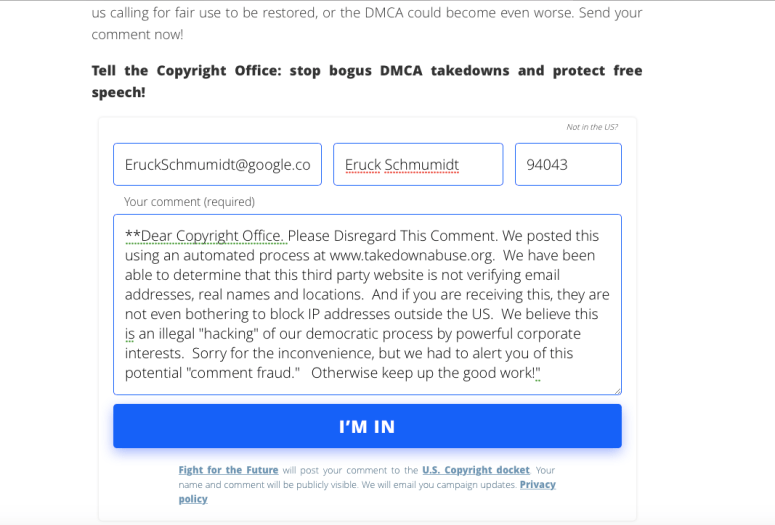
We replaced the canned message on the takedownabuse.org web form with a message like this, to verify that Google/YouTube proxy Fight For The Future website was indeed automating comments on an official US Government website.
Torrent Freak is reporting that Google/YouTube proxy “Fight for the Future” generated a flood of automated “comments” that crashed the regulations.gov website Thursday. This was within the crucial last 48 hours of a comment collection period for a consultation on the DMCA notify and takedown process which currently allows Google/YouTube to reap billions by monetizing “user generated content” that actually belongs to songwriters like myself.
FFTF (Fight for the Future) publicly boasted about the website outages on Thursday to Torrent Freak:
“The flood of new submissions over the last several hours appears to have repeatedly crashed the website that the government set up to receive feedback,”
(On Friday night around 10:30 PM we received a tip and then verified that the regulations.gov website was again unresponsive.)
Users? Actually FFTF web form bot crashed the page.
How did this happen?
FFTF employed a sophisticated campaign of technology and misinformation to electronically generate tens of thousands of identical canned comments to the CO website. Further instead of having users visit the consultation comment page for comments as the Copyright Office requires, FFTF used a web form hosted by Fight For The Future at www.takedownabuse.org, and this is where things get ugly. Very ugly!
Visitors to this website were directed to fill in their email address, name and ZIP code which then automatically posted a canned comment to the copyright office website. We tested the web form and discovered:
FFTF (Fight For The Future) did not verify email, name and ZIP code before accepting comments.
FFTF did not verify our IP address was in the US before accepting comments.
FFTF web form allowed multiple comments. By refreshing the page you could simply comment again and again.
FFTF put no restrictions on “bots” on their web form. Using the crudest keystroke automation we managed to post rapid fire comments (less than three seconds between comments).++
FFTF violated the federal rules that require comments be posted only using the regulations.gov interface. FFTF appears to have violated this rule and further may have used automation to simulate a visitor (rather than bot) to the official government website.
The Copyright Office website was non-responsive late Friday night when a large number of the automated comments came in.
FFTF was still auto-generating comments after the official deadline and demanding the copyright office accept these submissions.
We believe FFTF’s actions may have been illegal in several ways:
Using automation to post comments to a government website and as a result causing a website outage is essentially a denial of service attack on a USG agency.
Using a third party website and automated systems to post comments for the copyright office consultation is clearly against the consultation rules.
The campaign by FFTF would seem to qualify as Spam! Further the likely coordination between FFTF, Google and other commercial entities could qualify this as a deceptive commercial communication since the associated videos contained unsubstantiated claims, and the Google funded study reference also makes unsubstantiated conspiratorial claims+++
By effectively monopolizing the regulations.gov website for the last two days did FFTF unlawfully suppress the constitutional right of creators to petition their government?
We call on the Copyright Office, Congress and FBI to look into whether any laws were broken by Fight For The Future and their patron Google.
++ we conducted only a short burst of “automation” on the takedownabuse.org web form. Less than 7 comments were potentially posted. The copyright office was informed we made test comments through the takedownabuse.org website.
+++ Example: “A more pointed question is whether the notice escalation represents coordinated retaliation against Google for its role in opposing stronger enforcement obligations on OSPs, culminating in the defeat of the Stop Online Piracy Act in 2012. The timing of the escalation outlined by Seng is suggestive. 2011 saw a large 305% increase in notices over 2010. But the banner year was 2012, with a 524% increase overall and a 227% increase in April alone, in the immediate aftermath of the withdrawal of the bill. Most of the major rightsholders only began actively targeting Google Web Search during this period, including those who currently send massive numbers of notices: the RIAA and BPI, the major movie studios, and Degban Ltd.—the lead REO for the pornography industry.”
This is of course absurd and they presents no evidence to support their claim. Further with Occam’s Razor in mind, a theory that adds far less assumptions and doesn’t require a massive conspiracy among half a dozen multinationals is this: After the failure of SOPA large rights holders only had only one option left, DMCA takedown and notice, so as rational actors they all used this tool to protect their copyrights.







You must be logged in to post a comment.