Sorry We’re Not English: Four Spotify Red Herrings Went to Market

Music Technology Policy

There are a few recurring red herrings in the coverage about the Spotify lawsuits that I thought we could examine.

1.  Sorry We’re Not English:  Hooray Henry! Spotify is a European company, so it should come as no surprise that one of the most common red herrings we hear is that there’s something wrong with the US because we don’t do things the way the rest of the world does and that makes it inconvenient for Spotify.  So that’s our fault, you see.  And we might agree if it weren’t for the nondisclosure agreements that prevent some of the European societies from even telling their songwriter members what the rates are.  (See Jonathan David Neal’s groundbreaking guest post of his interview with Andrew Shaw from the PRS about their YouTube deal).

While there may be other aspects to the UK and European system of licensing that commend themselves…

View original post 513 more words

MTP: David Lowery is Spotify’s Worst Nightmare

It’s important to remember that David Lowery could have just sued Spotify over his own catalog.  He didn’t do that.  He brought a class action for the good of all songwriters who get overlooked and disrespected by Spotify and that’s a lot of people.  I don’t know Melissa Ferrick, but I would bet the same could be said of her.

The plaintiff who can’t be bought off is a defendant’s worst nightmare.  This is particularly true in David’s case because in addition to whatever money damages the class may be awarded, David is also asking for an injunction to require Spotify to bring in an independent third party compliance examiner to fix Spotify’s massive failure to identify copyright owners.

That injunction is probably more fear-inducing than whatever the payment might be, because that will once and for all fix the problem and eliminate the slush fund–or force Spotify to stop exploiting uncleared tracks.  Make no mistake–unpaid royalties are a source of interest-free loans.

Why do I think that Spotify is most afraid of someone they don’t control getting inside the company and looking under the hood?

Read the rest David Lowery is Spotify’s Worst Nightmare from Music Tech Policy

Major Publishers + Kobalt Get $5 Million, Spotify Escapes an Audit, Indie Songwriters Get To Help Build Song Database. Yay!

The major publishers are on the verge of a major settlement with Spotify.  Details have emerged that make it clear that everyone gets something except indie songwriters.  Well, indie songwriters may get  a few dollar IF they help build Spotify’s spiffy new database by dutifully submitting publishing information. But unlike the major publishers they won’t receive penalties or the statutory damages that may be legally due to them.  Statutory damages  can be in the thousands of dollars per unlicensed song

And why exactly are indies helping build a Spotify publishing database?  I mean Spotify built a streaming service and raised billions of dollars and they forgot to build a song royalty and licensing payment system? It’s not songwriter’s fault the company is apparently run by incompetents.  Further there were also plenty of third party vendors that could have done a halfway decent job licensing and paying royalties.  Which reminds me why does HFA get in on the deal?  They were in charge of licensing the songs that didn’t get licensed.   This literally punishes the victim while rewarding the apparent mass infringer and its enabler in chief.  This is a complete outrage.

Judging from preliminary data it appears  that the unlicensed songs (and resulting unpaid royalties) were largely indie publishers not represented by the major label publishers or the Harry Fox Agency.    So why is it that any remaining royalties will be paid out according to publisher market share?  That will only guarantee that the major publishers are paid royalties that should belong to indie songwriters.

So here we go again.  In a shortsighted cash grab the major publishers will take what most average-hardworking-play-by-the-rules Americans would call a $5 million bribe, in exchange for giving Spotify an out on the ongoing HFA audit and provide a smokescreen that misleads independent songwriters and Spotify investors into thinking that the unlicensed song problem has been fixed.  It has not.  In fact it’s worse than fixed.  It’s a $5 million dollar whitewash.


5 Things Wrong With Major Music Publisher Spotify Settlement

  1.  It’s not a real settlement, it’s more like a bail out.   It doesn’t get rid of the real problem: infringement liabilities.   Spotify will still be loaded with an unknown number of songs (hundreds of thousands?  millions?) that were never licensed and thus Spotify will still be infringing copyrights on a mass scale.  Why?  It would require tens if not hundreds of thousands of independent songwriters who have no relationship with NMPA to opt into the NMPA’s publisher payout settlement.  How likely is that to happen?  (Not to mention songwriters who live outside the U.S.)
  2. The NMPA publisher payout settlement supposes there is a royalty rate with which to calculate unpaid royalties.  But there is no royalty rate!   Why?  It is highly likely that Spotify failed in many cases to obtain compulsory licenses BEFORE they made available the songs (hence the settlement).   As a result by law Spotify is forbidden to use the compulsory licenses on a recording-by-recording basis (and song-by-song) and the associated statutory royalty rate.  This means Spotify must negotiate a direct deal with each songwriter.  Until that is done there is no way to calculate unpaid royalties.  Spotify is trying to unilaterally impose some theoretical royalty rate on all the world’s songwriters.
  3. The settlement essentially forces publishers and songwriters to build Spotify’s licensing and royalty database.  Can you imagine the outrage if a record label demanded that performers and managers build the back office royalty systems before they were paid?  Why?
  4. It looks like the $5 million “penalty” would be divided up among publishers by market share.  So this means the major publishers would capture most of this revenue.  Now think about it.  Who IS getting paid by Spotify?  The major publishers! So now they get paid again?  What’s the penalty for if the majors were already getting paid? The unpaid and unclaimed royalties are more likely to belong to the independents who weren’t licensed.
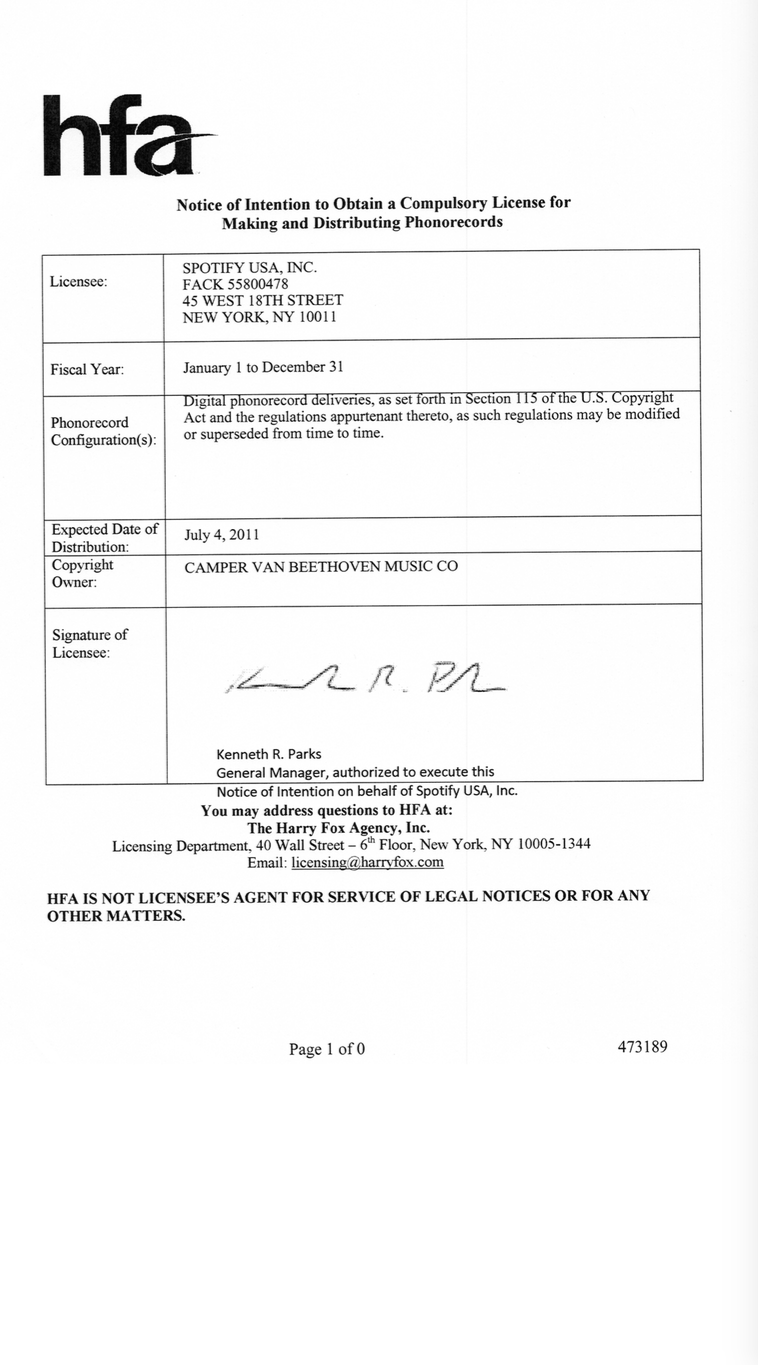
  5.  I have a fundamental objection to the premise that Spotify and HFA have somehow learned their lesson and reformed their practices and are thus deserving of a settlement.  It appears that they continue to engage in practices that violate a host of laws (not just copyright). Allow me to demonstrate.  HFA just sent to me on behalf of Spotify (via USPS) what appears to be backdated NOIs (“notice of intent to obtain a compulsory license”).  Here’s one postmarked Feb 16 2016  that we received for a use starting in 2011–FIVE YEARS LATE!  And it’s “signed” by Ken Parks, a Spotify executive who left the company nearly a year ago.  Not only that, but it lists an address for HFA that they didn’t have until they moved in 2012!  I have to believe I’m not the only one who is getting backdated NOIs trying to trick me into accepting them.

Screen Shot 2016-03-08 at 10.23.16 PM

Screen Shot 2016-03-08 at 10.23.40 PM


After Skipping Spotify, The 1975 Scores a Number 1 Album | DMN

“After avoiding Spotify entirely and focusing the release on iTunes and a variety of physical formats, the band achieved a number one album in several countries.  According to Billboard and its counting partner Nielsen Music, The 1975’s just-released album, I Like It When You Sleep, for You Are So Beautiful Yet So Unaware of It, sold 98,000 units in the US alone, a chart-topping tally.”

READ THE FULL STORY AT DIGITAL MUSIC NEWS:
http://www.digitalmusicnews.com/2016/03/08/despite-skipping-spotify-the-1975-gets-a-us-number-one/


Three Simple Steps To Fix The Record Business in 2016… Windows, Windows, Windows… (2015)


How to Fix Music Streaming in One Word, “Windows”… two more “Pay Gates”… (2014) 


Why Spotify is not Netflix (But Maybe It Should Be) (2013)

RightsFlow: What Kind of Racket Are These Guys Running?

Background on the “Notice of Intention to Obtain Compulsory Mechanical License”

Every recording of a song has two copyrights.  One for the recording and one for the composition (the song in abstract).   Because the composition is embedded in the recording anyone that wishes to use a recording of a song must ALSO obtain a license from the owner of the composition which is generally the songwriter.    So when a streaming service like Google Play ingests a recording  into their computers to distribute they must also obtain a license from the songwriter or the songwriter’s appointed agent.  This is a relatively easy thing to do. The service can either get a direct license or in the U.S. a compulsory mechanical license.

To get the compulsory license, by law all Google Play need do is send a notice to the songwriter, their publisher or licensing agent within 30 days of distribution. This is called a “Notice of Intention to Obtain a Compulsory Mechanical License.”  Or NOI for short.

The US government has limited the intellectual property rights of songwriters in a couple of important ways.  First, they allow anyone to “cover” a songwriter’s song.  Second they set the set a price for the various uses of the song.  For instance on a digital download the songwriter must be paid $0.091 per download.  For streaming services it is much more complex calculation, but essentially it’s 10.5% of the revenue generated by the service monthly, pro-rated by the number of spins the songwriter’s compositions generated.   This compulsory mechanical license is a good deal for streaming services and record labels.  All they have to do to take advantage of this license is send an NOI.  And those NOIs can list every single song in the songwriters catalogue.  In my case a service like Google Play could send an NOI for the 300 or so songs that I have in my catalogue.  All my songs and contact information are listed in an easily searchable Copyright Office database. 

Despite the ease of finding the BMI registrations for all of my songs, streaming services often whine that it is hard to send NOIs to all the songwriters.  Poor billion dollar babies.

However consider the following:

  1. I’m the one who has had my rights limited by the US government. At the very least I deserve to know who is using my songs. That way I know when I’m due money and from whom. I deserve to be directly accounted to and paid for the use of my songs.  That’s the point of sending the NOIs. Establish contact between licensor and licensee.
  2. Songwriters are forced by the US Government through the compulsory license to go into the music streaming business.  But the venture capitalists and technology companies that back and operate these services were not forced to go into the streaming business.  They chose to go into this business.  They knew the rules before they started.  If they really didn’t know the rules? I don’t know, maybe the venture capital firms that poured billions into these services should fire the executives running these firms and replace them with competent executives.
  3. If these services really can’t find the songwriters, they are allowed to send the NOIs to the Copyright Office.  Of course the Copyright Office charges a fee for processing these NOIs to cover their costs.
  4. Licenses for around 60% of the songs (by popularity) can be obtained by cutting deals with the three major music publishers. Additionally a large number of songs (sometimes the same songs) can be obtained through licenses with the Harry Fox Agency.
  5. No one is forcing the streaming services to make available every single song ever published. Too hard to find ALL the writers?  Don’t use ALL the songs. Simple.

Music Rights, RightsFlow, Harry Fox Agency and Medianet and Fake Compulsory Mechanical Licenses. 

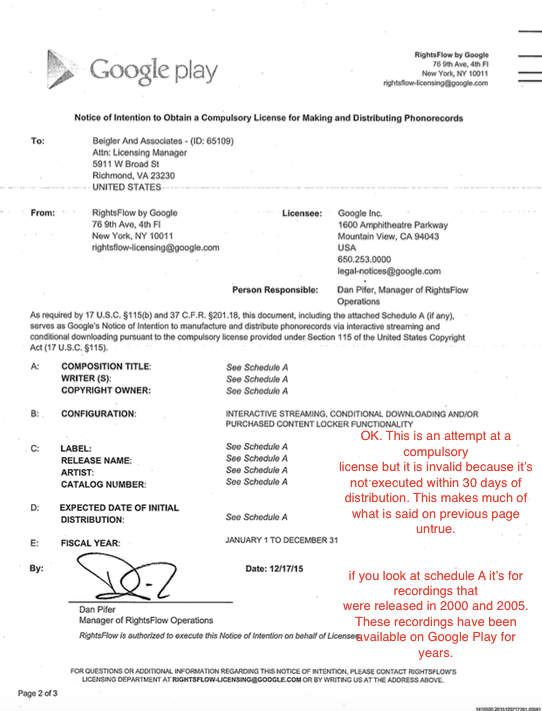
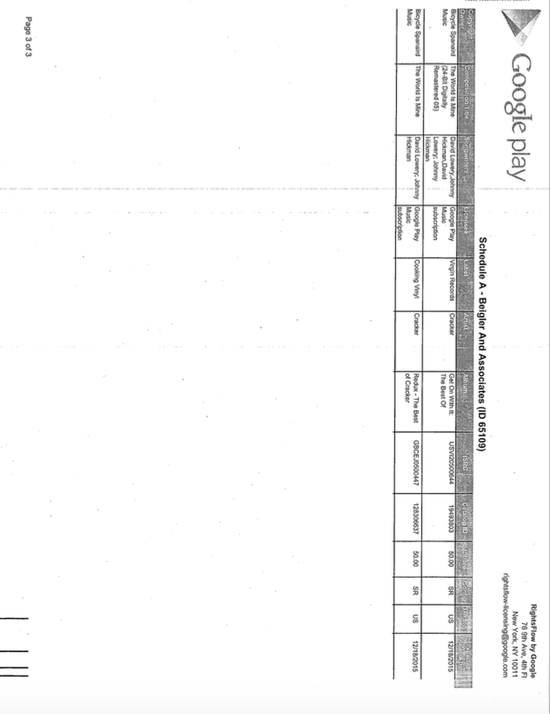
In order to help these services obtain the statutory compulsory mechanical licenses market incentives have produced a number of companies that provide this service.  Harry Fox Agency  in New York; Music Rights and RightsFlow now in California; and MediaNet in Washington. Over the last few months I’ve received invalid NOIs via the USPS from these services.  In particular if the NOI is late then the compulsory license is no longer available for those compositions. Instead a direct license is required. Further the rate is no longer set by government statute, instead it must be negotiated between the writer and the service.

And perhaps more importantly, since the notice is invalid the writer now has the ability to say no to these services.  Why would a writer want to say no?   Well consider that 10,000 monetized spins on a service like YouTube sometimes is the financial equivalent of a single 10 song album sale for a songwriter.  It’s entirely possible the songwriter would prefer to have a smaller audience or market share but generate more revenue!  This is not uncommon in business, profit is more important than market share.  For instance Apple has a smaller share of the smartphone market but will make more profit than all the Android smartphone makers combined!

For a songwriter losing the ability to say no to a streaming service that undercuts higher margin sales is a loss of something that has a measurable monetary value.  But regardless the right to say no once the compulsory license window has closed is a legal right. 

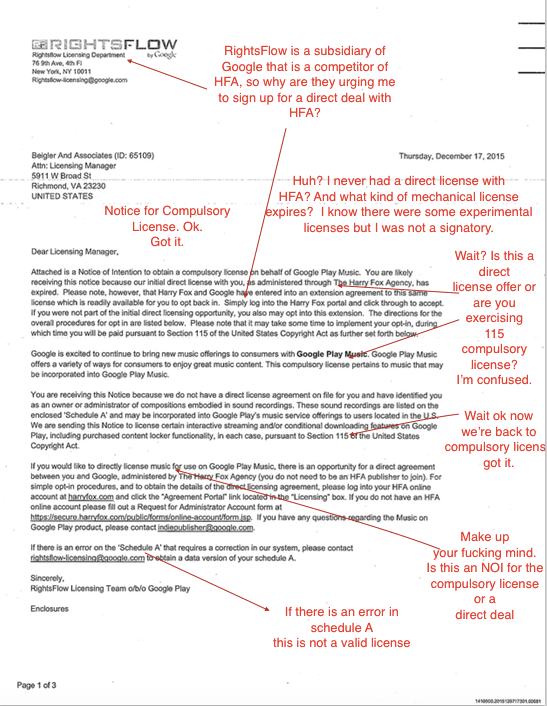
So that is why it is highly problematic that these services, RightsFlow, MRI, HFA and MediaNet are sending NOIs that are essentially fake NOIs to songwriters via the USPS.  As a result it is highly likely that even sophisticated songwriters are effectively being duped and deprived of their legal right to negotiate a direct license. The fact that these services purport to be experts on the licensing of songs we can assume they aware of the requirements of the law.   Thus it is not unreasonable to say they may be deliberately and willfully wording these notices in a confusing manner.  Further the NOI below indicates some coordination between RightsFlow and Harry Fox Agency who are ostensibly competitors.  The fact that I have fake NOIs from ALL of the services suggests a form of mass hysteria (or mass stupidity) on the part of all music licensing experts.  Either that  or someone somewhere suggested they ALL could get away with it. The end result is that thousands of songwriters may be deprived of their legal rights.   Why hasn’t the Copyright office weighed in on this issue?

The Mother of All Bad NOIs

With that said I’d like to post here what I consider to be the mother of all bad NOIs.   The language in this letter is so tortured, it can’t simply be bad writing.  Right?  I mean surely this letter was run by the legal department. RightsFlow is part of Google. Google is the largest or second largest company by market cap in the world (depending on the stock market). I’m pretty sure they have some good legal staff.   Anyway have a look. What do you think?
Screen Shot 2016-03-04 at 6.31.24 PM

Screen Shot 2016-03-04 at 6.35.21 PM

Screen Shot 2016-03-04 at 6.37.47 PM.png


Microsoft Does the Right Thing In Songwriter Class Actions But Where is the Government?

Music Technology Policy

You’ll probably have read a lot about how the Lowery, Ferrick and Yesh Music cases against digital services show how “broken” the music licensing practice is in the U.S.   As usual, instead of focusing on protecting songwriters and helping them actually get paid, the government is focusing on more bureaucracy and making life easy for tech companies.  Because that’s what bureaucracies do–after all, why does the Navy’s Army need an Air Force?

The U.S. Copyright Act produces no incentive for anyone to actually pay royalties–mostly because there is virtually no chance that anything bad will happen to a scoff law who just ignores their obligations under the Copyright Act.  Why?  Because the government puts the enforcement burden on songwriter who can ill afford to bring a copyright infringement case on their own.  And, of course, anyone who does is mocked in the tech press as a “copyright troll” as…

View original post 968 more words

What if You Threw a Music Streaming Service Party and No One Showed up with Licenses? Google Play, Slacker, Tidal, Deezer, Beats, Microsoft and Rdio get Lawsuits

You’ve probably by now heard that Yesh Music LLC and John Emanuele have sued Tidal for Copyright infringement.   It is alleged that Tidal did not obtain the required licenses to stream the songs.  The facts in the case are similar to class actions filed against another streaming service (ahem).

Now there is a sort of salaciousness to a lawsuit against  Jay Z’s artist friendly streaming service Tidal,  thus this story has got a lot of play.   What is going unreported is that Yesh Music LLC  and the same law firm have also filed similar suits against Google Play, Slacker, Deezer, Rdio, Beats, and Microsoft.    Some of these have since been settled out of court.   But it’s clear what is happening here: streaming  services are using songs first and then going back and trying to exercise a compulsory license later.

ALL OF THEM.  

The law is absolutely clear on this matter.  You can not go back and try to obtain a compulsory license once you have already made songs available.


Deficient Backdated Rdio MRI notice

At the heart of all these lawsuits are deficient “Notices of Intent” like this one sent by Music Reports on behalf of Rdio.  I received this notice via the US postal service.  It is a highly misleading letter that purports to be a valid notice to execute a compulsory streaming license a full 4 months after the service made the song available! I have dozens of these deficient notices.  I’m not an attorney but the relevant section of the copyright act is incredibly clear on this matter: Rdio no longer has the right to license the song in this manner.  Music Reports  are in the business of licensing music for streaming services.  Surely they understand the law?  They reference the relevant section of the copyright act at the top of the letter!  How many thousands of these notices have they sent out via the US Postal Service  to songwriters all across the United States? 


Artist Representatives Embarrass Themselves Again By Not Signing Their Clients for SoundExchange Royalties

Music Technology Policy

There’s another list circulating of some well-known artists who are not signed up for SoundExchange.  There’s always an implication somehow that this is the fault of SoundExchange as opposed to a failure on the part of the artist’s managers, business managers, accountants or lawyers.

Newsflash: SoundExchange can’t force anyone to sign up as a featured artist.  It is the role of the artist representatives to encourage their clients to get this done.

Newsflash:  It’s EASY to sign up.  In fact, it’s never been easier.

Newsflash:  Joining SoundExchange is one of the only ways a US artist can collect foreign performance royalties for sound recordings.

Affiliating with SoundExchange should be on the top of every representative’s new client checklist–right next to affiliating with ASCAP, BMI or SESAC.  If the manager failed to get their artist/songwriter client affiliated with a PRO, or let a PRO just sit on money they’d collected it…

View original post 29 more words

Former Director of P2P Piracy Alliance Endorses Nominee to Oversee Copyright Office

Screen Shot 2016-02-28 at 7.48.11 PM

K Street Lobbyist and Former P2P United Director Adam Eisgrau.

As we suspected, the nomination of Dr. Carla Hayden for Librarian of Congress looks troubling for writers,songwriters and other creators.  If you were not aware the Copyright Office is part of the Library of Congress, and thus the Librarian of Congress could have deep influence over copyright policy in the US.   Thus it deeply troubles us that we see the former executive director of the piracy alliance, P2P-United, endorse the nominee for Librarian of Congress.

The  experience of musicians over the last 17 years is that copyright exceptions like the DMCA “safe harbor” have been abused by companies like Google/YouTube to generate billions of dollars in income while often paying musicians nothing.   At the same time the DMCA safe harbor is creating an internet-wide market failure that has made it impossible for musicians to obtain a fair market value for their songs and recordings in the digital realm.

To be clear we do not know Dr. Hayden’s views on copyright,  but we hope she does not heed  Esgrua’s call to further “balance” copyright towards the exemptions and exceptions.   The companies that benefit from the exceptions are already some of the biggest companies on earth.   The Library of Congress needs a Librarian that understands that the books that fill the shelves are produced by copyright incentives not exceptions.