November 18, 2015
David C. Kully
Chief, Litigation III Section
Antitrust Division
U.S. Department of Justice
450 5th Street NW, Suite 4000
Washington, DC 20001
Re: Comments on PRO Licensing of Jointly Owned Works
Dear Mr. Kully:
I am a founder and principal songwriter of the bands Cracker and Camper van Beethoven. I appreciate the opportunity to participate in the public comments on modifications to the ASCAP and BMI consent decree regarding jointly owned works.
I have worked in the music business over 30 years. Both my bands are still together. We release records regularly and tour the world. During this time I have been signed as a songwriter to major publishing deals, self-administer and everything in between. I also write The Trichordist blog on artist rights and am in touch with many other songwriters in the U.S. and elsewhere.
In writing this letter it is not my intent to address this issue in dry legal terms or to get “down into the weeds” on the consent decrees. Firstly and foremost I am not an attorney and I am certainly not an expert in antitrust laws. But secondly I think it is important that we discuss the issues surrounding the PRO consent decrees at a macro level and in terms that the public and songwriters will understand. The lawyers that work for companies like Google, Apple, IHeart Media, ASCAP and Warner Music Group should not be the only audience for these discussions. Hence I have adopted an unorthodox narrative to illuminate my thoughts on the matter. I intend no disrespect to your office, I simply believe that songwriters and the public need to clearly understand what is at stake.
My understanding of the question is this:
Should the consent decree be modified so that ASCAP or BMI (that SESAC or the new Kobalt-Google Ventures owned AMRA surely will follow) can license 100% of a song even if their affiliated songwriter only owns say 5% of that song?
My smart aleck answer is an emphatic “yes!” The ensuing chaos of unintended consequences from 100% licensing will reduce any lingering rationale for the consent decrees to a Kafka-esque absurdity. It will make the licensing system less efficient and more complex. It will undermine the PRO system–one of the few organizations that actually work to make licensing more efficient. It will further favor enormous broadcasting (iHeart Media), webcasting (Pandora) and streaming concerns (YouTube and Spotify) that already have dominant market shares.
It seems to me that 100% licensing will unlawfully take private property rights by overturning private contracts (co-administration agreements) between songwriters. It will inhibit freedom of expression by making songwriters think twice about collaborating with songwriters from a different PRO. It seems to me it will violate the Department of Justice’s own guidelines and antitrust mandate. And finally it will effectively take away the rights of songwriters who are not members of ASCAP or BMI and who never agreed to be subject to consent decrees.
The last seems extraordinarily important (at least to this non-lawyer) as the affected songwriters have not agreed to have their rights limited; admitted to any wrong doing; and received no due process or just compensation for the rights the government would be taking away.
Nor has the legislative branch passed a law that would limit songwriters’ rights to be taken away as the DOJ proposes. At least legislation would have some imprimatur of legitimacy from the consent of the governed. In my high school history classes I seem to remember that an important advance in western civil society was the elimination of “writs of attainder” that were used by kings to punish individuals without trial. Doesn’t the DOJ’s proposed modifications sound similar?
The Department of Justice is attempting to change the rules of the road to something manufactured out of thin air and then pretend those new rules were there all along. Songwriters must ask why?
So again my smart aleck answer is “Yes, go ahead and add 100% licensing to the already unworkable consent decrees, because surely there is some clever constitutional lawyer out there who will now obliterate these decrees that have gone way beyond their intended purpose—and are bald faced takings without just compensation prohibited by the 5th Amendment.”
++++++++++++++++++++++++++++++++++++++++++++
But I understand that my answer while satisfying and darkly amusing to my fellow songwriters and me probably is not amusing to those of you that work at the DOJ. I imagine that most of you went to work for the DOJ because you believed in the system and wanted to see our nations laws applied fairly. You did not go to law school to navigate technicalities, conjure up impressive legal “gotchas” or read/write endless petitions by those with the resources to endlessly petition.
You probably didn’t go to the DOJ because you wanted to help multinational corporations or powerful billionaires unjustly become richer and more powerful. You certainly didn’t go to the DOJ because you yourself wanted to get rich in public service. And if you are in the antitrust division you definitely didn’t go there to get elected to public office because very few voters understand what you do. Most songwriters would say, “Antitrust? What’s that? You’re against trust?”
I would guess that your law school classmates who went into lawyering to get rich and accumulate power are working for the white shoe firms. They are busy making the rich and powerful more rich and powerful. And while you are riding the train into DC from some suburb in Maryland or Virginia your more ambitious and less idealistic classmates are probably in a car service riding down the Palisades into Manhattan. But I assume that doesn’t bother you. You are comfortable with your choices. And I sincerely respect you and admire you for making that choice. So the last thing you need is some moderately successful songwriter/performer with a blog criticizing you from what you probably perceive to be the sidelines.
The law and associated jurisprudence is often a beautiful thing. I understand someone wanting to devote a life to it. It often involves creating logical structures that are not unlike real physical structures like bridges and modern glass and steel towers. Often times the structures are beautiful and awe inspiring. Other times they are confusing, shabby things held together with gaffers tape and baling wire. Or like Gaudi’s Sagrada Familia the legal structures can be both beautiful and shabby at the same time. Is it a cathedral or something that sentient wasps built?
And then once in a blue moon our legal system creates a hideous legal abomination. Like the ASCAP and BMI consent decrees.
“Well we started out wanting to build a beautiful bridge but it somehow turned into a demon infested tower that sprays a fine mist of raw sewage and radioactive smallpox germs across the city. So we just kind of went with it.”
I’m not trying to make light of the serious antitrust concerns that could arise from allowing certain workers like songwriters to collectively bargain. But I say we should step back and look at the monstrosity that has been created since the first consent decree was implemented in 1941. Is it really doing what it was supposed to do? Or is it actually simply allowing the broadcasters, webcasters and streaming services to unfairly take advantage of songwriters?
In addition to being a performer I am also an instructor at the University of Georgia. I teach a music publishing class. As part of the section on PROs I have to go into some detail on the two consent decrees that govern the operations of the songwriter performing rights societies. As a result I recently spent an entire class period explaining what IMHO are the absurdities of the consent decrees and proposed changes. What follows are my whiteboard illustrations with a brief description of my complaints. I hope that you find this both amusing and illuminating.
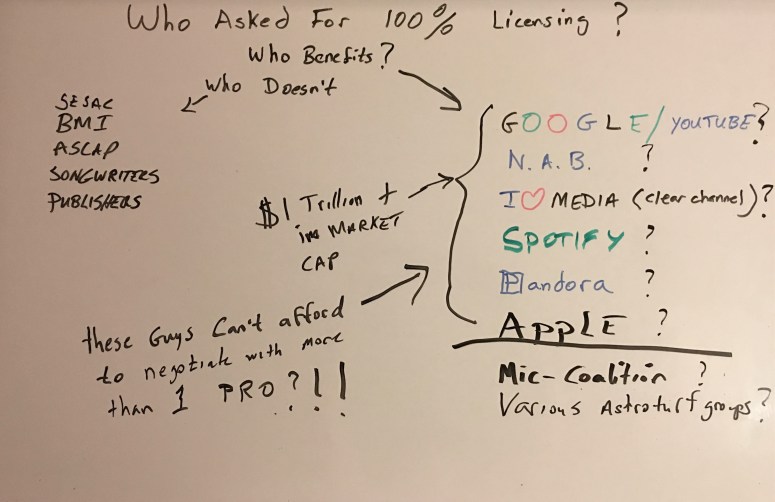
Who asked for 100% licensing? Certainly not songwriters! Do these multi-billion dollar companies really need the help? Are they really saying something like: “We don’t have enough time/resources to negotiate with all 3 performing rights societies” I don’t understand. No one forced them to go into a business that requires obtaining licenses for songs. (Or paying royalties–but that’s another story.)
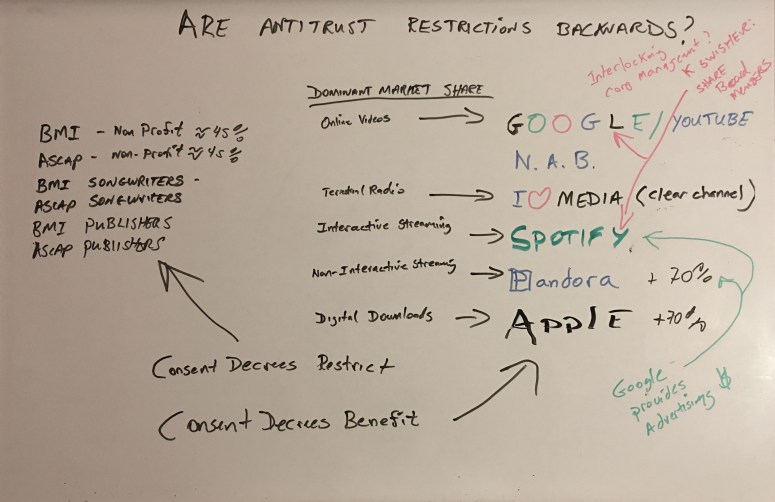
Is the whole antitrust regime backwards? Aren’t the companies on the right side of my whiteboard themselves monopolies or at least dominant? It has been reported that Google and Spotify have some sort of interlocking management/board members. Further Pandora and Spotify rely on Google for ads and revenue. How do they avoid collusion? Why are the antitrust laws still pointed at songwriters?
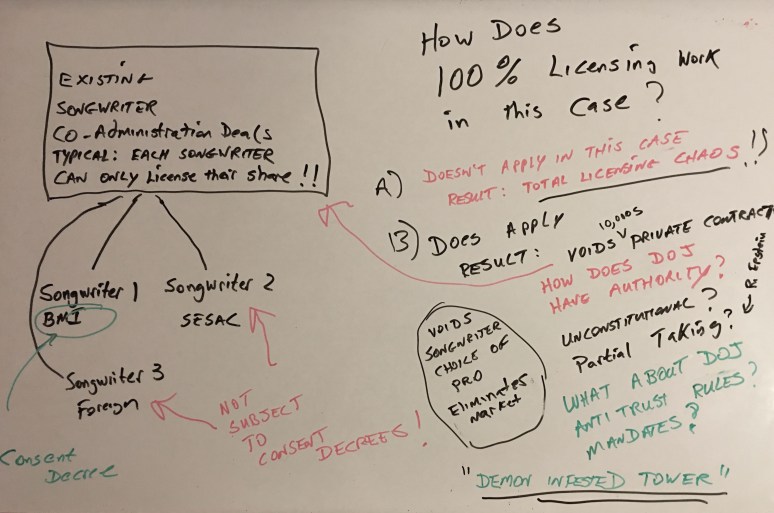
Back to the practical effects of 100% licensing. This is the demon-infested tower. How does 100% licensing work when songwriters have co-administration contracts? And only one songwriter is subject to a consent decree? How about if none of the songwriters are subject to the consent decree? It either voids hundreds of thousands–if not millions-of private contracts or creates licensing chaos. I don’t understand where the DOJ would derive authority to void these private contracts?
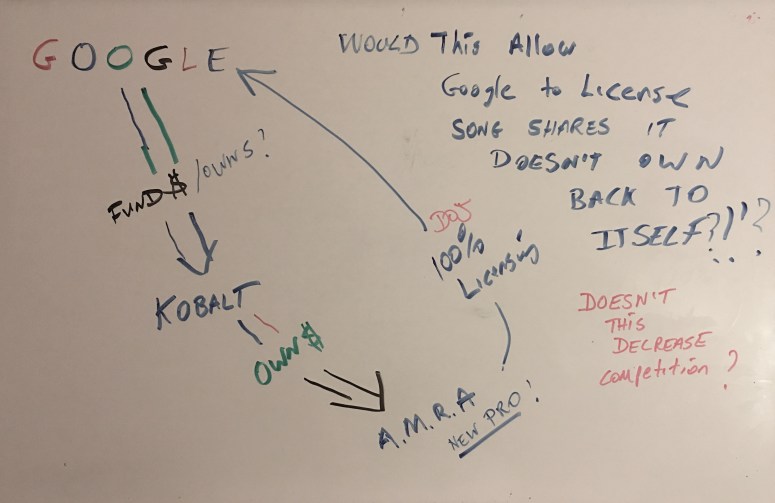
Google Ventures recently led a $60 million series C investment in the money losing Kobalt. In turn Kobalt bought the new “global” PRO AMRA. Don’t you think that AMRA will say they are “forced” to adopt 100% licensing for AMRA writers if the DOJ requires it of ASCAP and BMI? Isn’t this the monopolist Google licensing music back to itself on a certain level? And shares of songs it doesn’t control? If you say not true, then please show your work. Trust me, this will not end well.
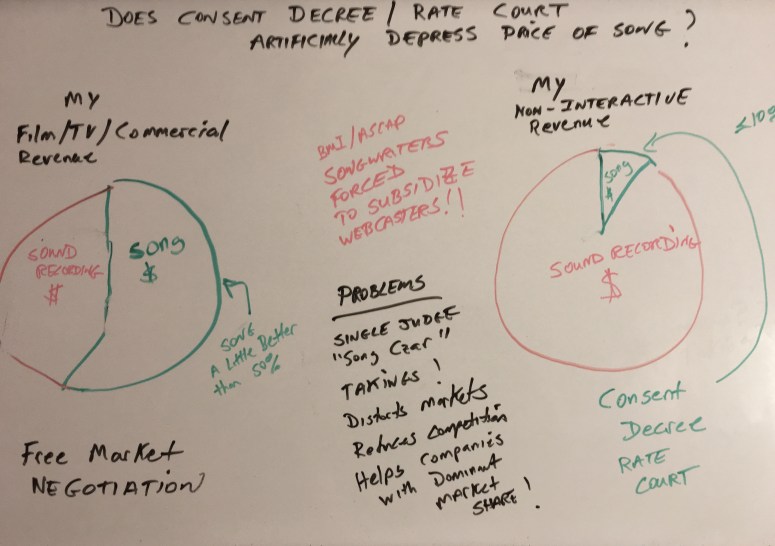
How can the government set wage and price controls through the rate court to approximate a free market when there hasn’t been a free market for songwriters since 1941? With my catalogue it appears that the BMI consent decree is pushing the price of the song below market value. This is in effect a subsidy from individual songwriters to well connected companies with dominant market share. How is this not an abuse of the antitrust laws? This sure looks like crony capitalism to me. Surely others must view it the same way. Why is the DOJ sullying its reputation by allowing this to continue year after year? This doesn’t just hurt songwriters, it reduces trust in the federal government.
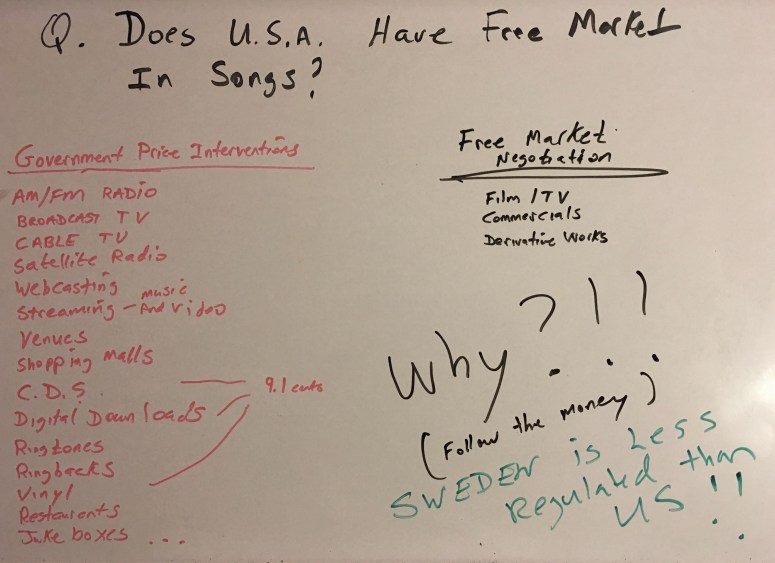
Why? Why are US songwriters so regulated? Doesn’t the US government have more important things to do? What if the DOJ and Federal government did less in the markets for licensing songs? What if they completely withdrew and did nothing? Would the economy collapse? Would the sky fall? No. Would companies that want to license music and songwriters come to mutually agreeable terms? Most likely, because that is the way it works in the unregulated parts of the economy like say synchronization licenses. Why wouldn’t it work with collective licensing?
Wouldn’t competition increase as AMRA, ASCAP, BMI, Global Music Rights and SESAC competed for greater market share? Take note, it is the multi-billion dollar corporations that are asking the U.S. government for protection from free markets not songwriters. Songwriters aren’t the ones asking for a handout, they are simply asking for a level playing field.
Thank you for allowing me to participate in this important discussion.
Sincerely,
David Lowery





You must be logged in to post a comment.