Guest Post: Taylor’s Guitar

By Charles J. Sanders

Recently, a viral video originating from Waxahachie, Texas made the social media rounds featuring the winning bidder of a Taylor Swift guitar immediately, publicly destroying it with the auctioneer’s hammer.  The perpetrator claims the stunt was intended as a light-hearted act of political satire protesting celebrity endorsements of a presidential candidate he does not support.  Most folks of a similar political bent cheered gleefully, while members of the other camp generally eye-rolled and shrugged their way through what appeared to be a somewhat more mean-spirited statement than the disgruntled, new owner was willing to acknowledge.  It’s tough to tell, but hey, free speech is free speech.

I suppose that in a world in which the legendary, guitar-smashing prowess of a Pete Townshend or Jimi Hendrix has long been celebrated, and in a country where Stan Laurel and Oliver Hardy turned the dismantling of upright pianos into an art form, perhaps the nonchalant reactions over the sad end to the icon’s former axe are understandable.  We are surely a country and a music community with bigger issues on our plate.  That reality, combined with the dangers of crying wolf being what they are, would ordinarily render the engagement in a humorless, long-winded diatribe against a gavel wielding, wannabe cowboy defacing a guitar a meaningless exercise. 

But in my role as chair of the National Music Council of the United States, the Congressionally-chartered umbrella organization of American music groups advocating for the advancement of musical culture and education, I feel obliged to at least offer reflections on what some may consider to be the far less-benign overtones of this seemingly trivial event. In simplest terms, the alternative of silence is made unacceptable by the ghastly results that such a non-response has produced in the past, particularly when it comes to the long, grim, global history of political violence against music creators and musical culture.  Shining a light just seems the better course.

Last year, it was NMC’s honor to host a series of discussions with several incredibly brave members of the international music community fighting to keep creators and their works safe from political harm.  One such hero of musical culture is Dr. Ahmad Sarmast, founder of the Afghanistan National Institute of Music currently in exile under the protection of the Government of Portugal.  Dr. Sarmast, who had nearly been beaten to death in previous run-ins with the ultra-rightist Taliban movement over his audacious teaching of young, female Afghani music students how to play musical instruments, was unsurprised that one of the first targets of the resurgent Taliban in 2021 was his world-renown music program. 

The group’s initial act in its renewed crackdown on infidelity was the burning not only the school’s instruments, but also of a large percentage of musical instruments throughout the entire country.  The teacher, his students and their families fled for their lives to Qatar and then Lisbon, where they remain two years later in defiant pursuit of musical creativity and freedom.  This week, meanwhile, the Taliban announced its intention to bar the artistic depiction “of any living thing” throughout Afghanistan pursuant to Sharia law.

The experiences of another international champion of artistic freedom NMC interviewed, Cambodian Living Arts organizational founder Arn Chorn Pond, serve as an even more fraught example of violent, music-related suppression and its horrific results.  Professor Pond, whose parents’ national opera company in Phenom Penh was one of the great gems of Southeast Asian musical culture, was a ten-year old flautist when ultra-leftist Khmer Rouge terrorists seized power in Cambodia during the mid-1970s.  The party’s first acts of cultural cleansing included the summary execution of most musicians and composers (including his parents and family), the destruction of virtually every traditional and modern musical instrument in the country, and the banning of all unapproved music on threat of death. 

The details of young Arn’s enslavement and unspeakable torture, even as he was relied upon as a resource for the creation and performance of new and “acceptable” Khmer musical works, are far too graphic to repeat here.  It has taken him a half-century following the defeat of the Khmer to rekindle the light of traditional Cambodian musical culture throughout his nation, all the while carrying scars that cannot possibly be fully healed even after a lifetime of fighting for greater protections for others.    

Other historical examples are legion.  In 1973, one of the first acts of the Pinochet military junta following its coup in Chile was the arrest of progressive singer-songwriter and nationally celebrated guitarist Victor Jara.  Rather than merely destroying his confiscated guitars, the regime mutilated both his hands prior to executing him at the National Soccer Stadium as a warning to others who might be contemplating musical protest.  Days later, the great Chilean poet Pablo Neruda was dead, as well.

Soviet dictator Joseph Stalin terrorized the towering composer Dimitri Shostakovich into an emotional wreck through political manipulation and death threats starting in the 1930s. Nazi Fuhrer Adolph Hitler launched an immediate program of terror against “degenerate art and artists” upon rising to power in 1933, culminating in the forced expatriation and eventually the execution of Germany’s greatest composers, conductors and performers (many of them Jewish victims of the Holocaust).  One such target, the poet and songwriter Ilse Weber, actually composed the famous lullaby “Wiegala” while imprisoned at Prague’s Terezin concentration to comfort the children in her care.  She later volunteered to accompany her physician-husband and those children to Auschwitz, where they were murdered in 1944 just as she expected they would be.  Only her music miraculously survived, attributable to the panic of the fleeing killers at war’s end.

And finally, in our own country the great jazz singer Billie Holiday was one among many American creators and artists with more than just a passing acquaintance with the travails of brutal, sometimes fatal repression.  Intimidation of music creators knows no geographical or political boundaries. 

As desperately uncomfortable as these past and continuing events may be to contemplate, the crucial reason to educate ourselves about them is their value as examples of exactly what must be avoided at all costs in the future.  Clearly throughout history, music creators and performers have not only been frequently subject to pressure to conform, or to participate in propaganda efforts by governments and extremist groups, but also victimized by repressive actions up to and including murder to enforce their silence. 

This depraved strategy often eliminates the most persuasive voices of protest, while at the same time setting an example of what happens to those less-visible citizens who choose dissent.  The threatening or carrying out of violent repression against outspoken music creators, performers and educators is simply one of the preferred means of warning everyday people in the bluntest possible terms, “if this is what we’ll do to them, imagine what we’ll do to you.” 

Nevertheless, even armed with such knowledge one might still legitimately ask in the current instance, “what has any of this really got to do with a laughing man in a cowboy hat destroying a celebrity’s former musical instrument?”  Well, probably nothing.  But potentially everything.

Visitors today to Berlin often wander over to the enormous square fronting the library at Humboldt University, a revered institution of learning whose alumnae include some of the greatest thinkers and artists in western history, from Mendelssohn and Heine to Planck and Einstein.  The empty cobblestoned plaza, restored after repeated wartime bombings some 80 years ago, remains completely devoid of any structures whatsoever.  There is only a barely discernable, rectangular glass plate embedded into the pavement in front of the library, allowing viewers to gaze downward into a room of empty bookshelves two stories below, and an equally flat plaque sunk into the ground next to it.  That view, gazing through the glass darkly into history, is why most visitors come. 

This is the very spot on which Joseph Goebbels lit the bonfire of books written by many of Humboldt’s most illustrious graduates, and where the people laughed and cheered as those works burned in 1933.  The empty shelves are self-explanatory, and the plaque has only one simple quote, written by Heinrich Heine fully one hundred years prior to the day that the Nazis struck their match. “Where they burn books,” it reads in German with extraordinary prescience, “they will eventually burn human beings.” 

As our own Mr. Twain was fond of reminding us, while history doesn’t actually repeat, it surely does rhyme.  Is a private citizen smacking a recently acquired guitar with a hammer for political effect the same as a government or terrorist group burning a book, banning a musical work for its content, or assaulting a creator?  No, probably not.  Was the destruction of the Waxahachie guitar a symbolic, political warning issued by an individual or group seeking power through intimidation, intended to be interpreted as a threat of actual violence to any one or all of us in the music community? 

That’s a harder question to answer.  We simply do not and cannot know the intent, effect, or seriousness of the action at this time, nor do we possess Heine’s cursed gift of farsighted genius. 

As a result, on the advice of the American bard of Hannibal, Missouri, we less-gifted prognosticators are left with just one inquiry that absolutely must be asked under this circumstance –and in every other instance like it– for the safety, security and freedom of everyone in our music community and in this country:

“Does the Waxahachie event, or any subsequent one, rhyme?” 

Whether it does or not, now or in the future, will in large part depend on us– not just on the folks with the hammers and the matches.

About the author: Attorney, historian and author Charles J. Sanders is outside counsel to the Songwriters Guild of America, chair of the National Music Council of the United States, and an adjunct professor of music business and its history at New York University.  For more information, visit https://www.musiccouncil.org/. All opinions are his own.

CHICKEN AND EGG SANDWICH:  Bad Song Metadata, Unmatched Funds, KYC and What You Can Do About It: Speaker Update for Nov. 20 @ArtistRights Symposium at @AmericanU @KogodBiz in Washington DC

We’re pleased to announce additional speakers for the 4th annual Artist Rights Symposium on November 20, this year hosted in Washington, DC, by American University’s Kogod School of Business at American’s Constitution Hall, 4400 Massachusetts Avenue, NW, Washington, DC 20016.  The symposium is also supported by the Artist Rights Institute and was founded by Dr. David Lowery, Lecturer at the University of Georgia Terry College of Business.

The Symposium has four panels and a lunchtime keynote. Panels will begin at 8:30 am and end by 5 pm, with lunch and refreshments. More details to follow. Contact the Artist Rights Institute for any questions.

Admission is free, but please reserve a spot with Eventbrite, seating is limited! (Eventbrite works best with Firefox)

Keynote: Graham Davies, President and CEO of the Digital Media Association, Washington DC.  Graham will speak around lunchtime.

We have confirmed speakers for another topic! 

CHICKEN AND EGG SANDWICH:  Bad Song Metadata, Unmatched Funds, KYC and What You Can Do About It

Richard James Burgess, MBE, President & CEO, American Association of Independent Music, New York
Helienne Lindvall, President, European Composer & Songwriter Alliance, London, England
Abby North, President, North Music Group, Los Angeles
Anjula Singh, Chief Financial Officer and Chief Operating Officer, SoundExchange, Washington DC

Moderator:  Christian L. Castle, Esq, Director, Artist Rights Institute, Austin, Texas

Previously confirmed panelists are:

SHOW ME THE CREATOR – Transparency Requirements for AI Technology:

Danielle Coffey, President & CEO, News Media Alliance, Arlington, Virginia
Dahvi Cohen, Legislative Assistant, U.S. Congressman Adam Schiff, Washington, DC
Ken Doroshow, Chief Legal Officer, Recording Industry Association of America, Washington DC 

Moderator: Linda Bloss-Baum, Director of the Kogod School of Business’s Business & Entertainment Program

THE TROUBLE WITH TICKETS:  The Economics and Challenges of Ticket Resellers and Legislative Solutions:

Kevin Erickson, Director, Future of Music Coalition, Washington DC
Dr. David C. Lowery, Co-founder of Cracker and Camper Van Beethoven, University of Georgia
  Terry College of Business, Athens, Georgia
Stephen Parker, Executive Director, National Independent Venue Association, Washington DC
Mala Sharma, President, Georgia Music Partners, Atlanta, Georgia

Moderator:  Christian L. Castle, Esq., Director, Artist Rights Institute, Austin, Texas

SHOW ME THE CREATOR – Transparency Requirements for AI Technology: Speaker Update for Nov. 20 @ArtistRights Symposium at @AmericanU @KogodBiz in Washington DC

We’re pleased to announce more speakers for the 4th annual Artist Rights Symposium on November 20, this year hosted in Washington, DC, by American University’s Kogod School of Business at American’s Constitution Hall, 4400 Massachusetts Avenue, NW, Washington, DC 20016.  The symposium is also supported by the Artist Rights Institute and was founded by Dr. David Lowery, Lecturer at the University of Georgia Terry College of Business.

The four panels will begin at 8:30 am and end by 5 pm, with lunch and refreshments. More details to follow. Contact the Artist Rights Institute for any questions.

Admission is free, but please reserve a spot with Eventbrite, seating is limited! (Eventbrite works best with Firefox)

Keynote: Graham Davies, President and CEO of the Digital Media Association, Washington DC.  Graham will speak around lunchtime.

We have confirmed speakers for another topic! 

SHOW ME THE CREATOR – Transparency Requirements for AI Technology:

Danielle Coffey, President & CEO, News Media Alliance, Arlington, Virginia
Dahvi Cohen, Legislative Assistant, U.S. Congressman Adam Schiff, Washington, DC
Ken Doroshow, Chief Legal Officer, Recording Industry Association of America, Washington DC 

Moderator: Linda Bloss-Baum, Director of the Kogod School of Business’s Business & Entertainment Program

Previously announced:

THE TROUBLE WITH TICKETS:  The Economics and Challenges of Ticket Resellers and Legislative Solutions:

Kevin Erickson, Director, Future of Music Coalition, Washington DC
Dr. David C. Lowery, Co-founder of Cracker and Camper Van Beethoven, University of Georgia
  Terry College of Business, Athens, Georgia
Stephen Parker, Executive Director, National Independent Venue Association, Washington DC
Mala Sharma, President, Georgia Music Partners, Atlanta, Georgia

Moderator:  Christian L. Castle, Esq., Director, Artist Rights Institute, Austin, Texas

Press Release: Opposition grows worldwide about TikTok’s decision to stop negotiations with @MerlinNetwork

[Editor Charlie sez: This post from Worldwide Independent Network is available here.]

TikTok’s decision to disintermediate Merlin and walk away from negotiations to renew its current license has sparked widespread concern across the global music industry. The platform is contacting independent music companies directly to try to reach individual deals. Many fear that with this move TikTok intends to pay less for music.

Merlin acts as the licensing partner for the independent sector, playing a crucial role in providing efficiencies for digital platforms, promoting diversity and consumer choice, as well as delivering market access and value for its members. With more than 500 members representing over 30.000 record labels, distributors, and rights holders around the world, Merlin currently accounts for 15% of the global recorded music market and has deals with over 40 digital services.

“TikTok’s decision to walk away from Merlin puts independent labels in an impossible place with their artists: it’s a choice between their music being available on the platform or ensuring fair license terms.” explains Zena WhiteWIN ChairNoemí PlanasWIN CEO, adds that “Merlin was created by independent music companies to compete at the highest level and ensure they can access the best terms. TikTok’s decision poses risks to cultural diversity, market access, and fair payment for independents. But this is not just about TikTok. We urge policymakers around the world to regulate the tech sector to ensure a truly competitive market where creators’ rights are protected from abusive and monopolistic behavior.” TikTok continues to resist calls from the sector to address the existing ‘value gap’, which has a negative impact on the independents’ ability to defend their music and rights.

Asia

Owned by Chinese company ByteDance, TikTok is the world’s largest social media platform after Facebook, YouTube, and Instagram. Asia is home to 6 of the top 10 countries by number of users and local music companies fear TikTok’s decision threatens the level playing field. Jong-Gill ShinSecretary General of the Record Label Industry Association of Korea (LIAK) says: “LIAK expresses profound concern over the current circumstances, which pose a significant risk of fostering discrimination against creative works. It is imperative that all music, regardless of whether it originates from major or independent sectors, be accorded equal value and recognition. We unequivocally oppose TikTok’s recent attempts that threaten to undermine our efforts to secure equitable terms. Aligned with our fellow WIN members globally, we stand resolute in our commitment to upholding and safeguarding the intrinsic value of independent music.” China’s neighbors have also raised concerns about TikTok’s compliance with data protection laws, with India banning the app over national security concerns.

North America

In the United States, the second-largest market by number of TikTok users with 120.5 million, concerns are raised about abuse of power from the platform. In April, President Biden signed a law that would ban TikTok unless ByteDance sells its stake within a year. Richard BurgessCEO of the American Association of Independent Music (A2IM), comments: “TikTok’s unwillingness to negotiate a licensing deal with Merlin is just the latest example of the platform doing whatever it can to avoid compensating artists fairly. Now, more than ever, we need Congress to enact the Protect Working Musicians Act and give musicians, songwriters, independent labels, and publishers the ability to negotiate collectively in the marketplace.”

Similar concerns are raised in Canada, where the music community is actively engaged in the regulatory process around the Online Streaming Act, which extends broadcasters’ requirements to invest in Canada’s music sector to digital platforms and is being met with mounting resistance from the tech sector. “By bypassing local regulations and enforcing unfavourable terms on rights holders, platforms create a significant power imbalance,” says Gord Dimitrieff, Chair of Government Relations at the Canadian Independent Music Association (CIMA)“It stifles competition, reduces cultural diversity, and limits consumer choice.” Andrew Cash, President and CEO of CIMA adds that TikTok’s decision “should act as a wake-up call to Canadian policy makers and politicians engaged in regulating the tech sector.”

Latin America

TikTok was the fastest-growing social media platform in Latin America in 2023. “From a Brazilian perspective, TikTok’s decision not to renew the agreement with Merlin could weaken the representation of independent music, which plays a crucial role in promoting cultural and regional diversity,” says Felippe Llerena, President of the Associação Brasileira da Música Independente (ABMI). “Without a collective agreement, small labels may have more difficulty negotiating individually, negatively impacting their visibility and participation on a platform as relevant as TikTok.” The Brazilian organization claims that this move not only compromises the diversity of content available on the platform, but also does not make sense from a commercial and strategic point of view. Brazil ranks third in TikTok users by country, with 105.3 million, followed by Mexico, with 77.5 million users, but concerns are also raised in other markets of the region. “It is extremely detrimental for the independent sector in Latin America that TikTok is applying this pressure to bypass Merlin. The very purpose of Merlin is to ensure fairer and more equitable representation for all, especially in regions like ours, and we stand by it. The most affected will be the smaller players, who will have few options, and our biggest fear is that they will end up facing the worst conditions.”adds Francisca Sandoval, President of Asociación Gremial Industria Musical Independiente de Chile (IMICHILE).

Europe

Following value gap concerns raised in April, the Independent Music Companies Association (IMPALA) has opposed TikTok’s attempt to boycott Merlin. The European organization highlights the importance of collective deals for diversity and consumer choice, and notes that it is vital that independents and digital services work together and explore ways to grow the value of the moment economy as a key part of the music ecosystem, as proposed in IMPALA’s ten-step plan to make the most of streaming. “We believe giving labels the option to work under a collective deal is the best way for TikTok to achieve these aims and work with artists and genres from across Europe,” says Dario Draštata, IMPALA Chair and Chair of RUNDA Adria. “We respect freedom of choice in entrepreneurship. The growth of the independent sector across all platforms is fundamental to provide fans and consumers with choice and diversity, exactly what TikTok stands for. The easiest way to achieve that is through Merlin.” says Helen Smith, IMPALA’s Executive Chair. She adds: “We invite TikTok to see the value of a renewed collective deal through Merlin and collaborate on growing this important part of the ecosystem. We hope that efficiency and choice for TikTok users, as well as access for artists and labels whatever their country or genre or level of success, and of course joint and standardised efforts on fraud, will prevail.” FranceBelgiumGermany, and other European countries have also come forward in support of Merlin.

Australasia

TikTok is crucial to the music industry, and music is crucial to TikTok. An experimentconducted by TikTok in Australia in 2023 to analyze how music is accessed and used on the platform showed that limiting the licensed music users can experience caused the number of users and the time they spend on the app to decline. “We are highly alarmed at the news of TikTok’s decision to walk away from the negotiating table with Merlin before any licensing renewal discussions could even begin. As if that wasn’t onerous enough, TikTok have stated their intention to seek direct deals, and provided a very, very short runway for labels to sign an NDA. This would be hilarious, if it wasn’t so disrespectful and further demonstrates that TikTok’s behaviour completely undermines their previously stated support of worldwide independent rights holders. IMNZ, as representative and advocate for New Zealand artists and labels, joins with our global compatriots in the hope that TikTok makes the right decision – and finds its way back to the licensing table with Merlin, and smartly”, says Dylan Pellett, General Manager at Independent Music New Zealand (IMNZ).

WIN is committed to ensuring that all businesses in the music sector are best equipped to maximize the value of their rights, regardless of their size and origin, and Merlin is a key partner in this. The global independent music community remains steadfast in its support for collective licensing negotiations and calls on TikTok to return to the table and work on solutions that benefit all parties involved.

Keynote and Speaker Update for Nov. 20 @ArtistRights Symposium

We’re pleased to announce the speakers for the 4th annual Artist Rights Symposium on November 20, this year hosted in Washington, DC, by American University’s Kogod School of Business at American’s Constitution Hall, 4400 Massachusetts Avenue, NW, Washington, DC 20016.  The symposium is also supported by the Artist Rights Institute and was founded by Dr. David Lowery, Lecturer at the University of Georgia Terry College of Business. 

The four panels will begin at 8:30 am and end by 5 pm, with lunch and refreshments. More details to follow. Contact the Artist Rights Institute for any questions.

Admission is free, but please reserve a spot with Eventbrite, seating is limited! (Eventbrite works best with Firefox)

Keynote: Graham Davies, President and CEO of the Digital Media Association, Washington DC.  Graham will speak around lunchtime.

The confirmed symposium panel topics and speakers are:

THE TROUBLE WITH TICKETS:  The Economics and Challenges of Ticket Resellers and Legislative Solutions:

Kevin Erickson, Director, Future of Music Coalition, Washington DC
Dr. David C. Lowery, Co-founder of Cracker and Camper Van Beethoven, University of Georgia
  Terry College of Business, Athens, Georgia
Stephen Parker, Executive Director, National Independent Venue Association, Washington DC
Mala Sharma, President, Georgia Music Partners, Atlanta, Georgia

Moderator:  Christian L. Castle, Esq., Director, Artist Rights Institute, Austin, Texas

SHOW ME THE CREATOR – Transparency Requirements for AI Technology, moderated by Linda Bloss-Baum, Director of the Kogod School of Business’s Business & Entertainment Program

CHICKEN AND EGG SANDWICH:  Bad Song Metadata, Unmatched Funds, KYC and What You Can Do About It, moderated by Chris Castle

NAME, IMAGE AND LIKENESS RIGHTS IN THE AGE OF AI:  Current initiatives to protect creator rights and attribution, moderated by John Simson, Program Director Emeritus, Business & Entertainment, Kogod School of Business, American University

Additional confirmed speakers to be announced soon.

Artist Rights Institute: Estimated 2025 Inflation Adjustment for Physical and Vinyl Mechanicals

A backgrounder for artists and songwriters from the Artist Rights Institute

Summary: The fight over frozen mechanicals continues to pay off as songwriters log another cost of living increase for physical/downloads while streaming falls farther behind.

The Copyright Royalty Board adjusted the US statutory mechanical royalty for physical carriers like vinyl, CDs and downloads annually during the current rate period. This is entirely due to the success of public comments by the ad hoc songwriter bargaining group that persuaded the Copyright Royalty Judges to reject the terrible “frozen mechanicals” settlement negotiated with the NMPA, NSAI and RIAA. 

As it turned out, once the judges rejected the freeze as unfair, the labels quickly agreed to a fair result that increased the physical/download rate from a 9.1¢ base rate to the 12¢ rate suggested by the Judges which went a long way to making up for the 15 year freeze at 9.1¢. In fact, if it had just been presented to the labels to begin with, a tremendous amount of agita could have been saved all round.

Crucially, not only did the base rate increase to 12¢, the judges also approved a prospective cost of living adjustment determined by a formula using the Consumer Price Index. The end result is that unlike streaming mechanicals paid by the streaming services like Spotify (i.e., not the labels) the value of the increase from 9.1¢ to 12¢ has been protected from inflation during the rate period (2023-2027). 

Unfortunately, the streaming services were allowed to reject a cost of living for streaming mechanicals, notwithstanding the Judges’ and the services’ acceptance of an COLA-type adjustment to the multimillion dollar budget of the Mechanical Licensing Collective. That COLA is ased on a government measurement of inflation (the Employment Cost Index) comparable to the CPI-U that is used to increase the services’ financing of salaries and other costs at the Mechanical Licensing Collective. So those who are paid handsomely to collect and pay songwriters get a better deal than the songwriters they supposedly serve.

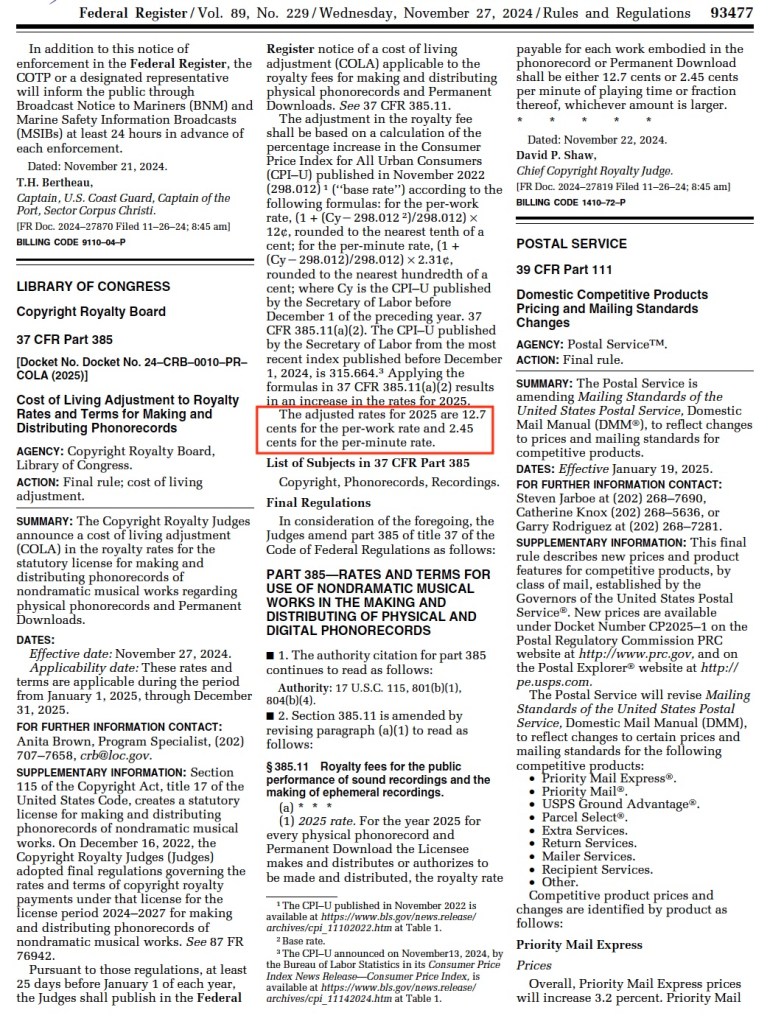
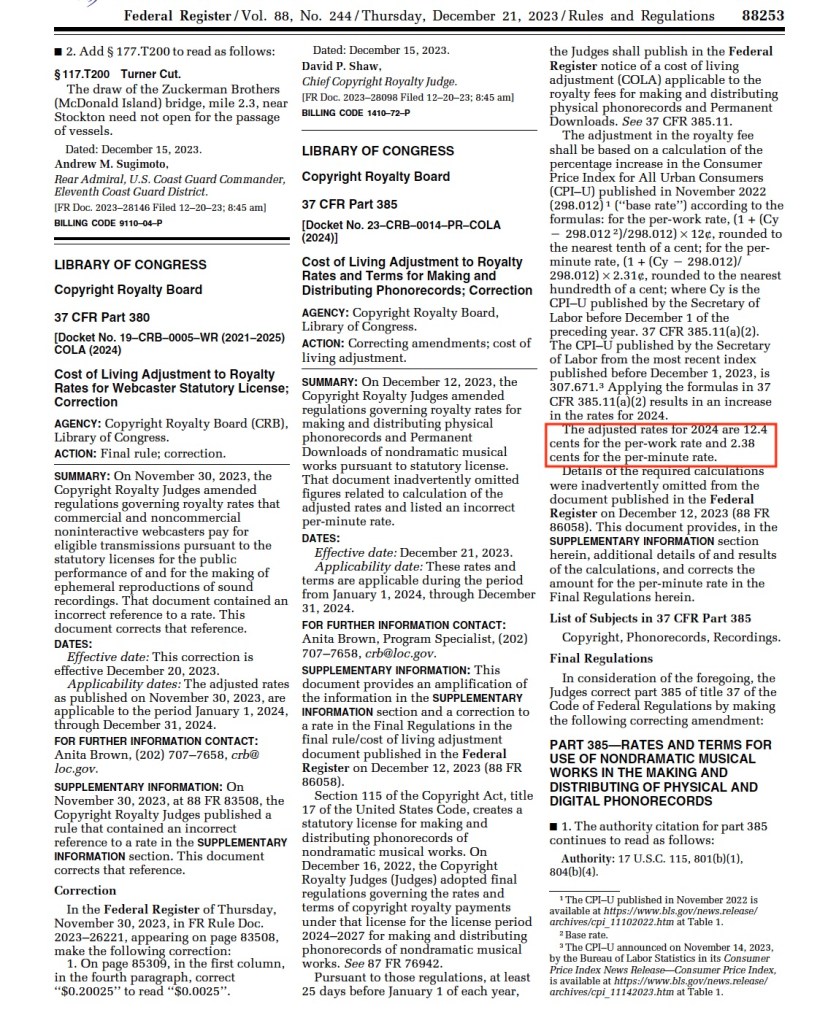
What is the increase in pennies this year for the physical/download mechanical rate? The Judges determine the inflation-adjusted rate every year during the five year rate period (2023-2027). The calculation is made in December for physical/download with reference to the CPI-U rate announced by the Bureau of Labor Statistics as of December 1, which means the rate published on November 11. The new rate goes into effect on January 1, 2025.

At this point, there does not seem to be any indication that there will be a large spike in inflation between now and November 11, so we can use the September rate (just announced in October) to make an educated guess as to what the 2025 statutory rate increase will be for physical/downloads (rounded down):

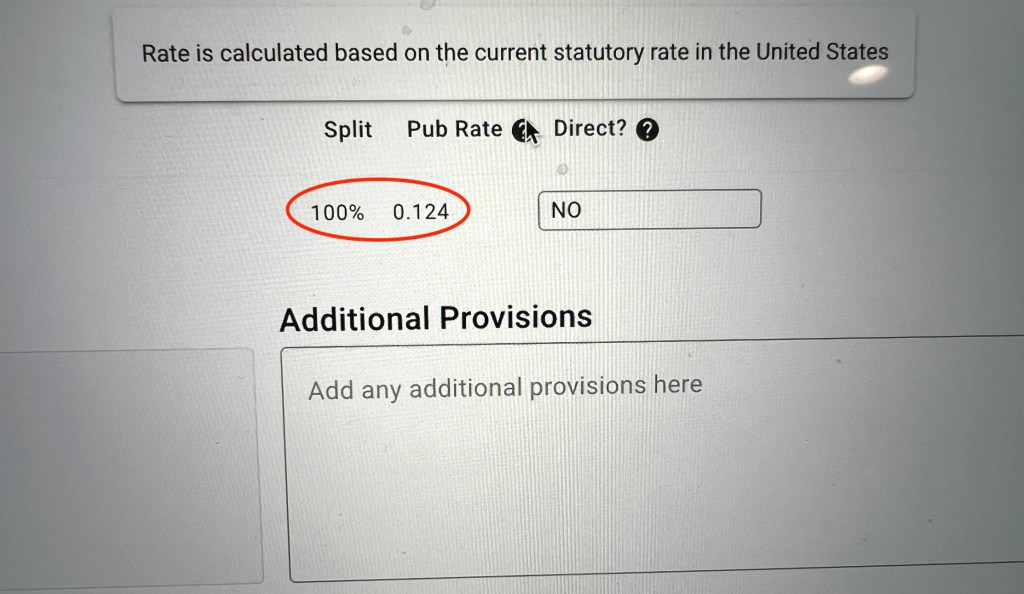
So we can safely project that the base rate will increase from 12.4¢ for 2024 to about 12.6¢ in 2025 without firing a shot. If you have a 10 x 3/4 rate controlled compositions clause, that means the U.S. controlled pool on physical will be approximately 94.5¢ instead of the old frozen rate of 68.25¢.

It’s important to note a couple things about the relevance of CPI-U as a metric for protecting royalty rates from the ravages of inflation. First of all, the CPI-U is a statistical smoothing of the specific rates for particular goods and services that it measures and doesn’t reflect the magnitude of changes of some components.

For example, the September CPI-U increased by 0.2% on a seasonally adjusted basis. However, the shelter index and the food index increased at higher rates:

The shelter index rose by 0.2%, and the food index increased by 0.4% Together, these two components contributed over 75% of the monthly increase in the all items index.

Moreover, the MLC itself receives an increase that is tied to the lesser of 3% or the Employment Cost Index (which was approximately 4.5% for the trailing 12 months ending June 30):

Chris Castle said, “These are good benchmarks to keep in mind as we head into a new rate setting period in a year or so when I expect songwriters to demand a COLA for streaming mechanicals. No more poormouthing from the services. If they can give it to MLC, they can give it to the songwriters, too.”

MIC Coalition Letter to @CopyrightOffice about @GMRO_PRO

Remember the “MIC Coaltion”? We haven’t heard from them in a while but they suddenly surfaced with a vengeance in the form of this letter to the Copyright Office under the guise of “PRO proliferation.”

This is the MIC Coalition membership. The MIC Coalition is dedicated to one thing and one thing only–screwing songwriters as hard as they can. And frankly, anyone else who gets in their way. If you’re good with zeros, you can add up the total market capitalization of all the companies that these trade associations represent and you will be into the $50,000,000,000,000 range.

That’s right, $50 trillion–and all these companies are protected by the government through the longest running antitrust consent decrees in the history of the United States. And who are they protected against? Songwriters. Pullllleeeeeeze.

With one exception: Global Music Rights or “GMR”. And while the letter to the Copyright Office doesn’t come right out and say it, what these people hate the most about GMR is that these behemoths have to actually negotiate directly with GMR rather than hiding behind the government in the rate courts. That’s right, they truly hate that free market. While the MIC Coaltion’s letter raises issues about multiple PROs, the one they really have the wood for is GMR because GMR has an extremely valuable catalog. In fact, if you can judge by comparing private equity placements, GMR–based on true free market licensing–is about 3x more valuable than BMI–based on the government’s crap deals. Which also pisses them off.

You also have to understand that these MIC Coalition people are hugely pissed off about a recent BMI rate court case that applied GMR benchmarks–free market negotiations–to set the government’s consent decree rates. Rates that are supposed to approximate what a willing buyer would pay a willing seller in the government’s version of free enterprise. That case is on appeal right now. You can get a flavor of just how silly this argument is from a post on Artist Rights Watch that discusses the case in detail or read this revealing friend of the court brief from the BMI rate court appeal.

The reason the trillionaires hate GMR so much is because songwriters got together and started their own PRO. Freedom of association, freedom of contract and free to bargain collectively, all quintessentially American values protected by the Constitution. Even though many radio stations settled an antitrust case with GMR resulting in a long-term license, they obviously haven’t given up sniping at the startup.

Unfortunately, the trillion-dollar soul crushers seem to have conned Congress into believing that Big Government is the way to go instead of protecting the free market. The plot sickens.

Are Your Hard Drives Turning to Bricks? Steve Harvey Takes Us Inside Iron Mountain

By Chris Castle

One day shortly after the sale to PolyGram, I got a call from Cheryl Engels with a problem she needed help with.  Cheryl at the time was A&M’s post-production director in mastering.  Among other things Cheryl supervised our audio assets storage room (which was mostly tape assets at the time) and also supervised mastering of new releases for other labels and artists such as U2.

Cheryl had received a call from some putz in PolyGram Special Markets demanding our best quality masters  be shipped to some place in New Jersey to be made into yet another stupid compilation record to be sold as God knows what kind of tchotchke.  In other words, our recordings were going to be used for the sole purpose of commoditizing music and being yet another place outside of A&M where our artist’s recordings could be purchased.

Cheryl had told this putz that he didn’t need our precious masters and that she’d be happy to run him off a DAT for his one track.  So why was she calling me?  Because of what he said next: “We’re the parent and you’re the child and the child doesn’t tell the parent what to do.”

I said just leave this with me.  I called the guy and said, “Hi, my name is Chris Castle.  You don’t know me but I’m calling to explain to you why you’re not getting what you want, Mr. SVP of Bullshit.  So first thing, I’ve been to your tape storage facility—are you going to store our masters by the broken water pipe or the space heaters?  Near the open window or in the car park?  And when would we get our tape back?”

After some back and forth, he accepted that this time it was different at least with A&M.  He apparently thought that Cheryl had been difficult with him.  I explained to him that he just needed to learn how things were done.  I explained to him that in Cheryl’s area the way things were done was the way Cheryl wanted them to be done—because she was correct.  I suggested to him that it worked for Herb Alpert, Bono, Sting and many other top artists and mastering engineers so maybe it could work for him, too.  And more importantly for him at that moment, it worked for me and I was backing Cheryl 100% with no daylight.

In signing off, I said, “and by the way, if we have a “parent” at A&M, his name is Jerry Moss and I’d be happy to transfer you to him right now if you have any questions.”

And as they say, that was that.  Another thing about Cheryl was that she kept track of the tape library which means that she knew where all of the original rolls and rolls and rolls of audio tape were that included outtakes, rough mixes, etc., etc., that are created as part of making a record, especially a high profile record.

Even with Cheryl Engels TLC, the media eventually wear out, whether it’s sticky shed syndrome for magnetic tape, or other degrading phenomenon for hard drives.

Steve Harvey writing in Mix Magazine has a very serious wakeup call coming our way:

[F]or the past 25 or more years, the music industry has been focused on its magnetic tape archives, and on the remediation, digitization and migration of assets to more accessible, reliable storage. Hard drives also became a focus of the industry during that period, ever since the emergence of the first DAWs in the late 1980s. But unlike tape, surely, all you need to do, decades later, is connect a drive and open the files. Well, not necessarily. And Iron Mountain would like to alert the music industry at large to the fact that, even though you may have followed recommended best practices at the time, those archived drives may now be no more easily playable than a 40-year-old reel of Ampex 456 tape.

This is why post production directors like Cheryl Engels were so insistent about quality control for the last 30 years.  The problem came up when we were working on a lot of 5.1 mixes in the 2002 era and it’s coming up again with immersive as Steve Harvey points out.  It will keep coming up as new mixing techniques required going back to the original multitracks. And 5.1 emulation is not the same as true 5.1.

Read Steve Harvey’s article—it’s very important to prepare for hard drive hell. Thankfully, Iron Mountain has some techniques up the sleeve to help, but trust me we are way past baking tapes in a hard drive reality.  For unlike a magnetic recording that at least might allow one pass over the tape heads to transfer it to a new storage medium, hard drives may end up just being bricks.  Assuming that tape wasn’t stored under a dripping water pipe in a basement, parents and children being what they are.

Read the post on Mix Magazine

[This post first appeared on Artist Rights Watch]