
Essential Reading on the Internet’s Emerging Exploitation Economy.

We write a lot about the issues facing creators, but we’re only just the first to be effected by the Exploitation Economy.


Uber and the Lawlessness of ‘Sharing Economy’ Corporates | The Guardian

It’s not only about musicians and creators, we are just the first to be effected.  The same Silicon Valley scam is going to exploit more and more people. Read on…

“Nullification is a wilful flouting of regulation, based on some nebulous idea of a higher good only scofflaws can deliver. It can be an invitation to escalate a conflict, of course, as Arkansas governor Orville Faubus did in 1957 when he refused to desegregate public schools and president Eisenhower sent federal troops to enforce the law. But when companies such as Uber, Airbnb, and Google engage in a nullification effort, it’s a libertarian-inspired attempt to establish their services as popular well before regulators can get around to confronting them. Then, when officials push back, they can appeal to their consumer-following to push regulators to surrender.”

READ THE FULL STORY AT THE GUARDIAN:
http://www.theguardian.com/technology/2015/jul/28/uber-lawlessness-sharing-economy-corporates-airbnb-google


Stop calling it the “Sharing Economy.” That isn’t what it is. | Olivier Blanchard

What it is, is the Exploitation Economy…

“Disruption rocks though!”

No, it doesn’t. The right kind of disruption rocks. The kind that has value, that solves a problem, that improves an imperfect system. But disruption for the sake of disruption is just noise. It can even be destructive, and that doesn’t rock. It doesn’t rock at all.

Because Apple was “disruptive,” anything deemed disruptive now somehow borrows from Apple’s cachet. “Disruption” has become another meaningless buzzword appropriated by overzealous cheerleaders of the entrepreneurial clique they aspire to someday belong to. And look… every once in a while, someone does come up with a really cool and radical game-changing idea: Vaccines, the motorcar, radio, television, HBO, the internet, laptops, smart phones, Netflix, carbon fiber bicycles, drought-resistant corn, overpriced laptops that don’t burn your thighs in crowded coffee shops… Most of the time though, “disruption” isn’t that. It’s a mirage. It’s a case of The Emperor’s New Clothes, episode twenty-seven thousand, and the same army of early first-adopter fanboys that also claimed that Google Plus and Quora and Jelly were going to revolutionize everything have now jumped on the next desperate bandwagon. What will it be next week? Your guess is as good as mine.”

READ THE FULL POST AT OLIVIER BLANCHARD:
http://olivierblanchard.net/stop-calling-it-the-sharing-economy-that-isnt-what-it-is/


The Crowdsourcing Scam | The Baffler

It’s all the same Silicon Valley scam. Whether you are a musician or a cab driver, this about labor, and you could be next…

Silicon Valley calls this arrangement “crowdsourcing,” a label that’s been extended to include contests, online volunteerism, fundraising, and more. Crowdsourced work is supposed to be a new, more casual, and more liberating form of work, but it is anything but. When companies use the word “crowdsourcing”—a coinage that suggests voluntary democratic participation—they are performing a neat ideological inversion.

The kind of tentative employment that we might have scoffed at a decade or two ago, in which individuals provide intellectual labor to a corporation for free or for sub-market wages, has been gussied up with the trappings of technological sophistication, populist appeal, and, in rare cases, the possibility of viral fame.

But in reality, this labor regime is just another variation on the age-old practice of exploiting ordinary workers and restructuring industrial relations to benefit large corporations and owners of the platforms serving them. The lies and rhetorical obfuscations of crowdsourcing have helped tech companies devalue work, and a long-term, reasonably secure, decently paying job has increasingly become a MacGuffin—something we ardently chase after but will likely never capture, since it’s there only to distract us from the main action of the script.

READ THE FULL POST AT THE BAFFLER:
http://thebaffler.com/salvos/crowdsourcing-scam


Silicon Valley Is Not a Force for Good | The Atlantic

We don’t need to throw the baby out with the bath water, what we need is fair and ethical businesses.

It’s been a long journey from Google to Snapchat—or to apps that enable drivers to auction off the public street-parking spot they’re about to leave in San Francisco. With a few exceptions, the Valley’s innovations have become smaller, and smaller-minded. Many turn on concepts (network effects, regulatory arbitrage, price discrimination) that economists would say are double-edged, if not pernicious. And while the Web was touted as a great democratizing force, recent tech innovations have created lots of profits at the top of the ladder and lots of job losses lower down. The tech sector itself has proved disappointing as a jobs engine and at times hostile to women.

READ THE FULL POST AT THE ATLANTIC:
http://www.theatlantic.com/magazine/archive/2015/07/silicon-valley-shrinking-vision/395309/


Jaron Lanier: The Internet destroyed the middle class | Salon

Jaron Lanier was the first to identify and speak about this issue. We’re glad to see others catching up to him. Here’s a refresher…

“Here’s a current example of the challenge we face,” he writes in the book’s prelude: “At the height of its power, the photography company Kodak employed more than 140,000 people and was worth $28 billion. They even invented the first digital camera. But today Kodak is bankrupt, and the new face of digital photography has become Instagram. When Instagram was sold to Facebook for a billion dollars in 2012, it employed only 13 people. Where did all those jobs disappear? And what happened to the wealth that all those middle-class jobs created?”

“Future” also looks at the way the creative class – especially musicians, journalists and photographers — has borne the brunt of disruptive technology.

READ THE FULL STORY AT SALON:
http://www.salon.com/2013/05/12/jaron_lanier_the_internet_destroyed_the_middle_class/


Sleeping Through a Revolution | Jonathan Taplin @ USC

This presentation by Jonathan Taplin at the Annenberg Innovation Lab breaks it all down. Required Viewing.
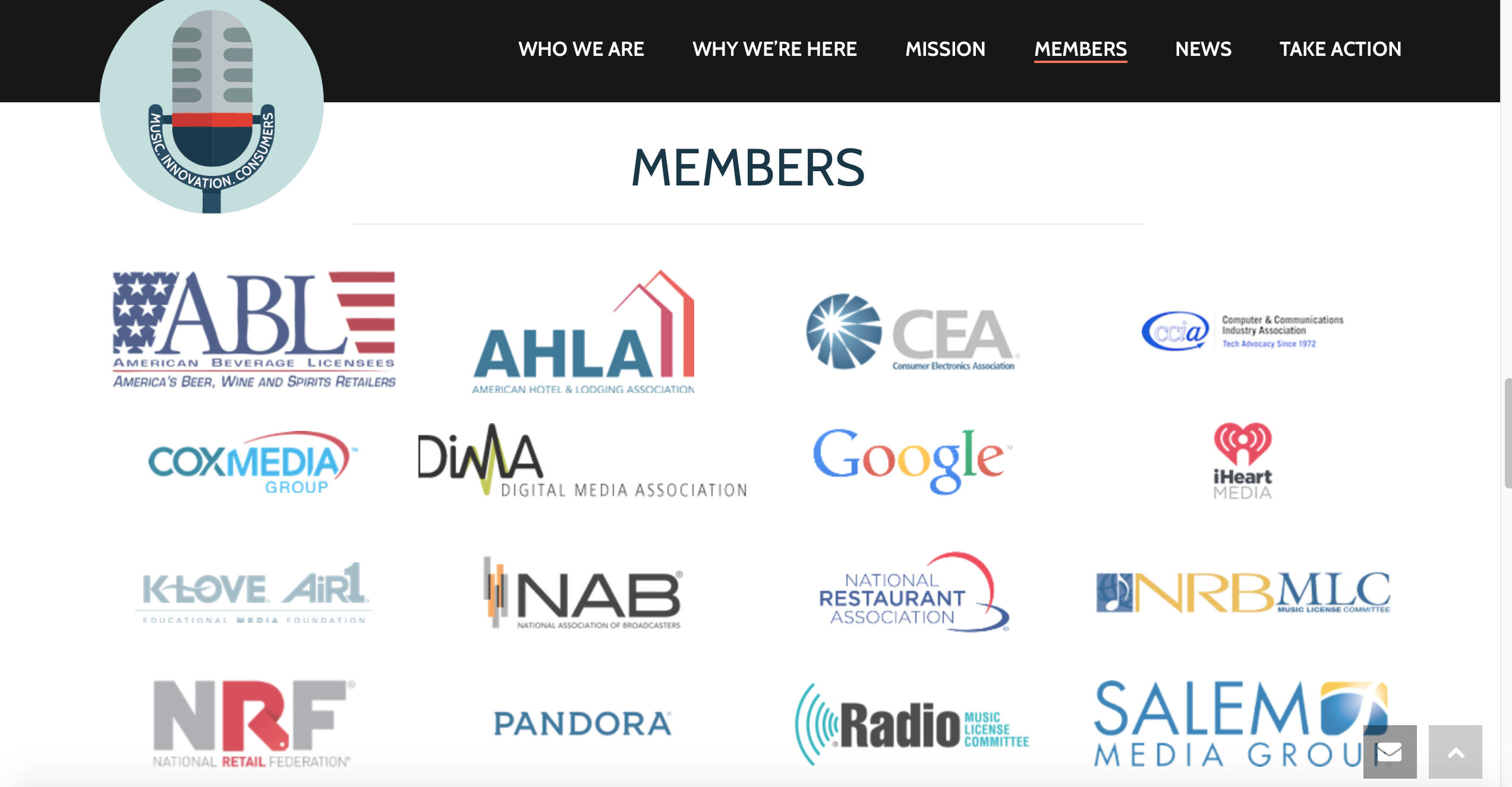


The MIC Coalition’s Revolving Door: The DOJ’s Google Lawyer Reviewing SESAC Acquisition of HFA

Google and Pandora’s “MIC Coalition” calls on former Google lawyer in Dept of Justice to go after SESAC and force more songwriters under the government’s boot.

Music Technology Policy

MIC Coaltion 8-15

Remember the MIC Coalition?  This is the uber lobbying group that Google and Pandora founded along with the National Association of Broadcasters to stop artist pay for radio play.

The MIC Coalition is missing two of its original members–Amazon and NPR both ran for the hills after less than three months being involved.  Now we know why.

Not content to stop artist pay for radio play, the MIC Coalition is now complaining to the Department of Justice about SESAC’s recent acquisition of the Harry Fox Agency.  Many journalists received this email from the Glen Echo Group, one of the MIC Coalition’s DC shilleries:

From: Aaron Alberico
Date: Mon, Aug 17, 2015 at 9:51 PM
Subject: MIC Coalition Members Urge Attorney General to Reject Calls to Weaken ASCAP and BMI Consent Decrees

I wanted to share with you the attached letter from the association members of the MIC Coalition to U.S…

View original post 509 more words

Jaron Lanier: The Internet destroyed the middle class | Salon

Jaron Lanier was the first to identify and speak about this issue. We’re glad to see others catching up to him. Here’s a refresher…

“Here’s a current example of the challenge we face,” he writes in the book’s prelude: “At the height of its power, the photography company Kodak employed more than 140,000 people and was worth $28 billion. They even invented the first digital camera. But today Kodak is bankrupt, and the new face of digital photography has become Instagram. When Instagram was sold to Facebook for a billion dollars in 2012, it employed only 13 people. Where did all those jobs disappear? And what happened to the wealth that all those middle-class jobs created?”

“Future” also looks at the way the creative class – especially musicians, journalists and photographers — has borne the brunt of disruptive technology.

READ THE FULL STORY AT SALON:
http://www.salon.com/2013/05/12/jaron_lanier_the_internet_destroyed_the_middle_class/

Streaming Music is Ripping You Off | Sharky Laguna via Medium

A worthy read from Sharky Laguna on how streaming music has disconnected fans from bands.

You Are Worthless

Imagine a hypothetical artist on a streaming service. Which do you think that artist would rather have: 10,000 fans who stream a song once, or one fan who streams it 10,001 times? Seems obvious, right? 10,000 fans is much better than one fan! But the Big Pool method, which only cares about the number of clicks, says the single person is worth more!
Ass-Backwards

This is bad for the artist, but astoundingly it’s even worse for streaming services: if each subscriber is paying $10 a month then those 10,000 subscribers would generate $1.2M in annual revenue, while the single user only generates a measly $120. Clearly the services benefit from getting more subscribers, not more streams, so why are they incentivizing streams and ignoring subscribers?

READ THE FULL POST AT MEDIUM:
https://medium.com/cuepoint/streaming-music-is-ripping-you-off-61dc501e7f94

Silicon Valley Is Not a Force for Good | The Atlantic

We don’t need to throw the baby out with the bath water, what we need is fair and ethical businesses.

It’s been a long journey from Google to Snapchat—or to apps that enable drivers to auction off the public street-parking spot they’re about to leave in San Francisco. With a few exceptions, the Valley’s innovations have become smaller, and smaller-minded. Many turn on concepts (network effects, regulatory arbitrage, price discrimination) that economists would say are double-edged, if not pernicious. And while the Web was touted as a great democratizing force, recent tech innovations have created lots of profits at the top of the ladder and lots of job losses lower down. The tech sector itself has proved disappointing as a jobs engine and at times hostile to women.

READ THE FULL POST AT THE ATLANTIC:
http://www.theatlantic.com/magazine/archive/2015/07/silicon-valley-shrinking-vision/395309/

Streaming “Transparency” and the 70% Black Box Lie… The Solution Is #gettherateright

The argument goes something like this…

Streaming companies are paying 70% of their revenue but artists are not getting paid enough. This must be the result of record labels and rights holders not passing on the right amount to artists.

The first question is, how do we know that streaming services are actually, really paying 70% of their top line gross revenue to rights holders? We know what the revenue of a transaction is on iTunes, because it is factually transparent – it is the list price being charged. We all know this, and we can all verify this. A $9.99 album on iTunes pays out $7.00, or 70%. Same thing for a $.99 song that pays out $.70, that’s also 70% of revenue.

But when if comes to streaming services however we do not know what the revenue is that should be credited to artists and rights holders. This is what is actually of concern. There is a big black box at the top of the waterfall from which all other money flows downstream.

So if streaming services are paying 70% of revenue, what exactly is that revenue? Let us see it. So here we are with the issue of transparency. If we can’t actually see or know what that number is then yes, the low payouts are very much of concern and have very little to do with intermediaries.

We can disagree about how the 70% of revenue is passed onto artists from iTunes and other transactional sales. But one thing is clear, we all understand the transparent economics of how much money is generated on each transaction. This is not so with streaming. So without transparency at the top of the waterfall, everything that follows is suspect.

More importantly, and more to the point, if there are established retail and wholesale rates for each stream, the calculations become immediately transparent in the same way they are with Itunes. See, the issue here is not what is going on downstream, but rather what is happening at the top of the waterfall.

“WE HAVE A MONETIZATION PROBLEM”

The truth is by now (and everyone should be able to agree on this), we know that streaming creates too little revenue relative to the value of the product. In other words the product is being sold to the consumer for less than the cost that it takes to create and produce it, and still remain sustainable.

In simple terms this is expressed as selling a Porsche for one dollar. It doesn’t matter how many Porsche’s you sell for one dollar while paying out 70% of the revenue, there will never be enough money to actually pay for the cost producing the car. Porsche’s, like professional music are expensive to produce. Despite the advances in recording technology, it is he cost of human labor that is the most important in the value chain.

This is the economics of music streaming in a nutshell, but with one added twist. The Porsche may be sold for one dollar one month, and be sold for only eighty cents the next month, and maybe the month after that sold for a dollar and ten cents. This is because of the fixed (and unsustainable) revenue pool that is divided by the total number of plays.

The common sense solution would be to establish a fixed per stream rate at each platform. This is the most simple way to encourage transparency and fairness as the revenue generated per stream can be transparently and easily calculated from top line data – no more black box at the top of the waterfall. The funny thing is, the people shouting the loudest for transparency also seem to be the most opposed to the easiest solution. Why is that?

So, if we are to have conversations about transparency let’s at least be clear about what it is that we actually need to see.


Music is the Product. | Adland.tv

Yup. Music is the product. Justin Vernon talks about Bon Iver and advertising.  The music is the product, not just the business card to book advertising and sponsorship gigs which some would like to suggest – and here’s why…

We did a photo shoot for Bushmills. To be clear: They gave us a bunch of money and we were able to finish without borrowing. It was great for us, and everybody that worked at the company was great, and I love Bushmills and wanted to do the deal because my dad loved Bushmills — we bond over Irish whiskey.

But the problem is that it isn’t just Bushmills. It’s run by a corporation, and you kind of forget that they’re not interested in you or really what you’re doing. They’re interested in your popularity and your reach, and it felt really sickening after a while. Not badmouthing Bushmills the company, but I regret it.

I regret it because it wasn’t us and they put my face on a fucking billboard, even though it was a cool billboard and I was with my brother and my sound engineer and we’re buds and we got drunk while we had the photo shoot. I just missed it. I missed the mark on that one and I let it all kind of get to me. It just doesn’t feel right after the fact, you know?

READ THE FULL STORY AT ADLAND:
http://adland.tv/adnews/music-product/971380697

Music Streaming Now Generates Trillions Of Plays — But Are Royalties Keeping Up? | Billboard

A lot of advertising gets slathered on A Trillion Streams, and served to the most highly prized consumer demographic… no wonder Google/YouTube, Spotify and Pandora are so opposed to non-free, subscription based models that could actually compensate musicians and songwriters fairly.

The headline number in the report is 1,032,225,905,640, or 1.03 trillion, the number of song plays on Pandora, Rdio, Spotify, SoundCloud, Vevo, Vimeo and YouTube that the company tracked in the first six months of this year. It’s a startling number, much larger than anything we’ve seen before it.

…

It’s safe to say not all 1.03 trillion plays were royalty-bearing streams. Some had a royalty in the 0.05 to 0.1 cents per stream range typical of subscription services. Many of the Pandora streams had a U.S. statutory rate for pure-play webcasters of 0.14 cents plus a smaller amount for publishers (some Pandora streams had a higher royalty applied to streams by subscribers). And SoundCloud, a new entrant to licensed, monetized streaming, most certainly had many non-monetized streams.

Yes, it’s safe to say not all 1.03 trillon plays were royalty-bearing streams. No kidding. For most musicians and songwriters a trillion streams still means the same thing, a couple hundred bucks, if they’re lucky…

READ THE FULL STORY AT BILLBOARD.COM
http://www.billboard.com/biz/articles/6663811/music-streaming-now-generates-trillions-of-plays-but-are-royalties-keeping-up

UK police are waging war on piracy sites’ funding — and it’s working | Business Insider

Ad Funded Piracy. Follow The Money. It’s not about sharing, it’s about profits.

Most big piracy sites don’t charge their users a fee, but are still able to profit off of copyright infringement. Why? Because the operators plaster their pages in advertising.

But British police now say they are making major headway in tackling this: On Wednesday, the Police Intellectual Property Crime Unit (PIPCU) announced that Operation Creative, launched in 2013, has led to a 73% decline in advertising “from the UK’s top ad spending companies on copyright infringing websites.”

READ THE FULL POST AT BUSINESS INSIDER:
http://www.businessinsider.com/operation-creative-piracy-73-percent-decrease-pipcu-2015-8