Searching for answers from Google about Google | The Hill | East Bay Ray

In 2001, a journalist named Bethany McLean posed a simple question in Fortune Magazine: “How exactly does Enron make its money?”

Neither company executives nor outside analysts could give her a simple answer. Her one question is now seen as the drip that opened the floodgates that drowned Enron. By 2006, the one-time Wall Street darling was closed, companies that enabled the fraud had failed, and executives were imprisoned. All this happened because Bethany McLean got the chance to ask a question.

The only way we’re going to learn about what Google is doing is through legal challenges like that of AG Hood.  I don’t see any Congressional hearings looking into Google’s practices (especially with Google spending almost $17 million on lobbying this past year). I don’t hear President Obama asking about Google (see previously mentioned $17 million). While there are European leaders and governments pushing Google to be more transparent, I don’t know why we’ve outsourced an investigation we ourselves should be doing.  I worry that if Google can block a state’s top law enforcement officer from even asking questions, then who is there to stand up and search for the answers we clearly should be seeking?

READ THE FULL STORY AT THE HILL:
http://thehill.com/blogs/congress-blog/technology/232681-searching-for-answers-from-google-about-google

East Bay Ray is the guitarist, co-founder and one of two main songwriters for the band Dead Kennedys. He has been speaking out on issues facing independent artists—on National Public Radio, at Chico State University, and on panels for SXSW, Association of Independent Music Publishers, California Lawyers for the Arts, SF Music Tech conferences, Hastings Law School and Boalt Hall Law School. Ray has also met with members of the U.S. Congress in Washington, D.C. to advocate for artists’ rights.

What are they afraid of: Will Schmidt Take the 5th Again in @agjimhood’s Mississippi Investigation?

Exactly what is Google afraid of?

Music Technology Policy

During Eric Schmidt’s Senate antitrust subcommittee hearing in 2011, a strange thing happened–Eric Schmidt refused to answer under oath on the advice of counsel when Senator John Cornyn–formerly of the Texas Supreme Court–asked questions about Google’s then-recent non-prosecution agreement with the U.S. Department of Justice.  While he didn’t give the usual catechism of “taking the 5th” around the answer, he definitely refused to answer on the advice of counsel.  And when you’re testifying before the U.S. Senate, invoking your right to refuse to answer on the advice of counsel pretty much has one meaning.

So it’s not surprising that Google is now trying to block Mississippi Attorney General Jim Hood’s investigation into the self same “plea bargain” that Google struck with the Criminal Division of the U.S. Department of Justice for which Google paid $500,000,000 of the stockholders money and for which Google is currently being sued by its stockholders.

View original post 1,022 more words

Smells Like Teen Enron: Pandora Sues Songwriters Again. Why?

Pandora is currently suing BMI songwriters over the rate it will pay for the next 4 or 5 years.

Pandora wants to pay 1.75%.  BMI songwriters would like them to pay 2.5%. In 2014 Pandora paid BMI $16.1 million dollars.   So basically Pandora is using the entire apparatus of the federal courts to get a reduction of less than $7 million dollars in 2015.  If it’s a 4 year deal that means Pandora saves $28 million dollars (Pandora growth has virtually stopped).  Court cases like this have typically cost the parties tens of millions of dollars.  This does not include the millions it costs taxpayers.

But let’s look at these numbers  in context to see just how ridiculous this case is.

(source for all of these charts are SEC filings and court testimony)

Pandora revenues in 2014 vs amount paid to BMI songwriter revenues  

Screen Shot 2015-02-12 at 1.02.27 PM

BMI represents about 48% of all songwriters


Pandora executive “stock compensation”  vs royalties to BMI songwriters 2014

Screen Shot 2015-02-12 at 1.18.52 PM

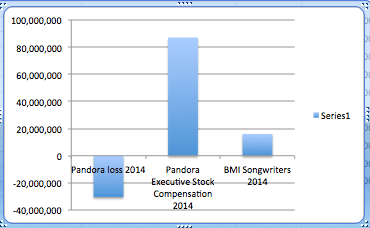
In 2014 Pandora paid $87.1 million dollars to executives in “stock compensation.”  In 2015 they plan to pay executives another $122 million.  By the end of the year will they have paid out over 1/2 a billion dollars to executives and investors in stock compensation.

Pandora 2014 net loss compared to executive stock compensation and royalties paid to BMI Songwriters.

Screen Shot 2015-02-12 at 1.28.14 PM

So if you were running a company that lost 30.41 million last year and you were seeking savings what would you do?

1) spend tens of millions of dollars suing BMI songwriters to “save” $7 million

or

2) would you maybe cut some of the $122 million in 2015 executive stock compensation?

Smells Like Teen Enron

This is totally batshit crazy right?  I mean this is more like something a petulant teenager would do ( I have a couple).   “I’m so mad at those songwriters I’m gonna sue them even though it doesn’t save me any money.”

So is Pandora behaving like a petulant teenager or is there something more sinister afoot?

When something doesn’t make sense one should always entertain alternative hypotheses to try to figure out what’s going on, right?  So why might Pandora management being pursuing and publicizing this high profile scorched earth strategy with songwriters and the music business?

One possibility is that they don’t want anyone noticing that the company would be profitable without the wildly excessive executive stock compensation.   By my rough reckoning Pandora would have made a profit of $56.7 million dollars last year without the executive stock compensation.   The BMI and  ASCAP songwriter lawsuits provide a false narrative as to why the company is unprofitable:  “Those damn greedy songwriters”.  And it has worked! With most of the financial press and even the major music industry press uncritically regurgitating this false narrative.

It also distracts from the fact that the executives and investors are sucking the life out of the company. By the end of 2015  they will have extracted over 1/2 a billion dollars from the company!

So let’s have a little fun here.  if you were forced to bet on this:


Pandora Execs Will Have Received Nearly 1/2 Billion Dollar in “Stock Compensation” By End of 2015

While Pandora is busy in court suing BMI songwriters for lower rates we thought you’d like to read this guest comment from George Johnson.

“The past 3 years, according to the SEC, Pandora executives and investors extracted over $360 million dollars in “stock compensation”. This new $122 million dollar gravy train for 2015 will put Pandora executives at almost $500 million dollars for themselves in 4 short years while they plead poverty to Congress, Judge Stanton, Judge Cote, and the Copyright Royalty Board. (Ed note: New information suggests it’s closer to $550 million.)

Not bad for a guy who thought of the entire idea for Pandora while “tripping on psychedelic mushrooms”. — see Washington Post in 2013.

It’s time for the SEC, DOJ, or Congress to shut down Pandora with a temporary injunction and have these executives PAYBACK these hundreds of millions of stolen royalty money to songwriters, music publishers, recording artists and independent labels and all their investors.”

Coincidence, or Did Mississippians Just Tell @agjimhood to Go For It in His Investigation of Google?

Strange goings on in Mississippi…

Music Technology Policy

Mississippi Attorney General at February 5 Main Justice News Conference Announcing Standard & Poors Multi-state and Federal Settlement

As noted in my post about the history of Mississippi House Bill 1201, a Mississippi lawmaker in Mississippi’s House of Representatives decided to put to a vote whether Mississippi’s attorney general should have the ability to bring actions all by himself (and by extension, conduct investigations in order to determine whether an action is appropriate).  In other words, to do what the people elect attorneys general to do in large part.

There is one particular investigation that is in the news in Mississippi right now–Attorney General Jim Hood’s investigation into Google’s business practices.  I don’t know the history here, but I have to say that it is pretty dang coincidental that Hood is investigating Google and then up pops a bill in the Mississippi legislature that could stop Hood from bringing his case…

View original post 504 more words

Pandora Sues Songwriters For Lower Rates While it Pays Execs $122 Million in Stock This Year

There they go again!

Pandora is currently suing BMI songwriters for lower rates.  Last year it was ASCAP.  They’ve also been been  sued by  The Turtles for refusing to pay royalties to artists who recorded before 1972.    Pandora’s entire business model seems to be either suing songwriters or artists and trying to set us against each other.

And taking money off investors.

Pandora plans to pay its top executives $122 million in “Stock Compensation” for this year alone.  That’s right, the money-losing Pandora plans on paying executives $122 million in stock this year. Unbelievable.  This is on top of their already inflated Silicon Valley size salaries. No wonder their stock is collapsing. It sure looks like the executives are vampires sucking the company dry.  While pleading poverty to the BMI rate court judge and public.  I don’t understand how these people stay out of jail.

“The Specialist” at Seeking Alpha has carefully detailed how virtually all the losses at the company can be attributed to overcompensation of executives through this “Stock Compensation”.   Read it here:

http://seekingalpha.com/article/2896676-pandora-is-even-more-overvalued-than-you-think


Tale of Two Trophies: While the Grammys Endorse Fair Pay for Artists On Streaming CMA Research Division Headed in Other Direction

Much of the post Grammy talk today concerned the surprise announcement from Grammy chief Neil Portnow that NARAS had formed a new advocacy group to press for better royalties from digital services.   As Billboard reports: 

“Music has tremendous value in our lives,” Portnow added. “While ways of listening to music evolve, we must remember that music matters in our lives, and that new technology must pay artists fairly.”

Holy shit! A plea for fair pay for artists on primetime tv in the middle of the 57th Grammy Awards?  I’ve seen it all now.

None of my artist colleagues had any idea anything like this was coming. We were just as surprised as the rest of you!

Now compare and contrast this to the Country Music Association.   Sadly this institution appears headed in the other direction.   Well at least their “research” department appears to be headed in the wrong direction.

Under the research director Karen Stump  the CMA “released” a study that as billboard reports “Streaming Drives Sales New Study Shows”  I say “released” because the study was presented in a closed door session and CMA refused to provide any details to anyone not in the room.

Okay that’s weird enough… but what was that headline again?

Streaming increases sales? What? Music sales are down streaming is up that’s pretty much what everyone is talking about.   I thought everyone had agreed on this?  I mean most people take it as a given that streaming is a replacement for owning music. Ask any college kid.  They don’t buy music anymore they stream it.  The mainstream and seemingly sensible debate has been about just how much streaming decreases sales and if streaming revenues will be enough to offset the decline in revenue from sales. But well we could all be wrong.  As Billboard reports on the study:

“YouTube might be “the devil” to Garth Brooks, but in another’s eyes, it’s a great source of music discovery. In fact, a new study being released by the Country Music Association suggests that adults 18-plus are far more likely to buy music after being exposed to it on YouTube, Spotify and other streaming services than listeners who hear a song for the first time on AM/FM radio.”

Well okay. I sort of see what they are doing here. Maybe their headline is overselling it. The actual body of the article hedges the claim a bit.  Still I didn’t see any statement from the CMA correcting the Billboard headline.

More troubling are the obvious flaws in this study.   As a part time academic researcher  I immediately saw four possible fatal biases/covariance problems with this study.  Let me simplify it for those whose eyes glaze over at the mention of statistics.

1) If you are streaming you have a device in your hand or in front of you that allows you to immediately buy the song.   Compare that to radio.  Most radio listening is done passively, say in the car or while working. Generally you don’t have a smartphone, tablet or computer at the ready. You are more likely to buy the song when you’re streaming because  you have buying device in hand! If you are listening to the radio especially while driving, it could be hours before you have a chance to buy the song. That likely accounts for the difference right there!

2) If you are using YouTube or Spotify, you already know the name of the song or the artist.  YouTube or Spotify generally don’t randomly play an unknown song for you!  So you are already engaged with the artist or song on some level if you are streaming it.  You are more likely to buy the song NOT because you are using YouTube or Spotify but because you are already engaged with the song or artist.

3) Users of YouTube and Spotify are much younger and are likely in the prime music buying age demo.

4)  Those who only listen to radio and don’t stream are likely to be older and poorer.   They are less likely to buy music because of their age and socioeconomic variables.  Not because they only listen to the radio.

It’s also likely that the “study” is making the most rookie of all moves: equating correlation with causation!

Now you can still adjust for these biases using a complex  but common statistical methodology and make the kind of claims that the CMA research department has claimed. You can also sometimes tease out causality using pseudo-experimental techniques.  So I wanted to see if they had controlled for these biases by using this statistical methodology.  Simple enough right?

I wrote to Ms. Stump and asked if the survey had adjusted for these biases.  And if she could share the report and data with me.  (The final report was not available at the time and the raw data and detailed methodology is still not available.)  First I wanted a copy of the report. Second I wanted to see if  those who conducted the survey adjusted for the biases above.

Her response indicated that they were not willing to share the report and the data with me since it had been conducted on their behalf by a third party vendor.

Huh?

This makes no sense. It’s their report. It’s their data. They hired the vendor. I followed up several times over the next few weeks with Ms. Stump and others at the CMA but I have been effectively stonewalled.  Not a single response.  I couldn’t even get them to send me a copy of the report.

So what is the CMA hiding?  There are no “unfriendly” facts. Data is  data. I don’t understand why the CMA would want to deny their members a second opinion by an experienced researcher? If they did the study correctly then my “peer review” will just bolster their claims.  So what are the other possibilities here?

One possibility is that the CMA misled people in the first place and are now trying to cover it up.

In this tale of two music trophies #IRespectNARAS  #NotSoMuchCMA



Straight Out of Rosedale: Mississippi’s Sudden Interest in Limiting State Lawsuits While Google Sues Attorney General Jim Hood

Chris Castle with news you can use…

Music Technology Policy

You can’t make this stuff up.  It reads like a subplot of a John Grisham novel with that vague warning that it could swing back across the stage as a plot twist in the third act to smash into the ending with a vengeance, carrying streaming guidons reading  “Here am I, the one true ending, send me.”   A single bugle sputtering a few bars of Garry Owen in the darkest gloom of dawn at Vicksburg.  The General, perhaps.

In a strange twist of fate worthy of Robert Johnson at the crossroads, a number of events transpired in recent weeks involving Mississippi State Attorney General Jim Hood who is being sued by Google for having the audacity to investigate a variety of potentially unsavory business practices having to do with sex, drugs and yes, rock and roll.

The timeline on this is that Hood served Google with a…

View original post 1,329 more words

Why Pandora Stock Collapse Should Worry Artists: Google

Artists and labels need to be careful which companies they cut deals with cause one never knows who will end up owning that company tomorrow.   That dumb looking MERLIN “steering” deal with the struggling Pandora may look even dumber if Pandora is acquired by a company like Google. 

+++++++++++++++++
I  had a few inquiries Friday asking if I wanted to comment on the collapse of Pandora Media  stock  (-17.22 %).  I passed because I didn’t really think the price of the stock was very relevant to artists.  I mean Pandora is gonna continue resisting paying performers and songwriters fairly whether their stock is $35 or $12.  Right?

But then I started to think about it from purely an equity/quant perspective.   At $15 dollars Pandora Media is valued at just over $3 billion.   One of the rules of volatility and quant trading is you don’t short a stock all the way down, because as a company becomes less valuable the “tail risk” or unpredictable/unexpected events start to accumulate on the upside.  Usually because the company becomes a takeover or buyout target.

Now, let’s turn our attention to Google.  Follow me here.  You’ll be glad you did.

Now you know that Google is basically a one trick pony?  Right?  It’s a data mining firm that also sells advertising.   This accounts for 90% +of its revenue.  And let’s be honest.  Data mining and user profiling is just what fancy Wall Street types call “spying.”   Look at what Google does:

Google Search:  data mining/spying/advertising

Chrome: data mining/spying

Gmail:  data mining/spying/advertising

Google tracking device in your pocket (Android OS phones):  data mining/spying

Google Maps: data mining/spying/advertising

Google Street View cars: data mining/spying. (literally–they got caught on that one)

Google Driverless Cars:  data mining/spying

YouTube: data mining/spying/advertising

Google Glass: data mining/spying

Google for education: data mining/spying

Google Fiber: data mining/spying

Google “free” WiFi: data mining/spying  (Check the privacy policy on your Starbucks WiFi by Google next time you’re visiting.)

(proposed) Google mobile phone service: data mining/spying.

Anything to do with drones and robots: data mining/spying

Google takes all this data and monetizes it through its web and search advertising.

Now recently Google’s core business, web and search advertising  has come under pressure.  So has their stock.  The problem is that many mobile users are not searching using a Google search or even using a browser.  Many users, especially young users have discovered you can get all internet has to offer through mobile apps.  This puts millions of  consumers out of the reach of Google’s data mining/spying/advertising ecosystem.  And Google wants you to believe that apps are a threat to freedom and will break the Internet.

THIS IS AN EXISTENTIAL CRISIS FOR GOOGLE.

Aside from YouTube (and maybe Google Maps)   Google does not have a killer app in the mobile world  Pardon the pun.   So how do they monetize the mobile web? They need more apps.  Apps with lots of users.  Things like Instagram, WhatsApp and SnapChat.  But largely Facebook has beaten them to the punch.  What’s left? Well there are music services.   Spotify and Pandora?  But Spotify already competes with YouTube Music Key and Google Play.   So Google put a board member on Spotify.  Hmm but not so much Pandora. Pandora, while not the shiniest hottest new app, is at least a complement to Google’s existing business.   Google already has a lock on Pandora’s advertising through DoubleClick.  And Pandora at $3 billion (really 2.7 billion since they have $300 million plus in cash reserves) is less than the variation in Google’s market cap on day to day basis.

$3 billion for Pandora’s 80 million users?  Isn’t this a cheap way for Google to kickstart it’s transition to mobile?

And yesterday we learned that Pandora joined the Internet Association.  Which is Google Facebook and Twitter among others.  So they are already part of the club.  And Pandora’s statement on the Copyright Office Music Licensing Study sounds just like Google already which would makes sense since Google already has Pandora by the balls through DoubleClick (see Pandora risk factors).

Check it:

“(Pandora) would be open to supporting the full federalization of pre-1972 sound recordings under a technology-neutral approach that affords libraries, music services and consumers the same rights and responsibilities that are enjoyed with respect to all other sound recordings.”

Since when does Pandora care about libraries?   Libraries is a Google “tell” after all the Google Books handwringing about the “digital library of Alexandria.”  I’m sort of joking here.  But I really do find the move to the Internet Association very curious.

So before artists and rightsholders start celebrating the collapse of Pandora’s stock,  consider what a formidable foe Chris Harrison (Pandora counsel) would be if he was backed–or employed–by Google.  It would really be the job he’s been auditioning for over the last 10 years.

Yep…Chris Harrison and Fred Von Lohman.  There’s a match made in heaven…depending on your definition of heaven.


Join @theblakemorgan on Twitter for #irespectmusic call for Artist Pay for Radio Play TONIGHT 7pm EST!

It’s a new session of Congress and time for artists to be heard on artist pay for radio play.  Let’s join Blake Morgan on Twitter TONIGHT starting at 7pm EST to get the year started right!

From Blake:

There are years that ask questions and there are years that answer them.
We’ve asked the question: “Why is the United States the only democratic country in the world where artists don’t get paid for radio airplay?”
Now, Congress is on the move. The United States Copyright Office is on the move. Music makers are on the move. Music Lovers are on the move.
It’s time for some answers from the people who believe that artists shouldn’t be paid for their work.
Join me tomorrow night on Twitter, Sunday February 8th at 7pm Eastern: hashtag #IRespectMusic.
It’s time to take the next step.
and tell Congress you support artist pay for radio play by signing the petition at irespectmusic.org!