So Much For Spotify in Sweden, Overall Sales Drop… and Norway Too…Streaming Kills…

Remember how we’ve been told for years that Spotify is the solution to the record industry’s problems? Remember how we’ve been told that Spotify is the solution to piracy? Remember the stories of how “sales are growing” in Sweden and Norway?

Well guess what? According to Digital Music News (reported by IFPI) overall sales in Sweden and Norway are actually down for 2014.

Overall. Down.

Hmmmm… Click the links below…

After Years of Recovery, Music Sales Are Now Declining In Sweden… | Digital Music News

Streaming Killed Piracy In Norway. It Also Killed Recording Sales… | Digital Music News

We’ve said it before, and we’re willing (and happy to be wrong) that streaming economics, specifically of the Spotify variety are unsustainable. That doesn’t mean the economics can’t be changed, or that streaming doesn’t work and can not work – it just means that the predictions about growing revenue via Spotify are wrong.

We’ve questioned the philosophy and math behind streaming for a while now and it appears some of our criticisms and concerns are coming true. For example we noted that the Spotify per stream rates are dropping as more users are added to the service.

If overall revenue continue to decline, especially in the most promoted and championed markets in the world, what does that say for the rest of the world?

We previously reported that the per stream rates are dropping as the service add more users (graph below). This new data suggests that not only is the per stream rate dropping, but in two the leading countries in the world overall revenues are also down.

It’s just math.

SpotifyNetMONTHLY_Charted


Bring Out Your Shills: Google’s Shill Mill Attacking Mississippi Attorney General Jim Hood for Having the Audacity to Investigate Google

Mississippi Attorney General Jim Hood is conducting what looks to be a criminal investigation into Google’s business practices including whether Google complied with a 2011 “non prosecution agreement” with the U.S. Department of Justice that required Google to pay $500,000,000 of the stockholders money to keep their senior management team from being prosecuted for violating the Controlled Substances Act.

Yes, that’s right. A $500,000,000 fine.  Of course you read about that in news far and wide, right?  Not really.  The only mainstream media outlets that covered it were pretty much the Wall Street Journal and Wired.  More about that later.

Google has sued Attorney General Hood to try to keep him from investigating potential crimes at Google, and David was interviewed about that case yesterday in the Washington Internet Daily, so we thought we’d give you some background.

Google’s Plea Bargain with the United States

Of the many things that are interesting about that faux plea bargain let us focus on three.  First, it was the result of a four year sting operation conducted by the Food & Drug Administration, the IRS, the FBI and the Justice Department.  Next, the U.S. Attorney for Rhode Island collected four million documents–that’s right–four million documents that the U.S. Attorney told the Wall Street Journal clearly implicated Google’s senior management including…wait for it…Larry Page.

Finally, the acts for which Google was to be prosecuted in federal court were the acts of Google employees acting as individuals and clearly not as part of their job descriptions.  (Unless promoting the sale of advertising for illegal drugs was in their job description in which case there’s much, much bigger problems.)

What that means is that when Google paid a $500,000,000 forfeiture–which was both Google’s profit and the sums Google paid to the illegal pharmacies as a revenue share that Google agreed to pay to keep from being indicted–that money was really not something that was Google’s fault as Google the corporation.  That fine should have been paid by the employees themselves.

That would, of course, have required identifying the employees which evidently included Larry Page.

One of the conditions of the faux plea bargain was that Google would not violate the Controlled Substances Act for a while.  And if they did–if Google violated their probation–the deal was off and the DOJ would pick up right where they left off.

That’s a big hammer.  And that’s part of what Mississippi Attorney General Hood is investigating.

Oh and there’s one other thing about the DOJ plea deal with Google.  It had nothing to do with copyright.  It had nothing to do with any conduct that’s in any safe harbor, Communications Decency Act, DMCA or otherwise.  It was GOOGLE’s own conduct at the highest levels of that depraved organization.  And if you read Hood’s subpoena on Google, it is entirely addressing Google’s OWN conduct, no issues of third party liability.

The Shareholder Suits

You would think that Google’s board would have said, hold on here, pay that $500,000,000 with your own money, Larry.  Right?  Another fine mess you got us in.  Because a company’s board of directors is supposed to protect the company’s interests, the shareholders interests.  It’s inconceivable that the $500,000,000 payment was made without the board’s approval.

But whose money is that?  Clearly not the money of the executives who caused the problem.  It’s not the board members’ money.

It’s the shareholders money, because Google is a public company.  So the board authorized the payment of $500,000,000 of the shareholders money to save Larry Page’s sorry ass.

Needless to say, the shareholders noticed this and promptly sued Google’s board and executive team for breach of fiduciary duty of loyalty, abuse of control, unjust enrichment and corporate waste. For starters.

Now remember–Google has a super duper category of stock that you can only hold if your name is Schmidt, Brin or Page that gives these three guys 100% control over the board of directors.  So you want it, you got it, kids.  There’s no such thing as a truly independent board member, because no other shareholders can replace the board.  In a way, the board did protect the shareholders’ interest, just the wrong ones.

This case is gradually moving toward a settlement and Google filed a tentative settlement with its stockholders.  If you read the settlement it’s kind of normal stuff you’d expect to see in a settlement of this kind:  Google refuses to admit liability, but agrees to spend more of the stockholder’s money to protect the world from Google’s management team.  But then out of the blue comes this section:

2.7 Criminal Activity Reporting

Google’s General Counsel shall be responsible for reviewing every situation in which a  Google employee is convicted of a felony under U.S. federal or state criminal statutes in connection with his employment by Google and for reporting to the Board (or an appropriate committee of the Board) with respect to that violation. Presumptively, any employee convicted of a felony under a U.S. federal or state criminal statute in connection with his employment by Google shall be terminated for cause and receive no severance payments in connection with the termination.If the General Counsel determines that such termination is not warranted, he shall so recommend to the Board (or an appropriate committee of the Board), which will act upon his recommendation in its discretion.

Notice that there’s not one word in this section dealing with drugs, drug advertising or the like.  Or copyright infringement.  Why is that language in there?  Golden parachutes for felons?  Huh?

No idea, but we would love to know.  And you know who else would like to know?  Attorney General Jim Hood.  (Interrogatory 18.)

And you know what?  It doesn’t mention copyright once.

Send in the Shills

Let’s pause a moment and remember another case involving Google: Oracle v. Google.  The judge in that case got so fed up with shillery he ordered the parties to disclose to the Court exactly who they paid to comment on the case and who they did not.  Oracle’s filing was pretty short.  Google’s, however, was not.  Google denied that they paid any of these people to comment on the case and denied that any of them were acting under Google’s influence when they commented, but they paid them or the organizations that employed them for something.

Google had to be ordered to produce the list twice, of course.  The “supplemental” filing has become known as the Google Shill List and has an interesting set of names and organizations.  (This includes Timothy B. Lee who worked for Jeff Bezos’s Washington Post.)

The names that are interesting to us today are the ones that also appear on the amicus briefs filed against Attorney General Hood:  Public Knowledge, the Electronic Frontier Foundation, Julie Samuels (working for EFF at the time now working at Engine Advocacy), the Communications and Computer Industry Association and the Center for Democracy and Technology.

Public Citizen has released a study called Mission Creepy a great guide to Google’s labyrinthine influence buying.  According to Public Citizen, Google also gives money to R Street Institute, Engine Advocacy, New America Foundation (where Google Executive Chairman Eric Schmidt is on the board), and of course the Consumer Electronics Association.

Moving now back to the Google v. Hood amicus briefs, Google came up with three that we are aware of–one was filed in support of Google by the Consumer Electronics Association, the Computer & Communications Industry Association and Engine Advocacy (where Julie P. Samuels–remember her from the Google Shill List–is Executive Director), and a third by the Internet Commerce Coalition.  Each organization is funded by Google.  The CEA and CCIA alone lobby for companies whose combined market cap surely has to be somewhere around $2 TRILLION.

Another amicus brief was filed in support of Google by Public Knowledge, R Street Institute, New America Foundation’s Open Technology Institute, the Electronic Frontier Foundation and the Center for Democracy and Technology.  The third was filed by the DLA Piper lobby shop for the Internet Commerce Coalition, also funded by Google according to Public Citizen.

In other words, the three amicus briefs filed in support of Google’s attempt to stop a criminal investigation were filed solely by organizations that receives funding from Google both directly and indirectly and in some cases has received that funding for many years.   Even in the world of Google influence buying where organizations seem to be created by binary fission straight out of the Benjamins, this is an odd result.

Did Google pay these organizations to put their names on the briefs?  We don’t have evidence of that level of detail.  So it’s theoretically possible that the reason the organizations–most if not all tax exempt, by the way–put their names on the briefs is because their beliefs are as close to Google’s as one is to two.  Or three.

But it sure is quite a coincidence.

Updated to include Internet Commerce Coalition.

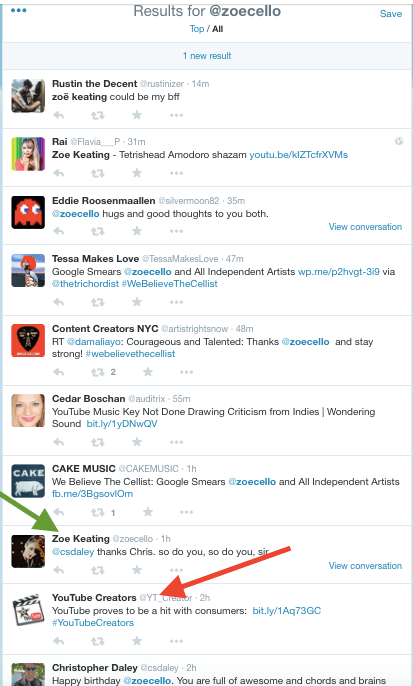
New YouTube Smear? When I search Twitter for @ZoeCello why do I get “YouTube Creators” account as search result? Why does it point to Business Insider Article?

Try it yourself.

 https://twitter.com/search?f=realtime&q=%40zoecello&src=typd

I don’t know.  Maybe it’s just me.  But if I search for “@zoecello” on twitter I get this YouTube account in the search results.  EVERY other search result contains “@zoecello”  except the YouTube Creators account.  Is there something funny going on here?

UPDATE:  Yes indeed there is something funny going on here.   As our good  friends at Adland.tv have quickly pointed out, The YouTube Creators twitter account has most likely targeted this search and must be using a bot cause they accidentally ran the link through 2 URL shorteners!  They tried to link to the business insider piece which is clearly part of The Great Smear Campaign Against Zoe Keating (Classic strawman argument, accuses her of being wrong about something she never said).

Here is their mangled URL:

http://zpzp.eu/shorten2.php?url=q.gs/5959472/http://www.businessinsider.com/youtube-allegedly-threatens-to-block-zoe-keating-2015-1?utm_medium=twitter

This is where they were trying to send you.

http://www.businessinsider.com/youtube-allegedly-threatens-to-block-zoe-keating-2015-1?utm_medium=twitter

This is sickening.   Fucking bullies.   New hashtag:
#HeyGoogleYouFucking370BillionDollarCorporationGoPickOnSomeoneYourOwnFuckingSize

Oh did we mention it was Zoe Keatings Birthday today?   Stay Classy YouTube!


Screen Shot 2015-02-03 at 9.15.35 PM


And here is the link to that YouTube Creator tweet.

https://twitter.com/YT_Creator/status/562770933803667458

We Believe The Cellist: Google Smears @zoecello and All Independent Artists

loop

As David noted in his recent post (“Zoë Keating vs YouTube: The End of an Artist’s Right to Choose Where Their Music Appears on The Internet“), Google started a whisper campaign to journalists against Zoë Keating as soon–if not even before–the story first broke on Digital Music News.  What is a “whisper campaign”?  It’s an anonymous effort by a usually skilled corporate PR department to discredit someone who is criticizing the corporation, an effort directed at journalists with whom the corporate flacks have a relationship and who are willing to publish unattributed statements that contradict the whistleblower who spoke on the record.

Aside from the first exchange with Digital Music News that was probably unintentionally on the record, this is exactly what YouTube is doing to Zoë, and it is exactly what Google does all the time.  Aside from very carefully scripted statements by Google executives, almost all of Google’s press statements are either on background (“…persons with knowledge of the case said…)  or unattributed (“a Google spokesperson said…”).   (See “Did YouTube Twist @sisario Article in NYT?“)

Google has spent a good deal of effort last week trying to destroy Zoë’s credibility, and they did so just this way.  If you read the stories, especially YouTube’s Music Key Terms for Artists, Clarified in Billboard, all Google’s statements are unattributed.  This means that the journalist knows who the Google source is but has agreed not to mention that person by name in their reporting–usually when everyone else in the article is mentioned by name.

Jane Hamsher Shows Billboard How It Is Done

Before we get to the substance, let’s point out how one journalist refused to be complicit in Google’s spinning.

Jane Hamsher writing in the Firedoglake blog broke the story of Google permitting the distribution of the Utoopi escort app in Google Play over the objections of Members of the U.S. House of Representatives Marsha Blackburn and Carolyn Maloney (Bytegeist Exclusive: Rep. Maloney Letter Blasting Google’s Larry Page Over Android Sex App Marketed to Students).  Google tried to get Ms. Hamsher to collude with them by printing a response attributed to an unidentified Google spokesperson.  Ms. Hamsher refused–and this is exactly what all publications should do with Google when requested to publish unattributed statements.

And guess what?  Google went on the record.  What Ms. Hamsher showed us all is that when journalists call Google on their BS, Google pretty much has to cave.

So why do journalists play along?  Aside from being spineless, that is.

UPDATE: In a comment to this post, Kidsleepy from Adland made this point:

One of the biggest reasons media outlets are keeping their mouth shut is because they don’t want to lose the ad revenue. We hear at Adland are all too aware of this. One critical article too many and all of a sudden our site was rejected from the adsense program because of so-called explicit material, which was nothing more than an advert. This is the real issue with google. They hold the purse strings on all of us. Musicians, content creators, bloggers and journalists. Since moving online we’re now at the mercy of one boss. Scary indeed.

Another reason might be because journalists are afraid of being blackballed by Google in the future and being cut out of the loop.  The idea that Billboard–the so-called “Bible of the music business”–would play along with this loathsome practice in a story about the very artists whose work pays their salaries and gives them something to put between their advertising and ever more meaningless streaming charts (that benefit Google, by the way), is particularly galling.  Not only does it make a mockery of the First Amendment and question Billboard’s entitlement to these protections as a mere shill mill, Billboard has seriously shaken any confidence that artists should have in their work product.

And we hasten to point out–they did this all by themselves.  They’ve had plenty of time to retract or correct the story and they haven’t.  We assume that there’s not going to be a correction.

Fortunately, we have other Billboard coverage of the situation by Glenn Peoples  (“Cellist Zoe Keating Opens Up on Her YouTube Battle: ‘There’s a Lot of Fear Out There’) who went to the source and did an objective interview with Zoë that actually named names of Google employees involved with the smear.  There are some shreds of objectivity in the offensive Billboard story.  But it’s really thanks to Glenn Peoples that we don’t simply stop reading the magazine.

But they came close.  Because, as you will see, there is enough language in Billboard that appears to have allowed the Google flacks to then push out these quotes to other publications that did not take the time to interview anyone and who simply reported about the reporting.  This should not be a shock to anyone–this is the way the game is played and we have to believe that everyone knows it.  Including Billboard.

https://twitter.com/TessaMakesLove/status/562358919209959425

The Fear and the Smear

This entire story has to be viewed in the context of artists being more fearful to speak against Google than they ever were to speak against their labels–artist’s complain about their labels all the time.  As Glenn Peoples’ interview with Zoë concluded:

[Billboard] You say Google has so much power that people would rather not cause any problems?

[Zoë] Yeah, I think so. Nobody’s said that to me, but that’s my impression.

But the torch has definitely passed from Spotify to Google for mishandling of artist relations.  As we saw with the boneheaded way Spotify handled Taylor Swift, these big tech companies immediately think of attacking the artist–which is why “there’s a lot of fear out there.”  Apple is a notable exception–they’ve never done it once.  At least Spotify’s CEO had the good graces and courage to make his statements on the record and for that we commend him.

The smear of Zoë Keating started with Google telling Digital Music News that Zoë’s account of her dealings with YouTube was “patently false.”  That’s like calling Zoë a liar.  While we think Daniel Ek approached that level of offensiveness with the Spotify debacle, he never said anything that blatant.

Google did.  Now they are doubling down as the suits take over.  You know that’s happened because they are releasing no names of “Google spokespersons.”  The only names we have of Google employees who are involved in this matter are Matt McLernon who actually sent an email to Digital Music News that was republished, and thanks to Glenn Peoples we know that at least Dan Abel (formerly of the Creative Artists Agency) and Vivien Lewit called Zoë to try to hondle her into agreeing to terms she didn’t want.

This isn’t surprising as we remember Ms. Lewit from a SXSW panel last year where she struggled to defend YouTube’s absurdly low royalty rates but yet seemed to somehow referred to her past work as an artist lawyer as qualifying her to understand how low the royalties really were.  Her LinkedIn bio says this about her background relating to artists: “As an associate at Rudolph & Beer, LLP, followed by years as partner (and, later, of counsel) at Davis Shapiro & Lewit, LLP, I provided counsel for my clients on countless business dealings ranging from traditional recording agreements to complicated and lucrative touring, branding, sponsorship, endorsement and merchandising deals.”  We’re not quite sure what having experience in “lucrative” anything has to do with artist royalties at YouTube, but we’re looking forward to finding out some day.

The way Google is conducting their current smear campaign is to attack the artist’s credibility and truthfulness.  Saying that Zoë’s account of the situation is “patently false” goes beyond the typical condescending tone of the new boss elites that artists can’t possibly read or understand their contract.  “Patently false” usually means a conscious disregard for the truth a/k/a a lie.

If there’s anything that is patently false in this saga it is Google’s position that Zoë didn’t understand what was being said to her or what promises were made.  She clearly not only understood what was said but took extensive notes.  What is not patently false is that threats were made and Google is doing the same thing to Zoë that Google tried to do to the UK songwriters as well as indie labels labels last year and for which the indie labels will hold Google to account before the European Commission antitrust authorities.

Why would Google make such fools of themselves in this dust up?  We think it may have had something to do with a “most favored nations” clause that quite possibly was in Google’s licenses with Merlin and the major labels.  Why?  Because of statements attributed to Google’s representatives that they “would not enforce” certain terms in Zoë’s agreement with YouTube but needed the objectionable words to stay in the contract.  This is exactly what people say when they have an MFN problem.  They want to be able to tell the people that they have given MFN to that all their contracts have the same language, whether the contracts exist on the day they grant MFN or come into existence after that MFN date.  But they need to be able to convince late comers to sign the same contracts they have given MFN in previously, so they try to overcome the objection by saying they want the words but won’t enforce the promise.

As MusicAlly said in their recent podcast on the subject, this is not something anyone should agree whether you’re signing with YouTube or buying a house.

What Google evidently was counting on was that they’d be able to keep all of this secret under their pervasive non-disclosure agreement.  But then as Google’s Eric Schmidt tells us, “If you have something that you don’t want anyone to know, maybe you shouldn’t be doing it in the first place.”

The smear continued in a variety of sources with Zoë alternatively being referred to as a “crappy edge case”, or somehow YouTube being forced to treat Zoë this way because of the major labels.  (Huh?)

But then came a second Billboard article that has some objectivity but misses some huge issues, particularly about the use of YouTube’s ContentID.  Being able to use ContentID to block is very important because it is one of the automated tools that allow artists at all levels to automate the process.  If YouTube takes away access to ContentID, then the artist has to search for each instance of infringing content and send a DMCA notice on a whack a mole basis.

Here’s the objective part in Billboard’s coverage:

Keating told Billboard that she came away from her many talks with YouTube representatives (which she transcribed in order to keep straight, portions from which she shared with Billboard) with the understanding that, regardless of whether or not she signed the Music Key contract, her music would end up on Music Key, via users uploading their own videos featuring her music.

This is essentially the exact same thing that the indies were threatened with last year.  The artist’s own videos would not be on Music Key, but YouTube would let the UGC videos of the artist flow onto Music Key–which could be identical copies of the artist’s own videos copied from another source.  And that was the threat that YouTube used to get you to sign up to Music Key.

Read this next part very carefully, because it all depends on what your definition of “is” is (we’ll add some emphasis and commentary).

This, YouTube tells Billboard, is not true. [“This” presumably is what Zoë’s contract actually said, so does that mean Zoë can’t read?]  Essentially, as YouTube now explains it — following a public debate following Keating’s blog post — Keating has a relatively simple choice. She can sign the contract and allow YouTube and Music Key access to her entire catalog [presumably the catalog that is currently on YouTube], along with the contract’s other provisions, allowing her to make money from its presence on the site. [Which site?  Presumably YouTube, but it’s unclear.] Or she can refuse the contract and leave her music unmonetized on YouTube.

Now watch this next part:

She will still retain control over her Content ID account, and can allow or block her music as she likes, YouTube explained [to Billboard, not to Zoë].

See what they just did there?  Zoë could have control over her ContentID account but as we understand it, the account’s functionality would be changed to not allow her to monetize or block, while the disabled account might still be available.  Zoë could “allow or block” as she chooses–just that she’d have to do it by the “whack a mole” method and not using ContentID.

But see what else they did?  If ContentID can locate and block infringing works, then why doesn’t YouTube use it to block everything that the artist has not already authorized and allow the artist to decide what should be made available to the public?  In other words an “opt in” system versus and “opt out” system.  And YouTube has gotten us all arguing about who has access to ContentID as opposed to why there’s a need for ContentID in the first place.  The answer to that is what David referred to as the “bad acts window” during which YouTube infringes to its profit, distributes human trafficking videos, jihadi recruitment, the lot.

So how do they sleep at night?

Timing is Everything

The Billboard story goes on to clearly identify Zoe’s position that YouTube is changing its position from what they told her during the extensive contract discussions that prompted this episode.

YouTube also addressed Keating’s concerns over the “exclusivity” agreement in the contract she saw, that her music was required to appear on YouTube in tandem with any other service, cutting her off from releasing new music to Bandcamp first, where, she told us, she makes most of her money. YouTube tells Billboard that the contract asks for the same music that’s available on similar services, but that artists are also allowed to do exclusives and promotions with other services. This was news to Keating, who responded that she was “very happy to hear Youtube has changed that language in the contract, and I look forward to seeing it, since mine does not say that.”  

These responses go against descriptions of the agreement presented to Keating (and transcribed by her) by YouTube previously, and presumably represent an update to the contract’s terms.

That is the story here.  YouTube changed its position and is trying to confuse people into thinking that it hasn’t, rather that the position now stated was the position all along.  Or what the definition of “is” is.  Why would it be “presumably” an “update to the contract’s terms”?  How about bald faced spin or…gasp..patently false?

And by the way, so far no one has seen a revised contract that says what YouTube told Billboard their deal was.  And evidently Billboard didn’t ask Google why that revised agreement had not been produced.

It all depends on what your definition of “is” is.  Google would probably say that they can’t provide a copy of either the before or after to Billboard because it’s under NDA.  So time won’t tell because time is under NDA.

But here is the part of the Billboard story that is pure spin:

While YouTube’s negotiations and contracts may have been hard-line, or even unacceptable, to some participants — they were acceptable to the 30,000-plus labels that have agreements with Merlin — they are now, at least for Zoe Keating, not (as) confusing. Hopefully.

See what he did?  YouTube’s deal might have been “unacceptable to some participants” like Zoë.  Sounds like the “crappy edge case” again, right?  But the next bit is really off.  “they were acceptable”–“they” meaning the terms offered to Zoë–“to the 30,000 plus labels that have agreement with Merlin”.

This guy has presented no evidence of whether Zoë’s terms were identical to the Merlin deal, which they almost certainly were not.  Merlin is under NDA so can’t talk about it without getting at least threatened if not sued by Google.  As Merlin CEO Charle Caldas said “I tend to get myself in trouble when I talk about that company.”  So what is the factual basis for Billboard’s claim?  Maybe Google told them the deals were the same or suggested that Billboard use that example?

First of all, we find it hard to believe that Merlin didn’t get an advance from YouTube or at least a fee for administering the deals with their labels.  So MONEY might be one major factor that’s different.  Also, as we understand it, all the Merlin licensing arrangements are done on an opt in basis.  So just because Merlin has a large number of labels doesn’t mean that any particular number of labels has opted in to the Music Key deal.  And even if they did, IMPALA is still pursuing their claim against YouTube in the European Commission arising out of the same transaction.   Does that sound like the terms were “acceptable” to the Merlin labels?  Or is that what Google told Billboard to say?

We’d also like to see a source for the number of labels licensed through Merlin.  We can’t find anyplace on the Merlin site that they actually give a total number of labels that Merlin represents.  While Merlin provides a valuable service to the independent community and is run by people who are committed to artist rights, 30,000 is an awful lot of labels.  It sounds like it’s being presented to show how out of step Zoë is with other indies.  Maybe that’s why IMPALA included a reference to Zoë in their 10 point plan to level the playing field recently filed with the European Parliament.  Because they’re all singing Kumba-freaking-yah with YouTube?  We don’t think so.

But the clear implication of the Billboard quote is that all these people made the same deal, so why should YouTube bend for one independent artist who creates a stink?  And that is very likely patently false.

The Propagation of the False Conclusion

So why does this matter?  Because people who write about the story but do no independent investigation regurgitate the conclusion.  Here’s two examples, one from Stereogum and the other from Business Insider.

Stereogum’s “update”:

UPDATEBillboard reports that YouTube claims the terms of the contracts aren’t quite what Keating was claiming. According to YouTube, artists who don’t sign Music Key deals will still control their Content ID accounts, which means they can block people from uploading videos with their music. They just won’t be able to monetize their music being on YouTube if they don’t sign. They also claim that artists will be able to grant exclusives to other services before those pieces of music go up on Music Key.

No mention of the fact that both Billboard and Zoë questioned when YouTube changed their deal and that Zoë had yet to see anything in writing that confirmed what YouTube was spinning to Billboard.

Business Insider draws the conclusion that Google wants put out there and does not add the timeline showing that Google changed its story:

There’s obviously a question of mixed messages here — Keating was under the impression that she’d be blocked by failing to agree [because that’s what her contract said], while YouTube is insisting that’s not the case [now that Google is offering new terms, supposedly]. But an article in Billboard has prompted a response from YouTube clarifying certain matters, including that if Keating doesn’t opt in, her material will not be included in Music Key. It’d previously been a worry that it’d be added whether she agreed or not.

And there still is because nobody has seen a new contract and this is exactly one of the issues that came up with the indie label negotiations.   But you see how Business Insider treated the Billboard article–as a response from Google.  It’s not Billboard’s fault that Google manipulates their pals in the press to use a Billboard article in a way that helps Google, but it would help everyone if Billboard didn’t write it as an article that helps Google in the first place.  This is particularly irritating when the publication is supposed to be about the music business.  We expect the suits to take the side of corporate America at Business Insider, but we expect more of Billboard.

Full disclosure:  The Business Insider post also said this:

[A] Google representative has confirmed to Business Insider that Keating (or other content creators) who choose not to opt the new terms will still have access to Content ID, allowing them to police the site for infringing material easily.  [And Business Insider confirmed to Google that Business Insider wouldn’t do anything to undermine the cause like ask for statements to be on the record or perhaps grow a pair.]

It’s a significant detail: If it weren’t the case “artists would have to manually find videos using their music, and file individuals takedown requests with YouTube to get them removed, the Guardian’s Stuart Dredge writes — an “onerous” process that would be “a bigger threat than blocking her channel.”

It also disproves what The Trichordist wrote in an article fiercely critical of YouTube and Google — that “artists who reject the Music Key deal would no longer be able to block unauthorised uploads of their music on YouTube — unless the artists track each upload and send a separate DMCA notice.”

“It” meaning the unknown Google representative’s statement to Business Insider was certainly not the deal at the time David wrote his Trichordist post, any more than it was the deal at the time the indie labels filed their claim in Brussels against YouTube before Merlin licensed Music Key.  And now that Google has been called out for copyright misuse in its notice and shakedown business model and complaints about monopoly behavior made to the Federal Trade Commission (which Business Insider also failed to mention for some unknown reason), they naturally are trying to cover it up.  But Business Insider doesn’t bother to ask these questions and just accepts the unknown Google representative.

So YouTube didn’t “disprove” anything.  Rather they proved that they are slippery characters and they are not above a whisper campaign to undermine the credibility of any artist with the courage to stand up to them.

We Stand With the Cellist

Here’s why what happens to Zoë is important to all of us:  There is no trade group or licensing body for independent artists.  We are on our own and what is done to Zoë could easily be done to all of us.  We need to understand the negotiation tactics of these “new boss” multinational digital services who somehow are managing to get rich off of our backs.  Thanks to Zoë, we have much clearer insight into exactly what Google and their legion of lawyers are willing to stoop to in order to crush artists.  They can trot out Vivien Lewit or whoever they want to spin, but it comes down to the same thing:  They are not on our side, they will sick their PR flacks onto anyone who fights back and in the end–YouTube will say they’ll change their deal, but does anyone really believe that they actually will?

 

An Interview with Andrew Shaw of PRS for Music on Negotiating with Google, a guest post by Jonathan David Neal

Essential reading for artists from Music Tech Policy.

Music Technology Policy

[Editor Charlie sez: BASCA came out in support of indie labels being bullied by YouTube as well as YouTube’s own bullying of songwriters by demanding a deal with PRS for Music that is soooo secret the PRS can’t even tell its own members what the terms are! This is absurd and BASCA is to be commended for PRS to refuse to continue its culture of secrecy–in the age of “transparency”. 

This post is by Jonathan David Neal and originally appeared in The Score, the membership publication of the Society of Composers and Lyricists.  You can read his blog at Composer’s POV. PRS for Music is the principal music licensing body for performances of music in the United Kingdom and is roughly the equivalent of ASCAP, BMI and SESAC for UK residents.  Although this interview is from 2009, it gives you some insight into Google’s over the top negotiation tactics and how…

View original post 3,664 more words

@IMPALAmusic Takes Action at European Commission on YouTube Abuses Against @zoecello

IMPALA Takes Action on Behalf Of Zoë Keating

Music Technology Policy

Thanks to the efforts of music makers and the fans and journalists who love them–who clearly respect music more than YouTube does–the latest round of abuse on Zoë Keating from YouTube has resonated all the way to Brussels where indie label trade group IMPALA launched a new initiative against Google inspired by the reaction to YouTube’s treatment of Zoë.  Paul Resnikoff of Digital Music News, Andrew Orlowski of The Register and Stuart Dredge of The Guardian deserve special recognition for doggedly sticking to the story despite Google’s Spotify-like whisper campaign to discredit Zoë.

IMPALA’s press release today in Brussels tells the story:

Independent music companies launched a unique Digital Action Plan today, calling for a new European industrial policy to drive the digital market through the cultural and creative sectors, which account for 4,2% of EU GDP and 7.1 million EU jobs.

The role of culture in Europe’s digital market will be one of…

View original post 586 more words

Zoë Keating Publishes Google/YouTube Transcript : Clarity | Zoë Keating Blog

With friends like these…

If i wanted to just let content ID keep doing it’s thing, and it does a great job at and i’m totally happy with it and i don’t want to participate in the music service, is that an option?

That’s unfortunately not an option.

Assuming i don’t want to, then what would occur?

So what would happen is, um, so in the worst case scenario, because we do understand there are cases where our partners don’t want to participate for various reasons, what we basically have to do is because the music terms are essentially like outdated, the content that you directly upload from accounts that you own under the content owner attached to the agreement, we’ll have to block that content. but anything that comes up that we’re able to scan and match through content ID we could just apply a track policy but the commercial terms no longer apply so there’s not going to be any revenue generated.

Wow that’s pretty harsh.

Yeah, it’s harsh and trust me, it is really difficult for me to have this conversation with all of my partners but we’re really, what we’re trying to do is basically create a new revenue stream on top of what exists on the platform today.

PLEASE READ THE ENTIRE POST/TRANSCRIPT AT:
http://zoekeating.tumblr.com/post/109312851929/clarity

Zoë Keating vs YouTube: The End of an Artist’s Right to Choose Where Their Music Appears on The Internet.

This is a call to action folks.

Many of you may already be aware of this blog post from  Zoë Keating detailing the new terms of the Google/YouTube “Music Key” service.  YouTube’s “communications manager” Matt McLernon has followed the Spotify approach and attacked Zoë Keating’s story as “patently false” although it looks like Google is not exactly backing up their “communications manager“.

I’m pretty sure that Google is not truthful about their conversation with Zoë–you know Google’s lying when their lips are moving–if for no other reason than I believe Zoë’s notes of her conversation with Google are accurate.  Not to mention that the description of the Music Key deal points from Zoë’s notes shows Google tying the YouTube and Music Key deals together in pretty much the same way as the Music Key deal that Google threatened indie labels with last year.

But I’m not sure if the mainstream press understands the consequences of the way Google has tied together the aggressive and anti-competitive terms of service for Music Key with YouTube.

Here’s how Zoë Keating describes these new terms for Music Key:

“1) All of my catalog must be included in both the free and premium music service. Even if I don’t deliver all my music, because I’m a music partner, anything that a 3rd party uploads with my info in the description [i.e., user generated] will be automatically included in the music service, too [i.e, Google’s Music Key streaming service]. 

2) All songs will be set to “montetize”, meaning there will be ads on them [and the artist has no choice in the matter].

3) I will be required to release new music on Youtube at the same time I release it anywhere else. So no more releasing to my core fans first on Bandcamp and then on iTunes.

4) All my catalog must be uploaded at high resolution, according to Google’s standard which is currently 320 kbps.

5) The contract lasts for 5 years.”

Why is this so terrible?

1)  YouTube allows certain artists and labels with special YouTube accounts to have access to its ContentID system.  ContentID tracks user generated content and allows artists to monetize or block that content in an automated way.  While YouTube creates a whack a mole problem by indiscriminately allowing user generated content to be posted on YouTube, ContentID provides a very imperfect solution to the problem that YouTube created.

This is important because the new terms that are being forced on artists like Zoë ties access to the Content ID system to participation in the new Music Key service.  Artists who refuse to participate in the new Music Key service would lose the ability to “monetize” (i.e. earn revenue) from the use of their songs on YouTube.  Further, artists who reject the Music Key deal would no longer be able to block unauthorized uploads of their music on YouTube–unless the artists track down each upload and send a separate DMCA notice.

What Zoe was told is pretty much exactly what the indie labels were told last year according to Rich Bengloff of A2IM:

Our members have been informed that if they do not sign up to these revised terms, YouTube has given notice to them that YouTube will remove/block our members’ and their artists’ musical repertoire from the entire YouTube service, not just the new audio music streaming service. As YouTube is one of the leading music outlets the effect on our members on the promotion and monetization of their artists will be severe as the premium videos our members create will be blocked and the User Generated Content videos created by consumers using our members artists’ music will cease to be monetized via advertising. Our members will then be forced to engage in the “whack-a-mole” process of getting these non-monetized videos off of YouTube, so as not to detract attention from services that are paying our Independent members, as was not anticipated when Congress enacted the DMCA in 1998.

In other words by saying “no” to Music Key, YouTube will still feature user generated videos on their service AND you won’t get any money.  Think about it. This is like saying “no” to a record deal but results in the label having your songs forever and paying you nothing!   YouTube is EVIL.

2) Because the new terms dictate that ALL your music must be available on YouTube as soon as you release it somewhere else,  there are no more exclusives! Your music cannot appear on the Internet anywhere unless it’s also on YouTube.   Why?  Because YouTube thinks they can use its monopoly position to enforce this tying deal against independent artists.

+++++++++++

On Cracker’s last album Berkeley to Bakersfield, we were able to do interesting cross promotions with our album precisely because we could offer exclusives to various services in different windows.   For instance, we gave Rolling Stone the exclusive rights to stream a song for one week.  In exchange, we were featured on the front page of Rolling Stone Country.  We also cut a deal with Amazon Prime to stream our entire album exclusively for one week in advance of the record release.  In exchange, our album received  favorable promotion and placement  across the entire Amazon service.  Both of these exclusives were key parts of the strategy to promote and sell our new album.   The YouTube Music Key service undermines this exclusivity to block us from exploiting these windows on our next album.

While it’s tempting to see Zoë’s experience as just another way that streaming services are screwing artists, notice that we haven’t even talked about the horrendously low royalty that YouTube pays.  That’s a complaint for another day.

Today, the issue is different.  Google is imposing dangerous anti-competitive moves on artists to screw over the artist’s fans and Google’s competitors.   This move will reduce competition and give artists and consumers less choice.

I believe that this is a dangerous precedent and should be examined by the Federal Trade Commission.  I urge you to write the FTC and ask them to look into this matter.  I understand that you can reach the chair of the FTC at this email address:  hstevenson@ftc.gov

Here’s what I’m writing:

Chairwoman Edith Ramirez and Director Bureau of Competition Deborah L. Feinstein
Federal Trade Commission
600 Pennsylvania Avenue, NW
Washington, DC 20580

Dear Chairwoman Ramirez and Director Feinstein:

I’m writing to call your attention to Google’s anticompetitive business practices described by cellist and independent artist Zoë Keating in her viral blog post What Should I Do About Youtube? that has been reported in The Guardian, Die Zeit, Online, Hypebot, Gizmodo, Forbes, Digital Music News and many other news channels.

Google is using its monopoly market power to force independent artists to grant terms to Google’s “Music Key” service by tying the Music Key to its YouTube video service.  As I’m sure you know, a substantial number of videos on YouTube are music videos and YouTube is the largest video search platform in the world.  By forcing terms onto independent artists, I believe that many artists are being duped into agreeing to terms for the Music Key service that grotesquely favor Google without understanding the implications.

I understand that Google is conducting a whisper campaign with journalists in an attempt to discredit Zoë Keating as was documented in Digital Music News, because she merely questioned the fairness of Google’s terms.

As I understand it, the key anticompetitive terms that Google is attempting to tie to its YouTube service are:

1.  Those artists who fail to submit to Google’s oppressive terms for Music Key will have their produced videos removed from YouTube;

2.  If artists agree to submit to the Music Key terms, Google requires that they give up the valuable property right to exclusively window their releases on different platforms because Google requires that all releases be made simultaneously on YouTube and Music Key with any other service;

3.  All of the artist’s catalog must be set to “monetize” which means that Google can sell advertising against all of the videos whether the artist wants it or not;

4.  If the artist does not submit to Google’s Music Key terms, then user generated videos of the artist’s work will be allowed to play on YouTube while the artist’s produced videos will be blocked from YouTube; and

5.  Artists who do not submit to Google’s terms for MusicKey will be prohibited from using YouTube’s ContentID system so will be forced to rely on the hopelessly outdated DMCA notice and takedown system rather than the automated take down available through ContentID.

Independent artists have no way to take on anticompetitive behavior by Google in the courts.  We rely on the government to force companies like Google to play fair.  I urge you to look into this matter immediately as every day more artists are being duped into signing these unfair deals with no more choice than our fans have to negotiate Google’s onerous privacy policy.

Zoë Keating’s experience is emblematic of all of us and I implore you to listen to her voice.

Thank you.

David Lowery


The Revolution Shall be Monetized: Zoë Keating Confirms YouTube Learned Nothing From Indie Labels

Artists who do not stand up to defend their rights, will lose their rights. Please support Zoë Keating by distributing the links to these reports and posts.

Music Technology Policy

…there was lunch in the larger, first floor cafeteria where, in the corner, on a small stage there was a man, playing a guitar, who looked like an aging singer-songwriter Mae’s parents listened to.

“Is that….?”

“It is,” Annie said, not breaking her stride.  “There’s someone every day.   Musicians, comedians, writers….We book them a year ahead.  We have to fight them off.”

The singer-songwriter was signing passionately…but the vast majority of the cafeteria was paying little to no attention.

“I can’t imagine the budget for that, ” Mae said.

“Oh god, we don’t pay them.”

The Circle, by Dave Eggers

Once again, Zoë Keating provides a leading voice for artists rights and leads by personal example.  In her compelling viral blog post, “What Should I Do About YouTube,” Zoë describes a recent encounter with the demands of YouTube the definitive “new boss” monopoly video service owned by Google.

She…

View original post 669 more words

* MUST READ * YouTube’s Heartbreaking Extortion Of Musicians Begins… | Zoë Keating Explains New Rules

Below is the opener, after that – it gets worse…

“My Google Youtube rep contacted me the other day. They were nice and took time to explain everything clearly to me, but the message was firm: I have to decide. I need to sign on to the new Youtube music services agreement or I will have my Youtube channel blocked.
This new music service agreement covers my Content ID account and it includes mandatory participation in Youtube’s new subscription streaming service, called Music Key, along with all that participation entails. Here are some of the terms I have problems with:

1) All of my catalog must be included in both the free and premium music service. Even if I don’t deliver all my music, because I’m a music partner, anything that a 3rd party uploads with my info in the description will be automatically included in the music service too.

2) All songs will be set to “montetize”, meaning there will be ads on them.

3) I will be required to release new music on Youtube at the same time I release it anywhere else. So no more releasing to my core fans first on Bandcamp and then on iTunes.

4) All my catalog must be uploaded at high resolution, according to Google’s standard which is currently 320 kbps.

5) The contract lasts for 5 years.”

Seriously the whole post is an absolute must read, in full, probably at least two or three times to have it all sink in.

READ THE FULL POST ON ZOE KEATING’S BLOG:
http://zoekeating.tumblr.com/post/108898194009/what-should-i-do-about-youtube