Google May Continue Driving Traffic To Pirate Sites After DMCA Notices by Using Its Google Alerts Product

Google’s ploy to get around 345 million shakedown notices

Music Technology Policy

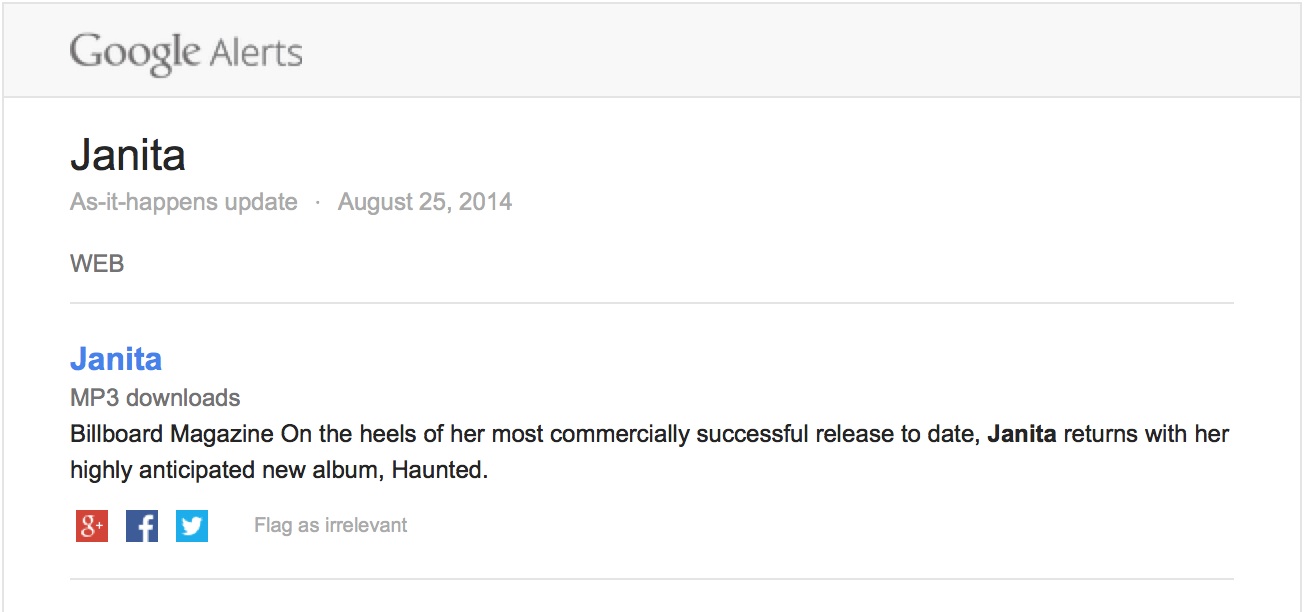
Searchenginewatch reports that Google received 345 million takedown notices during 2014 for search results alone–i.e, not including YouTube, Blogger or other Google properties–and it also doesn’t count the links that Google repackages and sends out through Google Alerts.

If you’ve been following the daily updates in the Google Transparency Report, this 345 million number will come as no surprise, as Google has been clocking about 30 million notices a month for a while now (currently even higher at 36 million for the last 30 days).  But what about the links to pirate content that Google delivers to your inbox daily through Google Alerts along with social media links so you can “share” those links to others through Google+, Facebook and Twitter?

Janita G Alert Email

Why so many DMCA notices?  Google would like you to believe that the high number of DMCA notices is due to aggressive tactics by copyright owners.  The truth…

View original post 826 more words

A Guide to Music Performance Royalties, Part 1

A nice primer for musicians and songwriters from Music Tech Policy.

Music Technology Policy

Let’s start at the beginning.  Broadly speaking, each recording of a song contains two copyrights: the copyright in the “musical work” or what is commonly called the “song” and the copyright in the recording of the song, commonly called the “track” or the “master”.

90% of all mistakes made by anyone in discussions of the online music business (and really the music business in general) starts right there. If you made this mistake, don’t feel self-conscious.  You are not alone, believe me.  Sometimes shockingly not alone.

Ownership and the Inception of Creation.  A song is not a recording and a recording is not a song. Each can be, and usually is, created by different people.  Songs are created by a “songwriter” (usually teams of songwriters coming together to write a single songs or many songs).  Recordings are created by “artists,” usually teams of artists known as a group or…

View original post 479 more words

Involuntarily Distribution Business Subsidies | East Bay Ray

One of the talking points that various tech company commentators, academics and bloggers have used to try to justify companies exploiting an artist’s work without consent (a loophole in safe harbor) is that it would lessen the barrier for tech companies to start up. The idea is that creators should be required to give something up to facilitate this goal. Business start-ups are all well and good, but to require anyone to involuntarily subsidize a business, internet or otherwise, with something they have put time, effort, money, and skill into is extremely problematic.

Would these same people advocate that landlords and utility companies also give up income and the right of consent to help internet companies? That would also make it easier for them to start. But no one has suggested that.

It could be ruinous for creators to be required to be involuntarily involved in start-ups that may or not succeed, tying them to businesses that the artists has no way to vet to see if they even know how to distribute competently or honestly. If they are to survive, artists need to examine their licensees and distributors. I’ve seen many artist’s careers die prematurely from incompetent, greedy or dishonest businesses. (Compulsory licenses that are a last resort to negotiation, rather than the first resort to eliminate negotiation, is an alternative that has for decades shown itself to ensure artist’s sustainability.)

To put it into personal terms, I shouldn’t be forced, or any person for that matter, into being a lab rat for some click bait experiment. And then if the experiment is successful, none of the content creators share in any of the IPO rewards. A bit un-American I’d say and bad policy, it does not allocate rewards according to risk.

History has shown that exploitation of another person’s work with little compensation or without their consent to insure an enterprise’s survival is fraught with ethical and moral issues. If internet companies can not make money selling a product or service on merit and integrity, and treating the people that supply their “product” justly and with respect, something is not right. No matter how well intentioned by well meaning people, economic philosophies that ignore consent or fair compensation, rarely turn out good for society.

– – –
East Bay Ray is the guitarist, co-founder and one of two main songwriters for the band Dead Kennedys. He has been speaking out on issues facing independent artists—on National Public Radio, at Chico State University, and on panels for SXSW, Association of Independent Music Publishers, California Lawyers for the Arts, SF Music Tech conferences, Hastings Law School and Boalt Hall Law School. Ray has also met with members of the U.S. Congress in Washington, D.C. to advocate for artists’ rights.

Artist Rights Leaders: Taylor Swift

0202


After the Charlie Hebdo tragedy, we thought we should start recognizing and praising those who stand up for artist rights.  We will also identify those who oppose artist rights and tell you why we think they are villains.  Not all of these people will be famous and you may not recognize some of their names, but that’s kind of the point.  We also want to emphasize that we’re not comparing anyone to anyone else, we’re just appreciating people for what they do and who they are–on both sides.

When we look back on the last year, there’s probably no one who did more for artist rights than Taylor Swift.  She really did not need to take on these issues, she could easily have sat back and let the money roll in.

And yet she did.  She put her career on the line and challenged the definitive “new boss” digital business–Spotify.  She challenged them in a very straightforward way by simply saying no.  Taylor had a lot to lose, and she went above and beyond to stand up to the “new boss.”

Spotify’s Daniel Ek revealed himself and did his best to play the “Lars card”–he talked down to her and attacked her.  Not as badly as the calculated and well-financed humiliation of Metallica by Napster’s litigation PR team, but a strain of it.  Can you imagine Steve Jobs doing that?  No way.  But that’s OK, we finally got the evidence on who this guy Ek really is and what his company really stands for.  Same old same old.

Taylor also showed that you don’t need YouTube, either–and she turned her team loose to present herself on YouTube the way she wanted, not the way YouTube wanted to force her to be presented.

She challenged The Man 2.0 by simply being who she was and exercising her rights as an artist–the very rights that the “new boss” constantly tries to take away from us.  It’s really simple:  The new boss needs hits, and hits don’t need the new boss.

And Taylor Swift showed us that artists can be strong and classy and successful, all at the same time.  She reminded us that it’s OK to take care of our business the way each of us want.  And she said it in the Wall Street Journal!

Music is art, and art is important and rare. Important, rare things are valuable. Valuable things should be paid for.


Satire is Serious Business

Music Technology Policy

I shall die, but that is all that I shall do for Death…

Though he flick my shoulders with his whip, I will not tell him which way the fox ran.
With his hoof on my breast, I will not tell him where the black boy hides in the swamp.
I shall die, but that is all that I shall do for Death; I am not on his pay-roll.

Conscientious Objector, by Edna St. Vincent Millay

It’s hard not to love the French in general and it’s actually quite impossible for me.  I realized I wasn’t going to win this one the first time I saw a McDonald’s on the Champs-Élysées and felt like I’d just been stabbed.  Or being moved to tears by Edith Piaf singing La Marseillaise (which is how I learned to roll my “r” in French, or try to).  Too late, I thought, they’ve really got…

View original post 359 more words

Nashville’s Musical Middle Class Collapses | Tennessean

This says it all…

Since 2000, the number of full-time songwriters in Nashville has fallen by 80 percent, according to the Nashville Songwriters Association International. Album sales plummeted below 4 million in weekly sales in August, which marked a new low point since the industry began tracking data in 1991. Streaming services are increasing in popularity but have been unable to end the spiral.

READ THE FULL STORY AT THE TENNESSEAN:
http://www.tennessean.com/story/entertainment/music/2015/01/04/nashville-musical-middle-class-collapses-new-dylans/21236245/

Google’s Muscle-Based Defacto Compulsory License: What About We Don’t Like You Don’t They Understand?

Music Technology Policy

The wisest among you learn to read your portents well
You know there’s no need to hurry, it’s all downhill to hell…

Don’t Stand Still, written by The Original Snakeboy, performed by Guy Forsyth on Unrepentant Schizophrenic Americana.

GMR Formed Out of Pandora Lawsuits Against Songwriters Affiliated with ASCAP and BMI

Yes, the portents are in the water–there will eventually be a showdown with Google (and probably Pandora, too) over the songs they routinely infringe in the name of “permissionless innovation.”  Whether it is today or tomorrow, that day is coming, and by the looks of it the first collision will be between Google’s bully boys and songwriters represented by Global Music Rights, the new PRO backed by Irving Azoff.

The why of all of this is pretty simple:  The unelected ASCAP and BMI rate court judges have decided that the government’s consent decree says that the only way…

View original post 1,771 more words

@andreworlowski’s Must Read Post at @theregister Exposes Google’s Astroturf Attack on the Truth

Another must-read exposé from Andrew Orlowski at The Register on Google’s desperate attempt to deflect attention from potentially criminal acts by their senior executives–it’s just plain vanilla astroturfing by another multinational in the worst traditions of British Petroleum, Enron, Halliburton, Reynold’s Tobacco and United Fruit.  Just another day at the white collar no-honor farm.

Blind justice: Google lawsuit silences elected state prosecutor

Mountain View moneybags tip the scales

Google’s success in “assassinating” a democratically-elected legal opponent last week raises troubling questions about corporate power and accountability. The feisty attorney for the USA’s poorest state is now trying to make peace, after being on the receiving end of a highly unusual lawsuit from Google.

Even if you will have no truck with the pigopolists of Hollywood, you should know the facts. A global corporation which is expected to bank $60bn in revenue this year and which is worth $382bn, has silenced an elected prosecutor.

Google’s income is 30 times that of the General Fund in Mississippi; its market valuation is four times the entire state’s GDP. What did Jim Hood do to make himself Google’s enemy? You may be surprised by the answer, which, it turns out, has nothing to do with Hollywood.

Let’s examine what happened to him – and what questions it raises.

Read it on The Register

Wondering Sound: “David Lowery Has Become Most Important Spokesperson for Artists Rights In Digital Era”

‘In the last three years, David Lowery has become perhaps most the important and ardent spokesperson for artist rights in the digital era. Who is he?’

Balanced, funny and in depth profile of fellow Trichordist writer David Lowery.  Must read.

READ THE FULL STORY AT WONDERING SOUND:
http://www.wonderingsound.com/feature/david-lowery-digital-music-cracker-interview/

Label Direct Deals With Digital Broadcasters Are Dire Threat To Artists’ Sound Exchange Royalties

Unlike terrestrial radio,  since 1998 the satellite radio (now mostly SiriusXM), webcasters and other digital broadcasters pay performance royalties to performers and record labels.  “Performers” in this case are both featured artists, and session players (“non featured artists”).  Normally these royalties are paid directly to performers and labels–separately–through the non-profit entity SoundExchange.   SoundExchange pays  45% of these revenues DIRECTLY to featured artists and 5% to union trust funds for non featured artists.

For featured artists this means no recoupment.  No waiting.  No middlemen, no funky accounting and no funny business.  (Other than a big aside with pre-72, which I’ve written about regarding the Turtles landmark law suit.)

And these digital royalties to performers have been growing quite quickly.  They now represent more than 8% of all recorded music revenues. For performers there are few costs to generate these revenues so the artist’s net profit on SoundExchange payments is probably higher than most other income streams.  SoundExchange royalties truly have been a positive story in a decade of otherwise grim news for performers.

Unfortunately, the law also allows record labels to cut “direct deals”  with digital services outside of SoundExchange.   And in the last couple months that is what we’ve seen. We found out that The Orchard (now part of Sony) cut a direct deal with Sirius.  In November, the large independent label licensing consortium Merlin cut a deal with Pandora.  We’re still looking for the artist signed to any label distributed by The Orchard or a Merlin label that got a heads up about these direct deals, much less asked if they wanted to opt out.  In the case of Merlin labels, somebody–presumably Merlin–negotiated lower royalties  in exchange for Pandora “steering” listeners to Merlin artists.  Never mind that this smells like payola, here’s the real problem:

Labels doing direct deals with digital services for SoundExchange royalties could require the service to pay 100% of the revenue to the label and not pay the performer’s share through SoundExchange–that is, require the digital service to pay the artist’s share directly to the label to be applied against any unrecouped balances.  It’s unclear to me what would happen to the union trust fund payments at least for labels that are not “signatories” to the AFM and SAG-AFTRA collective bargaining agreements.  Even if the label is a signatory, it’s unclear to me which would dictate the rules, the Copyright Act or the collective bargaining agreements.

If the labels take the money, artists would probably get paid at their label royalty rates and not 45% of gross revenue.

As far as I can tell, the labels are not obligated under the Copyright Act to pay artists their share of the SoundExchange royalties without recouping.  It’s even less clear whether labels could take away their contributions to the AFM/SAG-AFTRA Intellectual Property Rights Distribution Fund, but it appears that labels are under no obligation to make those payments, either.

None.

Nada.

Zilch.

They may choose to let SoundExchange keep paying artists directly, but when the dust settles they may also choose not to.  And if the labels choose to take the artist’s share directly, the labels can apply it to any unrecouped royalty accounts regardless of whether the accounts pre-date the existence of the sound recording performance royalty.  The Orchard deal with Sirius and the Merlin deal pay the performers’ share through SoundExchange, but as far as I can tell there’s nothing stopping the labels from changing their minds later on.

So far the labels that have publicly disclosed making direct deals say that they will continue to pay the performers their share through SoundExchange.   So that’s good right?   Sort of.   SoundExchange can deduct its costs from royalties it collects (and I have no beef with SoundExchange on their costs–very low.)  The problem with direct deals is that the label’s share of royalties is outside of SoundExchange, but the performer’s share is not.  This forces the performers to bear the administrative cost when labels do not.

Another problem with direct deals is that SoundExchange are unlikely to be able to audit the digital broadcasters on behalf of performers.   And since the performers are not party to the direct deal they wouldn’t have any rights to audit either. Even if performers could audit that’s an enormous burden to transfer to individual performers.

So performers would have to rely on the record labels to do the auditing, and frankly this scares me.  The very fact that labels are cutting payola-like direct deals with digital broadcasters is a sign that they are cozying up.

SoundExchange also has reciprocal agreements with their counterparts in other countries. It’s not clear how performers will then collect their foreign royalties if their labels cut direct deals.  Would they have to collect directly?  Would SoundExchange still be able to collect. There is a good chance that performers might lose some foreign royalties as a result.

Clearly this is not gonna end well for performers.  But frankly I don’t think it’s gonna end well for labels either. Why?  these direct deals are already being used in attempts to lower ALL digital royalties at royalty board hearings.  That hurts the labels as well.

After the streaming math fiasco I’m not optimistic labels are gonna figure out that these deals are  bad for them until it’s too late.  To put it mildly labels do not appear to be engaging in much long-term thinking these days.  And the digital broadcasters have been  playing the labels like a cheap violin.

As usual it looks like it is up to the performers to do the critical thinking and to try set this straight.  We need to fight this. Now.

Perhaps we need to amend the law to prevent labels from direct licensing the performers share of digital broadcast royalties. If labels want to direct license and take a lower rate for their share let them.  But don’t let them get their hands on our royalties.

 Respect Act II? anyone?

 To summarize:

Benefits to performers from SoundExchange:

  • Performers paid directly
  • Not Recoupable
  • Independent performers get same deal as major label performers
  • SoundExchange audits on behalf of all performers
  • Payola-like deals not allowed
  • SoundExchange collects foreign royalties for performers
  • Collective bargaining increases leverage with broadcasters

Dangers to Performers under direct deal.

  • Labels under no obligation to pass through the performers digital royalties.
  • Labels could apply royalties to un-recouped balances
  • Independent performers could get lower rates than major label performers
  • Performers lose ability to audit digital broadcasters
  • Payola type deals shut out independent performers
  • Potential loss of foreign revenue
  • Performers are burdened with entire administrative overhead of compulsory license system.
  • Fragmented bargaining decreases leverage with broadcasters