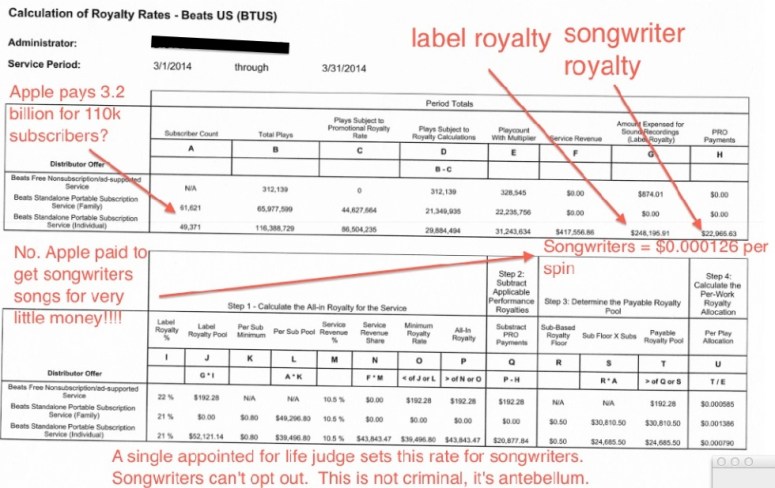
Q. When does $0.000126 = $3.2 Billion? A. When Apple Buys Beats Music.

Someone sent us this interesting document.   This is real.

Never mind that Beats only has 110k subscribers.   Is Apple Buying Beats simply because of the  ridiculously low royalty that songwriters are paid?

Screen Shot 2014-05-10 at 7.07.00 PM


++++++++++++++++++++++++UPDATE++++++++++++++++++++++++++++++++++++++++++

People may be getting the impression that we are down on the Beats service. We actually like Beats from an performers perspective for several reasons. here are two.

1)  As a pay platform-not advertising supported-there is higher revenue per stream.  We are paid on a percentage of revenue.  We make more money as a consequence.

2) The major record labels appear to own less of Beats (then they do of Spotify) and perhaps another explanation for the higher royalty rate at Beats is less was traded away for stock. Perhaps we will get more information about this if there is a Hart-Scott-Rodino Act hearing on the sale given Apple’s dominant position in hardware and music services.

What we don’t like is that as Songwriters we are paid so little.

DMCA “Take Down and Stay Down” Is The Logical Solution to a Flawed Loophole [VIDEO]

Earlier this week Digital Music News reported that Google is getting over 1 million DMCA take down requests per DAY! If this isn’t the single greatest illustration of the failure of the DMCA to protect artists and creators we don’t know what is.

No matter how many notices can be sent, or the standardization and efficiency in doing so, the volume of infringement far exceeds any rational ability to combat the flood of infringement.

The only logical solution is to fix the DMCA whereby when a valid notice is sent and complied with, that the infringing content can not be re-uploaded again, and again and again as we detailed in our post “The DMCA Is Broken.

These videos below illustrate the issue, both present testimony from the Congressional hearing on March 13, 2014.

https://vimeo.com/94514834


We’d also like to thank Congresswoman Judy Chu for acknowledging and entering into congressional record our post by Chris Castle on how to address these issues with the DMCA. Video below.

You can read that post here:

Safe Harbor Not Loophole: Five Things We Could Do Right Now to Make the DMCA Notice and Takedown Work Better


David Pakman is Wrong on The Price Of Music (and streaming subscriptions)

Is there anyone left in the record business with common sense and a calculator?

David Pakman wrote an interesting piece asserting the problem with streaming services getting up to scale is a matter of pricing. He puts forth that $10 a month, or $120 per year is too much. He claims that the ability of these services to scale should be more in line with a monthly fee of $3-$4, or $36 – $48 a year to appeal to a broader base of the “average” music consumer. We think there are some serious flaws with this line of thinking not the least of which is that we can’t get the math to scale at $10 a month per user!

The first and most important error is that an “average” music consumer does not exist. Sure, you can average the total spending by the estimated number of consumers to find an average per consumer but no “average” consumer actually exists. Some spend many times the average, some spend far below it.

Pakman makes the assumption that music subscription services are over priced citing that the “average” consumer is only willing to spend $64 a year on music.  This completely ignores that the majority of highly active music consumers that have historically purchased much more than the average.

Those working in music distribution have always know that the most active consumers, contribute the greatest percentage of revenue to the total. In traditional terms this would be an expression of the classic 80/20 model where the top 20% of consumers represent 80% of the revenue. Conversely 80% of consumers only account for 20% of the revenue overall. This is of course an over simplification but it illustrates the point being made.

Here’s some simple math. Apple’s iTunes boasted 200 million users in 2011. Using Pakman’s own estimates at $64 per “average” consumer, the store should have generated a cool $12.8 billion in revenue. As we all know that’s not true, it quickly illustrates the problem with Parkman’s methodology of the “average music consumer.” Of course Itunes is not the only music retail outlet, and surely not all of those Itunes users were strictly music consumers. Again this is the problem with attempting to define an “average” music consumer to broader market economics.

Pakman also doesn’t fully account for the fact that while music prices dropped nearly in half from $19.98 compact discs to $9.99 downloads the volume of sales continued to decline. This is a decline that began with the introduction of Napster and has spread through the expansion of ubiquitous illegal file sharing networks such as the now defunct Kazaa, Grokster and Limewire.

The single greatest factor effecting both the price of music and the volume of sales, was and remains the illegally free supply of the exact same product available to consumers without risk, investment or consequence by those distributing it for profit without paying for the cost of goods.

But Pakman may have stumbled upon some other points of interest in his observation. First, is that the music business needs to learn how to window releases and build a transactional streaming model as the film business employs. We detailed this in our post “Spotify is not Netflix, but maybe it should be.” Second, there should tiered access on streaming services. A basic $4 a month subscription gets you the hits, say the top 200 current singles and the top 200 catalog albums. For $9 a month you get the hits plus all music more than a year old. For $20 a month you get everything available.

The narrow band thinking of music industry business people is stunning when we don’t need to look any farther than the film and tv industry to see a robust variety of different streaming products for different consumers needs and demands. The film and tv industry successfully window releases and have different pricing tiers based on access and there’s really no reason why these models would not, and can not translate to the record industry.


Merlin on YouTube music payouts: “Their figures are by far the worst” | Music Ally

No surprise to us…

“The ironic thing is that the service that pays the least is the service that’s the most well funded and run by the biggest company in the world: their figures are by far the worst, whether you measure them on a per-stream basis or a per-user basis. I tend to get myself in trouble when I talk about that company…”

Hence his desire not to name them directly, but quote instead from an interview with Billy Bragg conducted by Music Ally earlier this year. “If we’re pissed off at Spotify, we should be marching to YouTube central with flaming pitchforks,” said Bragg – Caldas read this quote out before delivering his own pointed follow-up. “I can’t say Billy’s right, but I can say that he’s not wrong,” said Caldas.

READ THE FULL STORY AT MUSIC ALLY:
http://musically.com/2014/04/30/merlin-youtube-music-payouts-charles-caldas/

RELATED:

What YouTube Really Pays… Makes Spotify Look Good!

Artist Revenue Streams : Streaming Marketshare By Volume and Revenue (includes YouTube and Spotify)

Streaming Price Index : Now with YouTube pay rates!


A Response to Steve Albini About The Internet and Musicians by UNSOUND Film Director

By Count Eldridge

My rebuttal to Steve Albini’s bullet point post. Steve Albini’s poorly reasoned piece was posted, so I feel obligated to try to correct some of the glaring misinformation. I’ve spent the past 2 years working on a documentary called Unsound that addresses the issues that Steve brings up in his post.

You can read the original story here:
http://www.stereogum.com/1678835/steve-albini-thinks-the-internet-solved-the-problem-with-music/news/

On free global music sharing: “The single best thing that has happened in my lifetime in music, after punk rock, is being able to share music, globally for free. That’s such an incredible development.”

It is only an incredible development if you give CONSENT to share that music. Steve seems to have missed the most important aspect of ‘sharing’. Its not sharing without consent.

On consumer choice: “Record labels, which used to have complete control, are essentially irrelevant. The process of a band exposing itself to the world is extremely democratic and there are no barriers. Music is no longer a commodity, it’s an environment, or atmospheric element. Consumers have much more choice and you see people indulging in the specificity of their tastes dramatically more. They only bother with music they like.”

This is one of the most obvious positive aspects of the internet revolution, so Steve is not totally wrong on this piece- only about 95% wrong. Again, Steve seems to have missed the most important point. Music IS a commodity now. That is exactly what Spotify and Youtube have done. And in the process of enriching themselves, they devalued what we spent out entire lives creating.

“You can literally have a worldwide audience for your music… with no corporate participation, which is tremendous.”

No corporate participation? Is he serious? Google, Apple, Facebook, Comcast, and Spotify are the biggest, most powerful corporations we have ever seen. Apple alone is bigger than Exxon Mobile. That doesn’t necessarily mean they are bad. In fact Apple are really the good guys in all of this. But I can assure you that corporate participation is happening at all levels, and many of these corporations are exploiting artists on a level that makes those big bad labels Albini likes to complain about look like angels.

On the economics of streaming services: “I think they are extremely convenient for people who aren’t genuine music fans, who don’t want to do any legwork in  finding bands, [but] I think there is incorrect calculus being done by the people who are upset about them. I actually think the compensation is not as preposterous as anyone else. It’s like complaining that cars are going faster than horses.”

No Steve, it is your math that is incorrect about streaming services. An independent artist that could eek out a living selling 12,000 copies of their music simply goes bankrupt if those 12,000 people start streaming that music instead of buying it. The math could not be more simple. It seems Steve has fallen for the myth that Spotify has perpetuated. They love to talk about “scale”. If only their company could “scale”, then everyone would win! Wrong! Only Spotify wins. Steve, tell me why it is that you want so badly to support the IPOs of major corporations at your own expense? Why do you want to subsidize their businesses of the backs of creators? Why do you want to enrich these middlemen?

And his point about convenience? What could be more convenient than clicking one button on iTunes? Or even better, streaming my music on MY website instead of Spotify and Youtube, which only enriches those corporations at the expense of artists.  Steve is supposed to be railing against the big corporations. Clearly he hasn’t thought this through.

On the publishing industry: “Publishing was a racket. It was not a legitimate part of the music business. It never operated for the benefit of songwriters. Of all of the things that have collapsed in the music paradigm, the one I am most pleased to see collapse is the publishing racket.”

Dont like publishing deals, then simply don’t sign one. Deal with your own publishing. Nobody forces any artist to sign a deal. But artists don’t have a choice when it comes to Youtube and pirate sites. And realistically, artists don’t have much of a choice but to be on Facebook and Spotify either. But this issue of publishing is irrelevant to the conversation, as it has nothing to do with the internet revolution or anything ‘new’.

On the primacy of live music: “I think that’s a totally much more direct and genuine way for an audience to pay for a band, and a much more efficient means of compensation.”

Efficient?? Is he kidding? Driving across the country, or flying half way around the world to perform your music for fans is NOT efficient. Selling them a file which they can play any time is the ultimate in efficiency. And streaming (if it paid artists properly) would be just as efficient. But live performance is the absolute worst way to compensate an artist, and doesn’t address compensation for songwriters, producers, and engineers.  Live performance is the most expensive, least efficient way to deliver music to someone. If you are lucky enough to even be able to get gigs in this competitive market, they probably won’t be profitable enough for you to continue doing them even if they are well attended.

Don’t get me wrong. There are many positives here that should be pointed out. In fact many, if not most, of the problems that plagued the music business have improved…except for the whole making a living part. Sadly, that part has actually gotten worse.  An artist’s ability to perform live for fans has actually become more difficult. First of all, most bands lose money touring. Everyone in the music business should know this. This is why record labels used to give tour support. Touring has always been a loss leader for record sales. Eventually the lucky few who gain large fan bases over many years do actually make money touring. These are the 1%. All of the rest of us just hope to break even and sell a few recordings.

Secondly, the amount of bands trying to tour to make a living is exponentially increasing, while the number of venues and days in the year stay the same. It is physically impossible for all of the artists who actually have significant fan bases to tour. There are simply not enough dates and venues. Furthermore, even if there were more venues, people simply won’t see live shows every day, but they will listen to recorded music every day. In fact, people are consuming more music than ever. This means we MUST solve the problem of monetizing recorded music. Sean Parker and the Spotify folks love to spread this misinformation about how artists make money from touring. But we all know most artists loose money touring. If touring is so profitable and efficient, perhaps Spotify should change their business model and leave their families and friends for months at a time and go on tour hand delivering music to people one city at a time.

Instead of perpetuating the myth that artists make money touring, those in the music industry who know better should be focussing hard to make the delivery and monetization of recorded music better for artists by making it more efficient. This means less middlemen (or no middlemen) taking a smaller cut, rather than allowing a few giant corporations and rogue pirates to profit enormously from our work.

On cutting out the middleman: “On balance, the things that have happened because of the internet have been tremendously good for bands and audiences, but really bad for businesses that are not part of that network, the people who are siphoning money out. I don’t give a fuck about those people.”

There are now just as many middle men than before, and they are indeed siphoning out most of the money, leaving fractions of a penny for artists. The difference is that today’s middle men are ripping you off far worse than the middle men from before the internet, yet they invest nothing back in to the artists who make their platforms even possible. I know what Steve is probably thinking right now. “What about those big bad labels! They took a big percentage!” Don’t try to introduce labels into this issue. This is a distribution problem. Love them or hate them, labels invest in artists and take a huge risk. What does Youtube or Spotify invest annually in artists?

Sadly, it seems Steve Albini is so far out of touch that he doesn’t even realize that he is not railing against ‘the man’. Instead, he is playing right into their hands.

I really need to finish my film Unsound before more artists and music fans get fed more of this kind of misinformation.

http://unsoundthemovie.com/

-Count

RELATED:

The Problem With Steve Albini | AdLand

Finally, a Google Whistleblower, Part 1

Music Technology Policy

Americans are freedom loving people, and nothing says freedom like getting away with it.

From A Long Long Time by Guy Forsyth

The thing about public relations is that it works.  When famous personalities or executives have very carefully cultivated public images, large numbers of people come to be emotionally invested in them, a kind of mass hysteria.  Rarely does anyone criticize them in any sustained way.  Such a critic would have to be willing to withstand a lot of abuse and most people just aren’t cut out for that.

For a prosecutor to be able to even open an investigation into such people takes a lot of juice.  And that prosecutor had better be able to make their case successfully because such people will fight to the bitter end.  As they should.  But in some cases, their fight will not only be in the courtroom, not only in the…

View original post 1,634 more words

Has Pandora Stopped Paying Civil Rights Icons “The Freedom Singers?” Has Sirius Ever Paid Them?


The Freedom Singers were a landmark Civil Rights church singing group from Albany, Georgia.  They toured the country 1962-63  performing at hundreds of civil rights rallies culminating in the march on Washington. They may be best known for their recording of “This Little Light Of Mine.” The surviving members still perform. I saw them just last year.   Unbelievably powerful performances.

Here you can play it on Pandora.

Just don’t expect them to be compensated by Pandora or Sirius.  In most cases performers are paid a small royalty through SoundExchange when songs are webcast, streamed or digitally transmitted.  But Pandora and Sirius have decided not to pay these heroes of the Civil Rights movement performances of their recordings on these services.

Why? The Freedom Singers had the misfortune of recording this performance before 1972.  Huh? Let me explain.

Recently Pandora CEO admitted that Pandora have stopped paying performers royalties on their pre-1972 recordings.  (BTW this is a guy who received $29,000,000 in executive compensation last year.)

Sirius apparently never paid artists on pre-1972 recordings. So it’s unlikely they have ever paid these performers either.  How is this fair?  How does this happen in this country in this day and age? How do these companies get away with this?

Well both of these multi-billion dollar public listed companies have taken a novel legal approach to pre-1972 recordings.  Because pre-1972 recordings are covered by a patchwork of state rather than federal copyright law (or at least that’s Pandora’s and Sirius’s interpretation) these two companies claim they don’t have to pay performers royalties on these recordings.  Understand–it’s not that these recordings are not protected at all, it’s that federal copyright protection for sound recordings started on February 15, 1972 and the performance royalty is in the federal Copyright Act.  There is nothing in the Copyright Act that excludes pre-72 recordings.

Or in other words Pandora and Sirius treat some recordings less equally than others.


No RESPECT: Pandora Stops Paying Aretha Franklin And Other Artists Royalties While CEO Rakes in 29 Million Dollars

Screen Shot 2014-04-30 at 5.48.17 PM


Last year Pandora paid it’s CEO over $29 Million Dollars.  To be exact $29,167,388.

Aretha Franklin got $0 from pandora for her 1967 recording of RESPECT.

At least that’s what we must assume from Pandora CEO’s admission they are no longer paying royalties on pre 1972 recordings.

This confirms what was reported in the Wall Street Journal last year!  So the woman who sang RESPECT get’s no respect from Pandora or royalties from this classic 1967 recording.   Instead of finding a sustainable business model to create  lasting value for shareholders,  Pandora has resorted to legal gimmicks to try to temporarily prop up it’s bottom line.

Meanwhile Pandora executives are selling stock at fast clip.

The latest legal gimmick  from Pandora relies on the fact that sound recordings made before 1972 are covered by a patchwork of state law and not federal law.   Pandora’s highly questionable interpretation is that it doesn’t have to pay royalties to performers like Aretha Franklin on these songs.

It’s estimated that Pandora saves %5 with this gimmick.  5% from older artists who sometime are no longer physically able to to tour and perform.  Classy.

Pandora is already massively unpopular with songwriters and performers after last years failed legislative attempt to lower royalties. It then  sued all three songwriters collectives.   Now it is on a collision course with the rest of the recorded music business and artists.    Pandora has no friends left in the music business.  How is this a good long term strategy for it’s shareholders?  What happens when this company tries to expand to other markets that don’t have the compulsory licenses and rate courts that Pandora so skillfully abuses?

It’s bad enought that terrestrial radio already doesn’t pay performers royalties. Now Pandora has stopped?  It should also be noted that Sirius/XM is also not paying Royalties on pre 1972 recordings. How did they both separately come up with that idea? hmmm. Surely there is no collusion here?  And it’s Songwriters that are required to operate under DOJ anti-trust supervision?  WTF?

When will the sickening greed from these multi-billion dollar silicon valley firms finally end?  Who will finally stop these modern day robber barons? Pandora demonstrates once again it is the most artist unfriendly music company out there. Act accordingly folks.  Plenty of other options out there.

( You can do something about the terrestrial royalty problem.  You can Tell Congress #IRespectMusic.  This is a petition to institute a royalty for performers on terrestrial radio.)

How Long Can Reed Hastings Hide Behind Kevin Spacey’s Sarong?

Netflix is learning the math changes when you pay to produce your goods. How many bands is Spotify signing with investment capital?

Music Technology Policy

Netflix is rapidly finding that exclusive original programming is the solution to some of its subscriber problems.  We are kind of enjoying watching these “cutting edge” Silicon Valley “innovators” come to conclusions that are circa 1950 for our business, but glad that they are figuring these things out gradually.  Yes, Mr. Hastings, that’s called a “network.”

But in the Golden Age of Internet, that also means those who pay for the programming also support those who sell advertising to ad publishers who distribute illegal copies of that programming.  When both those who produce the programming and those who sell advertising are Silicon Valley tech companies, that’s an interesting problem of economic interdependence.

Keven Spacey is the star of one of Mr. Hastings most successful programs, House of Cards.  I would bet that Mr. Spacey has a nice piece of the back end on that show, which makes him Mr…

View original post 491 more words

Pandora CEO says “Pandora is Radio” so Pandora shouldn’t pay artists at all–and CEO Pay is Up 3,882%

The update to this post is stunning: Straight from the highly objective and reliable Morningstar investor service, Pandora CEO Brian P. McAndrews makes over $29 million (with cash salary of “only” $500,000) and Pandora executive compensation has grown nearly 400% in one year alone. And they are still screwing songwriters and want to do it to artists, too!

Music Technology Policy

Sometimes it pays to read the transcripts from earnings calls, especially for company’s like Pandora, our latest set of fake “friends” in the tech community.  Always striving to keep their executive salaries high, Pandora’s CEO let their true strategy slip out in yesterday’s earnings call (see the full transcript on Seeking Alpha):

For the landscape around content licensing remains a complex topic. We reached the important milestone related to content cost during Q1, with a decision in the ASCAP trial. In her ruling, Judge Cote, confirmed our longstanding belief that “Pandora is Radio”. An important finding was wide ranging legal implications for our company.

Additionally the court set a rate of 1.85% of Pandora’s revenue for the five years ending December 31, 2015, which was the upper end of our proposed range of rates. And this decision followed the court’s issuance of summary judgment in September 2013…

View original post 691 more words