60 Minutes Reports on Kim Dotcom…

By selling advertisements and premium subscriptions, Megaupload brought in an estimated $175 million. It became one of the most frequented sites on the Internet. How did it get so popular and profitable? According to federal authorities, by also allowing users to illegally share the hottest new movies, or hit songs, or TV programs, including some CBS shows.

Shawn Henry: Megaupload knowingly created and facilitated the distribution of stolen property.

Shawn Henry is former executive assistant director of the FBI. He was responsible for the Megaupload investigation.

Shawn Henry: No different than if somebody has a warehouse where stolen property is being dropped off. If you created the environment that facilitated it, and you encouraged it, and you incentivized people by paying them to drop off stolen property, I think that you are complicit.

In its indictment, the Justice Department calls Megaupload a “Mega Conspiracy”… a “worldwide criminal organization whose members engaged in criminal copyright infringement and money laundering on a massive scale…”

WATCH THE EPISODE HERE AT CBS NEWS:
http://www.cbsnews.com/news/kim-dotcom-60-minutes/

RELATED:

The case against Kim Dotcom, finally revealed

Kim Dotcom Parody Video Appears on YouTube

My Songs = Your Instagram Photos. A New Trichordist Statement of Purpose.

For the past 20 months or so the Trichordist has been almost exclusively focused on artists rights in the digital age.  In particular we have zeroed in on two main issues and suggested solutions.

#1 Government Mandated  Digital Uses and Pricing of Songs and Recordings Should be Ended

The Government and  institutional mechanisms that  limit artists’ choice over how to monetize their recordings and involuntarily collectivize their songs and recordings for the benefit of wealthy technology firms should be ended.

The compulsory licenses and antiquated DOJ consent decrees have become massive subsidies from songwriters (especially) and performers to webcasters and on demand streaming services.  Spotify and Pandora have market caps well in excess of $4 billion!  (EMI was recently sold for $2.1 billion.)  Apple and Google  recently started webcasting services and are the largest tech companies in the world.  Why do these companies need help from the US Government?

While many songwriters find it personally insulting that they are often paid micropennies per digital spin the truth is that no one  can really tell you the fair rate per spin for any particular song. Songwriters and artists can’t.  Spotify can’t. Pandora can’t.  Neither can BMG,  Sony nor the US Congress.  This is because  there is not really a free market in songs and recordings in the US to set those fair prices.  This is easily solved: Create one.

That is why we are simply asking our government to dismantle the regulations that prevent a free market in songs and recordings from developing.  We are asking our government to dismantle the biggest impediment to a free market:  The rate courts and consent decrees that keep a free market from developing for songwriters.   At a minimum, our government could at least allow an “opt out” for artists and songwriters so that compulsory rates become a “floor” rather than a “ceiling”.

It should be noted that contrary to what some in the  technology press have been saying, we are not  asking for special treatment,  handouts or subsidies for artists and songwriters.   We aren’t asking for special legislation to protect prices for our industry. We are not asking to be protected from the disruptions caused by technological innovations.  To the contrary, it’s the webcasters, broadcaster and Silicon Valley giants that have lobbied Congress for royalty fixing legislation to prevent “disruption” of their business models.

#2 Ad Supported Piracy.  Payment Processor Supported Piracy.

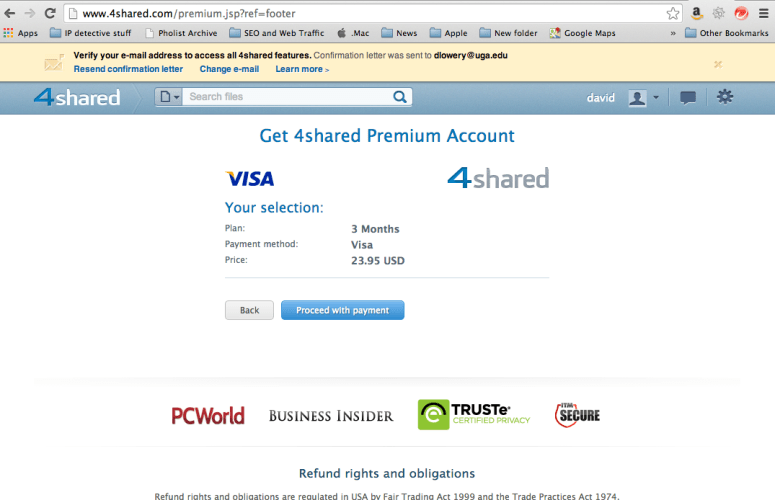
The second thing we have focused on is ad  and payment processor  supported piracy.   Virtually every major music piracy website seems to sell their inventory for some kind of advertising . Some sites proudly display advertising  from Fortune 500 companies.   Others sites charge premium subscriptions for faster downloads with the complicity of companies like Paypal, Mastercard, Amex and Visa.
Screen Shot 2014-01-01 at 12.43.33 PM

This is ridiculous–massive banks and credit card companies (that got a huge taxpayer bailout which we’ve never asked for or gotten) profit from massive theft.  It is very easy to find out which sites are likely involved high levels of infringement–just ask creators if they ever licensed the site.  Credit card companies do all kinds of checking on creditworthiness, why don’t they check on dishonesty?

If asking doesn’t “scale,” Google helpfully provides The Google Transparency Report on number of DMCA takedown notices (copyright infringement notices) associated with each site–notices that Google has acknowledged are over 90% accurate.  An advertiser or payment processor need only look at this link.

I am not a lawyer but I understand  that mass copyright infringement is a predicate for federal prosecutors to bring a case under the Racketeer Influenced and Corrupt Organizations Act or “RICO”–which is the law that the government used to take down white collar criminals like Michael Milken (a Gordon Gekko figure who may have done a lot of things but who wasn’t engaged in global advertising fraud).  I believe that at the very least the federal government should be investigating the online advertising industry and the payment processors  to see if they are knowingly involved in any criminal conspiracies associated with these sites. (Processing payments? Paying ad revenue to pirates? How could they not be? Don’t the accountants and bankers who “move” money for the mob usually go to jail? Orange Is The New Black?)

But this is unlikely to happen.  The Federal Government, in particular the Department of Justice and the Federal Trade Commission seem unwilling to give even slaps on the wrists to the companies involved in these practices. In particular frequent White House dinner guest Eric Schmidt and his company Google.

While this may seem like a wild accusation to some,  it seems to be supported by objective facts.  If the federal government will  fine Google a measly $25,000 dollars in the NSA-like Google Maps “WiSpy” data vacuuming scandal why would they bother with a silly thing like RICO criminal acts? $25,000 dollars? Think about it.   This is a $370 billion company. They make $25,000 in seconds.

Well that’s just one isolated case right? Google doesn’t get special treatment.  Right.

Sadly it looks like they do.

Ever heard of the Google drugs case?   This was a CRIMINAL international drug trafficking case brought against Google by the Rhode Island US Attorney’s office.   Google paid a $500,000,000 dollar fine in that case to avoid CRIMINAL prosecution.

Well that sounds better. They didn’t get away with that!

Really? Since when do people pay fines instead of going to jail for being key part of promoting organized international drug operations?  Since when does the  DOJ purportedly offer an apology for prosecution, as the Wall Street Journal reports? 

This Is What Corruption Looks Like

So after 20 months of arguing for artists rights in the digital age I’ve come to the conclusion that this goes way beyond a few thousands artists losing 2/3 their revenue to shady websites with the complicity of multi billion dollar  corporations.  This is much worse.

We have monopolistic companies doing bad things on a scale we haven’t seen since the days of the Robber Barons. And getting away with it.   The most positive spin I can put on it? We have the same old “Pay to Play Democracy” except this time instead of picking our pockets they are only picking our data.  We should call it what it is:

Corruption.

We need a new Teddy Roosevelt to “Bust these Internet Trusts”.

Our love affair with the internet has left us blinded to the enormous power that these companies hold over our government and our daily lives.  It has blinded us to the massive invasions of privacy and and attempts to collectivize our private data, personal information and  even our photos with no protection from our federal government.

Why are we letting these giant monopolies develop?  Has anyone considered that a single search engine controls nearly 70% of all web searches in the US.   Recently Google “demoted” both JC Penny and  Rap Genius in search results for using “black hat”  search engine optimization techniques. These are not laws that were broken. This is a private company’s arbitrary rules (they “black hat” their own properties like YouTube)  What’s to stop them “demoting” one political candidate and “promoting” another one?  How would you ever know if they have already done it?

What’s to stop them from sharing their vast store of data on us with government spy agencies or the political candidates they favor.  How do we know they haven’t already done this, too?

My Songs = Your Instagram Photos.

Remember the Instagram Terms of Service changes?   They get to use your photos for advertising? Without your permission?  The Internets went crazy.   That’s exactly the same thing these Silicon Valley companies (that are essentially just big advertising agencies) have been doing with my songs and lyrics for years.   They slather advertising on sites that don’t ask my permission to use my songs or lyrics.  I don’t get any of the revenue and no one will stop them because they are too politically powerful.

If they can do this with my songs they WILL do it with your Instagram photos. Your FaceBook profile, your Google+photos.  (Heard of “shared endorsements”?)  It’s just a matter of time!

Oh, wait–they’ve already done it.  Facebook sponsored stories. And Google plus shared endorsements.  These “services” probably weren’t part of the deal when you first signed up for these “convenient” and “free” services.  Right?  Facebook and Google just changed their terms of service. And then helped themselves to your identity and photos. “Permissionless Innovation” is what the suits in Silicon Valley call it (as if that’s a good thing).

Here’s The Washington Post succinctly on the subject:

“But critics say tactics that further exploit the data people leave online amount to a bait-and-switch. People signed up for Google’s services because they were free and convenient. They probably never thought their words and identities would be put in front of strangers to sell a product.”

New Statement Of Purpose.

Well I’ve oversold this a little. There isn’t really a new statement of purpose.  Just simply we are expanding the blog to cover more than just artists rights.

Why?

Your average Internet user is being exploited in exactly same way that the artists are.  You are being exploited by exactly the same companies.  Ad supported piracy?   What’s the difference from “shared endorsements”? They take something that belongs to you without your permission.  They then sell advertising against it and keep all the money without letting  you set the price–much less paying you a share of the revenue.

It’s time that the average Internet user understands that the web is something we collectively created.  And when it doesn’t work the way we want it to?  We can change it. We can make it better.  We can upgrade it.  The web doesn’t belong to these multibillion dollar internet behemoths. It belongs to all of us.  And these companies need to play by the same set of rules that the rest of us play by.

Sympathy for RapGenius

Yes.  You read that correctly.

As I stated before I never wanted to see RapGenius.com go away or get shut down.  I just wanted to see them get licensed.  And I was pleased to see that they decided to sit down with The National Music Publishers Association and work out licenses.

But then I see this story.

http://valleywag.gawker.com/is-rap-genius-fucked-1489917137

RapGenius engaged in some “black hat” spammy SEO (search engine optimization) and they got caught.   And now Google has demoted them. Rather than ranking number #1-5 on lyric searches as they did in many searches I conducted, they are now on page 7!

Not search result #7!  Page 7!  Has anyone ever scrolled 7 pages into search results?

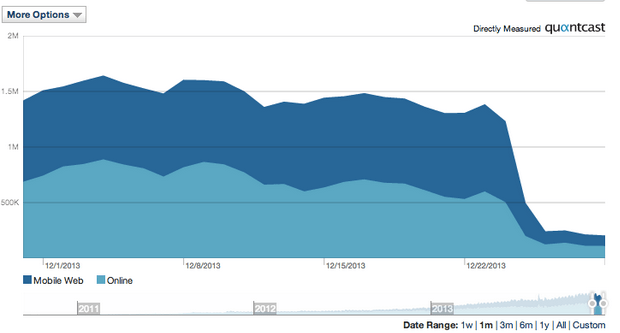
Industry pundits claim this is an effective “death sentence” for the site. And I bet they are right.  According to Vice and Quantcast they’ve lost 80% of their web traffic in days!!

Screen Shot 2014-01-02 at 12.26.07 AM

So think about it.

RapGenius violated the Search Engine Optimization rules arbitrarily set by a private company Google.  A set of rules Google itself  appears to routinely violate to push it’s own property YouTube up in search results.

RapGenius didn’t violate any real law created by an elected legislative body when they did this.  But now they are considered “toast”

So do we really want a monopolistic über politically connected company like Google to be this powerful?  To have life or death power over any and all websites? No trial, no jury, no appeals process, no nothing.

Face it people the web is ruled by an autocratic, unelected and unaccountable search engine.

What happens to freedom of expression when you have a search engine that is this powerful?

Fuck that, what happens to democracy?  If a candidate proposes something that Google doesn’t like will that candidate’s website suddenly sink to page 7?  (And the first 6 pages are filled with links to negative stories about the candidate?)

Surely the internet free speech advocates have something to say about this?

<crickets>

Isn’t it funny that Google won’t noticably demote a site demonstrably and unequivocally involved in a RICO predicate like industrial scale file infringement. But you try to game their SEO and you get demoted to page 7.   Don’t be evil. Yeah right.

On the bright side Google just admitted that they can do more than they say they can about file infringing websites. They can demote them. Same with human trafficking and other exploitative businesses. And see the Internet didn’t break.

No, Streaming is not more profitable than Transactional Sales… Not Today, Maybe Not Ever…

There’s a recent report from the Wall Street Journal that is being grossly misinterpreted from this line,

“Data reviewed by The Wall Street Journal showed that one major record company makes more per year, on average, from paying customers of streaming services like Spotify or Rdio than it does from the average customer who buys downloads, CDs or both.”

This does NOT mean that streaming will be more profitable than transaction sales anytime soon. It seems to suggest that streaming could possibly, possibly become more profitable than transactional sales, but that is seemingly unlikely due to simple math which will review below.

What that sentence says is that a premium paid subscriber spends approximately $120 per year on music purchasing, whereas an average music consumer spends less in total over the course of a year. This does not take into account the non-average music consumer who spends much more than $120 a year, nor does it take into account that the number of “average music consumers” is hundreds if not thousands of times larger than the number of premium paid subscribers.

What would be truly interesting and important to the conversation is to see how much total revenue is being generated by streaming in the aggregate against transactional sales. As we’ve reported before, using a simple spreadsheet, streaming services would need at least 90 million subscribers to be competitive as a viable option to replace transactional sales.

By most estimates there are few people who think Spotify can scale up to and maintain 30 Million paid subscribers in the US. So this begs the question…

If streaming is the future how does $2.5b in revenue from a massively successful Spotify replace the loss of $8.3b in annual earnings?

Complicating discussions around the streaming revenue issues are also the risks of cannibalization. As the early year end numbers come in for 2013 we’re already seeing transactional download numbers starting to flatten and decline.

As Music Downloads Decline, Expect More Anti-Spotify Anxiety | FastCoLabs

It’s official: We’re buying less digital music. Just like vinyl, cassettes, and CDs before it, the digital download may have reached it peak, with total sales dropping 4% from last year. The culprit? It’s complicated, but expect the already-raging debate over Spotify, streaming, and the future of music distribution to heat up.

Here’s a breakdown. In the first half of this year, U.S. music fans paid for 25-30 million digital tracks per week, according to Billboard. In October and November, that number dipped below 20 million. Billboard blames “a web of interrelated stories that show new technologies affecting consumer behavior” for the decline, with the most obvious culprit being that little green and black icon on your home screen.

READ THE FULL STORY AT THE WALL STREET JOURNAL:
http://online.wsj.com/news/articles/SB10001424052702304020704579276123352482930

Fake Iron Maiden Story Raises Questions About MusicMetric and Illustrates Decline in Quality of Music Business Journalism.

By now you’ve heard that Iron Maiden used  torrenting data apparently obtained from a UK company called MusicMetric to find and embrace it’s “worst pirates” and go and play for them!  This story appears to have originated on November 29 with Alexandra Topping in the Guardian in a post that focused more on the benefits to the British economy of “small businesses” like Iron Maiden–ahem.

Ms. Topping was smart enough to avoid the causal trap that MusicMetric fell into.  But the post by ex-Slashdot blogger Andy Patrizio, a freelancer for Citeworld, went straight for that bait, and that post that was picked up by CNET and The Verge almost immediately.  All loudly proclaimed that Iron Maiden embraced piracy and got rich–apparently without ever asking the band what they thought.  Until Citeworld retracted the story, we can’t find any post that repeated the Patrizio story that also had quotes from the band.

http://www.theverge.com/web/2013/12/25/5244204/iron-maiden-responds-to-piracy-by-planning-tours

http://www.citeworld.com/consumerization/22803/iron-maiden-musicmetric

http://crave.cnet.co.uk/software/iron-maiden-makes-millions-by-touring-where-its-pirates-are-50013113/

This story was then widely re-reported and re-blogged in the music press.  In particular the two flagship music business publications Billboard and Rolling Stone ran with the story.

What is interesting about the Alexandra Topping story in the Guardian is in these opening paragraphs (links in the original):

Iron Maiden have never been exactly fashionable: too mainstream for punk, too scruffy for New Wave, too hairy and loud for pop. But it seems the classic British metal act is very good at turning metal into gold.

In a report published on Friday by the London Stock Exchange, the group – formed in Leyton, east London in the 1970s – has been cited as one of the UK’s fastest growing music firms, helping to pull the UK from economic heart failure into recovery.

Iron Maiden LLP, the group’s holding company, is one of six music firms at the vanguard of the new music business, according to the report entitled 1,000 Companies to Inspire Britain.

The Guardian story that Topping linked to was a generic news summary of stories about the London Stock Exchange.  But that summary digest had a link to a post–a post with no by-line, just “Guardian Music”–that included this quote from MusicMetric’s CEO, the quote that launched a 1,000 retractions:

Iron Maiden’s BitTorrent data suggests Brazil is a huge driver of fans – and given Brazil is one of the biggest file sharing nations on the planet, this is a strong indicator of popularity,” said Greg Mead, CEO and co-founder of Musicmetric.

“With their constant touring, [the] report suggests Maiden have been rather successful in turning free file-sharing into fee-paying fans. This is clear proof that taking a global approach to live touring can pay off, and that having the data to track where your fan bases lie will become ever more vital.”

Still–no one seems to have asked the band what they think about this classic post hoc ergo propter hoc fallacy of mistaken causation that is so fashionable.

But sure enough, the penny eventually dropped.  According to Tech Crunch the entire story appears to be fabricated.

In fact–if anything, particularly given the band’s “constant touring” (since 1970s) as quoted by MusicMetric’s CEO, the opposite is the real story: How Pirates Turned Iron Maiden Fans into Advertising Revenue–for Pirates and Ad Exchanges.

Sorry, guys, the BS filter is full.

We suspected this story was bunk right from the start if for no other reason than because every band already has access to very reliable data that shows locations of your assumed fans. You don’t need bittorrent data.  (Unless you’re part of the charm offensive for Bit Torrent, Inc.’s next round of financing.)  And you don’t even have to be tech savvy to get the most important pieces. Facebook anyone?

But suppose you are tech savvy and need more detail? You still don’t need torrent data. Try Google or Quantcast analytics for your website.

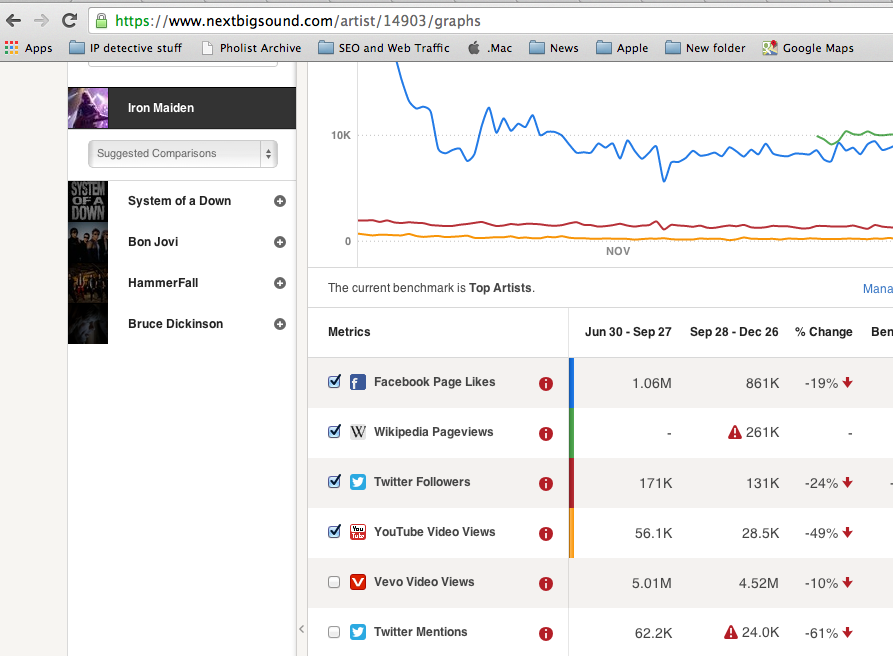
Somewhere in the middle?  Use http://www.nextbigsound.com, to track all kinds of social metrics in a precise geographic manner on a single aggregated screen!  Basic accounts are free!

Image

(And actually-at least for the last 7 days-the embedded claim that Brazil, Argentina and Chile are hot markets for Iron Maiden is contradicted by the fact that tiny Luxembourg had more Iron Maiden oriented twitter activity than any of these markets. Hurry Iron Maiden! Go play Luxembourg!) 

But you don’t even need the internet to figure this out.  Analog  PRO (BMI/ASCAP) statements or even record company royalty statements provide accurate if slightly stale data on where your fans are!    Eyeballing my catalogue, bittorrent data mirrors this stuff exactly.  My most popular bitTorrent territories are the same territories I get a high volume of airplay and streams. (In my very extensive experience with my own catalog, BitTorrent activity actually follows not leads radio play and other publicity.)

So Iron Maiden collaborating on a major touring project with MusicMetric to do what I teach my first year Music Business students to do in the 1st week of class? Seemed highly suspect to me.

Hence this retraction from Citeworld:

The original version of this article incorrectly stated that Iron Maiden used MusicMetric’s analysis to plan its South American tours. MusicMetric did not work directly with Iron Maiden. The analysis described in this article was carried out without the band’s participation or knowledge, and we have no confirmation that the band ever saw or used it. [Because why would the band ever have done so?] CITEworld deeply regrets this error, and we apologize to our readers [but didn’t change the patently false headline that still reads “How Iron Maiden turned piracy into paying customers”].

Look we’ve gotten things wrong here at the Trichordist a few times. It happens.  But we’ve never f*cked up this bad.  Did anyone ever actually bother to call Iron Maiden’s management?  Agency? Press Officer? Did anyone question why Iron Maiden didn’t go to Southeast Asia or China at the same time? For they have an even greater volume of piratical fans in those territories.

Did anyone question how many times a band that’s been around since the 1970s has toured these same countries in the past and might have a watchamacallit–a fan base?

This is starting to seem  like the Goldblox VS Beatie Boys lawsuit where many news outlets erroneosly reported that  Beastie Boys were suing Goldieblox when in actuality it was the other way around!

The main question music business journalists should now be asking:

“Did MusicMetric have any role in pumping up this purportedly fabricated story?”

I’m not saying they intentionally did this to generate notoriety for themselves or funding for  Bit Torrent, Inc. but like Goldieblox the misreported story certainly provided a lot of free publicity for their company.  And in the world of Journalism 2.0 where “news” outlets print first and fact check later, headline consumers will likely walk around with a head full of garbage in, and we know then there’s going to be garbage out.  It’s just that this particular strain of garbage–piracy is good for you, yummy–bears a striking resemblance to the talking points generated by the Computer & Communications Industry Association and of course Bit Torrent itself.

But there is also a question that the music industry and artists should be asking themselves:

Why should the artists send dollars to MusicMetric, a company that seem to provide propaganda for it’s enemies?  If you look at the many of the company’s statements they seem to tacitly endorse piracy.   As a result I certainly wouldn’t hire this company to work any of my product.

It’s too bad.  MusicMetric generally provides a good product.  They may come out of this looking like they are just another purveyor of digital snake oil aka the Bit Torrrent charm offensive,  more interested in hyping their own product than actually helping their customers.

Makes you wonder where the funding is coming from.

Attention Mr. Almunia: Justice Department Evidence Against Megavideo Confirms Adsense Account

(from Chris Castle)

Music Technology Policy

by Chris Castle

Joaquín Almunia, the Vice President of the European Commission in Charge of Competition currently investigating Google’s unsavory business practices in Europe may wish to consider the dark underbelly of Google’s advertising business when deciding whether to give the company an unprecedented third opportunity to settle the competition questions against the global monopolist.

According to evidence released by the Justice Department in the Megavideo criminal prosecution, Megavideo was a Google Adsense customer until at least May 17, 2007:

On or about May 17, 2007, a representative from Google AdSense, an Internet advertising company, sent an e-mail to DOTCOM entitled “Google AdSense Account Status.” In the e-mail, the representative stated that “[d]uring our most recent review of your site [Megaupload.com,]” Google AdSense specialists found “numerous pages” with links to, among other things, “copyrighted content,” and therefore Google AdSense “will no longer be able to work with you.” The…

View original post 993 more words

Is Rap Genius F*cked? | Gawker

A fascinating twist in the saga of Rap Genius…

“We effed up,” lyrics annotation supersite Rap Genius admitted this week after its SEO cheating was revealed. They sure did. And there’s good reason to believe this isn’t just a gaffe for the cartoonish startup posse: a Google eff up could haunt them forever—but no one search should have all that power.

Rap Genius will never be safe on the internet again, because as far as they’re concerned, Google is the internet. The search engine functions like public infrastructure, a road that takes anyone who wants to look up lyrics to the internet lyrics store, but it thinks like any Walmart of Exxon. It has its own secret rules, its own private penalties, and its own willingness to harm any company that dares make it look stupid. The Rap Genius co-creators must have known what they were getting themselves into: an inordinately complex game of Mouse Trap with the devil that’s finally snapped back.

READ THE FULL STORY AT GAWKER:
http://valleywag.gawker.com/is-rap-genius-fucked-1489917137

RELATED:

Rap Genius Says It Will Seek Licenses for Lyrics

Google Renders Rap Genius Unsearchable As Punishment for Spamming

The case against Kim Dotcom, finally revealed | Ars Technica

Feds lay it all out: Megaupload made $150+ million, and Dotcom must stand trial.

The government’s 191-page “Summary of Evidence” also details the stunning sums that Dotcom and his colleagues made running their site. Dotcom, who owned 68 percent of Megaupload and all of sister site Megavideo, made more than $42 million in calendar year 2010. CTO Mathias Ortmann, who owned 25 percent share of Megaupload, made more than $9 million that same year; designer Julius Bencko (2.5 percent) made more than $1 million, and programmer Bram Van Der Kolk (also 2.5 percent) made more than $2 million. Chief Marketing Officer Finn Batato, who was not a shareholder, made $400,000. And no perk was too excessive: the company spent $616,000 renting Mediterranean yachts.

READ THE FULL STORY AT ARS TECHNICA:
http://arstechnica.com/tech-policy/2013/12/us-unveils-the-case-against-kim-dotcom-revealing-e-mails-and-financial-data/

The Failure of the DMCA Notice and Takedown System | CPIP

Section 512 of the Digital Millennium Copyright Act will be turning 15 years old soon, and it’s showing its age. Its design belongs to a different era. Like a 15-year-old automobile, it no longer runs as well as it used to. It can’t keep up with the newer, faster vehicles on the road. Its users are beginning to look for alternative forms of transportation. Pieces of it have been wearing down over time, and ultimately something is going to break that outweighs the cost of replacement.

That time may be now: the notice-and-takedown provision of Section 512 is straining under the weight of a blizzard of notices, as copyright owners struggle to abate the availability of infringing copies of their most highly valued works. The tool is no longer up to the task. Mainstream copyright owners now send takedown notices for more than 6.5 million infringing files, on over 30,000 sites, each month. Printing out the list of sites for which Google receives takedown requests in just one week runs to 393 pages. And that just counts the notices sent to Google; duplicates of many of those notices are sent to the site hosts and to other search engines. For example, over a six-month period ending in August, the member companies of the Motion Picture Association of America sent takedown notices for 11,996,291 files to search engines, but sent even more notices—for 13,238,860 files—directly to site operators. (See chart below.)

The problem is that notice-and-takedown has been pressed into service in a role for which it was never intended. Section 512 was originally designed as an emergency stopgap measure, to be used in isolated instances to remove infringing files from the Internet just long enough to allow a copyright owner to get into court. That design reflected the concerns of its time. In 1998, the dawn of widespread public use of the Internet, there was considerable anxiety about how the law would react to the growing problem of online infringement. Online services worried that they might be held directly liable as publishers for infringing copies of works uploaded by users, despite lacking any knowledge of those copies. Section 512 addressed these concerns by giving service providers a safe harbor to protect them from liability for unknowingly hosting or linking to infringing material.

READ THE FULL STORY AT CPIP:
http://cpip.gmu.edu/2013/12/05/the-failure-of-the-dmca-notice-and-takedown-system-2/