
Get smart about the NO AI Fraud Act with this MTP Mini Brief on the NO AI Fraud Act.
@RepMariaSalazar and @RepDean Introduce No AI Fraud Act to protect artists against AI Fakes #irespectmusic @human_artistry
Press Release
SUPPORT THE No AI FRAUD ACT
AI-Generated Fakes Threaten All Americans
New personalized generative artificial intelligence (AI) cloning models and services have enabled human impersonation and allow users to make unauthorized fakes using the images and voices of others. The abuse of this quickly advancing technology has affected everyone from musical artists to high school students whose personal rights have been violated.
AI-generated fakes and forgeries are everywhere. While AI holds incredible promise, Americans deserve common sense rules to ensure that a person’s voice and likeness cannot be exploited without their permission.
The Threat Is Here
Protection from AI fakes is needed now. We have already seen the kinds of harm these cloning models can inflict, and the problem won’t resolve itself.
From an AI-generated Drake/The Weeknd duet, to Johnny Cash singing “Barbie Girl,” to “new” songs by Bad Bunny that he never recorded to a false dental plan endorsement featuring Tom Hanks, unscrupulous businesses and individuals are hijacking professionals’ voices and images, undermining the legitimate works and aspirations of essential contributors to American culture and commerce.
But AI fakes aren’t limited to famous icons. Last year, nonconsensual, intimate AI fakes of high school girls shook a New Jersey town. Such lewd and abusive AI fakes can be generated and disseminated with ease. And without prompt action, confusion will continue to grow about what is real, undermining public trust and risking harm to reputations, integrity, and human wellbeing.
Inconsistent State Laws Aren’t Enough
The existing patchwork of state laws needs bolstering with a federal solution that provides baseline protections, offering meaningful recourse nationwide.
The No AI FRAUD Act Provides Needed Protection
The No AI Fake Replicas and Unauthorized Duplications (No AI FRAUD) Act of 2024 builds on effective elements of state and federal law to:
- Reaffirm that everyone’s likeness and voice is protected, giving individuals the right to control the use of their identifying characteristics.
- Empower individuals to enforce this right against those who facilitate, create, and spread AI frauds without their permission.
- Balance the rights against the 1st Amendment to safeguard speech and innovation.
The No AI FRAUD Act is an important and necessary step to protect our valuable and unique personal identities.
What would Lars say? Artificial Intelligence: Nobel or RICO?
All the true promise of AI does not require violating writers, artists, photographers, voice actors etc copyrights and rights of publicity. You know, stuff like reading MRIs and X-rays, developing pharmaceuticals, advanced compounds, new industrial processes, etc.
All the shitty aspects of AI DO require intentional mass copyright infringement (a RICO predicate BTW). You know stuff like bots, deep fakes, autogenerated “yoga mat” music, SEO manipulation, autogenerated sports coverage, commercial chat bots, fake student papers, graphic artist knockoffs, robot voice actors etc. But that’s where the no-value-add-parasitic-free-rider-easy-money is to be made. That’s why the parasitic free-riding VCs and private equity want to get a “fair use” copyright exemption.
Policy makers should understand that if they want to reduce the potential harms of AI they need to protect and reinforce intellectual property rights of individuals. It is a natural (and already existing) brake on harmful AI. What we don’t need is legislative intervention that makes it easier to infringe IP rights and then try to mitigate (the easily predictable and obvious) harms with additional regulation.
This is what happened with Napster and internet 1.0. The DMCA copyright infringement safe harbor for platforms unleashed all sorts of negative externalities that were never fairly mitigated by subsequent regulation.
Why do songwriters get 0.0009 a stream on streaming platforms? Because the platforms used the threat of the DMCA copyright safe harbor by “bad actors” (often connected to the “good actors” via shared board members and investors*) to create a market failure that destroyed the value of songs. To “fix” the problem federal legislation tasks the Copyright Royalty Board in LOC to set royalty rates and forced songwriters to license to the digital platforms (songwriters can not opt out). The royalty setting process was inevitably captured by the tech companies and that’s how you end up with 0.0009 per stream.
TBF the DMCA safe harbor requires the platforms to set up “technical measures” to prevent unlicensed use of copyrights, but this part of the DMCA safe harbor were never implemented and the federal government never bothered to enforce this part of the law. This is the Napster playbook all over again.
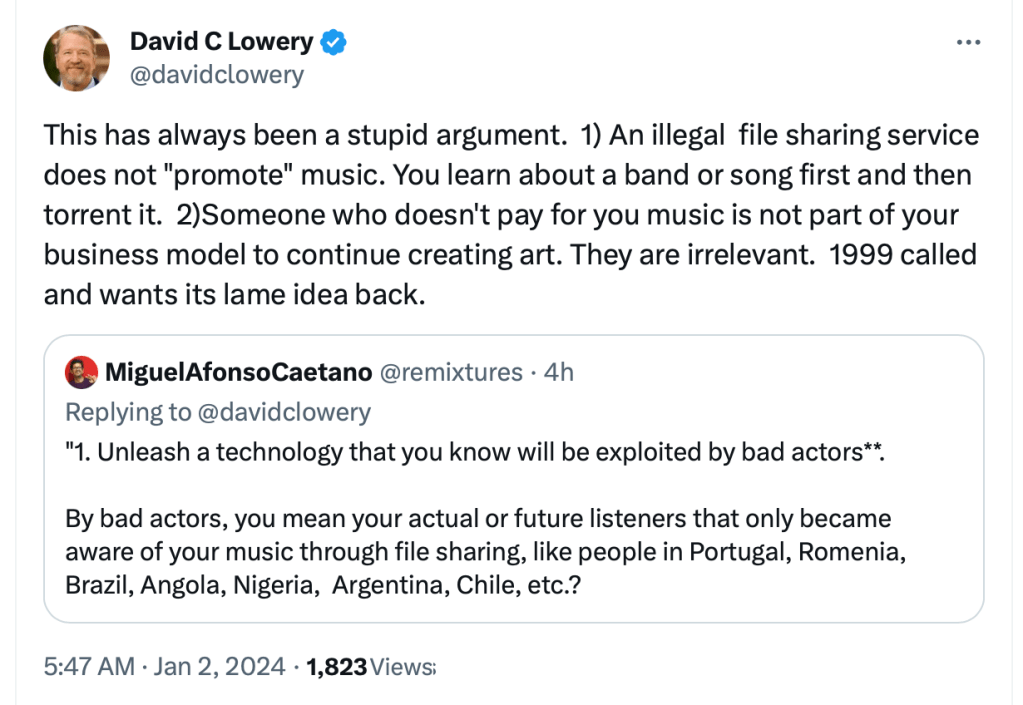
1. Unleash a technology that you know will be exploited by bad actors**.
2. Ask for federal intervention that essentially legalizes the infringing behavior.
3. The federal legislation effectively creates private monopoly or duopoly.
4. Trillions of dollars in wealth transferred from creators to a tiny cabal of no-value-add-parasitic-free-rider-easy-money VCs in silicon valley.
5. Lots of handwringing about the plight of creators.
6. Bullshit legislation that claims to help creators but actually mandates a below market rate for creators.
The funny thing is Lars Ulrich was right about Napster. [See our 2012 post Lars Was First and Lars Was Right.] At the time he was vilified by what in reality was a coordinated DC communication firm (working for Silicon Valley VCs) that masqueraded as grassroots operation.
But go back and watch the Charlie Rose debate between Lars Ulrich and Chuck D, everything Lars Ulrich said was gonna happen happened.
If Lars Ulrich hadn’t been cowed by a coordinated campaign by no-value-add-parasitic-free-rider-easy-money Silicon Valley VCs, he’d probably say the same thing about AI.
And he’d be right again.
Bridgeport Music Files Notice of The MLC’s First Royalty Audit
[Editor Charlie sez: a royalty “audit” is a right of the song owner to look inside the books and records of the party paying royalties to confirm that all royalties were paid and that all royalties were paid correctly, usually during a specified period of time. This usually results in the song owner discovering an underpayment that would have gone unpaid without the audit.]
By Chris Castle
It is commonplace for artists to conduct a royalty examination of their record company, sometimes called an “audit.” Until the Music Modernization Act, the statutory license did not permit songwriters to audit users of the statutory license. The Harry Fox Agency “standard” license for physical records had two principal features that differed from the straight statutory license: quarterly accounting and an audit right. When streaming became popular, the services both refused to comply with the statutory regulations and also refused to allow anyone to audit because the statutory regulations they failed to comply with did not permit an audit. I brought this absurdity to the attention of the Copyright Office in 2011.
After much hoopla, the lobbyists wrote an audit right for copyright owners into the Music Modernization Act. However, rather than permitting copyright owners to audit music users as is long standing common practice on the record side, the lobbyists decided to allow copyright owners to audit the Mechanical Licensing Collective. At the expense of the copyright owner, of course, no matter how many mistakes the copyright owner discovered or how big the underpayment. This is consistent with the desire of services to distance themselves from those pesky songwriters by inserting the MLC in between the services and their ultimate vendors, the songwriters and copyright owners. The services can be audited by the MLC (whose salaries are paid by the services), but that hasn’t happened yet to my knowledge.
But the MLC has received what I believe is its first audit notice that was just published by the Copyright Office after receiving it on November 9. First up is Bridgeport Music, Inc. for the period January 1, 2021, through December 31, 2023. January 1, 2021 was the “license availability date” or the date that the MLC began accounting for royalties under the MMA’s blanket license.
Why Audit Now?
Bridgeport’s audit is wise. There are no doubt millions if not billions of streams to be verified. The MLC’s systems are largely untested, compared to other music users such as record companies that have been audited hundreds, if not thousands of times depending on how long they are operating. Competent royalty examiners will look under the hood and find out whether it’s even possible to render reasonably accurate accounting statements given the MLC’s systems. Maybe it’s all fine, but maybe it’s not. The wisdom of Bridgeport’s two year audit window is that two years is long enough to have a chance at a recovery but it’s not so long that you are drowned in data and susceptible to taking shortcuts.
In other words, why wait around?
Auditing the Black Box
A big difference between the audit rules the lobbyists wrote into the MMA and other audits is that the MLC audit is based on payments, not statements. The relevant language in the statute makes this very clear (17 USC §115(d)(3)(L):
A copyright owner entitled to receive payments of royalties for covered activities from the mechanical licensing collective may, individually or with other copyright owners, conduct an audit of the mechanical licensing collective to verify the accuracy of royalty payments by the mechanical licensing collective to such copyright owner…The qualified auditor shall determine the accuracy of royalty payments, including whether an underpayment or overpayment of royalties was made by the mechanical licensing collective to each auditing copyright owner.
Royalty payments would include a share of black box royalties distributed to copyright owners. It seems reasonable that on audit a copyright owner could verify how this share was arrived at and whatever calculations would be necessary to calculate those payments, or maybe the absence of such payments that should have been made. Determining what is not paid that should have been paid is an important part of any royalty verification examination.
Systems Transparency
Information too confidential to be detected cannot be corrected. It is important to remember that copyright owner audits of the MLC will be the first time an independent third party has had a look at the accounting systems and functional technology of The MLC. If those audits reveal functional defects in the MLC’s systems or technology that affects any output of The MLC, i.e., not just the royalties being audited, it seems to me that those defects should be disclosed to the public. Audit settlements should not be used as hush money payments to keep embarrassing revelations from being publicly disclosed.
Unsurprisingly, The MLC lobbied to have broadly confidential treatment of all audits. Realize that there may well be confidential financial information disclosed as part of any audit that both copyright owners and The MLC will want to keep secret. There is no reason to keep secrets about The MLC’s systems. To take an extreme example, if on audit the auditors discovered that The MLC’s systems added 2 plus 2 and got 5, that is a fact that others have a legitimate interest in having disclosed to include the Copyright Office itself that is about to launch a 5 year review of The MLC for redesignation. Indeed, auditors may discover systemic flaws that could arguably require The MLC to recalculate many if not all statements or at least explain why they should not. (Note that a royalty auditor is required to deliver a copy of the auditor’s final report to The MLC for review even before giving it to their client. This puts The MLC on notice of any systemic flaws in The MLC’s systems found by the auditor and gives it the opportunity to correct any factual errors.)
I think that systemic flaws found by an auditor should be disclosed publicly after taking care to redact any confidential financial information. This will allow both the Copyright Office and MLC members to fix any discovered flaws.
The “Qualified Auditor” Typo
It is important to realize that there is no good reason why a C.P.A. must conduct the audit; this is another drafting glitch in the MMA that requires both The MLC’s audited financial statements and royalty compliance examinations be conducted by a C.P.A, defined as a “qualified auditor” (17 USC § 115(e)(25)). It’s easy to understand why audited financials prepared according to GAAP should be opined by a C.P.A. but it is ludicrous that a C.P.A. should be required to conduct a royalty exam for royalties that have nothing to do with GAAP and never have.
To be frank, I doubt seriously whether anyone involved in drafting the MMA had ever personally conducted or managed a royalty verification examination. That assessment is based on the fact that royalty verification examinations are one of the most critical parts of the royalty payment process and is the least discussed subject in the lengthy MMA; at the time, the lobbyists did not represent songwriters and tried very hard to keep songwriters inside the writer room and outside of the drafting room as you can tell from The MLC, Inc.’s board composition; and that the legislative history (at 20) has one tautological statement about copyright owner audits: ”Subparagraph L sets forth the verification and audit process for copyright owners to audit the collective, although parties may agree on alternate procedures.” Well no kidding, smart people. We’ll take some context if you got it.
As Warner Music Group’s Ron Wilcox testified to the Copyright Royalty Judges, “Because royalty audits require extensive technical and industry-specific expertise, in WMG’s experience a CPA certification is not generally a requirement for conducting such audits. To my knowledge, some of the. most experienced and knowledgeable royalty auditors in the music industry are not CPAs.” (Testimony of Ron Wilcox, In re Determination of Royalty Rates and Terms for Ephemeral Recording and Digital Performance of Sound Recordings (Web IV), Copyright Royalty Judges, Docket No. 14-CRB-0001-WR (Oct. 6, 2014) at 15.).
I would add to Ron’s assessment that the need for “extensive technical and industry-specific expertise” has grown exponentially since he made the statement in 2014 due to the complexity and numerosity of streaming. I’m sure Ron would agree if he had a chance to revisit his remarks. But inside the beltway of the Imperial City, it ain’t that way and you can tell by reading their laws handed down by the descendants of Marcus Licinius Crassus. All accountants are CPAs, all accounting is according to GAAP, all the women are strong, all the men are good-looking, and all the children are above average and go to Sidwell Friends. In the words of London jazzman and club owner Ronnie Scott to an unresponsive audience, “And now, back to sleep.”
The “qualified auditor” defined term should be limited to the MLC’s financials and removed from the audit clauses. This was a point I made to Senate staff during the drafting of MMA, but was told that while they, too, agreed it was stupid, it’s what the parties wanted (i.e., what the lobbyists wanted). And you know how that can be. So now we sweep up behind the elephants in the circus of life. But then, I’m just a country lawyer from Texas, what do I know.
All praise to Bridgeport for stepping up.
This post first appeared on MusicTech.Solutions
Must See Testimony by @MMercuriadis at @KevinBrennanMP Hearing on Streaming Economy
Very important testimony by Merck Mercuriadis at the UK House of Commons Culture Media and Sport Committee revisiting the Committee’s inquiry into the economics of streaming.
Read Merck’s fireside chat with Chris at last year’s Artist Rights Symposium at the University of Georgia.
Selected Comments on the Copyright Office Proposed Rule on Termination Rights and MLC Operations: John Barker
The Copyright Office has asked for comments from the public on important issues for rulemakings under the Music Modernization Act. This will potentially affect the operations of The MLC and related rights especially because the Copyright Office recently extended the scope of that rulemaking. The proposal drew a mixed response.
We will be posting selected comments that we think might be interesting to Trichordist readers. The project is a bit wonky, but important to stay informed on. This comment by Nashville publisher John Barker who founded ClearBox Rights, the IP rights management company is a great introduction to the termination issue and how we got to where we are today by a deep thinker on copyright.
In today’s digital streaming marketplace, there is rarely a need for a traditional re-release of a recording into a collection, best-of, or other packaging combination, since most streaming services offer single song selections, with the ability to create a custom “play list” to suit the consumer’s taste. The basic result is, once a song is recorded, licensed and utilized on a DMP, there is little need for new licenses for that recording/song combination with the DMP provider. The significant portion of compensation writers and heirs had experienced through new licenses of that recording/song in the mechanical world has been reduced to almost nothing.
What had been an accepted practice of Terminating Claimants participating in licensing and receiving royalties for older recordings with new licenses was thwarted to a considerable extent through the unintended consequences of this modern-day digital distribution method.
The combination of the negative impact through the MLC’s Notice and Dispute Policy, along with the consequences of the digital marketplace replacing recorded re-packaging, makes this issue of the Copyright Office ruling even more critical for writers and heirs.So here we are, dealing with this again.
Physical/Download Song Rate Increases, No Change for Streaming
Thanks to the efforts of the “frozen mechanicals” commenters to the Copyright Royalty Judges and the labels who agreed to the structure, there is now an annual cost of living adjustment (called a “COLA”) for the statutory mechanical royalty paid for songs on physical (like vinyl or CDs) and permanent downloads. Starting this month and going forward, that COLA is made by the Copyright Royalty Judges in December, effective the next January 1.
Remember that the frozen minimum statutory mechanical rate was 9.1¢ since 2006 but increased to 12¢ effective 1/1/23.
The Copyright Royalty Judges announced the new COLA rate yesterday which has increased to a minimum rate of 12.40¢ for recordings of songs with a running time of 5 minutes or less, and a per-minute long-song rate of 2.39¢. Depending on how frequently you get accountings, you could see that COLA rate increase show up on your next statements for sales after 1/1/24.
Remember, the purpose of having a COLA is to preserve the buying power of the government’s royalty because songwriters get one opportunity every five years to negotiate compensation for mechanical royalties. Of course, the COLA rate may get distorted by “controlled compositions” clauses in artist agreements, so check your contracts.
Also remember that the rate paid for physical and downloads is actually paid by the record companies as the “licensee” who agreed to the COLA on royalties they pay.
The rate paid for streaming is paid by the digital music platforms like Spotify, Apple, Google, Amazon, Tidal and others.
There is no COLA adjustment for streaming even though same songs and same time period and even though the MLC gets a guaranteed annual increase in its “administrative assessment”.
2024 rate. For the year 2024 for every physical phonorecord and Permanent Download the Licensee makes and distributes or authorizes to be made and distributed, the royalty rate payable for each work embodied in the phonorecord or Permanent Download shall be either 12.40 cents or 2.39 cents per minute of playing time or fraction thereof, whichever amount is larger.
Selected Comments on the Copyright Office Proposed Rule on Termination Rights and MLC Operations: Digital Licensee Coordinator
The Copyright Office has asked for comments from the public on important issues for rulemakings under the Music Modernization Act. This will potentially affect the operations of The MLC and related rights especially because the Copyright Office recently extended the scope of that rulemaking. The proposal drew a mixed response.
We will be posting selected comments that we think might be interesting to Trichordist readers. The project is a bit wonky, but important to stay informed on. This comment by attorney Allison Stillman representing the Digital Licensee Coordinator (who controls the purse strings for The MLC) has some interesting complaints about The MLC that are food for thought in light of the MLC’s potential redesignation coming next year.
The DLC’s firm view is that any additional costs associated with a proposed rule that upends the practices of the entire industry, without actually facilitating the payment of royalties to songwriters or music publishers, as a matter of law would not be “reasonable collective total costs” that could be imposed on the DMPs, through the administrative assessment or otherwise….
As noted in the DLC’s Initial Comments…the [Copyright Office] raises important issues regarding the need for the MLC to have a fair, efficient and transparent methodology for administering corrections and adjustments to payments. These are issues that apply…more broadly to any form of payment adjustment that may be necessary….
While some other commenters echoed similar concerns, the MLC suggests that error corrections, adjustments, disputes and payee changes outside of the specific and purportedly unique termination context “do not represent a controversial topic that would require regulation of operational details” and merely constitute part of “the normal course of business, which The MLC can administer without additional regulation.”But the DLC members’ experiences in waiting for corrections and adjustments from the MLC where the issue has arisen so far indicate otherwise, and that is before the MLC has had to operationalize the anticipated regular practice of DMPs’ over-estimating monthly royalties [or Phonorecords III retroactive adjustments]…. The same principles underlying any regulatory approach to ensuring the prompt and transparent correction of erroneous payments to one rightsholder vs another as a result of copyright termination apply equally to require the prompt and transparent correction of [other payments to DMPs or rights holders].
@marksweney: Spotify CFO cashes in £7.2m in shares after value surges on news of job cuts:
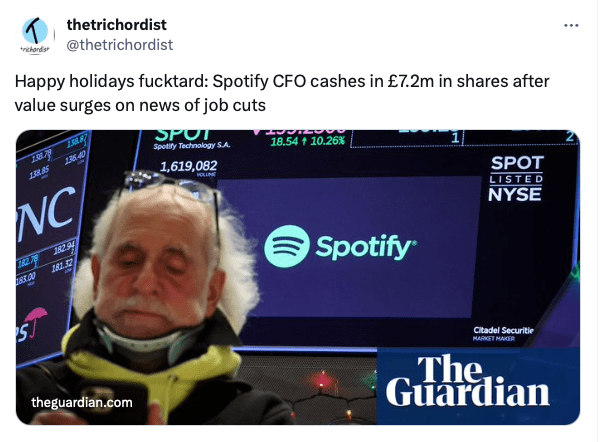
Read the post on The Guardian. Any bets that Ek loots the company into the wall at 150mph and flips the keys to the first person he sees?

 The Trichordist
You must be logged in to post a comment.