Hey Tumblr Users, Why Is This Man Smiling? Because he sold your content and you worked for him for free.

“Loser Generated Content…”

Music Technology Policy

Great news for Tumblr users–the eponymous Mr. Dave Karp just sold your content for $1.1 billion!  In cash!  And of course, he’s sharing that money with you, right?

No, he’s not.  But then again, record companies, movie studios, newspapers and music publishers don’t share the proceeds with their artists, journalists, songwriters or actors, when they’re sold either.  Of course…that’s not an apt comparison because all those companies paid for the “content” they’re selling.  As Francis Cianfrocca noted adroitly on Coffee and Markets, much of the value of companies like Tumblr is based on the appropriation of user content (and I think you could add YouTube to that list).

I really enjoyed the part of the Copyright Principles Project that dealt with artist rights issue of compensating users when the product of their free labor is sold for big bucks…no wait, that wasn’t covered.

So meet the new boss…worse than…

View original post 32 more words

Trichordist Bookshelf – Essential Reading for Artists Rights

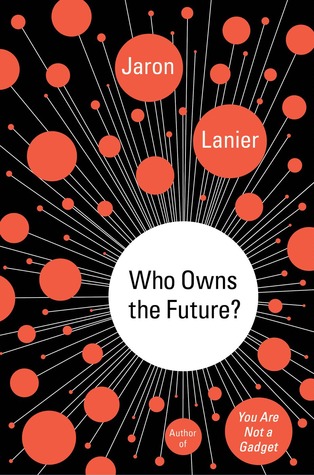
“WHO OWNS THE FUTURE” by JARON LANIER – BUY AT AMAZON:
http://www.amazon.com/Who-Owns-Future-Jaron-Lanier/dp/1451654960/

The Dazzling New Masterwork from the Prophet of Silicon Valley

Jaron Lanier is the bestselling author of You Are Not a Gadget, the father of virtual reality, and one of the most influential thinkers of our time. For decades, Lanier has drawn on his expertise and experience as a computer scientist, musician, and digital media pioneer to predict the revolutionary ways in which technology is transforming our culture.

Who Owns the Future? is a visionary reckoning with the effects network technologies have had on our economy. Lanier asserts that the rise of digital networks led our economy into recession and decimated the middle class. Now, as technology flattens more and more industries—from media to medicine to manufacturing—we are facing even greater challenges to employment and personal wealth.

But there is an alternative to allowing technology to own our future. In this ambitious and deeply humane book, Lanier charts the path toward a new information economy that will stabilize the middle class and allow it to grow. It is time for ordinary people to be rewarded for what they do and share on the web.

Insightful, original, and provocative, Who Owns the Future? is necessary reading for everyone who lives a part of their lives online.

“FREELOADING” by CHRIS RUEN – BUY AT AMAZON:
http://www.amazon.com/Freeloading-Insatiable-Content-Starves-Creativity/dp/1935928996

“A wonderful book that catches an encouraging shift in the zeitgeist. Ruen’s epiphany regarding the effects of his own piracy and freeloading of the bands he loves was eye opening.” – David Byrne

“Fascinating.” – The Village Voice

“The original slacker’s dream of free everything may have been realized by the Internet-but along with it came the slacker’s nightmare of never getting paid for one’s creativity. Freeloading seeks-and to a large extent succeeds-to wrestle with the collapse of the commons and the possibilities for a renewed social contract.” – Douglas Rushkoff

“Brooklyn’s Chris Ruen is one of the most compelling and forward thinking critics of our current download culture.” – M3 Music Conference, Netherlands

“A book…that promises to contribute greatly to copyright debates.” – Terry Hart, Copyhype

Author Chris Ruen, himself a former dedicated freeloader, came to understand how illegal downloads can threaten an entire artistic community after spending time with successful Brooklyn bands who had yet to make a significant profit on their popular music. The product of innumerable late-night, caffeine-fueled conversations and interviews with contemporary musicians such as Craig Finn of The Hold Steady, Ira Wolf Tuton of Yeasayer, and Kyp Malone of TV on the Radio, Freeloading not only dissects this ongoing battle-casting a critical eye on the famous SOPA protests and the attendant rhetoric-but proposes concise, practical solutions that would provide protection to artists and consumers alike.

“FREE RIDE” by ROBERT LEVINE – BUY AT AMAZON:
http://www.amazon.com/Free-Ride-Parasites-Destroying-Business/dp/0307739775

“A book that should change the debate about the future of culture….With this stylishly written and well-reported manifesto, Levine has become a leading voice on one side of our most hotly contested debate involving law and technology.”
—Jeffrey Rosen, The New York Times Book Review

“Turbo-reported….Free Ride is a timely and impressive book–part guilt trip, part wake-up call, and full of the kind of reporting that could only have been done with a book advance from an Old Media company.”
—Businessweek

“[A] smart, caustic tour of the modern culture industry.”
—Fortune

“Brilliant…A crash course in the existential problems facing the [media].”
—Richard Morrison, The Times

“The most convincing defense of the current predicament of the creative industries that I have read.”
—James Crabtree, Financial Times

“With penetrating analysis and insight, Levine, a former executive editor of Billboard magazine, dissects the current economic climate of the struggling American media companies caught in the powerful fiscal grip of the digital industry…. This incisive book is a start at an informed dialogue.”
—Publishers Weekly

“Can the culture business survive the digital age? That’s the burning question Robert Levine poses in his provocative new book. And his answer is one that will get your blood boiling. Rich with revealing stories and telling tales, Free Ride makes a lucid case that information is actually expensive – and that it’s only the big technology firms profiting most from the work of others that demand information be free.”
—Gary Rivlin, author of Broke, USA

“One of the great issues of the digital age is how people who create content will be able to make a living. Robert Levine’s timely and well-researched book provides a valuable look at how copyright protection was lost on the internet and offers suggestions about how it could be restored.”
—Walter Isaacson, President/CEO of the Aspen Institute and author of Benjamin Franklin

“This book thoroughly documents a wide-spread outbreak of cyber amnesia. Despite libertarian delusions, industries often get Free Rides, especially in their early days, but they eventually give back. Taxpayers build roads, then get hired to build cars. The Internet gives back a lot in exchange for its Free Ride, but one thing it defiantly isn’t giving back is a way for enough people to make a living. No matter how amusing or addictive the Internet becomes, its foundation will crumble unless it starts returning the favors it was given and still depends on.”
—Jaron Lanier, author of You Are Not a Gadget

“Free Ride is a brilliantly written book that exposes the dark side of the Internet. A must read for anyone interested in the horrific undermining of our intellectual culture.”
—Edward Jay Epstein, author of The Big Picture: Money and Power in Hollywood

“Robert Levine deftly dissects the self-serving Orwellian freedom-speak being served up by Silicon Valley’s digital new lords as they amass fortunes devaluing the work of artists, journalists and other old-fashioned ‘content creators.’ Free Ride begs us to remove our blinders and take a hard look down a cultural dead-end road.”
—Fred Goodman, author of Fortune’s Fool: Edgar Bronfman Jr., Warner Music, and an Industry in Crisis

“Without being a Luddite, Levine makes the phony digital media gurus of our day seem as simple-minded as their slogans.”
—Ron Rosenbaum, author of How the End Begins and Explaining Hitler

“YOU ARE NOT A GADGET” by JARON LANIER – BUY AT AMAZON:
http://www.amazon.com/You-Are-Not-Gadget-Manifesto/dp/0307389979

A NATIONAL BESTSELLER

A programmer, musician, and father of virtual reality technology, Jaron Lanier was a pioneer in digital media, and among the first to predict the revolutionary changes it would bring to our commerce and culture. Now, with the Web influencing virtually every aspect of our lives, he offers this provocative critique of how digital design is shaping society, for better and for worse.

Informed by Lanier’s experience and expertise as a computer scientist, You Are Not a Gadget discusses the technical and cultural problems that have unwittingly risen from programming choices—such as the nature of user identity—that were “locked-in” at the birth of digital media and considers what a future based on current design philosophies will bring. With the proliferation of social networks, cloud-based data storage systems, and Web 2.0 designs that elevate the “wisdom” of mobs and computer algorithms over the intelligence and wisdom of individuals, his message has never been more urgent.


The Return of IRFA: Million a Month Tim Charges On

Tim Westergren wants to take money away from musicians and give more to himself, wow… Follow. The. Money.

Music Technology Policy

Timmy

In case you were wondering, as Tim Westergren’s crew prepares to reintroduce legislation to require the Congress to reduce artist royalties paid by SoundExchange, old “million a month” Tim continues to make bank on Pandora stock sales.  Pandora’s only product?  Music.

View original post

Pandora Wants You, the Working Musician, to Sign This Letter to Congress…

This is part of a broader attempt by Pandora to win the hearts-and-minds of working musicians, and bolster support in Congress.  Here’s an email shared with Digital Music News; we blotted out the name of the artist (and some other identifying details) but everything else is intact…

READ THE ENTIRE LETTER AT DIGITAL MUSIC NEWS:
http://www.digitalmusicnews.com

ALSO AT DIGITAL MUSIC NEWS:
Pandora Tries to Convince a Musician That He Isn’t Getting Screwed…

From: Blake Morgan
To: Tim Westergren @ Pandora

Without us, you don’t have a business.

The idea of “allowing” us to “participate” in a business that is built solely on distributing and circulating our copyrighted work is like a grocery store saying it has an idea to “allow” the manufacturers of the goods it carries to get paid. The store isn’t “allowing” Del Monte to get paid for their cans of green beans, right? Of course not.

The New Ruling Class of Silicon Valley and Their Exploitation Economy

The Daily Beast published a must read on the new ruling class and the transfer of wealth in the economy, America’s New Oligarchs—Fwd.us and Silicon Valley’s Shady 1 Percenters. Of particular interest was one sentence in this paragraph,

Perversely, the small number of jobs—mostly clustered in Silicon Valley—created by tech companies has helped its moguls avoid public scrutiny. Google employs 50,000, Facebook 4,600, and Twitter less than 1,000 domestic workers. In contrast, GM employs 200,000, Ford 164,000, and Exxon over 100,000. Put another way, Google, with a market cap of $215 billion, is about five times larger than GM yet has just one fourth as many workers.

This is an equation that defines inequality: more and more wealth concentrated in fewer hands and benefiting fewer workers.

Here is the operative sentence from the paragraph above with one word added…

Google, with a market cap of $215 billion, is about five times larger than GM yet has just one fourth as many [PAID] workers.

It occurs to us in the new exploitation economy of loser generated content that many people are “working” for Google and other tech companies supplying endless hours of consumer created content from Facebook posts to Instagram photos. That’s just the stuff that people are willing to give away by consent (although we don’t know how much privacy they are actually consenting to give up in the process).

But the larger truth is even more scary. Google and other internet businesses profit greatly by avoiding paying for the cost of the goods they are monetizing (primarily by advertising). YouTube is a company built on infringement and theft as a business model.

In other words, it’s a lot easier to make money when you don’t have to pay for the labor or fixed costs of developing and producing a product. You know products like music, film, books, software, etc.

Obviously if all of these creators and producers were paid fairly in the value chain to which their work is creating revenue, than there would be less profit for the distributor. What we have now is a distribution mechanism that profits without paying the creative producers. Which is exactly how a company like Google can earn such extraordinary wealth, essentially through stolen labor.

Read the whole story here at The Daily Beast:

http://www.thedailybeast.com/articles/2013/05/14/america-s-new-oligarchs-fwd-us-and-silicon-valley-s-shady-1-percenters.html

The Constitutional and Historical Foundations of Copyright Protection

The Constitutional and Historical Foundations of Copyright Protection
By Paul Clement, Viet Dinh & Jeffrey Harris [1]

Article I, section 8 of the Constitution grants Congress authority “[t]o promote the Progress of Science and the useful Arts, by securing for limited Times to Authors and Inventors the exclusive Right to their respective Writings and Discoveries.”  There was little debate over this provision during the Convention, but James Madison (as Publius) emphasized in Federalist 43 that “[t]he utility of this power will scarcely be questioned,” and “[t]he copyright of authors has been solemnly adjudged, in Great Britain, to be a right of common law.”  With respect to both copyrights and patents, Madison asserted that “[t]he public good fully coincides in both cases with the claims of individuals.”

*     *      *

This history flatly refutes any notion that copyright law is a matter of legislative grace intended solely to serve utilitarian ends. The Copyright Clause of the U.S. Constitution was inspired by a long intellectual tradition—extending back to the very origins of printing and publishing—in which legislators, jurists, scholars, and commentators recognized authors’ inherent property rights in the fruits of their own labor.

Just as the scope of the pre-existing right informs both the contemporary public understanding of, and the Supreme Court’s interpretation of, the right enshrined by the Second Amendment, see Heller, 554 U.S. at 592, 603, this pre-constitutional history is useful both in interpreting the scope of Congress’ copyright power and in informing policy debates about how that power should be exercised. The Supreme Court itself has harkened back to the Statute of Anne in interpreting the copyright laws. See Feltner, 523 U.S. at 349-50. A view of the copyright laws that ignores this history is sorely incomplete.

READ THE FULL REPORT AT:
http://cfif.org/v/index.php/commentary/42-constitution-and-legal/1679-the-constitutional-and-historical-foundations-of-copyright-protection

The Copyright Principles Project: Selflessness, Valley Style Amongst A Dedicated Group of Likeminded People

Music Technology Policy

We heard a new twist on the Copyright Principles Project–because the participants are academics, they are not “self interested” the way that creators are.  Ah, disinterested elites on a quest for truth that only the anointed can divine.

Although this point of view is common to academics (who frequently seem to think that their views are superior to everyone else’s–as any law student can attest), allow this non acolyte to diverge from the path to an “A” (or other form of approval, such as a nice fresh fish so appreciated by trained seals) and express a contrary view at the risk of getting an “F”.

First off, the Copyright Principles Project is not entirely made up of people who don’t know each other and is also not entirely made up of academics.  Some corporate types are represented–just not one soul from the photography business, playwrights, visual artists, or anyone from…

View original post 611 more words

Universal Declaration of Human Rights – Article 27

Somethings are so simple, fundamental and common sense they cross the boundaries of countries and culture. If only these same principles could penetrate the fortress walls of Silicon Valley which now claims “the internet” as a nation state outside the governance or protection of human rights.

Universal Declaration of Human Rights

The Universal Declaration of Human Rights (UDHR) is a milestone document in the history of human rights. Drafted by representatives with different legal and cultural backgrounds from all regions of the world, the Declaration was proclaimed by the United Nations General Assembly in Paris on 10 December 1948 General Assembly resolution 217 A (III) (French) (Spanish) as a common standard of achievements for all peoples and all nations. It sets out, for the first time, fundamental human rights to be universally protected.

Article 27.

(1) Everyone has the right freely to participate in the cultural life of the community, to enjoy the arts and to share in scientific advancement and its benefits.

(2) Everyone has the right to the protection of the moral and material interests resulting from any scientific, literary or artistic production of which he is the author.

Getting Copyrights, Right. David Lowery at Politico

Our own David Lowery makes a lot of compelling arguments in Politico on Monday morning, but this one in particular regarding a copyright registry and orphan works should be of interests to all consumers and individuals as well as all creators. Copyright effects everyone, not just musicians.

Register Your Family Albums

Both conservatives and liberals should be frightened by the “Principles’” attempt to “reformalize” effective copyright protection by encouraging Goodlatte to take away “rights and remedies” for those who do not register their works. Especially those works that the report deems to have “no commercial value”—as decided by the elites rather than the market, apparently.

So if one of the “users” the principles seem to think they represent — like me — posts a photo of my children on my Facebook page but I don’t register it, and somehow a company or individual then uses this picture commercially, or in some other vile manner, this report explicitly states that I would not have the same “rights and remedies” that I currently enjoy. In fact my reading of this report says I would have no remedies unless I were to win an argument that my family photos have commercial value — full employment for lawyers.

So are we all gonna have to register our family photos with Big Brother in order to keep control of them?

Read the full article here at Politico:
http://www.politico.com/story/2013/05/building-a-real-copyright-consensus-91231.html

