BMI’s Happy Talk Campaign Has Failed

By Chris Castle

According to Billboard, Complete Music Update, and the awesome MusicAlly, nobody appears to be buying what they’re selling over to the BMI. For what seems like the second time in less than 30 days, Artist Rights Alliance, Black Music Action Coalition, Music Artists Coalition, SAG-AFTRA and Songwriters of North America rejected the hummina, hummina, hummina happy talk from BMI’s comms shop which comes out to trickle down mixed with a rising tide.

It’s really a shame because it would have been so easy to provide concrete answers if for no other reason than SAG-AFTRA is on a war footing already and is likely not going to back down. And with SAG-AFTRA comes the AFL-CIO which for BMI’s benefit are unions, see, unions that have been down this path before and are…oh, yes…on strike right now. How close are we to signs like this showing up outside of BMI HQ in New York? It’s OK, Larry and Sergey didn’t think they’d get one, either. Thank goodness we have the smart people to guide us. But BMI should look closely at this picture of a Google labor action and think about what they’d do if it happened to them.

When the CEO is trying to sell the company, in a very real sense they are auditioning for continued employment. Do you think this helps or hurts? Friends don’t let friends become a closing condition.

[This post first appeared on MusicTechPolicy]

The Videogame Industry is Larger Than Film and TV Combined, Why Aren’t They Paying Musicians Fairly?

The videogame industry is larger than the film and tv industries, combined. Despite this, most if not all of the composers creating original videogame music are not paid the same as they would be doing the same work for films and tv shows. Here’s why.

Composers who create the music for your favorite films and tv shows are paid a fee which generally covers the actual hard costs of writing, producing and recording the music for that show. Most of the time that fee doesn’t leave a lot for the composer to live on after the hard costs listed above. However, film and tv composers also typically receive a royalty in the form of an additional payment when the film or show is broadcast or streamed.

This is called a public performance royalty. In most countries the composers are also paid in the same manner for theatrical exhibition (the United States is one of the few countries that does not pay this).

In addition to the public performance royalty most countries also pay a mechanical reproduction royalty. Both of these royalties may vary slightly from territory to territory but both are long established norms for the composer as the songwriter, and hence the creator of the copyright of the original music.

It is these royalties that have long been established as an essential form of compensation that allows composers to actually make a living. Videogame Composers however do not receive these long established payments that their film and tv composer counterparts receive.

To be fair to the videogame industry the early distribution methods of games and gameplay operated in a very different manner than that of film & tv. Even in the 90s for example, games were still distributed on cartridges and music was written for the hardware chipset of each console (or standard pc soundcard).

Since that time the videogame industry has evolved significantly with emerging technologies bringing the gameplay closer to traditional media in user experience and workflow. In fact the videogame industry has grown so large, that its annual revenues now exceed those of the film & tv industries combined. Unfortunately for videogame composers, they are still being compensated under a business model that is half a century old, where music was played by a chipset, not a live orchestra (and the commercial internet was in its infancy).

Game composers are now working under many of the same requirements and expectations as film and tv composers, delivering massively epic scores recorded at major studios with large classical orchestras. In fact, the process of writing music for videogames is a larger and more complex process and requires writing much, much more music due to the scale of the games.

The distribution methods of games has changed as well with many now streamisng in real-time multiplayer modes across a range of consoles, computers, phones and tablets. Some streaming games are free to play, but generate billions of dollars from in-game purchases. Videogame Composers do not participate in any of these revenues created by the new distribution technologies (both downloads or streaming).

The current labor strikes in Hollywood by Writers and Actors highlight and underscore the changing economic realities for creatives presented by these new distribution technologies such as streaming media. A similar situation affects the videogame industry who are transitioning from physical transactional sales to various types of streaming models. Streaming equals broadcast. Broadcast requires both public performance and mechanical reproduction royalties (although these may differ slightly from territory to territory). Streaming is not a transactional model. Streaming is a real-time broadcast and delivery of the media. This is not controversial. Even audio only interactive music streaming services are also bound by these same long established standards and norms.

There is talk of SAG (the Screen Actors Guild) extending the reach of their strike from traditional linear media to video game production. It should be noted that film & tv composers are barred from unionizing and have no collective bargaining power. It is against this backdrop that Videogame Composers recognize their need to advocate for the same royalties that have been long established by traditional media which are currently being reevaluated and updated for the streaming era.

In conclusion, now is the time for this fundamental and long overdue misaligned inequity to be addressed and resolved. A healthy industry is one the invests in itself, its talent and its next generation of creatives who will continue to ensure the growth of the business.

Press Release: Rep. @DeboarahRossNC Introduces Protect Working Musicians Act of 2023 #IRespectMusic

September 19, 2023

Today, Congresswoman Deborah Ross (NC-02) introduced the Protect Working Musicians Act of 2023. This legislation will give small independent artists and music creators the power to collectively negotiate with both streaming platforms and generative artificial intelligence (AI) developers for fair compensation.

Under current laws, small and independent musicians have little ability to bargain for market value rates for the use of their music by global streaming platforms, such as Spotify and Apple Music. Instead, they are forced to accept whatever terms are offered by these platforms, while also having almost no ability to engage with AI companies who routinely scrape and use their music without permission or consent. This legislation allows independent artists to band together and collectively negotiate with large streaming platforms and AI developers, without the obstacles of antitrust laws. 

“North Carolina has long been home to outstanding artists and a vibrant music scene that plays a vital role in our state’s culture and economy,” said Congresswoman Ross. “Working musicians and small independent labels face urgent challenges to their livelihoods posed by the market power of streaming platforms as well as the explosion of AI applications that use their work without licensing or pay. This legislation will help give small, independent music creators a level playing field, empowering them to stand together for fairer compensation and giving them a voice in important negotiations that will determine the future of the music industry.” 

The Protect Working Musicians Act is endorsed by the American Association of Independent Music (A2IM) and the Artist Rights Alliance (ARA).

“Musicians today are fighting for fair treatment on so many fronts, including both in the online streaming marketplace and against the growing threat posed by AI companies who exploit creators’ work without permission,” said Jen Jacobsen, ARA Executive Director. “The ‘Protect Working Musicians Act’ will give small and independent artists a shot at facing these challenges by allowing them to negotiate collectively with the large and powerful entities who profit from musicians’ hard work. We thank Rep. Ross for her leadership in empowering creators with tools to navigate this ever-changing market.”

“Thank you, Rep. Deborah Ross, for championing the rights of artists through the introduction of the Protect Working Musicians Act,” said Dr. Richard James Burgess MBE, President & CEO of A2IM. “The PWMA would help level the playing field for indie artists who struggle to make a living from the mega corporations that control the streaming marketplace.” 

“I’m so grateful to my fellow North Carolinian Deborah Ross for fighting for independent music and the future of creativity,” said singer-songwriter Tift Merritt, Co-Chair of the Artist Rights Alliance. “Artists, songwriters, and independent labels have never needed each other more, and this legislation will ensure our voices are heard and we receive fair pay for our work.” 

“The Protect Working Musicians Act is a necessary tool for independent artists and labels to compete in today’s marketplace and receive fair compensation for their work from streaming platforms and AI companies,” said ARA Co-Founder John McCrea of CAKE. “It is amazing that it even needs to be said, but people who make things have a fundamental right to negotiate with the giants who use and distribute their work.” 

“We at Merge would like to thank Congresswoman Ross for endorsing the North Carolina music scene as the strong cultural and economic force it is and taking this step to make sure we can compete and succeed in the digital world,” said Laura Ballance, Co-Founder, Merge Records and member of the band Superchunk.

The bill text is available here

The Copyright Office Sends Modernized Regrets

As we reported in a prior post about George Johnson’s grass roots effort to ask the Copyright Office to review that status of the compulsory license which is the raison d’être for the existence of their Mechanical Licensing Collective, the US Copyright Office turned him down. The Office has refused to look into a study on the continued viability of the compulsory license in the United States as part of the five year review of their Mechanical Licensing Collective. The five year review is the perfect opportunity to consider whether the compulsory license itself is fit for purpose.

This is particularly true after the near-fiasco of the MLC’s testimony to the House IP Subcommittee which is well worth watching, particularly the Subcommittee’s “show me the money” questioning about what the MLC is doing with the hundreds of millions that the MLC is “investing”. The only reason the MLC has these hundreds of millions is because of the compulsory license. This requires an explanation that nobody seems interested in making to the songwriters like George Johnson.

It seems to us impossible to consider one without the other and we appreciate George Johnson taking the time to make that argument to the Copyright Office. In coming days we will have some additional thoughts about the continued viability of the compulsory and look forward to a robust debate on the topic. We may have to conduct that conversation outside of the Imperial City, but that’s OK. There are many international interests involved as well as motivated constituents all around this country.

Here is the Copyright Office rejection letter. There are a number of assumptions it makes, such as the negotiation of Title I of the MMA was a free and open process and not a star chamber for the insiders. We’ll get to these in coming days.

Dear George,

Thank you for your letter requesting a study concerning repealing the section 115 compulsory license.  As you know, the section 115 license was previously explored by the Office and it was recently amended by Congress as part of the Music Modernization Act (MMA).  As the changes made to the license through the MMA have been effective only for the past two and a half years, the Office believes that it would be premature at this time to engage in a new study of the section 115 license.

To briefly recap this history, in 2015, the Copyright Office issued its policy report “Copyright and the Music Marketplace,” which reviewed the then-current conditions affecting the U.S. music marketplace and made various suggestions for reform, including with respect to the section 115 license.  The report was built on input we received from organizations and individuals, including yourself, who shared their insights and experiences in written comments and in roundtable discussions. 

With respect to the section 115 license, the report observed that “[m]any parties have called for either the complete elimination or modernization of section 115, citing issues such as the administrative challenges of the license, the inaccuracy and slowness of the ratesetting process, and frustration with government-mandated rates.”  Ultimately, however, the Office recommended modernizing, but not repealing, the section 115 license.  While the Office was sympathetic to arguments in favor of repealing the license, it was also concerned that eliminating the license would cause extraordinary difficulties associated with negotiating individual licenses for the millions of musical works offered on digital music providers’ services.

Three years later, Congress updated the section 115 license as a part of the MMA—an Act that Senator Grassley referred to as “the product of long and hard negotiations and compromise.”  One of the Act’s cornerstones was the new compulsory blanket section 115 license, which became available on January 1, 2021.  

Although we do not intend to undertake a new study of the section 115 license at this time, we want to remind you that the Office welcomes input from stakeholders and members of the public to better inform our decision-making.  I would like to thank you again for your letter and any additional views that you may wish to provide to the Office in the future.

Sincerely,

Suzy Wilson

General Counsel and Associate Register of Copyrights

U.S. Copyright Office

Copyright Office Rejects George Johnson’s Request for a new Study of the Effectiveness of the Compulsory License as Part of MLC Five Year Review

Before we get to George’s letter, a little context. If you’re coming to this subject for the first time, mechanical royalties are paid to songwriters (and their publishers) for the mechanical reproduction of their songs. The federal government established a compulsory license for this purpose and corresponding royalty rates starting in 1909. The license has evolved over time and now includes physical configurations like vinyl (paid by record companies) and digital transmissions like streaming (paid by DSPs like Spotify).

Until the Music Modernization Act, songs were licensed on a song-by-song basis notice-based system except for catalog licenses. Or at least theoretically–pre-MMA most of the streaming services didn’t take advantage of the statutory license they were entitled to because they couldn’t be bothered. (Until David’s class action called them out. We note that the Copyright Office, in particular a former lawyer at the Office now representing Big Tech against songwriters, allowed the streamers to get away with tens of millions of flawed “address unknown NOIs” that a cynic might say was a catastrophe with a purpose. Chris has an article about this fiasco that went largely unreported except by Hypebot.)

Fast forward to today. Every five years the Copyright Office is required to review the company that the Office has designated to run the Mechanical Licensing Collective. Currently that entity is The MLC, Inc. designated by the Copyright Office on July 8, 2019. Remember that The MLC, Inc. was independently chosen by the Copyright Office as the best in breed of all applicants after a rather odd beauty contest. This is their thing, and the MLC, Inc. is their idea. So do you think that creates an incentive to create a five year review that everything is peachy and they were geniuses for creating this dumpster fire?

Even though the first five year review is set to happen next year, Congress has already held a hearing about the MLC, Inc. which frankly did not go well for the company. Nobody got their ears nailed to the barn door, but the hearing was not the usual love fest. The review is to be conducted by the Copyright Office, so there’s a question as to why Congress decided that the House Judiciary Committee IP Subcommittee should conduct the first of what may be multiple hearings.

Everyone assumed that the Copyright Office would choose the first MLC as the NMPA-backed entry, The MLC, Inc. That company was so confident of winning the contract their confidence made people ask why anyone else bothered to try out. And when the next charade resulted in The MLC, Inc. choosing the former NMPA affiliate the Harry Fox Agency as their data vendor, everyone knew there was definitely gambling at Rick’s. All paid for by Big Tech (or maybe we should say Really Big Tech) because not even the taxpayer is stupid enough to fall for this BS. After all, nothing blew up and nobody died.

So the lobbyists and lawyers and the Copyright Office were busily building up a new bureaucracy to drive mechanical licensing back to the future and essentially preserve the 1909 compulsory license that George refers to. Because what they didn’t do was throw out the compulsory license and come up with an alternative more in keeping with streaming. You know, modernization.

In fact, they never really considered how one might implement mechanical licensing without the compulsory part. And that’s probably because there is a cottage industry of lobbyists, lawyers, and government clerks built up around compulsory licensing that would simply be out of a job if the compulsory were rejected. But they will get out the green eyeshades and the furrowed brow and tell you that mere songwriters cannot appreciate the complexity of getting rid of the compulsory license that governs their lives and has done for over a century.

But then there’s this five year review. What is the review reviewing if it never takes into account the compulsory license itself. Are we to just assume that the compulsory lasts forever? Are they just to review how The MLC, Inc. and HFA are doing administering a law that itself doesn’t work? Where does the failure of one start and the other begin?

The effectiveness of the statute itself really must be part of the five year review as well as a review of the MLC.

Enter George Johnson. George is a songwriter who has effectively represented himself at the Copyright Royalty Board and is fighting hard for increased songwriter royalty rates, holding up a mirror to the emperor in the Imperial City of Washington, DC. Needless to say, George has made no new friends among the grandees and courtiers who all see the advantage in complementing the emperor on his new clothes and complain that George does not shut up and let his betters run things the way they like. Billboard did an extensive profile on George during the frozen mechanicals crisis in which he played a major part.

George has written a timely letter to the Copyright Office anticipating the need for a review of the compulsory license statute itself from which spring all these problems for the obvious reason that you can’t really talk about the MLC with out talking about that statute (17 USC §115). (You may want to take a look at a proposal that David made a few years ago for a US version of extended collective licensing.) Just remember that it’s not really that difficult to transition off of song-by-song licensing to a blanket license administered by the MLC fiasco compared to extended collective licensing with an opt-in for songwriters who want to get away from HFA and the compulsory licesne.

Spoiler alert–the Copyright Office rejected George’s request. Their rejection does not mean George was wrong, it just means that the right person didn’t ask the question,

Following is George’s letter to the Copyright Office and we will later post the Copyright Office response. You can read George’s white paper here.

Monday, June 12, 2023

Via Email 

Attn:  Ms. Shira Perlmutter,

Register of Copyrights and Director

U.S. Copyright Office

101 Independence Ave. S.E.

Washington, D.C., 20559-6000

Re:  Study to Repeal §115 Compulsory License & Ex Parte Meetings to benefit Congress and all U.S. Songwriters and Music Publishers

Dear Register Perlmutter,

For the benefit of all American songwriters and music publishers “bound by” 1 the 114 year old §115 compulsory license, and to benefit Congress in their upcoming 2 decision making processes involving intellectual property law and music copyright policy, I respectfully request that the Copyright Office please initiate a compulsory license study and roundtables regarding it’s full repeal, including ex parte meetings.

The century old compulsory license is no longer an incentive or profitablefor all U.S. songwriters and music publishers, and there are many problems arising from it’s use, and misuse, not intended by Congress, the Constitution, and copyright law.

The 1909 compulsory license was designed for a different time, for the local sale of piano rolls and not contemplated to be used by the largest trillion-dollar corporations in the history of the world, with teams of attorneys, with no sale, by “access”, on “computers” or telephones, distributed digitally, through the air, and all for free from songwriters and publishers?  Now, with no COLA for streaming. 

Former Register Ms. Marybeth Peters initiated several studies 3 that questioned the continued necessity of the compulsory license, and for it’s full repeal or full reform 4. Unfortunately, those studies are now outdated and considering the vast changes in the delivery of musical works and sound recordings, experts 5 6 now think a new study would be very helpful in updating Congress on how the license is functioning post Music Modernization Act (MMA), to benefit their 2024 MLC review, but primarily so Congress can make an informed decision on full repeal or full reform?

While my comments here are my own and separate from my participation in the current Phonorecords III & IV proceedings at the Copyright Royalty Board, please feel free to notify me if there is any conflict or other legal protocol to be followed.

Other than the obvious economic arguments to finally pay songwriters the true value of their copyrights, the primary reason I believe compulsory license roundtables are necessary and so dire is the 3 major record labels’ current anticompetitive misuse of the compulsory license 7 at the CRB (See #1, 2, 3 in the attached white paper) that I’ve experienced as a 4 time CRB participant and appellant in Sound Exchange v. CRB 8 and Johnson v. CRB 9.   The 3 major labels’ misuse of the license is the #1 issue including several dozen other serious issues.

The license, the rate-structure, and the CRB process are all truly broken in almost every way and must be fixed immediately or completely abandoned.  All rational market actors who currently use private collective blanket licensing providers would certainly switch, proving no need for federal licensing to operate efficiently.

We all could really benefit from the Copyright Office’s input, ideas, and legal opinions on these extremely important issues since each and every songwriter cannot compete with RIAA and NMPA counsel, nor 25 years of their regulatory capture. 

We songwriters truly need Congress and the Copyright Office’s help and guidance.

We pray the Copyright Office 11 will initiate a study with roundtables, in addition to ex parte communications and meetings to benefit Congress, and all American songwriters and music publishers “subject to”11 the license — for these good reasons, good cause, and those contained in the following white paper attached below.

Thank you for your time and thoughtful consideration. 

Respectfully,

George D. Johnson

Singer/Songwriter

PO Box 22091

Nashville, TN, 37202

@georgejohnson

cc: Librarian of Congress                                                 

     General Counsel of the Copyright Office   

     U.S. House Judiciary Committee

     U.S. Senate Judiciary Committee

     Office of the TN Attorney General

1.  https://www.federalregister.gov/documents/2022/03/30/2022-06691/determination-of-royalty-rates-and-terms-for-making-and-distributing-phonorecords-phonorecords-iv  March 30, 2022 Withdrawal of Subpart B Final Rule by the Copyright Royalty Board.  Referencing §801(b)(7)(A) “That provision directs the Judges to provide those who would be bound by the negotiated rates and terms an opportunity to comment on the agreement.” Page 3 (emphasis added)

2.  Upcoming 5 year work product review of the Music License Collective (“MLC”) by Congress in 2024.

3.  https://www.copyright.gov/newsnet/2022/981.html  September 30, 2022 — In Memory of Marybeth Peters.  “Her leadership of the Office also included the generation of several landmark studies, such as those on statutory licenses…”

4.    To me, a full overhaul in dollars of the “nano-penny” rate-structure in §385 Subpart C streaming.

5. https://musictechpolicy.com/2023/04/05/should-the-copyrightoffice-begin-at-the-beginning-with-the-mlcs-first-five-year-review/  April 5, 2023 — by attorney and Phonorecords IV Commenter Mr. Chris Castle.  Should the Copyright Office Begin at the Beginning With The MLC’s First Five year Review “The continued need for a song compulsory license is just the kind of information that Reps. Jordan and Issa could use in case they were inclined to just get rid of it. It would be a great topic for the Copyright Office to study and hold round tables on, this time preferably lead by a Copyright Office lawyer who was not being recruited by Spotify.”

6.  https://musictechpolicy.com/2023/05/28/should-the-compulsory-license-be-re-upped/ May 28, 2023, Should the Compulsory License Be Re-Upped? by music attorney and official CRB Commenter Mr. Chris Castle.

7. …through NMPA’s, et al. re-writing all laws and definitions, and MMA, to fit label business models, not U.S. songwriters.  This is also in no way the Judges fault, they have to deal with it too, so reform would help them.   The Judges are great and not to blame when I say the process is broken.

8.  https://www.cadc.uscourts.gov/internet/opinions.nsf/8AE80A6C0FBDFB7B8525830C004D863A/$file/16-1159-1751123.pdf  SoundExchange, Inc. v. Copyright Royalty Board and Librarian of Congress, Case No. 16-1159, consolidated with 16-1162 (DC Cir. Sept. 18, 2018) (Srinivasan, J)

9.  https://www.cadc.uscourts.gov/internet/opinions.nsf/720464D843B0D6C7852585C10074B11B/$file/19-1028-1856124.pdf  George Johnson v. Copyright Royalty Board and Librarian of Congress, Case No. 19-1028, (D.C. Cir. Aug. 7, 2020) (Henderson, Garland, and Millett)

10.  https://www.govinfo.gov/content/pkg/FR-2023-02-17/pdf/2023-03392.pdf Ex parte.

11.  https://app.crb.gov/document/download/3715  September 29, 2016, SDARS III Order Denying Services’ Motion To Dismiss George D. Johnson d/b/a Geo Music Group.  “The Services’ reliance on the Librarian’s decision in PSS II—a decision that involved neither a copyright owner nor a copyright user—is misplaced because it is based on an erroneous premise. Unlike the party in PSS II, GEO is subject to the license at issue…and GEO would have no say in the matter—that is the essence of a statutory license.  For the forgoing reasons, the Judges DENY the Services’ Motion.” 

How Good is Greed? What is to be done about the BMI sale

Greed is good!! Or not.

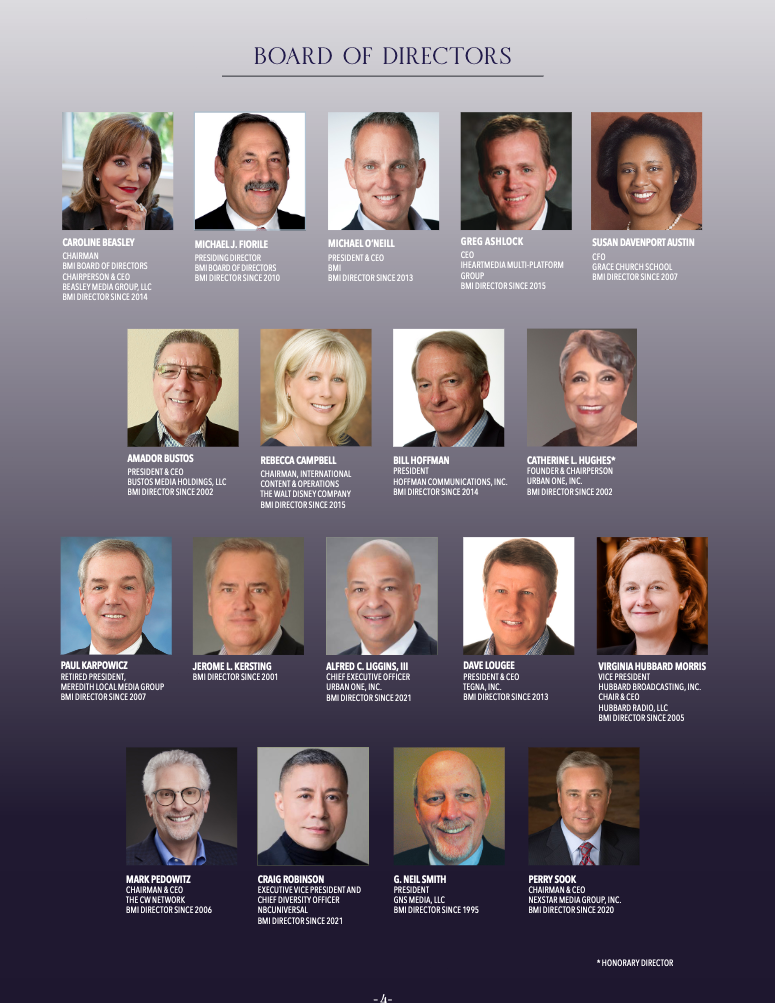
We’ve all looked on in horror as executives at BMI are structuring a way to extract the value that generations of songwriters have bestowed on the broadcasters’ PRO. Because BMI had operated as a nonprofit corporation since 1939, extracting that value in the form of a sale of BMI was a bit of a problem because nonprofits have pretty extensive restrictions on who they can sell to (most prominently, other non profits and not the for profits who have the money) not to mention the responsibility of board members and no stock ownership by board members, liquidation preferences, etc. Some songwriter advocacy groups sent a letter asking a number of questions to BMI’s head honcho Mike O’Neil. You can read the letter and O’Neil’s non-answer on Music Business Worldwide. After reading the nonanswer see if you have the same reaction a lot of people have had–yep, it’s bullshit.

Enter the team that BMI and their broadcaster board plays for: The White Shoes of Wall Street with their notorious manager Goldman “Shifty” Sachs. As we know, the most dangerous geography in the world is the conflict zone between Shifty Sachs and fees not yet doing the english shift into Shifty’s pockets. So unsurprisingly, BMI did some kind of rollout (aka the Delaware two step) that presto changeo turned BMI into a for profit company ready for serving up on Shifty’s fees menu. And extracting songwriter value for BMI executives with tips all round for Shifty and his White Shoes.

And they’re getting away with it by the look of things. Are you surprised?

One reason they are getting away with it is that the rumored competitive offer from a songwriter buyer group hasn’t materialized yet. But the main reason they are getting away with it is because somehow a firm that has no connection to the music business (North Mountain Capital) seems to be interested in forking over a rumored $1.7 billion price tag for BMI. And that’s a lot of streams.

Because North Mountain have no detectable connection to the music business (aside from a valuation firm which to our knowledge hasn’t humped a trap case in quite a while) they are not really focused on a songwriter revolt against a business whose core asset is rented songs. We say “rented” because any BMI songwriter or publisher agreement can be unilaterally terminated by the songwriter or publisher. Even though that termination can be delayed a while, we wonder if Shifty has really taken that into account.

Of course, North Mountain itself may have some investors who are familiar with the music business. We can’t help noticing that the MLC invests hundreds of millions of other peoples black box money and they may very well have put some of your millions into North Capital as they have with mutual funds in which they are a “controlling person.” Since MLC refuses–under oath–to disclose their investments for the ludicrous reason that they might move markets…sheesh…and since the Copyright Office doesn’t compel the MLC to disclose those investments, we have no idea what they are up to. (There may be a simple explanation for this lack of spine given the Copyright Office’s past revolving door activities.) But we cannot rule out that the black box might be used to fund, albeit indirectly, an acquisition that the songwriters don’t want. In fact, there’s nothing to say that MLC has not already either directly invested in a takeover fund or made loans of black box money to publishers or their buddies who want to buy catalogs.

Unless something’s changed this morning, the BMI sale still isn’t done yet, but we have every confidence in Shifty and the White Shoes.

Because as Gordon Gekko taught us, greed is good.

@MikeHuppe: Protecting the Creative Class

Guest post By Mike Huppe
President & CEO at SoundExchange

Creators – whether they be writers, actors, or musicians – are the heart of the entertainment industry. They inspire us with their words, move us with their performances, and get our blood pumping with their beats. 

Now two of the major unions representing creators – the Writers Guild of America (WGA) and the Screen Actors Guild (SAG-AFTRA) – have gone on strike to make the case for better pay and residuals, improved working conditions, fairer treatment in the age of streaming, and protections against the widespread use of artificial intelligence to replace creators. 

This is the first time that writers and actors have gone on strike at the same time since 1960, and it has brought the movie and TV industry to a virtual standstill. After cable increased content to fill a new crop of channels, streaming platforms fueled an explosion of new series and features to feed a new business model. Now, production has ground to a halt and the availability of new movies and shows will dwindle in the coming days, weeks, and months.

At its core, this dispute is about ensuring that, even as business models evolve and change, creators are treated fairly so they can continue to do the work that brings meaning to them and joy to us.

At SoundExchange, we love creators. We champion their work. We’ve seen the music industry go through technology-driven disruption (just as the motion picture industry is now), and we were created to ensure that streaming music business models enable creators to make a living doing what they do best. We’ve been fighting for 20 years to build a fairer, simpler, and more efficient music industry – by successfully increasing royalty rates across a variety of platforms; by holding accountable those who seek to cheat creators; by increasing the speed and transparency of payments, and by scoring a big win for music creators with the Music Modernization Act in 2018 (which provide comprehensive music licensing reform).

And we continue to fight these battles.

As streaming matures and new royalty models are debated, and as technology platforms evolve in Web3 and the metaverse, SoundExchange will remain a strong and vocal voice to ensure creators are fairly compensated. As artificial intelligence improves and matures at an astounding rate, SoundExchange became a founding member of the Human Artistry CampAIgn to demand that the rights of human creators are at the center of any copyright and intellectual property decisions, and we are proud that both SAG-AFTRA and the Writers Guild of America (WGA) are among the coalition’s members.

And it’s worth noting that music performers are still not compensated – at all — for their work when played on AM/FM broadcast radio. For this reason, SoundExchange is a driving force in the effort to convince Congress to act on the American Music Fairness Act, which would require multi-billion-dollar radio corporations to pay performance royalties like digital streaming platforms do.

So, to the creators out there on strike, we say this. We stand with you and hope that these disputes can be resolved quickly in a way that supports fair treatment, compensation, and protections for creators. And for those of you who are registered with SoundExchange, we will continue to work every day to make sure that you receive the digital royalties that you are due in a timely manner. 

We know this mission matters more now than ever.

[This post first appeared on LinkedIn]

Five Points for Potential AI Framework Agreements

By Chris Castle

This post first appeared on MusicTechPolicy

When you see Big Tech start to make Newspeak noises about wanting to license creative works for artificial intelligence, it’s well to remember a couple facts about how they treat people, business practices that they don’t talk about at parties. Or to Congress.

Take their supply chain, particularly their manufacturing supply chain in China where some of all their products use slave labor. And the cobalt that goes into every battery powered device like your smartphone is obtained through the equally Newspeak “artisanal mining” otherwise known as impossibly poor children mining cobalt by clawing it out of the dirt with their bare hands. You know, “artisanal”. (Read Cobalt Red by Sid Kara for that story.). Not to mention the grotesque and parasitic waste of electricity and the resources that provide it whether they are crowding out the public investment in renewables or driving coal powered generators. They don’t talk about it because they feel entitled to all of it which is to be expected from that feeder school for the Silicon Valley elites built with blood money from the Central Pacific Railroad.

So when you sit down at the negotiating table with these people, this is who they really are. That realization tells you a few things, but it mainly tells you they simply cannot be trusted in either life choices or in business choices.

Universal has taken a real leadership role in the AI negotiations that has both respected their artists and songwriters and given teeth to the principles of the Human Artistry Campaign. First of all, the company has made it clear that they are going to support their artists and songwriters in having a meaningful seat at the table. They will not send their artists to the charnel house. The only artists who participate will be the artists who decide to participate–opt in rather than Google’s preferred “opt out” structure which relies on the abuse of various safe harbors at scale. 

It appears that until such time as both the artists and songwriters and Universal are comfortable with the integrity of the creative and business model of YouTube’s AI music suite of tools, there’s no deal. Negotiations presumably will continue so there may be at least a commercial frameworks. 

To that end, here are five points that might prove useful.

  1. Artists and songwriters need to be at the table: One takeaway from the frozen mechanicals experience is how necessary it is for the creators to be included–not through an organization but actual individuals who speak for themselves and are not influenced by lobbyists.  Universal has proven that this is possible. This is a huge advancement in label-artist relations and publisher-writer relations, particularly because it’s obvious from the creators who stepped forward that these are articulate independent thinkers who are not going to tow the party line.  That is the whole idea. If you don’t trust your artists and writers enough to give them freedom to speak their minds, then let’s face it–there’s something wrong with your business model.
  2. All AI licenses should be opt in: Most of YouTube’s many artist relations issues arise from artists not having the right and ability to withhold their work from whatever the platform is. This is particularly true with UGC and advertising supported platforms. When you have poured out your soul in a recording that ends up with ads for drugs or miracle hair replacement treatments, it’s deflating and if anyone asked for approval, you’d probably decline. Which is why you negotiate marketing restrictions that prevent your music being used in advertising.
  3. No blind check deals and no “big pool” royalties: We haven’t gotten to the royalty rates yet, but there will be riots in the streets if anyone tries to perpetuate YouTube-style accountings, the grotesquely unfair TikTok blind check deals or “big pool” market centric royalties. AI gives us all a chance to get it right and build a new system that is artist centric. It’s encouraging that Lucian Grainge’s blog post announcing the relationship with YouTube is entitled “An artist centric approach to AI innovation” which is consistent with his prior statements about making streaming royalties more fair.
  4. Ability to track and account is a precondition: It should go without saying that in order to have meaningful royalty accounting, the service must have the ability to track and account. This is especially challenging in AI given the “training” issues. I will be pleasantly shocked if Google engineers designing the music AI tools have not entirely ignored tracking and accounting which they typically have viewed as a bug, not a feature. This is what gives rise to the blind check deals and other unworkable approaches which are most definitely not “artist centric.” Accordingly, the need to issue per work reports is essential.
  5. Audits should be much more frequent: This new product is a chance to revisit the standard approaches to auditing which have unfortunately become perpetuated in digital deals and most prominently in the Music Modernization Act (Title I). There is not much difference between the MMA audit rights and the audit clause from a 30 year old record deal notwithstanding the vast difference in commerce between the two. With AI, not only have the DSPs blown up the album to a commercial singles world, they are now trying to blow up the single to mind-numbing fragmentation. Potentially, this world will be like selling stems. This ushers in a whole new need for minimum viable data laws and enforcement for using standard identifiers.

There will be many other issues to address, but I think if we don’t address these key points we’ll find ourselves to be artisanal workers scratching out a living for ChatGPT. 

Press Release: Universal and YouTube Announce AI Music Principles Consistent with Human Artistry Campaign and Artist Advisors

NEW YORK, Aug. 21, 2023 /PRNewswire/ — Today YouTube published a first ever set of AI music principles and launched the YouTube Music AI Incubator, kicking off with artists, songwriters and producers from Universal Music Group. YouTube’s three fundamental AI music principles are rooted in its commitment to collaborate with the music industry alongside bold and responsible innovation in the space. 

YouTube CEO, Neal Mohan, shared the platform’s AI music principles and his vision for how the framework will enhance creative expression while also protecting artists on the platform. The principles include:

  • Principle #1: AI is here, and we will embrace it responsibly together with our music partners. As generative AI unlocks ambitious new forms of creativity, YouTube and our partners across the music industry agree to build on our long collaborative history and responsibly embrace this rapidly advancing field.  Our goal is to partner with the music industry to empower creativity in a way that enhances our joint pursuit of responsible innovation. 
  • Principle #2: AI is ushering in a new age of creative expression, but it must include appropriate protections and unlock opportunities for music partners who decide to participate. We’re continuing our strong track record of protecting the creative work of artists on YouTube. We’ve made massive investments over the years in the systems that help balance the interests of copyright holders with those of the creative community on YouTube.
  • Principle #3: We’ve built an industry-leading trust and safety organization and content policies. We will scale those to meet the challenges of AI. We spent years investing in the policies and trust and safety teams that help protect the YouTube community, and we’re also applying these safeguards to AI-generated content. Generative AI systems may amplify current challenges like trademark and copyright abuse, misinformation, spam, and more. But AI can also be used to identify this sort of content, and we’ll continue to invest in the AI-powered technology that helps us protect our community of viewers, creators, artists and songwriters–from Content ID to policies and detection and enforcement systems that keep our platform safe behind the scenes. And we commit to scaling this work even further. 

In a rare guest YouTube blog Universal Music Group Chairman and CEO, Sir Lucian Grainge – who helped shape the principles – shared his vision for an artist centric approach to generative AI and how partnering with YouTube would best position the music industry for success as this technology continues to develop. Excerpts from the blog post include: 

  • “Our challenge and opportunity as an industry is to establish effective tools, incentives and rewards – as well as rules of the road – that enable us to limit AI’s potential downside while promoting its promising upside. If we strike the right balance, I believe AI will amplify human imagination and enrich musical creativity in extraordinary new ways.”
  • “Our enduring faith in human creativity is the bedrock of Universal Music Group’s collaboration with YouTube on the future of AI. Central to our collective vision is taking steps to build a safe, responsible and profitable ecosystem of music and video—one where artists and songwriters have the ability to maintain their creative integrity, their power to choose, and to be compensated fairly.”
  • “Today, our partnership is building on that foundation with a shared commitment to lead responsibly, as outlined in YouTube’s AI principles, where Artificial Intelligence is built to empower human creativity, and not the other way around.  AI will never replace human creativity because it will always lack the essential spark that drives the most talented artists to do their best work, which is intention. From Mozart to The Beatles to Taylor Swift, genius is never random.” 

Today’s announcement also introduced YouTube’s AI Music Incubator, a program that will bring together some of today’s most innovative artists, songwriters, and producers to help inform YouTube’s approach to generative AI in music. The incubator will kick off with a genre-spanning cohort of creatives from Universal Music Group, that includes Anitta, Björn Ulvaeus, d4vd, Don Was, Juanes, Louis Bell, Max Richter, Rodney Jerkins, Rosanne Cash, Ryan Tedder, Yo Gotti, and the Estate of Frank Sinatra, amongst others. 

  • Björn Ulvaeus shares: “While some may find my decision controversial, I’ve joined this group with an open mind and purely out of curiosity about how an AI model works and what it could be capable of in a creative process. I believe that the more I understand, the better equipped I’ll be to advocate for and to help protect the rights of my fellow human creators.”
  • Juanes shares: “Music is fundamental to the human experience – culturally and personally. For artists, our music is part of who we are. Given music’s role, artists must play a central role in helping to shape the future of this technology.  I’m looking forward to working with Google and YouTube as part of this influential group of UMG artists to assure that AI develops responsibly as a tool to empower artists and that it is used respectfully and ethically in ways that amplify human musical expression for generations to come.”
  • Max Richter shares: Like every new technology, AI brings with it opportunities, but it also raises profound challenges for the creative community. The tech world and the music distribution ecosystem are quickly evolving to embrace this transformative technology and, unless artists are part of this process, there is no way to ensure that our interests will be taken into account. We have to be in this conversation, or our voices won’t be heard. Therefore, I’m very happy to be part of the “artist incubator” which will allow me to advocate for the interests of the creative community in the applications of AI to music and music distribution.” 

Neal Mohan Blog : https://blog.youtube/inside-youtube/partnering-with-the-music-industry-on-ai/
Sir Lucian Grainge Guest Blog: https://blog.youtube/news-and-events/an-artist-centric-approach-to-ai-innovation/

I Grift Therefore I Am: Jared Polis Supports Silicon Valley’s “Speculative Tickets” Grift in Colorado

If you had a chance to watch the CLE panel that David Lowery, Mala Sharma and Chris Castle did for the University of Texas School of Law CLE last week, you’ll remember that the panel spent a good deal of time talking about “speculative tickets”. In fact, the title of the panel was “When is Ticketing Like Pork Bellies?” which was a direct reference to the similarities between speculative tickets and commodities futures contracts (like pork bellies).

The way this grift works is that somebody (or some thing in the case of bots) offers to sell a promise to sell a ticket in the future. The trick is that the ticket is not yet on sale anywhere but certain dates have been announced so it will be on sale. This could be any ticket, like a concert tour or a sporting event like the Super Bowl, the Rose Bowl, the World Series, and so on.

This is actually worse than a pork belly contract, because you know that the pork bellies exist when you buy the contract, you just don’t know the price. Market events could cause the price to fluctuate, but there will be some pork belly available somewhere. So to even call it a ticket is a misnomer. It’s a promise to sell something that may exist to get all Cartesian about it.

The grifter prices the speculative ticket promise at a premium, naturally. Some of them actually promise an actual seat, some promise a certain section or block of seats. They then list that ticket on a ticket reseller market place like Stubhub which was most definitely lobbying in force for the nonsensical Georgia ticketing bill that failed and which we assume is behind all these bills that keep popping up like syphilitic warts.

After the ticket is listed, a fan buys the speculative ticket promise and waits to get their actual tickets. And this is the really insidious part. As David noted on our panel, the grifter’s transaction is like covering on a naked short in short selling. Naked shorts are a very risky thing because unlike with speculative tickets, the market enforces the trade. You will pay on that bet unlike speculative tickets where there is no market enforcement except the occasional prosecution by a state attorney general or the FTC.

It seems impossible for the speculative ticket short seller to obtain the actual tickets without using bots. Plausible, perhaps, but seems very unlikely. Thanks to Senator Marsha Blackburn and Richard Blumenthal and their BOTS Act, federal law prohibits using bots, but again, it’s a science of getting caught. Senator Blackburn recently complained quite rightly that the FTC is not sufficiently enforcing the BOTS Act.

If the grifter cannot come up with the tickets, it is apparently very rare that the fan gets their money back. The fan will be offered all manner of things other than cash or maybe the grifter just slithers off into the night. Awful stuff, right?

The grifter is preying on the buyer’s love of the artist or the team (or the family member of the buyer) which is so great that they are willing to spend the money because they are made to believe they have a sure bet that will pay off with a real ticket. What kind of a heartless dickweed would do that to someone?

And here’s where Jared Polis comes in. If you’ve never heard of him, Jared Polis is the governor of Colorado. The Colorado legislature recently passed SB60 that would have joined other states in banning speculative tickets. But–on June 6, 2023 Jared Polis vetoed the bill.

So how did StubHub get to Jared Polis? Remember, Jared Polis is a 99er who made a fortune on the Internet before the Internet repriced itself. He also founded TechStars, so he’s a VC, too. So he knows all about grifters and could not give a rip about artists–as he has demonstrated many times. But his veto letter is worth reading because of its complete head up the ass approach to speculative tickets.

Polis goes through the “if you only had a brain” analysis saying there are some good things in SB60 which he could support but then there are the bad things which he, Polis the Lawmaker, simply cannot abide–like a prohibition on speculative tickets. Except he doesn’t call them speculative tickets like the Federal Trade Commission does, or the Attorney General of New York. Oh, no. In his veto letter, he calls them “innovative products that address existing market failures, such as online ticket waiting services“.

Wait a minute–are we talking about the same thing here?

The bill prohibits anyone that “Advertises, offers for sale, or contracts for the resale of a ticket unless the person has possession or constructive possession of the ticket and the person has an agreement with the rights holder.”

Somehow the bill language got transformed from protecting consumers against speculative ticketing to a whole new thing, an innovative product that a VC might invest in and even take that company public. Or could have in 1999.

Sure seems like Polis is in on the grift, don’t it? You can’t call it a conspiracy theory because there’s nothing theoretical about it.