Google’s Charm Offensive Comes to Nashville Behind YouTube Front: But Where is the Straight Count?

Music Technology Policy

It’s really important that we protect the rights of really good looking people in this society,”

Attorney Andrew Bridges of Fenwick & West (frequently representing Google) quoted at Beautiful Person Derek Khanna’s SXSW Panel

______________________________________

First They Send the Missionaries

If you read much about the expansion of the British Empire, you will begin to get the idea: First they send the missionaries.

This is the thought that went through my mind a few years ago when I was on a panel with Alex Curtis from Public Knowledge at the Leadership Music Digital Summit in Nashville.  (MTP readers will remember this is the panel at which we formed the rule–don’t participate in panels when your fellow panelists are using iPads on the stage.  They may be tweeting questions to a ringer in the audience who then asks questions that the Tweeting Panelist wants to answer.)

That summit was…

View original post 1,645 more words

Artists Rights Watch – Monday April 15, 2013

VICE:
* Chris Ruen Is Taking the Anti-Piracy Argument Back from the Music Industry

… If we can agree that artists have legitimate rights to their own work, it follows that we have some duty as individuals and as a society to respect those rights”.

NEW YORK TIMES:
* The Slow Death of the American Author

The Constitution’s framers had it right. Soviet-style repression is not necessary to diminish authors’ output and influence. Just devalue their copyrights.

BILLBOARD:
* Martin Mills’ Call to Action: His Billboard MIDEM Speech In Full

I want to address the lack of support that governments, politicians and bureaucrats worldwide show to the creative industries. Many pay lip service to the value and importance of the creative economy, but most fail to match that with their actions.

Creative industries are built upon strong and defendable intellectual property rights, and without that they will inevitably wither and fail. It is impossible to make the investments to produce new creative goods without the security that ownership of them is protected.

BRISBANE TIMES:
* Why are you still stealing Game of Thrones?

Is there some sort of internet freetard math I’m unaware of that lets the producers of GoT spend millions of actual dollars making the show while you suck it down off the intertubes for free because somehow the ‘exposure’ will put enough money in their bank accounts to pay for all the writers and actors and camera guys and set designers and costume makers and caterers and editors and special effects dudes and CGI mavens and musicians and lighting and sound techs and drivers and so on whatever and ever amen?

SPIN:
* Marc Ribot’s Ceramic Dog Slam Free Culture on Art-Grinder ‘Masters of the Internet’

“We have a new business model / We’ll blow you for a nickel”

AD LAND:
* Artists to TBWA Chiat Day and American Eagle: Screw You

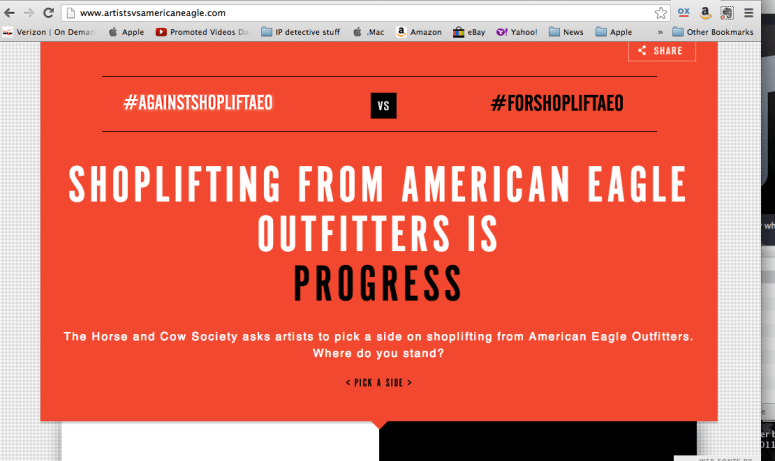
Artists vs. American Eagle. An edgy campaign asking people to take a stand on shoplifting and selling out. Wink wink. Artists Vs American Eagle recreates the Ghost Beach site right down to the color palette. But instead of asking you to pick a side on piracy, they’re asking you to pick a side on shoplifting from American Eagle. They even have hashtags at the read. #AGAINSTSHOPLIFTAEO and #FORSHOPLIFTAEO

BWHAHAHAHAHA.

VOX INDIE:
* Who Really Gets “Chilled” by Chilling Effects?

THE ILLUSION OF MORE:
* Copyright is Anti-Civil Liberties?

The truth is that the total volume of free expression produced by creative artists is one of the greatest buffers against social injustice within democratic societies.

In one hand the artist holds the right of free expression, and in the other, he holds copyright. Wielded together, these tools have done more social good than any politician could ever hope to achieve.

THE REGISTER:
* P2P badboys The Pirate Bay kicked out of Greenland: Took under 48 hours

TPB had hoped that when it registered itself in the tiny country – an autonomous constituent of Denmark with a population of just 57,000 people – it would finally have a safe home. Its new host had other plans, though.

“Tele-Post has today decided to block access to two domains operated by file-sharing network The Pirate Bay,” the company said in a statement.

ALL AFRICA:
* Namibia: Nascam Takes Action Against Piracy

DIGITAL MUSIC NEWS:
* A Reader Asks, ‘Why Do You Hate Spotify So Much?’
* 40 Years of Music Industry Change, In 40 Seconds or Less…
* Artist Group Asks: ‘Is Shoplifting from American Eagle Stealing, or Sharing?’

WIRED:
* Report: US government agencies’ adverts inadvertently support piracy

Along with corporate brand names appearing on the sites, from Adidas and Amazon to Walmart and World of Warcraft, the US Army found its way on to alleged pirate sites, the Verge first pointed out.

THE VERGE:
* US government agencies are advertising on accused pirate sites

LIMERICK LEADER:
* Priests and piracy: Retailers reel from illegal downloading

AHRAM ONLINE:
* Arab Publishers failing to fight book piracy, risking future

BERKLEY TECHNOLOGY LAW JOURNAL:
* The Purpose of Copyright? Examining the Retracted Republican Study Committee Brief

Which are the relevant facts, figures, and considerations to the debates surrounding the extent and limitations of copyright? After comparing Khanna’s brief and Hart exegesis, what emerges seems to be a disagreement about not only the direction copyright reform should take, but also the philosophical precepts that determine source of law, historical interpretation, and, in essence, reality.

MUSIC ALLY:
* The challenge of connecting the streaming music silos
* US music sales fell 0.9% in 2012 as digital revenues topped $4bn

The $7.1bn is still above 2010′s low point of $7bn, but it’s not yet the sustained bounce-back that the industry was hoping for.

TORRENT FREAK:
* IMAGiNE Piracy Group Founder Jailed For 23 Months
* YouTube’s Deal With Universal Blocks DMCA Counter Notices

YouTube enters into agreements with certain music copyright owners to allow use of their sound recordings and musical compositions.

In exchange for this, some of these music copyright owners require us to handle videos containing their sound recordings and/or musical works in ways that differ from the usual processes on YouTube.

In some instances, this may mean the Content ID appeals and/or counter notification processes will not be available.

REASON:
* The Long, Fruitful History of Music Piracy

Rather the book is valuable because it shows how long, and how thoroughly, the history of recorded music has been the history of “pirated” music. It turns out that the Internet isn’t apocalyptically transformative. It’s just a new extension of an old dynamic. And that means that rather than creating apocalyptically transformative new legislative solutions, we could instead perhaps look to the past for ideas.

CREATIVE AMERICA:
* Study finds that removing just one pirate site benefits creators.

Artists Give Madison Ave and American Eagle Outfitters a Lesson in Messaging. Meanwhile Ghost Beach Gets Buried.

Last week we covered the strange and divisive “Artists Vs Artists” campaign brought to you by   American Eagle Outfitters and Madison Avenue firm TBWA Chiat Day.  In case you’ve been in a cave for the last week this consisted of four story high LED billboards on the front of the American Eagle Outfitters store in Time Square.  On these billboards provocative slogans like “Piracy is Freedom” and “Piracy Is Our Generation”  were displayed. The related (Chiat Day registered and owned) website  www.artistsvsartists.com mirrored the campaign.

Now as reported by Adland.tv and Digital Music News an anonymous group of artists has responded with their own campaign.  “Artists VS American Eagle Outfitters.”  The campaign parodies the original site and recycles the same “conversation starting statements”  except  “Piracy”  is replaced with “Shoplifting From American Eagle Outfitters.”  The fake twitter comments are a must read!

Screen Shot 2013-04-02 at 6.39.50 PM

Overlooked in all of this has been  the fact was that this campaign was partial compensation for the band Ghost Beach.  The band had earlier supplied a song for an American Eagle promotion. American Eagle paid the band back by giving them the billboard space.  In theory this billboard campaign was supposed to generate sales for Ghost Beach.

 Personally I have empathy for the band.  They are just trying to make a name for themselves in a very difficult time. But as usual when the artist’s agenda meets the corporate agenda the artist always gets buried.  The band has become a footnote to the story.  Despite some chatter in the tech blog echo chamber we can objectively conclude the campaign has generated little real engagement for Ghost Beach.

Screen Shot 2013-04-02 at 6.33.43 PM

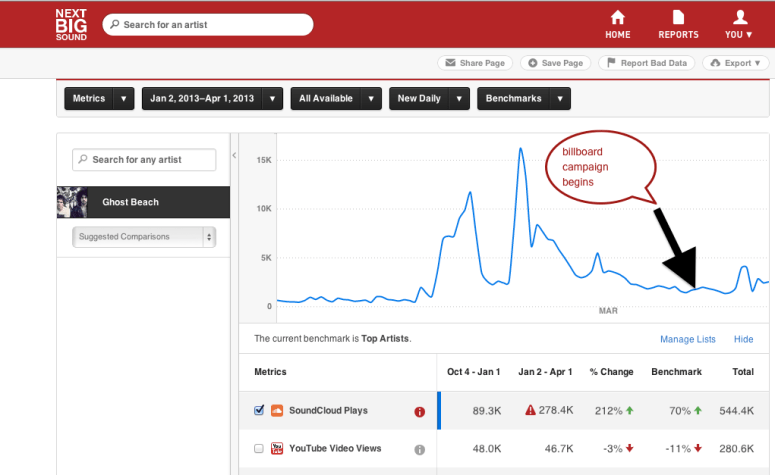
Above  are publicly available metrics for Ghost Beach’s social media activity.  In this case facebook likes. The big spike you see is generated by Ghost Beach’s touring activity on the west coast.   On the right the solid line indicates the duration of the  $50,000 Times Sq Billboard campaign which appears to have generated almost nothing for the artist

Younger acts don’t often don’t want  advice from legacy artists like myself, but I’m gonna give them my two cents anyway:  Touring is the most reliable way to engage fans and sell music. One wonders what $50,000 worth of tour promotion  and support from American Eagle Outfitters  would have done for the artist?

It is also rarely mentioned that the band itself Ghost Beach is Anti-Piracy.  In a thoughtful statement the band clearly states on it’s website:

 “In no way do we want to encourage theft of intellectual property.”

Whatever one thinks of this campaign, this fact has been lost in the story.

+++++++++++++++++++++++++++++++++++++++++++++++++

The other metrics generally agree. SoundCloud spins for Ghost Beach.  To be fair there looks to be a small bump up  after NY Times article which was clearly the result of the billboard campaign. 

Screen Shot 2013-04-02 at 9.49.14 PM

YouTube Views are always very “noisy” but this is  trending down slightly.  But I still like YouTube views cause they are now harder to manipulate then SoundCloud. 

Screen Shot 2013-04-02 at 9.49.30 PM

Twitter may show a spike almost as big as the one generated by their touring activity. But the twitter followers start from a very low number.  So the spikes are a daily gain of a little over 30 twitter followers.  Also after looking at the actual tweets it seems like this spike is just before the start of the  billboard campaign and is more likely the result of their SXSW live showcase.

Screen Shot 2013-04-02 at 9.53.43 PM

Music Technology Policy

“It’s possible to make forgetting impossible, because we can all wear our Google Glasses that will store everything we see. Whereas if you actually thought deeply about the role of forgetting in enabling us to become who we are, perhaps you would actually find some redeeming features to that process.”
–Evgeny Morozov, quoted in the Globe and Mail

Riddle me this:  Would there have been a Street View without a Wi-Spy?  Or a Wi-Spy without a Street View?  If Google had sent cars around the world with just the Wi-Spy sniffers, would they have gotten away with it for as long as they did?  Which is the more valuable to Google long term?  Pictures of your house or the location of your wi-fi?  Which gives them more hyperaccurate (you know…innovative) maps?  Can they resell the pictures of your house to the National Security Agency, or would the government be more…

View original post 997 more words

Madison Avenue Firm TWBA Chiat Day Runs Pro-Piracy Billboards In Times Square. Is this Payback For Calling Them Out on Ad Supported Piracy?

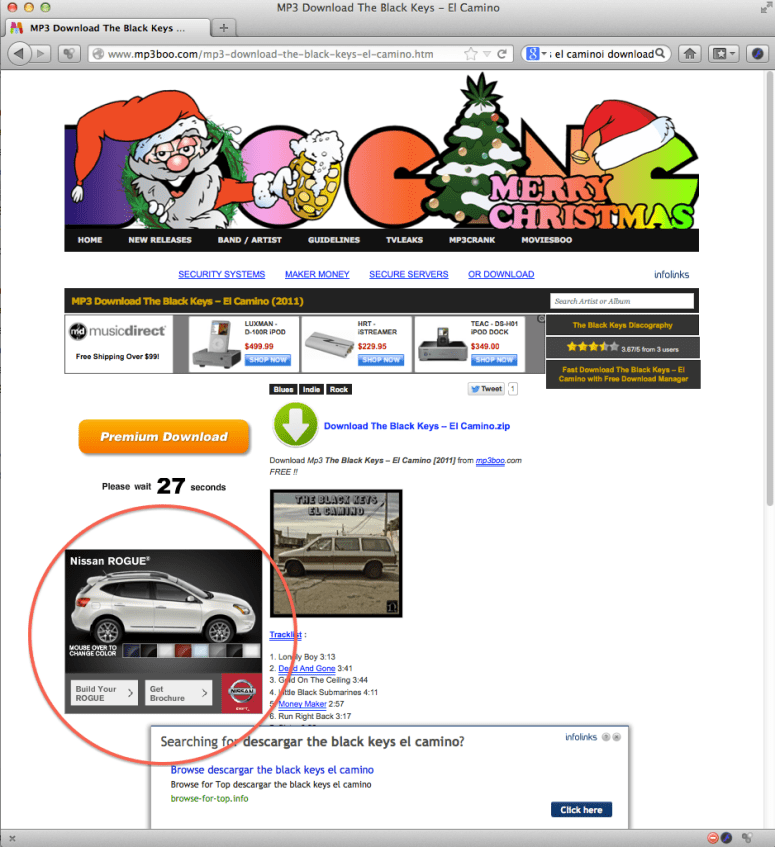
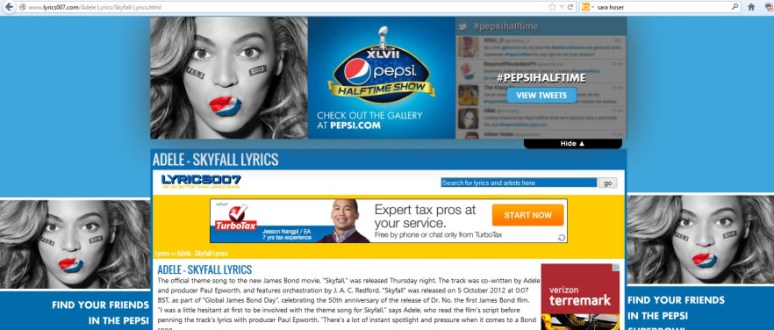
As we have detailed here many many times on The Trichordist,  the advertising industry profits by selling advertising to pirate sites like www.webgalu.com.   But we were  mightily surprised to see advertising firm  TBWA Chiat Day,  apparently doubling down and actually running billboards in Times Square that say things like “Piracy is Progress”.   I can see why they think it’s “progress” if they profit from this exploitative practice.  Here at The Trichordist we have repeatedly called out companies that TBWA Chiat Day lists as their clients for advertising on these sites–and we know in some cases the complaints went up the flagpole.

That is why we ask:

 Is this some sort of Ad-Agency-Gone-Cowboy payback scheme?  We’re open to other explanations, but the “PIRACY IS PROGRESS” campaign seems to us to be both straight out of Orwell’s 1984 and retaliatory against the many brand sponsored piracy efforts.

Especially since another aspect of this campaign is a highly manipulative and cynical attempt to pit artists against artists.  

Examples of companies that TBWA Chiat Day claims as clients that we spotted also advertising on pirate sites:

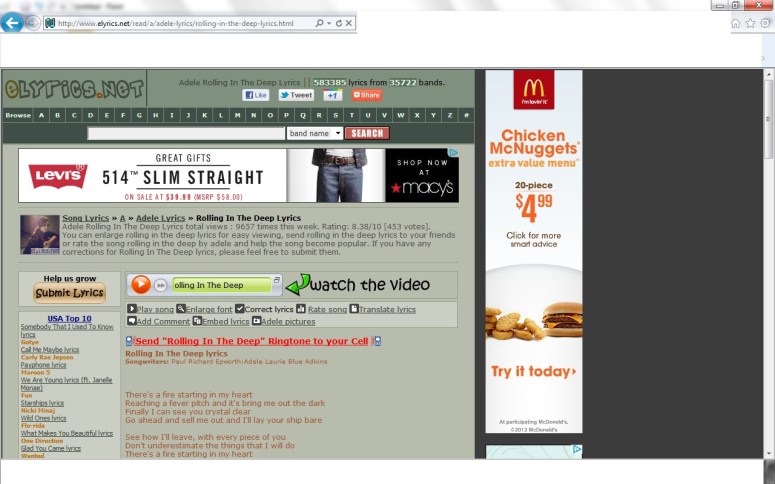
bk_mp3boonissan

lyrics007-adele-pepsi

adele-rolling-in-the-deep1

Artist Rights Watch – Monday March 25, 2013

THE HILL:
* Protect rights of artists in new copyright law

Should Congress take on the challenge of updating the Copyright Act, it must do so guided by sound principles, and its deliberations must be based in reality rather than rhetoric.

Chief among these principles is that protecting authors is in the public interest. Ensuring that all creators retain the freedom of choice in determining how their creative work is used, disseminated and monetized is vital to protecting freedom of expression. Consent is at the heart of freedom, thus we must judge any proposed update by whether it prioritizes artists’ rights to have meaningful control over their creative work and livelihood.

ZIMEYE:
* Mukanya’s Concern on Music Piracy: The New Zimbabwean Epidemic

Personally, I take unbridled umbrage at such individuals who are tired of working real jobs and are now trying to snatch easier ways to cut corners and make survival here in the Diaspora. By committing such nasty internet acts of pirating on our Zimbabwe musicians products they are feeding on other people’s blood.

This is in cases where most of our entertainers throw in their blood, sweat and tears to emerge with such scintillating music hoping to make headlines, best sellers and earn decent income. I would then wonder why someone would, from the blues, make such an evil act of trying to benefit from someone’s work using the internet, hoping not to be caught.

BUSINESS WEEK:
* Congress Reviews the Copyright Act in the Digital Age

BILLBOARD:
* Business Matters: Digital Piracy Study Conflicts with Two Papers it Cites

There have been numerous studies that have concluded file sharing hurts recorded music sales. The JRC study is different because it focuses only on file-sharing’s effect on digital purchases.

* SXSW: David Lowery and Co. Lash out Against Industry ‘Pimps’

Lowery said it was incumbent on artists to speak out about the importance of paying for music. Many artists who defer to corporate interests suffer from a kind of “Stockholm Syndrome,” he said.

“Lars Ulrich was the first to speak out and they put his head on a stake,” Lowery said, referring to the backlash against the Metallica singer after he took Napster to court in 2000. “But Ulrich was right. If you go back and watch his interview with Charlie Rose, everything he said came true. The technologists were wrong.”

COPYRIGHT ALLIANCE:
* Worth the Wait: 9th Circuit Delivers Big Win for Creators in Isohunt Case

the court pointed to numerous instances in which Fung was instrumental in assisting users in finding, acquiring, and burning infringing content. The court also explained how Fung profited off this infringement:

“Fung promoted advertising by pointing to infringing activity; obtained advertising revenue that depended on the number of visitors to his sites; attracted primarily visitors who were seeking to engage in infringing activity, as that is mostly what occurred on his sites; and encouraged that infringing activity. Given this confluence of circumstances, Fung’s revenue stream was tied directly to the infringing activity involving his websites, both as to his ability to attract advertisers and as to the amount of revenue he received.”

THE MUSIC VOID:
* EU Piracy Report – Ramifications For The Music Business

More importantly, there can be no argument that Google has played a massive unarguable part in helping piracy to thrive. Whether that was intentional or not is a moot point. The fact is you can type in any artist name and you links will have links to pirate site’s outnumbering those to legal sites.

The recent campaign to shame brands who’s advertising supports illegal file sharing sites is a worthy cause which TMV supports.

It would be helpful if Google gave all of the revenue it earns from SEM directly related to pirate sites back to the industry so rights holders and ultimately artists actually got paid from pirate sources. Hitting the pirates in the money pocket is exactly the right way to bring them to the negotiating table. Why do we want to negotiate with such people – because the user data is of immense value to brands and music rights holders themselves.

BRAND-E.BIZ:
* Ads fund illegal music, says IFPI

“Brand owners typically want to avoid the reputational damage that can be caused when their advertisements are placed on websites that engage in or facilitate unlawful activity,” says the IFPI. “They also want to be sure their advertising budget is not providing financial support to unlicensed websites.”

VOX INDIE:
* A Good Week for Copyright
* Mirror, Mirror…Why Does the Anti-Copyright Lobby Live in Opposite World?

The talking points echoed by the panel at SXSW reflected the anti-copyright lobby’s disingenuous mantra that content creators seeking to protect their work from theft should be viewed as criminals, while those who brazenly steal (and monetize) the work of others are somehow the “innovators.” Are you serious? I hate to break it to these folks, but the tech industry does not have first dibs on the adjective “innovative.”

Creative artists have always thrived on the cutting edge–and while the modern-day tech industry has developed new means of delivery and consumption–their innovations would be useless were it not for the content their products deliver. In many ways, creative content is the fuel has fed the tech revolution. Why can’t we have a discussion that acknowledges this symbiosis, rather than diminishes it?

THE ILLUSION OF MORE:
* More Than 3Dimensions
* Copyright, copyright everywhere…

So, for anyone who reads this blog and is not knee-deep in the gore of the copyright battle, the big picture as I see it this: I believe the copyright system will change over the next decade or so, but if that change is predicated too much on the self-serving premises of its tech-industry antagonists, the results for artists in particular, and for society in general, will be regressive rather than progressive. It would be like allowing the oil industry to overly influence emissions policy.

MUSIC WEEK:
* IFPI slams EU piracy study as ‘flawed and misleading’

The findings seem disconnected from commercial reality, are based on a limited view of the market and are contradicted by a large volume of alternative third party research that confirms the negative impact of piracy on the legitimate music business.

CENSORSHIP IN AMERICA:
* Music Censorship – A Timeline

SPITFIRE HIPHOP:
* What You Can Do Today – To Stop Brand Sponsored Piracy Through Touring Contracts or Sponsor Deals: Artists Helping Artists

If you are like most artists, you feel overwhelmed by the alliance of Big Tech and Fortune 500 companies allied against us in the intricate network of brand sponsored piracy.

ABC ONLINE:
* Internet Piracy – is it a right to not pay artists you like?

The self-righteous anger of free downloaders reveals much about the weakness of human nature and the often heartless and faceless nature of what constitutes debate on the internet.

This is one of the most revealing books about how technology shapes us I have ever read. It goes far beyond the normal platitiudes and in forensic detail explains the connections between human endeavour, morals, consumption and commerce.

DIGITAL MUSIC NEWS:
* Streaming Accounts for Just 4 Percent of Global Recording Revenues, Study Finds…
* For the First Time Ever, Song Downloads Are Declining In the US…
* Chevrolet Is Now Financing Grooveshark’s Mobile Expansion…
* Why Non-Disclosure Agreements Are Making It Impossible to Watch a Video In Germany…

A source close to one of the other negotiations with YouTube said that the rights holders had proposed that they’d base the deal on a revenue share – a proposal that seems more than fair. Only problem, the source said, is that Google/YouTube won’t tell anyone what its revenue and profits are.

For a corporation that has based its entire business on the sharing of information, it’s somewhat ironic how reluctant it is to share its own.

THE VERGE:
* Google accidentally blocks entire Digg domain from search, is working on a fix

MASHABLE:
* Supreme Court Refuses to Hear $220k Music Piracy Case

This is the third time the court has refused to hear a peer-to-peer piracy case. One of the other cases was that of Joel Tenenbaum, the other person who refused to settle with the RIAA, and was sentenced to pay $675,000 for downloading 30 songs. The Supreme Court declined to hear his case in May.

TORRENT FREAK:
* Spain to Crackdown on Pirate Sites and Outlaw File-Sharing
* isoHunt Loses Appeal Against the MPAA, Keyword Filter Remains
* Fresh Calls to Congress to Make Movie and Music Streaming a Felony
* MPAA: Pirates Can’t Hijack Freedom of Expression

THE SUN DAILY:
* Putting a stop to digital piracy

Internet companies all work together to block IP addresses that broadcast spam (www.spamhaus.org/). This doesn’t “break the internet” or “violate free speech”. The notion that brilliant technologists in the US$400 billion telecom business that is growing at 10% a year and the US$28 billion internet advertising business that is growing 10% a year can’t help make the internet a just and ethical marketplace for musicians is false.

DIGITAL TRENDS:
* Set-top showdown: Apple TV vs. Roku 3 vs. Boxee Box vs. WD TV Play vs. Google TV

TORONTO STAR:
* Government urged to invest in music industry to drive economic activity

Music Canada has come up with 17 recommendations in a report, “The Next Big Bang: A New Direction for Music in Canada,” released at Canadian Music Week this week.

SPYGHANA:
* Dying Musicians cry out over 1M CD sales drop to 50K

The National Chairman of Ghana Musicians Rights Organisation (GHAMRO,) Mr. Carlos Sakyi, has lamented the increasing rate of piracy in the industry saying it is collapsing Ghana’s music industry.

THE INDIAN EXPRESS:
* Piracy Equals Drunken Driving

Flipkart made a clear distinction about guilt-free downloads, paid or otherwise. It was an affirmation that downloading music (or movies) off torrents has now become a sort of uncool behaviour…much like drunken driving.

THE FUTURE OF COPYRIGHT:
* Controversial copyright bill passes German Upper House

On 1 March 2013, the Bundestag, the Lower House of the German Parliament, approved a new legislative proposal that aims to protect the copyright of publishers on the Internet. The new bill would require search engines and news aggregators like Google News to pay a fee for displaying content longer than “individual words or short excerpts” (snippets). Read more in our previous article on this topic.

THE DEANS LIST:
* Music, Copyright and New Technology in the News From a Creator’s Perspective

THE LEFT ROOM:
* Piracy, free books, etc

5. What I think

I have endless and fantastically violent contempt for the sites making money off the back of work they didn’t help create, and for the people behind them. I have nothing, really, against the ordinary people who illegally download my books – I can’t stop you, most of you wouldn’t have bought them anyway, and I just hope that, if you enjoy them, you consider buying some of them at some point, to support not just me, but also the other people, less visible, whose work made my books possible in the first place.

WIRSINDLEGION:
* The Pirate Bay and human rights

STOP THE CYBORGS:
* Google Glass ban signs

For a complete listing of every weekly update of the Artists Rights Watch, CLICK HERE!

Like A Rock. Digital Music News Reports that Chevrolet Is Sponsoring Grooveshark’s Mobile App.

Paul Resnikoff at Digital Music News is reporting that Chevrolet is sponsoring the new Grooveshark App. We verified this.  For those that don’t know, Grooveshark is NOT a legitimate streaming service.  Like most artists, Grooveshark has my entire catalogue available for streaming despite the fact they do not have permission to use my songs  nor have they ever paid me the proper royalties.

But what is amusing about all of this is that Chevrolet more than any other truck brand has relied on performers to build their brand and their image.  In particular they have relied on Bob Seger.   “Like A Rock”  the Bob Seger track was the Chevy truck theme song for years.

Here is Chevrolet exploiting Bob Seger via Grooveshark.  This was at 12:35 pm EDT  March 21 2013.

chevy grooveshark

like a rock and grooveshark

My Cracker catalogue on Groove shark.  (Oh yeah screw you WestJet).

cracker on grooveshark

My CVB Catalogue on Grooveshark (again screw you WestJet).

cvb on grooveshark

IsoHunt Court Ruling Notes “Ad Sponsored Piracy”: Exploitation is not Innovation

The 9th Circuit delivers a substantial win for creators in its IsoHunt ruling, as The Copyright Alliance notes in it’s summary which quotes this from the court directly,

“Fung promoted advertising by pointing to infringing activity; obtained advertising revenue that depended on the number of visitors to his sites; attracted primarily visitors who were seeking to engage in infringing activity, as that is mostly what occurred on his sites; and encouraged that infringing activity. Given this confluence of circumstances, Fung’s revenue stream was tied directly to the infringing activity involving his websites, both as to his ability to attract advertisers and as to the amount of revenue he received.”

It would appear that the motives of these for profit businesses are being seen for what they are, nothing more than than the blatant exploitation of artists and creators. It should be recognized that this practice is not unknown within the online advertising/tech business either, as reported by Jack Marshall’s post titled “Why is Ad Tech Still Funding Piracy?” in DigiDay,

Visit the top torrent search engines, and you’ll find ad calls from Yahoo, Google, Turn, Zedo, RocketFuel, AdRoll, CPX Interactive and others. These sites exist to connect people with illegal downloads of intellectual property, a practice that’s estimated to cost the U.S. economy $20 billion in the movie industry alone. No matter your feelings about U.S. copyright laws, they are laws, and there’s no doubt these sites facilitate illegal behavior, even if they don’t house the content themselves. The oxygen that sustains many of these sites is advertising, delivered by the vast archipelago of the ad tech industry.

According to AppNexus CEO Brian O’Kelley, it’s an easy problem to fix, but ad companies are attracted by the revenue torrent sites can generate for them. Kelley said his company refuses to serve ads to torrent sites and other sites facilitating the distribution of pirated content. It’s easy to do technically, he said, but others refuse to do it.

“We want everyone to technically stop their customers from advertising on these sites, but there’s a financial incentive to keep doing so,” he said. “Companies that aren’t taking a stand against this are making a lot of money.”

If you want to see more examples of Ad Sponsored Piracy in action, see our post, “Over 50 Major Brands Supporting Music Piracy, It’s Big Business!” Mainstream awareness of the subject has been growing due in part  by the work being done by the Annenberg Innovation Lab which has been reported in the Los Angeles Times and The New York Times earlier this year. And The Wall Street Journal also reported on the role of advertising in its reporting of wider ranging issues facing creators battling online piracy,

Another focus is online-ad networks, which media companies say help finance piracy by placing ads on sites that traffic in unauthorized content. A study last summer, commissioned in part by Google, found that 86% of peer-to-peer sharing sites are dependent on advertising for income.

As more awareness builds, the truth becomes plain to see and painfully obvious. Unfortunately there are still those in the tech blogosphere who like to defend businesses exploiting artists and claiming that this is a non-issue making statements like, “internet display ads pay next to nothing.” This remark seems to be a direct contradiction with the statement by the very knowledgeable AppNexus CEO Brian O’Kelley, who above stated, “Companies that aren’t taking a stand against this are making a lot of money.”

Bottom Line: Exploitation is not Innovation.

Ad Sponsored Piracy is a land grab by internet BUSINESSES to steal money from musicians, artists, photographers, authors and other creators. It’s about money.

Music Technology Policy

I’ve had enough questions lately about why I started focusing on brand sponsored piracy that I thought it important enough to give credit where it’s due.  It all started with this quotation from Professor Eric Goldman, commenting on the dip in Google’s stock price after the announcement that it had dodged a career-ending indictment for promoting the sale of illegal drugs when the Department of Justice allowed the company’s executives to pay a fine with $500,000,000 of the stockholders money.

The Google drug dealing case was followed by a still-ongoing shareholder lawsuit that named, among others, the entire Google board of directors and certain executives including Larry Page and Sheryl Sandberg.  Yes, that Sheryl Sandberg.

Shareholder Suite

Here’s Professor Goldman’s money quote, so to speak from the New York Times:

“Web companies can be held liable for advertising on their sites that breaks federal criminal law, and Google and…

View original post 344 more words