Hypebot Have No Defense of Ad Supported Piracy So They Resort To Name-Calling.

East Bay Ray of The Dead Kennedys  and I had an informal bet going.  Well maybe not a bet,  just a sort of prediction that once Ray spoke against ad supported piracy at SF Music Tech,  the music tech bloggers would start with the usual name calling. 
 
 Sure enough right on cue we see Bruce Houghton’s Hypebot giving Mike Masnick (see the “Google Shill List”) a platform to bash Ray and other  artists. “Whining” “Old” “Grumpy” and “Rant” were some of the unfair and unbalanced terms  that Ray and I predicted they would use in the de rigueur  postSF Music Tech cyber bullying. And they did.
 
This is pretty sad since ending ad supported piracy is a no-brainereven Google and Yahoo! fall over themselves to try to explain their unexplainable connection (see USC Annenberg Innovation Lab report).   Both artists and the legitimate music tech firms are negatively affected by ad supported piracy.  For instance legitimate music streaming services have to compete against these same unlicensed services for ad revenue.   Why the music tech space bloggers fail to grasp this is a mystery.
 
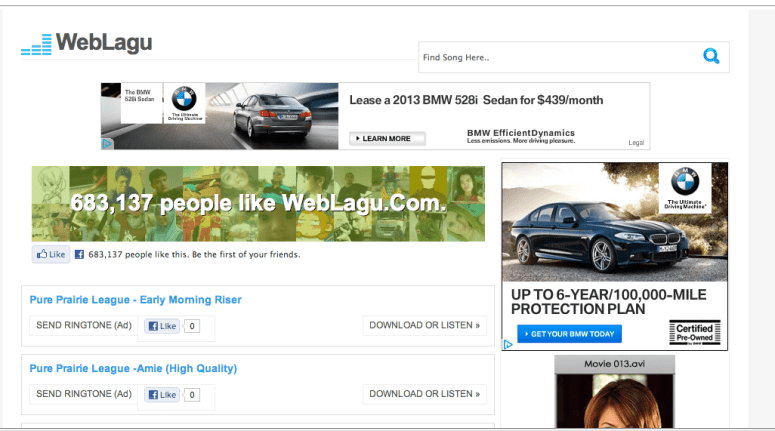
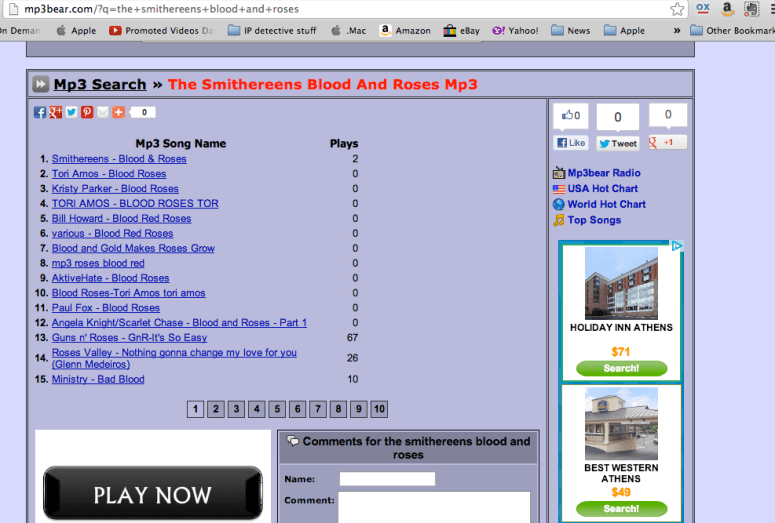
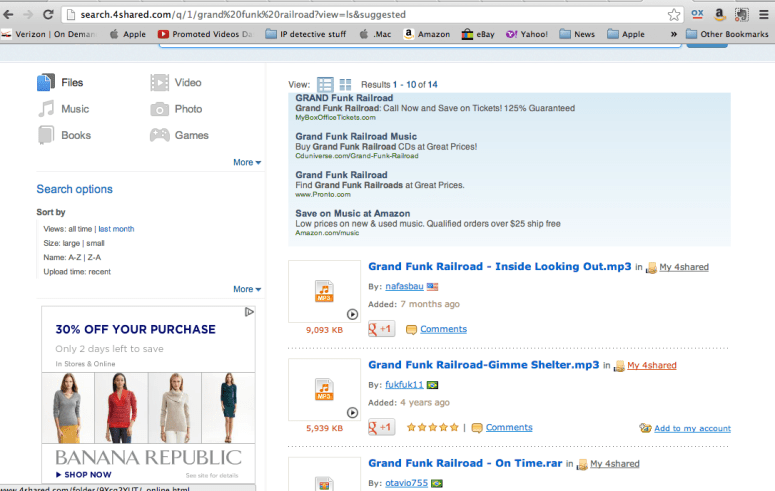
Bruce Houghton also owns the talent agency  Skyline Agency.   This agency tends to have a lot of “Old” and “Grumpy” artists that would probably go on a “Rant” if they were to see that their agency head is tacitly defending this practice.  So we prepared a few screenshots.  
 
Any comment Bruce?  Do you think that this practice is acceptable?  How do our “future” music models like streaming compete with the  guys that don’t pay any royalties to artists?   We’re all ears. 

Pure Prairie League piracy brought to you by BMW.

Screen Shot 2013-02-22 at 3.57.36 PM

Al Stewart By Celestion and zZounds.

Screen Shot 2013-02-22 at 7.23.02 PM

The Smithereens By Priceline

Screen Shot 2013-02-22 at 7.29.48 PM

Grand Funk Railroad By Banana Republic, Amazon and others. 

Screen Shot 2013-02-22 at 7.32.59 PM

Music Technology Policy

Greg Sandoval is one of the great reporters on tech and music.  While I don’t always agree with him, I think he’s fair and one thing I know for sure–he is old school when it comes to getting facts and sources right.  So when Sandoval says Spotify is going back to the well to drive down artist royalties even further, you better believe that I believe him.

According to his story at the Verge:

About 70 percent of Spotify’s revenues pays music-licensing fees while another 20 percent covers customer acquisition, these sources said. That leaves 10 percent to pay all of the company’s other costs, including its much praised technology platform. Insiders have told The Verge that this cost structure zeroes out Spotify’s profits.

So brace yourself–Spotify is about to do a Pandora-style argument about how artists should take even less because Spotify’s “profits” are consumed by royalties.  (And…

View original post 831 more words

Music Technology Policy

MTP readers no doubt saw the coverage on last month’s installment of the USC-Annenberg Innovation Lab transparency report that identified ad networks that facilitated IP theft.  Now we see that this month’s report names brands.  You can read all about it here.

Here’s a sample of the top brands driving brand sponsored piracy and theft from artists:

Amazon

American Express

AT&T

BMW

Buick

Converse

Dropbox

Equifax

FingerHut

General Motors

Honda

K Swiss

Lenovo

Lexus

Mazda

Mercedes Benz

Nationwide Insurance

Nissan

Nokia

Progressive Insurance

Saks Fifth Avenue

Samsung

State Farm Insurance

Toyota

Transunion

Verizon

Victoria’s Secret

Visa

Volkswagen

WalMart

View original post

Artists Rights Watch – Monday Feb 11, 2013

A Weekly Recap of Artists Rights, Copyright and Technology News for Creators from Around The Web

THE WALL STREET JOURNAL:
* Reappearing on YouTube: Illegal Movie Uploads

The recent problematic uploads may have undercut the rental effort. Movies produced by Disney’s Touchstone Pictures, such as “I Am Number Four” and “Shanghai Noon” are available free on YouTube, even though the studio struck a rental deal through the site.

HYPEBOT:
* Spotify Listener Data Used To Predict Grammy Winners

THE GUARDIAN UK:
* Pirate sites are raking in advertising money from some multinationals

Sites such as Pirate Bay often portray themselves as altruistic, non-profit “freedom fighters”, when the truth is they’re nothing of the sort – their exploitation of artists for their own monetary gain is far worse than the most unscrupulous labels ever were, as they pocket large sums of ad revenue without having to invest it into developing the content they flog.

MUSIC TECH POLICY:
* Pirate Site Isohunt Selling Dead Kennedys Tickets

JAPAN DAILY PRESS:
* Japan’s ‘Operation Decoy File’ to help deter online piracy

THE DEANS LIST:
* Music, Copyright and New Technology in the News From a Creator’s Perspective 02/05/2013

COPYHYPE:
* Friday’s Endnotes – 02/08/13
* Bringing Reality Back to Copyright Debates

Smith and Telang found that of the papers based on empirical data (as opposed to theoretical models), 25 found economic harm from piracy, while only 4 found little or no harm. And for those who are skeptical of non-academic papers: Smith found that 12 peer-reviewed papers published in academic journals found a negative impact from piracy while only 2 did not (and there are legitimate questions concerning the methodology of those 2 outlier papers, some of which are explored in Stan Liebowitz’s 2005 article Economists’ Topsy-Turvy View of Piracy).

Evidence like this, of course, does not tell us where to go from here. But it is amazing how many who join with skeptics of copyright either don’t know about the scholarly record on piracy or don’t care.

DIGITAL MUSIC NEWS:
* The Average TuneCore Artist Now Makes $120 a Year…
* Spotify Executive: “We’re Totally Transparent, and We Definitely Live by That Principle.”
* In Just 3 Years, P2P Usage Has Dropped 35% In France…

FORBES:
* We Need Strong Copyright Laws Now More Than Ever

So why does CEA attack songwriters in this way? Flawed logic. They reason that member companies can make more money if they pay songwriters and other creators less. The truth is that music creators and technology companies need each other. Many innovative and wonderful music-related products are made by CEA members. But many of these products have no purpose without music. The copyright and associated costs—often pennies on the dollar—are deemed harmful. Make no mistake, the companies of the CEA believe in intellectual property. Just ask them about their own intellectual property, such as their patents or trademarks.

Mr. Shapiro’s conclusion is that copyright laws are hurting America. Nothing could be further from the truth.

CNET:
* Next-gen Xbox will require constant net connection

THE HOLLYWOOD REPORTER:
* Recording Academy Chief on the Grammys, Pandora and Getting Artists Paid (Q&A)

The problem is, in the transition of all this, we have to remember that it all comes back to the men and women who are creating this wonderful music, and do they have a real ability to make that a full-time vocation as opposed to a part-time hobby?

USWITCH:
* Fines to replace disconnections for internet pirates?

SMART COMPANY:
* Why Telstra plans to slow you down to fight online piracy

Telstra will soon conduct a “limited trial of a range of technical options for better managing broadband internet performance for our customers during peak periods”. One of those options is to “shape”, as the industry euphemism puts it, customers’ access to peer-to-peer (P2P) file distribution networks such as BitTorrent.

PC PRO:
* Anti-piracy letter plans face delay over costs

COMPLEX:
* The 25 Most Important Civil Rights Moments in Music History

BILLBOARD:
* Business Matters: MP3 Stores Harder to Find as Google Search Removal Requests Accumulate

Legitimate MP3 links are becoming harder to find even as the RIAA has sent more than 3,400 removal requests to Google relating to approximately 10 million specific URLs from its search results. Legal stores like Amazon and Myxer, as well as legal streaming sites like YouTube and legal streams and downloads at music blogs, are buried under more illegal MP3 links than when Billboard.biz examined 30 artists in November.

Now, using the same 30 artists as before, it took an average of 11.06 search results to find the first legal search result of any kind and 26.84 search results to find the first legal MP3 store. In November, the results were 7.9 and 11.75, respectively. (Each search was conducted by typing in “MP3” and then the name of the artist. Two spellings were used for Ke$ha and P!nk.)

SONIC SCOOP:
* Input\Output Podcast: David Lowery and the Future of Artists’ Rights

SPIN:
* Music Piracy’s Search Problem: Recording Industry Bringing the Fight to Google

THE DUQUESNE DUKE:
* Pirating or advancing; Debating illegal music downloads – Stealing intellectual property is still a crime

The debate against music piracy has also decreased in popularity. Illegal downloading has become a socially accepted practice and as friends talk about what music they recently downloaded, they forget that they are discussing a crime.

Because of piracy, the music industry is in a downward spiral. And when the time comes for our favorite musicians to pack up their instruments and cancel their tours, we will look at each other, dumbfounded, wondering what could have caused such misfortune to manifest. We will blame the labels. We will blame iTunes. We will demonize Justin Bieber and denounce greed.

But what is really holding the industry back isn’t the greed of the structure. It’s the greed of the people who believe they have the right to all the music they want without paying for it. For the love of music, buy the album and appreciate it for what it is worth.

RAPID TV NEWS:
* Legal content downloading up in France, video and TV series stir piracy

CNN:
* What happens if the price of music falls to zero?

THE HUFFINGTON POST:
* The Internet Is Not Free by Lowell Peterson Executive Director, Writers Guild of America, East

So far, the brightest minds in the business have not figured out how to replicate the revenue streams currently generated by television advertising, theater tickets, and DVD sales, so the market for programs created directly for digital distribution has been pretty thin. Thus, if traditional television and cinema are displaced by the Internet, there will not be enough high-quality content for the ISPs to distribute unless we can figure out how to generate more money to pay people to create it.

TERRIBLE MINDS:
* 25 Thoughts On Book Piracy

MUSIC ALLY:
* Pandora’s active listeners dropped by 1.5m in January

HARPERS:
* Google’s Media Barons

As a journalist and board member of the Authors Guild, I’ve watched in dismay as writers, living and dead, have suffered steep drops in income and copyright control thanks to Google’s — and its smaller rivals’ — logistical support for pirating and repackaging everything that we writers, editors, and publishers hold dear. From the humblest newspaper reporter to the most erudite essayist, we do the work, we invest the money and time, some of us risk our lives — and Google, broadly speaking, reaps the benefits without spending a dime.

FROM THE TRICHORDIST:
* What You Can Do Today to Stop Brand Sponsored Piracy Through Touring Contracts or Sponsor Deals: Artists Helping Artists
* Yes, Piracy Does Cause Economic Harm
* Streaming Services Ranked By “Artist Friendliness”
* Wolves in Sheeps Clothing Criminalizing All Who Oppose Them But for He Who Brings the $unlight: The Troubled, $trange, Fearful, Frightened World of Gary $hapiro, the Diogenese of Anti-Copyright Lobbyists
* Google, Advertising, Money and Piracy. A History of Wrongdoing Exposed.
* Google’s Dehumanized “Safe” Advertising Practices in Gmail: More Laughs From the Leviathan of Mountain View
* Music Streaming Math, Can It All Add Up?
* One Bad Apple: The Complete Checklist on Google’s “Non Anti-Piracy” Anti-Piracy Policies

We love Google. We really do. However it’s these kinds of practices that harm artists and creators that are very, very disappointing.

Music Technology Policy

Written by Chris Castle

[Editor Charlie sez: It was recently reported that Google has now received notices for over 10 million infringing links in search results–actually a low number given that Google receives 3 million notices a week for search alone–i.e., not counting Blogger or YouTube.  Before the anti-copyright crowd goes spinning into the ether that the volume of notices is somehow evidence of the orphan cause of action “copyright misuse”–Google acknowledges that 97% of these notices are properly sent.  “One Bad Apple” was first posted on 9/2/2011 after the COICA legislation caught Google’s attention and the company announced it was taking steps to protect the interests of artists because they really do care.  It was reposted on January 13, 2012–no change.  And as we all know–purity is a prophylactic against scrutiny.  Let’s see how much–if anything–has changed since January 13, 2012.  The answer?  Nothing.]

This post is a compilation…

View original post 6,191 more words

Music Streaming Math, Can It All Add Up?

Music streaming is clearly a challenge for the recording industry and even more so for the new generation of artists hoping to build professional careers in music like Zoë Keating. This new report from the New York Times, “As Music Streaming Grows, Royalties Slow to a Trickle” is the latest to reignite controversies about music streaming royalties.

We’ve leveled our own criticism of streaming sites in the past perhaps focusing unfairly on Spotify. But as we reported in the, Music Streaming Price Index : Pay Rates as of 12/31/11 our complaint is more with the revenue models and royalty payments than with the services themselves.

To be clear, we like Spotify and the people we’ve met that work there. We’d just like to see better royalty rates and the kind of transparency requested by Zoë Keating, and/or the kind we get from Apple’s Itunes.

We also like that Spotify and other music streaming services are legal and licensed. Spotify (Rhapsody, Zune and Napster) are far more ethical businesses than YouTube and Grooveshark. There are no unauthorized copies of an artists material on Spotify and no massive DMCA issues. We’d love to see more brands spending their money with legitimate services than the shady ad networks that feed advertising to pirate sites.

It’s now clear that the brands themselves are a big part of the problem by supporting piracy when they could be supporting the legally licensed sites. Brands, advertising networks and payment processors are driving the race to the bottom in the “optional payment” and “Illegally free” world of exploiting musicians through online piracy.

In a recent interview for Hypebot, music and technology veteran Ted Cohen sums it up well,

Do you still favor subscription over advertising-based music services?

Yes, I do. I don’t think that the advertising model so far has proved to be sustainable. I think that we have undervalued subscription. I am paying $150 a month for cable. I watch 20 or 30 hours of TV a week. I probably listen to 50 to 60 hours of music a week. I’d argue with you that music is worth more than $10 a month subscription service.

The labels were so concerned about (piracy)—and I was there at the time—that we had to come up with a price that was just a little bit more than free to convince people that they should pay. So far, we have not been able to raise the price. I think that music is worth at least $20 or $25 a month.

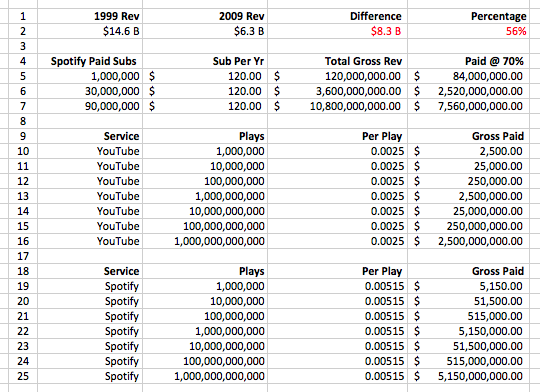
In the chart below calculations are created in tables to illustrate the simple math required to determine the revenue opportunities in different streaming models. For example, lines 5, 6, and 7 detail how much revenue Spotify can generate to artists, songwriters and rights holders paying out 70% of their gross at 1m, 30m and 90m paid subscribers.

If Spotify can capture what most believe is an optimistic amount of paid subscribers in the USA (30m) that would only generate $2.5b in revenue for rights holders. Line 2 represents the revenues of the record industry in the USA between 1999 when it was $14.6b through 2009 when it had plummeted to $6.3b leaving a loss of $8.3b annually since that time.

Maybe we’re missing something. If streaming is the future how does $2.5b in revenue from a massively successful Spotify replace the loss of $8.3b in annual earnings?

streamingmath

So in 2012 when Spotify has claimed 1 million paid subscribers in the US, that’s a payout to artists and rights holders of only about $84m. In simple math, this is about 12m albums at $7 wholesale each (what iTunes pays on a $9.99 album).

Additional food for thought is that Spotify is currently valued at 3 billion dollars. That’s just a little less then half of the entire earnings of the entire US record industry in 2012 at an estimated 7 billion dollars. This means that if the same valuation method is used for both Spotify as a single company, and the domestic record industry as a whole, than either Spotify is overvalued or the record industry is undervalued.

But there are larger problems here than Spotify. As you can see in the chart above YouTube also represents a challenge for artists and rights holders. The site was born of infringement as a business model, and despite policy changes at Google (YouTube’s parent company) the situation is still completely unacceptable for artists as East Bay Ray of The Dead Kennedy’s explains to NPR.

YouTube really deserves it’s own post, and there will be several forthcoming.  In the new “exploitation economy” artists seem to be willing to trip over transactional dollars attempting to pick up streaming pennies. Again, one of the most important distinctions between Spotify and YouTube is that Spotify does not have a massive DMCA and rights management issues that cheats artists of their due. Additionally, YouTube is paying a fraction of what Spotify is, so if this is the future, everyone is really in trouble.

Music Technology Policy

There are lots of people who have had lots of questions about Gmail, Google’s “free” email service.  You know, “free”–as in you give them your data and they sell it to advertisers to push ads to you in your emails based on–what exactly?

I haven’t met anyone who doesn’t believe that the ads get to your email by scanning your emails for keywords.  And therein lies the rub for doctors, lawyers and–world governments.  What does Google say about this?  Well, they don’t say they monetize your “information” (meaning your email correspondence).  They also don’t say that they read your mail, or at least not exactly.

Here’s what they say (or what they said today in response to criticism from Microsoft) according to Politico’s Morning Tech:

“‘Advertising keeps Google and many of the websites and services Google offers free of charge. We work hard to make sure that ads are…

View original post 367 more words

Google, Advertising, Money and Piracy. A History of Wrongdoing Exposed.

Readers of this blog will know that we’ve been gaining attention and awareness on brand sponsored piracy. We’ve noted how 50 Major Brands are Supporting Music Piracy. When that information is paired with The LA Times and The New York Times reports from the USC Annenberg Innovation Lab’s Transparency Report on Advertising Networks financing piracy we see a very clear picture emerging.

It is very clear that online piracy is a mass scale, for profit, enterprise level commercial business. There is a lot of money changing hands. Google is said to make approximately $30 Billion a year, with 97% of the money coming from advertising revenue. All of Google’s other products combined only account for less than 3% of it’s annual earnings.

So we can see that there are a lot of people making a lot money from the unauthorized, illegal infringement of artists and creators work. This is no longer about individual “sharing.” This is about businesses exploiting artists for profit, and not paying the artists a penny. We do not know of one cent being paid to artists from sites like The Pirate Bay, 4Shared and Filestube just to name a few of the major offenders.

So where does Google fit into this? Why do so many artists rights advocates focus so intently on Google? Simply because public documents have exposed Google as having knowledge of wrong doing and doing nothing about it – until they got busted, red handed, twice.

In 2011 Google paid $500,000,000 (that’s half a billion dollars) in a non-prosecution settlement agreement to avoid criminal prosecution. Yes, Google paid half a billion dollars to avoid criminal prosecution and the documents in the case revealed that knowledge of wrongdoing went all the way to the top, to none other than Larry Page himself. The story caught the attention of many mainstream media outlets including CNN.

The Wall Street Journal Reported:

“Larry Page knew what was going on,” Peter Neronha, the Rhode Island U.S. Attorney who led the probe, said in an interview. “We know it from the investigation. We simply know it from the documents we reviewed, witnesses that we interviewed, that Larry Page knew what was going on” . . .

Harvard Law Associate Professor Ben Edelman continues;

These admissions and the associated documents confirm what I had long suspected: Not only does Google often ignore its stated “policies”, but in fact Google staff affirmatively assist supposed “rule-breakers” when Google finds it profitable to do so…

In June I observed that Google’s bad ads span myriad categories beyond pharmaceuticals — charging for services that are actually free, promising free service when there’s actually a charge, promoting copyright infringement, promoting spyware/adware, bogus mortgage modification offers, work-at-home scams, investment rip-offs, identify theft, and more.

Note that Edelman reports the problem is much larger than just the illegal advertising of drugs.  It appears to even extend into such black markets as human trafficking. This issue was even met with a Change.Org petition as well as being reported on here and here.

So if Google has been caught lying about their knowledge of wrong doing in the past, and violating their actual practices versus policies, than what else do they know and what else are they doing? How many other of their own policies do they not follow, or worse, aid others in circumventing them? All reasonable questions to ask given the publicly available information.

The profiting from illegal behavior was also reported by Ars Technica ,

When the sting began in 2009, Google had in place policies designed to block illicit pharmaceutical advertising. Whitaker’s orders were initially rejected under those policies. But Whitaker says Google sales reps helped him tweak his sites to skirt the rules.

“It was very obvious to Google that my website was not a licensed pharmacy,” Whitaker told the Journal. “Understanding this, Google provided me with a very generous credit line and allowed me to set my target advertising directly to American consumers.”

All of this brings us back to where we are now regarding Google’s non-denial regarding financing commercial scale infringement sites. There is a history of this behavior with Google that dates back further. In May of 2011 The Copyright Alliance noted the following regarding the 2007 case of EasyDownloadCenter.com and TheDownloadPlace.com.

Indeed there is even publicly documented history of Google knowingly and purposefully working with pirate websites to increase traffic to such websites and profits to Google from the Sponsored Links/Adwords programs. In conjunction with the settlement of a copyright infringement lawsuit brought by the major Hollywood studios against Luke Sample, Brandon Drury and their companies for operation of subscription based websites devoted to helping consumers find and download pirated copyrighted works, Sample’s Affidavit was filed by one of the defendants testifying to the fact that Google worked directly with the illegal website to drive traffic to it and increase Google’s revenues from its participation in the sponsored links program.

This is the part below really gives us pause, reported not just by The Copyright Alliance, but also many tech publications and outlets such as DailyTech.

In fact, Google’s ad teams even made suggestions designed to optimize conversion rates by using keywords targeted to pirated content – such as suggesting downloading films still in theatrical release, that obviously were not available yet in any authorized format for home viewing.

According to PCWorld this added up to some decent money…

EasyDownloadCenter.com and TheDownloadPlace.com generated US$1.1 million in revenue between 2003 and 2005, and Google received $809,000 for advertising, the Journal reported.

So the question today is what does Google actually know about how it’s advertising practices are financing the destruction of the creative community by supporting these unauthorized, illegally operating, commercial infringers? How much has really changed?

Keep in mind that although Google pays it’s “partners” a revenue share on YouTube for claimed content, the company makes no such offer to artists and creators on the advertising that it still appears to be serving to pirate sites. This is further demonstrated by the lack of ability for the company to make a definitive statement that Google does not serve any ads, to any pirate sites (or at least the 43,000 listed in the companies own transparency report).

Also central to this conversation is that the way consumers access the unauthorized, illegal and infringing sites which usually starts with a Google search itself. In fact according to Google’s own public transparency report there are over 13 million infringing links being removed from Google’s search engine monthly by rights holders. Those 13 million infringing links represent over 43,000 infringing sites.

Wouldn’t the rational and logical solution be to create a joint review board the represents the interests of all stakeholders that can negotiate penalties or the removal of bad actors?
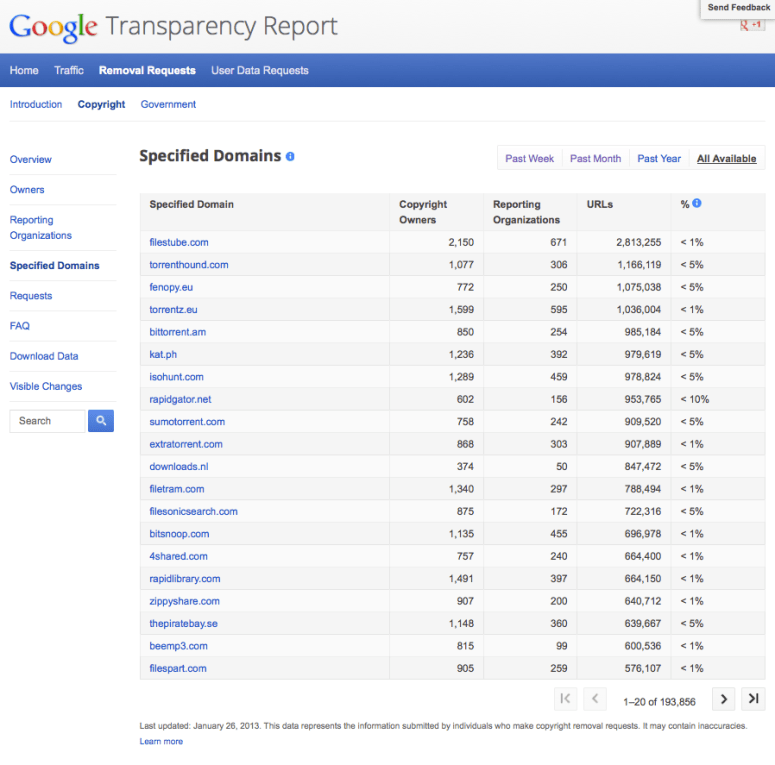

GoogleTransparencyReport

Of Foxes and Henhouses…

Music Technology Policy

[Editor Charlie sez: This post orginally appeared on December 15, 2011 and in light of Gary Shapiro’s recent  editorial–still looking for that copyright law that passes the CEA purity test–we thought it might be time for a reprise.  See also David Israelite’s excellent op ed responding to Shapiro.  Yes, like Diogenes, Gary Shapiro wanders the earth in search of “reform” he can support.  To paraphrase Saul Alinsky, when they stop asking for reform, you’ll know they finally have the bullets.]

We are reviewing the public statements of the lobbyist Gary Shapiro, a leading voice in the anti-copyright lobbying crowd for over a decade.  Why?  Because his speeches have a Groundhog Day aspect making me think “I swear I’ve heard this before.”  And it turns out that I have.  Many of the same phrases keep showing up in his public language, and not just once or twice–but for a decade.

Here’s a little…

View original post 2,145 more words