The Return of Orphan Works: Trojan Horse: Orphan Works and the War on Authors by Brad Holland, Part 2

Artists have taken note of the recent legislative activity in the European Union regarding “orphan works”.  The European Union defines these works as “works like books, newspaper and magazine articles and films that are still protected by copyright but whose authors or other rightholders are not known or cannot be located or contacted to obtain copyright permissions. Orphan works are part of the collections held by European libraries that might remain untouched without common rules to make their digitisation and online display legally possible.”

Of course, these libraries–the real ones, like the British Museum, not the Google Books Project–have a legitimate interest in digitizing their holdings and making them available online.  However, just as we saw with the Google Books project, Big Tech uses orphan works as a dodge (note that the lobbyist for the “Library Copyright Alliance” also is the lobbyist for the Computer & Communication Industry Association and the Net Coalition–and has been going around the country bashing collecting societies who want payments from his clients.  What’s common to all these things?  Google.

We are expecting another push at so-called “orphan works” legislation in the U.S. Congress during the upcoming legislative session because the U.S. Copyright Office is soliciting comments in a Notice of Inquiry proceeding that closes February 4, 2013 (in a few weeks).

We take a dim view of the “orphan works” theory–it seems to be yet another way of undermining copyright through a back-door safe harbor. If the last effort at “orphan works” legislation was any guide, it will another excuse for copyright infringement–if the infringer doesn’t quite qualify for a “fair use” defense, then they will say that their use of the infringed work is an “orphan” because they tried really, really hard to find the copyright owner, but couldn’t quite seem to find them. We think that “orphan works” puts the fox squarely in the henhouse, and is another clear example of the law creating another moral hazard to the detriment of artists.

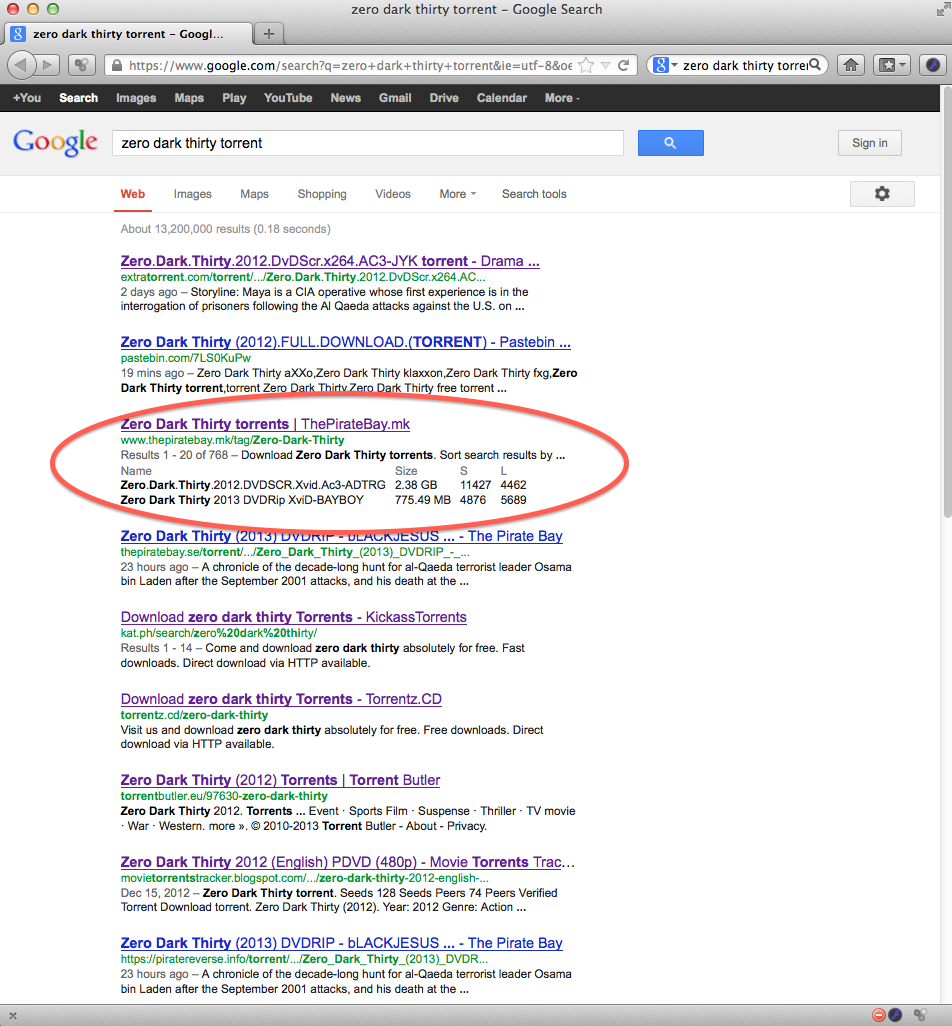
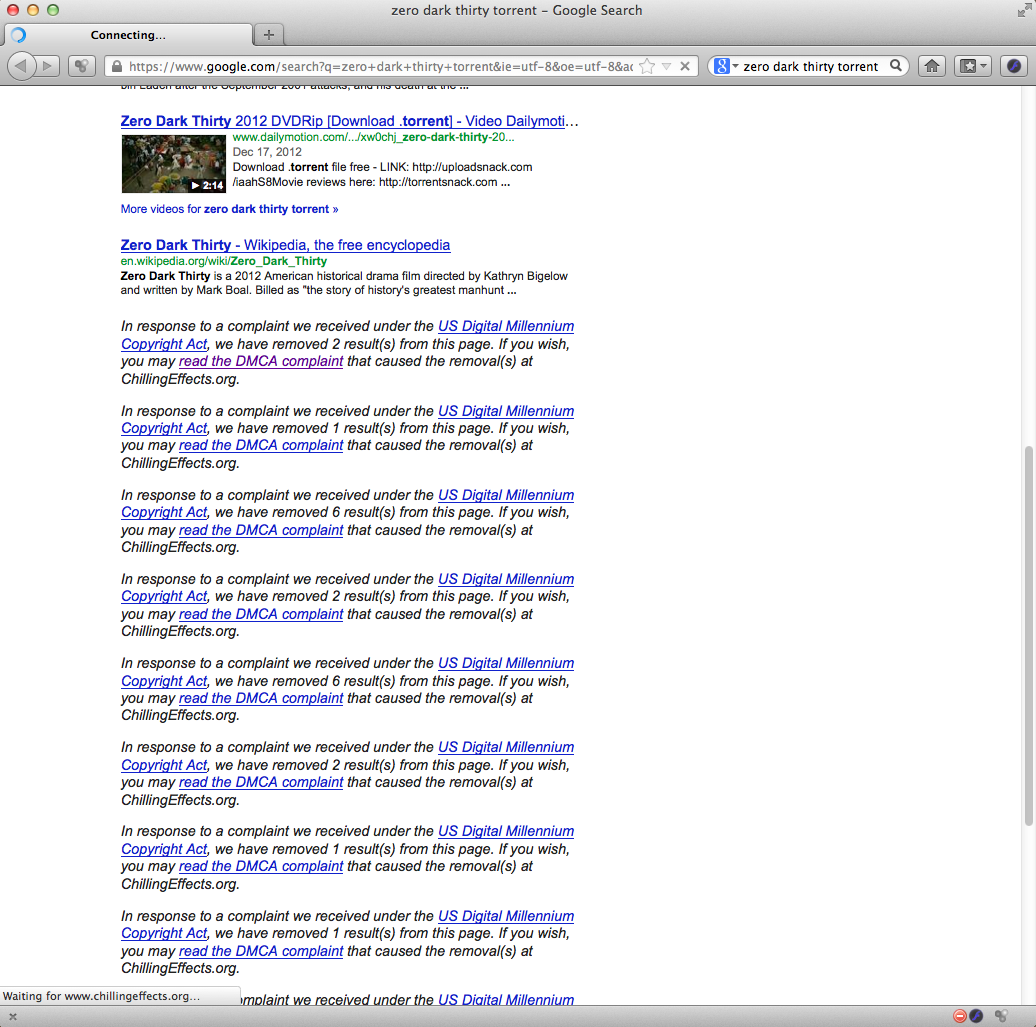
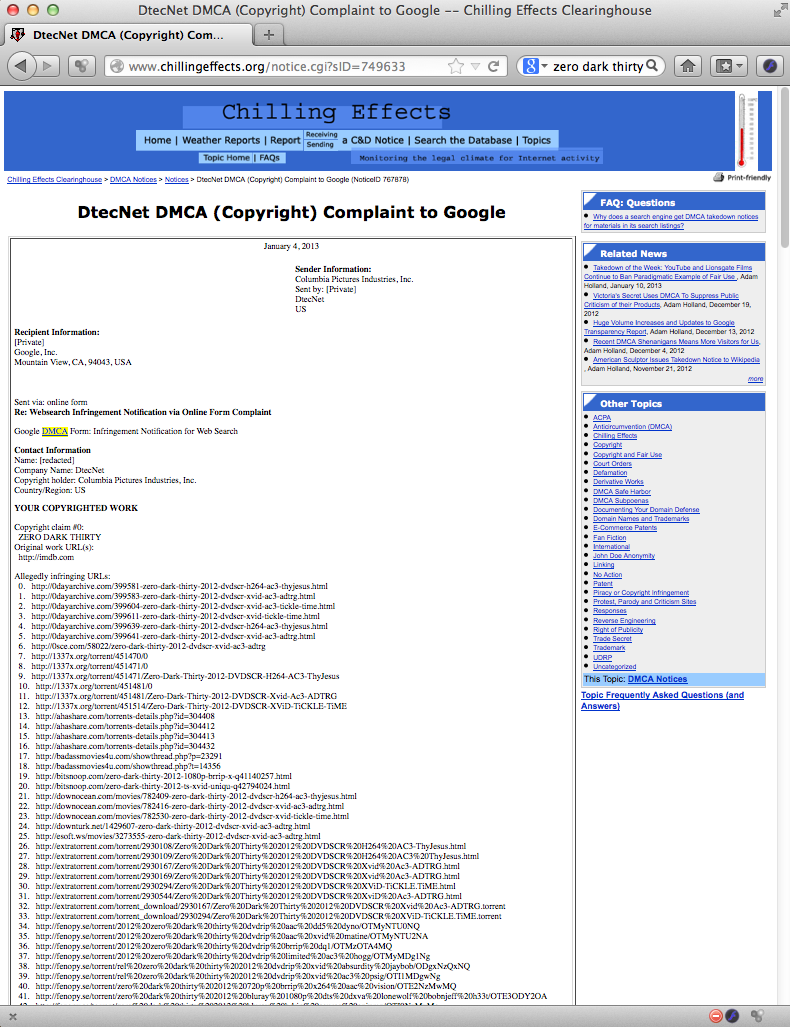
We have a lot of readers in the music business, and people in the music business often think that “orphan works” don’t affect them–we have all these databases after all. That places an awful lot of trust in the infringer. Remember–Google specifically asked the Copyright Office to consider users of “millions” of orphan works and the outside counsel for Google seems to be parking the orphanworks.com domain on the EFF’s servers. Still want to be so trusting? What about Google getting 3 million DMCA notices a week for search alone suggests that artists should trust the system? Keep this thought in mind as you read the article: If orphan works represent a market failure, how can you have a market failure without a market, and how can you have a market without enforceable property rights?

We are pleased to be able to serialize an excellent article about the history of the “orphan works” movement in the U.S. written by the distinguished illustrator, Brad Holland. We encourage readers to make common cause with the illustrators and photographers who will likely be most harmed by this specious legislation backed by Google the last two times it appeared in the Congress. The article first appeared in the Journal of Biocommunication in 2010 and is used by permission of the author.

If you missed Part 1 of this important article, you can read it here along with Brad’s bio.

Part 2: Trojan Horse: Orphan Works and the War on Authors, by Brad Holland

Claims Without Evidence

While academics, college professors, and students may have submitted anecdotes to the Copyright Office study, the weightiest contributions appear to have come from big Internet concerns whose business models depend on providing free or cheap access to other people’s intellectual property. These groups invariably submitted statements claiming that creative works once published have virtually no commercial value. A typical example is the joint statement submitted by NetCoalition.com, whose members “include Bloomberg, CNET, Google and Yahoo, as well as a number of smaller state and local ISP associations.” The coalition congratulated the Copyright Office for identifying “a significant issue that requires expeditious resolution.” Then it stated:

“The vast majority of copyrighted works have little or no economic value soon after their creation or publication.”9

This blatant assertion was offered with no evidence of any kind, nor was it even propped up by argument. Indeed, the letter went further (again without evidence) to state that “[a]uthors of such works typically are willing to permit others to reproduce, distribute, perform, or display their works at no charge because the authors still benefit in tangible and intangible ways from their uses.” (Italics added. ) 10

It should be self-evident that such unsupported conclusions are self-serving. Many Internet content providers are dependent on business practices that have invited major lawsuits for infringement. In March 2007, for example, Google filed a mandatory 10-Q Filing with the US Securities and Exchange Commission in which it acknowledged “copyright claims filed against us [by copyright owners] alleging that features of certain of our products and services, including Google Web Search, Google News, Google Video, Google Image Search, Google Book Search and YouTube, infringe their rights.” Google admitted that “[a]dverse results in these lawsuits may include awards of substantial monetary damages, costly royalty or licensing agreements or orders preventing us from offering certain functionalities, and may also result in a change in our business practices, which could result in a loss of revenue for us or otherwise harm our business.” [Italics added.] 11

Having acknowledged their exposure to costly infringement litigation, one can easily understand why such companies might seek to denigrate the value of the work they’ve been charged with infringing. What’s not clear, however, is why the US Copyright Office should urge Congress to undermine the intellectual property rights of citizens based on such claims.

Google Sees Value in Orphan Works

Despite having joined its NetCoalition partners in asserting that orphaned works “have little or no economic value,” Google sang a different tune at the Orphan Works Roundtables on July 26, 2005 in Washington. There, the company’s attorney, Alexander MacGillivray, made it clear that his firm actually believed the work under consideration was worthless only when it still belonged to the people who created it:

“The thing that I would encourage the Copyright Office to consider is not just the very, very small scale – the one user who wants to make use of the [orphaned] work – but also the very, very large scale – and talking in the millions of works.” 12

“Google strongly believes that these orphan works are both worthwhile, useful, and extremely valuable. In fact, I think that’s why most of us are here. We do think there is a lot of value in these works.” 13

“[W]e expect that [Google’s] use of these orphan works will likely be in the 1 million works range…we know that many of them will be in the public domain, that most of their authors won’t care. But there are a few that really will care and they will come forward [to ask for payment] and it will be extremely inefficient for us [to have to pay them].” (All italics added.)14

Four months later, in November 2005, at the same time as the Copyright Office was concluding its Orphan Works study and preparing its final report to Congress, Google made a surprising $3 million contribution to the Library of Congress for its “World Digital Library” project. The Library of Congress oversees Copyright Office activities. While the Library of Congress acknowledged that the World Digital Library project would be supported by public and private partnerships, it appears that Google was the project’s first, largest, and perhaps only private sector contributor. 15

Turning a Legal Fiction into Reality

It’s not a compelling argument for a large global corporation to say it should be allowed to infringe your intellectual property based on its own assurance that your property is worthless. But while Internet powerhouses such as Google can only make such assertions, a more devious strategy has emerged from the small but dedicated core of copyright “reform” attorneys smitten by the romance of mass digitization. Their idea was not simply to claim that small rightsholders’ work is worthless, but to propose a legal metamorphosis that would make it so.

Of particular interest is the 106 page paper “Reform(alizing) Copyright” submitted to the Copyright Office by the advocacy group Creative Commons. In it, attorney Christopher Sprigman proposed a scheme that would effectively roll back the 1976 Copyright Act by requiring artists, writers and others to mark and register every single work they create or find the work deemed (page 491) “commercially valueless”: 16

“[T]his Article proposes a system of formalities that, although nominally voluntary, are de facto mandatory for any rightsholder whose work may have commercial value. Non-compliance with the newstyle formalities would subject works to a perpetual and irrevocable ‘default license’ with royalties set at a very low level, thus effectively moving works into the public domain.” (Emphasis added.) (Pages 490-491)17

The logic behind this proposal is as cynical as it is clearly stated. Since authors, particularly visual artists, would lack the time and resources to mark and register every drawing, painting, photograph or sketch they create, then track and renew these tens of thousands of registrations over a period of decades, billions of copyrighted works by working authors would inevitably fall through the cracks and into the public domain. This would happen not because the authors have actually abandoned their works (which would be the legal presumption), but merely because the law had swamped them with paperwork. In effect, this proposal would turn a legal fiction – that “most copyrighted work has little or no value soon after its creation or publication” – into reality.

The problem with this proposal is that any government that required rightsholders to register their work as a condition of its protection would violate international copyright law. Article 5.2 of the Berne Convention is explicit: “The enjoyment and the exercise of these rights shall not be subject to any formality.”18

So, the question for advocates of registration became how to skirt the letter of the law in pursuit of its violation. The answer turned out to be simple: amend existing copyright law to “limit” the remedies for infringement wherever an infringer can successfully assert an orphan works defense; then promise rights holders that they can sill protect their exposed work, but only by registering it with for-profit databases to be created in the private sector. Then let the marketplace take care of the rest. Once infringers came to rely on these databases as one-stop shopping centers for rights clearance, any work not available from the databases would become a de facto orphan. This would avoid an explicit violation of international copyright law because it would not legally require you to register your work. It would merely redefine your work as an orphan if you didn’t.

According to the official account, this proposal was the result of the Copyright Office’s year-long study. The facts, however, don’t bear this out.

“The Legislative Blueprint”

The essential language of the Orphan Works legislation was written at least a year before the release of the 2006 Copyright Office Report. It was drafted, ostensibly by law students, as a classroom project at the Glushko-Samuelson Intellectual Property Law Clinic under the guidance of its Director, Peter Jaszi and was submitted to the Copyright Office March 24, 2005. In a few simple words, the Glushko-Samuelson Copyright Clearance Initiative (CCI) spelled out the operative feature of the Copyright Office recommendations that were released nearly one year later. From the CCI, Section III (page 5):

“Remedies and Liability “Under no circumstances will Sec. 504 statutory damages, attorneys fees, damages based on the user’s profits or injunctive relief relating to the challenged use be available against a qualified user.

•  If infringement by a qualified user is proved, damages would be limited to the lesser of •  Actual damages or •  An award of $100 per work used, up to a maximum of $500 for any group of works claimed by a single owner and subject to a single use.”19

This “limitation on remedies” was rationalized (page 6) as necessary to guarantee “certainty” to good faith infringers. Supposedly this would protect the “innocent” infringer from ruinous fees or penalties in the event the owner of an infringed orphan “came forward.” It was said this would encourage worthy users to make older works of cultural or historical significance available to the public. If so, it was never explained why the bill would throw the doors wide open to infringement by commercial users. Since the emasculation of penalties would apply throughout the entire world of publishing, it would create a haystack of “legal” infringements in which bad faith infringers could hide like needles.

To pass such a law would pull the only teeth that current copyright law possesses. There’s no other mechanism for copyright enforcement; no Copyright Bureau of Investigation, no Copyright Office Police Force. All copyright owners are responsible for policing their own copyrights, and the existing penalties for infringement are the only mechanism the law gives us to do it with. Provide infringers with certainty and you create massive uncertainty in commercial markets as well as in the lives of all small copyright owners.

This was one of the key objections to the Glushko-Samuelson proposal that medical illustrator Cynthia Turner and I raised on May 9, 2005, when we submitted a critique of the Glushko-Samuelson proposal to the Copyright Office study. 20We faulted it for granting benefits to scholars, consumers, the public – and infringers – at the expense of authors’ rights:

“The Glushko-Samuelson plan proposes a ‘minimalist approach’ to amending Title 17 USC. But what it actually portends is an expansion of fair use by weakening authors’ rights. It would empower users to annul copyrights based on the user’s own definition of due diligence.

“Glushko-Samuelson defines an orphan work (p. 3) ‘as a work for which the copyright owner cannot be reasonably located.’ But it allows the would-be user to define what constitutes a reasonable effort, then it defines ‘reasonable effort’ as ‘a flexible definition that applies to a variety of situations . . .’ It adds: ‘In the rare instances where there is disagreement about whether a search was adequate, the courts are open to make the required determination.”21

“But while sending authors to court to seek relief from abuses,” we concluded (page 5) that the plan “would restrict an author’s ability to seek redress.” In effect this would undermine copyright protections for all but large corporations, which in most cases would have the resources to staff up and register work, then hire sophisticated search technology to police and protect the copyrights they acquire. 22

The full text of our critique can be read on the Copyright Office website, where it’s been sitting [since 2005]. These excerpts should be enough to demonstrate that it reads like an analysis of the final Orphan Works bill; yet we wrote it 10 months before the Copyright Office report was released and more than a year before the House Judiciary Subcommittee unveiled its first legislative draft. Clearly we could not have condemned the Orphan Works plan a year before it was written if the plan itself had not been written sometime before we condemned it.

To be continued..

10.  ibid

11.  United States Securities and Exchange Commission Form 10-Q/A, Amendment No. 1, Quarterly Report Pursuant to Section 13 or 15(d) of the Securities Exchange Act of 1934 For the quarterly period ended March 31, 2007, Page 36  http://investor.google.com/documents/20070331_10-Q.html

12.  United States Copyright Office Transcript of Orphan Works Roundtable, July 26, 2005, Page 21   http://www.copyright.gov/orphan/transcript/0726LOC.PDF

15.  United States Copyright Office Transcript of Orphan Works Roundtable, July 26, 2005, Page 119 http://www.copyright.gov/orphan/transcript/0726LOC.PDF

13. United States Copyright Office Transcript of Orphan Works Roundtable, July 26, 2005, Page 166 http://www.copyright.gov/orphan/transcript/0726LOC.PDF

14. “Library of Congress Launches Effort to Create World Digital Library,” News From the Library of Congress, November 22, 2005 http://www.loc.gov/today/pr/2005/05-250.html

15. Christopher Sprigman, “Reform(alizing) Copyright,” Stanford Law Review Vol. 57: 485 November 2004, Comment to Copyright Office Orphan Works Study, Page 491 http://www.copyright.gov/orphan/comments/OW0643-STM-CreativeCommons.pdf

16. Christopher Sprigman, “Reform(alizing) Copyright,” Stanford Law Review Vol. 57: 485 November 2004, Pages 490-491, Comment to Copyright Office Orphan Works Study http://www.copyright.gov/orphan/comments/OW0643-STM-CreativeCommons.pdf

17. Article 5.2 Berne Convention for the Protection of Literary and Artistic Works http://www.law.cornell.edu/treaties/berne/5.html

18. Glushko-Samuelson Intellectual Property Law Clinic Response to Notice of Inquiry on the Issue of “Orphan Works,” Submitted to the United States Copyright Office, Library of Congress March 24, 2005, Page 5 http://www.copyright.gov/orphan/comments/OW0595-Glushko-Samuelson.pdf

19. Brad Holland and Cynthia Turner, Reply Comment to Copyright Office Orphan Works Study (70FR3739) May 9, 2005 http://www.copyright.gov/orphan/comments/reply/OWR0139-IPA.pdf

20. Brad Holland and Cynthia Turner, Reply Comment to Copyright Office Orphan Works Study (70FR3739) May 9, 2005, Page 3http://www.copyright.gov/orphan/comments/reply/OWR0139-IPA.pdf

21. Brad Holland and Cynthia Turner, Reply Comment to Copyright Office Orphan Works Study (70FR3739) May 9, 2005, Page 5 http://www.copyright.gov/orphan/comments/reply/OWR0139-IPA.pdf

Final Recap, News and Last Links of 2012…

Grab the coffee!

Recent Posts:
* What Can Songwriters Do: Copyright Office Comment Period Ends Today for Mechanical Royalty Statements of Account
* The Return of Orphan Works: A Review of the 2008 Shawn Bentley Orphan Works Act Part 1
* Ending Decade Old Arguments : How the Promise of the Internet has Failed Artists and Musicians…
* Billy Corgan Exploited By… Citi Bank, AT&T, Target, Virgin Atlantic, Mazda, Neiman Marcus, Musicians Friend, Hertz, BMW, Audi, Boston Market, Urban Outfitters, Williams Sonoma
* Songwriter comments on Section 115 Rulemaking
* FTC Treats Google With Kid Gloves and No Transparency
* Fair Pay for Air Play, Terrestrial Radio Performance Royalties for Musicians
* The Piracy-Pandora Connection: Can the Super Bowl, Oscars and Grammys Move the Needle on Brand Supported Piracy?
* The Return of Orphan Works: Trojan Horse: Orphan Works and the War on Authors by Brad Holland

FROM AROUND THE WEB

Seattle Weekly:
* It’s Time for Artists to Fight Piracy as Vigorously as They’ve Challenged Pandora

“…it’s time for artists to band together to set the story straight. Don’t leave it to the few brave enough to speak strongly on the matter. There needs to be a large, coordinated effort by bands big and small to tell their story–to sign a letter to fans explaining how devastating piracy is to their ability to make music for a living (or at all).”

Vox Indie:
* IP and Instagram–a Teaching Moment Perhaps?
* Should More Artists Speak Out Against Piracy?
* Creative Commons Celebrates 10 Years

CNN Money:
* Instagram can now sell your photos for ads
* Instagram says it won’t sell your photos to advertisers

Copyhype:
* Freeloading: How Our Insatiable Hunger for Free Content Starves Creativity, by Chris Ruen

The Guardian UK:
* Intellectual property crime unit to be set up by City police

Torrent Freak:
* U.S. and Russia Announce Online Piracy Crackdown Agreement
* Anti-Piracy Chief Patents “Pay Up or Disconnect” Scheme

Mashable:
* “T-Shirts and Touring” as Revenue for Artists just took a left Turn (YOLO)

Brian Pickings:
* The Best Music Books of 2012

Digital Music News:
* 10 People That Totally Changed the Industry In 2012…

(11) Oh, there’s one more guy…In one fiery and insanely-viral post, performer and professor David Lowery somehow managed to reframe the entire debate over technology, piracy, and the plight of the artist. And, draw attention from seemingly every corner of both the tech and creative communities. It was the biggest post of the year for the music industry, and potentially, the start of a very different type of discussion in 2013.

* Major Label Lobbying vs. Google Lobbying, 2012…
* The State of Music Subscription, December, 2012…
* USC Is Now Researching the Amount of Advertising Flowing Into Pirate Sites…
* Google Exec: If You Really Want to Kill Piracy, Then Kill the Advertisers Who Support It…

Ad Land:
* Senate passes a resolution asking Backpage.com to drop adult classifieds
* Adland booted from Google Adsense due to PETA’s misogynist ads

Copyright Alliance:
* Capitalist Copyrights: A Republican Reply to “Three Myths about Copyright”
* MUSIC Act introduced
* YouTube Moves for Safe Harbor Against Viacom

Daily Dot:
* YouTube strips Universal and Sony of 2 billion fake views

The Cynical Musician:
* Copyright and Scarcity

The Return of Orphan Works: Trojan Horse: Orphan Works and the War on Authors by Brad Holland

We at the Trichordist are expecting another push at so-called “orphan works” legislation in the U.S. Congress during the upcoming legislative session.  We take a dim view of the “orphan works” theory–it seems to be yet another way of undermining copyright through a back-door safe harbor.  If the last effort at “orphan works” legislation was any guide, it will another excuse for copyright infringement–if the infringer doesn’t quite qualify for a “fair use” defense, then they will say that their use of the infringed work is an “orphan” because they tried really, really hard to find the copyright owner, but couldn’t quite seem to find them.  We think that “orphan works” puts the fox squarely in the henhouse, and is another clear example of the law creating another moral hazard to the detriment of artists.

We have a lot of readers in the music business, and people in the music business often think that “orphan works” don’t affect them–we have all these databases after all.  That places an awful lot of trust in the infringer.  Remember–Google specifically asked the Copyright Office to consider users of “millions” of orphan works and the outside counsel for Google seems to be parking the orphanworks.com domain on the EFF’s servers.  Still want to be so trusting?  What about Google getting 3 million DMCA notices a week for search alone suggests that artists should trust the system?  Keep this thought in mind as you read the article:  If orphan works represent a market failure, how can you have a market failure without a market, and how can you have a market without enforceable property rights?

We are pleased to be able to serialize an excellent article about the history of the “orphan works” movement in the U.S. written by the distinguished illustrator, Brad Holland.  We encourage readers to make common cause with the illustrators and photographers who will likely be most harmed by this specious legislation backed by Google the last two times it appeared in the Congress.  The article first appeared in the Journal of Biocommunication in 2010.

Part 1: Trojan Horse: Orphan Works and the War on Authors, by Brad Holland

About the Author

Brad Holland is a self taught artist and writer whose work has appeared in Time, Vanity Fair, The New Yorker, Playboy, Rolling Stone, the New York Times and many other national and international publications. His paintings have been exhibited in museums around the world, including one-man exhibitions at the Musée des Beaux-Arts, Clermont-Ferrand, France; the Museum of American Illustration, New York City and the Torino Atrium, Turin, Italy. His satire of the art business, “Express Yourself, It’s Later Than You Think,” first published in The Atlantic Monthly, has been widely republished, both in print and on the Internet. In 2005 he was elected to the Society of Illustrators Hall of Fame.

“During a career that has stretched over three decades,” wrote Steven Heller in Print Magazine, October 2002, “Brad Holland has changed the way illustration is perceived and practiced. By the late ’60s he had helped transform a profession of renderers into one of conceivers, challenging editors and art directors to let him create images that complemented rather than mimicked texts.” In 2000, the editors of the artists’ directory RSVP voted Holland “the one artist, who in our opinion, has had the single greatest impact on the illustration field during the last twenty five years.” Holland has won more awards presented by the New York Society of Illustrators than any other artist in its long history. The American illustrator Mark English has called him “the most important illustrator in America today.”

In the last decade, Holland has become an outspoken advocate for artists’ rights and is a founder of the Illustrators’ Partnership of America. In 2005, he represented artists at the Orphan Works Roundtables held by the US Copyright Office; in 2006, he testified before the Intellectual Property Subcommittees of both the US House and Senate, and in 2008 he and medical illustrator Cynthia Turner led the opposition to the Orphan Works Act of 2008. It was through their lobbying efforts that the US Small Business Administration acted to conduct its own Orphan Works Roundtable at the Salmagundi Club in New York City, August 8, 2008.

Holland is featured in the documentary, “Citizen 3.0 Copyright, Creativity and Contemporary Culture,” available at www.kinobserver.com and his article, “First Things About Secondary Rights,” published by The Columbia Journal of Law and the Arts is available at weblog.ipcentral.info/holland_ColumbiaLaw.pdf

Holland’s blog, Poor Bradford’s Almanac, can be accessed at http://www.drawger.com/holland/?article_id=9022

Introduction

In 2004, lawyers at the US Copyright Office adopted a premise of the anti-copyright lobby that the public is being harmed because some people lack sufficient access to other people’s copyrighted works. In 2006 they released the results of a year-long study, announcing that they had documented evidence of a “market failure” so serious that Congress should amend existing copyright law to spare the world the loss of valuable cultural works.

The changes they proposed would effectively redefine each and every creative work as a potential “orphan,” unless the author takes steps to register it with new commercial registries yet to be created in the private sector. This would reverse the automatic protection currently guaranteed by the 1976 Copyright Act. Yet this radical change to a law protecting private property was to be enacted not by a transparent Congressional debate over new legislation, but through the Trojan Horse of an Orphan Works Amendment that would serve to emasculate the penalties for infringement whenever an infringer believed that he or she had made a “reasonably diligent” but unsuccessful effort to find the rightsholder.

Twice (in 2006 and 2008) the bill’s sponsors have tried to ram this legislation through the US Congress. The last time they nearly succeeded by means of backroom deals. Both times the legislation was stopped by an aggressive opposition campaign led by artists and photographers. Although the legislation’s stated purpose has been to let libraries and museums digitize their archives of old work, the bill would actually permit the widespread commercial infringement of work created by contemporary artists and ordinary citizens. While supporters say the bill would help users find artists so that artists can be paid, the provisions would undermine every artist’s exclusive rights, devalue works in derivative markets, breach contracts past and present, and expose every citizen’s intellectual property to unwanted changes and uses.

When spelled out like this, it’s hard to see why anyone would want such legislation. But if we go to the heart of the matter, we’ll see why some special interest groups have invested so much time and money in the effort.

Harvesting Orphans

The Internet has made it possible for entrepreneurs to create financial empires by supplying the public with access to copyrighted material. The problem for these enterprises is how to cheaply acquire the legal right to license other people’s intellectual property. By redefining millions of copyrighted works as orphans on the premise that some might be, this legislation would allow Internet content providers to profit by harvesting the works this law would orphan, providing their online databases with marketable content they could never afford to create themselves nor license from authors.

To justify this mass transfer of intellectual property from individuals to corporations, scholars of the anti-copyright lobby have whitewashed it as a long-overdue public service. Taking a page from postmodern literary criticism, they argue that individual authorship is a “romantic myth,” suggesting that all creativity comes from the masses and that a change in the law is therefore necessary to give the masses access to their communal property. In this theory then, big Internet corporations would merely be sharing the property of ordinary citizens with other citizens for the greater good of the public.

The idea of a left-wing literary theory employed in the service of a potential corporate rights grab may strike some as incongruous. Yet the fight over this bill is merely one battle in a gathering war on authors that has united opportunists of the right and left. Surprisingly, this effort was launched by a government agency long thought by many to be author-friendly. So to understand the symbiotic relationship that has made left-wing theorists the Remoras of big business, we need to look closely at the document that’s routinely used to justify the amendment: the US Copyright Office’s 2006 Report on Orphan Works.

The Myth of the Big Chill

Public Knowledge is a Washington-based “advocacy group” with a Six Point Plan to “reform” copyright law.1On May 29, 2008, its President and co-founder Gigi Sohn, addressed the 8th Annual Intellectual Property Symposium at the Center for Intellectual Property at the University of Maryland University College. In her speech she presented the official account of how the Orphan Works bill had risen out of the foamy sea of copyright chaos.

“At the urging of libraries, museums, academics like American University Law Professor Peter Jaszi, and advocacy groups like Public Knowledge, the Copyright Office sought public input on the orphan works problem and suggestions for how to deal with it. After receiving some 850 comments from a wide variety of stakeholders, the Copyright Office in 2006 issued a detailed report that showed that there was ample evidence that users were chilled from using works under copyright when they could not find the holder, and that as a result, millions of works were not being used. The Copyright Office proposed a framework for solving this problem that has, for the most part, become the basis of the current legislation.” (Italics added.)2

This official line has become the standard talking point supplied by the Copyright Office to Congressional lawmakers and by lawmakers to their constituents. If you’re one of the tens of thousands of copyright holders who’ve already written Congress to protest this bill, you’ve probably received a version of the talking point in your Congressman’s reply: Congress will do what’s best for all parties and rely for guidance on the detailed Orphan Works Study conducted by the Copyright Office.

But what if this “detailed study,” with its inference of millions of “chilled” copyright users, was based on no more “evidence” than 215 anecdotal letters? What if its legislative “framework” was written not after the year-long study, but before it? Here are the facts. In 2005 the Copyright Office published a Notice of Inquiry3 requesting comments from interested parties on the specific subject of orphaned work. It did not inquire about the workings of commercial markets, and there is no evidence in its subsequent report that business clients have any substantial difficulty finding the authors they wish to work with. While it may seem heretical to suggest that the Copyright Office report contains no evidence to justify its sweeping recommendations, the fact is it doesn’t. How it came to be accepted as an important study requiring the overturning of existing copyright law is quite a story.

A “Paucity of Data”

In its 2006 Report on Orphan Works, the Copyright Office reported “an overwhelming response” to its “year-long study.” The Register of Copyrights testified to Congress that it “documents the nature of the orphan works problem, as synthesized from the more than 850 written comments we received.” 4In a nation of more than 300 million people, 850 letters might not seem like an “overwhelming response.” Yet read the Report itself, and we learn that at least 600 of those letters had to be discounted as irrelevant. Here’s how the Copyright Office itself characterized the results:

Page 17: “The [Copyright] Office received an overwhelming response (by comparison to past studies), receiving 721 initial comments, and 146 reply comments [for a total of 867].”

Page 21: “A large portion of the comments (about 40%) did not identify a specific instance where a copyright owner could not be identified or located.

“Another portion (10%) presented enough specific information for us to conclude that the problem presented was not in fact an orphan works situation.

“Still, approximately 50% of comments did contain information that could fairly be construed as presenting an orphan works situation, and a significant number of those comments (about 45%, or about 24% of all comments) provided enough information about a specific situation for us to conclude that it presented an orphan works situation.” (Italics added.) 5

Twenty four percent of 867 letters equals 215. This means that even by counting “reply comments,” there were no more than 215 letters to the Orphan Works study that could even “be construed” as relevant to the subject. While the President of Public Knowledge has said these comments came from “a wide variety of stakeholders,” it appears they overlooked the stakeholders with the greatest stake of all: authors. Instead, most of the comments appear to have been generated by appeals such as this one, from the College Art Association to its members:

“As you may already know, the U.S. Copyright Office is soliciting formal comments from the public on the problem of ‘orphan’ works… If successful, this initiative could significantly help artists, scholars, and others who use copyrighted images and texts in their creations and writings… In order to make a strong case to the Copyright Office, we need anecdotes – as many as you can think of – about specific instances where scholars or artists have had difficulty using copyrighted materials because the copyright holder cannot be located.” (Emphasis added) 6

By telling artists, scholars, and others that they would “significantly help” creators by flooding the Copyright Office with such anecdotes, what artist, scholar, etc. would not want to help by responding? One wonders though, how accurate is the implication that a scholar’s “inability to locate a copyright holder” could lead to legal peril. In fact, it appears to be at odds with the truth. As the drafters of the 1976 US Copyright Act made clear:

“[I]t is important to realize that the [1976] bill would not restrain scholars from using any work as source material or from making “fair use” of it; the restrictions would extend only to the unauthorized reproduction or distribution of copies of the work, its public performance, or some other use that would actually infringe the copyright owner’s exclusive rights.” (Emphasis added.) U.S. Code, House Historical and Revision Notes Report No. 94-1476, at 136 (1976) 7

We can’t know how many of the 215 “relevant” letters were generated by appeals from such groups as the College Art Association, or how many were based on misinformation regarding the latitude of “fair use” available to copyright users. Yet even if every single letter of the 215 represented a legitimate “orphan works situation,” it would hardly qualify as “ample evidence” that “millions” of potential users are being “chilled from using works under copyright.” In fact, as David Rhodes, President of New York’s School of Visual Arts has observed:

“[I]n its report the Copyright Office provides little or no evidence that there is in fact a problem. There is no systematic review of the various markets to see if they are in fact dysfunctional. All of the supposed examples of the harm caused by orphan works are clearly anecdotal and in a country of 300,000,000 fall far short of the threshold for serious consideration. The Copyright Office’s own paucity of data should lead one to conclude that ‘Orphan Works’ are not a problem at all.” 8

Of course, that’s not what the Copyright Office concluded.

To Be Continued….

Footnotes

  1. Gigi B. Sohn: “The Orphan Works Act of 2008: Copyright Reform Takes Its First Steps,” Presented to the Center for Intellectual Property 8th Annual Intellectual Property Symposium, University of Maryland University College May 29, 2008 http://www.publicknowledge.org/node/1594
  2. ibid
  3. United States Copyright Office, Library of Congress, Notice of Inquiry on Orphan Works, [Federal Register: January 26, 2005 (Volume 70, Number 16)] [Notices] [Page 3739-3743] http://www.copyright.gov/fedreg/2005/70fr3739.html
  4. Register’s testimony on the “Orphan Works Problem and Proposed Legislation” before the Subcommittee on Courts, the Internet, and Intellectual Property; Committee on the Judiciary; United States House of Representatives March 13, 2008 http://www.copyright.gov/video/testimony-3-13-08.html
  5. Report on Orphan Works, A Report of the Register of Copyrights, January 2006 United States Copyright Office    http://www.copyright.gov/orphan/orphan-report.pdf   (Note: download is 133 pages.)
  6. College Art Association. This website appeal is available at: http://web.archive.org/web/20050319091445/www.collegeart.org/orphan-works/
    and the emailed appeal to members can be accessed as a re-post at:
    http://h-net.msu.edu/cgi-bin/logbrowse.pl?trx=vx&list=H-New-Jersey&month=0503&week=a&msg=+ByJSt4DOW0FQI+t+wMbZg&user=&pw
  7. U.S. Code, House Historical and Revision Notes Report No. 94-1476, at 136 (1976) http://www.law.cornell.edu/uscode/html/uscode17/usc_sec_17_00000302—-000-notes.html
  8. David Rhodes, President, School of Visual Arts, U.S. Small Business Administration Roundtable on Orphan Works Legislation, August 8, 2008

Music Technology Policy

The Seattle Weekly’s Chris Kornelis has a thoughtful article today asking why artists came together to oppose the so-called Internet Radio Fairness Act but haven’t consistently been a united front against the unprecedented levels of online theft we’re all too familiar with (read “It’s Time for Artists to Fight Piracy as Vigorously as They’ve Challenged Pandora“).   This is actually a very insightful point because the alliterative piracy and Pandora are more connected than one might think.

Catching Up to the Google Propaganda Machine

Kornelis mentions David Lowery’s “Letter to Emily” which was almost universally received as a balanced and courteous discussion of the underpinnings of piracy as a culture and pointed out how successfully Big Tech has attempted to commoditize music and movies in order to sell hardware and Internet access.  Nowhere is this more prevalent than Google, which has built an entire litigation and lobbying…

View original post 1,177 more words

Happening now…Google is using crony capitalism to dodge another threat to its monopoly.

Music Technology Policy

According to MLex, the Federal Trade Commission is preparing to allow Google to submit a non-binding letter that will describe a few things Google is willing to do to get out of the pesky FTC investigation into its business.  Bowing and scraping to Google…well, maybe not scraping…the FTC is taking an unprecedentedly lax approach that reeks of political favoritism and crony capitalism.

The letter makes no mention of the most serious complaint against Google, which alleged the company deliberately biased its search results to favor its own products….Under the normal settlement procedures, FTC staff draft a consent order with legally binding commitments by which a company must abide….[T]he public can submit comments on the settlement before it is finalized….In the absence of a consent order, companies opposed to the resolution of the Google probe likely won’t have the opportunity to provide formal public comments….Independent observers said privately that they…

View original post 48 more words

Billy Corgan Exploited By… Citi Bank, AT&T, Target, Virgin Atlantic, Mazda, Neiman Marcus, Musicians Friend, Hertz, BMW, Audi, Boston Market, Urban Outfitters, Williams Sonoma

At SXSW in 2012 Billy Corgan shared his thoughts about the music business from his perspective, including his thoughts that you can’t really make money in the music business anymore. Billy is probably right that musicians can’t really make money in the music business anymore, but it appears there is plenty of money being made by internet sites dedicated to infringement as well as the ad networks and payment processors who allow the sites to profit from the musicians work.

Surely these advertisements are not appearing without being paid for, and there actually is money is being paid to finance and support the operation of major piracy sites (as reported by Google’s own transparency report). What’s worse is that the money financing these major piracy sites ripping off artists and creators are being paid by well know major consumer brands and corporations. See below…

Citi Bank – 4Shared
AT&T – 4Shared
AT&T – Mp3Skull
Target – Mp3Skull
Virgin Atlantic – IsoHunt
Mazda – Mp3Raid
Neiman Marcus – Mp3Skull
Hyundai – Mp3Skull
Musicians Friend – 4Shared
Hertz Rent A Car – 4Shared
BMW – 4Shared
Audi – Mp3Skull
Boston Market – 4Shared
Urban Outfitters – 4Shared
Williams Sonoma – IsoHunt

SP_4sharedAudioCitiATT

SP_ATTTargetMP3Skull

SP_ishunt_VirginAtlantic

SP_mazdapumpkinsmp3raid

SP_mp3skullHyndai

SP_MusiciansHertsBMW

SP_pumpkinsAudioMp3Skull

SP_UrbanOutFitters4Shared

SP_WilliamsSonomaIsoHunt

Ending Decade Old Arguments : How the Promise of the Internet has Failed Artists and Musicians…

As Jaron Lanier tells it, Ted Nelson envisioned his version of the internet (Xanadu) as a single walled garden where everyone could be both a consumer and a producer. Ideas and art could be exchanged in a frictionless environment where a truly free market would emerge. People could make their wares available for free, or charge for them. However, once a price was set, the market would then determine the demand for that information be it a song, poem, movie or software. This truly free and open market would have empowered creators of all kinds access to a marketplace the likes of which we’ve never seen. Ted’s vision would have truly empowered creators and democratized distribution. Unfortunately, Ted’s vision has not come to be.

Much has been written about the record industry in particular failing to “adapt and evolve” to the new online digital economy. Whereas this may have been a valid argument in 2002 it holds little water a decade later in 2012. In the past decade we’ve seen many new offerings to consumers for legal and licensed music services tailored to many different consumer lifestyles. The tip of the iceberg includes such well known offerings as Itunes, Spotify, Pandora, Rhapsody and literally hundreds of others. And yet despite there being over 500 legal music services neither sales nor revenue have begun any significant rebound. The one thing these services still require, that piracy does not, is payment.

Let’s take a look back. In 1999 in the USA there were probably ten thousand retail points of sale for physical music, Tower, Sam Goody, Target, Walmart, etc. At the time they were selling $20 dollar physical discs – much of the overhead due to physical packaging, manufacturing, shipping, stocking fees and the overhead of real human beings being employed in record stores who need to eat, have shelter, etc.

These physical retail locations also had all the problems of supply side inventory management – a band would be on tour, and no stock would be in that market, a song would be played on the radio and the album would quickly be out of stock, etc. An artist could get placed on a TV show or featured in a commercial and suddenly there is demand, but no availability. These supply side inventory issues combined with limited points of sale were a massive problem for the artists and the record industry.

Digital distribution has none of these problems. Today someone can walk from their living room to their computer (or it may be on their lap) to purchase the latest hot song, featured in Gossip Girl. Or not even, they can buy the song/album on their iphone while watching the TV show or in a movie theater or at a club or concert.

So today in 2012 there are an estimated 500 million retail points of sale for prerecorded music via itunes alone. Just stop and think about this for a second. We went from ten thousand points of sale to five hundred million points of sale in less than a decade and removed all of the supply side inventory issues… wow. The promise, size and scale of the internet should have seen sales of pre-recorded music increase, massively.

There is frequent argument made that if music cost less, it would sell more… well, we now have 99 cent songs and $9.99 albums and sales have dropped by half in a decade…

So the recording industry adapted by:
1) removing inventory problems
2) making music instantly available
3) allowing for songs to be sold individually at a price never before possible and…
4) dropped the price of the album by half of the retail list price of a decade ago

All of this should be a net positive, not a net negative except for one very big thing, payment is now optional to everyone, and there are no consequences for not paying… So let’s be clear about what the problem is when talking about potential solutions.

The problem is not a lack of viable new business models, the problem is the proliferation of illegally distributed recordings being monetized by advertising on infringing websites. There is money in the distribution of recordings on the internet, the problem is the majority of that money is being made illegally and not paying the artists a penny.

Music Technology Policy

[Editor Charlie sez:  Given that the Google Party in Europe is jamming a new orphan works on steriods bill through the UK and EU Parliaments, this is a good time to repost this history of orphan works from last year.  See “UK’s Brazen Copyright Landgrab Sneaked Into Enterprise Bill” and Photography Organisations Raise Objections to EU Orphan Works Law]

In the aftermath of the Google Books debacle, we are starting to hear noises that Google will back a new orphan works bill in this Congress.  There are some commentators—truly misguided in my view—who are calling for Congress to bring back the failed legislation from 2008 known as the “Shawn Bentley Orphan Works Act”.  (The late Shawn Bentley was a tech industry lobbyist and former Senate Judiciary staff counsel.)  Let’s review that legislation in light of what we now know.  (For a more detailed account, see Unhand That…

View original post 1,631 more words