Launch and Iterate: Google’s Permissionless Innovation.

Every once in a while Google will accidentally reveal their true  nature through some cute slogan or catchphrase.

There is of course their famous corporate slogan  “Don’t be evil”.

As noted previously, we at The Trichordist believe that  “Don’t be evil” is not their corporate slogan but secretly their  corporate reminder.  Eric Schmidt has this written on the back of his hand in black marker.

Then there is their Net Neutrality campaign slogan they farmed out to one of their astro-turf organizations:  “We are the web.”   Yes Google we are quite aware that you think that “you are the web”. That you believe you own the web and all of our personal data.  Sergey Brin recently became apoplexic when discussing the fact that companies like Facebook and Apple have “closed” ecosystems that do not allow Google to scrape all of their data.    “How dare they? We Are the Web!”

Like Germans Google is mostly unintentionally funny.   Last week’s howler came in hearings on Capitol Hill. Google’s Internet Evangelist  Vint Cerf let this slip out:

“Such proposals raise the prospect of policies that enable government controls but greatly diminish the ‘permissionless innovation’ that underlies extraordinary Internet-based economic growth, to say nothing of trampling human rights,” said Vint Cerf.”

Now I understand that Vint Cerf was talking about some specific  proposals  from authoritarian governments that would  really truly be a threat to free access to the internet.  For once I agree with a Google spokesperson. But what caused me to guffaw was the phrase “permissionless innovation”.   It slipped out so smoothly and seemed so well-worn it was as if  Google’s collective Id  was speaking directly to us all.

It  seems particularly significant when you combine that with Van Lohman’s ( Google Senior Copyright Counsel)  cheerful admission of  Google’s “Launch and Iterate” copyright contempt strategy.  As reported in the Huffington Post:

Fred von Lohmann, senior copyright counsel at Google, reflected on how copyright has been an issue since the earliest search engines. Asked how to address the various obstacles of digital platforms, he cheerfully sloganeered “As we say at Google ‘launch and iterate,’ ” by which he meant the best approach for digital media companies, since the waters of copyright will remain murky for some time, is simply to launch content, learn from the inevitable public and legal response and then improve. The “launch and iterate” mentality allows for experiments in freedom of expression as well as public participation.

This same wonderful “experiment” also allows google to make plenty of money by exploiting artists without compensation.  But I digress.

From the Google Permissionless Innovation Department:

Google Books:  Don’t ask the authors if we can digitize their books, let’s just  monetize search within those books?

YouTube:  Let’s just put all this video content on the web and we’ll deal with the copyright owners later.

Shareholder rights:  Let’s screw virtually everyone but the founders by issuing new  non voting class c stock.  We’ll deal with the SEC and shareholder lawsuits later.

And of course you can apply “permissionless innovation” to many other rogue companies in the web space. After all according to the largely google funded copyleft  file-sharing sites are more innovative than sites like iTunes that seek permission.  That’s why consumers prefer The Pirate Bay to iTunes.  Not because they get stuff for free but because  The Pirate Bay is a pioneer in “permissionless innovation”.

I suppose the ultimate in “permissionless innovation” are the human trafficking sites.  No wonder Google apparently  refuses to restrict the flow of advertising dollars to these sites.  They are fellow “permissionless innovators”.

All sarcasm aside.  This is the problem with Google. It has never grown up.  There is something juvenile and narcissistic about it’s corporate culture. It’s slogan should be “you are not the boss of me”.  They have perverted the concept of internet freedom to mean don’t tell Google what to do ever.  Think I’m exaggerating?

” If we could wave a magic wand and not be subject to US law, that would be great.” —Sergey Brin quoted in The Guardian UK. 

Permissionless Innovation.  We love this phrase.  Do you mind if we Artists For An Ethical Internet keep it?

FarePlay.Org – An Open Letter


Below is an open letter from FarePlay founder Will Buckley – Support FarePlay.
http://fareplay.org/
https://www.facebook.com/FarePlay

An open letter.

FarePlay is an advocacy group supporting the rights of individuals to control the distribution and sale of their Intellectual Property.

Our mission is to confront the misinformation and misperceptions voiced by illegal downloading proponents to justify their actions.

The proponents of online piracy would have you believe that illegal downloading is a victimless crime and they are “entitled” to distribute anyone’s work without permission.  They talk about wealthy super-stars and corporate greed to justify their action and would have you believe that without unrestricted, unlimited free access to copyrighted material no one would be aware of the great music and film that’s out there.

It is time the truth be told by the people whose lives are directly impacted; the creative community.

We need to involve the musicians and filmmakers and empower them to have an open discussion with their fans about the impossible challenges they face when people are unwilling to pay for their music and film.  An online community where artists can communicate with their fans about the importance of fan support without the fear of ridicule and recrimination.

Most importantly, we need to change the conversation.
Will Buckley
founder, FarePlay

CopyLike.Org – Pay Creators Like You Pay Everyone Else

Check out this great organization:
http://copylike.org/
https://www.facebook.com/copylike

It looks like you don’t want to pay
for us to create stuff you like.
Why do you pay everyone else?

Some people think there’s no harm in making illegal copies,
and the price of copies of our work should be zero.

They think only big companies love copyright, using it to do
evil things. That’s only part of the truth.

Copyright begins with the creator. It’s the only weapon
we have to force big companies to negotiate with us, instead of
just ripping us off.

You gave all your money to phone companies, internet service
providers, laptop manufacturers and enormous breweries.

There’s nothing left for us.

Defend Copyright.
It’s All We Have Left.
COPYLIKE.ORG

[ THE 101 ] [NEW BOSS / OLD BOSS ] [ARTISTS KNOW THEY ENEMY] [WALL OF SHAME]

The Wall of Shame Continues: Tell Them If You Do Not Want Your Records and Tours Advertised on Pirate Sites–no @mcdonalds for you

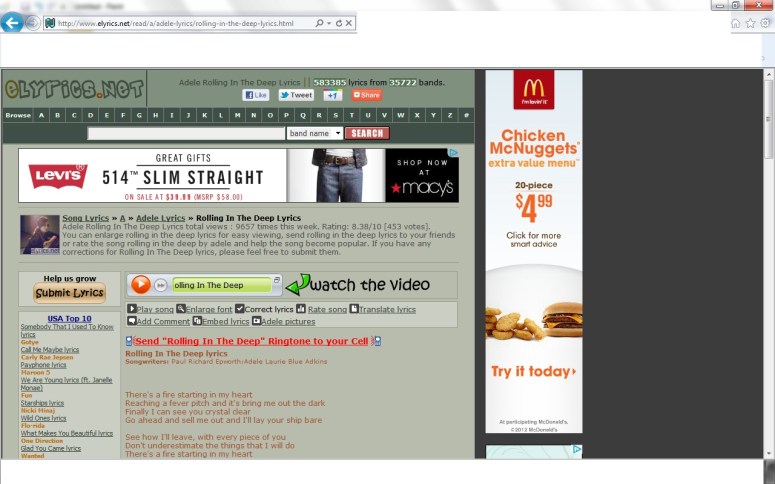
We’ve been posting about advertising on illegal lyric sites and it has become apparent that these sites are pretty clearly direct infringers–meaning they don’t get safe harbors.  This is because all seem to directly copy the lyrics themselves.

It’s also very apparent that the sites are based in China and other locations outside of US law.  Yet–of course–they all prattle on about how they respect the “DMCA” as though US law applied to them wherever they are located and that they are entitled to the “DMCA” safe harbors, which they pretty clearly are not.

Plus, these sites sell a ton of advertising, have referrals for spyware and illegal ring tones, link to artist videos on YouTube,and both the sites and the advertisers free ride off of the brand identity of artists and songwriters whose lyrics are stolen.  This advertising is not only from US companies, but is mostly from Fortune 500 companies like McDonalds, Macy’s, Levi’s and CVS Pharmacies.  Do these companies care so little about artists and songwriters that they are willing to associate their brands with unlicensed lyric sites?

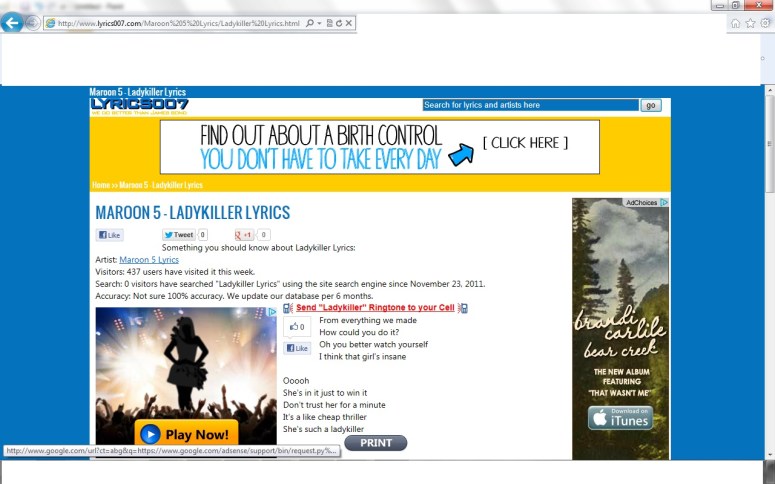
Unfortunately, we have also seen several instances of legitimate artist ads being served to pirate sites such as this Brandi Carlisle ad (below on the right) served to an the Lyrics007.com illegal lyric site.  This ad for Brandi Carlisle’s new album is served next to Maroon 5 lyrics and a click through ad to a spyware toolbar that attracts users with the hope of acquiring more “free” mp3s–and we all know what “free” means.

The Brandi Carlisle ad is served by Google’s “AdChoices” adserving network and we saw many that were served by Doubleclick.  (In case you missed it, “AdChoices” used to be called “Ads by Google” but was changed during the SOPA debate for some unknown reason.)

And the answer to how in the world does a record company’s ad show up on an illegal lyric site probably lies with the adserving network.  That ad network–Google in this case–knows where the ad inventory exists, but won’t tell the advertiser where their brand is being promoted.  So you get these incongruous pairings.

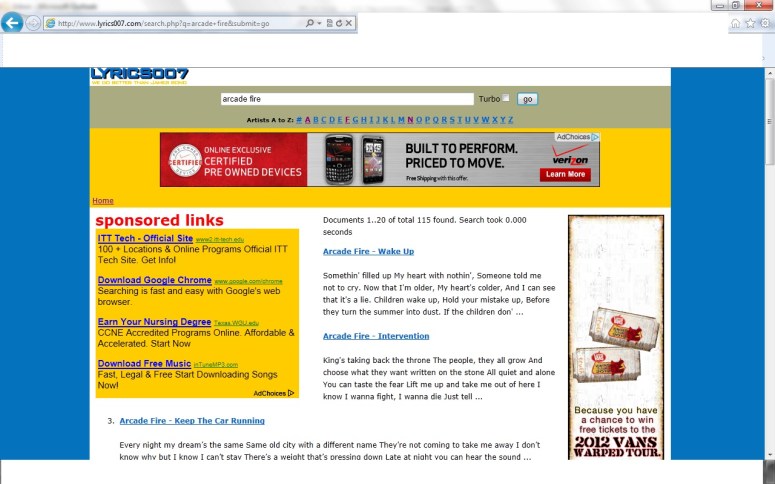
And then there is another legitimate ad for the Warped Tour served next to illegal lyrics for Arcade Fire as well as Google AdChoices sponsored links for Google Chrome and what appears to be a pirate mp3 download application (more likely spyware but we didn’t want to find out) as well as some other bogus looking stuff.

So what can you do as the artist or the artist’s negotiator?  Tell your lawyer or manager that you require in your record deal or tour contract that your name and brand cannot be used in advertising served to illegal sites.  You can even list examples of the sites.  In your tour contract, require that the tour not advertise on pirate sites and give examples.  There may be some advertising networks that are so corrupt that they shouldn’t be used at all.

Don’t stop there–also require that the tour obligate sponsors (or their ad agencies) to not advertise on pirate sites.

Before you throw up your hands and say “forget it, they’ll never agree to that” remember–artists didn’t used to get approval over singles, approval over the use of their music in commercials, or in political ads.   Now it’s pretty routine.

You don’t get if you don’t ask.

[ WHY ARENT MORE MUSICIANS WORKING ] [ ARTISTS FOR AN ETHICAL INTERNET ]

The Trichordist Random Reader News & Links Sun Jun 10

Grab the Coffee!

This past weeks posts on The Trichordist;
* How Copyright Encourages Creativity In Hollywood
* Artists Know They Enemy, Who’s Ripping You Off and How…
* Google Tells Ari Emanuel To Change His Business
* Artist Exploitation Calculator – Internet Edition
* Musicians, What to do when you find your Lyrics on Pirate Lyric Sites
* CopyLike.Org – Evil Corporations, We Don’t Like Them

We discovered two Artists Rights groups this week definitely worthy of support:
http://copylike.org/
http://musikschaffende.ch/
and in English via Google Translate; http://bit.ly/Mx21tg

Electronic Musicians grapple with having their work being Illegally Exploited, Synthtopia reports:
http://www.synthtopia.com/content/2012/06/05/how-should-electronic-musicians-deal-with-file-sharing/

Billy Corgan and Noel Gallagher are quoted in this fantastic piece by the UK’s Guardian about the illegal exploitation of artists work on line and how the next generation of upcoming developing artists are negatively effects, well done;
http://www.guardian.co.uk/music/musicblog/2012/jun/08/behind-music-piracy-pop?CMP=twt_gu

Writer David Newhoff wrote a compelling piece this week for Copyright Alliance addressing the frequent “Copyleft” argument that copyright and free speech can not co-exist;
http://blog.copyrightalliance.org/2012/06/guest-post-is-copyright-a-threat-to-free-speech-by-david-newhoff/

Spotify was the subject of hot debate this week as both Digital Music News and Hypebot picked up and republished the current “Steaming Price Index” from The Trichordist;
http://digitalmusicnews.com/permalink/2012/120604youtube#5ArY3BUTQBtv273GLJ0Ddg
http://www.hypebot.com/hypebot/2012/06/an-indie-labels-shares-what-spotify-streaming-music-services-pay-them.html

Speaking of Spotify more and more artists are realizing the model is unsustainable, artists Hyland and Lewis discuss;
http://christianmusiczine.com/hyland-lewis-spotify/

We found this enlightening and ironic.  A Pirate Party Australia Spokesperson  is opposed to Spotify, guess they don’t like the competition. What does it say about a commercial legal service when the pirate party doesn’t like it for cutting in on their business?
http://olbrychtpalmer.net/2012/02/22/streaming-is-not-an-alternative-to-piracy/

Editor’s note:  Mr Olbrycht-palmer wrote us a very polite note begging to differ on our characterization above. He notes he was speaking for himself not in his official capacity as Press Officer for  PPAU.  We stand corrected! And it is duly noted.   He has written a thoughtful rebuttal to our piece here: http://olbrychtpalmer.net/2012/06/14/trichordist-strawmen/

Not surprising, the same people ripping off artists are also trying to rip off their governments. Once a thief, always a thief, good luck with that, Torrent Freak reports;
http://torrentfreak.com/bittorrent-admin-jailed-for-tax-evasion-on-site-donations-120605/

This one is so over the top it should be eligible for a Nyan Cat Award as presented by The Magic Beaver. TechDirt goes down the rabbit hole thinking about the likelihood of copyright infringement post-Singularity, pure comedy at it’s best;
http://www.techdirt.com/articles/20120523/04341919034/how-copyright-would-make-singularity-infringement-if-it-ever-arrived.shtml

[ THE 101 ] [NEW BOSS / OLD BOSS ] [ SPOTIFY ] [GROOVESHARK ] [ LARRY LESSIG ]
[ JOHN PERRY BARLOW ] [ HUMAN RIGHTS OF ARTISTS ] [ INFRINGEMENT IS THEFT ]

[ THE SKY IS RISING : MAGIC BEAVER EDITION ] [SF GATE BLUNDERS PIRACY FACTS ]
[ WHY ARENT MORE MUSICIANS WORKING ] [ ARTISTS FOR AN ETHICAL INTERNET ]

CopyLike.Org – Evil Corporations, We Don’t Like Them!

Check out this Organization:
http://copylike.org/
https://www.facebook.com/copylike

We know that there are
evil corporations in the world.
We don’t like them.

With copyright laws, we get to decide who can use our work,
and how much that have to pay for it.

If we want, we can give it away for free to our favourite charity,
or as a gift to our fans and supporters.

If a company wants our music, we can tell them yes or no.
If they steal it, we can take them to court.

That’s one of the reasons we like copyright.

Defend Copyright.
It’s All We Have Left.
COPYLIKE.ORG

Musicians POV: Songwriters: How to find yourselves on pirate lyric sites and what to do about it

We’ve all heard about Bit Torrent sites like the Pirate Bay, Isohunt, Megavideos.  One kind of site we haven’t heard much about is lyric sites.  These are often large websites with heavy traffic that are text based and advertising supported.

How do you find these sites?  One good way is to search for yourself and your song title on Google.  Google will helpfully deliver you the top illegal lyric sites so you can move right along.  Or you could set up a Google alert for your songs and Google will deliver directly to you the information that they know about already.  Nice and neat package.

Let’s take Lyrics007.com for example.  This is an illegal site that has the lyrics from 1,000s of songs, allows users to create ringtones for “free” (or so they say, we haven’t clicked on those links because who knows what might happen), and lyrics.com is ad supported.

So search for your song in the search box and see if it comes back.  Even if you are not a rock star, you will probably be in the database if you have ever released your lyrics online (like on your own website for example).  When you find your songs, you will notice that your song lyric will be surrounded by advertising.  In the case of Lyrics007.com, it looks like Google has an exclusive on serving advertising to the site, because advertising for Google Play, Google’s music service that had a hard time launching because the music community believed that Google profits from piracy.

You’ll also see a variety of Google ads (hover over the ad and you will see a web address for the ad which will have the name “google” or “doubleclick” in the URL–Google owns Doublclick thanks to the antitrust authoritites).  There will also be ads for “AdChoices” which is also a Google adserving company.  These ads are generating revenue for the ad publisher (Lyrics007) and for Google.  Presumably also for the advertiser, such as McDonalds, Warped Tour and H2O Festival that we saw.

You can find out who is the registrant of the site by searching the WHOIS database at a registry, such as Network Solutions http://www.networksolutions.com/whois-search/lyrics007.com:

The site is registered to HICHINA ZHICHENG TECHNOLOGY LTD.  In China.  But Lyrics007 is in the top 2500 websites in the US according to Alexa.

So what can you do about this?  Not much.  One thing you can do is take a screen capture of your lyrics and email it to us for the Wall of Shame and we will keep others abreast of what you are finding.  Make sure you get the ads included in the screen shot, but be careful what you click on.

We are particularly interested in screen captures of advertising by big brands (like McDonalds below).  Email them to us and we will post the best ones!

Like this:

Or this:

[ JOHN PERRY BARLOW ] [ HUMAN RIGHTS OF ARTISTS ] [ INFRINGEMENT IS THEFT ]

Artist Exploitation Calculator – Internet Edition

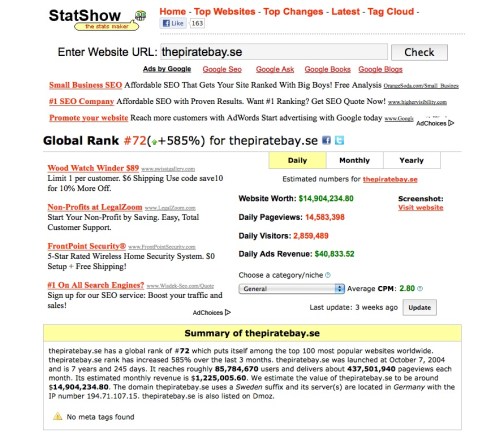
If there is any doubt left in anyone’s mind about the Exploitation Economy ripping off artists, this fantastic website shows the estimated revenue generated for commercial businesses on the backs of artists and creators without paying the artists a single penny.

Stat Show:
http://www.statshow.com/

The Pirate Bay – $14 Million Dollars Annually Estimated
http://www.statshow.com/thepiratebay.se

4 Shared – $11 Million Dollars Annually Estimated
http://www.statshow.com/4shared.com

Iso Hunt – $4 Million Dollars Annually Estimated
http://www.statshow.com/isohunt.com

And that’s just the tip of the iceberg, we also recommend reading:

Artists, Know They Enemy:
https://thetrichordist.wordpress.com/2012/06/05/artists-know-thy-enemy/

Ethical Fan – Wall Off Shame:
http://ethicalfan.com/2012/04/wall-of-shame-april-2012/

[ WHY ARENT MORE MUSICIANS WORKING ] [ ARTISTS FOR AN ETHICAL INTERNET ]
[ THE SKY IS RISING : MAGIC BEAVER EDITION ] [SF GATE BLUNDERS PIRACY FACTS ]
[ THE 101 ] [NEW BOSS / OLD BOSS ] [ SPOTIFY ] [GROOVESHARK ] [ LARRY LESSIG ]
[ JOHN PERRY BARLOW ] [ HUMAN RIGHTS OF ARTISTS ] [ INFRINGEMENT IS THEFT ]

Nothing Says Freedom Like Getting Away With It: Google Tells Ari Emanuel to Change His Business

Americans are freedom loving people, and nothing says “freedom” like getting away with it….
Long Long Time, written by Guy Forsyth

Ari Emanuel spoke at the D10 conference recently which tells you something right there.  He has a far greater tolerance for bull than we do.

It’s probably easier to catch the engrained bias toward piracy amongst the Silicon Valley cognoscenti and the journalists who protect them when you are watching it on playback than when you are on the stage, take this for an example.

The most interesting reaction came from Mr. Emanuel’s statement about Google that boils down to what we all know:  Google’s business is in large part built on illegal stuff, including piracy.  (See Google drugs nonprosecution agreement antitrust claims in the US, Europe and South Korea; human trafficking complaints; Wi-Spy scandal in the UK, Germany, US, France, South Korea; major litigation losses in the Google Books and YouTube litigation; attempts to destroy unions; stockholder lawsuits for mismanagement by the 10 votes per share insider group that spent $500,000,000 of company money to stay out of a drug prosecution, etc.)

Mr. Emanuel said that Google filters child pornography with no problem because they can and because it’s the right thing to do–so there are limits to even what Google is willing to profit from.

Mr. Emanuel says that a comparable solution for content from illegal sites is also the right thing to do.  Google fails miserably to do so, to their great profit.  Mr. Emanuel would prefer that they did not.

Google’s answer was the usual “catch me if you can” that we have heard from Google for years as they profit from piracy.  What Google wants the creative community to do is take time–a lot of time–away from making movies, television shows, writing books and songs and making music and chase Google to stop them before they infringe again.

This is essentially the same losing argument that Google made to Judge Denny Chin in the Google Books case last week to try to force authors and photographers to sue Google individually and work by work rather than through their associations.  Judge Chin got it immediately—it’s not that Google wants hundreds of thousands if not millions of claims by authors.  It’s that Google’s bet is that they will only be sued by a handful who can afford it.

It seems clear that this is the same strategy Google has used for years–Google thinks this is the best way to get away with it.

I agree with Judge Chin that Google must hope that few of the authors and photographers  will have the ability to catch Google stealing and sue them for it.  This is the point.  And the argument didn’t work with Judge Chin and it didn’t work with Mr. Emanuel, either.  Nor should it work with any fair minded person.

Which is why Mr. Emanuel suggests that Google do the right thing, as Apple does, as Microsoft does, and as a host of other tech companies do.

According to the Hollywood Reporter, Sergei Brin’s sister-in-law, Google’s Susan Wojcicki responded thusly to Mr. Emanuel’s charge that Google profits from piracy:

Google [Senior Vice President of Advertising] Susan Wojcicki said: “I think he was misinformed, very misinformed,” Wojcicki responded Thursday at the D10 conference. “We do not want to be building a business based on piracy.”

While child pornography is easily spotted, “When I see content, I don’t know if you own the copyright,” she said.

First of all, Mr. Emanuel was not misinformed at all.  As we have seen again and again in many different examples across its advertising business, Google intends to profit from anything that is not nailed down.

As the Wall Street Journal reported earlier this year, senior Google executives aided and abetted the importation of controlled substances from Mexico, China and many other countries, drugs like human growth hormone, steroids and the abortion drug RU 486—and no one was misinformed about that, either:

[A whistleblower] fled to Mexico in 2006 and started an Internet pharmacy, selling steroids and human growth hormone to U.S. consumers through Google ads….”It was very obvious to Google that my website was not a licensed pharmacy,” [the whistleblower] wrote to the Journal. “Understanding this, Google provided me with a very generous credit line and allowed me to set my target advertising directly to American consumers.”

Posing as the fictitious Jason Corriente, an agent for advertisers with lots of money to spend, [the whistleblower worked with federal agents and] bypassed Google’s automated advertising system to reach flesh-and-blood ad executives. Federal agents created http://www.SportsDrugs.net, designed to look “as if a Mexican drug lord had built a website to sell [human growth hormone] and steroids,” [the whistleblower] said in his account of the sting.

Google first rejected it, along with an anti-aging website called http://www.NotGrowingOldEasy.com. But the company’s ad executives worked with [the whistleblower] to find a way around Google rules….Federal agents…[created a] site selling the abortion pill RU-486, which in the U.S. can only be taken in a doctor’s office.

By the end of the operation in mid-2009, agents were buying Google ads for sites purportedly selling such prescription-only narcotics as oxycodone and hydrocodone. Agents also got Google’s sales office in China to approve a site selling Prozac and Valium to U.S. customers without a prescription.

As a tape recorder ran, [the whistleblower] walked Google executives through the illegal parts of the websites. He said he told ad executives that U.S. Customs had seized shipments, for example, and that one client wanted to be “the biggest steroid dealer in the United States.”

“Suffice to say this was not two or three rogue employees at the customer service level doing this on their own,” said Mr. Neronha, the U.S. attorney. “This was corporate decision to engage in this conduct.”  [Mr. Neronha was quoted in a different Journal article saying that the decisions went up to Larry Page.]

Six private shareholder lawsuits have so far been filed against Google’s executives and board members, alleging they damaged the company by not taking earlier action against the illegal pharmacy ads.

Google has other potential legal exposure. Record companies and movie studios say Google willfully profits from illegal Internet piracy—an issue raised last week, when Congress dropped antipiracy legislation after opposition from Internet companies, including Google.

So you understand why Ms. Wojcicki and her brother in law would be very interested in diverting attention away from the many ways Google profits from piracy and other bad acts?   As Santa Clara Law School Professor Eric Goldman told the New York Times, “’How much of Google’s overall revenues are tied to product lines that are questionable?’ he said. ‘For investors, I think they just got a little bit of a jolt [after Google reserved $500,000,000 to pay its forfeiture in the drugs case] that maybe Google’s profits are due to things they can’t ultimately stand behind.’”  (Emphasis mine.)

If Google’s complicity in the drugs case went all the way to Larry Page as Mr. Neronha has stated, you have to wonder if Ms. Wojcicki herself—a senior Google advertising executive–was on those whistleblower tapes.  There’s currently a valiant shareholder lawsuit by a pension fund being heard in Delaware where these outsiders are trying to find out what Google’s insider team is up to–and remember that the insiders shares get 10 votes per share to the outsiders one vote per share–so the only way the outsiders can have a say in the corporation’s governance is to sue Google because the insiders can simply ignore the outsiders.

Exhibit A?  Google’s drug prosecution.  Google’s drug problem resulted in one of the largest forfeitures in US history–$500,000,000 of the stockholders’ money paid in a curious deal to keep executives from being indicted.  And for which Google is currently being sued by its stockholders in six separate cases.

So naturally, Ms. Wojcicki is motivated to divert attention away from Google’s addiction to piracy.

And…

Ms. Wojcicki says that when Google sees content online they don’t know who owns the copyright.  Just like they didn’t know the drugs were illegal?

And the decision—the decision that a human makes—when they see a red flag is to let the drugs be sold or the copyright be duplicated, or the mail order brides to be sold.  Or provide a link to someone who is allowing it to be happen because it profits Google to so do.

Just like the drugs case, it is hard to believe that piracy on a global scale all happens without any human interaction by Google employees.

But this just doesn’t ring true.  Google has acknowledged receiving five million DMCA notices last year alone, and over three million the year before that.   Don’t you think that if someone tells you five million times a year that you are doing something wrong there might be some truth to it?

Imagine if a CD or DVD duplicator decided—decided—not to inquire as to whether someone who wanted to use their services had the right to do so.  They would certainly make a lot more money for a while.  But they would be headed straight to jail in the long run.  This is why duplicators require considerable proof before they allow their facilities to be used to create copies of what are obviously works of copyright.

So all Mr. Emanuel is asking is that Google do the right thing.  Show that they are a reliable business partner, show that they can be trusted with content.

According to Ms. Wojcicki, we are a long, long way from anyone at Google doing the right thing.  Because nothing says freedom like getting away with it.

So let’s all remember that.

[ WHY ARENT MORE MUSICIANS WORKING ] [ ARTISTS FOR AN ETHICAL INTERNET ]
[ THE SKY IS RISING : MAGIC BEAVER EDITION ] [SF GATE BLUNDERS PIRACY FACTS ]
[ THE 101 ] [NEW BOSS / OLD BOSS ] [ SPOTIFY ] [GROOVESHARK ] [ LARRY LESSIG ]
[ JOHN PERRY BARLOW ] [ HUMAN RIGHTS OF ARTISTS ] [ INFRINGEMENT IS THEFT ]

Artists, Know Thy Enemy – Who’s Ripping You Off and How…

Musicians have been getting the short end of the stick for a long time. There are no shortage of stories about the wrong doings of managers, booking agents, etc and of course record labels.

But today we find ourselves in a battle with an enemy few of us understand. If we were to believe the writings and ramblings of the tech blogosphere, than they would have us believe that our enemy is our fans. This is simply not true.

The enemy are the for profit businesses making money from our recordings and songwriting illegally. Let’s be clear about this, our battle is with businesses ripping us off by illegally exploiting our work for profit. This is not about our fans. It is about commercial companies in the businesses of profiting from our work, paying us nothing and then telling us to blame our fans. That is the ultimate in cowardice and dishonesty.

Who are these companies? You know some of them, the ones that have been prosecuted and are no longer operating, Napster, Limewire, Grokster and Kazaa to name a few. Some have been convicted of operating illegally and are running from the law, switching servers to jurisdictions outside the reach of justice, such as The Pirate Bay. And, there are other still others who have yet to go to trial like Megaupload who alone made a billion for it’s owner Kim Dotcom who paid artists nothing, nadda, zero, zilch, zippo…

Our friends over at Ethical Fan recently published a Wall of Shame showing not only the sites who are profiting, but also who is paying for the advertising. This is no different than your music being used in a TV Commercial by AT&T, Time Warner, Verizon, State Farm Insurance, etc. Virtually all of these Artist Exploitation sites such as The Pirate Bay, Demonoid, Iso Hunt and others are operating for profit. Again, this is not about fans sharing, this is about illegally operating businesses making millions (and more likely Billions collectively) of dollars a year from the exploitation of artists work and not sharing any of the revenue with artists.

To the uninitiated, it might seem odd that what seems like a simple question of right or wrong is even being debated, but these sites that exploit artists are supported and promoted by faux civil liberty groups opposed to protecting creators rights — and internet giants are happy to throw their support behind them. Together, they have crafted a narrative of creator rights as quaint and outdated, offering artists a brave new online world where they can throw off the shackles of labels (or publishers, or studios, etc.) and give away their work to find fame and fortune. However, after a decade of half baked ideas, faulty business models, and outright lies, we know this is simply untrue. If the internet is working for musicians, why aren’t more musicians working professionally?

We may not always be fans of record labels, but at least the labels negotiate contracts, pay advances, market and promote artists, and are contractually accountable for wrong doing. However, the Artist Exploitation sites who are operating illegally and completely above the law are making 100% of the money from work created by musicians and artists. We would love to see the day when these sites license music legally, governed by fairly negotiated contracts.

Being able to collect 100% of the money from exploiting the work of artists is no doubt profitable when these companies don’t have to share any of that money with the artists themselves. This is expressly why copyright exists, specifically to protect artists and musicians from corporate interests who would illegally exploit the artist for profit. This is why record labels, publishing companies as well as the producers of films and television must negotiate with artists for the use of their work. And the artist has the free agency to decline. The artist has no such enforceable rights online today in the Exploitation Economy.

In other words, artists, creators and musicians have become road kill on the information super highway.

Opponents of the enforcement of Artists Rights online often cite what a powerful tool the internet is for distributing music cheaply. We are encouraged by many new and promising services to musicians that are being developed. But is absolutely false to assert that an artist’s work must be exploited illegally for the artists to enjoy the benefits of the internet.

Nothing is stopping any artist from sharing or giving away their work online through legitimate sites such as Soundcloud and Bandcamp.  Artists have the full right and capability to distribute their work freely, and by choice without having to be exploited illegally to the benefit and profit of an exploitative  company or corporation.

This is not about being for, or against technology or the internet, this is about being opposed to illegally operating businesses on the internet exploiting artists for commercial gain. It’s really just that simple. 

Those attacking Artists Rights also want you to believe that if you want to be paid you must be against technology and for censorship. Nothing could be more wrong. The internet is a amazing tool and most musicians we know are also early adopters of new technology (especially of the musical variety!). More so, it was artists and record labels who have historically fought against censorship and for freedom of expression. No where was this been more evident than in the 90’s battles against the PMRC in regards to record labeling with “Explicit Lyrics” stickers. Many artists have been on the front line of the battle for freedom of expression such as ICE-T, Jane’s Addiction and many others.

Let’s be clear, there is a difference between protecting the right to the freedom of expression, and profiting from the illegal exploitation of that expression itself.

In other words, artists and musicians are champions of freedom of expression and new technology. The only question that we ask is, is the use of the technology legal and does it respect artists rights as expressed in copyright. Copyright serves as the foundation that enables an artist the free agency to make the choices for themselves that are meaningful to them. Without the enforcement of copyright artists are bullied into forced collectivism by the new gate keepers who control the access to distribution revenues of music exploited illegally.

An economy built on the illegal exploitation of artists, is very simply an Exploitation Economy.

Any wrong doing of illegally operating businesses ripping off artists and illegally exploiting their work should be held accountable, even if they are on the internet.