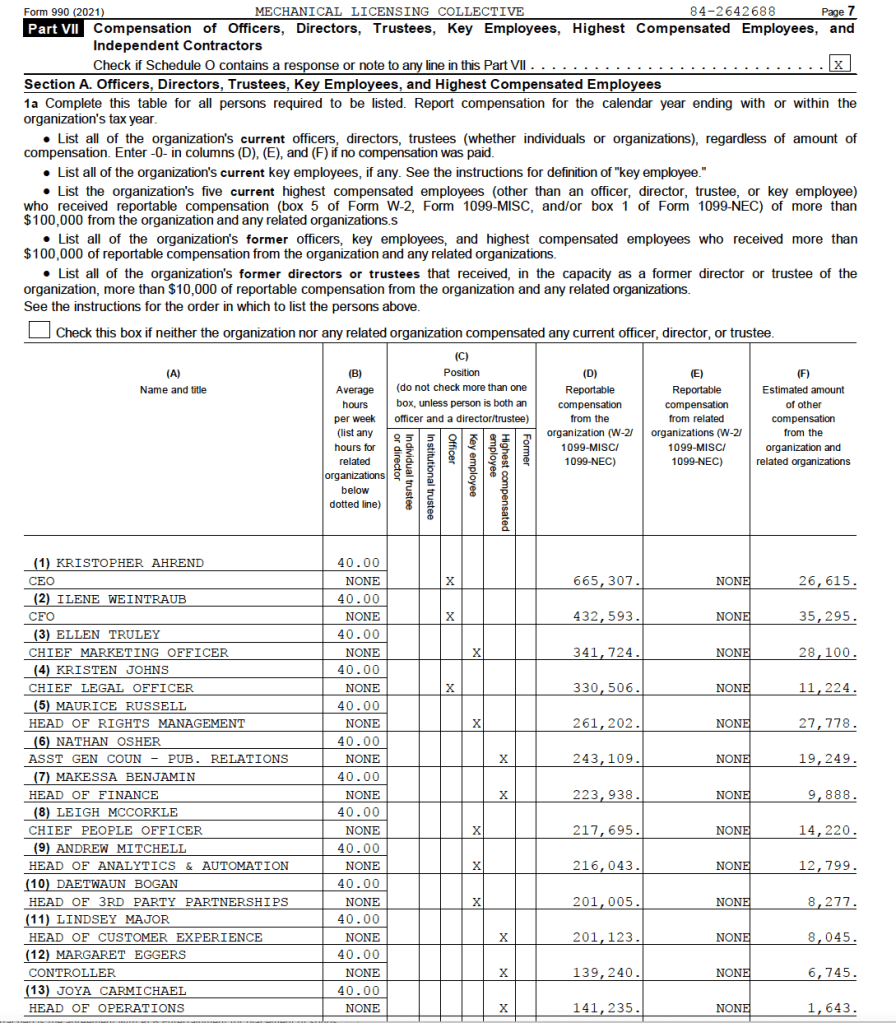
The Mechanical Licensing Collective, Inc. published its tax return for 2021 so you could have a look at the salaries of all those people who can’t manage to pay out the hundreds of millions in black box money to songwriters. Did the Copyright Office approve these nauseatingly rich salaries? We’re not going to point out the disparities in this little list but…. We can’t help but wonder how many songwriters make anything like these salaries?
New York, January 31, 2023 – TIDAL, the global music and entertainment platform, and Universal Music Group (UMG), the world leader in music-based entertainment, today announced that the two companies will work together to explore an innovative new economic model for music streaming that might better reward the value provided by artists and more closely reflect the engagement of TIDAL subscribers with those artists and music they love.
Streaming has revolutionized music, catalyzed industry growth, transformed the entertainment experience and provided incredible opportunities for engagement, to the benefit of artists and fans alike. As it has gained mass adoption over the past decade, there is more desire from all parties to look at how to best economically align fans’ interests with those of their favorite artists.
TIDAL and UMG will research how, by harnessing fan engagement, digital music services and platforms can generate greater commercial value for every type of artist. The research will extend to how different economic models could accelerate subscriber growth, deepen retention, and better monetize fandom to the benefit of artists and the broader music community.
“From day one, TIDAL has stood out as artist-first, leading with a premium subscription tier to pay artists more and experimenting with new ideas like fan-centered royalties to see if there are fairer and more equitable ways to get artists paid,” said TIDAL Lead Jesse Dorogusker. “We are setting aside our current fan-centered royalties investigation to focus on this opportunity for more impact. We’re thrilled to partner and learn along the way about the possibilities for more innovative streaming economics. This partnership will enable us to rethink how we can sustainably improve royalties’ distribution for the breadth of artists on our platform.”
“As the digital landscape continues to evolve, it’s become increasingly clear that music streaming’s economic model needs innovation to ensure a vibrant and sustainable future,” said Michael Nash, UMG’s Executive Vice President, Chief Digital Officer. “Tidal’s embrace of this transformational opportunity is especially exciting because the music ecosystem can work better – for every type of artist and fan – but only through dedicated, thoughtful collaboration. Built on deeply held, shared principles about the value of artistry and the importance of the artist-fan relationship, this strategic initiative will explore how to enhance and advance the model in keeping with our collective objectives.”
Suzanne Wilson General Counsel and Associate Register of Copyrights U.S. Copyright Office 101 Independence Avenue S.E. Washington D.C. 20559 Re: Notice of Proposed Rulemaking: Termination Rights and the Music Modernization Act’s Blanket License Docket No. 2022-5 Comment
Dear General Counsel Wilson:
Thank you for the opportunity to make this comment on the docket referenced above.[i]
I am a music lawyer in Austin, Texas and write this comment on my own behalf only and not on behalf of anyone else.
Others will address the substantive termination issues that are well-described and assayed in the Notice, so I will focus on the procedural tension between The Mechanical Licensing Collective, Inc. (“The MLC, Inc.”) currently designated as the mechanical licensing collective (“MLC”), its officers and directors, and the law as described in the Notice.
I argue that the need for this Notice is symptomatic of a larger problem in the relationship between Congress and The MLC, Inc. I hope the Office will consider resolving this tension as it has been authorized to do under the Music Modernization Act[ii] such as through regulations establishing the type of code of conduct that is common for other federal contractors.
This tension is alarming. The Notice states the MLC “does not follow the Office’s rulemaking guidance”[iii] regarding terminations, and that The MLC, Inc. “declin[es] to heed the Office’s warning….”[iv] These disclosures are diametrically at odds with the clear intent of Congress in crafting the MLC’s role.[v]
The disclosures confirm clearly that there are governance and oversight controversies at The MLC, Inc. that in my view need to be conclusively disposed of, and quickly.[vi] These governance issues are symptomatic of what may be much greater problems with the administrative capabilities of The MLC, Inc. that may be metastasizing but have not yet risen to the level of a public inquiry.
The recklessness that gives rise to the Notice also highlights The MLC, Inc.’s general lack of accountability and suggests a conscious disregard for the Copyright Office’s oversight role on a significant matter of law that is not capable of proper resolution through any “business rules.”[vii]
I also note this troubling statement in the Notice:
But, having reviewed the MLC’s policy, the Office is concerned that it conflicts with the MMA, which requires that the MLC’s dispute policies ‘‘shall not affect any legal or equitable rights or remedies available to any copyright owner or songwriter concerning ownership of, and entitlement to royalties for, a musical work.’’[viii]
It seems clear that The MLC, Inc.’s conscious failure to comply with Congressional intent as well as the Office’s guidance is, or ought to be, a decision of some import that surely must have been taken by someone—that is, one or more persons—employed or appointed by the MLC. It seems likely to be a subject that would have been reviewed both by its General Counsel and as part of the millions in outside counsel fees[ix] spent by The MLC, Inc.
The fact that the decision-making process is not readily known is itself of concern and leads one to further consider developing a code of conduct for The MLC, Inc. to assure the Office, the Congress and the public of its administrative capabilities.
Respectfully, I request that you determine how this decision was arrived at and what internal controls The MLC, Inc. has put in place to assure the Congress, the Office and interested parties that these mistakes will not happen again. This should not be an “oh well” moment and should be taken seriously by The MLC, Inc.
If The MLC, Inc. fails to disclose what it is doing by establishing opaque “business rules”, it is essentially creating de facto regulations that have the practical effect of law or regulations made behind closed doors unless the Office or other oversight agency happens to catch them out. The public will never know that the business rule was established, how the “business rule” was arrived at, or have a meaningful opportunity to comment such as in response to this Notice.
For example, do the minutes of The MLC, Inc.’s board of directors or statutory committees reflect a discussion or vote on the adoption of the MLC’s policies on termination treatment? Did such a vote implicate any conflicts of interest? Who determined that there was or was not a conflict of interest in the MLC’s decision to adopt the termination policy, however it was taken? Were there any dissenting votes recorded? Did an officer or director of The MLC, Inc. certify the completeness of the record in these findings in the corporate minute book?
This leads to other concerns under public discussion regarding the hundreds of millions of “black box” monies being held by The MLC, Inc. Given that the public has very little information available to it regarding the results and implications of the MLC’s operational decisions, I respectfully request that you determine what, if any, financial implications have arisen as a result of The MLC, Inc.’s reckless failure to comply with the law and the guidance of the Office in implementing its termination policy. Such determination should likely include any funds[x] that The MLC, Inc. is apparently trading in the market for its own account.[xi] Any curative action required by the Office should, of course, be retroactive in scope which will require considerable before-and-after accounting disclosures.
It must be asked whether the “business rule” established for terminations increases or decreases the enormous black box which was of considerable interest to Chairman Leahy at the recent Copyright Office oversight hearing at which the Register testified.[xii] This is particularly true if the implementation of the business rule results in financial harm to interested parties who rely on The MLC, Inc. to get it right.
The subject of black box came up in the Questions for the Record from Chairman Leahy. The Copyright Office’s response to Chairman Leahy’s inquiry about the hundreds of millions in black box held by the MLC directed the Chairman to the MLC’s annual report for answers.
Respectfully, I find this odd. Chairman Leahy did not ask what the MLC told the world in its annual report; rather he asked, “What can the Copyright Office do to help ensure that the MLC is working to make sure that rightful owners of music works are identified and paid?”[xiii]The question is transitive: We have oversight of you, you have oversight of The MLC, Inc., therefore we have oversight of the MLC.
Surely no one is surprised by this. The question many have is why The MLC, Inc. itself—a quasigovernmental organization operated by inferior officers[xiv] of the United States–is not the subject of an oversight hearing at Senate Judiciary regarding the hundreds of millions it is sitting on. Maybe next time.
It must also be said that the answer to Chairman Leahy goes on:
Notably, the MLC plans to wait to process historical unmatched royalties from the Phonorecords III rate period [2018-2022] until the Copyright Royalty Judges finalize those rates in the ongoing remand proceeding and digital music providers provide adjusted reports of usage and royalty payments. It is the Office’s understanding that the bulk of historical unmatched royalties come from that period.[xv]
Without getting into the timeline of what came when, how is it exactly that The MLC, Inc. took the decision in February 2021—nearly two years ago–to sit on top of hundreds of millions of other peoples’ money that they were somehow investing under their undisclosed “Investment Policy”? Was anyone asked? Who gave the MLC the permission to do this? Do they not hold the black box corpus in trust for songwriters and copyright owners yet to be identified? Does this not compound the already painful series of failures that resulted in the black box in the first place, the delay in accounting to songwriters (or their families) under Phonorecords III remand, and still more delay while legions of lobbyists and lawyers argue over the post-remand true up accountings?
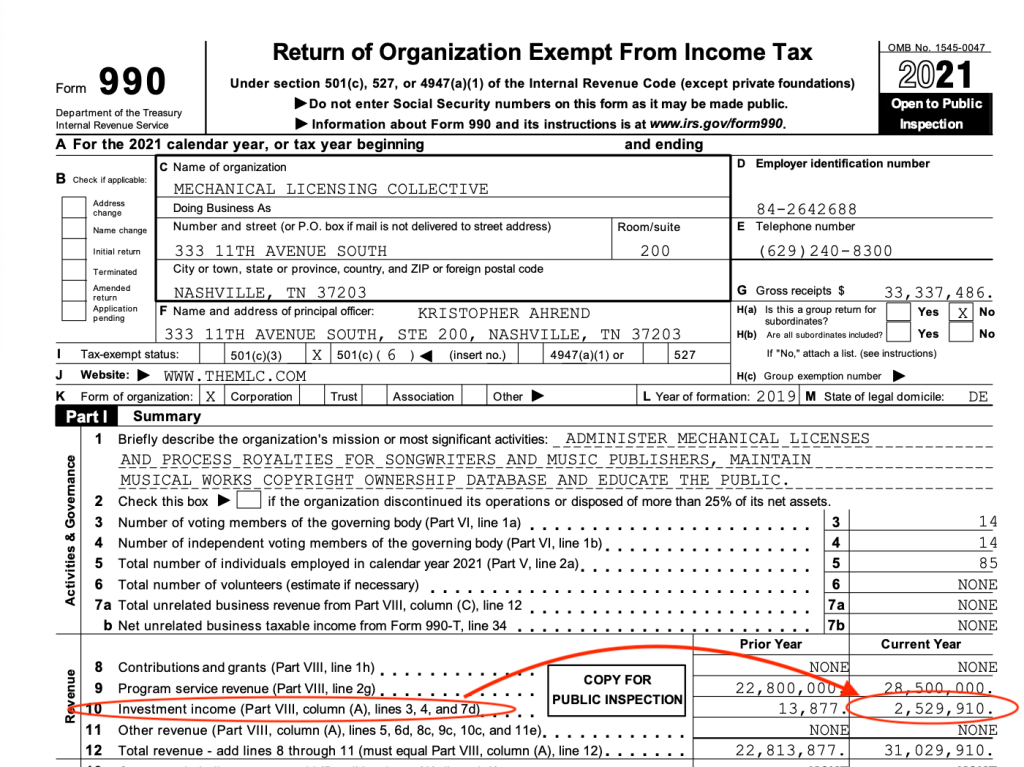
The MLC reported $2,529,910 investment income on its 2021 US Federal tax return 990
Respectfully, there is also, of course, a larger question that the Office may consider answering: If The MLC, Inc. adopts a policy or takes some action outside of the law or its remit, is that policy binding on any future entities designated by the Office as the MLC?
These are all questions that I would expect to have answers that are readily available to the public given that The MLC, Inc. is in a position of public trust administering a compulsory license on behalf of the United States and has been given great privileges under the MMA.[xvi]
Thank you again for the opportunity to comment.
Very truly yours,
Christian L. Castle
CLC/ko
[i] U.S. Copyright Office, Notice of Proposed Rulemaking, Termination Rights and the Music Modernization Act’s Blanket License 87 FR 64405 (Oct. 25, 2022) (Doc. No. 2022-5) (hereafter “Notice”).
[ii]Orrin G. Hatch-Bob Goodlatte Music Modernization Act, Public Law 115–264, 132 Stat. 3676 (2018) (“MMA”) and specifically Title I thereof.
[v]See S. Rep. 115-339 (115th Cong. 2nd Sess. Sept. 17, 2018) at 7 (“Senate Report”). (“The collective is expected to operate in a transparent and accountable manner.”)
[vi] I would hope that this failure will be weighed and measured by the Copyright Office as part of The MLC, Inc.’s quinquennial review as is required under the legislative history. See, e.g., Senate Report at 5 (“[E]vidence of fraud, waste, or abuse, including the failure to follow the relevant regulations adopted by the Copyright Office, over the prior five years should raise serious concerns within the Copyright Office as to whether that same entity has the administrative capabilities necessary to perform the required functions of the collective.”)(emphasis added).
[vii] It must be said that the MLC’s disregard for this particular matter may present a moral hazard (at best) for the publishers represented by at least some of its board members.
[x]See the MLC’s annual report stating that the MLC invests the black box according to its internal “Investment Policy” established by its board of directors but not made public. MLC 2021 Annual Report at p. 4 available at https://www.themlc.com/hubfs/Marketing/23856%20The%20MLC%20AR2021%206-30%20REFRESH%20COMBINED.pdf(“Annual Report”) (“Investment Policy: This policy covers the investment of royalty and assessment funds, respectively, and sets forth The MLC’s goals and objectives in establishing policies to implement The MLC’s investment strategy. The anti-comingling policy required by 17 U.S.C. § 115(d)(3)(D)(ix)(I)(cc) is contained in [The MLC, Inc.’s] Investment Policy. The Investment Policy was approved by the Board in January 2021.”) (emphasis added).
[xi] Realize that every CMO is confronted with the decision about what to do with the royalty float and black box, but not every CMO decides to invest these funds in the market. If they do invest the funds, it is generally the case that any trading profits, dividends or interest goes to offset the CMO’s administrative costs that otherwise would be deducted from collected royalties. However, the MLC, Inc.’s administrative costs are paid by the users of the blanket license (making the United States, I believe, the only country in history or the world that charges for the use of a statutory license). Therefore, the return on the MLC’s investment of the songwriters’ money would not be used for the same purpose as all the world’s CMOs that follow a similar practice. The continuity in ownership for profits derived from The MLC, Inc.’s trading is also unclear; if The MLC, Inc.’s existing designation is not continued but securities are being held or profits generated, what happens?
[xii]Senate Judiciary Committee, Subcommittee on Intellectual Property, Oversight of the U.S. Copyright Office, Responses to Questions for the Record by Shira Perlmutter, Register of Copyrights and Director of the Copyright Office (Sept. 7, 2022), available at https://artistrightswatchdotcom.files.wordpress.com/2022/10/qfr-responses-perlmutter-2022-09-07.pdf. (“Questions for the Record”) (“With respect to the historical, pre-2021, unmatched royalties, which were reported to be about $426 million, the annual report says that the MLC recently started distributing those that it has been able to match. It also says that the MLC has begun making associated usage data for historical unmatched royalties available to copyright owners, which will facilitate further claiming and matching.”)
[xiv] President Donald J. Trump, Statement on Signing the Orrin G. Hatch-Bob Goodlatte Music Modernization Act (October 11, 2018) available athttps://www.govinfo.gov/content/pkg/DCPD-201800692/pdf/DCPD-201800692.pdf (“Because the directors are inferior officers under the Appointments Clause of the Constitution, the Librarian must approve each subsequent selection of a new director.”)
[xvi]See, e.g., Senate Report at 5 (emphasis added). “For the responsibilities described in subparagraphs (J) [distribution of unclaimed royalties] and (K) [dispute resolution] of paragraph (3), the collective is only liable to a party for its actions if the collective is grossly negligent in carrying out the policies and procedures adopted by the Board of Directors pursuant to section 115(d)(11)(D). Since the Register has broad regulatory authority under paragraph (12) of subsection (d), it is expected that such policies and procedures will be thoroughly reviewed by the Register to ensure the fair treatment of interested parties in such proceedings given the high bar in seeking redress.”
In this comment to the Copyright Office, Abby North (independent publisher and Artist Rights Symposium III Moderator) calls on the Copyright Office to stop the MLC quango from unilaterally establishing “business rules” that hurt songwriters and their heirs and protect working families from these arbitrary actions of The MLC. The passing of Jeff Beck reminds us once again that we must take care to protect the heirs of creators.
Re: Termination Rights and the Music Modernization Act’s Blanket License
To the United States Copyright Office:
My name is Abby North. I am a music publishing administrator based in Los Angeles. My views expressed in this letter are solely my own.
With my husband, I am a copyright owner of the classic song “Unchained Melody,” among other copyrights. I also administer musical works and sound recordings on behalf of songwriters, their families and heirs. In many instances, I assist my clients in identifying their termination windows, assist in the research required, and interface with the attorneys who process termination filings.
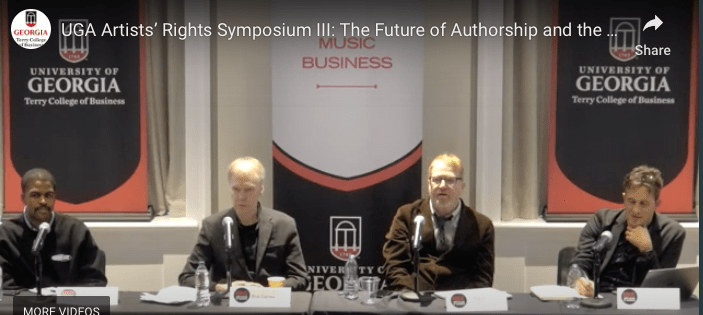
Abby North, Helienne Lindvall, Erin McAnaly, Melanie Santa Rosa speaking at UGA Artist Rights Symposium III (Nov. 15, 2022 in Athens, GA)
I’m thankful for the opportunity to submit comments in support of the Copyright Office’s proposed rule.
The ability to recapture rights via the United States copyright termination system truly provides composers, songwriters and recording artists and their heirs, a “second bite of the apple.” Many of my clients exercise this right, and in doing so grow their family’s revenue, which, given today’s inflation and very high interest rates, coupled with a depleted stock market, is absolutely necessary.
Allyn Ferguson was a successful composer of film/television scores including “Little Lord Fauntleroy,” “Les Miserables,” “Charlie’s Angels,” and “Barney Miller.” According to Variety in its June 27, 2010 obituary, Ferguson was “among the most prolific composers of TV in the past 40 years.” My company North Music Group administers works controlled by Ferguson’s family.
In addition to his scores, Ferguson wrote songs performed by artists including Johnny Mathis, Count Basie Band and Freddie Hubbard. While the bulk of his film and television scores were created on a work for hire basis, and therefore are not eligible for termination under US copyright law, Ferguson’s commercial compositions and songs were not created as works for hire. Ferguson’s family has been able to exercise its termination rights in various musical works,
thereby increasing its earnings as it now collects the publisher share of United States royalties generated by the terminated works. Individual songwriters and composers and their heirs are not copyright aggregators. Every musical work, and every penny generated is very necessary to these families.
The Music Modernization Act created the blanket digital mechanical license. This move from one-off copyright licenses to a blanket license was a dramatic improvement in US mechanical licensing. However, the suggestion that rights held at the inception of this blanket license might remain, in perpetuity, with the original copyright grantee was frightening. I concur with the Office’s proposed rule and legal analysis of the relevant statutes and authorities.
I appreciate the Office requesting comments on the mechanics of solving the payment issues, because for the independent publishers I speak with and for me personally, many operational questions arise regularly regarding The MLC’s uncharted territories.
As one of The MLC’s statutory goals is to provide transparency to songwriters and copyrightowners, I would ask that the Office require The MLC to notify copyright owners (1) if The MLC’s unilateral termination policy has already been imposed on payments previously paid or that are being held in the historical or current black box, and (2) when the adjusting payment required by the proposed rule had been made.
To be clear, this rule must absolutely be retroactive to inception date of The MLC. Beyond the simple, clarifying amendment to the MMA, I believe there are additional, related issues that must be resolved:
1) What is The MLC’s “business rule” regarding the MLC/HFA Song Code for the terminated work? Prior to the inception of The MLC, the Harry Fox Agency would assign one HFA Song Code fr the work and its pre-termination parties, and a different HFA Song Code for the work with the post-termination parties.
What happens now? Do these multiple HFA Song Codes remain in The MLC’s database? Will there continue to be two separate MLC/HFA Song Codes, particularly given the Harry Fox Agency continues to license physical and download mechanicals on behalf of many publishers? Is it reasonable for the HFA Song Code to be the same as The MLC Song Code, when there is no derivative works exception in Section 115?
2) Which party is entitled to the Unmatched (Black Box) royalties, the related interest fees and to The MLC’s investment proceeds for a terminated work?
Finally, it should be noted that the initial concept proposed by The MLC Board (that the server fixation date should impact termination dates) most likely would have served large publishers, not songwriters.
It is crucial that the Copyright Office exercise vigilant oversight and governance of The MLC’s reporting regarding any payment obligations to copyright owners. Specifically, composers, songwriters and their heirs must have as significant a voice as the largest publishers and copyright aggregators.
Additionally, in the spirit of full transparency, I request full disclosure of board or committee votes, minutes of meetings or other documentation of process. For me and others like me, this would tremendously enhance our understanding of The MLC.
Decisions are being made by The MLC’s board and committee members, while the general MLC member or songwriters have no mechanism to gain information regarding the discussions, the decisions and the implementations thereof. Access to minutes and notes would provide valuable insights to the general membership.
I applaud the Copyright Office for moving swiftly to create this rule and clarify and codify how The MLC must treat copyright terminations. It is important that this rule be dictated by the Office as it is absolutely not The MLC’s job todecide who controls rights and is entitled to collect royalties.
That said, a “business rule” established by The MLC could have the effect of law absent vigilance by the Copyright Office.
On behalf of my family and clients, I wholeheartedly support this proposed regulation, and I truly appreciate the Copyright Office’s consideration of my comments.
Recent data suggests that songwriters and artists are financing the necessities in the face of persistent inflation the same way as everyone else–with their credit cards. This can lead to a very deep hole, particularly if it turns out that this inflation is actually the leading edge of stagflation (that I predicted in October of 2021).
According to the first data release for the US Census Bureau’s recent Household Plus survey, over 1/3 of Americans are using credit cards to finance necessities at an average interest rate of 19%. Credit card balances show an increase that maps the spike in inflation CPI over the same time period. This spike results in a current debt balance of $16.51 trillion (including credit cards). There’s nothing “transitory” about credit card debt no matter the helping of word salad from the Treasury Department. Going into the Christmas season (a bit after this chart) U.S. credit card debt increased to the highest rate in 20 years
These balance increases, being practically across the board, are not surprising given the strong levels of nominal consumption we have seen. With prices more than 8 percent higher than they were a year ago, it is perhaps unsurprising that balances are increasing. Notably, credit card balances have grown at nearly double that rate since last year. The real test, of course, will be to follow whether these borrowers will be able to continue to make the payments on their credit cards. Below, we show the flow into delinquency (30+ days late) grouped by zip code-income. Here, it’s clear—delinquency rates have begun increasing, albeit from the unusually low levels that we saw through the pandemic recession. But they remain low in comparison to the levels we saw through the Great Recession and even through the period of economic growth in the ten years preceding the pandemic. For borrowers in the highest-income areas, delinquency rates remain well below historical trends. It will be important to monitor the path of these delinquency rates going forward: Is this simply a reversion to earlier levels, with forbearances ending and stimulus savings drying up, or is this a sign of trouble ahead?
What does it mean for artists and songwriters? It is more important than ever that creators work is valued and compensated. When it comes to government-mandated royalty rates like webcasting for artists and streaming for songwriters, due to the long-term nature of these government rates, it is crucial that creators be protected by a cost of living adjustment. (Remember, a cost of living adjustment or “COLA” is simply an increase in a government rate based on the rise of the Consumer Price Index, also set by the government.)
Of course, songwriters are in the position that the MLC could issue low to no interest credit cards to help them through hard times at least until the MLC was able to distribute the $500 million in black box they are sitting on.
Thankfully, the webcasting rates (set in “Web V”) are protected by the benchmark cost of living adjustment, as are the mechanical royalty rates paid to songwriters for physical and download.
The odd man out, though, is the streaming mechanical rate which has no cost of living adjustment protection. This is troubling and exposes songwriters to the ravages and rot of inflation in what we continue to be told is the most important income stream for songwriters. If it’s the most important royalty, why shouldn’t it also have the most protection from inflation?
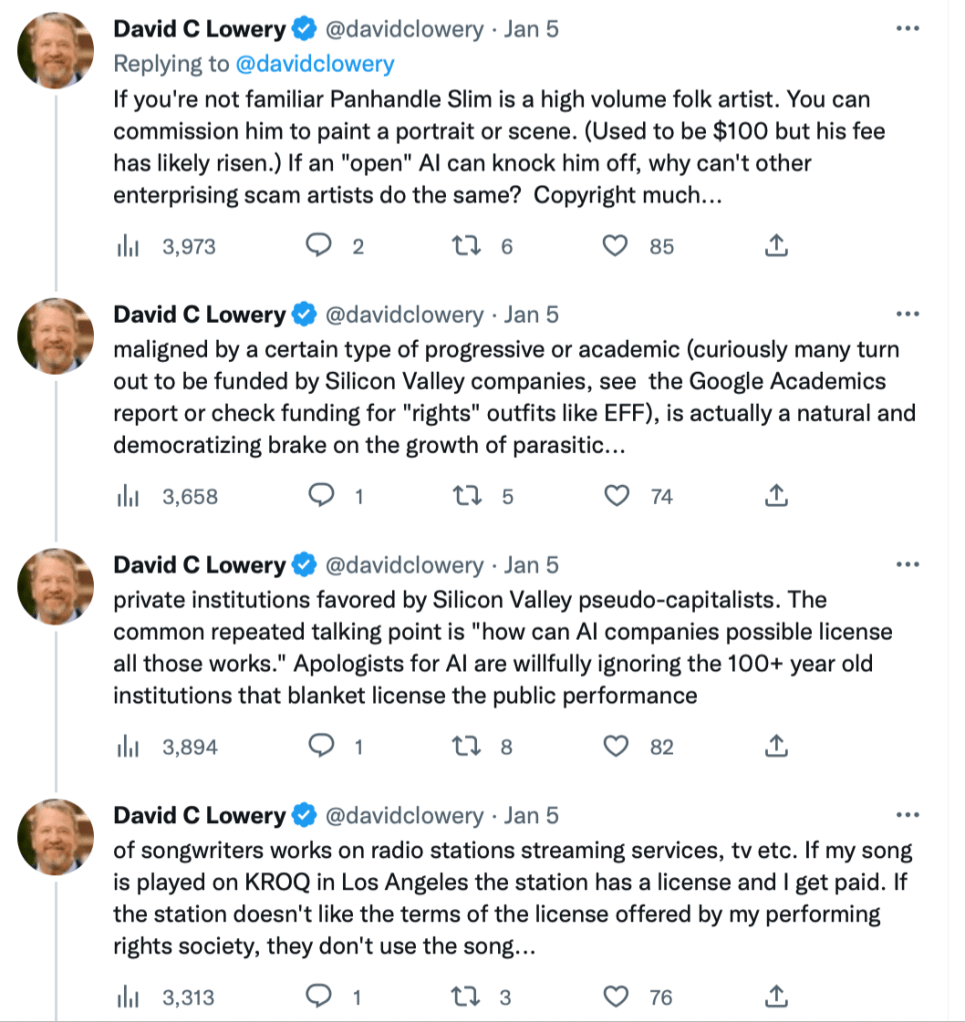
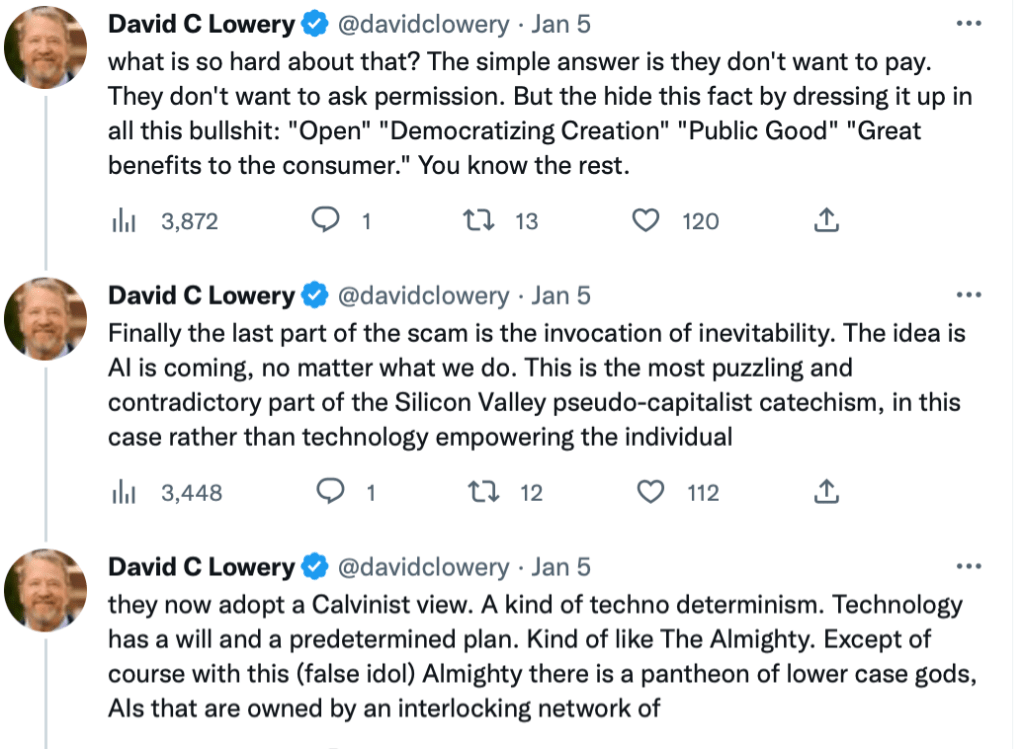
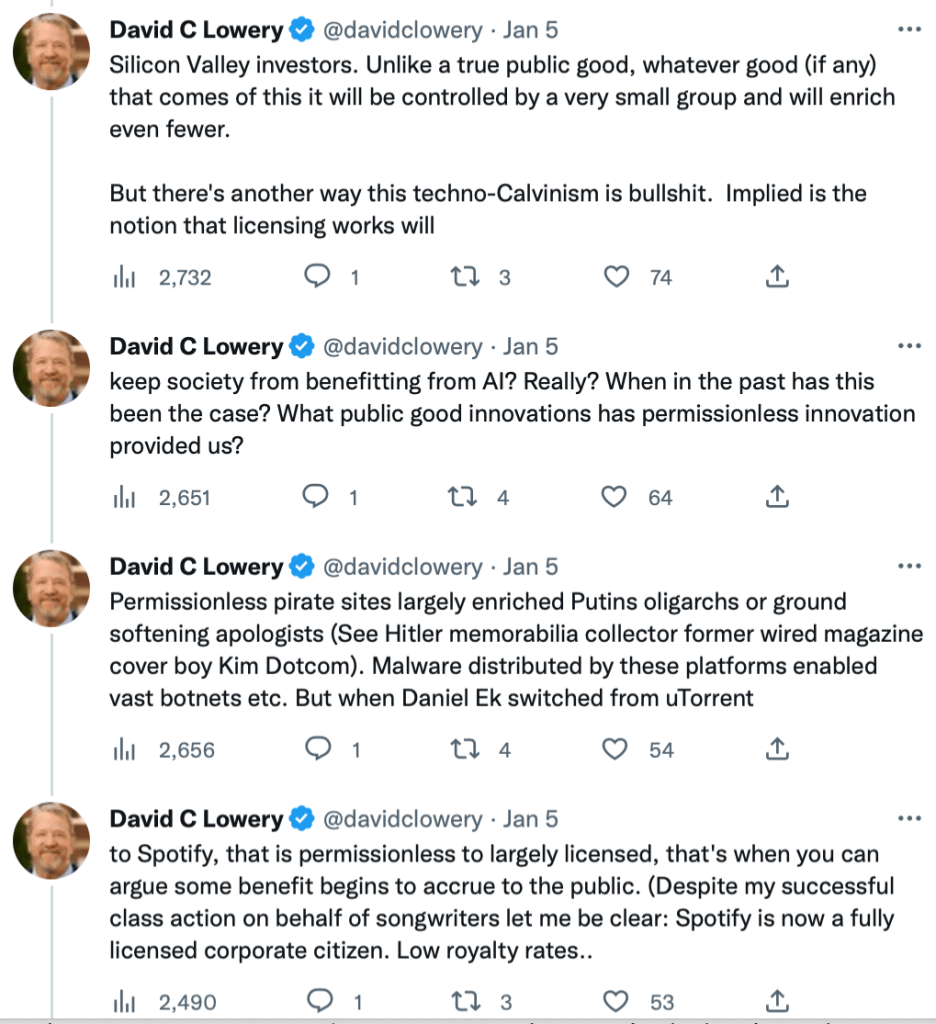
In the age of Silicon Valley monopoly pseudo-capitalism, a tell that an organization is up to no good, is the use of the word "open." Take OpenAI. It has slathered itself in a pseudo-academic ooze, presenting papers, hosting "discussions, hoping you don't realize who really owns
OpenAI: The same Silicon Valley monopoly pseudo capitalists that have given you all the other monopoly platforms. Start with Sequoia capital. Go from there. Now it's important for the scam to present it as something that is "open" to the public as if they are creating something..
like a public park or library (one of SVs favorite Trojan horses). Because what they are really doing is taking private property (copyrights, TM, ROP) that rightfully belong to artists (big and small, professional and hobbyist) without permission and converting it to a private…
company owned by the same people who brought you the current monopoly platforms. The trick works cause commentators (especially tech journalists) willfully repeat the framing that a public good is being created. Not the next Google.
The second trick these cynical pseudo capitalist opportunists are playing is that nothing is really"owed" to creators because no one is harmed, AI is simply creating new works, based on collective Artist impulses. Really? The why can I input "in the style of Panhandle Slim"…
Government intervention into the economy can, and usually does, produce negative externalities (or unanticipated harms). Government interference with price can produce the negative externality of poverty. While we can sue if we are harmed by some negative externalities, we usually can’t sue the government for causing poverty.
Understanding poverty often considers the government’s interaction with citizens. Do the government’s policies increase poverty or reduce poverty?
One of those analytical inquiries is whether the government gives the people too much or too little agency in establishing poverty policy. Does poverty policy remember to allow people the ability to have a meaningful effect on their lives and outcomes based on their own efforts and human agency? Or does poverty policy trap them and limit or even take away their agency?
The Compulsory License as Poverty Program
I can’t think of a better example of the government limiting the outcomes of a class of people than the compulsory mechanical license. Minimum wage tries to influence poverty favorably by establishing a lower bound of fair compensation for employees. Minimum wage policy anticipates that some employers will pay above minimum wage because employees will be able to quit a lower paying job and strive for a higher paying job.
Employees exercise agency because the government policy does not stop them from doing so and gives them a seat at the table in negotiating their own compensation. Money isn’t the only consideration, but it is a core issue. And employees can walk across the street and get a better paying job. Unlike the minimum wage, the compulsory license places a limit on what the biggest corporations in the world are required to pay a specific class of people–songwriters.
Neither can I think of a better example of the government working with Big Tech to destroy human agency than the Copyright Royalty Board–which is strangely consistent with Big Tech’s dehumanizing data trafficking business model.
The New Streaming Mechanical Rates
The Copyright Royalty Judges have issued their final ruling on the rates and terms under the government-mandated compulsory license for streaming mechanicals. That ruling is to be published in the Federal Register in the coming days and is based on a settlement among the National Music Publishers Association, Nashville Songwriters International, Amazon, Apple, Google, Pandora, and Spotify.
The CRJs mostly discuss the 20 comments they received on the proposed version of their rule and don’t really spend much time defending why they are adopting the settlement reached by the richest corporations on Earth (and in Earth’s history) on the one hand and–let’s be honest (and we’ll come back to this)–the major publishers on the other hand. The Judges are adopting the deal these parties made essentially because the CRJs can’t find anything unreasonable or illegal about it.
Said another way, the Judges can’t find a reason to take the heat of rejecting it. That’s unfortunate, because they did reject the “frozen mechanicals” settlement as is their role in the Copyright Royalty Board process required by Congress.
I’m not going to argue about the rates and terms of the settlement itself. I could and I know others will, but I’m going to focus on one economic point today: the absence of a cost of living adjustment (or COLA). There are some other points that should also be addressed that are more nuanced and policy oriented which I’ll come to in another post.
It’s important to understand one aspect of the CRB’s procedural nomenclature: Participants and commenters. There is only one individual songwriter who is a participant in Phonorecords IV–a songwriter named George Johnson who represents himself. Being a “participant” means that you are appearing before the Judges as a legal matter. In the case of settlements that the Judges intend to approve and adopt as law, the Judges are required to make those settlements available for public comment which they did. Those comments are posted in the CRB’s docket for the particular proceeding, styled as “Phonorecords IV” in our case today. Note that if the Judges did not make those settlements available, no one who is answerable to the electorate would be involved in the rate setting.
It is important to understand that the voluntary settlement excludes George Johnson from negotiation and drafting of the settlement even though he is a participant. Commenters are also excluded and only find out the terms of the proposed settlement once the Judges post the settlement as a proposed rule and seek public comments.
Unless commenters persuade the Judges to reject a settlement (which MTP reader will recall happened in the “frozen mechanicals” proceeding), this means that the only people who have a meaningful opportunity to affect the outcome are the important people: The National Music Publishers Association, Nashville Songwriters International, Amazon, Apple, Google, Pandora, and Spotify, that is, “Big Tech.”
Nobody else.
It should be noted that the smart money is betting that the next session of Congress will not be a pleasant experience for any of these DSPs based on public statements of a number of Members, including House Judiciary Chairman-select Jordan. It will be easy for songwriters to point to the latest insult in the form of the streaming mechanical ruling as yet another example of that special combination of Big Tech, the compulsory license and the nine most terrifying words in the English language. One novel issue of law at least at the CRB that the Copyright Office may wish to opine on is what happens if one or more participants in a proceeding negotiate an oppressive voluntary agreement but cease to exist when it is put into effect. Just sayin.
But songwriters will be able to point to the poverty-creating externality of the compulsory rate and the human agency-destroying effect of Congress’s Copyright Royalty Board.
The Failure to COLA
As the Judges confirm in the streaming mechanicals ruling, George Johnson and the commenters who opposed the settlement all support some version of a cost of living adjustment applied to the statutory rate. A COLA is the standard government approach to preserving buying power in a number of areas of the economy driven by government intervention including the physical mechanical royalty for the same songs.
However, since the important people did not agree to a COLA as part of their settlement for the streaming mechanical, the Judges evidently believed they were unable to add a COLA in the final rule because it might disturb the “negotiation” by the biggest corporations in commercial history and God know we wouldn’t want to do that. They might get mad and there’s no poverty at Big Tech.
The Judges authority is an issue that one day may be decided in another forum, perhaps even the Supreme Court. I’m not so sure the role of the Judges was to ignore the utility of a COLA and merely scriven into law the deal the lobbyists and lawyers made while ignoring George and all the public comments in this case supporting a COLA.
This is of particular interest because the Judges had just adopted a COLA in Phonorecords IV for physical records and permanent downloads and have adopted COLAs in other compulsory licenses (and have done so for many years). It must be said that one reason there is a COLA in the “Subpart B” proceeding for physical royalties is becausethe Judges themselves suggested it when they rejected the initial Subpart B settlement. Presumably the Judges could have done the same thing in the streaming mechanicals proceeding despite the tremendous political clout wielded by Big Tech, at least for the moment.
For some reason, the Judges decided not to treat likes alike when it involved the richest corporations on Earth. This means that the exact same writers with the exact same songs will have the value of the government’s compulsory rate protected by a COLA when exploited on vinyl but not when the exact same song and the exact same writers on the exact same recordings are streamed.
If that’s not arbitrary, I’m looking forward to the explanation. I’m all ears.
Bootstrapping for Rich People
One might think that this unequal treatment wasn’t arbitrary because the Judges are directed by Congress to favor adopting as the law applicable to all songwriters voluntary settlements agreements on rates and terms reached among some or all of the participants in a proceeding like Phonorecords IV. Of course Congress made it so expensive to be a participant in a proceeding (and that negotiation) that it’s likely that if you are both a participant and also a party to any voluntary settlement, you must be one of the rich kids.
What is very interesting about Phonorecords IV is that the proceeding was divided between physical and streaming mechanicals. Although the publisher representatives were the same (NMPA and NSAI), the music users were, of course different: The major labels were in the physical negotiation and the DSPs were in the streaming. Faced with strident opposition from commenters and continued opposition from George Johnson, the major labels came up with a solution that included a COLA and got the publishers to agree. That solution increased the minimum penny rate from 9.1¢ to 12¢ as a base rate with an annual COLA.
Why this difference between labels and DSPs? Could it be because the labels understand that they are in the age of the songwriter and they need to be certain that songwriters thrive? You know, no hits, no hit records? Could it be because the DSPs are so blinded by leverage, wealth and political power that they and their THIRTY SIX LAWYERS lack this understanding?
The label deal was acceptable to a lot of people, albeit begrudgingly in some cases, but it closed. And the deal was a step toward what I would call the primary goal of government rate setting–stop bullying songwriters with insulting rates while repeating nonsense talking points that nobody in the trenches believes for a second. It should not be forgotten that the label deal also came with a renewed commitment to finding a way toward a longer table with more people at it to negotiate these deals in the future. We’ll see, but the labels should expect to be reminded about this in the future.
But–nothing like this common sense approach to inclusion happened on the streaming side with DSPs. Why not? Probably because the rich kids were calling the shots and did not give a hoot about what the songwriters thought. They used their situational leverage as participants throughout the Phonorecords IV proceeding to jam through an insulting deal no matter how much they embarrassed themselves in the process. The conduct of the DSPs–and did I mention their THIRTY SIX LAWYERS–was the complete opposite of how the major labels conducted themselves.
You may notice that I refer to the DSPs and the labels as calling the shots in these negotiations. There’s a very simple reason for that–the government has put its thumb on the scale because of the compulsory license. Songwriters can’t say “no” (much less “Hell, no”), so are forced to fight a rear guard action because the outcome is predetermined–unless the settling parties do something to change that outcome. To their great credit, the labels did. But to their great–and highly predictable–shame the DSPs–and did I mention their THIRTY SIX LAWYERS–didn’t. The way the government has constructed the CRB procedures songwriters are thrown into the arena to engage in what amounts to slow motion begging and managed decline.
When the Judges’ ruling is subject to legal review, this arbitrary distinction may be difficult to defend and the Judges certainly don’t put much effort into that defense in their ruling. They say, for example:
[T]he Judges observe the broad increases within the Settlement, including the headline percentage rate applicable to Service Revenue, the percentage of Total Content Costs, and each of the fixed per subscriber elements. The Judges find that the structure and increases are a reasonable approach to providing an organic cost of living adjustment.
In other words, the DSPs and the Judges are pushing a “trickle down” approach that a rising tide lifts all boats. They ignore the underlying algebra that is the flaw at the heart of the “big pool” royalty calculation that’s as true for songwriters as it is for artists. The more DSPs keep prices the same and the more songs are added to the big pool denominator, the lower the per-song royalty trends (particularly for estates because the numerator cannot grow by definition). If the rate of change in the denominator is greater than the rate of change in revenue or the number of songs being paid out in the numerator, the Malthusian algebra demands that the per-writer rate declines over time. It may be less obvious in streaming mechanicals due to the mind bending greater of/lesser than formula, TCC, etc., but gravity always wins.
Why COLA?
There is a common misapprehension of what the COLA is intended to accomplish as well as the government’s compulsory license rate. A COLA is not an increase in value, it is downside protection to preserve value. Stating that the headline rate increases over time so you don’t need a COLA compares apples to oranges and gets a pomegranate. It’s a nonsense statement.
Plus, no element of the Judge’s list of producer supply side inputs have anything to do with cost items relevant to songwriters providing songs to DSPs (or publishers and labels for that matter). The relevant costs for COLA purposes are the components of the Consumer Price Index applicable to songwriters who receive the government’s royalty such as food at home, rent, utilities, gasoline and the like. That’s why you have a COLA–otherwise the real royalty rate declines BOTH because of inflation AND because of the Malthusian algebra. And that creates the negative externality of poverty among songwriters and discourages new people from taking up the craft.
There’s a reason why Big Tech never wants to talk about per-stream rates on either recordings or songs. That’s because if you explained to the average person or Member of Congress what the rates actually were in pennies, the zeros to the right would make it obvious how insulting the entire proposal is to songwriters.
One of the surest ways to cause poverty is for the government to cap income and destroy human agency. But this is what has happened with the streaming mechanicals. Songwriters are crushed again by Big Tech–and did I mention their THIRTY SIX LAWYERS?
And don’t forget–if no one writes hits, no one has hit records. Eventually, this will become a catalog business and American culture will be impoverished right along side the impoverishment of songwriters.
We have a chance to make history today––the American Music Fairness Act, our bi-partisan congressional bill, is on the runway to pass but we need the support of just one Senator who is holding it up:
Call @SenatorLeahy and tell him to support The American Music Fairness Act: (202) 224-4242
We don’t ask you to take time out of your day to support legislation very often, but this is one of those times and YOUR CALL MATTERS!
We have all worked together on the #IRespectMusic campaign towards this moment for years, and our moment has finally arrived. Make your voices heard, please call @SenatorLeahy and urge him not to turn his back on American artists in our hour of need!
DID YOU KNOW the USA is the only democratic country in the world where artists don’t get paid for radio airplay? DID YOU KNOW only Iran & North Korea share the USA’s position on this issue? Tell Senator Leahy that it is time to get America off this list!
Starting with Frank Sinatra on December 12, 1988–nearly 34 years ago to the day–artists have campaigned for fair treatment in line with the rest of the world and get a performance royalty for broadcast radio. The House Judiciary Committee led by the stalwart Rep. Jerry Nadler moved that goal a little closer this week by passing HR 4130, the American Music Fairness Act, out of committee.
Almost as significant as the vote was the comments by Rep. Jim Jordan and Rep. Darrell Issa (the remaining author of the bill after the wonderful Rep. Ted Deutch announced he would not run for reelection). Given the party change in the House next session, Rep. Jordan is the front runner for Chair of the House Judiciary Committee. He was very clear that the committee will be taking up the bill if it doesn’t pass in the lame duck, because it is time to resave this unfairness. Rep. Darrell Issa summed it up: It is time for bipartisan compromise so that America is not in the same category as North Korea, Cuba and Iran, and whatever the right number is it is not zero.
This is not where we needed up before on prior versions of the legislation. We are in a much, much better place than before. I would say that’s for two reasons. First, because the legislation itself addresses radio’s objections and makes the NAB’s mean-spirited lobbying tactics ring hollow and cheap. That dog just won’t hunt anymore.
The other reason is because of a superb messaging effort by the MusicFirst Coalition under new management. MusicFirst under Joe Crowley took their job seriously and understood their job to be very simple: We win, they lose. Too often, lobbyists view their job as perpetuating the conflict so the money keeps flowing. You can tell when you are in one of those because the organization doesn’t seem to quite get it that when you have fewer points when the clock runs out, we call that losing. Even in Washington.
Turning this beast around was a tough job and the entire MusicFirst team deserves recognition and appreciation. We’re not done–there may still be some magic tricks left in this session. But as Congressmen Jordan and Issa said, if the bill doesn’t pass this session, they are committed to taking it up early next session and getting it passed in the House.
Godspeed to everyone who has worked so hard for so long to make this a reality for all of our artists and musicians who need it. It’s what Frank would do.
We’re back! David Lowery hosted the third annual Artist Rights Symposium at the University of Georgia’s Terry College in Athens on November 15 as an in-person event. The Symposium is an all-day event that allows students in the Music Business program to participate and interact with panelists as part of the music business program.
Our keynote speaker was the inspiring Merck Mercuriadis, long time songwriter advocate, manager and music industry veteran who founded and runs the Hipgnosis Songs Fund. Merck is an active songwriter advocate around the world, particularly with the recent inquiry into the music streaming economy by the UK Parliament’s Digital Culture Media & Sport Committee and the UK Competition and Markets Authority. As Kristin Robinson reported on Billboard
Merck explained why he feels the industry is in the “age of the songwriter.” “There has been a massive paradigm shift,” he said. “Forty years ago, the power was in the artist brand,” but now, most songs that top the Billboard charts are written by a larger number of songwriters than ever, meaning the demand has never been higher for good hitmakers. “But songwriters have to have a place at the negotiating table now,” he said, citing that in the United States, rates for mechanicals are set by the government’s Copyright Royalty Board, barring “free market” negotiations. “Let’s face it, [the government controlling rates] is insulting to songwriters.”
This year’s symposium topic was “The Future of Authorship and the US Copyright Office” and Merck and the stellar panelists had a lot to say about the many advocacy issues facing contemporary songwriters.
Fortunately, thanks to Terry College the symposium is available on YouTube at no charge and you can watch it in its entirety.
Welcome/Opening remarks
9:00 AM -9:10 AM David Barbe, Director, Terry College Music Business Program
Georgia Legislative Overview and Agenda 9:10 AM- 9:30 AM
Panel 1: Libraries vs Authors: The Internet Archive’s “Controlled Digital Lending” and Fair Renumeration for Authors. 9:35 AM- 10:50 AM











 The Trichordist
You must be logged in to post a comment.