Series 3 of The Artist Rights Watch Podcast is here! Nik, David, and Chris are joined by attorney Kevin Casini to talk about the latest with the Copyright Royalty Board and mechanical rates in the Phonorecords IV proceeding and discuss alternatives so songwriters are better represented at the CRB compared to the status quo.
ARW Podcast S3E1: Unfreezing Mechanicals show notes
On the this episode of the Artist Rights Watch, Nik, David, and Chris sit down to talk about the recent developments with the CRB and mechanicals with lawyer and advocate, Kevin Casini. The Copyright Royalty Board who herein will more than likely be referred to as the CRB, ‘is a US system of three copyright reality judges who determines rates and terms for copyright statutory licenses and make determinations on distribution of statutory license royalties collected by the US Copyright Office.’ The US mechanical royalties are determined by the CRB and they meet every 5 years to determine the rate. Songwriter groups argued for a higher rate, and the CRB agreed. On March 29, 2022 the CRB agreed to unfreeze the $0.091 mechanical royalty rate which would commence a fight for a new rate in the 2023-2027 period. Over the past few years, there has been numerous criticisms about the constant rule for freezing the mechanical royalty rate. The royalty rate currently is $0.091 which was set back in 2006, and frankly, songwriters are making less money due to economic inflation.
If you’ve received one of these emails from the MLC about having to recast their monthly statement inside of a single month, when you’re eying that $500,000,000 of supposedly unmatched money that’s sitting in the MLC, Inc.’s bank account (maybe?), or if you’re trying to figure out when they are launching the vastly overdue claiming portal, you’re probably wondering–who’s in the clown car today? Bozo or Pennywise?
But maybe they’re smarter than they look. Because all they have to do to distribute that $500,000,000 on a market share basis is keep you looking at the bright and shiny object while they run out the clock.
And if you’re waiting for the Copyright Office to save you because they have “oversight”, you’re going to be waiting for a long time. Here’s the reality–nobody is minding the store. There’s a difference between “oversight” and “overwatch.” In Washington, “oversight” means finding someone else to blame and from the very beginning it has been clear who the MLC intends to blame–you. Because you didn’t “play your part” or sufficiently “connect to collect”.
The Copyright Office has done a couple things while under the supervision of the current head lobbyist for Spotify. They’re good at studies, terrible at oversight, so let’s give credit where it’s due. But also realize that’s where it stops because they have about as much moxie as a starfish. (And if you think the NMPA is going to save you, take a look at the frozen mechanicals debacle and ask yourself if a rational person could really take that seriously.)
At the core of the MLC’s business model is the ability to match. Matching is kind of a “See Spot run” building block. If you can’t match, it’s very close to saying you can’t count. Because it depends on what the definition of “match” is.
So what is a match? Or as the Bard might say, how can I screw thee? Let me count the ways. The Copyright Office produced the Unclaimed Royalties Best Practices study partly on this very topic. Notice the difference between “best practices” and “rules.” “Best practices” is not the same as “rule”. If you violate a best practice, nothing happens to you, so therefore perfect for Washington. If you violate a rule, bad things happen to you. The connective tissue is enforcement. If you violate a rule at the Securities and Exchange Commission, you wear stripes. If you violate a rule at the Environmental Protection Agency, you will pay a fine, for sure. If you violate a rule at the MLC? There really aren’t any so it can’t happen. In other words, it’s just like the Harry Fox Agency.
But that’s what we have so let’s look at one passage in particular from the Best Practice Study because that’s the closest we have to a rule book.
The Office recommends that the MLC make all [matching] metrics publicly available, except to the extent it would cause confidential or business sensitive information to be improperly disclosed. [God forbid.] Specifically regarding match rates, the Office acknowledges the MLC’s point that “vendors can easily increase their claimed ‘match percentage’ by simply dropping the confidence level at which they call something a match.” For that reason, the Office recommends that the MLC provide appropriate context for its metrics, including information surrounding how it defines a match, relevant confidence levels, and how confidence levels are tuned. Additionally, so that they are clear and precise, and to avoid possible confusion, the Office recommends that all royalty figures be provided both with and without accrued interest.[How about a best practice of how they are practicing complying with best practices best?
The Office recommends that in addition to providing annual statistics in its annual report, the MLC also have a dedicated public webpage displaying all of these metrics in a clear, well-organized, user-friendly, and accessible manner. The webpage should be interactive and allow users to search, sort, and break down the data so it may be more easily reviewed and analyzed. The webpage should also have an export or download feature, including bulk exporting/downloading, to aid public consumption and dissemination. The Office recommends that the webpage be updated monthly after each batch of new reports of usage arrive and go through initial matching processes. All metrics should be retained and made available online indefinitely (though the MLC could distinguish between current and historic metrics in the future) so long-term trends can be assessed and to ensure the public and the Office have access to them in connection with the review of the MLC’s designation every five years. The MLC should also be very clear about how applicable metrics may change in response to DMP reporting adjustments and the reconciliation of any related royalty underpayments or overpayments permitted by the Office’s regulations. Relatedly, the Office also recommends that the MLC make publicly available relevant metrics about DMP reported usage that the MLC determines is not subject to blanket licenses (e.g., where it is subject to a voluntary license instead, public domain musical works, etc.), such that any related paid royalties have been credited or refunded back to the DMP.
What would also be nice is to tell you how much of your money they are holding and how you get it back. Maybe they could practice the best out of that.
There’s nothing particularly insightful about any of that, right? It’s the kind of thing that any songwriter giving the subject a moment or two of thought could have figured out at any point in the last 100 years. It’s also the kind of thing that you would have expected to have been built into the MLC’s system–which is essentially the HFA system–from the beginning.
It doesn’t matter what they say they aspire to do. Naturally they have to say they aspire to get it 100% correct–because otherwise that raises some interesting questions about intent, right?
Will they ever be called to account for their failures? Doubtful. The only business in the world where you can get the government to let you hold $500,000,000 of other people’s money and then keep it because paying it out was just too hard for you.
Do you think this mess is what Congress had in mind after they were fed a bunch of crap by the know-nothing lobbyists?
One of the main beefs I’ve had with the Copyright Royalty Board is the secrecy in plain sight. Very few people follow what’s going on there, yet every time you move a rock, another toad hops out. Now that we are turning our attention to the streaming mechanical proceeding–which as we were told ad nauseam is the important one, don’t you know–the first thing we find is the shameful antics of Google on full display.
Remember–the Copyright Royalty Board split the rate proceedings in two. One was for the physical and download mechanical (paid by record companies) and one for the streaming mechanical (paid by digital music services), all under the compulsory license which was adopted for the huge benefit of each music user. And of course if it’s compulsory it takes (there’s that word again) away the rights of songwriters to bargain and set their own price without government intervention. (There are alternative ways to do this such as the Nordic model of extended collective licensing that David Lowery discussed in an important blog post a few years ago.)
The Copyright Royalty Judges are given the unenviable task of divining what a willing buyer would pay a willing seller in the open market. Of course that willing/willing rate is a complete legal fiction because in the novella of statutory rates there hasn’t been an open market for over 100 years which for rate setting purposes means there has never been an open market for songwriters. Why? Not sure, really, but there must have been an original sin, the novella tells us so. We can only assume that when that writer room door closes, those pesky songwriters just naturally start colluding, unlike Facebook, Amazon, Apple, Spotify and especially Google. Google who have never been prosecuted for violating the Controlled Substances Act for which they paid a $500,000,000 fine and who we let take over our children like they were a trustworthy television network or something.
So since there’s never been an open market because the government took the songwriters’ rights back in 1909 in this case (and 1941 in the case of the ASCAP consent decree), you can well imagine that a cottage industry of executives, lawyers and lobbyists have grown up to service the bizarre rate setting process that has totally lost their way in my view. It’s hard to believe when we read the shenanigans going on in front of the Judges that this is all designed to determine the value of songs. There are 38 lawyers billing time in the streaming proceeding which will raise the transaction cost of the proceeding to an absurd and Kafka-esque level, but it does help you understand why the lobbyists think that proceeding is so important–it’s definitely more important to them.
Which leads us to the extremely Googley discovery request that Google has filed and the Judges appear to have approved. In a nutshell, Google has said that they only way that the rates can be set is if the Judges force the National Music Publishers Association and the Nashville Songwriters Association International to turn over all to Google of your accounting statements and licenses so Google can determine if the past earnings back up the NMPA and NSAI royalty claims made by their many Lecterian lawyers.
But don’t feel bad–it’s not like they will be turning over the data to the public, just to Google. What a relief, right?
Here’s what the order actually says:
That’s right–Google wants “Music Publishers” to produce all the royalty statements for the most successful songwriters in the world to “test” whether songwriters are struggling financially. Given that this will involve many, many statements which probably have to have personally identifiable information redacted, it’s going to take many hours which is great for those who get paid by the hour but not so great for those who get paid by the song.
Is there no other way to determine whether mechanical royalties have declined to subsistence levels? Surely there must be, and you know what else? There’s also a way to test whether mechanical royalties have declined to below subsistence levels which is really the point here, right?
Yes, I got your test right here, soulless Google lawyers.
But wait, there’s more. Google also wants to raise transaction costs on songwriters by forcing the production of all “free market” licenses. (“Free market” benchmarks are themselves a laughable concept in a hugely distorted market that still suffers from the governments negligent wage and price control of a 2¢ rate from 1909 to 1978).
And given the parameters of the Copyright Royalty Board, the Judges seem to have granted Google’s request in part for the statements and entirely for the licenses.
You do have to ask whether there’s anything songwriters can do to keep their confidential royalty statements and license agreements out of the hands of the Leviathan of Mountain View. It does seem that there could be a process to intervene in the Phonorecords IV case to stop this from happening. Just because Google is trying to prove that songwriter income has not been decimated when we all know it has been does not seem to require the humiliation of having your royalty statements put on display. This is definitely something to speak about to your lawyer and your publisher.
This entire exchange is exceptionally bizarre because the “Copyright Owners” are the NMPA and NSAI, neither of whom own copyrights, send statements or enter licenses. And yet there seems to be an assumption that some group of publishers are bound by the order. I can only assume that the publishers who are on the receiving end of this order are the music publisher affiliates of the CRB participants at the group level of Sony, Universal and Warner, although the order doesn’t really demonstrate that connective tissue because…well, it doesn’t. Publisher affiliates are not participating and if the principle and policy is that every stand alone affiliate of a corporate parent is participating and subject to discovery because the corporate parent is…well, that’s an interesting proposition.
Before you heave a sigh of relieve that only the songwriters signed to a major will have their privacy invaded by the greatest privacy invader of all time, that would be Google hands down, just realize the cost of what can happen if you were to have the temerity to think you could participate in the Copyright Royalty Board.
You can have one of the biggest corporations in commercial history that rips you off every minute of every day and essentially prints money in the public market that they use to destroy your rights and creations sick their army of soul-crushing lawyers on you to prove that songwriters are dying penniless because of Google’s income transfer. And still pay you a number that starts many decimal places to the right and laugh about it over steaks at The Palm with fava beans and a fine Chianti.
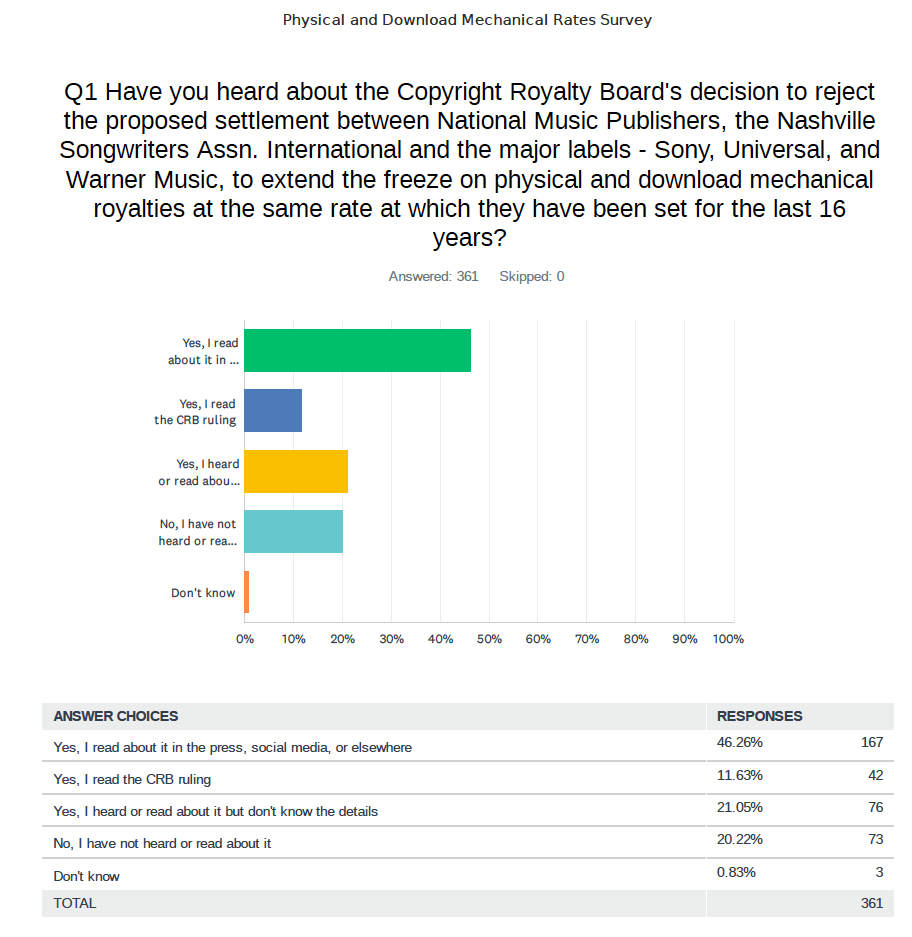
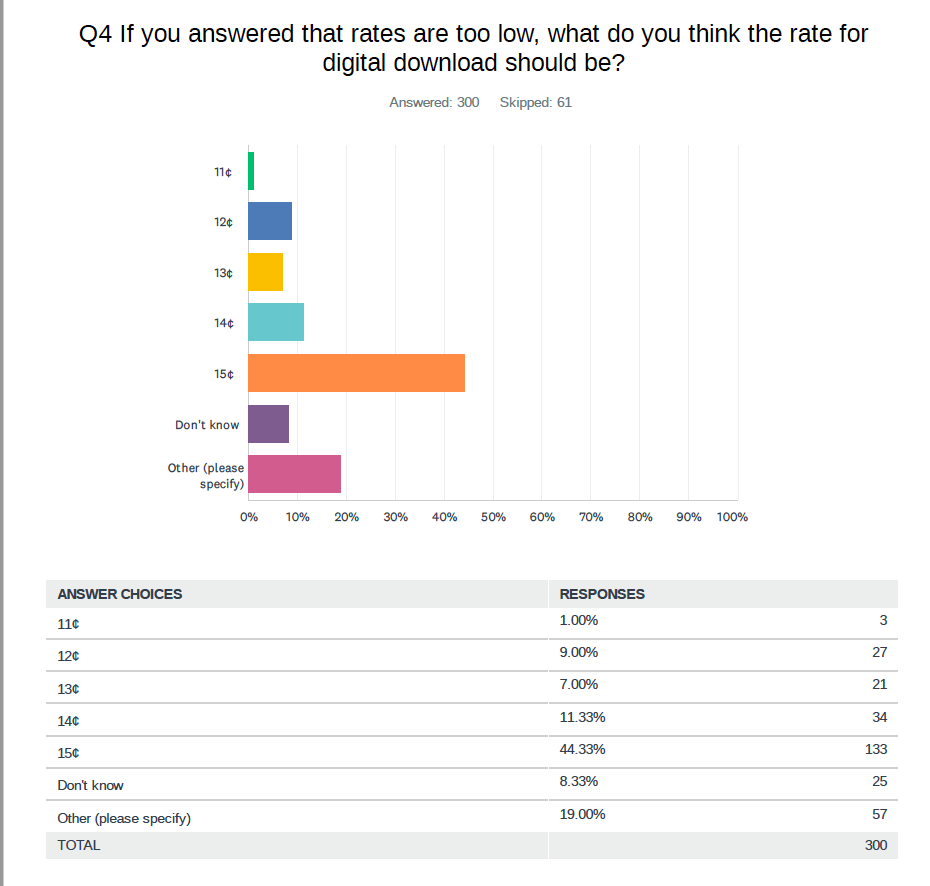
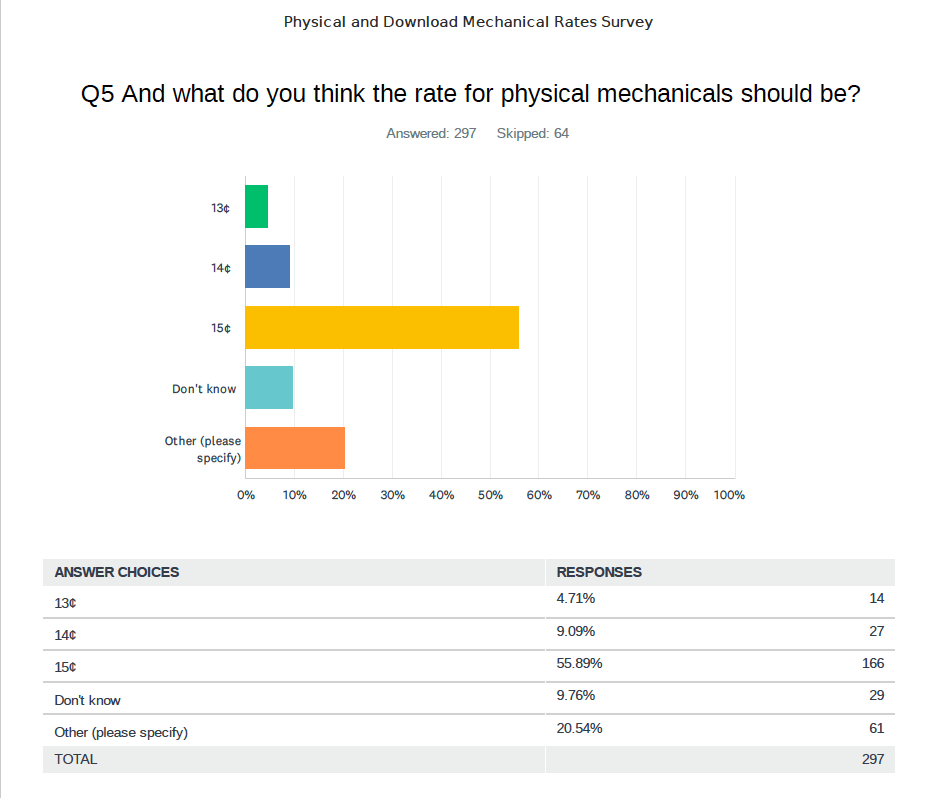
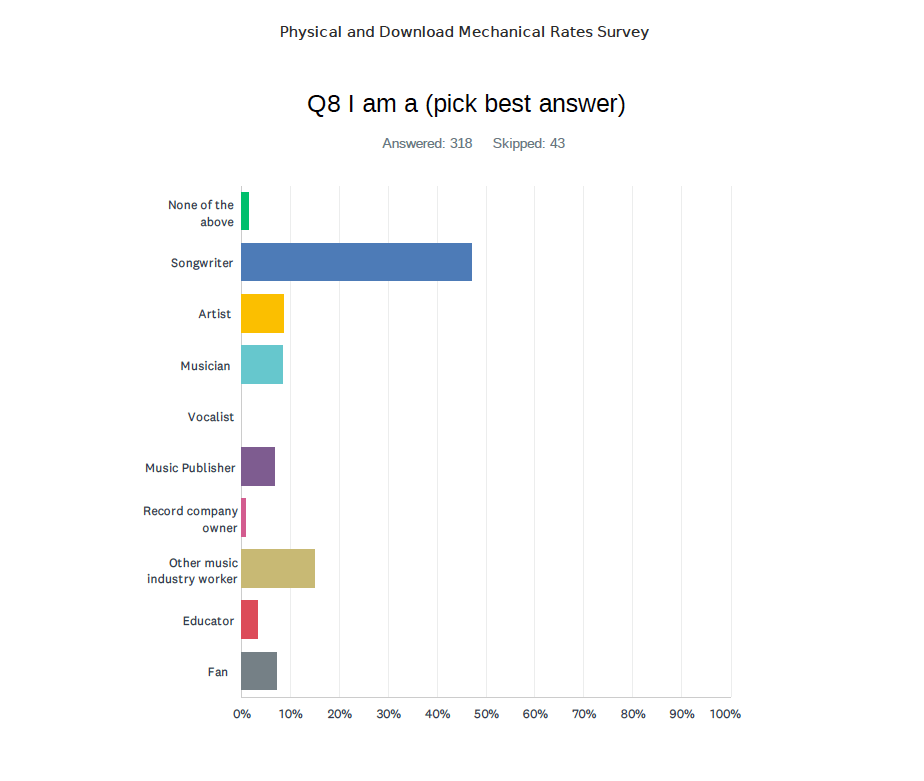
Many readers participated in the Physical and Download Mechanical Rates Survey that various organizations have sent to their members over the last few weeks. Here are the results of the main questions for which we had 361 respondents who self-selected their participation. (Other answers included comments which we chose not to publish for privacy reasons.).
The results suggest that participants were mostly informed songwriters who had never been asked before what they thought about the issues in the Copyright Royalty Board. We would have to conclude that any of our regular readers would be a bit skewed toward knowledgeable because between the Trichordist, MusicTechPolicy, ARW, Hypebot and Celebrity Access we were probably carrying a very high percentage of the available information on the frozen mechanicals issues.
It also is striking how few respondents said they had ever been asked what they think about any mechanical rates (physical, download, streaming), an important and easily measurable issue. This is something to add to the learning from this episode. It may be that our data is skewed, but even so we didn’t expect that 68% would say they’d never even been asked their opinion. An easy way to find out what people think about something is to ask them.
As MTP readers will recall, the National Music Publishers Association and the Nashville Songwriters Association International purported to agree on behalf of a “consensus” that never seemed to materialize to extend the long-frozen 9.1¢ mechanical rate for physical and downloads in the form of a settlement agreement in the Copyright Royalty Board’s Phonorecords IV proceeding. I thought this deal reeked and so did a number of other people, including the Copyright Royalty Board itself which rejected the settlement.
To their great credit, Sony, Universal and Warner stepped up and agreed to offer all the world’s songwriters increased rates of 12¢ plus inflation indexing for the next five years which they didn’t have to do (and was a deal that the CRB hinted that they would find acceptable when they resoundingly rejected the first settlement). Assuming the Copyright Royalty Board accepts the deal—a step you might miss out from the press coverage–this had the effect of a quick end to a process the labels had every right to litigate at the CRB.
The other benefit to the settlement is that it should—if it doesn’t get screwed up again—it should take away a major argument that the digital retailers are using against songwriters in the streaming part of the Phonorecords IV proceeding. That argument is the most obvious negotiating tactic in the world: What’s good for the goose is good for the gander. The services are essentially saying that if the rates should be frozen when the labels are paying the mechanical (which they are on physical and downloads), then the rates should be frozen when the services are paying the mechanical (which the services are on streaming). And no inflation adjustment. Well, no kidding.
In one power move, the labels did something fair for songwriters and incidentally also helped publishers in spite of themselves by taking away a major argument from the digital retailers. Rather than play a schoolyard game of high/low bargaining and stretching out the process for another couple years, the labels cut to the chase and closed. Hopefully the CRB will agree (again, don’t forget that the CRB still has to approve the proposed deal.)
Do we still have bones to pick with the labels? Absolutely. Could the rate have been even more fair? Sure. Might it have been if the publishers had actually done their job and negotiated in the first place? Maybe. Probably. But they didn’t so we’ll never know. However, credit where credit’s due, the labels pulled this one out and saved the publishers’ bacon in spite of themselves.
I do have to note in passing that when you read the press coverage on the filing of the settlement, there’s not one US group with a press release today that actually picked up a pen and filed a comment at the CRB when they were needed and duty called. The awesome UK songwriter group Ivors Academy stepped up and bled with songwriters like Rosanne Cash, George Johnson, Helienne Lindvall, David Lowery and Blake Morgan and all the other commenters who took one for the team when it was unpopular to do so. And as that guy said, he who sheds his blood with me shall be my brother.
You’ll hear a lot of hoorah about how streaming is what’s important from people who are trying to CYA today. Here’s a hot tip: IT’S ALL IMPORTANT IF IT’S YOUR MONEY. Why is that so hard to understand?
Which is why going forward all songwriters and all publishers need to be involved with the rate-setting proceedings at CRB including on streaming. The CRB knows this and acknowledges. I think the labels know this on their side.
The question is whether the publishers do. The announcement of this settlement proposal is both inauspicious and true to form. Remember—they had practically nothing to do with making the deal they celebrate today. But don’t let that stop anyone.
We need fairness at the Copyright Royalty Board. Notice I’m not using the word “transparency” which means whatever the speaker wants it to mean. I’m very specifically talking about a seat at the table not just for songwriters, but for independent labels and publishers as well as the majors. As Ann Richards used to say, if you’re not at the table you are on the menu, and this was a very, very close run thing in Phonorecords IV.
If it weren’t for all the people who commented negatively and resisted the rates that had been bootstrapped in the past and would have been again, I don’t know where songwriters would be today. You gave the Judges the truth, straight from the heart and they responded. So thank you, all of you. And thank you to the readers of MTP and The Trichordist who raised hell right along side. It’s a good day for everyone.
Remember–keep coming back because it works if you work it.
Read the thread. Don’t forget that there will be another opportunity to comment to the Copyright Royalty Board (probably) if the Judges adopt the new rate settlement.
[You may have never heard of George Johnson, but you should have. He’s the only songwriter in the Phonorecords III and IV rate proceedings at the Copyright Royalty Board, representing himself. It’s also important to understand that if George wasn’t carrying the flag as a “participant” in the proceedings, it’s unlikely that the Copyright Royalty Judges would have rejected the bizarre “settlement” proposed by the major labels and publishers paving the way for the second proposed settlement announced today that raises the mechanical rate to 12¢. George asked us to post a short comment on today’s settlement.]
Unfortunately, as glad as I am to see the labels finally offer a slightly better rate of 12 cents, the Judges have not even ruled on the last unreasonable settlement that they rejected, nor had time to hear a back from the Register on the Novel Question of Law proposed by the 3 Major Record Labels. Therefore, it would be premature for me to agree to any rushed deal before first hearing the Register‘s and the Judges’ rulings of law on this issue, and the many other problems the Judges pointed out with these extremely flawed settlements.
Furthermore, the multiple conflicts of interest, self dealing, vertical integration “warning flags”, side deals, and other problems may still need to be resolved by the Judges before any new settlement can be approved.
NMPA CEO David Israelite even stated in 2015 that the rate should be 50 cents, yet he continues to fight me to keep the rate frozen and below market, despite now being forced to offer 12 cents to the Judges which he absolutely did not want to do and fought every step of the way. He is no songwriter advocate whatsoever. He also makes $2 million dollars a year in salary and extra compensation to keep songwriters frozen at 9.1 cents all these years because he really works for the parent record labels, not their vertically integrated publishing division as he claims. It’s a total waste of time for songwriters and I hope Congress puts a stop to this self-dealing and increasing antitrust issues created by these two-timing lobbyists’ behavior.
Btw, when the rate is accurately calculated for inflation since 2006 it’s actually 13 cents, not 12 cents like they offered, but it’s still way below market considering the rate was 2 cents in 1909. A rate based on today’s marketplace reality would place the rate at a break-even point of 58 cents per song to make up for 89 ignored years of zero inflation adjustments for songwriters, who are entitled to a raise, much less a simple cost of living adjustment for 2022 real world prices. Plus there is no legal difference between adjusting from 2006 or 1909. NMPA, NSAI, and RIAA just don’t want to increase the profits for their own songwriters, much less all their competitors who have to have their rates frozen by NMPA, NSAI, and the RIAA, which is extraordinary and must end.
There is also the issue of the free unlimited “limited download” loophole which must be paid a mechanical and, of course, the labels completely ignored this core issue which goes hand in hand with a properly adjusted 58 cent inflation royalty rate which all songwriters and publishers deserve now. Apple and the other Services need to reduce their 30% per dollar fee on downloads to help share in the cost of the Judges’ ruling of no more static rates for songwriters. If the labels offer a reasonable rate and fix their self dealing conflicts and side deals, along with a paid mechanical for limited downloads, then I would sign a deal like that. Plus, the labels refuse to address the issue of old controlled composition clauses at 75% of the lawful statutory rate or any new controlled composition clauses to reduce any new agreed increases.
Thanks for the HUGE response to the songwriter survey on what you think the new unfrozen mechanical rate should be!! The response has been so strong we’re going to keep the survey open so more of you can participate.
This Survey Monkey questionnaire is anonymous and easy to take–3 minutes to complete–and you could really help a lot by giving your opinions on what you think the rate should be! We will post the results so everyone can see.
We are participating in a survey being conducted by a number of songwriter groups around the world to ask our readers what you think the new un-frozen mechanical royalty rate should be since the Copyright Royalty Judges rejected the settlement that would have extended the 9.1¢ freeze. Trichordist readers have heard a lot about the frozen mechanicals but after the Judges rejected extending the freeze we have moved on now to a new phase–if the rate isn’t 9.1¢ anymore, what should it be?
This Survey Monkey questionnaire is anonymous and easy to take–3 minutes to complete–and you could really help a lot by giving your opinions on what you think the rate should be! We will post the results so everyone can see.
After all the effort and achievement by our great audience in support of songwriters getting paid fairly in the #FrozenMechanicals crisis, we are finally coming to where the rubber meets the road and trying to decide how much songwriters should get paid by record companies selling music in three ways (called “configurations”):
permanent downloads, like iTunes and Amazon;
vinyl discs, like you buy in record shops on Records Store Day;
and compact discs (CDs).
We’re expecting the final proposal to get made in a matter of days, and we thought it would be good to start with a short Survey Monkey questionnaire to get an idea of what this audience thinks. We’re collaborating with a number of songwriter organizations to distribute the questionnaire to their members and friends.
All the data will be anonymous and will be released when the questionnaire is done!
The plan is to get some more evidence of what we all think about a few core pricing ideas, thanks to the awesome Copyright Royalty Judges who have rejected extending the 16 year freeze in response to comments from the public and objections by George Johnson, the only songwriter in the Phonorecords IV proceeding.






 The Trichordist
You must be logged in to post a comment.