Blake Morgan songwriter, publisher, producer and label owner, two-time U.S. Supreme Court amicus, founder of the #irespectmusic campaign and relentless artist rights advocate joins the list opposing frozen mechanicals on vinyl and physical. “This is about so many things, but we simply must fight to keep digging out from a 68 year injustice. Big thanks to the inspirational Abby North for standing up for fairness and transparency!”
TY @northmusicgroup + @thetrichordist 🚀 The Copyright Royalty Board must allow songwriters + indy publishers to participate in CRB decisions. A public comments period would ensure that testimony not be limited to only wealthy, powerful interests.https://t.co/R1MQUwKadY
Senator Dianne Feinstein Senator Alex Padilla United States Senate United States Senate 331 Hart Senate Office Building B03 Russell Senate Office Building Washington, D.C. 20510 Washington, D.C. 2010
Re: Potential Settlement of Mechanical Royalty Rates in CRB Phonorecords IV
Dear Senators Feinstein and Padilla:
I am a California-based music publisher.
I’m writing to you to express my concern regarding the private party settlement submitted to the Copyright Royalty Board by the NMPA, NSAI, UMG, WMG and SME related to the Phonorecords IV physical and download mechanical rate.
My father-in-law was the composer and songwriter, Alex North. Alex worked for years, crafting scores to Hollywood feature films, and writing songs to accompany picture.
In 2015, Alex’s score to A STREETCAR NAMED DESIRE was added to the Library of Congress’ National Registry, as a recognition of the music’s importance as part of the fabric of United States arts and culture.
Alex composed the score to a 1955 film entitled UNCHAINED. The theme to that film became the melody to the song “Unchained Melody,” with the lyric written by Hy Zaret.
“Unchained Melody” has been recorded by thousands of artists, in all styles and genres. The lyric has been adapted to at least 20 different languages. “Unchained Melody” is among the most popular wedding songs of all time. Listeners still download recordings of “Unchained Melody.” They still buy CDs and vinyl releases.
I am the music publishing administrator of “Unchained Melody,” on behalf of my family and the Zaret family. I also administer over one hundred thousand other copyrights on behalf of legacy songwriters and their families, and on behalf of current songwriters and composers.
Songwriters struggle to earn a living wage. With the advent of digital streaming, physical and download sales have certainly declined. However, they have absolutely not disappeared. Anybody who says this royalty stream does not matter is simply not telling the truth.
The royalty amount for the digital stream of a song is a micropenny. Unless it is a top songwriter with hundreds of millions to billions of streams, there is an excellent chance that songwriter still may be driving Uber to support herself and her family.
It takes hundreds of streams of a recording to equal the 9.1 cent mechanical publishers receive for a physical sale or download. That’s why this physical and download mechanical rate is so important.
Vinyl sales are strong for many retailers including Amazon and Best Buy. CDs remain a significant media format, and many listeners still prefer to “own” rather than temporarily cache the music they listen to.
Increasing the statutory mechanical rate to simply adjust for inflation will dramatically (and positively) effect songwriters’ and publishers’ bottom lines. This fight is akin to the battle for an increased minimum wage.
Major music publishers do not face the same struggles as independent publishers and songwriters. Major publishers are part of multi-national conglomerates that own both the major publishers and major record labels. Major publishers that agree to fix the statutory rate simply are leaving more money in the pockets of the labels that are their sister companies.
Those of us that do not have sister companies have no such opportunity. That’s why we must fight to be heard.
Each quarter, I process statements from approximately 100 domestic and global sources, many of which include mechanical royalties for physical and download media. Each quarter, I make distributions to the multiple families that are heirs to, and owners of these copyrights. Songwriters and their families depend on royalties for food, mortgages, education and more.
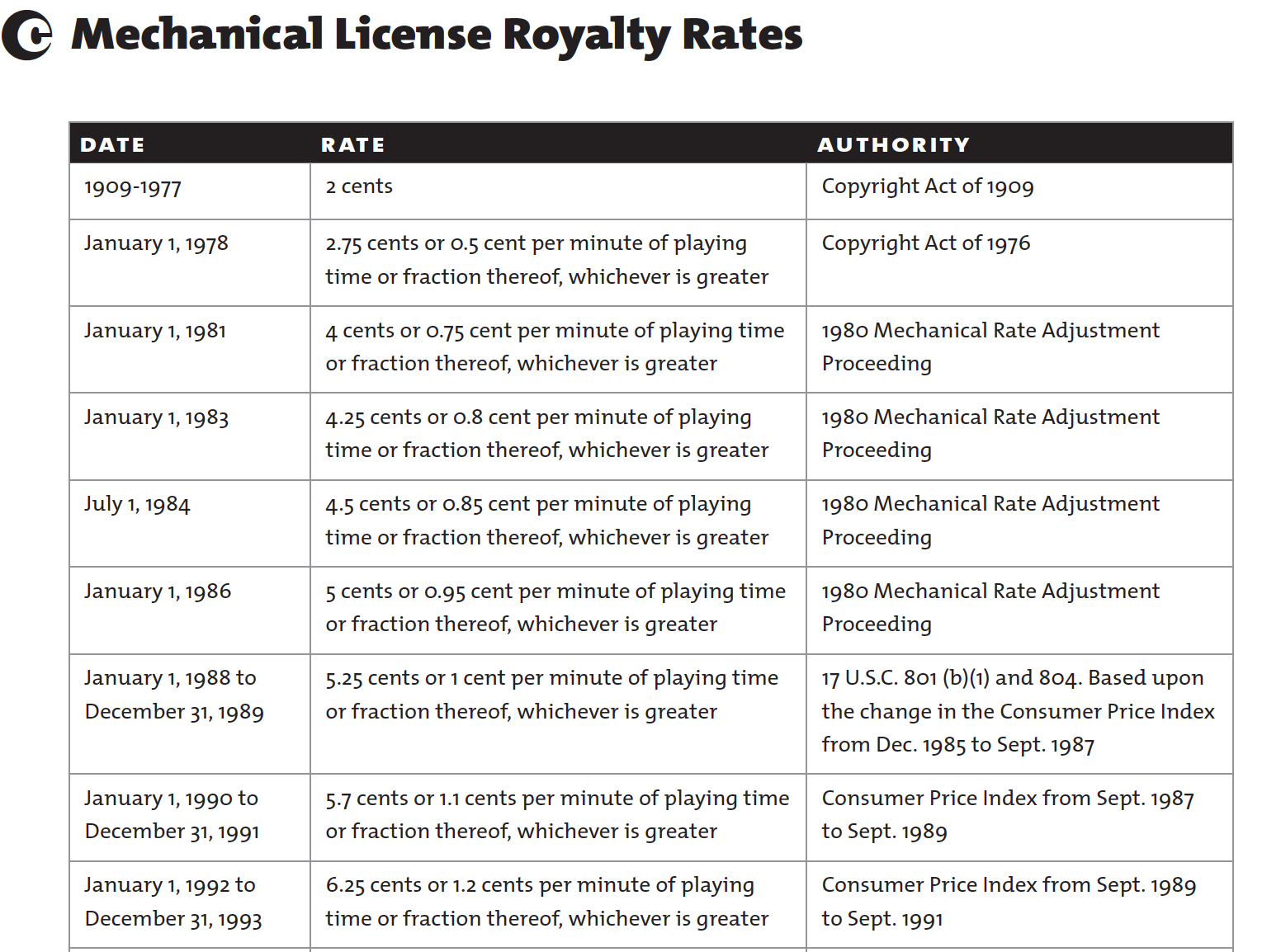
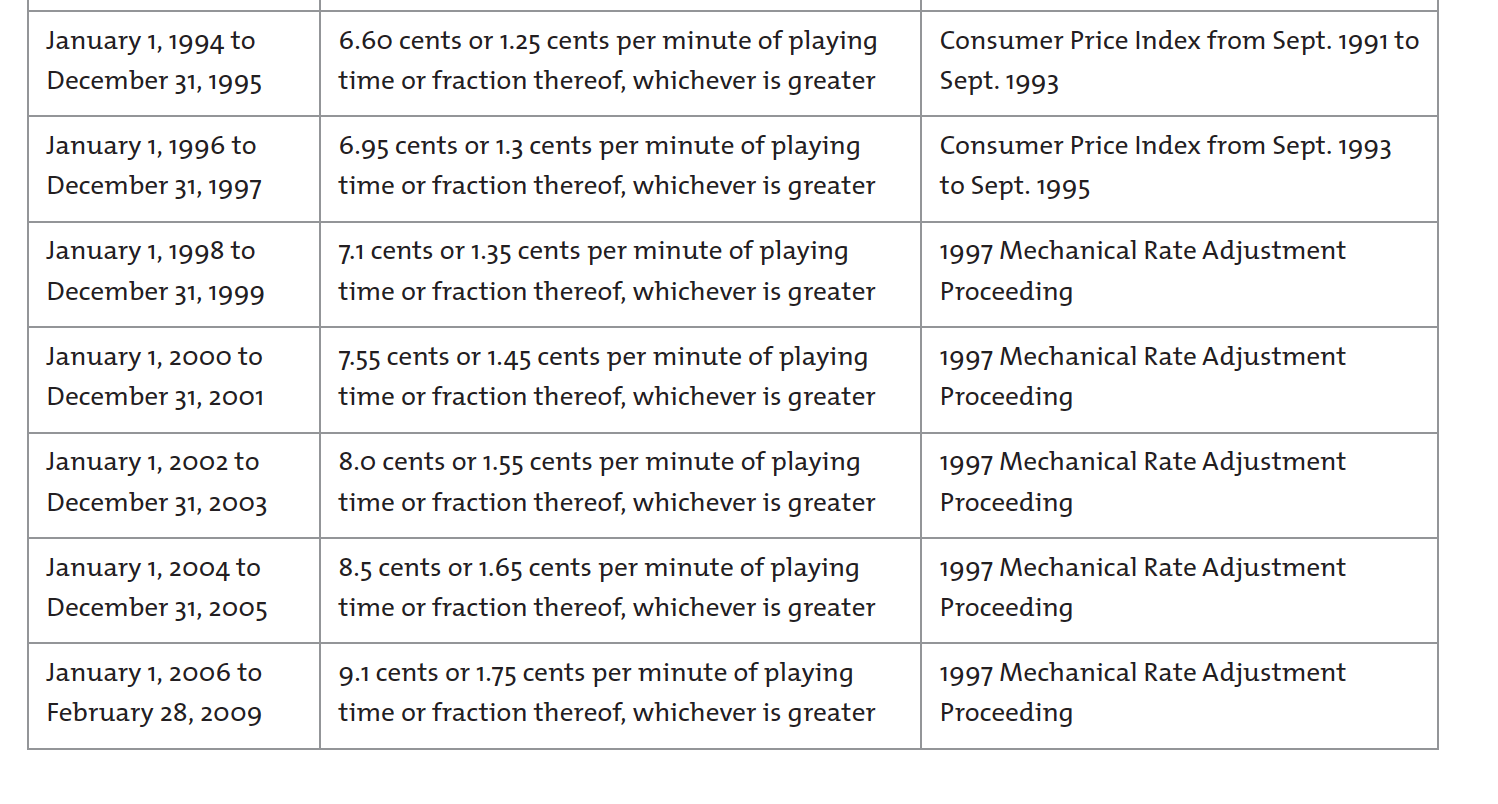
From the initial publication of “Unchained Melody” in 1955 through 2005 (approximately 50 years!), the statutory mechanical rate was fixed at 2 cents. Starting in 1977, the mechanical royalty incrementally increased from 2¢ to 9.1¢ per unit until 2006. But since 2006, the statutory rate again was frozen and remains so. The private settlement would extend that freeze until 2027.
I ask that you review the Copyright Royalty Board practices and consider allowing songwriters and independent publishers – who do not speak through trade organizations or major multi-national corporations — to voice their concerns through public comments that the CRB takes into account before it makes its final decision.
We’ve been keeping track of those who are for freezing the statutory mechanical royalty rate for physical and permanent downloads for another five years out to 2027. The issue is currently part of the rate setting proceeding before the Copyright Royalty Board–which froze the same rate at 9.1¢ in 2006 and was first extended in 2009.
Here is the current list of those for and against freezing mechanicals on these categories for a total of 21 years:
The twist here is that if the CRB approves the private settlement at the request of “the parties” and doesn’t take into account the views and evidence of people who actually write songs and have to earn a living from songwriting, it will be grotesquely unfair and possibly unconstitutional wage and price control. The CRB will have frozen the mechanical rate for physical and downloads at the 2006 rate when inflation alone has eaten away the buying power of that royalty by approximately 30%. This would be like the Minerals Management Service adopting a settlement written by Exxon.
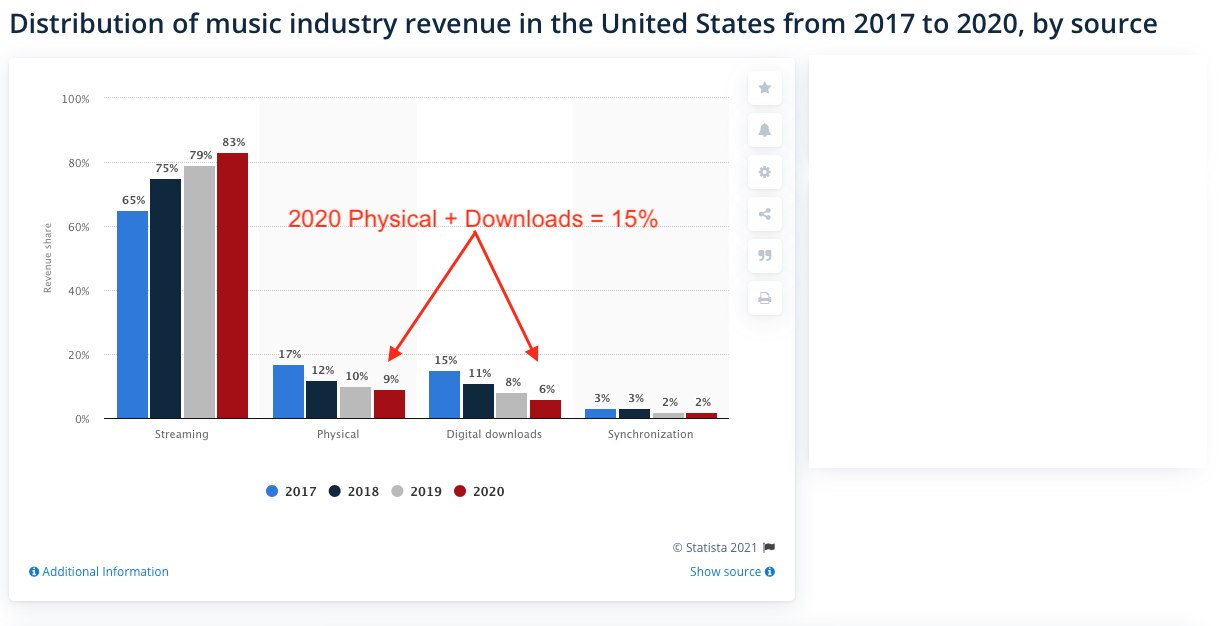
On average–on average–the physical and download configuration make up 15% of billing for the majors and for some artists vinyl is a welcome change from fractions of a penny on streaming. And then there’s Record Store Day–hello? These are a couple of the many reasons anyone who is paying attention should reject the terms of the settlement.
The Coalition had a simple ask: Let the public comment:
In the interests of justice and fairness, we respectfully implore the CRB to adopt and publicize a period and opportunity for public comment on the record in these and other proceedings,especially in regard to so-called proposed “industry settlements” in which creators and other interested parties have had no opportunity to meaningfully participate prior to their presentation to the CRB for consideration, modification or rejection. In the present case, hundreds of millions of dollars of our future royalties remain at stake, even in a diminished market for traditional, mechanical uses of music. To preclude our ability to comment on proposals that ultimately impact our incomes, our careers, and our families, simply isn’t fair.
The Copyright Royalty Board responded! According to our sources, the Copyright Royalty Board said that they would publish the private settlement in the Federal Register and give the pubic the chance to comment. This is great news!
But we will see what they actually do. The Copyright Royalty Board does not have a great track record in understanding songwriter interests in raising the mechanical rates as we can see in this except from their final rule freezing mechanicals again in 2009:
Copyright Owners’ argument with respect to this objective is that songwriters and music publishers rely on mechanical royalties and both have suffered from the decline in mechanical income. Under the current rate, they contend, songwriters have difficulty supporting themselves and their families. As one songwriter witness explained, “The vast majority of professional songwriters live a perilous existence.” [Rick] Carnes [Testimony] at 3. [Rick Carnes signed the Coalition letter as President of the Songwriters Guild of America.] We acknowledge that the songwriting occupation is financially tenuous for many songwriters. However, the reasons for this are many and include the inability of a songwriter to continue to generate revenue-producing songs, competing obligations both professional and personal, the current structure of the music industry, and piracy. The mechanical rates alone neither can nor should seek to address all of these issues.
We simply do not accept that the Founders put the Copyright Clause in the Constitution so creators could have a side hustle for their Uber driving which is exactly where frozen mechanicals take you, particularly after the structural unemployment in the music business caused by the COVID lockdowns.
Here is a summary of who is for and who is against frozen mechanicals.
Against Frozen Mechanicals
Proposing Frozen Mechanicals
Songwriters Guild of America
National Music Publishers Association
Society of Composers and Lyricists
Nashville Songwriters Association International
Alliance for Women Film Composers
Songwriters Association of Canada
Screen Composers Guild of Canada
Music Creators North America
Music Answers
Alliance of Latin American Composers & Authors
Asia-Pacific Music Creators Alliance
European Composers and Songwriters Alliance
Pan African Composers and Songwriters Alliance
Which side are you on? If you want to write your own comment to the Copyright Royalty Board about frozen mechanicals, send your comment to crb@loc.gov
[Editor T says this is a letter from a coalition of US and international songwriter groups to the Copyright Royalty Board about the frozen mechanical issue. If you want to write your own comment to the Copyright Royalty Board about frozen mechanicals, send your comment to crb@loc.gov]
MUSIC CREATORS NORTH AMERICA
May 17, 2021
Via Electronic Delivery
Chief Copyright Royalty Judge Jesse M. Feder Copyright Royalty Judge David R. Strickler Copyright Royalty Judge Steve Ruwe US Copyright Royalty Board 101 Independence Ave SE / P.O. Box 70977 Washington, DC 20024-0977
To Your Honors:
As a US-led coalition representing hundreds of thousands of songwriters and composers from across the United States and around the world, we are writing today to express our deep concerns over the “Notice of Settlement in Principle” recently filed by parties to the proceedings before the Copyright Royalty Board concerning its Determination of Royalty Rates and Terms for Making and Distributing Phonorecords (Phonorecords IV) (Docket No. 21–CRB–0001–PR<(2023–2027)). For reasons explained below, several highly conflicted parties to this proceeding have apparently agreed to propose a rolling forward to the year 2027 of the current US statutory mechanical royalty rate for the use of musical compositions in the manufacture and sale of physical phonorecords (such as CDs and vinyl records). This proposal (and related industry agreements yet to be disclosed by the parties— see, https://app.crb.gov/document/download/23825) should neither be acted upon nor accepted by the CRB without the opportunity for public comment, especially by members of the broad community of music creators for whom it is financially unfeasible to participate in these proceedings as interested parties. It is our livelihoods that are at stake, and we respectfully ask to be heard even though we lack the economic means to appear formally as parties. If procedures are already in place to accommodate this request, we look forward receiving the CRB’s instructions as to how to proceed.
The current U.S statutory mechanical rate for physical phonorecords is 9.1 cents per musical composition for each copy manufactured and distributed. That rate has been in effect since January 1, 2006. It represents the high-water mark for US mechanical royalty rates applicable to physical products, a rate first established in 1909 at 2 cents. That 2-cent royalty rate, in one of the most damaging and egregious acts in music industry history, remained unchanged for an astonishing period of sixty-nine years, until 1978. Nevertheless, the recording industry now seeks to repeat that history by freezing the 9.1 cent rate for an era that will have exceeded twenty years by the end of the Phonorecords IV statutory rate setting period.
Inflation has already devalued the 9.1 cent rate by approximately one third. By 2027, 9.1 cents may be worth less than half of what it was in 2006. How can the US music publishing industry’s trade association, and a single music creator organization (which represents at most only a tiny sliver of the music creator community) have agreed to such a proposal?
The answer to that question is an easy one to surmise. The three major record companies who negotiated the deal on one side of the table have the same corporate parents as the most powerful members of the music publishing community ostensibly sitting on the other side of the table. Songwriter, composer and independent music publisher interests in these “negotiations” were given little if any consideration, and the proposed settlement was clearly framed without any meaningful consultation with the wider independent music creator and music publishing communities, both domestically and internationally.
How on earth can these parties be relied upon to present a carefully reasoned, arms-length “Settlement in Principle” proposal to the CRB under such circumstances, fraught as they are with conflicts of interest, without at least an opportunity for public comment? Further, how can these parties be relied upon in the future to argue persuasively that mechanical royalty rates applicable to on-demand digital distribution need to be increased as a matter of economic fairness (which they most certainly should be), when they refuse to seriously conduct negotiations on rates applicable to the physical product the distribution of which is still controlled by record companies (who not so incidentally also receive the lion’s share of music industry revenue generated by digital distribution of music)?
The ugly precedent of frozen mechanical royalty rates on physical product has, in fact, already served as the basis for freezing permanent digital download royalty rates since 2006. Is this the transparency and level playing field the community of songwriters and composers have been promised by Congress through legislation enacted pursuant to Article I, Section 8 of the Constitution?
The trade association for the US music publishing industry is supported by the dues of its music publisher members, the costs of which are often in large part passed along to the music creators affiliated with such publishers. It is thus mainly the songwriter and composer community that pays for the activities of that publisher trade association, a reality that has existed since that organization’s inception. Still, the genuine voice of those songwriters and composers is neither being sought nor heard. Further in that regard, we wish to make it emphatically clear that regardless of how the music publishing industry and its affiliated trade associations may present themselves, they do not speak for the interests of music creators, and regularly adopt positions that are in conflict with the welfare of songwriters and composers. Their voice is not synonymous with ours.
Unfortunately, the music creator community lacks the independent financial resources –in the age of continuing undervaluation of rights, rampant digital piracy and pandemic-related losses–to rectify these inequities by expending millions more dollars to achieve full participation in CRB legal and rate-setting proceedings. Clearly, such an inequitable situation is antithetical to sound Governmental oversight in pursuit of honest and equitable policies and results.
In the interests of justice and fairness, we respectfully implore the CRB to adopt and publicize a period and opportunity for public comment on the record in these and other proceedings,especially in regard to so-called proposed “industry settlements” in which creators and other interested parties have had no opportunity to meaningfully participate prior to their presentation to the CRB for consideration, modification or rejection. In the present case, hundreds of millions of dollars of our future royalties remain at stake, even in a diminished market for traditional, mechanical uses of music. To preclude our ability to comment on proposals that ultimately impact our incomes, our careers, and our families, simply isn’t fair.
Finally, we request that this letter be made a part of the public record of the Phonorecords IV proceedings. We extend our sincere thanks for your attention to this very difficult conundrum for music creators, and further note that your consideration is very much appreciated.
Respectfully submitted,
Rick Carnes President, Songwriters Guild of America
Ashley Irwin President, Society of Composers and Lyricists Officer, Music Creators North America Co-Chair, Music Creators North America
cc: Ms. Carla Hayden, US Librarian of Congress Ms. Shira Perlmutter, US Register of Copyrights Mr. Alfons Karabuda, President, International Music Council Mr. Eddie Schwartz, President, MCNA and International Council of Music Creators (CIAM) The MCNA Board of Directors The Members of the US Senate and House Sub-Committees on Intellectual Property Charles J. Sanders, Esq.
At its meeting on the 21st of April 2021, the Nordic Musicians Union, NMU, discussed the issue of copyright buyouts.
Technological development has been rapid in connection with digitalisation and globalization. This has challenged existing remuneration models that have been developed over a long period of time. This includes legislation, agreements, and collective management organisations. This rapid development has affected the income of performers in a very negative way.
We note that the compensation levels generated via digital uses are unreasonably low. Therefore, the NMU, at both national and international levels, have introduced the need for stricter legislation regarding the balance of power in negotiations. This includes mandatory rules that ensure a reasonable remuneration for digital uses. The European Commission has acknowledged this need in the 2019 Copyright Directive by introducing provisions on appropriate and proportionate remuneration to authors and performers and further provisions to improve the bargaining position of performers. The Directive shall be implemented no later than 7 June 7, 2021.
The NMU recognise that business models are emerging that work around the legislation by maximizing the use of musicians’ and artists’ performances whilst ignoring long-standing practices and established copyright systems. Instead, they pay one-time compensation, undermine the moral rights, and might even demand that musicians and artists leave their own collection management organisations.
NMU’s view is that musicians should be paid fairly and correctly, both for their labour and for their copyright based on the actual exploitation over time. The moral rights must be fully respected and the choice to be a member of one’s own collective management organisation must be defended.
Performing artists receive far too little of the value that music generates when it is used. During the Corona pandemic, it has become all too clear that musicians need the backing and support of legislators as well as the audience and the music industry.
The NMU strongly opposes wholesale of rights for any possible use, known or yet to be discovered, against a one-off payment. Complete buyouts are not the future business model for performers!
If you’re not a lawyer, you may not be that familiar with law clerks. The title sounds very…well, clerical. But make no mistake, they are very powerful people who are largely unknown to clients but who are in the room with their judges, often every step of the way. As Wikipedia tells us:
A law clerk or a judicial clerk is an individual—generally an attorney—who provides direct assistance and counsel to a judge in making legal determinations and in writing opinions by researching issues before the court. Judicial clerks often play significant roles in the formation of case law through their influence upon judges’ decisions.
Yet, we know virtually nothing about them from the outside. If your case is heard, wouldn’t you want to know about everyone who was influencing the outcome of your case?
During your clerkship, you will provide valuable assistance as your judge resolves disputes that are of great importance to the parties, and often to the public. The parties and the public accept judges’ rulings because they trust the system to be fair and impartial. Maintaining this trust is crucial to the continued success of our courts. That’s why, although you have many responsibilities that demand your attention, you must never lose sight of your ethical obligations.
While that all sounds good, how would anyone ever know exactly what the story is with the clerks who are writing opinions with their judge or justice that directly affect the outcome of your case. As the ethical rules clearly state:
Although many of your obligations are the same as those of other federal judicial employees, certain restrictions are more stringent because of your special position in relation to the judge. Some obligations continue after your service to the court concludes.
But again–how would you ever know? If you go to the bible of the revolving door, Open Secrets, you’ll notice someone is missing…the entire judicial branch of our government.
Let’s take the easy one: Conflicts of interest. When does a law clerk have a conflict of interest? The rulebook tells us:
Canon 3F(1) of the Code of Conduct advises judicial employees, including law clerks, to avoid conflicts of interest. Conflicts arise when you—or your spouse or other close relative—might be so personally or financially affected by a matter that a reasonable person would question your impartiality.
Note the disjunct: “personally or financially affected.” Either can give rise to a conflict or a question as to the clerk’s impartiality.
Conflicts come in several flavors, but two biggies are actual conflicts and potential conflicts, very routine inquiries in any conflict check. The ethical rules for clerks give examples of each: For example, an actual conflict is “The firm where you plan to work after your clerkship serves as counsel in a matter before your judge”. “Firm” in this case presumably applies to the situation where a company where the clerk plans to work appears before the judge.
A potential conflict includes “An attorney you met and talked with at a social function appears to argue a motion before your judge.” It’s not a far reach to think that the example would include a former professor, amicus, or author of an amicus brief filed or to be filed in a case before your judge.
But the point is, how would the litigants ever know any of these situations were an issue. Who keeps track of who knows whom among the clerks cloistered away in the ivory tower?
Joshua Revesz (Yale 2017/Garland) will be clerking for Justice Kagan in OT 2020. If his distinctive surname rings a bell, perhaps you’ve heard of his famous father: Professor Richard “Ricky” Revesz, former Dean of NYU Law School, and a former Supreme Court clerk (OT 1984/Marshall).
Readers of ARW may also recognize the name from a different place: The deep and abiding controversy over the American Law Institute’s failing Restatement of Copyright project. Professor Revesz joined the ALI in 2014 right after the noted Lowery insulter, Spotify lawyer, Lessig mentee and all round anti-copyright advocate Christopher Jon Sprigman joined the NYU faculty in 2013, presumably under then-Dean Richard Revesz.
Somehow–we don’t know exactly how–of all the lawyers in all the world, how ALI Director Revesz chose Professor Sprigman to run the Restatement of Copyright project, an undertaking that by all reports is devoted to weakening copyright and expanding loopholes for Big Tech. How do we know this? Because Sprigman pitched Revesz on the idea very soon after Revesz took over at ALI.
And the rest is history with everyone from authors to the Congress criticizing the very idea of a Restatement of Copyright; indeed, Professor Peter Menell of the UC Berkeley law school and Professor Shyamkrishna Balganesh of Columbia law school wrote an extensive critique that “explains why perfunctory extension of the common law Restatement model to copyright law produces incoherent, misleading and seemingly biased results that risks undermining the legitimacy of the eventual product.” (“The Curious Case of the Restatement of Copyright“). In other words–it’s bad.
It will come as no surprise that I would go further–I think that is exactly the purpose of the Restatement (and Professor Samuelson’s Copyright Principles Project it descends from).
Hold on, you say–what does this have to do with Clerk Revesz and his judge, Supreme Court Justice Elena Kagan, the former Dean of Harvard Law School (whose remarks at the 10 year anniversary celebration of the Berkman Center are illuminating (home to both Lessig and poker aficionado and alleged counsel to copyright infringer Mr. Tennenbaum, Charles Nesson)). Maybe nothing.
But isn’t it the kind of thing you might want to know about someone who was in close contact with someone who was deciding the outcome of your case? Or was in close contact with other clerks who were deciding the outcome of your case? How would you ever know what contacts the clerks had with anyone who might be influencing their case or who had donated money to an institution that benefited the family member of someone who had influence over your case? Either directly, over cocktail party conversation or the dinner table? I am not implying any skulduggery here, it could all have been very innocent or appear so as conflicts often do.
While their judges are obligated to public financial disclosures, clerks do not have such obligations to litigants, much less to the public. Disposition of conflicts disclosed by clerks seem to be handled in chambers without consulting the litigants.
Given the number of clerks in chambers across the country, the possibility for conflicts are significant. When a lawyer has a conflict of interest that is waivable, she must give the client the option to waive the conflict with informed consent. But if the conflict is not waivable or the client refuses to waive, the lawyer must decline the representation.
Is there a corollary for law clerks? There definitely are rules and there definitely are processes. But are the litigants ever asked if they consent to a conflicted clerk working on their case?
I’ve never heard of it. Maybe there should be such a process.
Who can forget how Taylor Swift stood up for songwriters, producers and artists against Apple’s bizarre decision to impose a royalty-free three month trial period on the launch of Apple Music. (Of course, songwriters, producers and artists weren’t the only ones involved, but that’s a story for another day.)
We hear you @taylorswift13 and indie artists. Love, Apple
What is equally memorable is how fast Apple changed course and all the goodwill that came to Apple as a result. Faster than you can say “Arsenal”, Eddie Cue announced that Apple would scale it back. Lemonade out of lemons. Of course, the issue should have been obvious, but sometimes smart people miss the point like everyone does sometimes. (Rolling Stone has a good short post on the backstory.)
The point of the story is that when you make a mistake, it’s better to fix it quickly than let it fester. So it is with the “frozen mechanical” problem that has become all the rage in recent days. The good news is the problem can be solved with the payment of money. It won’t be easy, but as a great man once said, this is the business we’ve chosen.
The Copyright Royalty Board decides on the statutory rate that’s paid under compulsory content licenses in the United States. For mechanical royalties, the CRB makes that decision every five years which means that if there isn’t a CRB hearing going on at any given moment, wait a little while and there will be one. (Needless to say, the volume of CRB hearings varies directly with full employment for lawyers and lobbyists in Washington, DC.) The “frozen mechanical” issue dates back to 2006 (or 2009 depending on how you count it) when the CRB allowed the end of rising mechanical royalty rates on physical and permanent downloads (and a couple others). However, the sour memories of frozen mechanicals date to 1909–also a story for another day.
Instead, the CRB has allowed a private agreement among the biggest players to become the law. This has happened at least one other time and it appears that it is about to happen again according to public documents filed with the CRB on March 2, 2021 (read it here). Contrast that private agreement to the bitter struggle against the streaming services over streaming mechanicals that is still in the appeal process. Different people paying, same songwriters getting paid.
If you haven’t heard about the tentative settlement by private agreement at the CRB, it admittedly was not well socialized.
The inescapable problem is that any fixed or “frozen” rate determined at one point in time but paid over relatively long periods of time is at the mercy of inflation in the economy that may rise in that intervening time period. The Congress and the industry recognized this harsh truth in the 1976 revision to the Copyright Act and eventually indexed mechanical rates, meaning that they floated upward with the Consumer Price Index. (CPI has its own problems, but it’s a bogey that lots of people use so it’s easier than reinventing the wheel with a bespoke factor.)
Given what has been happening in the economy, it was inevitable that inflation was about to come back strong in the U.S. and global economy. Sure enough, the Department of Labor announced yesterday:
The Consumer Price Index for All Urban Consumers (CPI-U) increased 0.8 percent in April on a seasonally adjusted basis after rising 0.6 percent in March, the U.S. Bureau of Labor Statistics reported today. Over the last 12 months, the all items index increased 4.2 percent before seasonal adjustment. This is the largest 12-month increase since a 4.9-percent increase for the period ending September 2008.
Yes, the CPI ignored the Fed and increased like the pesky little devil it is. There’s no reason to think that this is going to stop any time soon. (If you were born after 1960 or so, you may not remember that inflation and stagflation resulted in the prime interest rate peaking at 21.5% in December of 1980. That drove mortgage rates to 13.41% in 1981 (often plus points). And then there were the credit cards. That’s where inflation can lead. Personally, my money is on stagflation in the form of high inflation and high unemployment due to what Secretary Yellen called the scarring effects of the pandemic which the music business is experiencing in spades.)
It just wouldn’t be prudent to enter into a long term contract at a fixed rate that does not take into account inflation. Yet that is exactly what the tentative settlement wants to do with the mechanical rate for physical, downloads, and a couple other categories. Yet, we must acknowledge that it is very difficult to herd the cats to get them to agree to anything. But having gotten everyone to agree to freezing mechanicals and having gotten the CRB to agree to adopt that agreement in the past, it may be the case that the parties can get the CRB to let them increase mechanicals going forward.
In other words, take a lesson from Taylor Swift and Eddie Cue and do a quick course correction before the final settlement gets announced on May 18.
So what would that look like? Precedent suggests that the CRB (and its predecessors) have accepted two principal methods of increasing the rate, which is phased in over time: fixed penny-rate increases and CPI indexing. My suggestion would be to employ both methods in a greater of formula (so popular with streaming).
If phased in over 5 years like other rates, it seems that there could be an immediate step up to compensate songwriters for a rate was frozen starting at the time that physical was still a very significant percentage of sales back in 2006. That stepped up rate could then gradually increase with a greater of a fixed penny increase or CPI. I wouldn’t presume to tell anyone what that step up should be, but if you apply the CPI index, it should probably be about 4¢, bringing the minimum rate to 13¢ from 9.1¢. Given that big–albeit entirely justified–jump, increases over the out years might be more modest.
Now that we know that there’s a strong possibility that inflation will be in our lives for the foreseeable future, the good news is there’s still time to do something about it. The CRB has shown us that they are willing to accept radical changes in the mechanical royalty rate by adopting private settlements, so there seems to be no impediment. I’m not aware of a rule that says the CRB only adopts rules that freeze songwriters in place, so it should work to the songwriters betterment and not just to their detriment.
In case you haven’t noticed, songwriter mechanical royalty rates are about to be set again at a faraway Congressional operation called the Copyright Royalty Board. You may say, hold on–I thought that mechanical royalties were being appealed?! True, but that’s just for the ha’penny streaming rates. The rate for physical, permanent downloads, ringtones and bundles are separate rates that were set as part of the last rate hearing.
Well…those rates were not really “set” in the traditional sense. There were no hearings, no evidence was presented, none of the usual back and forth that you see when a handful of the little intellectual elite in a far-distant capitol try to divine what a market rate should be for mechanical royalties–for which there has not been a free market in over 100 years. And you can take this to the bank–all that bluster about songwriters just want a free market that you hear from the lobbyists is a load of crap. Children have been put through years of prep school, college and law schools on what it costs to set these rates.
So when the anointed decide not to present any evidence and burn up legal fees by freezing a mechanical rate, you have to wonder what the motivation is.
The statutory rate for physical and permanent downloads have been frozen at 9.1¢ since 2006 because of these side deals that extended the 2006 rates. And they are about to do it again.
The way it works is that the publishers and the record companies get in a back room and decide to freeze the rate. Then they submit their settlement to the Copyright Royalty Board (who, unlike the judicial branch, ultimately work for Congress). The CRB then announces that “the parties” having agreed, the judges will adopt the rate without hearing any evidence. And presto changeo, as if by magic every songwriter in the world whose songs are exploited under the U.S. compulsory license are subject to a deal they had no part in deciding and probably didn’t even know was on offer.
It must also be said that U.S. songwriter rates ordered by the government cast a long shadow around the world, so it’s actually worse than that.
And guess what? It’s all happening again, and it’s happening in plain sight if you happen to be someone who reads through the CRB public docket which the smart money says you are not. Possibly because you trust the lobbyists who you made rich to do it for you.
Why is this important? For one thing, if this deep freeze is allowed to go into law, the rate will have been the same for 20 years. Remember that the mechanical rate in the U.S. was frozen at 2¢ for 70 years and this is exactly how it happened. Nobody came in back in 1909 and said, “hey, let’s freeze those rates for 70 years, OK?” Nope, it just creeped and creeped and creeped until one day a songwriter named Hoyt Axton of a predecessor of the Songwriters Guild of America had enough. He lobbied and lobbied and lobbied and finally got the rate increased and eventually got it indexed to inflation.
In the words of Alan Shepard, why are they doing this to us? There’s no easy answer. The first thing they often say is that they extend the rate because they are concerned it might go down. There is no CRB in history that has lowered a previously set rate. So that’s bullshit for starters.
Then they say it is because of declining sales in these configurations. Well that wasn’t true in 2006 when CDs made up 80% of US revenues. It wasn’t true in 2009 when CDs were 55%, and it wasn’t true in 2018 when these physical and digital formats were about 20% of revenue. It’s also not true today when these formats are about 15% of billing. Is there a label out there that would say 15% of billing is trivial? So that is also bullshit.
And yet, we are told there is a proposed settlement between NMPA, NSAI, Sony, Universal and Warner that extend the deep freeze another five years if it becomes law. We don’t have the detail, but it should be coming any day now. You can read it here.
The proposed settlement also includes this rather mysterious sentence at the bottom of page 1:
NMPA, UMG, WMG and SME have also reached an agreement in principle concerning a separate memorandum of understanding addressing certain related issues.
Big reveal to follow.
So what is that all about? It couldn’t possibly be a commissionable pending and unmatched settlement for those unimportant physical and download mechanicals? You don’t think it might have something to do with cash changing hands doya?




 The Trichordist
You must be logged in to post a comment.