Not the Onion: Spotify Claims it is Suing to Raise Songwriter Royalty Rates


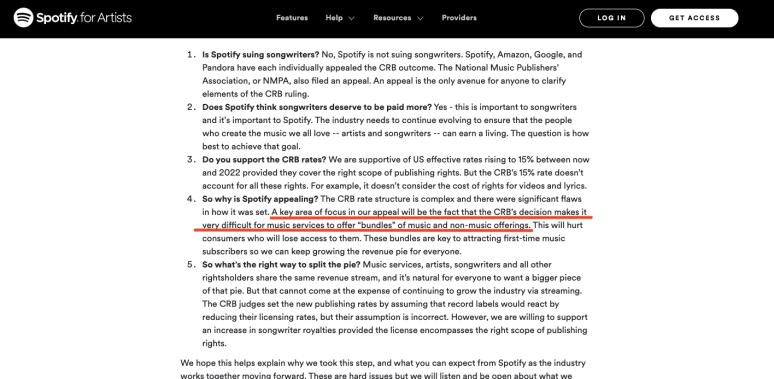
Look! It says so in this blog post! Spotify says it is “supportive” of the 15% effective royalty rate to songwriters but it just wants you to throw in  a bunch of other rights for which you are already paid a separate fee.  See? That’s cool right?  That’s not a pay cut.  The appeal of the Copyright Royalty Board rate-setting is actually done to help songwriters!

I mean you can kind of sort of maybe say they are reducing your pay because yes that separate income you get from micro sync and lyric display will be deducted from the 15% effective rate.  But no they aren’t trying to lower your mechanical royalty rate, they are just trying to take away other streams of revenue that you already have.  I suppose you can say technically they are slashing your pay. While technically correct that would be silly!

I know it’s a little confusing cause by law the Copyright Royalty Board was charged with only setting the streaming mechanical  rate in this proceeding. But hey, these are extraordinary times, its okay if the CRB just goes ahead without any constitutional authority and effectively ex-post facto eliminates royalties paid under a different private contract. Sure that’s technically unconstitutional and administrative judges don’t enjoy the same immunity from liability that other judges enjoy, but yeah why not?   In times of extraordinary hardship, if streaming services have to wield the awesome power of the federal government to hurt the little guy, so be it. I mean you have to starve a few million peasants to make a crony capitalist omelette right?   What’s a 20-30% pay cut to help a billionaires get by?


Negative Royalty Checks: Streaming Service Appeal Makes it Real Possibility

Billboard has reported that streaming services have won their appeal to force the Copyright Royalty Board to recalculate songwriter streaming royalties for 2018-2022. Yes, that means retroactively calculate 2 1/2 years of royalties.  This could easily lead to songwriters getting reduced or negative royalty checks.

Here is how:

In 2017 the royalty rate per stream for songwriters was calculated by dividing 10.4% of gross streaming service revenue by the total number of streams.  In 2020 it is calculated using 13.3% of gross streaming service revenue by the total number of streams.  If streaming services like YouTube and Spotify get their way that 13.3% will be reduced dramatically.  Let’s say streaming services manage to get the Copyright Royalty Board judges to reduce it retroactively to 10.4%.  Spotify and  YouTube would back out the overpayment from songwriters future royalty checks.  Remember Spotify has already done this once when they claimed they overpaid on family subscriptions.

Example: suppose you earned exactly $1000 per quarter over the last 2 1/2 years, or $10,000.  Streaming services could contend that they “overpaid” you 28% each quarter.  They would be within their rights to back out $2,800 from your next checks.  Negative royalty checks. Expect that in late 2020 or early 2021 just when your BMI royalties will shrink from the pandemic induced collapse in local advertising.

Now various industry and trade operatives are trying to spin this ruling as just a technical setback. That the Copyright Royalty Board used a flawed process to calculate songwriter royalty rates. The recalculation is no big deal. They would have you believe that streaming services spent millions of dollars on a federal appeal to get the same rate, to pay songwriters the same amount of money.  Does that make any sense to you?  Do not be fooled by this exercise in covering their ass.  It is unlikely that songwriters rates will remain the same.   The purpose of the exercise is to get lower rates and these lower rates will come retroactively out of your checks.

You have to wonder what kind of people work at these streaming services.  What kind of person is fully on board with a corporate policy to claw back pay from workers, when those workers have already lost most of their live music income.  I urge anyone that knows employees of these three companies (Google, Amazon and Spotify) to publicly out/shame these individuals. Force them to denounce their companies regressive and inhuman policies. Shun them from polite society.  Further any artists still cooperating with the digital services like Spotify, Amazon and YouTube should be regarded as strikebreakers and scabs. These artists should be treated accordingly.  Artists should pull new releases from streaming services that are pursuing this policy.

This is war.

Good data in Garbage Out: The MLC/HFA Data Disaster


As many of you already know the new federal Music Licensing Collective has selected Harry Fox Agency as the vendor to provide song data to the MLC. It is rapidly becoming clear that what this really means is that the MLC will start with the HFA song database and then through a rather convoluted and manual process, songwriters will be required to “ensure the quality of that data” if they expect to get paid. In other words songwriters will do all the heavy lifting.

I’m a little confused here.  The MLC received $37 million dollars in startup costs from digital music services.  Clearly an accurate database is necessary to start up an entity designed to distribute song royalties.  So it should be a start up cost, not an after thought outsourced to songwriters. Especially after we songwriters were told over and over again that the streaming services would pay for MLC.

As an aside,  we will never know much about what the MLC spends its money on  because the whole fucking budget of the MLC has been redacted on the copyright office website.  This is not a joke.  How is this even legal?  Why the fuck is the budget secret from the songwriters/public it’s supposed to serve? You think the so-called songwriter groups represented on the various boards of the MLC would be the least bit embarrassed by this.  Apparently they aren’t.

Figure 1.  MLC filing on Copyright Office website.  The entire budget is redacted in the public record. 

But I digress. That’s another blog. The much bigger problem is the MLC is apparently building the database around the existing HFA database.  You know the database that got Spotify and Rhapsody sued.  This will be the MLC database. Garbage in Garbage out. This will be an unmitigated disaster.  Let me show you:

In 2019 I chose HFA to administer the mechanicals on the self-published part of my catalog.   When my team first contacted HFA they were told HFA had information for around 80 of my songs already.  Unfortunately the data was wrong.  It showed me as 100% writer on many songs that were co-written and co-published. Interesting cause at that point I’d  never been paid by HFA. And I am not sure where this information came from as at that point I had never given any splits to HFA.  I suspect ass covering because the Spotify/Rhapsody lawsuits involved this part of my catalog (HFA was vendor hired by Spotify to clear songwriter licenses and pay songwriters. They failed and the lawsuits were the result.)

Regardless my team proceeded to update the data and provided the proper splits and co-publishers to HFA.   And this is where it gets weird. We received this email from HFA.  Here is a snippet.

“For updating songs it is most efficient to process them manually, by entering specific song codes in the “Add/Update Song” section of the eSong tool. Additionally, you cannot relinquish or decrease your splits on songs in our system, as this requires an agent to do it on your behalf. I say this because it appears you have a 100% split on nearly all songs in your catalog. (Emphasis added.)

The wording is a little unclear.  But I thought that this meant I could “decrease” my share on specific songs, and have the co-writers co-publishers attributed if I went through the manual process.  So we sent a list with updated songs splits,ISWC (unique international identifier for a composition) and IPI numbers (unique international identifier for a songwriter or publisher).

I didn’t think any more of this until I had my team build a CWR file.  CWR is the most widely used international data format for song information (The MLC is not using this format for some reason).  When we created the CWR file we discovered that the HFA publisher data still did not match. Not only that it seemed to be missing important data (ISWC, IPI and ISRC) that we had provided.

Here is an example song:

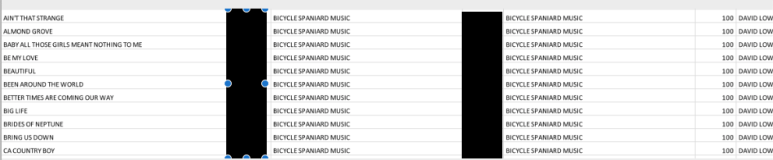
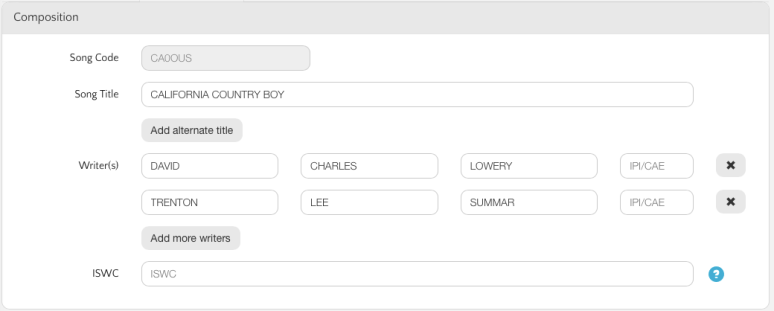
Our Data (submitted in 2019 based on BMI records):


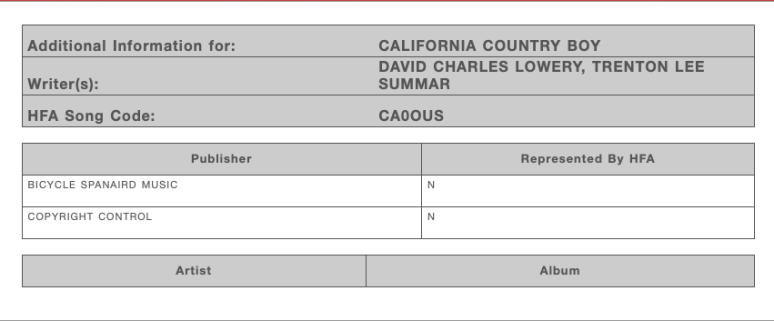
Resulting HFA data (2020 public facing database):

First thing we notice is that HFA is reporting that I am not an HFA registered publisher. WTF? Second problem is that Trent Summar’s publishing share (Farm Rock Music) is not listed. This has instead been assigned to “copyright control.”  It is unclear what that means. It is clear that since this song was previously mis-registered as David Lowery/Bicycle Spanaird 100%, HFA records have been updated. The co-writer has been added, but not the co-publisher. But curiously they somehow have Trent’s middle name. Now I thought perhaps this was just a deficiency in the public facing database.  So I double checked by looking up the song from my own HFA account.

Here is the (internal data) that search returned.

No IPI numbers? Well maybe those are hidden for privacy. But no ISWC number? And Farm Rock Music is still not listed as a publisher.  That is again listed as copyright control. This is really shoddy work. How is the MLC supposed to distribute royalties based on this data?

I checked an additional 25 co-written songs and the data was fucked on all of them: multiple song codes, incorrect splits, missing co-publisher information, missing ISWC codes, and some songs were just not in the HFA database.  Honestly it looks like someone never finished doing the job.

It’s possible that I or someone on my team somehow screwed this up, but it seems unlikely. I have copies of the HFA formatted excel sheets that were submitted and they are correct.  If all the self-published songwriters are in the same situation then we are likely talking about millions of songs that have bad data. This is very troubling.

“But my BMI Data is Correct.  Why Didn’t MLC Start With That Data?”

Really odd, right? The data the MLC is seeking already exists in a machine readable format at the PROs (BMI, ASCAP, SESAC etc).  Why is it that songwriters can’t simply opt in to have their data transmitted to the MLC? Wouldn’t this be the easiest way to correct the MLC database?  Instead songwriters are going to have to go through and get HFA to manually update each song.  For an average songwriter like myself, even at minimum wage that’s probably several hundred dollars worth of work. And my data is pretty organized!

The sad thing is we were told over and over again that streaming services were supposed to pay for costs of the MLC.  Why are songwriters being asked to do all this unnecessary work? Even the MLC’s official title they’ve given to the effort make songwriters clean up their mess is insulting: “Play Your Part™.”  They thought it so clever apparently they have trademarked the phrase.

The US Copyright Office should step in and look at whats happening with the MLC database.  Something is very wrong with the HFA data.


Copyright Office Regulates The MLC: Selected Public Comments on the Copyright Office Black Box Study: @SoundExchange

[The Copyright Office is asking for public comments on best practices for dealing with the black box as part of the “Unclaimed Royalties Study” mandated by the Music Modernization Act.  We are posting comments or excerpts from comments that we found interesting.  You can find other the posted comments here.

This post is from SoundExchange’s filing.  I have to say that I have long been impressed by SoundExchange’s problem-solving abilities and commitment to get artists paid. SoundExchange sets the standard that The MLC will be measured by and should try to live up to.  Unfortunately, The MLC’s selection of HFA as their data vendor immediately means The MLC is unlikely to have a functioning much less accurate database by the January deadline.  They should really pay attention to SoundExchange’s example.]

Core strategies

Through its experience, SoundExchange has identified and embraced certain core
strategies for administering a blanket license that have had the direct effect of minimizing the incidence of unclaimed royalties. First, a collective must act with a total commitment to transparency and accountability.

Second, to the extent possible, a collective must build systems and practices around standard unique identifiers, which are the best way to manage the huge volume of usage and repertoire data that a collective receives in the digital age.

Third, in building its systems and practices, a collective should rigorously distinguish between repertoire data and usage reporting data, and base the repertoire database on data from authoritative sources, typically rights owners. Fourth, it is essential for a collective administering a statutory license to prioritize education and outreach to those who will receive royalties under the blanket license because the collective represents all payees, not just those who have the sophistication or knowledge to register with the collective in the first place. While no system will ever be perfect, a collective that embraces and implements these core strategies will be best positioned to minimize unclaimed royalties. We address each in more detail below.

A. Commit to transparency and accountability

As a collective, it is critical for SoundExchange to commit to transparency and
accountability. We must be responsive to our stakeholders – the people we pay, who have
entrusted us to collect a critical component of their income. As a baseline, a collective must be governed by those it pays. As a next level, a collective must provide tools to stakeholders that give them transparency into how their royalties are collected and distributed, and a means for providing feedback on the metadata associated with their works.

SoundExchange has adopted a policy and practice of continuous improvement. Most
recently, SoundExchange has rolled out new features in SoundExchange Direct, our online account management portal that allows recording artists and rights owners to navigate their digital performance rights and royalties. SoundExchange Direct allows users to manage multiple SoundExchange accounts and add guest users, update account information including contact and payment or banking information, view payment history and revenue data by top recordings and top services and, most relevant here, upload and manage their repertoire data.

[Read the full post here.]

What’s Good for Google is Not What’s Good for the USA: Supreme Court Brief of @davidclowery, @helienne, @theblakemorgan and @sgawrites in Google v. Oracle, Part 6

Google’s appeal of its major loss to Oracle on fair use is shaping up to be the most important copyright case of the year, if not the decade.  It could set fair use standards for years to come.  We’re going to be posting installments from the friend of the court brief that David, Helienne, Blake and The Songwriters Guild filed in the U.S. Supreme Court supporting Oracle in the Google v. Oracle fair use case.  This is the last installment.  We decided to omit the footnotes for this posting, but you can read the whole brief here.

Cover Page

Moreover, Amici believe that Google’s fair use expansion campaigns are designed to serve as a honeypot for Google’s data scraping business model that feeds its outsized profits from ads. Google likewise seems to promote expansion of the fair use doctrine as way to easily keep more videos on YouTube, while providing material support to its partners that allows them to outlast any songwriter or artist in the game of whack-a-mole under its copyright strike policies. No one is giving creators a shadowy milliondollar fund to defend against the misapplication of fair use.

Amicus Mr. Lowery summed it up in his 2014 testimony to the House Judiciary Committee:

I am not concerned with parody, commentary, criticism, documentary filmmakers, or research. These are legitimate fair use categories. I am concerned with the illegal copy that masquerades as fair use, but is really just a copy. This masquerade trivializes legitimate fair use categories and creates conflict where there need be none.

Scope of Fair Use at 22.

Unfortunately, Google manipulates fair use to extract value by monetizing verbatim  copies to the great disadvantage of creators who can little afford to fight back against the multi-national, trillion dollar corporation, and usually do not. Thus, independents
are caught without leverage in cases that rarely get to court.

The end result is that even where its use is “free,” Google’s interests are steadfastly commercial. Accordingly, the Federal Circuit was correct in finding that the nature and purpose of Google’s use was entirely commercial in nature.

III. GOOGLE’S PRIVATE INTERESTS ARE
NOT THE PUBLIC INTEREST.

The ultimate question in a fair use analysis is “whether, and how powerfully, a finding of fair use would serve or disserve the objectives of the copyright.” Leval at 1110–1111; see also Harper & Row, 471 U.S. at 546 (noting purpose of copyright is to give creators
“a fair return for their labors”).

Google’s only response to whether its use furthers the public interest—i.e., in promoting an effective system of copyright—is that allowing it to copy verbatim Oracle’s declaring code and structure would be “promoting software innovation.” Such verbatim copying is a “facile use of the scissors.” Folsom v. Marsh, 9 F. Cas. 342, 345 (C.C.D. Mass 1841) (Story, J.).

Yet what is good for Google is not synonymous with what is good for the public—no more than “[w]hat’s good for General Bullmoose is good for the USA.” Johnny Mercer and Gene De Paul, Li’l Abner (1956).  In fact, a ruling for Google would be “promoting” software innovation only in that the purported “innovation” would be furthering Google’s private
interest—i.e., using works without permission or a license fee.

This case again appears to be the latest in Google’s long-term strategy to use its market dominance and overwhelming commercial power to continually distort copyright exceptions, thereby artificially depressing the market price of copyrighted works.  Google’s proposed outcome would be yet another distortion. Were Google to prevail here, Amici expect Google (and its proxies) to throw its full weight behind such a ruling, far beyond the confines of its text. This case would become another totemic faux license or safe harbor that Google could use as a cudgel against creators and copyright owners.

Left unchecked, eventually the copyright distortions they seek—including in the case at bar—could nullify copyright, particularly for those who cannot afford to fight back or fear retaliation for doing so. Under the Google anti-copyright regime, exceptions would devour the rules of protection in whole, digesting art and culture along with them.

CONCLUSION

Amici respectfully suggest that the Court should consider whether a decision in favor of Google would merely “unleash” yet another weapon for Google’s private benefit, and whether Google’s infringement of Oracle’s declaring code and structure constitutes
“simple piracy” for which the company should most certainly be held accountable.

This Court should affirm the decision of the Federal Circuit below.
Respectfully submitted,
CHARLES J. SANDERS
Counsel of Record
29 KINGS GRANT WAY
BRIARCLIFF, NEW YORK 10510
(914) 366-6642
cjs@csanderslaw.com

CHRISTIAN CASTLE
CHRISTIAN L. CASTLE, ATTORNEYS
9600 GREAT HILLS TRAIL
SUITE 150W
AUSTIN, TEXAS 78759
(512) 420-2200
asst1@christiancastle.com
Counsel for Amici Curiae


How Google Treats Copyright as an Inconvenience: Supreme Court Brief of @davidclowery, @helienne, @theblakemorgan and @sgawrites in Google v. Oracle, Part 5

Google’s appeal of its major loss to Oracle on fair use is shaping up to be the most important copyright case of the year, if not the decade.  It could set fair use standards for years to come.  We’re going to be posting installments from the friend of the court brief that David, Helienne, Blake and The Songwriters Guild filed in the U.S. Supreme Court supporting Oracle in the Google v. Oracle fair use case.  This is part 5.  We decided to omit the footnotes for this posting, but you can read the whole brief here.

Cover Page
Cover Page of Friend of the Court Brief

ARGUMENT

B. Google Benefits Commercially from Weaker Copyright Protection.

Amici, as creators in the digital age, are largely beholden to the whims of distributors. As romantic the notion is of solitary artists laboring over their works, the fact remains that they will ultimately need to distribute their creative expression. That means going
through Google far more often than not.

Artists like Amici have a tense relationship with Google and its subsidiaries. On the one hand, Google controls access to the market directly or indirectly. On the other hand, Google has consistently abused or outright ignored copyright when it comes to
interactions with creators and their intellectual property.

For example, when YouTube rolled out its subscription service, it reportedly warned independent artists and labels that if they refused YouTube’s licensing terms, their music would be blocked on YouTube’s free service, and YouTube would keep any advertising revenue. Ben Sisario, Independent Music Labels Are in a Battle with YouTube, N.Y. Times
(May 24, 2014) https://www.nytimes.com/2014/05/24/business/media/independent-music-labels-are-in-abattle-with-youtube.html.

In Amici’s experience, Google has a long history of leveraging copyright exceptions for its enormous profit at creators’ expense. Through YouTube, Google profits directly from verbatim copies of Amici’s own works. These copies are often unauthorized, unlicensed, and severely undermonetized. See Jonathan Taplin, Do You Love Music? Silicon Valley Doesn’t, L.A. Times (May 20, 2016).

Google is able to artificially lower the floor for the market for music and other copyrighted works by strategically leveraging a variety of copyright exceptions and loopholes across all of its platforms, particularly YouTube and search.

As discussed above, in order to maximize user engagement with its ads, Google needs a constant influx of creative content. Copyright is treated as an imposition, and Google avoids liability through an abuse of exceptions such as the safe harbor provisions
in the Digital Millennium Copyright Act. See 17 U.S.C. § 512(a)–(d). Google frequently argues that these provisions immunize Google from liability for infringing content, while also making it very easy for Google to restore content with the check of a box.

Google has cobbled together a system of copyright “strikes” based on DMCA notices received from copyright owners against infringing YouTube channels. With sufficient strikes, YouTube blocks public access to the channel. The channel operator, however, can easily restore content by filing a counternotification with YouTube often attesting without firm legal grounds to a good faith belief that their unauthorized use of the material is non-infringing.

Such an assertion frequently mimics Google’s general assertions that the fair use doctrine is malleable enough to accommodate any use no matter how damaging, non-transformative, commercially based or unnecessarily broad. See 17 U.S.C. § 512(g)(3)(C).
Assuming the copyright owner does not seek relief in court—and very few do because of the prohibitive costs and time required—then YouTube restores the content, and Google has another video to monetize.

Thus, assertions of fair use (real or imagined) play a critical role in this scheme, and therefore ultimately Google’s advertising inventory. YouTube’s counternotification
webform, in fact, arguably encourages a channel operator to claim a good-faith belief that its infringing video was fair use under the broadest of circumstances. See Lenz v. Universal Music Corp., 801 F.3d 1126 (9th Cir. 2015).

These channel operators are rarely represented by counsel, meaning their claims of fair use are more folk wisdom and internet legend than law. Five-time Grammy Award winner and independent composer and band leader Maria Schneider gave an example of this culture in comments to the Copyright Office:

“As just one small example, just put in the YouTube “search” bar the phrases “fair use” and “full CD.” There are literally countless whole albums digitally uploaded by users who state that it is “fair use” (which it obviously isn’t).

YouTube knows there is infringement of epic proportions broadly across its platform, and . . .certainly makes it possible, and easier, for infringement to occur.”

Coupled with its porous repeat infringer policy, YouTube has leveraged counternotifications into a broad-based fair use business strategy—truly an attempt to fashion its non-existent “fair use industries” entirely out of whole cloth.

Google overamplifies fair use in other ways. For example, since 2015, YouTube has  sponsored an initiative to subsidize legal fees for certain fair use cases that it decides are “some of the best examples of fair use on YouTube by agreeing to defend them in
court if necessary.”34 YouTube announced that it intended to “indemnify creators whose fair use videos have been subject to takedown notices for up to $1 million of legal costs in the event the takedown results in a lawsuit for copyright infringement.”

Google tells us “[they] believe even the small number of videos [Google] are able to protect will make a positive impact on the entire YouTube ecosystem, ensuring
YouTube remains a place where creativity and expression can be rewarded.”

The promise of Google’s million-dollar fair use indemnity promotion effectively provides a faux license against copyright liability without the consent of the copyright owner, and purports to protect YouTube partners for fair use cases that Google judges worthy, i.e., cases that promote Google’s private interests in protecting and expanding YouTube’s advertising inventory. It is unclear which, if any, cases Google or YouTube have taken on under this indemnity or what the criteria would be because Google does not disclose
when or if they get involved. One can easily discern through market behavior, however, that the threat alone more than satisfies Google’s imputed aims to dissuade creators from even attempting to enforce their rights.

[To be continued…]

Copyright Office Regulates The MLC: Selected Public Comments on the Copyright Office Black Box Study: Zoë Keating

[The Copyright Office is asking for public comments on best practices for dealing with the black box as part of the “Unclaimed Royalties Study” mandated by the Music Modernization Act.  We are posting comments or excerpts from comments that we found interesting starting with comments by our friend Zoë Keating.  You can find other the posted comments here.]

Regarding unclaimed royalties: To facilitate the population of correct metadata going forward, when someone registers a composition or a composition with a sound recording, that information should lead to an automatic registration with the MLC.

Why is it necessary in the first place to register works in so many places? Why can’t I as a self-published composer who owns all my copyrights, register my compositions and my recordings with the copyright office and have that information shared with the MLC for mechanical rights, SoundExchange for digital performing rights and a selected PRO for the performance right?

I am making this comment here in the unclaimed royalty study because as long as this is not facilitated, there will continue to be more unclaimed royalties than there should be. As long as the process remains confusing and opaque to self-published creators, who will rely exclusively on the MLC, there will be gaps in the data. As long as there are gaps in the data, the more likely it is that royalties will go unclaimed.

Rather than spend money on continually educating the public as to where they need to register their information in order to collect a royalty – why not spend the money to automate the process from the inception?

As for the unmatched royalties themselves, I have the following comment:

A database of the unmatched compositions for which there are royalties should be publicly searchable in order to effectively crowd-source and facilitate at least part of the matching process. There are bound to be errors on the DSP reporting side, some of which the copyright owners themselves might be familiar with from reporting errors in the past with other types of royalty databases, and know what to look for.

Also, given that the MLC will be collecting royalties on behalf of foreign songwriters and publishers, I would expect the core MLC database itself and any searchable index of the unmatched database to feature standardized character normalization for search and subsequent matching of diacritics, umlauts, accents etc.

Guest Post: The TikTok Blame Game Starts

By Chris Castle

The walls appear to be closing in on TikTok (or as it’s becoming known, TikSoft).  This is probably particularly galling to the founder of Bytedance (TikTok’s parent company). Zhang Yiming worked at Microsoft but left in 2008.

Mr. Zhang is launching a Google-style reaction and deflection campaign against the U.S. Government’s standard Committee on Foreign Investment in the United States (“CFIUS”) review of Bytedance’s 2017 acquisition of Musical.ly that started on November 1, 2019.  Bear in mind–Zhang must be well aware that pre-acquisition review by CFIUS is a standard procedure which Bytedance chose not to pursue.  Had Bytedance submitted the Musical.ly transaction to a pre-acquisition review, TikTok might still have the current problem, but it would have to come from a less legally solid ground.

The key issue in the CFIUS review is the one that Mr. Zhang is not discussing–China’s National Intelligence Law.   The reason for the U.S. concern about TikTok is that the National Intelligence Law has broadly drafted and poorly defined provisions that create gaping exposure for U.S. and other foreigners doing business or even studying in China, as well as their Chinese business partners, employees and colleagues.

Two parts of the Intelligence Law are particularly concerning, Article 7 and Article 14.  Article 7 mandates that “any organization or citizen shall support, assist, and cooperate with state intelligence work according to law” and Article 14 empowers State Security officials to demand this cooperation, stating that “state intelligence work organs, when legally carrying forth intelligence work, may demand that concerned organs, organizations, or citizens provide needed support, assistance, and cooperation.”

Other clauses are equally alarming.  Article 16 authorizes State Security to interrogate  any individual and to search their reference materials and files. Article 17 authorizes police to seize and take over the operation of communications equipment [aka TikTok], transportation, buildings, and other facilities of both individuals and organizations.

It is this law that is at the bottom of U.S. concerns about TikTok’s data scraping–it is, after all, spyware with a soundtrack.  There’s a strong case to be made that U.S. artists, songwriters, creators and fans are all dupes of TikTok as a data collection tool  in a country that requires its companies to hand over to the Ministry of State Security all it needs to support the intelligence mission (MSS is like the FBI and CIA in one agency with a heavy ration of FSB).

Mr. Zhang does not discuss this part.  It should come as no surprise–according to his Wikipedia page, Mr. Zhang understands what happens when you don’t toe the Party line:

ByteDance’s first app, Neihan Duanzi, was shut down in 2018 by the National Radio and Television Administration. In response, Zhang issued an apology stating that the app was “incommensurate with socialist core values“, that it had a “weak” implementation of Xi Jinping Thought, and promised that ByteDance would “further deepen cooperation” with the ruling Chinese Communist Party to better promote its policies.

I would find it very, very hard to believe that Mr. Zhang is not a member of the Chinese Communist Party, but in any event he understands very clearly what his role is under the National Intelligence Law.  Do you think that standing up to the MSS to protect the data privacy of American teenagers is consistent with “Xi Jinping Thought”? (Xi Jinping is the Chairman for Life of the Chinese Communist Party.)

Kind of like this recent police banner from Hong Kong:

hong-kongs-new-weapon-against-protesters-a-purple-warning-flag

It’s not that I don’t believe a word he says, it’s just that I’m still waiting to hear how operating the company in the U.S. in line with the public protestations of TikTok executives is consistent with “Xi Jinping Thought” and being “commensurate with socialist core values.”

But hope springs eternal.

$2 Billion: US Should Make TikTok Sale Contingent on Paying Songwriters

The Twitter-sphere has been captivated by the imminent ban of TikTok or forced sale to American investors. What many people do not realize is that the service, built on a foundation of stolen songs, has refused to license or pay royalties to songwriters.

Songwriters have been forced to finance the hyper growth of the social media phenomenon. So why shouldn’t they be rewarded like any other venture capitalist? Further why should the venture capital firms like SoftBank be rewarded for knowingly financing an apparent criminal RICO racket. Give songwriters their share.

And I’m not exaggerating when I say “apparent criminal RICO racket.” Normally major publishers and trade organizations  would be all over a deep pocketed infringer like TikTok. Songwriters have been puzzled by their apparent lack of interest in TikTok before national securities concerns began to threaten to shut the service down. Fueling suspicions that something nasty is afoot, is the fact several digital licensing executives from major publishers seem to have let TikTok slide and then a few months later started working for TikTok (here, here, here) . This by itself deserves a look from the DOJ. It stinks to high heaven. Especially as these executives were fully aware of the scale of ongoing and willful infringement.

Some of you may have seen headlines announcing that major labels entered into licensing agreements with TikTok.  Those licenses are for the recordings but not the underlying compositions which are generally owned by songwriters and publishers.  To make matter more confusing the National Music Publishers Association announced a settlement in the last few days. Curious timing, right?  This is an opt-in agreement for publishers not songwriters. Further no one knows the terms of this deal. If it’s anything like the Spotify-NMPA settlement, the vast majority of the settlement was split between the big five publishers.

Regardless the main US trade beef with China has been the theft of IP from US businesses. Songwriting is a business and TikTok has engaged in blatant infringement of our IP. This is no different than theft of trade secrets or infringement of technology patents. It is not beyond the scope of a US directed settlement to make TikTok and its investors pay for its crimes committed against US songwriters before a sale is allowed.

Given the scale of the apparent willful infringement and the rumored $30 Billion price tag for TikTok. Two billion dollars is quite reasonable.

Further this settlement should be paid directly to songwriters as it appears major publishers did nothing to stop infringement of songwriters’ works. These publishers have an implicit fiduciary responsibility to songwriters and they apparently did nothing.  They should not be rewarded. Pay the settlement through songwriter PROs at 100% writer 0% publisher. This could be wrapped up in a few weeks. Fairness dictates songwriters, the victims of the apparent racket, should be compensated and TikTok and its investors punished.

There are untold riches in running the internet of other people’s things: Supreme Court Brief of @davidclowery, @helienne, @theblakemorgan and @sgawrites in Google v. Oracle, Part 4

Google’s appeal of its major loss to Oracle on fair use is shaping up to be the most important copyright case of the year, if not the decade.  It could set fair use standards for years to come.  We’re going to be posting installments from the friend of the court brief that David, Helienne, Blake and The Songwriters Guild filed in the U.S. Supreme Court supporting Oracle in the Google v. Oracle fair use case.  This is part 4.  We decided to omit the footnotes for this posting, but you can read the whole brief here.

Cover Page
Cover Page of Friend of the Court Brief

ARGUMENT

II. GOOGLE’S USE IS CLEARLY COMMERCIAL.

Against this backdrop, Amici agree wholeheartedly with the Federal Circuit that “the fact that Android is free of charge does not make Google’s use of the Java API packages noncommercial.” Oracle Am., Inc. v. Google, LLC, 886 F.3d 1179, 1197 (Fed. Cir. 2018) (“Oracle II”). In arriving at this conclusion, the Federal Circuit cited evidence that Google generated over $42 billion from Android through advertising. Id. at 1187, 1197.

Google concedes that its creation of Android was “a commercial endeavor,” but argues more amorphously that its copying of Oracle’s code and organization served the noncommercial purpose of “promoting software innovation.” Pet. Br. at 43-44. Likewise,
Google’s amici argue that because Android was offered to consumers for free, its copyright cannot be commercial. See Copyright Scholars Br. At 12.

Yet contrary to the views of Google’s amici, the Federal Circuit properly found that Google’s use was commercial and properly weighed such a commerciality finding in the fair use inquiry. Just because Google did not sell Android to consumers does not mean its
copying did constitute commercial use. In fact, the $42 billion figure cited by the Federal Circuit is likely only the tip of the iceberg.

A. Google’s Market Dominance Lowers the “Customary Price” of Copyrighted Works.

As this Court stated in Harper & Row, whether a use is commercial “is not whether the sole motive of the use is monetary gain but whether the user stands to profit from exploitation of the copyrighted material without paying the customary price.” 471 U.S. at 562 (emphasis added). In other words, a commercial use is found where a defendant is “[g]iving customers for free something they would ordinarily have to buy.”  Oracle II, 886 F.3d at 1197 (quoting A&M Records, Inc. v. Napster, Inc., 239 F.3d 1004, 1015 (9th Cir. 2001)).

The Federal Circuit is in accord with the other Courts of Appeals that have considered this proposition. See, e.g., Soc’y of Holy Transfiguration Monastery, Inc. v. Gregory, 689 F.3d 29, 61 (2d Cir. 2012) (“‘Profit,’ in this context, is thus not limited simply to dollars and coins; instead, it encompasses other non-monetary calculable benefits or advantages.”); Weissmann v. Freeman, 868 F.2d 1313, 1324 (2d Cir. 1989) (factor one disfavored use where professor’s benefit in academic prestige and recognition was “ill-measured in dollars”); A&M Records, 239 F.3d at 1015 (“Direct economic benefit is not required to
demonstrate a commercial use.”); see generally Nimmer on Copyright 13.05  “Commercial uses’ are extremely broad.”).

Here, there should be no question that the purpose of offering a mobile platform was commercial in nature: Google simply wanted to maintain its ad sales dominance. See Oracle II, 886 F.3d at 1210.

One thing that content creators have grown to understand is that Google is not a tech company—it is an advertising company. When one sees this, all is revealed. See Jake Swearingen, Can Google Be More Than an Advertising Company? New York Magazine
(Feb. 5, 2019) (“Of the $39 billion [Google’s parent Alphabet] brought in [during Q4 2018], $32.6 billion of it was in advertising revenue — that’s 83 percent of its total revenue.”). Google has become enormously successful, though not always transparently.
Moreover, Google dominates the market for online advertising, with disturbing  implications for privacy.

As is well-known by now, Google extracts value from its users through selling advertising on works that Google makes available at no charge to the user, and through scraping user data in the background that Google then adds to its ballooning behavioral knowledge database through highly complex user profiling. Google extracts this value by selling targeted advertising, often in connection with verbatim copies of works generally offered for free to users on YouTube. There are untold riches in running the
internet of other people’s things.

The reason is this: free is critical to Google’s model, which depends on the en masse exploitation of copyrighted content. This business model is the sort that this Court has analyzed as commercial:

[Defendants] make money by selling advertising space, by directing ads to the screens of computers employing their software. As the record shows, the more the software is used, the more ads are sent out and the greater the advertising revenue becomes. Since the extent of the software’s use determines the gain to the distributors, the commercial sense of their enterprise turns on high-volume use, which the record shows is infringing.

See Grokster, 545 U.S. at 940. Likewise, Google’s business model enables staggering profits with little to no direct commercial transactions between it and the
end-user, particularly on YouTube. See Jason Fitzpatrick, If You’re Not Paying for It; You’re the Product, Lifehacker (Nov. 23, 2010).

Google’s evangelists have even coined a term to describe such takings: “permissionless innovation.” See Adam Thierer and The Mercatus Center, Permissionless Innovation and Public Policy: A 10 Point Program at 12 (2016). Vinton G. Cerf, Keep the Internet Open, N.Y. Times (May 24, 2012) https://www.nytimes.com/2012/05/25/opinion/keep-theinternet-
open.html.

Yet “permissionless innovation” is just another term for what polite creators call the underpinning of the infamous “value gap” currently plaguing the global community of music creators and artists. In fact, the disparity between artists’ royalties and Google’s
enormous ad-based music distribution profits off of their music has become its own market phenomenon and largely led to the adoption of the European Copyright Directive in 2019 which seeks to address the devastating value gap by requiring Google to
operate on a more level playing field for creators.

In order to achieve and maintain permissionless innovation in the United States, accused infringers in contrast continue to lean on burden-shifting regimes like the DMCA safe harbors to impose the costs of policing infringement onto copyright owners while
giving Google leverage in licensing negotiations.

From a copyright perspective, permissionless innovation relies on a system of risk shifting safe harbors and forces artists into an unsustainable game of whack-a-mole to which Google’s amorphous interpretation of fair use is tightly bound. Google leverages this commercial windfall into exerting dominance at scale. For example, while Google makes much of the purported (and unsubstantiated) “lock in” effect that would result from Oracle’s vindication of its copyrights, see Pet. Br. 40, Google itself locks in creators to coerce their agreement to commercial deals with YouTube. For example and
as further discussed below, contracting with YouTube’s subscription service was a condition of access to YouTube’s infamous Content ID system28 a linkage that
continues to draw scrutiny.

Any revenue that copyright owners receive, then, must price in the transaction costs of dealing with Google’s unpredictable policies. The aggregate revenue from Google after deducting transaction costs is a long way from a “customary price.”

[To be continued]