[The Copyright Office is asking for public comments on best practices for dealing with the black box as part of the “Unclaimed Royalties Study” mandated by the Music Modernization Act. We are posting comments or excerpts from comments that we found interesting starting with comments by our friend Zoë Keating. You can find other the posted comments here.]
Regarding unclaimed royalties: To facilitate the population of correct metadata going forward, when someone registers a composition or a composition with a sound recording, that information should lead to an automatic registration with the MLC.
Why is it necessary in the first place to register works in so many places? Why can’t I as a self-published composer who owns all my copyrights, register my compositions and my recordings with the copyright office and have that information shared with the MLC for mechanical rights, SoundExchange for digital performing rights and a selected PRO for the performance right?
I am making this comment here in the unclaimed royalty study because as long as this is not facilitated, there will continue to be more unclaimed royalties than there should be. As long as the process remains confusing and opaque to self-published creators, who will rely exclusively on the MLC, there will be gaps in the data. As long as there are gaps in the data, the more likely it is that royalties will go unclaimed.
Rather than spend money on continually educating the public as to where they need to register their information in order to collect a royalty – why not spend the money to automate the process from the inception?
As for the unmatched royalties themselves, I have the following comment:
A database of the unmatched compositions for which there are royalties should be publicly searchable in order to effectively crowd-source and facilitate at least part of the matching process. There are bound to be errors on the DSP reporting side, some of which the copyright owners themselves might be familiar with from reporting errors in the past with other types of royalty databases, and know what to look for.
Also, given that the MLC will be collecting royalties on behalf of foreign songwriters and publishers, I would expect the core MLC database itself and any searchable index of the unmatched database to feature standardized character normalization for search and subsequent matching of diacritics, umlauts, accents etc.
The walls appear to be closing in on TikTok (or as it’s becoming known, TikSoft). This is probably particularly galling to the founder of Bytedance (TikTok’s parent company). Zhang Yiming worked at Microsoft but left in 2008.
Mr. Zhang is launching a Google-style reaction and deflection campaign against the U.S. Government’s standard Committee on Foreign Investment in the United States (“CFIUS”) review of Bytedance’s 2017 acquisition of Musical.ly that started on November 1, 2019. Bear in mind–Zhang must be well aware that pre-acquisition review by CFIUS is a standard procedure which Bytedance chose not to pursue. Had Bytedance submitted the Musical.ly transaction to a pre-acquisition review, TikTok might still have the current problem, but it would have to come from a less legally solid ground.
The key issue in the CFIUS review is the one that Mr. Zhang is not discussing–China’s National Intelligence Law. The reason for the U.S. concern about TikTok is that the National Intelligence Law has broadly drafted and poorly defined provisions that create gaping exposure for U.S. and other foreigners doing business or even studying in China, as well as their Chinese business partners, employees and colleagues.
Two parts of the Intelligence Law are particularly concerning, Article 7 and Article 14. Article 7 mandates that “any organization or citizen shall support, assist, and cooperate with state intelligence work according to law” and Article 14 empowers State Security officials to demand this cooperation, stating that “state intelligence work organs, when legally carrying forth intelligence work, may demand that concerned organs, organizations, or citizens provide needed support, assistance, and cooperation.”
Other clauses are equally alarming. Article 16 authorizes State Security to interrogate any individual and to search their reference materials and files. Article 17 authorizes police to seize and take over the operation of communications equipment [aka TikTok], transportation, buildings, and other facilities of both individuals and organizations.
It is this law that is at the bottom of U.S. concerns about TikTok’s data scraping–it is, after all, spyware with a soundtrack. There’s a strong case to be made that U.S. artists, songwriters, creators and fans are all dupes of TikTok as a data collection tool in a country that requires its companies to hand over to the Ministry of State Security all it needs to support the intelligence mission (MSS is like the FBI and CIA in one agency with a heavy ration of FSB).
Mr. Zhang does not discuss this part. It should come as no surprise–according to his Wikipedia page, Mr. Zhang understands what happens when you don’t toe the Party line:
I would find it very, very hard to believe that Mr. Zhang is not a member of the Chinese Communist Party, but in any event he understands very clearly what his role is under the National Intelligence Law. Do you think that standing up to the MSS to protect the data privacy of American teenagers is consistent with “Xi Jinping Thought”? (Xi Jinping is the Chairman for Life of the Chinese Communist Party.)
Kind of like this recent police banner from Hong Kong:
It’s not that I don’t believe a word he says, it’s just that I’m still waiting to hear how operating the company in the U.S. in line with the public protestations of TikTok executives is consistent with “Xi Jinping Thought” and being “commensurate with socialist core values.”
The Twitter-sphere has been captivated by the imminent ban of TikTok or forced sale to American investors. What many people do not realize is that the service, built on a foundation of stolen songs, has refused to license or pay royalties to songwriters.
Songwriters have been forced to finance the hyper growth of the social media phenomenon. So why shouldn’t they be rewarded like any other venture capitalist? Further why should the venture capital firms like SoftBank be rewarded for knowingly financing an apparent criminal RICO racket. Give songwriters their share.
And I’m not exaggerating when I say “apparent criminal RICO racket.” Normally major publishers and trade organizations would be all over a deep pocketed infringer like TikTok. Songwriters have been puzzled by their apparent lack of interest in TikTok before national securities concerns began to threaten to shut the service down. Fueling suspicions that something nasty is afoot, is the fact several digital licensing executives from major publishers seem to have let TikTok slide and then a few months later started working for TikTok (here, here, here) . This by itself deserves a look from the DOJ. It stinks to high heaven. Especially as these executives were fully aware of the scale of ongoing and willful infringement.
Some of you may have seen headlines announcing that major labels entered into licensing agreements with TikTok. Those licenses are for the recordings but not the underlying compositions which are generally owned by songwriters and publishers. To make matter more confusing the National Music Publishers Association announced a settlement in the last few days. Curious timing, right? This is an opt-in agreement for publishers not songwriters. Further no one knows the terms of this deal. If it’s anything like the Spotify-NMPA settlement, the vast majority of the settlement was split between the big five publishers.
Regardless the main US trade beef with China has been the theft of IP from US businesses. Songwriting is a business and TikTok has engaged in blatant infringement of our IP. This is no different than theft of trade secrets or infringement of technology patents. It is not beyond the scope of a US directed settlement to make TikTok and its investors pay for its crimes committed against US songwriters before a sale is allowed.
Given the scale of the apparent willful infringement and the rumored $30 Billion price tag for TikTok. Two billion dollars is quite reasonable.
Further this settlement should be paid directly to songwriters as it appears major publishers did nothing to stop infringement of songwriters’ works. These publishers have an implicit fiduciary responsibility to songwriters and they apparently did nothing. They should not be rewarded. Pay the settlement through songwriter PROs at 100% writer 0% publisher. This could be wrapped up in a few weeks. Fairness dictates songwriters, the victims of the apparent racket, should be compensated and TikTok and its investors punished.
Google’s appeal of its major loss to Oracle on fair use is shaping up to be the most important copyright case of the year, if not the decade. It could set fair use standards for years to come. We’re going to be posting installments from the friend of the court brief that David, Helienne, Blake and The Songwriters Guild filed in the U.S. Supreme Court supporting Oracle in the Google v. Oracle fair use case. This is part 4. We decided to omit the footnotes for this posting, but you can read the whole brief here.
Cover Page of Friend of the Court Brief
ARGUMENT
II. GOOGLE’S USE IS CLEARLY COMMERCIAL.
Against this backdrop, Amici agree wholeheartedly with the Federal Circuit that “the fact that Android is free of charge does not make Google’s use of the Java API packages noncommercial.” Oracle Am., Inc. v. Google, LLC, 886 F.3d 1179, 1197 (Fed. Cir. 2018) (“Oracle II”). In arriving at this conclusion, the Federal Circuit cited evidence that Google generated over $42 billion from Android through advertising. Id. at 1187, 1197.
Google concedes that its creation of Android was “a commercial endeavor,” but argues more amorphously that its copying of Oracle’s code and organization served the noncommercial purpose of “promoting software innovation.” Pet. Br. at 43-44. Likewise,
Google’s amici argue that because Android was offered to consumers for free, its copyright cannot be commercial. See Copyright Scholars Br. At 12.
Yet contrary to the views of Google’s amici, the Federal Circuit properly found that Google’s use was commercial and properly weighed such a commerciality finding in the fair use inquiry. Just because Google did not sell Android to consumers does not mean its
copying did constitute commercial use. In fact, the $42 billion figure cited by the Federal Circuit is likely only the tip of the iceberg.
A. Google’s Market Dominance Lowers the “Customary Price” of Copyrighted Works.
As this Court stated in Harper & Row, whether a use is commercial “is not whether the sole motive of the use is monetary gain but whether the user stands to profit from exploitation of the copyrighted material without paying the customary price.” 471 U.S. at 562 (emphasis added). In other words, a commercial use is found where a defendant is “[g]iving customers for free something they would ordinarily have to buy.” Oracle II, 886 F.3d at 1197 (quoting A&M Records, Inc. v. Napster, Inc., 239 F.3d 1004, 1015 (9th Cir. 2001)).
The Federal Circuit is in accord with the other Courts of Appeals that have considered this proposition. See, e.g., Soc’y of Holy Transfiguration Monastery, Inc. v. Gregory, 689 F.3d 29, 61 (2d Cir. 2012) (“‘Profit,’ in this context, is thus not limited simply to dollars and coins; instead, it encompasses other non-monetary calculable benefits or advantages.”); Weissmann v. Freeman, 868 F.2d 1313, 1324 (2d Cir. 1989) (factor one disfavored use where professor’s benefit in academic prestige and recognition was “ill-measured in dollars”); A&M Records, 239 F.3d at 1015 (“Direct economic benefit is not required to
demonstrate a commercial use.”); see generally Nimmer on Copyright 13.05 “Commercial uses’ are extremely broad.”).
Here, there should be no question that the purpose of offering a mobile platform was commercial in nature: Google simply wanted to maintain its ad sales dominance. See Oracle II, 886 F.3d at 1210.
One thing that content creators have grown to understand is that Google is not a tech company—it is an advertising company. When one sees this, all is revealed. See Jake Swearingen, Can Google Be More Than an Advertising Company? New York Magazine
(Feb. 5, 2019) (“Of the $39 billion [Google’s parent Alphabet] brought in [during Q4 2018], $32.6 billion of it was in advertising revenue — that’s 83 percent of its total revenue.”). Google has become enormously successful, though not always transparently.
Moreover, Google dominates the market for online advertising, with disturbing implications for privacy.
As is well-known by now, Google extracts value from its users through selling advertising on works that Google makes available at no charge to the user, and through scraping user data in the background that Google then adds to its ballooning behavioral knowledge database through highly complex user profiling. Google extracts this value by selling targeted advertising, often in connection with verbatim copies of works generally offered for free to users on YouTube. There are untold riches in running the
internet of other people’s things.
The reason is this: free is critical to Google’s model, which depends on the en masse exploitation of copyrighted content. This business model is the sort that this Court has analyzed as commercial:
[Defendants] make money by selling advertising space, by directing ads to the screens of computers employing their software. As the record shows, the more the software is used, the more ads are sent out and the greater the advertising revenue becomes. Since the extent of the software’s use determines the gain to the distributors, the commercial sense of their enterprise turns on high-volume use, which the record shows is infringing.
See Grokster, 545 U.S. at 940. Likewise, Google’s business model enables staggering profits with little to no direct commercial transactions between it and the
end-user, particularly on YouTube. See Jason Fitzpatrick, If You’re Not Paying for It; You’re the Product, Lifehacker (Nov. 23, 2010).
Google’s evangelists have even coined a term to describe such takings: “permissionless innovation.” See Adam Thierer and The Mercatus Center, Permissionless Innovation and Public Policy: A 10 Point Program at 12 (2016). Vinton G. Cerf, Keep the Internet Open, N.Y. Times (May 24, 2012) https://www.nytimes.com/2012/05/25/opinion/keep-theinternet-
open.html.
Yet “permissionless innovation” is just another term for what polite creators call the underpinning of the infamous “value gap” currently plaguing the global community of music creators and artists. In fact, the disparity between artists’ royalties and Google’s
enormous ad-based music distribution profits off of their music has become its own market phenomenon and largely led to the adoption of the European Copyright Directive in 2019 which seeks to address the devastating value gap by requiring Google to
operate on a more level playing field for creators.
In order to achieve and maintain permissionless innovation in the United States, accused infringers in contrast continue to lean on burden-shifting regimes like the DMCA safe harbors to impose the costs of policing infringement onto copyright owners while
giving Google leverage in licensing negotiations.
From a copyright perspective, permissionless innovation relies on a system of risk shifting safe harbors and forces artists into an unsustainable game of whack-a-mole to which Google’s amorphous interpretation of fair use is tightly bound. Google leverages this commercial windfall into exerting dominance at scale. For example, while Google makes much of the purported (and unsubstantiated) “lock in” effect that would result from Oracle’s vindication of its copyrights, see Pet. Br. 40, Google itself locks in creators to coerce their agreement to commercial deals with YouTube. For example and
as further discussed below, contracting with YouTube’s subscription service was a condition of access to YouTube’s infamous Content ID system28 a linkage that
continues to draw scrutiny.
Any revenue that copyright owners receive, then, must price in the transaction costs of dealing with Google’s unpredictable policies. The aggregate revenue from Google after deducting transaction costs is a long way from a “customary price.”
Google’s appeal of its major loss to Oracle on fair use is shaping up to be the most important copyright case of the year, if not the decade. It could set fair use standards for years to come. We’re going to be posting installments from the friend of the court brief that David, Helienne, Blake and The Songwriters Guild filed in the U.S. Supreme Court supporting Oracle in the Google v. Oracle fair use case. This is part 3. We decided to omit the footnotes for this posting, but you can read the whole brief here.
Cover Page of Friend of the Court Brief
ARGUMENT
I. INDEPENDENT ARTISTS AND SONGWRITERS RELY ON COPYRIGHT
PROTECTION AND CLEAR FAIR USE STANDARDS TO DEFEND THEMSELVES
IN THE MARKET (continued from Part 2).
Google interacts with the music industry in a variety of ways, but primarily through its YouTube video platform. YouTube is by far the world’s most popular music streaming service, with over 1.9 billion registered users as of June 2018. It is much, much
larger than subscription-based services like Spotify (with 160 million users) or Apple Music (with 45 million users). According to the International Federation of the Phonographic Industry, nearly half of all streaming users consume music on YouTube. It is hard to be in the music business online and not do business with YouTube.
And in turn, music is a large part of YouTube’s business. As of Jan 2020, 93% of the most-watched videos were music videos.” Kit Smith, 54 Fascinating and Incredible YouTube Statistics, Brandwatch (Jan. 17, 2020) available at https://www.brandwatch.com/blog/youtube-stats/; “47% of time spent listening to on-demand music is on YouTube,” Music Consumer Insight Report, International Federation of the Phonographic Industry (IFPI) at 13 (2018). This revenue accrues to Google’s great benefit, with its parent company Alphabet reporting more than $15 billion in revenue from YouTube last year alone.
Unfortunately, despite YouTube’s market success, revenue does not proportionately flow back to copyright owners. In the aggregate, advertising-supported free streaming services (of which YouTube is by far the largest) contributed one-third of all streams in 2018, but only 8% of total revenue. See Recording Industry Association of America, RIAA 2018 Year End Music Revenue Report (Feb. 2019). YouTube’s royalty rates are consistently lowest among the top digital music services. In fairness, Google does contract with aggregators representing independents to collect YouTube royalties, such as Audiam.
However, in Amici’s experience, YouTube is the primary music service that actually incorporates an ad hoc and arbitrary exploitation of copyright safe harbors
and exceptions like fair use as a part of its largely advertising-supported business model which is grounded substantially on “user-generated content” or “UGC.”
Therefore, YouTube is incentivized to unfairly attempt over and again to utilize narrow, statutory exceptions to copyright protection, including the fair use doctrine, on a seemingly ad hoc and extremely expansive basis to undermine the very protections that
creators rely on. This unpredictable fiat guides YouTube’s partners toward monetizing their UGC—which generates a reward of revenue that YouTube shares with the partner. Google’s exploitation of fair use as a business significantly increases the transaction cost of dealing with YouTube beyond what independents like Amici can reasonably afford. It sure costs a lot of money to give things away for free.
This is particularly true since independents cannot credibly use litigation as leverage against a commercial giant. Examples of these costs include engaging services to identify infringements and send takedown notices under the Digital Millennium Copyright Act (hereinafter DMCA) for infringing links in search or on YouTube, or analyzing fair use claims in counternotifications. See 17 U.S.C. §§ 512(c)(1)(C), 512(g). Nor are these costs common across other ad-supported digital music services. For example, Amici
do not bear these high transaction costs with other ad-supported digital music services such as Spotify’s free version.
It appears to Amici that Google’s business model, both with YouTube and with its verbatim copying in Android, are prime examples of what one of Google’s
amici has repeatedly proclaimed to be the “fair use industries.”
Amici—like most creators—do not think of fair use as the basis for an “industry” whose “rights” can be asserted separately from authorship furthered by reliable rules of copyright protection and narrow exceptions under individualized, special circumstances.
If fair use were an “industry,” Amici would be rendered into both the unlicensed input and the royalty-free output of that economic sector, destroying the market balance that has developed under copyright regimes over a period of centuries. Rather, fair use is a
statutory defense that permits creators to use copyrighted materials for well-defined and generally noncommercial or noncompeting purposes. Without copyright, of course, there is no fair use. At best, the notion of “fair use industries” and its protection is a non-sequitur. At worst, it is a destroyer of markets and eventually of national cultures.
In short, the “fair use industries” spin is Google’s attempt to invent cover for its extremely predatory market practices against creators. Amici are concerned that “fair use industries” are merely those markets in which Google’s monopoly power permits it to simply ignore the copyright interests of other market actors (including and especially independent creators) and call its conduct fair use, safe in the knowledge that challenging Google in court is a nonstarter for most independents. This spin is bolstered through funding academic research as well as outright lobbying and strategic litigation that consistently weakens copyright and undermines creators. Even Google’s amici in this appeal include individuals paid by or otherwise associated with Google. See Br. of 83 Computer Scientists at A1 n.1.
In fact, Google reportedly said as much to former Prime Minister David Cameron when lobbying him in 2011 to amend UK copyright laws to remove “barriers to new internet-based business models” raised by the “costs of obtaining permissions from existing rightsholders.” Adam Sherwin, David Cameron’s “Google-Model” Vision for Copyright Under Fire, The Guardian (March 14, 2011) (“[Prime Minister Cameron’s announcement] was greeted with unalloyed delight at Google’s California HQ—and left the music industry, ravaged by web piracy, with that all too familiar sinking feeling.”).
Of course, Google’s responses are essentially the same each time—as they are [in the Oracle case]. Google wields a variety of weaponized copyright exceptions on top of rhetoric that is both deceptively public-spirited (letting Google win is “promoting innovation”) and ominous (impeding Google would “break the internet”). Google further seeks to justify these exceptions by trying to hide behind small players. It engages in astroturfing tactics to give the impression that it has more public support than it does.
All of this is on display in Google’s brief and its many amicus briefs. See, e.g., Pet. Br. 44 (“Android is an open source initiative that benefits hundreds of device manufacturers, millions of developers, and more than a billion consumers around the world.”), 45
(Android “enabled Java developers to unleash their creativity” by using Google’s platform), 49 (“Android benefitted Oracle”); 50 (finding against Google “would
disrupt the ongoing development of modern, interoperable computer software”).
[To be continued: Google’s Use Is Clearly Commercial]
Google’s appeal of its major loss to Oracle on fair use is shaping up to be the most important copyright case of the year, if not the decade. It could set fair use standards for years to come. We’re going to be posting installments from the friend of the court brief that David, Helienne, Blake and The Songwriters Guild filed in the U.S. Supreme Court supporting Oracle in the Google v. Oracle fair use case. This is part 2. We decided to omit the footnotes for this posting, but you can read the whole brief here.
Cover Page of Friend of the Court Brief
ARGUMENT
I. INDEPENDENT ARTISTS AND SONGWRITERS RELY ON COPYRIGHT
PROTECTION AND CLEAR FAIR USE STANDARDS TO DEFEND THEMSELVES
IN THE MARKET.
Copyright is of critical importance to independent creators and artists. It is not empty rhetoric to say that without the statutory and constitutional protections of copyright, professional creators could not earn their livings and simply would not produce new works, and the world would be poorer for it. The reason is simple but profound: copyright protection allows for a vibrant creative environment in which artists can predictably recover the gains of their creative labors. See U.S. Const. Art. I, § 8, cl. 8; see also Harper & Row Publishers, Inc. v. Nation Enters., 471 U.S. 539, 558 (1985) (“By establishing a marketable right to the use of one’s expression, copyright supplies the economic incentive to create and disseminate ideas.”). Because Congress has codified this incentive structure through centuries of copyright legislation, independent artists
and songwriters regularly rely on the exercise of their exclusive rights by creating, reproducing, distributing and publicly performing their works.
Importantly, these rights are not just abstractions. They tangibly alter the licensing negotiations vital to a modern creative ecosystem. An exclusive right to exploit a creative work (such as a musical composition or a sound recording) can be the only backstop against markets where the marginal cost to digitally create perfect copies of an original is nil. See Metro-Goldwyn-Mayer Studios Inc. v. Grokster, Ltd., 545 U.S. 913, 928 (2005) (noting “digital distribution of copyrighted material threatens copyright holders as never before, because every copy is identical to the original [and] copying is easy”). These burdens do not fall solely on creators of sound recordings or musical compositions, but extend across copyrightable subject matter, including visual arts, motion pictures, and literary works such as novels or software. See 17 U.S.C. §§ 101, 102(a).
To be sure, independent creators may also benefit from uses that fall under the category of fair use. Fair use helps disseminate the artist’s work to the larger culture, and increases the amplitude and quality of discourse within and surrounding the work—all without compromising the work’s value. See Campbell v. Acuff-Rose Music, Inc., 510 U.S. 569, 578 (1994) (noting fair use must be analyzed “in light of thepurposes of copyright”); Pierre N. Leval, Toward a Fair Use Standard, 103 Harv. L. Rev. 1105, 1107 (1990). (“[f]air use should be perceived . . . as a rational, integral part of copyright, whose observance is
necessary to achieve the objectives of that law.”). It is therefore not surprising that a significant number of fair use cases arise in the music business. See, e.g., Campbell v. Acuff-Rose Music, 510 U.S. 569 (1994); Estate of Smith v. Graham, No. 19-28 (2d Cir. Feb. 3,
2020); Capitol Records, LLC v. ReDigi Inc., No. 16-2321 (2d Cir. Dec. 12, 2018); Lennon v. Premise Media Corp., 556 F. Supp. 2d 310 (S.D.N.Y. 2008); Fisher v. Dees, 794 F.2d 432 (9th Cir. 1986); Elsmere Music, Inc. v. Nat’l Broad. Co., 482 F. Supp. 741 (S.D.N.Y.), aff’d, 632
F.2d 252 (2d Cir. 1980).
Yet these fair use benefits only accrue when the analysis is predictable, consistent, and respectful of the underlying existing copyright incentives for original creation. Under such market conditions, independent creators nearly always stand ready to license their works at a fair market rate to those who respect their rights. This is how fair use works effectively within the creative industries. On the other hand, the more amorphous and unreasonably expansive the analysis and application of the fair use doctrine, the harder it becomes to establish the value of the copyrighted work during licensing negotiations that are the lifeblood of the creative ecosystem.
In the modern music business, such licensing negotiations are intricate and delicate. The exclusive rights guaranteed by the U.S. Copyright Act have allowed independent songwriters, recording artists and labels to contract with distributors such as Audiam, CD
Baby, INgrooves, Merlin Network, The Orchard and TuneCore. These aggregators in turn sublicense collectively to interactive, on-demand digital delivery services like Amazon Music, Apple Music, Deezer, iTunes, Google Play Music, Pandora, and Spotify in return for royalties that the aggregators pay to their songwriter or artist licensees.
SoundExchange, for example, administers the limited statutory performance license for
noninteractive exploitations of sound recordings. See 17 U.S.C. § 114. Through this statutory scheme, SoundExchange oversees the statutory license of sound recordings used by many noninteractive services such as Pandora, SiriusXM, iHeart Radio and other Internet radio services as well as business establishments. Meanwhile, performing rights organizations like ASCAP, BMI, Global Music Rights and SESAC collectively license the public performance of the corresponding compositions.
Artists and songwriters rely on this intricate market system of licensing that is entirely based on the exclusive rights of copyright owners and the traditionally reasonable application of the fair use doctrine. These market practices have, over the past two decades, undergone a metamorphosis, as new customs evolved in the digital age, emerging once again into a predictable licensing landscape. The exclusive rights that independents enjoy as copyright owners allow them to compete with the licensing, distribution and marketing operations of major labels and music publishers—when those rights are respected.
And that is where Google’s seemingly perpetual campaign for fair use expansion becomes a major hindrance in the equitable and efficient functioning of
the marketplace.
Google’s appeal of its major loss to Oracle on fair use is shaping up to be the most important copyright case of the year, if not the decade. It could set fair use standards for years to come. We’re going to be posting installments of the friend of the court brief that David, Helienne, Blake and The Songwriters Guild filed in the U.S. Supreme Court supporting Oracle in the Google v. Oracle fair use case. You can read the whole brief here.
Cover Page of Friend of the Court Brief
SUMMARY OF ARGUMENT
Independent creators rely on copyright protection to safeguard their works. This is true not just of songwriters and composers, but of countless creators, including recording artists, photographers, filmmakers, visual artists, and software developers. Copyright is,
in fact, of existential importance to such creators, who would be utterly lacking in market power and the ability to earn their livings without it.
Google’s business model is a prime example of the need for strong copyright protection. Since Google’s founding, Amici have experienced, observed and believe that Google has used its unprecedented online footprint to dictate the terms of the market for creative works. By tying together a set of limited exceptions and exclusions within the U.S. Copyright Act and analogous laws in other countries, and then advocating for the
radical expansion of those exceptions, Google has amplified its own market power to the great detriment of copyright owners. Thus, where fair use is meant to be a limited defense to infringement founded on the cultural and economic good for both creators and the public, Google has throttled it into a business model: what its amicus brazenly refers to as the bedrock on which rests the fictitious “fair use industries.”
There is no shortage of amici exhorting this Court to weigh carefully the implications of this case’s fair use issues, and their resolutions. Amici today simply join the chorus of those seeking to illustrate Google’s longstanding pattern of integrating willful copyright
infringement into its business model. Google does so, as it did here, by advocating for fair use exceptions so broad as to include its wholesale, verbatim copying of Oracle’s declaring code and structure without a license. Google’s flagrant disregard of original expression in order to make a larger profit—by taking without authority the works belonging to others—compromises any argument that its use is non-commercial,
transformative, or in any sense “fair.”
Accordingly, the Federal Circuit was correct in finding that the nature and purpose of Google’s unlicensed use of Oracle’s code and program organization was to create a commercial substitute in the form of Android. It is abundantly clear that this
unauthorized substitution is not in the public interest. Here, Google’s claim to be, “promoting software innovation” is just a code word for promoting Google’s
interest in extracting higher profit margins out of the pockets of creators. Given that its interest in doing so is antithetical to incentives to create original works, finding fair use would clearly not serve the constitutional and statutory purposes of copyright.
[Tomorrow: Independent Artists and Songwriters rely on copyright protection and clear fair use standards to defend themselves in the market.]
The Antitrust Division of the Department of Justice has announced the speakers for a series of public–but not too public please—workshops regarding the competition in licensing music public performance rights. Inevitably, this means a discussion of the ASCAP and BMI consent decrees. So why wouldn’t you want to be as inclusive as possible in a discussion about free market competition? Doesn’t the free market start with the free market of ideas?
Let’s be clear—as a general proposition, we despise these ancient consent decrees. There’s a very simple reason for that view: The consent decrees are like original sin visited upon the unborn.
We’re fully prepared to believe that some paper pusher pensioner at ASCAP overreached at some point in the distant past, just like paper pusher pensioners overreached with The MLC (another story, but a fine example of government run amok). People at ASCAP no doubt deserved punishment in 1941 (but the offenders no doubt kept their salaries and their pensions unlike the songwriters whose catalogs they mishandled). Instead of going after the individuals at ASCAP who broke the law, the government punished generations of songwriters, including those who were not even born yet The fundamental question is should the later generations of songwriters be denied due process because of something some nebbish did in the 1940s?
We think not. Yet what we have seen happen for generations is that all those who benefit from the administrative state created by the consent decrees want to keep it going. Like the cockroaches who survive nuclear holocaust, the destructive effects for songwriters matters little to these people as long as they get their salaries, bonuses and pensions unlike the songwriters they purport to represent. Because let’s remember—it wasn’t the songwriters who caused the problem. And if you want to fix the anticompetitive problem, just make it the personal responsibility of whichever bureaucrat messed up, not the organization and certainly not the songwriters. You won’t hear that idea from anyone on the DOJ’s panels.
In other words, whichever executive caused the problem in 1941 mishandled their responsibilities to the songwriters they were allowed to represent, and they are still doing it today. Nothing much has changed. And you know what else hasn’t changed? They are still collecting their salaries, bonuses and pensions. Songwriters still have the government’s boot on their throats with judges still trying to conjure up “market rates” where a free market doesn’t exist. The free market hasn’t existed for so long and technology has changed so much you could say a free market never has existed and all of this is a kafka-esque charade.
The point being—the Justice Department is on the right track in reviewing the consent decrees to absolve songwriters of the original sin. The push back DOJ is getting from the administrative state that has sprung up around the consent decrees should not be surprising. The transaction costs to songwriters are astronomical given the full employment for lawyers, accountants and experts required by rate setting under the consent decrees, all of whom no doubt make more from administering the consent decrees that over 50% (at least) of songwriters will ever make from royalties under the consent decree rate setting.
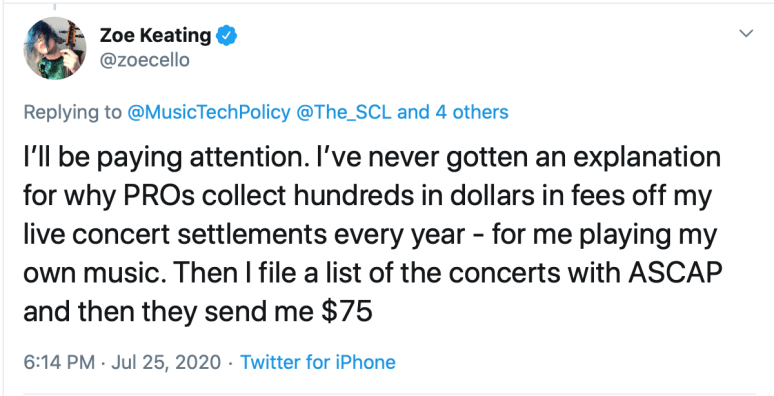
Case in point from Zoë Keating who will be watching the DOJ panels:
It’s for reasons like this that we look askance at the PRO’s braying about their collections and distributions. If they distribute $1 billion, we ask, how much did you cost the songwriters in hidden transaction costs for compliance (you know, like an unfunded mandate)? How much money did you miss in your porous collection system?
Another example: YouTube fails to pay songwriters for score or licensed music embedded in user-generated clips that the DMCA permits but does not provide guidance for (the related administrative state two aisles over in the “Safe Harbor” department). This is the DOJ’s consent decree at work with the equally pernicious DMCA safe harbor. Is anyone going to raise this issue? I doubt it. Why should they? DOJ has the government’s boot on the songwriters neck and the administrative state has their boot on the songwriter’s wallet.
Will these issues come up on the DOJ panels? Not from the line up of speakers that the lobbyists picked for the Antitrust Division’s public workshop. Those speakers will present a very tightly messaged order of battle to preserve the administrative state, their jobs, their bonuses and their pensions.
Another case in point is the movie theater exception. Unlike most of the rest of the major economies, movie theaters in the US do not pay songwriters and composers public performance royalties. This is the result of another ancient DOJ settlement that unfairly constrains income for composers and songwriters.
As the Society of Composers and Lyricists and the Songwriters Guild of America noted in their comments to DOJ:
[T]he principle “evidence” offered by the [National Association of Theater Owners in support of stiffing songwriters and composers] was, in fact, a forty-five year old case in which a mid-level employee of a third-party music licensing agent testified that she thought the forced combining of synchronization and movie theater performing rights was not an obstacle to her productivity. Citing CBS v. ASCAP, 400 F. Supp. 737, 760 (S.D.N.Y. 1975), the movie theater trade group stated:
In CBS, Albert Berman, managing director of the Harry Fox Agency, Inc. and Marion Mingle, the Fox employee who handled music rights, gave testimony describing the simple process they use to license both synchronization and performing rights for use in a theatrical motion picture—which can be completed roughly simultaneously most of the time. Mingle and her assistant were able to license “several hundred movies each year” this way.
Much has changed in the past half-century in regard to the licensing of musical works in films, but both SGA and SCL have little doubt one aspect of the process has not evolved in favor of music creators since the days of Ms. Mingle: that the Movie Theater Exemption has by default artificially relegated the value of US performing rights in motion pictures exhibited in US movie houses to at or near zero.
There is no good reason why the consent decrees ever needed to reach movie theaters as far as songwriters are concerned. We see only one reason why anyone wants that travesty to continue. As was widely reported at the time, streaming services—and theater owners—like Netflix got caught trying to jam buyouts of performance rights down the throats of composers:
At the end of October [2019], close to 90 composers and songwriters from around the world traveled to Budapest to discuss a contentious issue: streaming services’ efforts to upend how composers are compensated for their work.
Headlining the two-day International Council of Music Creators (CIAM) General Assembly was top Netflix music lawyer Carolyn Javier, who sought to defuse composers’ concerns over licensing contracts, known as buyouts, in which the streaming service pays them a one-time fee for all or most of the rights to their work, precluding them from receiving any backend royalties in the future. It has long been standard procedure for composers to be paid royalties for their compositions each time one is performed in a public setting: on the stage, at a bar, in a network TV or cable series, and now in audiovisual content streaming worldwide.
It’s obvious that if streaming services negotiate a buyout of performance rights for the music in their shows, it will apply across the board to the theaters they own. This gives them added protection just in case the movie theater exception should go away.
We believe this is exactly the plan that these Big Tech companies have in mind. Of course, if the DOJ had invited the CIAM—or its US affiliate Music Creators North America of which both the Society of Composers and Lyricists and the Songwriters Guild of America are members—then the Division might have had the opportunity to hear this side of the story directly from the songwriters and composers most directly affected by the shortcomings of the pensioners.
Motion picture and television composers are overrepresented in performance royalty earnings. By any estimates, a significant chunk of performance royalties are earned by these craftsmen and they are directly affected—almost exclusively—by the movie theater exception which the PRO pensioneers blithely give away. It is shocking that the DOJ has not included at least the Society of Composers and Lyricists in the not too public workshops, but it is not surprising—industry lobbyists have systematically excluded both the SCL and the Songwriters Guild of America from such hearings. Whenever we see the lineup of songwriter groups present at the not too public workshops, we know exactly how they came to be selected. It was not based on merit or representation.
You have to appreciate the irony of an anticompetitive suppression of voices by dominant forces being used to explore whether the consent decrees promote competition in the free market.
We can’t even have a free market of ideas to talk about the free market for songwriters.
An open letter on PEN’s publication of Matt Bailey’s article containing anti-copyright positions.
Dear PEN–
As musical artists who have been forced to defend our livelihoods from Silicon Valley’s relentless attacks on our rights; and as supporters of PEN’s positive action in so many other areas; we were shocked that PEN chose to publish Matt Bailey’s “Three Big Discussions We Need to Have ASAP About AI and Social Media Moderation.”7/8/2020
Mr. Bailey’s discussion of free speech issues in policing the ideological content of online posts is welcome. His conflation of this issue with copyright infringement is irrational and harmful: the overwhelming majority of copyright-infringing files are 100% identical copies of commercially available music, film, or writing.
This is not the exercise of “free speech”, and the technology to regulate such infringement is 100% blind to the ideological content of the files.
The gutting of the market that has resulted from this mass infringement has chilled more free speech— simply by defunding and devaluing it— than any censor, human or AI, possibly could. [See this article by Neil Turkewitz].
The Tech corporate narrative represented in Mr. Bailey’s article– positing copyright as the enemy of free speech– is contrary to our own experience, the positions of virtually all major representative groups of musical artists*, filmmakers**, PEN’s other positions, and the interests of all writers.
We urge you to remove or edit Mr. Bailey’s anti-artist, anti-writer, anti-copyright article.
It’s becoming more apparent with each passing day that TikTok is about to get shut down by the U.S. Government for any one of a variety of crimes like it has been in India and other countries. Which means that they are a perfect candidate for an “NMPA Special” which is where a handful of insiders decide on the terms and a pool of money is paid by the infringer to the NMPA for what amounts to a promise not to sue the infringer by the insiders and whatever useful idiots the NMPA can get to opt in to their deal. (Or at least the deal they tell you about–and remember that some running dogs are more equal than others.)
Then some impenetrable claiming portal is set up for the average dog to “claim” a share of a revenue pool they had nothing to do with negotiating while being forced to give up any rights to sue (because the last thing that the NMPA wants is getting shown up again by a David Lowery, Melissa Ferrick, Randall Wixen or anyone represented by Richard Busch), and then the money just kind of disappears. The amount of the pool is always so low it makes you wonder if that’s all there is, but in any event it has a distorting effect on the market place to drive down the rates paid to songwriters.
In a world where Cox Communications, a stupid but largely legitimate company, pays $1 billion for copyright infringement on a handful of copyrights, TikTok should pay $1 billion to get a meeting. And if the FBI is right that TikTok is a front for the Chinese Communist Party, they could easily pay $1 billion for a meeting. Anyone want to bet the over/under that the NMPA settlement is less than $1 billion?
How much the NMPA gets to keep out of the gross on the front end or the unclaimed after the claiming period expires is never disclosed and as you will see, the NMPA deal with TikTok, like all other NMPA deals, only applies to NMPA members. So if you want to participate, you most likely will have to join the NMPA and pay a fee (sometimes based on market share). And as came up in The MLC designation, The NMPA members may have a large market share of revenue but not necessarily on the number of songs.
Here’s the twist: TikTok has no way to track what music has been used, much less account for it. TikTok has no Content-ID type technology or control over what music is used so has no way to count or monitor what uses are made of which songs. So unless that gets fixed, it’s a bit unclear exactly what you would be claiming from the NMPA’s claiming portal Based on the NMPA’s YouTube and Spotify settlement portals, this one is almost certainly going to be absolute shite.
The deal “accounts for TikTok’s past use of musical works and sets up a forward-looking partnership” according to the announcement.
“This new partnership will give NMPA members the ability to opt-in to a licensing framework that allows them to benefit from their works included on TikTok and is effective retroactively as of May 1, 2020.”
The deal comes a day after TikTok announced a licensing deal with independent distributor Believe, and its TuneCore subsidiary.
“We are pleased to find a way forward with TikTok which benefits songwriters and publishers and offers them critical compensation for their work,” said NMPA boss David Israelite.
“Music is an important part of apps like TikTok which merge songs with expression and popularise new music while also giving new life to classic songs. This agreement respects the work of creators and gives them a way to be paid for their essential contributions to the platform.”
That might be true–but remember, there’s nothing in it for anyone who is not an NMPA member. And a lot of people are not NMPA members regardless of what they tell judges. So what happens to the great unwashed who are not NMPA members? Unclear, but NMPA has likely set the market rate for TikTok settlements, so unless you plan on suing, they’ll just jam that deal down your throat. Which works out well for TikTok.
But some lobbyist at TikTok has a friend when they are in need.





You must be logged in to post a comment.